

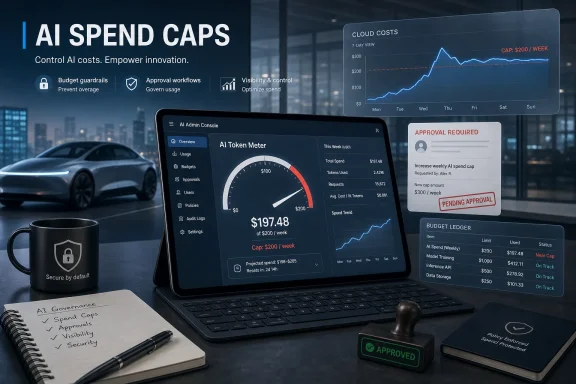
Tesla will reportedly cap employee spending on artificial intelligence tools at $200 per week starting Monday, July 6, after software engineers at the electric-car maker were said to be running up thousands of dollars in weekly token costs. The move, first reported by The Information and summarized by PYMNTS, is not a retreat from AI so much as a collision between AI evangelism and corporate finance. Tesla wants workers to use AI aggressively, but it also wants the bill to behave like a budget line instead of a slot machine. That tension is becoming one of the defining enterprise software stories of 2026.
The interesting part of Tesla’s reported policy is not the number. Two hundred dollars per week is still meaningful access for many office workers, and for disciplined use it may be plenty. The story is that Tesla, a company whose market narrative is now inseparable from AI, autonomy, robotics, and Elon Musk’s promise of a software-defined future, is drawing a hard line around employee consumption of generative tools.
According to The Information, Tesla told staff in an internal memo last month that the limit would begin July 6. Workers who need to exceed the cap will reportedly need permission. PYMNTS framed the change as part of a broader corporate shift: companies that spent the last two years urging employees to experiment with AI are now asking why the experimentation has no predictable ceiling.
That is the part WindowsForum readers should care about. This is not merely a Tesla culture story or another entry in the Musk-industrial news cycle. It is a signal that generative AI is moving from the “put it on the corporate card and see what happens” era into the same governance machinery that already surrounds cloud instances, SaaS seats, endpoint agents, and developer platforms.
The enterprise did not reject AI. It did what the enterprise always does after the pilot phase: it asked procurement, finance, security, and IT operations to turn enthusiasm into a policy.
Generative AI has introduced a messier model. Token-based pricing means the cost of a tool can depend on how much text, code, context, image data, or internal material employees feed into it, and how much output the model produces in return. A developer refactoring a large codebase, an analyst summarizing piles of documents, or a support team generating customer responses can turn a small experiment into a rapidly compounding expense.
PYMNTS put the issue neatly in earlier coverage: AI pricing does not map cleanly onto the stable annual-license assumptions that finance teams were built around. A conventional SaaS deployment gives managers a known population of users and a known per-user charge. A token meter gives them behavior, volume, prompt design, model choice, and hidden workflow repetition.
That is why Tesla’s reported cap matters. The company is not just saying “AI is expensive.” It is acknowledging that without constraints, employees can create cloud-like cost spikes from ordinary daily work. The cloud world already learned this lesson through surprise compute bills, zombie instances, over-provisioned databases, and data egress fees. Generative AI is now speed-running the same governance arc, except the “server” is often a chat window.
For Windows administrators and corporate IT teams, that should sound familiar. The real enterprise job is rarely buying the shiny thing. It is deciding who gets access, what telemetry exists, which data can be entered, what the acceptable use cases are, and how to prevent a promising tool from becoming an uncontrolled operating expense.
That narrative raises the stakes of a small internal spending policy. A $200 weekly cap does not undermine Tesla’s robotics ambitions by itself. But it does reveal a less glamorous truth behind every AI-first strategy: intelligence may be magical in demos, but its deployment is brutally material in budgets.
Axios has reported this year that investors are increasingly focused on Tesla’s AI ambitions, including robotaxis and humanoid robots, even as vehicle deliveries and the traditional EV business remain under pressure. In April, Axios also noted that the costs of Tesla’s AI pivot were adding up alongside the company’s push into self-driving cars, robots, and chips. Against that backdrop, a staff AI cap reads less like a clerical rule and more like a small window into the economics of the company’s transformation.
Musk has repeatedly described Tesla’s future as dependent on autonomy and robotics. That framing makes internal AI usage more than an employee productivity perk. It becomes part of Tesla’s broader industrial operating system, the layer where engineers, analysts, designers, and managers are supposed to accelerate the work that supports the company’s biggest bets.
And yet even Tesla apparently wants receipts.
On paper, a company can reasonably prefer approved internal or affiliated AI tools over a scattered mix of third-party services. Security teams like centralized controls. Legal teams like known data-handling terms. IT teams like fewer vendors. Finance teams like negotiated arrangements and predictable accounting.
But Tesla is not a normal enterprise buyer when the preferred AI vendor is tied to its CEO’s broader business empire. If employees face a hard cap on third-party AI consumption while xAI beta products sit outside that meter, the internal incentive structure changes. Workers may still prefer Claude, ChatGPT, Gemini, or other tools for certain tasks, but policy can shift behavior even when preference does not.
That is where IT governance becomes corporate strategy. The approved model is not just a tool; it becomes the path of least resistance. The thing exempted from the cap becomes the thing employees are silently encouraged to use.
There may be defensible operational reasons for the carve-out, and Tesla has not publicly explained the policy in detail. But in the enterprise world, exceptions are never merely administrative. Exceptions reveal the real hierarchy of priorities.
According to PYMNTS, Tesla is not alone. Meta, Uber, Walmart, and others have reportedly moved from encouraging employee AI adoption to imposing spending limits or curbs. The pattern is obvious: companies pushed broad usage first, then discovered that broad usage produced broad bills.
This is not necessarily hypocrisy. It is the natural result of deploying a technology before its unit economics are culturally understood. Employees were told AI could help with writing, coding, research, summarization, data analysis, documentation, marketing, support, and planning. Many took that seriously. Now companies are finding out what “AI everywhere” costs when it is used everywhere.
Uber’s reported monthly AI spending cap, cited in several accounts of the broader trend, is a particularly useful comparison because Uber is a company built on usage-based systems. If even a platform company comfortable with dynamic demand needs to rein in internal AI consumption, the issue is not simply old-school finance failing to understand new technology. It is that the cost model itself is volatile.
The challenge for enterprises is that AI tools often feel individually cheap and collectively expensive. A single prompt may cost little. A hundred employees writing sloppy prompts, uploading large context windows, regenerating outputs, asking models to process entire repositories, and using premium models for trivial tasks can create a very different cost curve.
The result is a new corporate ritual: model choice as budget discipline. Employees will increasingly be asked not just whether AI is useful, but whether a particular task warrants a premium model, a cheaper model, an internal model, a retrieval system, or no model at all.
For sysadmins, the immediate issue is not whether Tesla engineers can spend $200 or $2,000. It is whether their own organizations have any visibility into equivalent spending. Many companies already have employees using AI through sanctioned tools, browser sessions, personal accounts, extensions, IDE plug-ins, and API keys. Some of that use is budgeted. Some is invisible. Some is probably happening with sensitive data.
Microsoft has pushed Copilot across Windows, Microsoft 365, GitHub, security operations, and developer workflows. That gives many Windows-heavy organizations a more centralized AI procurement path than a random assortment of third-party tools. But centralization does not eliminate the governance problem. It simply moves the argument into licensing tiers, admin centers, audit logs, data boundaries, and usage analytics.
A company that standardizes on Microsoft 365 Copilot still has to decide who gets licenses, which departments have priority, how success is measured, and whether employees can use competing AI services. A developer organization using GitHub Copilot still has to decide how to handle code privacy, model output review, and whether more expensive AI coding agents are justified. A security team using AI-assisted analysis still has to separate helpful triage from automation theater.
Tesla’s reported cap is therefore less an oddity than a preview. Enterprises will not ask “Should we use AI?” for much longer. They will ask “Which AI, for whom, under what spending rules, with what data, and with which model default?”
AI vendors have sold the productivity story in broad strokes: faster drafts, quicker code, better search, easier analysis, fewer repetitive tasks. Some of those claims are real in specific workflows. But corporate budgets require measurement, and measurement gets difficult when AI use is diffuse, task-specific, and entangled with human judgment.
This is where a blunt cap can be both useful and crude. It stops runaway spending, but it may also penalize genuinely valuable high-intensity use. A blanket limit treats a senior engineer using AI to accelerate a core product deadline and a casual user generating meeting summaries as variations of the same cost center. That may be administratively simple, but it is not strategically precise.
The better long-term answer is not merely lower caps. It is better instrumentation. Companies need to know which teams are using AI, which models they are using, what categories of work are involved, whether sensitive data is entering the pipeline, and whether the output is saving time, improving quality, or simply generating more review work.
Until that proof exists, finance teams will reach for the simplest available tool: a ceiling.
The Information’s report, as summarized by PYMNTS, notes that corporate guardrails around AI became common after generative tools entered the workplace. That matches what IT teams have seen in practice. The initial panic over employees pasting secrets into chatbots gave way to approved-tool lists, enterprise plans, data-retention promises, and administrative controls.
For Windows-centric organizations, the AI governance conversation sits next to familiar concerns: identity, conditional access, data loss prevention, endpoint telemetry, browser controls, and compliance logging. If employees access AI through a managed Microsoft environment, administrators may have more policy levers. If they access it through personal accounts or unsanctioned web tools, the organization may have little more than hope and a stern acceptable-use policy.
Tesla’s reported approach is framed around spending, but the same mechanism can be used to enforce vendor preference and reduce shadow AI. If employees must seek approval above a threshold, the company gains an opportunity to ask what tool is being used, why it is needed, and whether the data belongs there. In practice, the budget gate becomes a security checkpoint.
That is why IT should resist treating AI caps as merely a finance story. The spending limit is the visible part. The deeper shift is toward managed AI access, where cost, security, compliance, and vendor strategy are bundled together.
That is not necessarily bad. The first wave of AI adoption encouraged a kind of prompt maximalism: feed the model everything, ask it repeatedly, compare outputs, and let the machine iterate. A cost cap pushes users toward more intentional interaction. In a mature environment, employees should understand that every large context dump and every premium-model call has an opportunity cost.
But there is a risk that caps create performative austerity. Workers may underuse tools that genuinely help because they fear scrutiny. Teams may shift costs into other budgets. Power users may seek unofficial workarounds. If a company does not pair limits with clear guidance, the policy can become another source of workplace ambiguity.
Good AI governance should distinguish between casual convenience, approved productivity, and strategic use. A legal team summarizing routine correspondence, a support team drafting knowledge-base updates, and an autonomy engineer processing large technical material do not have identical needs. Treating them identically is easy. Managing them intelligently is harder.
Tesla’s reported permission model may allow for that distinction, depending on how it is implemented. The real test will be whether exceptions are fast, rational, and tied to business value, or whether they become another bottleneck in a company already famous for intense internal pressure.
PYMNTS argued that access is moving from an “always-on utility” to a managed service shaped by pricing tiers, limits, and usage windows. That is a crucial shift. Users may love a model, but procurement teams love predictability. The winning enterprise AI providers may be the ones that make spending legible before they make demos dazzling.
This could favor vendors that offer strong admin consoles, usage analytics, departmental controls, data isolation, model routing, and clear invoices. It could also favor platforms that bundle AI into existing enterprise agreements, even if their models are not always the favorite among power users. In corporate IT, being good enough and governable often beats being brilliant and chaotic.
That dynamic matters for Microsoft. The company has a powerful advantage because it can embed AI into tools businesses already buy: Windows, Office, Teams, Azure, GitHub, Defender, and the broader Microsoft 365 stack. But Microsoft also faces the same scrutiny as everyone else. If Copilot licenses sit unused, produce fuzzy productivity gains, or require expensive add-ons, customers will push back.
The next phase of AI competition will not be won solely in benchmark charts. It will be won in admin dashboards, procurement meetings, security reviews, and quarterly budget calls.
Tesla’s reported $200 cap will not decide the future of enterprise AI, and it will not decide whether Tesla can deliver robotaxis, Optimus, or the larger autonomy story Musk has sold to investors. But it does mark a useful moment of sobriety. The AI revolution is still coming to the workplace; it is just arriving with a purchase order, an admin console, and someone in finance asking why last week’s prompts cost more than expected.
 Tesla Discovers That “Use AI Everywhere” Has an Invoice Attached
The interesting part of Tesla’s reported policy is not the number. Two hundred dollars per week is still meaningful access for many office workers, and for disciplined use it may be plenty. The story is that Tesla, a company whose market narrative is now inseparable from AI, autonomy, robotics, and Elon Musk’s promise of a software-defined future, is drawing a hard line around employee consumption of generative tools.According to The Information, Tesla told staff in an internal memo last month that the limit would begin July 6. Workers who need to exceed the cap will reportedly need permission. PYMNTS framed the change as part of a broader corporate shift: companies that spent the last two years urging employees to experiment with AI are now asking why the experimentation has no predictable ceiling.
That is the part WindowsForum readers should care about. This is not merely a Tesla culture story or another entry in the Musk-industrial news cycle. It is a signal that generative AI is moving from the “put it on the corporate card and see what happens” era into the same governance machinery that already surrounds cloud instances, SaaS seats, endpoint agents, and developer platforms.
The enterprise did not reject AI. It did what the enterprise always does after the pilot phase: it asked procurement, finance, security, and IT operations to turn enthusiasm into a policy.
The Token Meter Breaks the Old Software Budget
For decades, corporate software spending was annoying but legible. A company bought seats, negotiated annual licenses, added maintenance, maybe overpaid for shelfware, and then fought about renewals. CFOs disliked the process, but they understood it.Generative AI has introduced a messier model. Token-based pricing means the cost of a tool can depend on how much text, code, context, image data, or internal material employees feed into it, and how much output the model produces in return. A developer refactoring a large codebase, an analyst summarizing piles of documents, or a support team generating customer responses can turn a small experiment into a rapidly compounding expense.
PYMNTS put the issue neatly in earlier coverage: AI pricing does not map cleanly onto the stable annual-license assumptions that finance teams were built around. A conventional SaaS deployment gives managers a known population of users and a known per-user charge. A token meter gives them behavior, volume, prompt design, model choice, and hidden workflow repetition.
That is why Tesla’s reported cap matters. The company is not just saying “AI is expensive.” It is acknowledging that without constraints, employees can create cloud-like cost spikes from ordinary daily work. The cloud world already learned this lesson through surprise compute bills, zombie instances, over-provisioned databases, and data egress fees. Generative AI is now speed-running the same governance arc, except the “server” is often a chat window.
For Windows administrators and corporate IT teams, that should sound familiar. The real enterprise job is rarely buying the shiny thing. It is deciding who gets access, what telemetry exists, which data can be entered, what the acceptable use cases are, and how to prevent a promising tool from becoming an uncontrolled operating expense.
Tesla’s AI Mythology Makes the Cap Louder Than It Would Be Elsewhere
If a midsize insurer imposed a weekly AI budget, the story would barely travel outside procurement circles. Tesla imposing one is different because Tesla has spent years persuading investors, customers, and employees that it is not merely a car company. The company’s public narrative now leans heavily on robotaxis, Full Self-Driving, Optimus humanoid robots, AI chips, and massive compute ambitions.That narrative raises the stakes of a small internal spending policy. A $200 weekly cap does not undermine Tesla’s robotics ambitions by itself. But it does reveal a less glamorous truth behind every AI-first strategy: intelligence may be magical in demos, but its deployment is brutally material in budgets.
Axios has reported this year that investors are increasingly focused on Tesla’s AI ambitions, including robotaxis and humanoid robots, even as vehicle deliveries and the traditional EV business remain under pressure. In April, Axios also noted that the costs of Tesla’s AI pivot were adding up alongside the company’s push into self-driving cars, robots, and chips. Against that backdrop, a staff AI cap reads less like a clerical rule and more like a small window into the economics of the company’s transformation.
Musk has repeatedly described Tesla’s future as dependent on autonomy and robotics. That framing makes internal AI usage more than an employee productivity perk. It becomes part of Tesla’s broader industrial operating system, the layer where engineers, analysts, designers, and managers are supposed to accelerate the work that supports the company’s biggest bets.
And yet even Tesla apparently wants receipts.
The xAI Shadow Turns a Budget Rule Into a Platform Signal
Several reports, including Electrek’s coverage of The Information’s reporting, say Tesla’s cap does not apply in the same way to beta versions of products from xAI, Musk’s separate AI company. That detail is important because it changes the policy from a neutral budget mechanism into a possible platform nudge.On paper, a company can reasonably prefer approved internal or affiliated AI tools over a scattered mix of third-party services. Security teams like centralized controls. Legal teams like known data-handling terms. IT teams like fewer vendors. Finance teams like negotiated arrangements and predictable accounting.
But Tesla is not a normal enterprise buyer when the preferred AI vendor is tied to its CEO’s broader business empire. If employees face a hard cap on third-party AI consumption while xAI beta products sit outside that meter, the internal incentive structure changes. Workers may still prefer Claude, ChatGPT, Gemini, or other tools for certain tasks, but policy can shift behavior even when preference does not.
That is where IT governance becomes corporate strategy. The approved model is not just a tool; it becomes the path of least resistance. The thing exempted from the cap becomes the thing employees are silently encouraged to use.
There may be defensible operational reasons for the carve-out, and Tesla has not publicly explained the policy in detail. But in the enterprise world, exceptions are never merely administrative. Exceptions reveal the real hierarchy of priorities.
AI Adoption Is Entering Its Expense-Report Era
The first enterprise phase of generative AI was missionary. Executives told staff to experiment, vendors promised productivity miracles, and managers worried they would look backward if they slowed the rollout. The second phase is actuarial.According to PYMNTS, Tesla is not alone. Meta, Uber, Walmart, and others have reportedly moved from encouraging employee AI adoption to imposing spending limits or curbs. The pattern is obvious: companies pushed broad usage first, then discovered that broad usage produced broad bills.
This is not necessarily hypocrisy. It is the natural result of deploying a technology before its unit economics are culturally understood. Employees were told AI could help with writing, coding, research, summarization, data analysis, documentation, marketing, support, and planning. Many took that seriously. Now companies are finding out what “AI everywhere” costs when it is used everywhere.
Uber’s reported monthly AI spending cap, cited in several accounts of the broader trend, is a particularly useful comparison because Uber is a company built on usage-based systems. If even a platform company comfortable with dynamic demand needs to rein in internal AI consumption, the issue is not simply old-school finance failing to understand new technology. It is that the cost model itself is volatile.
The challenge for enterprises is that AI tools often feel individually cheap and collectively expensive. A single prompt may cost little. A hundred employees writing sloppy prompts, uploading large context windows, regenerating outputs, asking models to process entire repositories, and using premium models for trivial tasks can create a very different cost curve.
The result is a new corporate ritual: model choice as budget discipline. Employees will increasingly be asked not just whether AI is useful, but whether a particular task warrants a premium model, a cheaper model, an internal model, a retrieval system, or no model at all.
Windows Shops Should Recognize the Shape of This Problem
The Windows ecosystem has seen this movie in other forms. Endpoint management, Microsoft 365 licensing, Azure consumption, security add-ons, developer subscriptions, and collaboration platforms all began as productivity enablers and eventually became governance problems. AI is joining the same stack, but with a sharper edge because the marginal cost of behavior can be harder to see.For sysadmins, the immediate issue is not whether Tesla engineers can spend $200 or $2,000. It is whether their own organizations have any visibility into equivalent spending. Many companies already have employees using AI through sanctioned tools, browser sessions, personal accounts, extensions, IDE plug-ins, and API keys. Some of that use is budgeted. Some is invisible. Some is probably happening with sensitive data.
Microsoft has pushed Copilot across Windows, Microsoft 365, GitHub, security operations, and developer workflows. That gives many Windows-heavy organizations a more centralized AI procurement path than a random assortment of third-party tools. But centralization does not eliminate the governance problem. It simply moves the argument into licensing tiers, admin centers, audit logs, data boundaries, and usage analytics.
A company that standardizes on Microsoft 365 Copilot still has to decide who gets licenses, which departments have priority, how success is measured, and whether employees can use competing AI services. A developer organization using GitHub Copilot still has to decide how to handle code privacy, model output review, and whether more expensive AI coding agents are justified. A security team using AI-assisted analysis still has to separate helpful triage from automation theater.
Tesla’s reported cap is therefore less an oddity than a preview. Enterprises will not ask “Should we use AI?” for much longer. They will ask “Which AI, for whom, under what spending rules, with what data, and with which model default?”
The Productivity Story Now Needs Proof
The most optimistic version of enterprise AI says higher spending is acceptable if it produces higher output. If a Tesla software engineer spends several thousand dollars in tokens but saves weeks of work on simulation, testing, code analysis, or internal tooling, the bill may be rational. The problem is that most companies are still bad at proving that relationship.AI vendors have sold the productivity story in broad strokes: faster drafts, quicker code, better search, easier analysis, fewer repetitive tasks. Some of those claims are real in specific workflows. But corporate budgets require measurement, and measurement gets difficult when AI use is diffuse, task-specific, and entangled with human judgment.
This is where a blunt cap can be both useful and crude. It stops runaway spending, but it may also penalize genuinely valuable high-intensity use. A blanket limit treats a senior engineer using AI to accelerate a core product deadline and a casual user generating meeting summaries as variations of the same cost center. That may be administratively simple, but it is not strategically precise.
The better long-term answer is not merely lower caps. It is better instrumentation. Companies need to know which teams are using AI, which models they are using, what categories of work are involved, whether sensitive data is entering the pipeline, and whether the output is saving time, improving quality, or simply generating more review work.
Until that proof exists, finance teams will reach for the simplest available tool: a ceiling.
The Security Argument Was Always Waiting Behind the Cost Argument
Cost is the public-facing reason for many AI controls, but security has been waiting in the wings since the beginning. Employers have long worried that workers might paste proprietary code, customer records, strategy documents, contracts, credentials, or incident details into external AI systems. Spending caps do not solve that problem, but they often arrive alongside broader access controls.The Information’s report, as summarized by PYMNTS, notes that corporate guardrails around AI became common after generative tools entered the workplace. That matches what IT teams have seen in practice. The initial panic over employees pasting secrets into chatbots gave way to approved-tool lists, enterprise plans, data-retention promises, and administrative controls.
For Windows-centric organizations, the AI governance conversation sits next to familiar concerns: identity, conditional access, data loss prevention, endpoint telemetry, browser controls, and compliance logging. If employees access AI through a managed Microsoft environment, administrators may have more policy levers. If they access it through personal accounts or unsanctioned web tools, the organization may have little more than hope and a stern acceptable-use policy.
Tesla’s reported approach is framed around spending, but the same mechanism can be used to enforce vendor preference and reduce shadow AI. If employees must seek approval above a threshold, the company gains an opportunity to ask what tool is being used, why it is needed, and whether the data belongs there. In practice, the budget gate becomes a security checkpoint.
That is why IT should resist treating AI caps as merely a finance story. The spending limit is the visible part. The deeper shift is toward managed AI access, where cost, security, compliance, and vendor strategy are bundled together.
Caps Will Change How Employees Prompt, Not Just How Much They Spend
Once workers know a meter is running, behavior changes. They may use smaller prompts, shorter context windows, cheaper models, internal tools, or fewer regenerations. They may also avoid AI for marginal tasks where the payoff is unclear.That is not necessarily bad. The first wave of AI adoption encouraged a kind of prompt maximalism: feed the model everything, ask it repeatedly, compare outputs, and let the machine iterate. A cost cap pushes users toward more intentional interaction. In a mature environment, employees should understand that every large context dump and every premium-model call has an opportunity cost.
But there is a risk that caps create performative austerity. Workers may underuse tools that genuinely help because they fear scrutiny. Teams may shift costs into other budgets. Power users may seek unofficial workarounds. If a company does not pair limits with clear guidance, the policy can become another source of workplace ambiguity.
Good AI governance should distinguish between casual convenience, approved productivity, and strategic use. A legal team summarizing routine correspondence, a support team drafting knowledge-base updates, and an autonomy engineer processing large technical material do not have identical needs. Treating them identically is easy. Managing them intelligently is harder.
Tesla’s reported permission model may allow for that distinction, depending on how it is implemented. The real test will be whether exceptions are fast, rational, and tied to business value, or whether they become another bottleneck in a company already famous for intense internal pressure.
The Vendor Market Is About to Feel the Squeeze
Enterprise AI vendors have benefited from a simple message: adoption is inevitable, and companies that hesitate will fall behind. Spending caps complicate that pitch. If customers are no longer willing to let internal usage expand without limits, vendors must compete not only on model quality but on cost predictability.PYMNTS argued that access is moving from an “always-on utility” to a managed service shaped by pricing tiers, limits, and usage windows. That is a crucial shift. Users may love a model, but procurement teams love predictability. The winning enterprise AI providers may be the ones that make spending legible before they make demos dazzling.
This could favor vendors that offer strong admin consoles, usage analytics, departmental controls, data isolation, model routing, and clear invoices. It could also favor platforms that bundle AI into existing enterprise agreements, even if their models are not always the favorite among power users. In corporate IT, being good enough and governable often beats being brilliant and chaotic.
That dynamic matters for Microsoft. The company has a powerful advantage because it can embed AI into tools businesses already buy: Windows, Office, Teams, Azure, GitHub, Defender, and the broader Microsoft 365 stack. But Microsoft also faces the same scrutiny as everyone else. If Copilot licenses sit unused, produce fuzzy productivity gains, or require expensive add-ons, customers will push back.
The next phase of AI competition will not be won solely in benchmark charts. It will be won in admin dashboards, procurement meetings, security reviews, and quarterly budget calls.
The $200 Line Draws the New Enterprise AI Map
Tesla’s reported cap is a small policy with a large shadow. It compresses the enterprise AI debate into a single weekly number: ambition on one side, control on the other. The lesson is not that companies are souring on AI. It is that they are beginning to manage it like infrastructure.- Tesla reportedly plans to limit employee AI spending to $200 per week beginning July 6, with approval required for higher usage.
- The policy follows reports that some Tesla software engineers were consuming thousands of dollars in AI tokens per week.
- The cap fits a broader corporate pattern in which companies that encouraged AI experimentation are now imposing spending controls.
- Token-based AI pricing is harder for finance teams to forecast than traditional seat-based enterprise software licensing.
- Reported exemptions for xAI beta tools make Tesla’s policy both a cost-control measure and a possible platform-preference signal.
- Windows and Microsoft-heavy organizations should treat Tesla’s move as a preview of their own coming AI governance debates.
Tesla’s reported $200 cap will not decide the future of enterprise AI, and it will not decide whether Tesla can deliver robotaxis, Optimus, or the larger autonomy story Musk has sold to investors. But it does mark a useful moment of sobriety. The AI revolution is still coming to the workplace; it is just arriving with a purchase order, an admin console, and someone in finance asking why last week’s prompts cost more than expected.
References
- Primary source: pymnts.com
Published: 2026-07-06T00:10:15.302952
Loading…
www.pymnts.com - Related coverage: investing.com
Tesla sets $200 weekly cap on staff AI spending starting July 6 - Information By Investing.com
Tesla sets $200 weekly cap on staff AI spending starting July 6 - Informationwww.investing.com - Related coverage: livemint.com
Loading…
www.livemint.com - Related coverage: techjournal.org
Tesla Caps Employee AI Spending at $200/Week (2026)
Tesla is limiting employees to $200/week on AI tools from July 6, after engineers ran up thousands in token bills. Here's why AI costs are spiking and what it means for you.techjournal.org - Related coverage: inews.zoombangla.com
Loading…
inews.zoombangla.com - Related coverage: electrek.co
Tesla caps employee AI spending at $200/week except for Grok | Electrek
Tesla is capping employee AI spending at $200 per week from July 6 after engineers burned thousands in tokens weekly, joining Uber, Meta, and Walmart.electrek.co
- Related coverage: winbuzzer.com
Tesla Reportedly Sets $200 Weekly Staff AI Cap With xAI Carve-Out
Tesla is introducing a $200 weekly staff AI spending cap on July 6, with approvals for higher limits and an exemption for beta tools from xAI.winbuzzer.com - Related coverage: explainx.ai
Tesla $200/Week AI Cap: Cost Math & Enterprise Limits (2026) | explainx.ai Blog | explainx.ai
Tesla caps employee AI spend at $200/week from July 6, 2026. vs Meta 73.7T tokens, Uber budget blowout, Grok/Cursor routing, and whether the cap is generous.explainx.ai - Related coverage: theinformation.com
Tesla Caps Employee AI Spend at $200 per Week After Adoption Push — The Information
Tesla told employees last month it would impose a $200 per week limit for staff’s AI spending beginning July 6, according to an internal memo, a sign that even companies committed to using the technology to transform their operations and products are having to watch their costs. Over the past ...www.theinformation.com - Related coverage: techtimes.com
Tesla Limits AI Tool Spending to $200 Weekly While Musk's Grok Stays Exempt
Tesla AI spending cap takes effect July 6, limiting employees to $200 per week on third-party tools while xAI’s Grok faces no limit. Four Tesla engineers say staff prefer Anthropic’s Claude, andwww.techtimes.com - Related coverage: easternherald.com
Loading…
easternherald.com - Related coverage: gate.com
Loading…
www.gate.com - Related coverage: axios.com
Loading…
www.axios.com - Related coverage: tomsguide.com
Loading…
www.tomsguide.com