

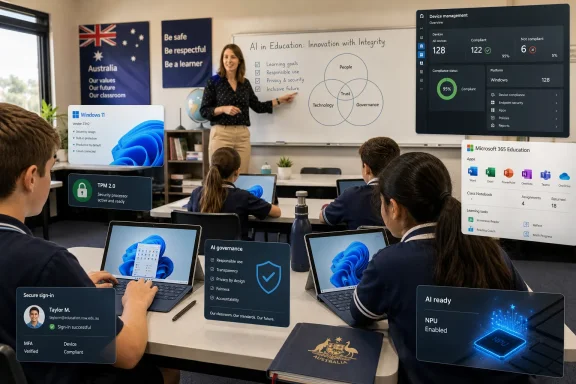
Microsoft is pitching Surface devices to Australian schools as an AI-ready Windows 11 and Microsoft 365 Education platform for secure classroom deployment, device management, and teaching productivity, according to a new Microsoft Australia education campaign. The message is not subtle: AI in schools is no longer being sold as an experiment, but as infrastructure. Surface is the hardware anchor in that argument, and Microsoft wants IT leaders to see the device fleet as the place where AI risk can be contained rather than amplified. The harder question is whether schools should read this as a breakthrough in learning technology or as another turn of the Microsoft ecosystem flywheel.
The most important thing about Microsoft’s latest Surface education pitch is not the Surface hardware itself. It is the way Microsoft frames the school device as a governance tool.
The company’s Australian campaign argues that schools are facing a “defining moment” with AI, and that IT managers now need devices they can deploy, protect, update, and justify at scale. That is a revealing order of priorities. Microsoft is not leading with creativity, coding, or a Jetsons-style classroom of the future. It is leading with manageability.
That makes sense. The first wave of generative AI in education arrived through browsers, personal accounts, consumer chatbots, and uneasy workarounds. Teachers experimented, students improvised, and administrators tried to decide whether they were watching a cheating crisis, a productivity revolution, or both. Microsoft’s answer is that AI should be pulled back into the managed stack: Windows 11, Microsoft 365 Education, Intune, Surface Management Portal, hardware security, firmware updates, and identity controls.
This is the old Microsoft argument with a new acronym attached. The company has always been strongest when it can persuade institutions that the safest way to adopt a disruptive technology is to make it boring, licensed, centrally managed, and auditable. In 2026, AI is getting the same treatment that email, collaboration suites, cloud storage, and endpoint management received before it.
Those figures matter because they shift the debate away from whether AI belongs in education at all. The more serious debate is now about design: which AI tools, for which students, under which teacher supervision, and with which privacy and assessment guardrails. Microsoft Research has made a similar point in its own work on generative AI and learning outcomes, warning that AI can help when used as a scaffold but can undermine higher-order thinking when it replaces the productive struggle of learning.
That tension is mostly absent from the Surface campaign. The marketing language is full of “purposeful,” “secure,” and “manageable,” but it naturally spends less time on the uncomfortable pedagogical questions. A device can run an AI tool locally, authenticate a student securely, and receive firmware updates on schedule. It cannot, by itself, decide whether the student is learning or merely outsourcing the hard part.
This is where school leaders should be careful. The evidence base for AI in education is becoming stronger, but it is not a blank cheque for every AI-branded workflow. A meta-analysis can support the proposition that AI interventions may improve outcomes; it does not prove that any given school will get better results by buying a premium Windows fleet.
Surface gives Microsoft a neat story: because it controls the hardware, firmware, operating system, cloud management layer, and productivity suite, it can reduce the number of seams that IT teams have to stitch together. The company points to Windows 11, Microsoft 365 Education, OneNote, Learning Accelerators, Microsoft Learning Zone, and Microsoft 365 Copilot as parts of one connected environment. It also highlights Intune and the Surface Management Portal as the operational layer for device security, updates, and support.
There is a real administrative appeal here. Mixed fleets can be cheap upfront and expensive forever after. Each model variation becomes another BIOS, driver, accessory, repair, imaging, and support wrinkle. In schools, those wrinkles are multiplied by age groups, classroom requirements, exam conditions, accessibility needs, and the simple fact that children are not gentle endpoint users.
Microsoft’s argument is that standardisation lowers the cognitive load on IT. That does not mean every school should buy Surface. It does mean Microsoft understands the pain point. For many education IT teams, the most valuable feature in a device is not a brighter display or a faster neural processing unit. It is predictability.
In education, that claim has extra force. Schools may have uneven connectivity, bandwidth constraints, and stricter privacy expectations around minors’ data. If AI features can run locally, or at least split work intelligently between the device and the cloud, IT leaders get more architectural options. That is the theory.
But the reality is still uneven. Many of the most useful AI experiences remain cloud-tethered, especially when they depend on large language models, Microsoft 365 data, or enterprise-grade orchestration. The Copilot key on a keyboard is a convenient entry point, not a guarantee that the intelligence behind it lives on the laptop. Microsoft’s own campaign describes Microsoft 365 Copilot as an add-on to Microsoft 365 Education, which means licensing and cloud service design remain central to the experience.
So the NPU story should be treated as future-proofing rather than magic. Buying AI-capable PCs may be prudent for a school refreshing devices in 2026, especially if it wants a fleet that lasts several years. But it is still a bet on Microsoft and software vendors making enough useful local AI experiences to justify the hardware emphasis.
That is the right posture for modern education. Schools are attractive targets because they hold sensitive student data, often operate with limited security staffing, and must support large populations of young users who are still learning digital judgement. A school laptop is not just a learning tool; it is an identity endpoint, a data access point, and sometimes a weak link into administrative systems.
The integration of firmware and operating system updates through Windows Update is a practical advantage if it works as advertised. Firmware patching has historically been one of the messier parts of PC management. Anything that makes those updates more consistent and less dependent on vendor-specific utilities is valuable to overstretched IT teams.
Still, “chip-to-cloud” should not become a lullaby. Security outcomes depend on configuration, identity policy, conditional access, staff training, backup practices, incident response, and the boring discipline of patch compliance. Surface can provide a cleaner baseline. It cannot compensate for a school that underfunds security operations or treats AI adoption as a purchasing exercise instead of a governance programme.
These quotes do what customer stories always do: they reassure prospective buyers that someone like them has already crossed the bridge. They are not independent evaluations, and nobody should confuse them with a controlled study. But they identify the real buying criteria in education: confidence, control, lifecycle value, and the ability to explain a decision to non-technical leaders.
The Canterbury College quote is particularly useful because it captures the cultural shift. Schools are no longer deciding whether AI exists. They are deciding whether they can shape its use before students and staff shape it for them. Microsoft’s position is that Surface gives institutions a more controlled entry point into that future.
The Sandhurst example also points to the hidden driver behind many fleet decisions: bring-your-own-device policies can reduce capital expenditure, but they often scatter risk. BYOD may look flexible until the school needs consistent security policy, assessment integrity, supportability, and data protection across hundreds or thousands of personally owned machines. Microsoft is clearly pushing Surface as the antidote to that fragmentation.
Surface has not always had the strongest reputation for repairability. Earlier generations were often criticised for designs that made battery replacement and component access difficult. Microsoft has spent the past few years trying to change that perception, and its education pitch reflects the new political economy of hardware. Repairability is now a procurement feature, a sustainability claim, and a budget defence all at once.
For schools, the repair story is concrete. A broken screen, damaged keyboard, failed battery, or abused charging port is not an edge case. It is Tuesday. If a device can be repaired faster and kept in circulation longer, the school saves money and avoids learning disruption.
But repairability also needs scrutiny at procurement time. Schools should ask which parts are actually replaceable, who is authorised to replace them, how quickly parts are available in Australia, what warranty tier covers accidental damage, and what happens in the third or fourth year of ownership. “Designed to repair” is encouraging language. A service-level agreement is better.
If true in a given environment, those savings are substantial. Multiply 17 hours by hundreds or thousands of devices, then translate the result into staff capacity, faster ticket resolution, or avoided contractor spend, and the total cost of ownership case becomes much stronger. This is exactly how premium hardware fights the “cheapest acceptable laptop” procurement instinct.
But the phrase “compared to other Windows devices” carries a lot of weight. Other Windows devices vary wildly. A well-standardised fleet from another major OEM, managed competently through Intune and Windows Update for Business, may narrow the gap. A bargain-bin mixed fleet with inconsistent firmware, drivers, and warranty support may make Surface look heroic.
The IDC finding is therefore best understood as evidence for standardisation and vertical integration, not as a universal law of Surface superiority. Microsoft wants schools to compare Surface with the messiest version of multi-vendor PC management. Smart procurement teams should compare it with the best realistic alternative they can afford.
For teachers, that could be useful. AI-assisted lesson planning, draft feedback, quiz generation, summarisation, accessibility support, and administrative writing are plausible productivity wins. Microsoft Learning Zone, which the campaign promotes as a way to turn teaching ideas into interactive lessons, fits neatly into this “reduce preparation friction” story.
For students, the picture is more complicated. Personalisation can be powerful, especially for learners who need different pacing, language support, or alternative explanations. But always-available AI assistance also forces schools to rethink assessment, authorship, classroom norms, and digital dependency. The same tool that helps a student understand algebra can also produce a polished answer that masks confusion.
The Copilot key lowers the barrier to use. It does not answer the policy question. Schools still need to decide when AI is allowed, when it must be disclosed, how teachers should evaluate AI-assisted work, and how to protect students from over-reliance. The key is an affordance. The strategy has to come from the institution.
Microsoft’s messaging is carefully localised around Australian schools, Australian customer stories, and the practical burdens on local IT teams. That helps the campaign feel less like a generic Surface brochure and more like a response to the country’s current AI-in-education debate. The core pitch, however, is global.
Every school system is wrestling with the same contradiction. AI is arriving faster than policy, faster than teacher training, and faster than many device fleets can comfortably support. Microsoft is offering a familiar institutional bargain: adopt the new thing, but do it inside our managed environment.
That bargain will appeal to many schools because the alternative is not purity. The alternative is often unmanaged AI use through consumer services, personal devices, shadow IT, and inconsistent classroom practice. Microsoft’s greatest advantage is that it is not asking schools to leap into the unknown. It is asking them to extend systems they already use.
Google’s education pitch has historically emphasised simplicity, browser-based management, low-cost devices, and cloud-native workflows. Apple’s pitch leans on creativity, app quality, accessibility, and hardware longevity. Traditional Windows OEMs compete on range, price, repair channels, and procurement flexibility. Surface competes by trying to make Microsoft’s full stack feel less like a collection of products and more like one managed system.
That is both its strength and its risk. A school that standardises on Surface, Windows 11, Intune, Microsoft 365 Education, and Copilot gains coherence. It may also deepen dependence on one vendor’s licensing, roadmap, and interpretation of responsible AI. The more AI becomes embedded in the productivity layer, the harder it may be to switch away later.
For IT leaders, lock-in is not automatically disqualifying. Schools already accept many forms of lock-in because standardisation has value. The question is whether the operational gains, security posture, and learning benefits are worth the reduced optionality. Microsoft’s campaign assumes the answer is yes. Procurement committees should make it prove the case.
That matters for education because schools often need price diversity. A premium Surface Pro or Surface Laptop may suit teachers, senior students, specialist labs, and administrative staff. It may be harder to justify as a universal student device in cost-sensitive environments unless the total cost of ownership case is unusually strong.
Microsoft’s campaign says five new devices were released this year, positioning the moment as an attractive time to build a school environment on Surface. That gives IT buyers more configurations to consider, including 2-in-1 and laptop formats. But it also reinforces a reality: Microsoft is not trying to be the cheapest hardware vendor in the room. It is trying to be the most integrated one.
That distinction is crucial. Surface will win where schools value manageability, security integration, and premium design enough to offset higher acquisition costs. It will struggle where the procurement question is simply how to put the largest number of acceptable devices into student hands at the lowest upfront price.
But governance is not something a vendor can ship in a box. It requires policy, training, curriculum design, parent communication, student digital citizenship, privacy review, and continuous evaluation. If a school buys Surface devices without doing that work, it has not modernised learning. It has merely upgraded the endpoint through which old confusion travels faster.
The best schools will treat Surface as one layer of an AI readiness plan. They will ask what data Copilot can access, how student accounts are protected, what teacher training is required, which AI features are age-appropriate, and how outcomes will be measured. They will also pilot before scaling, because classrooms have a way of exposing assumptions that procurement decks glide past.
Microsoft’s campaign is right that IT managers are no longer asking whether AI will enter the classroom. The better question is whether it enters as a controlled institutional capability or as a thousand improvised shortcuts. Surface is Microsoft’s bid to make the first path look safer.
 Microsoft Turns the School Laptop Into an AI Control Plane
The most important thing about Microsoft’s latest Surface education pitch is not the Surface hardware itself. It is the way Microsoft frames the school device as a governance tool.The company’s Australian campaign argues that schools are facing a “defining moment” with AI, and that IT managers now need devices they can deploy, protect, update, and justify at scale. That is a revealing order of priorities. Microsoft is not leading with creativity, coding, or a Jetsons-style classroom of the future. It is leading with manageability.
That makes sense. The first wave of generative AI in education arrived through browsers, personal accounts, consumer chatbots, and uneasy workarounds. Teachers experimented, students improvised, and administrators tried to decide whether they were watching a cheating crisis, a productivity revolution, or both. Microsoft’s answer is that AI should be pulled back into the managed stack: Windows 11, Microsoft 365 Education, Intune, Surface Management Portal, hardware security, firmware updates, and identity controls.
This is the old Microsoft argument with a new acronym attached. The company has always been strongest when it can persuade institutions that the safest way to adopt a disruptive technology is to make it boring, licensed, centrally managed, and auditable. In 2026, AI is getting the same treatment that email, collaboration suites, cloud storage, and endpoint management received before it.
The Evidence for AI in Schools Is Promising, but Microsoft Is Selling Certainty
Microsoft’s campaign leans on academic and survey evidence to argue that purposeful AI can improve learning. It cites a 2025 peer-reviewed meta-analysis of 29 empirical studies finding a significant positive effect from AI on students’ academic performance, as well as survey data suggesting students believe AI helps them study more efficiently and access personalised resources. Microsoft also points to classroom reporting that 58 percent of teachers saw higher student engagement when AI was integrated into lessons.Those figures matter because they shift the debate away from whether AI belongs in education at all. The more serious debate is now about design: which AI tools, for which students, under which teacher supervision, and with which privacy and assessment guardrails. Microsoft Research has made a similar point in its own work on generative AI and learning outcomes, warning that AI can help when used as a scaffold but can undermine higher-order thinking when it replaces the productive struggle of learning.
That tension is mostly absent from the Surface campaign. The marketing language is full of “purposeful,” “secure,” and “manageable,” but it naturally spends less time on the uncomfortable pedagogical questions. A device can run an AI tool locally, authenticate a student securely, and receive firmware updates on schedule. It cannot, by itself, decide whether the student is learning or merely outsourcing the hard part.
This is where school leaders should be careful. The evidence base for AI in education is becoming stronger, but it is not a blank cheque for every AI-branded workflow. A meta-analysis can support the proposition that AI interventions may improve outcomes; it does not prove that any given school will get better results by buying a premium Windows fleet.
Surface Is Being Sold as the Anti-Chaos Device
The campaign’s strongest argument is aimed not at teachers, but at IT departments. Australian schools, like schools everywhere, are trying to support hybrid learning, student privacy, cyber resilience, constrained budgets, and now AI. The device fleet is where all of those pressures collide.Surface gives Microsoft a neat story: because it controls the hardware, firmware, operating system, cloud management layer, and productivity suite, it can reduce the number of seams that IT teams have to stitch together. The company points to Windows 11, Microsoft 365 Education, OneNote, Learning Accelerators, Microsoft Learning Zone, and Microsoft 365 Copilot as parts of one connected environment. It also highlights Intune and the Surface Management Portal as the operational layer for device security, updates, and support.
There is a real administrative appeal here. Mixed fleets can be cheap upfront and expensive forever after. Each model variation becomes another BIOS, driver, accessory, repair, imaging, and support wrinkle. In schools, those wrinkles are multiplied by age groups, classroom requirements, exam conditions, accessibility needs, and the simple fact that children are not gentle endpoint users.
Microsoft’s argument is that standardisation lowers the cognitive load on IT. That does not mean every school should buy Surface. It does mean Microsoft understands the pain point. For many education IT teams, the most valuable feature in a device is not a brighter display or a faster neural processing unit. It is predictability.
AI-Ready Hardware Is Really a Debate About Where Work Happens
Surface’s AI pitch depends heavily on the idea that modern PCs need neural processing units, or NPUs, to run AI workloads efficiently on-device. Microsoft’s broader Copilot+ PC strategy has pushed the same argument since 2024: local AI acceleration can reduce latency, enable offline or hybrid features, and keep some processing away from the cloud.In education, that claim has extra force. Schools may have uneven connectivity, bandwidth constraints, and stricter privacy expectations around minors’ data. If AI features can run locally, or at least split work intelligently between the device and the cloud, IT leaders get more architectural options. That is the theory.
But the reality is still uneven. Many of the most useful AI experiences remain cloud-tethered, especially when they depend on large language models, Microsoft 365 data, or enterprise-grade orchestration. The Copilot key on a keyboard is a convenient entry point, not a guarantee that the intelligence behind it lives on the laptop. Microsoft’s own campaign describes Microsoft 365 Copilot as an add-on to Microsoft 365 Education, which means licensing and cloud service design remain central to the experience.
So the NPU story should be treated as future-proofing rather than magic. Buying AI-capable PCs may be prudent for a school refreshing devices in 2026, especially if it wants a fleet that lasts several years. But it is still a bet on Microsoft and software vendors making enough useful local AI experiences to justify the hardware emphasis.
The Security Pitch Is More Convincing Than the Learning Pitch
Microsoft’s best case for Surface in schools is security. The company points to chip-to-cloud protection across hardware, firmware, Windows, and cloud services, including TPM 2.0 and Microsoft Pluton. It also frames Surface around Zero Trust principles, meaning devices should not assume a trusted network just because they are on campus.That is the right posture for modern education. Schools are attractive targets because they hold sensitive student data, often operate with limited security staffing, and must support large populations of young users who are still learning digital judgement. A school laptop is not just a learning tool; it is an identity endpoint, a data access point, and sometimes a weak link into administrative systems.
The integration of firmware and operating system updates through Windows Update is a practical advantage if it works as advertised. Firmware patching has historically been one of the messier parts of PC management. Anything that makes those updates more consistent and less dependent on vendor-specific utilities is valuable to overstretched IT teams.
Still, “chip-to-cloud” should not become a lullaby. Security outcomes depend on configuration, identity policy, conditional access, staff training, backup practices, incident response, and the boring discipline of patch compliance. Surface can provide a cleaner baseline. It cannot compensate for a school that underfunds security operations or treats AI adoption as a purchasing exercise instead of a governance programme.
Microsoft’s Australian Case Studies Do the Emotional Work
The campaign uses Australian school voices to turn an abstract platform story into something more tangible. Afzal Shariff, Director of IT Services at Canterbury College, is quoted saying AI is here to stay and that Surface devices are more intuitive and adaptive to user habits. Kieran Bailey of Great Southern Grammar emphasises the balance of cost and performance, including screen size, battery life, processing speed, and all-round functionality. Ryan Neville of Catholic Education Sandhurst Limited points to improved control over security and a more holistic IT strategy.These quotes do what customer stories always do: they reassure prospective buyers that someone like them has already crossed the bridge. They are not independent evaluations, and nobody should confuse them with a controlled study. But they identify the real buying criteria in education: confidence, control, lifecycle value, and the ability to explain a decision to non-technical leaders.
The Canterbury College quote is particularly useful because it captures the cultural shift. Schools are no longer deciding whether AI exists. They are deciding whether they can shape its use before students and staff shape it for them. Microsoft’s position is that Surface gives institutions a more controlled entry point into that future.
The Sandhurst example also points to the hidden driver behind many fleet decisions: bring-your-own-device policies can reduce capital expenditure, but they often scatter risk. BYOD may look flexible until the school needs consistent security policy, assessment integrity, supportability, and data protection across hundreds or thousands of personally owned machines. Microsoft is clearly pushing Surface as the antidote to that fragmentation.
Repairability Is the Budget Argument Wearing a Sustainability Jacket
Microsoft also talks up Surface repairability, modular components, internal labelling, digital repair guidance, standard manufacturer warranties, and Microsoft Complete for Schools. This is a necessary pivot because schools do not buy devices like enthusiasts do. They buy fleets, and fleets live or die by lifecycle cost.Surface has not always had the strongest reputation for repairability. Earlier generations were often criticised for designs that made battery replacement and component access difficult. Microsoft has spent the past few years trying to change that perception, and its education pitch reflects the new political economy of hardware. Repairability is now a procurement feature, a sustainability claim, and a budget defence all at once.
For schools, the repair story is concrete. A broken screen, damaged keyboard, failed battery, or abused charging port is not an edge case. It is Tuesday. If a device can be repaired faster and kept in circulation longer, the school saves money and avoids learning disruption.
But repairability also needs scrutiny at procurement time. Schools should ask which parts are actually replaceable, who is authorised to replace them, how quickly parts are available in Australia, what warranty tier covers accidental damage, and what happens in the third or fourth year of ownership. “Designed to repair” is encouraging language. A service-level agreement is better.
The IDC Number Is Powerful, but It Needs Context
One of Microsoft’s sharpest claims is that IDC found IT staff spend 25 percent less time securing and managing Surface devices compared with other Windows devices, saving almost 17 hours per year per device plus additional support time. For a school fleet, that number is designed to light up a spreadsheet.If true in a given environment, those savings are substantial. Multiply 17 hours by hundreds or thousands of devices, then translate the result into staff capacity, faster ticket resolution, or avoided contractor spend, and the total cost of ownership case becomes much stronger. This is exactly how premium hardware fights the “cheapest acceptable laptop” procurement instinct.
But the phrase “compared to other Windows devices” carries a lot of weight. Other Windows devices vary wildly. A well-standardised fleet from another major OEM, managed competently through Intune and Windows Update for Business, may narrow the gap. A bargain-bin mixed fleet with inconsistent firmware, drivers, and warranty support may make Surface look heroic.
The IDC finding is therefore best understood as evidence for standardisation and vertical integration, not as a universal law of Surface superiority. Microsoft wants schools to compare Surface with the messiest version of multi-vendor PC management. Smart procurement teams should compare it with the best realistic alternative they can afford.
The Copilot Key Is a Symbol, Not a Strategy
Microsoft says every Surface includes a Copilot key, giving users one-tap access to Microsoft 365 Copilot in Windows and Microsoft apps such as Teams, Word, Excel, PowerPoint, Forms, and Edge. This is a small physical detail with large symbolic intent. Microsoft wants AI to feel like part of the operating system, not a separate destination.For teachers, that could be useful. AI-assisted lesson planning, draft feedback, quiz generation, summarisation, accessibility support, and administrative writing are plausible productivity wins. Microsoft Learning Zone, which the campaign promotes as a way to turn teaching ideas into interactive lessons, fits neatly into this “reduce preparation friction” story.
For students, the picture is more complicated. Personalisation can be powerful, especially for learners who need different pacing, language support, or alternative explanations. But always-available AI assistance also forces schools to rethink assessment, authorship, classroom norms, and digital dependency. The same tool that helps a student understand algebra can also produce a polished answer that masks confusion.
The Copilot key lowers the barrier to use. It does not answer the policy question. Schools still need to decide when AI is allowed, when it must be disclosed, how teachers should evaluate AI-assisted work, and how to protect students from over-reliance. The key is an affordance. The strategy has to come from the institution.
Australia Is a Useful Test Bed for Microsoft’s Education Pitch
The Australian focus of this campaign is not incidental. Australia has a mature education technology market, a mix of public, Catholic, and independent schools, and a procurement culture that often demands evidence of manageability and value. It is also a market where distance, hybrid learning, and distributed campuses can make endpoint consistency especially valuable.Microsoft’s messaging is carefully localised around Australian schools, Australian customer stories, and the practical burdens on local IT teams. That helps the campaign feel less like a generic Surface brochure and more like a response to the country’s current AI-in-education debate. The core pitch, however, is global.
Every school system is wrestling with the same contradiction. AI is arriving faster than policy, faster than teacher training, and faster than many device fleets can comfortably support. Microsoft is offering a familiar institutional bargain: adopt the new thing, but do it inside our managed environment.
That bargain will appeal to many schools because the alternative is not purity. The alternative is often unmanaged AI use through consumer services, personal devices, shadow IT, and inconsistent classroom practice. Microsoft’s greatest advantage is that it is not asking schools to leap into the unknown. It is asking them to extend systems they already use.
The Real Competition Is Not Just Apple, Google, or Dell
It is tempting to frame Surface for Education as a fight against Chromebooks, iPads, MacBooks, and conventional Windows laptops from Dell, HP, Lenovo, or Acer. That competition matters, especially on price. But the deeper competition is between models of school computing.Google’s education pitch has historically emphasised simplicity, browser-based management, low-cost devices, and cloud-native workflows. Apple’s pitch leans on creativity, app quality, accessibility, and hardware longevity. Traditional Windows OEMs compete on range, price, repair channels, and procurement flexibility. Surface competes by trying to make Microsoft’s full stack feel less like a collection of products and more like one managed system.
That is both its strength and its risk. A school that standardises on Surface, Windows 11, Intune, Microsoft 365 Education, and Copilot gains coherence. It may also deepen dependence on one vendor’s licensing, roadmap, and interpretation of responsible AI. The more AI becomes embedded in the productivity layer, the harder it may be to switch away later.
For IT leaders, lock-in is not automatically disqualifying. Schools already accept many forms of lock-in because standardisation has value. The question is whether the operational gains, security posture, and learning benefits are worth the reduced optionality. Microsoft’s campaign assumes the answer is yes. Procurement committees should make it prove the case.
The Surface Line Itself Is Becoming More Focused
Microsoft’s Surface hardware strategy has also been narrowing. Recent reporting from outlets including Windows Central, Tom’s Hardware, and TechRadar has described Microsoft pruning or moving away from some lower-cost Surface lines, while Microsoft’s own device announcements in 2026 have focused heavily on Surface Pro and Surface Laptop models built for performance, flexibility, business use, and AI acceleration.That matters for education because schools often need price diversity. A premium Surface Pro or Surface Laptop may suit teachers, senior students, specialist labs, and administrative staff. It may be harder to justify as a universal student device in cost-sensitive environments unless the total cost of ownership case is unusually strong.
Microsoft’s campaign says five new devices were released this year, positioning the moment as an attractive time to build a school environment on Surface. That gives IT buyers more configurations to consider, including 2-in-1 and laptop formats. But it also reinforces a reality: Microsoft is not trying to be the cheapest hardware vendor in the room. It is trying to be the most integrated one.
That distinction is crucial. Surface will win where schools value manageability, security integration, and premium design enough to offset higher acquisition costs. It will struggle where the procurement question is simply how to put the largest number of acceptable devices into student hands at the lowest upfront price.
Schools Need Governance More Than Gadgets
The strongest version of Microsoft’s argument is not that Surface makes students smarter. It is that schools need a governed way to bring AI into daily learning, and unmanaged devices are a poor foundation for that. That is a serious argument, and it deserves to be taken seriously.But governance is not something a vendor can ship in a box. It requires policy, training, curriculum design, parent communication, student digital citizenship, privacy review, and continuous evaluation. If a school buys Surface devices without doing that work, it has not modernised learning. It has merely upgraded the endpoint through which old confusion travels faster.
The best schools will treat Surface as one layer of an AI readiness plan. They will ask what data Copilot can access, how student accounts are protected, what teacher training is required, which AI features are age-appropriate, and how outcomes will be measured. They will also pilot before scaling, because classrooms have a way of exposing assumptions that procurement decks glide past.
Microsoft’s campaign is right that IT managers are no longer asking whether AI will enter the classroom. The better question is whether it enters as a controlled institutional capability or as a thousand improvised shortcuts. Surface is Microsoft’s bid to make the first path look safer.
Microsoft’s Classroom AI Bet Comes Down to Five Practical Tests
The Surface campaign is persuasive because it connects AI ambition to the daily mechanics of school IT. Its weakness is that it sometimes implies the integration itself is the transformation. The real test will be whether schools can turn that integration into measurable learning and operational gains.- Schools should treat AI-ready Surface devices as infrastructure for a broader governance plan, not as a substitute for policy and teacher training.
- The strongest argument for Surface in education is fleet consistency, security integration, and management simplicity rather than any single AI feature.
- Microsoft’s claims about improved IT efficiency should be tested against a school’s real alternative fleet, support model, warranty terms, and staffing constraints.
- On-device AI acceleration is a sensible future-proofing consideration, but many valuable Copilot experiences still depend on cloud services and Microsoft 365 licensing.
- Repairability, warranty coverage, and parts availability should be evaluated as procurement requirements, not accepted as marketing language.
- The learning benefits of AI depend on classroom design, assessment rules, and student support, not merely access to a Copilot key.
References
- Primary source: Microsoft
Published: 2026-07-06T10:23:10.812913
Loading…
www.microsoft.com - Related coverage: tomshardware.com
Microsoft's flagship Windows PC lineup will drop reportedly drop budget options — firm prunes Surface Go and Surface Laptop Go | Tom's Hardware
No plans for refreshes of aging, out of stock devices.www.tomshardware.com - Related coverage: techradar.com
Loading…
www.techradar.com - Official source: blogs.windows.com
Introducing the next Surface Pro and Surface Laptop, built for performance and flexibility
For more than 13 years, Surface has been shaped by the people who use it. Architects sketch buildings, developers train models, students build startups and field engineers solve problems that rarely make headlines. We didn't intend to design for onblogs.windows.com - Official source: news.microsoft.com
Loading…
news.microsoft.com - Related coverage: techspot.com
Loading…
www.techspot.com
- Related coverage: windowscentral.com
Microsoft unveils Surface Laptop 8 and Surface Pro 12 for 2026 with Intel Core Ultra Series 3 chips, display upgrades, and new haptics: Launching first for business customers today | Windows Central
Microsoft is refreshing its Surface for Business portfolio today with new Intel chips, with consumer models expected in the coming months along with Snapdragon X2 variants over the summer.www.windowscentral.com - Official source: techcommunity.microsoft.com
Loading…
techcommunity.microsoft.com - Related coverage: techrepublic.com
Loading…
www.techrepublic.com - Related coverage: gadgets360.com
Microsoft Surface for Business (2026) Series Launched With Up to Intel Core Ultra X7 Processor: Price, Specifications | Technology News
Microsoft Surface for Business (2026) series has been launched as the latest addition to the US-based tech giant's Surface lineup.www.gadgets360.com - Related coverage: data3.com
Loading…
www.data3.com - Official source: info.microsoft.com