

NHS England is accelerating an AI triage tool inside the NHS App from July 2026, aiming to reach more than 200,000 patients within 12 months and all NHS App users in England by April 2028. The move is the clearest sign yet that the health service’s digital transformation is no longer about portals, PDFs, and appointment reminders; it is about routing clinical demand before a human receptionist, nurse, or GP sees it. As detailed by NHS England and first summarised by Resultsense, the project sits inside a £10 billion technology, digital, and data push that ministers say will deliver roughly half of the government’s 10 Year Health Plan. The bet is simple, risky, and very 2026: if the front door to healthcare is broken, rebuild the front door as software.
For years, the NHS App has been treated as a digital convenience layer: book something, view something, renew something, prove something. The new triage tool moves it into a much more consequential role. It will ask patients adaptive questions, interpret their responses, and direct them toward a GP appointment, pharmacy, A&E, community service, or self-care advice.
That sounds like a user-experience upgrade, but it is really a demand-management system. The NHS does not have a shortage of patients willing to seek care; it has a shortage of capacity, continuity, and navigable routes through the system. A triage layer in the app is designed to solve the mismatch by sorting requests earlier, collecting cleaner information, and reducing the administrative drag around first contact.
NHS England says the tool follows a successful trial at Wealden Ridge Medical Partnership in Sussex, where phone queues reportedly fell by 29% while patient satisfaction was maintained. That figure matters because the politics of the NHS App are not abstract. Labour promised to end the notorious 8am scramble for GP appointments, and AI triage is now being positioned as one of the mechanisms for doing it.
There is a useful distinction here between access and availability. An app can make it easier to ask for help at 10pm rather than join a phone queue at 8am, but it cannot conjure extra clinicians from the ether. The best version of this system improves the signal reaching overstretched practices; the worst version merely moves the queue from the telephone to a digital holding pen.
That is a striking ratio, and it deserves scrutiny. Public-sector technology programmes often arrive wrapped in productivity arithmetic that looks more precise than the underlying operational reality. A saved minute in a pilot does not automatically become a saved minute across a national workforce; a successful GP practice trial does not automatically survive contact with thousands of local workflows, legacy systems, staffing gaps, and patient populations.
Still, the direction of travel is unmistakable. The government’s 10 Year Health Plan wants care to shift from hospital to community, from analogue to digital, and from sickness treatment to prevention. AI triage, ambient voice transcription, Microsoft Copilot, the Single Patient Record, NHS Online, and digital rehabilitation tools are not separate gadgets in this vision. They are meant to become the connective tissue of a service that has historically struggled to make its own data move at the speed of patient need.
That is why the NHS announcement is more important than the phrase “AI rollout” suggests. This is not just a chatbot bolted onto a public website. It is a declaration that the NHS intends to use software to reshape the flow of clinical work.
NHS England says a Great Ormond Street Hospital-led study found ambient voice technology freed clinicians to spend nearly a quarter more time with patients. It also says a St George’s Hospital emergency department pilot saved clinicians an average of 47 minutes per shift, enough time, in NHS England’s framing, to see an additional patient.
The attraction is obvious. In a hospital corridor, a clinic room, or an emergency department, time is the scarce commodity that governs everything else. A tool that reduces the clerical tail of each patient encounter does not need to be magical to be useful; it only needs to be accurate enough, fast enough, and integrated enough that clinicians trust it more than they resent it.
But this is also where implementation becomes destiny. Ambient voice tools touch patient confidentiality, consent, clinical record accuracy, and medico-legal accountability. A wrong summary is not just a typo if it becomes part of the record that informs future care.
Copilot is not a diagnostic system, and that is partly why it can move faster. Drafting documents, summarising meetings, analysing data, and producing internal communications sit closer to familiar productivity software than to medical-device territory. Yet the governance problem does not disappear just because the tool is general-purpose.
For IT administrators, the question is not whether Copilot can save time in a demo. It is whether the organisation has the data hygiene, access controls, retention policies, and training needed to prevent a productivity assistant from becoming a very confident leak amplifier. In healthcare, “who can see what” is not a back-office concern; it is core patient safety infrastructure.
The NHS has been here before in different forms. Large technology rollouts often promise standardisation and expose fragmentation. If Copilot lands in teams with well-managed Microsoft 365 tenants, sensible information architecture, and clear usage policies, it may be a practical win. If it lands on top of chaotic permissions and unstructured data sprawl, it may mostly reveal how much digital housekeeping was deferred.
The Health Foundation’s Tim Horton has argued that the missing piece is a longer-term strategy to avoid piecemeal adoption. The King’s Fund has also highlighted the need to make digital services inclusive, warning that tools built for confident app users can deepen exclusion if traditional access routes degrade in practice even while remaining available in theory.
Those warnings go to the heart of the NHS bet. AI can improve routing, documentation, and administrative throughput, but it can also make a system feel colder, more opaque, and harder to challenge. A patient who does not understand why an app has sent them to a pharmacy instead of a GP is not experiencing “empowerment”; they are experiencing automated deflection.
The important line is between decision support and decision laundering. If AI helps collect better information for clinicians, it may improve care. If AI becomes the politically convenient mechanism by which scarcity is disguised as personalisation, it will corrode trust quickly.
The King’s Fund has repeatedly stressed that digital inclusion depends on access to devices, connectivity, skills, and confidence. Those are not evenly distributed across the population. Older patients, people with disabilities, people with limited English, people in poverty, people with chaotic housing situations, and patients with complex needs are exactly the groups most likely to need healthcare and least likely to benefit from a purely app-first model.
The NHS has to avoid designing for the median smartphone owner and then treating everyone else as an exception. Healthcare demand is not shaped like a consumer SaaS funnel. The edge cases are often the patients with the highest clinical risk.
That does not mean AI triage should be abandoned. It means success should be measured by more than adoption curves and reduced call volumes. The system needs to prove that it improves access for people who are already underserved, not merely convenience for those who were already good at navigating digital services.
But security is broader than confidentiality. Availability matters when a digital front door becomes critical infrastructure. Integrity matters when AI-generated notes or summaries may influence clinical decisions. Resilience matters when ransomware groups have repeatedly shown that healthcare systems are high-value targets with low tolerance for downtime.
The NHS says cyber security is part of the technology investment, and that is essential. A national app-based triage layer raises the stakes for authentication, fraud prevention, incident response, supplier assurance, logging, and clinical safety engineering. If the app becomes the route through which millions of patients seek care, then app reliability becomes a healthcare capacity issue.
For Windows and Microsoft administrators watching from the enterprise side, this is the familiar lesson of digital transformation at scale: every new convenience is also a new dependency. The more successful the NHS App becomes, the less optional it becomes.
A triage app that feeds structured, prioritised information into a GP practice could reduce duplication and help clinicians focus. The same tool bolted onto an unchanged workflow could simply create another inbox. Ambient voice summaries could save time, or they could generate drafts that clinicians must painstakingly correct because the record is too important to trust.
This is why the “pilot to national rollout” jump is dangerous. Pilots are often staffed by motivated teams, supported by vendors, and conducted in environments where the tool receives unusual attention. National deployment exposes the product to tired staff, inconsistent infrastructure, local workarounds, procurement constraints, and the brutal diversity of real-world patients.
The NHS should be judged less on whether it can announce AI at scale and more on whether it can retire old work as new tools arrive. If AI adds a digital process while the phone queue, paper workaround, email chase, and manual reconciliation all remain, the productivity case collapses.
The NHS is a national brand wrapped around a very complex federation of organisations, systems, contracts, and local histories. Data sharing has improved in places, but patients still routinely encounter the absurdity of repeating information that the system theoretically already knows. A functioning patient record that follows the patient across care settings would be transformative.
It would also make AI more useful and more dangerous. Better data can improve triage, summarisation, population health analysis, and care coordination. It can also magnify the consequences of poor permissions, weak governance, inaccurate entries, and algorithmic assumptions.
This is where the NHS technology programme stops being an app story and becomes an architecture story. AI layered on fragmented records is a patch. AI integrated into coherent, governed, clinically trusted data infrastructure is something much more consequential.
The less flattering reading is that AI is being asked to absorb political pressure that properly belongs to workforce planning, estates, social care, and long-term funding. Software can route demand, but it cannot make undercapacity disappear. It can reduce wasted effort, but it cannot fully compensate for shortages of clinicians, beds, scanners, community services, and care packages.
Both readings can be true at once. The NHS should absolutely modernise its digital infrastructure. It should also resist the fantasy that digital transformation is a substitute for system capacity.
That is the tension running through the £10 billion plan. AI is not being introduced into a stable service looking for polish. It is being introduced into a pressured service looking for oxygen.
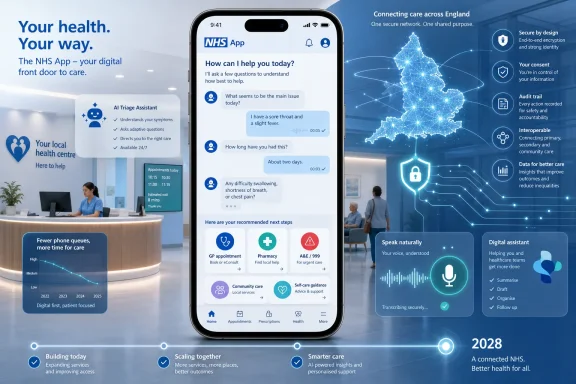 The NHS App Is Becoming a Gatekeeper, Not Just a Front Door
For years, the NHS App has been treated as a digital convenience layer: book something, view something, renew something, prove something. The new triage tool moves it into a much more consequential role. It will ask patients adaptive questions, interpret their responses, and direct them toward a GP appointment, pharmacy, A&E, community service, or self-care advice.That sounds like a user-experience upgrade, but it is really a demand-management system. The NHS does not have a shortage of patients willing to seek care; it has a shortage of capacity, continuity, and navigable routes through the system. A triage layer in the app is designed to solve the mismatch by sorting requests earlier, collecting cleaner information, and reducing the administrative drag around first contact.
NHS England says the tool follows a successful trial at Wealden Ridge Medical Partnership in Sussex, where phone queues reportedly fell by 29% while patient satisfaction was maintained. That figure matters because the politics of the NHS App are not abstract. Labour promised to end the notorious 8am scramble for GP appointments, and AI triage is now being positioned as one of the mechanisms for doing it.
There is a useful distinction here between access and availability. An app can make it easier to ask for help at 10pm rather than join a phone queue at 8am, but it cannot conjure extra clinicians from the ether. The best version of this system improves the signal reaching overstretched practices; the worst version merely moves the queue from the telephone to a digital holding pen.
The £10 Billion Bet Turns AI From Pilot Theatre Into Infrastructure
The money behind the announcement is large enough to change the character of the debate. NHS England says £10 billion over three years, allocated by the government last year, will overhaul technology, digital, and data systems across the health service. The expected return, according to NHS England, is £41 billion in total benefits over the next decade.That is a striking ratio, and it deserves scrutiny. Public-sector technology programmes often arrive wrapped in productivity arithmetic that looks more precise than the underlying operational reality. A saved minute in a pilot does not automatically become a saved minute across a national workforce; a successful GP practice trial does not automatically survive contact with thousands of local workflows, legacy systems, staffing gaps, and patient populations.
Still, the direction of travel is unmistakable. The government’s 10 Year Health Plan wants care to shift from hospital to community, from analogue to digital, and from sickness treatment to prevention. AI triage, ambient voice transcription, Microsoft Copilot, the Single Patient Record, NHS Online, and digital rehabilitation tools are not separate gadgets in this vision. They are meant to become the connective tissue of a service that has historically struggled to make its own data move at the speed of patient need.
That is why the NHS announcement is more important than the phrase “AI rollout” suggests. This is not just a chatbot bolted onto a public website. It is a declaration that the NHS intends to use software to reshape the flow of clinical work.
Ambient Voice Is the Easier Sell, Because Everyone Hates Paperwork
If AI triage is politically sensitive, ambient voice technology is the easier pitch. Clinicians spend too much time documenting care, and almost nobody thinks the current documentation burden is a triumph of modern medicine. AI notetaking tools that record consultations and generate summaries promise to give clinicians back time without asking patients to accept a new form of clinical judgement.NHS England says a Great Ormond Street Hospital-led study found ambient voice technology freed clinicians to spend nearly a quarter more time with patients. It also says a St George’s Hospital emergency department pilot saved clinicians an average of 47 minutes per shift, enough time, in NHS England’s framing, to see an additional patient.
The attraction is obvious. In a hospital corridor, a clinic room, or an emergency department, time is the scarce commodity that governs everything else. A tool that reduces the clerical tail of each patient encounter does not need to be magical to be useful; it only needs to be accurate enough, fast enough, and integrated enough that clinicians trust it more than they resent it.
But this is also where implementation becomes destiny. Ambient voice tools touch patient confidentiality, consent, clinical record accuracy, and medico-legal accountability. A wrong summary is not just a typo if it becomes part of the record that informs future care.
Microsoft Copilot Shows the NHS Wants General-Purpose AI Too
The NHS programme is not limited to clinical AI. More than 500,000 staff are being given access to Microsoft Copilot after a trial that NHS England says cut admin time by an average of two days per month. That is a massive deployment by any enterprise standard, and it brings the WindowsForum audience onto familiar ground: Microsoft 365, identity, permissions, data governance, audit trails, and the messy reality of rolling out AI assistants across a sprawling organisation.Copilot is not a diagnostic system, and that is partly why it can move faster. Drafting documents, summarising meetings, analysing data, and producing internal communications sit closer to familiar productivity software than to medical-device territory. Yet the governance problem does not disappear just because the tool is general-purpose.
For IT administrators, the question is not whether Copilot can save time in a demo. It is whether the organisation has the data hygiene, access controls, retention policies, and training needed to prevent a productivity assistant from becoming a very confident leak amplifier. In healthcare, “who can see what” is not a back-office concern; it is core patient safety infrastructure.
The NHS has been here before in different forms. Large technology rollouts often promise standardisation and expose fragmentation. If Copilot lands in teams with well-managed Microsoft 365 tenants, sensible information architecture, and clear usage policies, it may be a practical win. If it lands on top of chaotic permissions and unstructured data sprawl, it may mostly reveal how much digital housekeeping was deferred.
The Critics Are Not Anti-AI; They Are Anti-Magic
The pushback from health leaders has been more nuanced than the usual “robots replacing doctors” caricature. The Royal College of Nursing welcomed technology that could reduce administrative pressure, but Professor Lynn Woolsey warned against overly optimistic assessments of AI productivity benefits and said patient safety must sit at the heart of triage. That is not Luddism. It is the institutional memory of people who know that flawed systems create work for humans rather than removing it.The Health Foundation’s Tim Horton has argued that the missing piece is a longer-term strategy to avoid piecemeal adoption. The King’s Fund has also highlighted the need to make digital services inclusive, warning that tools built for confident app users can deepen exclusion if traditional access routes degrade in practice even while remaining available in theory.
Those warnings go to the heart of the NHS bet. AI can improve routing, documentation, and administrative throughput, but it can also make a system feel colder, more opaque, and harder to challenge. A patient who does not understand why an app has sent them to a pharmacy instead of a GP is not experiencing “empowerment”; they are experiencing automated deflection.
The important line is between decision support and decision laundering. If AI helps collect better information for clinicians, it may improve care. If AI becomes the politically convenient mechanism by which scarcity is disguised as personalisation, it will corrode trust quickly.
Digital Inclusion Is the Test the App Cannot Grade Itself On
NHS England says patients will still be able to use traditional routes to contact their GP practice. That assurance is necessary, but it is not sufficient. In public services, a channel can remain formally available while becoming practically worse, slower, or less supported as investment flows elsewhere.The King’s Fund has repeatedly stressed that digital inclusion depends on access to devices, connectivity, skills, and confidence. Those are not evenly distributed across the population. Older patients, people with disabilities, people with limited English, people in poverty, people with chaotic housing situations, and patients with complex needs are exactly the groups most likely to need healthcare and least likely to benefit from a purely app-first model.
The NHS has to avoid designing for the median smartphone owner and then treating everyone else as an exception. Healthcare demand is not shaped like a consumer SaaS funnel. The edge cases are often the patients with the highest clinical risk.
That does not mean AI triage should be abandoned. It means success should be measured by more than adoption curves and reduced call volumes. The system needs to prove that it improves access for people who are already underserved, not merely convenience for those who were already good at navigating digital services.
The Security Story Is Bigger Than Confidentiality
Whenever AI enters healthcare, privacy is the first concern raised, and rightly so. Ambient voice tools process intimate conversations. Triage tools collect symptoms and personal context. Copilot-style assistants may touch internal documents, operational reports, and patient-adjacent information depending on deployment boundaries.But security is broader than confidentiality. Availability matters when a digital front door becomes critical infrastructure. Integrity matters when AI-generated notes or summaries may influence clinical decisions. Resilience matters when ransomware groups have repeatedly shown that healthcare systems are high-value targets with low tolerance for downtime.
The NHS says cyber security is part of the technology investment, and that is essential. A national app-based triage layer raises the stakes for authentication, fraud prevention, incident response, supplier assurance, logging, and clinical safety engineering. If the app becomes the route through which millions of patients seek care, then app reliability becomes a healthcare capacity issue.
For Windows and Microsoft administrators watching from the enterprise side, this is the familiar lesson of digital transformation at scale: every new convenience is also a new dependency. The more successful the NHS App becomes, the less optional it becomes.
The Real Productivity Gain Is Workflow, Not AI
The political selling point is artificial intelligence, but the operational prize is workflow redesign. The AI label attracts attention, funding, and ministerial speeches. The actual value will come from whether practices, hospitals, community teams, and administrative staff can change how work moves through the system.A triage app that feeds structured, prioritised information into a GP practice could reduce duplication and help clinicians focus. The same tool bolted onto an unchanged workflow could simply create another inbox. Ambient voice summaries could save time, or they could generate drafts that clinicians must painstakingly correct because the record is too important to trust.
This is why the “pilot to national rollout” jump is dangerous. Pilots are often staffed by motivated teams, supported by vendors, and conducted in environments where the tool receives unusual attention. National deployment exposes the product to tired staff, inconsistent infrastructure, local workarounds, procurement constraints, and the brutal diversity of real-world patients.
The NHS should be judged less on whether it can announce AI at scale and more on whether it can retire old work as new tools arrive. If AI adds a digital process while the phone queue, paper workaround, email chase, and manual reconciliation all remain, the productivity case collapses.
A Single Patient Record Is the Quietly Radical Piece
Among the announced plans, the Single Patient Record may ultimately matter more than the headline AI features. NHS England says it wants specialists across the service to have a fuller picture of a patient’s medical history. That is the kind of ambition that sounds obvious until anyone who has worked near health IT starts laughing darkly.The NHS is a national brand wrapped around a very complex federation of organisations, systems, contracts, and local histories. Data sharing has improved in places, but patients still routinely encounter the absurdity of repeating information that the system theoretically already knows. A functioning patient record that follows the patient across care settings would be transformative.
It would also make AI more useful and more dangerous. Better data can improve triage, summarisation, population health analysis, and care coordination. It can also magnify the consequences of poor permissions, weak governance, inaccurate entries, and algorithmic assumptions.
This is where the NHS technology programme stops being an app story and becomes an architecture story. AI layered on fragmented records is a patch. AI integrated into coherent, governed, clinically trusted data infrastructure is something much more consequential.
The NHS Is Trying to Buy Time With Software
The most sympathetic reading of the announcement is that the NHS is trying to buy time. Waiting lists, GP access problems, staff burnout, and financial pressure have created a system in which marginal gains are not trivial. If AI can reduce call queues, cut documentation time, and help patients reach the right service earlier, those gains matter.The less flattering reading is that AI is being asked to absorb political pressure that properly belongs to workforce planning, estates, social care, and long-term funding. Software can route demand, but it cannot make undercapacity disappear. It can reduce wasted effort, but it cannot fully compensate for shortages of clinicians, beds, scanners, community services, and care packages.
Both readings can be true at once. The NHS should absolutely modernise its digital infrastructure. It should also resist the fantasy that digital transformation is a substitute for system capacity.
That is the tension running through the £10 billion plan. AI is not being introduced into a stable service looking for polish. It is being introduced into a pressured service looking for oxygen.
The App Rollout Will Succeed Only If the NHS Measures the Boring Things
The NHS has put dates, money, and ambition behind its AI push, which makes the next phase less about vision and more about evidence. The strongest claims in the announcement are measurable, and they should be measured in public where possible. The weakest claims are the broad productivity promises that tend to survive precisely because they are too diffuse to falsify quickly.- The AI triage tool is scheduled to reach more than 200,000 patients within 12 months and all NHS App users in England by April 2028.
- NHS England says the Sussex GP trial reduced phone queues by 29%, but national success will depend on whether that result survives across very different practices and patient populations.
- Ambient voice technology has a clearer immediate use case because documentation burden is real, visible, and widely disliked by clinicians.
- Microsoft Copilot’s NHS rollout is an enterprise governance challenge as much as a productivity programme.
- Traditional contact routes must remain meaningfully usable, not merely technically available.
- The £41 billion benefits claim will need hard, transparent evidence if it is to be more than another optimistic public-sector technology forecast.
References
- Primary source: Resultsense
Published: 2026-07-06T15:27:12.248954
NHS makes AI app triage a priority in £10bn tech push
NHS England accelerates an AI triage tool in the NHS App and ambient voice notetaking under a £10bn overhaul, as nursing and policy leaders warn on the evidence.www.resultsense.com
- Related coverage: england.nhs.uk
NHS England » NHS accelerates artificial intelligence rollout to cut waiting times and improve care for millions
NHS England » NHS accelerates artificial intelligence rollout to cut waiting times and improve care for millionswww.england.nhs.uk - Related coverage: biology.digital
NHS Accelerates AI Rollout to Reduce Waiting Times and Improve Patient Care | Biology Digital News | Biology Digital
NHS England is accelerating a nationwide rollout of artificial intelligence tools, backed by a £10 billion government fund, aimed at significantly...www.biology.digital - Related coverage: thenhsalliance.org
NHS Alliance responds to rollout of new AI tools across the NHS
thenhsalliance.org
- Related coverage: kingsfund.org.uk
Responding to the government’s announcement of a £10bn investment in NHS technology and data | The King's Fund
Pritesh Mistry says NHS tech funding could improve care and productivity – if staff are supported and digital exclusion is avoided. www.kingsfund.org.uk