

Semiconductor supply-chain risk in 2026 is no longer a pandemic-era shortage story; it is a structural contest over where advanced chips are designed, fabricated, packaged, shipped, insured, powered, and staffed across a fragmented global production system. The article supplied by BISinfotech gets the central point right: chips are the foundation of the modern economy, but the foundation is narrower, slower, and more politically exposed than most buyers want to admit. The uncomfortable lesson for Windows users, server buyers, automakers, cloud operators, and governments is that “more fabs” is necessary, but nowhere near sufficient. The semiconductor bottleneck has moved from a simple lack of wafer capacity to a dense web of choke points that industrial policy can bend only over years.
The semiconductor industry spent the early 2020s teaching the public a vocabulary it never asked to learn. Wafer starts, mature nodes, foundry capacity, substrates, packaging, and lead times suddenly mattered to car buyers, gamers, hospital procurement teams, and school districts trying to buy laptops. The shortage that began as a pandemic logistics crisis became a civic lesson in how much of everyday life depends on tiny components made by a small number of firms in a small number of places.
That lesson has not expired. If anything, the AI boom has made the supply chain more lopsided. Gartner recently forecast semiconductor revenue well above the levels discussed in older market estimates, while WSTS and Deloitte have also pointed to a market being pulled upward by AI infrastructure and memory demand. The exact forecast varies by methodology, but the direction is not in dispute: the industry is not merely recovering from a shortage cycle; it is being rebuilt around a much more voracious class of customers.
That matters because the old semiconductor cycle was already unforgiving. PC and smartphone demand rose and fell, manufacturers overbuilt and underbuilt, and inventories lurched between glut and panic. AI data centers add a different rhythm. They are not buying chips one tray at a time; they are absorbing advanced logic, high-bandwidth memory, power components, optical networking, storage, cooling gear, and server racks as integrated systems.
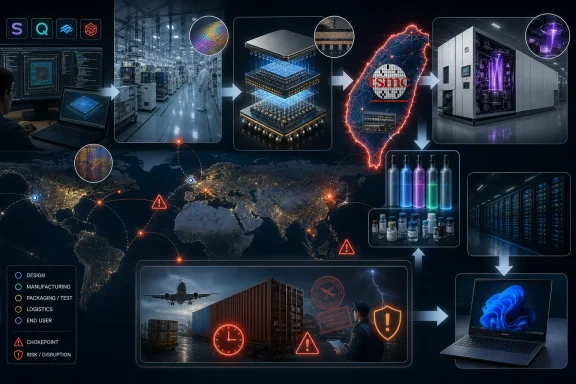
BISinfotech’s framing is useful because it avoids the comforting myth that chips are simply “made” somewhere. A chip is designed in one ecosystem, fabricated in another, packaged in a third, shipped through a fourth, and qualified inside products that may have five-to-ten-year support lives. The supply chain is not a line. It is a relay race in which every runner uses different shoes, different rules, and different national security lawyers.
This upstream layer is dominated by a small group of companies in the United States and Europe. Electronic design automation tools are not just productivity software; they are industrial infrastructure. They encode the rules by which modern chips are laid out, tested, optimized for heat and power, and translated into something a foundry can manufacture at terrifying precision.
That concentration creates a quieter kind of geopolitical leverage. Export controls on advanced chipmaking do not stop at machines. They can include design software, IP cores, and technical support, turning a licensing regime into a production constraint. A company may have capital, engineers, and customers, but if it cannot legally access the tools needed to design at the leading edge, its roadmap becomes theoretical.
This is why technological sovereignty is harder than the slogan suggests. A country can subsidize buildings and still remain dependent on foreign design platforms, foreign lithography, foreign chemicals, foreign substrates, and foreign packaging know-how. The modern semiconductor ecosystem is a stack of monopolies and near-monopolies, each one tolerable in normal times and destabilizing in a crisis.
That indispensability did not happen by accident. TSMC perfected the foundry model at a scale and technical depth that competitors have struggled to match. Fabless companies such as Nvidia, AMD, Apple, Qualcomm, and many others could focus on architecture and product design because TSMC could translate those designs into silicon at the leading edge. The result was one of the most successful divisions of labor in industrial history.
It is also one of the most concentrated. Taiwan faces earthquake risk, water stress, energy constraints, and the overriding geopolitical danger of coercion or conflict across the Taiwan Strait. Even a disruption short of war could matter. Shipping delays, insurance spikes, export restrictions, cyberattacks, or power disruptions would ripple through product launches and infrastructure buildouts almost immediately.
The industry’s answer has been diversification, but diversification is not duplication. TSMC’s investments in Arizona, Japan, and elsewhere are strategically important, as are Samsung’s and Intel’s manufacturing ambitions outside East Asia. Yet a fab abroad does not instantly recreate the supplier mesh, engineering culture, process maturity, and packaging ecosystem that grew around Taiwan over decades. Moving capacity is possible. Moving an ecosystem is slower.
The American law mixed manufacturing incentives with research and workforce funding. Europe’s program aimed to mobilize public and private investment and double the bloc’s share of global production. India has expanded its semiconductor ambitions, trying to convert its electronics-manufacturing momentum and engineering base into a deeper role in fabrication, packaging, and design.
These policies are not cosmetic. They change investment math and can pull projects forward that would otherwise struggle against cheaper incumbent locations. They also send a signal to suppliers that demand may exist for regional clusters, not merely isolated fabs. In an industry where confidence shapes multiyear capital spending, that signal has value.
But policy cannot repeal physics, qualification cycles, or experience curves. A leading-edge fab can cost tens of billions of dollars, require highly specialized equipment, and take years to build, tool, ramp, and qualify. The first wafer out of a new site is not the same thing as reliable high-volume production. Industrial policy is buying options against future shocks, not delivering instant self-sufficiency.
The machines are almost absurdly complex. They depend on precision optics, lasers, vacuum systems, metrology, motion control, and a supplier network that itself spans borders. A single EUV system costs hundreds of millions of dollars and requires elaborate logistics to ship and install. It is less a machine than an ecosystem condensed into a factory tool.
This creates a bottleneck with a different character from ordinary capacity constraints. A shortage of commodity components can sometimes be solved by price. A shortage of EUV capacity cannot be solved quickly because the product is difficult to assemble, its suppliers are specialized, and the engineers who install and maintain it are scarce. When lead times stretch, new fabs become shells waiting for the tools that turn capital expenditure into wafers.
Export controls sharpen the problem. Restrictions on shipping advanced lithography and related technologies to China have made ASML’s order book a geopolitical instrument. The West’s strategy is to slow China’s access to the most advanced manufacturing capabilities; China’s strategy is to build substitutes, stretch older deep-ultraviolet tools, and develop domestic alternatives. Neither path lowers global tension.
Neon, krypton, and xenon became visible during the war in Ukraine because semiconductor-grade gases are not interchangeable commodities. Gallium and germanium became strategic talking points as China imposed export controls on materials important to compound semiconductors, power electronics, optics, and defense-related systems. ABF substrates and specialty resins have become part of the AI packaging discussion because powerful accelerators need more than a good logic die.
The challenge is not simply that these materials are rare. It is that they are qualified. A fab process is tuned around specific inputs with microscopic tolerances. Changing a supplier can mean months of validation, yield testing, and customer approval. In a mature product line, that delay may be annoying. In automotive, aerospace, medical, defense, or data-center platforms, it can be operationally decisive.
This is the part of the supply chain least suited to political theater. A government can announce a fab with a rendering. It cannot as easily announce a globally competitive ecosystem of chemical purification, photoresist manufacturing, specialty glass, gas processing, and substrate production. Yet without those layers, the fab is dependent from day one.
Epoch AI’s analysis of 2025 supply constraints argued that HBM and advanced packaging, rather than logic dies alone, were the binding bottlenecks for frontier AI chips. TrendForce has similarly described a race for CoWoS capacity, HBM, substrates, and related materials as AI chips migrate to more advanced nodes and larger packages. That reporting matches what buyers have experienced: even when demand is visible and money is available, delivery depends on several scarce capacities lining up.
High-bandwidth memory is especially unforgiving. It stacks DRAM dies vertically and connects them to logic through advanced packaging, delivering the bandwidth needed by large AI models. The suppliers are few, the qualification demands are intense, and the same memory industry also feeds servers, PCs, graphics cards, phones, and enterprise storage.
Advanced packaging has become the new strategic terrain. TSMC’s CoWoS technology is central to many leading AI accelerators, and the company has been expanding capacity aggressively. But packaging expansion has its own toolsets, cleanrooms, substrates, inspection systems, and skilled labor needs. A fabricated die waiting for packaging is not revenue in a customer’s rack.
Memory is the cleanest example. AI systems consume HBM directly, but the broader memory industry allocates capital, wafers, and attention across DRAM products. When data centers absorb more high-value memory output, PC buyers may not see a direct one-to-one shortage, but they can see pricing pressure, slower transitions, and tighter supply of high-density modules. The same dynamic can appear in enterprise SSDs, high-end networking, power management, and server-class CPUs.
This does not mean every Windows laptop will suddenly become unaffordable. The PC market is large, mature, and diversified across many component tiers. But it does mean the old assumption that consumer electronics sit at the top of the allocation ladder is gone. Hyperscalers and AI infrastructure customers now have the margins, urgency, and strategic importance to command priority.
Administrators should read the chip supply chain as part of capacity planning. If a business depends on GPU workstations, AI inference servers, high-memory database nodes, or specialized industrial PCs, procurement can no longer be treated as a last-quarter exercise. Component choice, vendor qualification, and lifecycle planning are now risk-management disciplines.
This creates a strange inversion. Chips are physically tiny, but their logistics footprint is strategically large. A delayed pallet of components can idle an automotive line. A missed delivery of accelerators can delay a data-center cluster. A customs hold on specialized equipment can push a factory ramp by weeks.
The Red Sea crisis, broader maritime disruption, and rising geopolitical tension have reminded manufacturers that logistics shocks do not need to target semiconductors specifically to affect them. When routes change, insurance rates rise, air cargo tightens, or customs scrutiny increases, high-value electronics feel the consequences. Supply chains designed around punctuality become exposed to the politics of transit.
Environmental reporting adds another layer. Large companies are under growing pressure to account for transport emissions, not merely factory emissions. That may be good policy and good governance, but it also means suppliers must track and document movement with more precision. Compliance work becomes part of delivery work.
This is where the global fab-building race runs into a human constraint. The United States, Europe, Japan, India, Taiwan, South Korea, and others all want more semiconductor talent at the same time. They need process engineers, technicians, tool-maintenance specialists, packaging experts, chemical engineers, and operators comfortable inside unforgiving production environments.
The shortage is not only at the PhD level. Technicians matter enormously. A fab with advanced tools and insufficient maintenance talent will not reach its theoretical output. Packaging facilities need their own specialized workforce. Chemical and substrate suppliers need theirs. The supply chain is short of hands as much as it is short of machines.
Universities and community colleges can help, but training pipelines take time. Immigration policy matters too, especially for countries trying to scale quickly. If governments treat talent as an afterthought, they will discover that subsidized buildings can sit below capacity while the bottleneck walks around on two legs.
Those assumptions now look fragile. Companies are holding more strategic inventory, qualifying second sources where possible, and mapping deeper into their supplier networks. The phrase just-in-case sounds inelegant, but it captures the new mood. Resilience costs money up front because disruption costs more later.
The hard part is deciding what to buffer. Stockpiling every chip is impossible and often foolish, especially when products change quickly or components have lifecycle constraints. The more practical strategy is to identify parts that are low-cost but high-impact, long-lead but stable, or difficult to qualify in a hurry. Automotive microcontrollers, industrial sensors, power-management ICs, networking components, and high-density memory modules may deserve different treatment from commodity parts with many substitutes.
Digital supply-chain mapping also matters, but it should be approached with skepticism. Dashboards do not create supply. AI risk tools and digital twins can reveal exposure to Tier 3 and Tier 4 suppliers, but the discovery is useful only if companies act before the disruption. Visibility is not resilience unless it changes purchasing, design, qualification, and inventory behavior.
The industry is too specialized for autarky. The United States remains strong in design, EDA, equipment, and some manufacturing. Taiwan dominates advanced foundry. South Korea is central to memory and advanced logic. Japan remains critical in materials and equipment. The Netherlands owns the EUV choke point through ASML. Southeast Asia is deeply important to assembly, testing, and packaging. China is vast in electronics assembly, mature-node capacity, and increasingly determined domestic substitution. India wants a larger role in design, packaging, and eventually fabrication.
That map will change, but it will not flatten. The likely future is not national self-sufficiency; it is managed interdependence. Governments will decide which sectors require domestic or allied capacity, which suppliers are trusted, which technologies must be controlled, and which dependencies are acceptable because replacing them would be too expensive or technically unrealistic.
For companies, the practical answer is less ideological. Design products with substitutability where possible. Qualify multiple suppliers before the crisis. Avoid single-source dependence for parts that can halt revenue. Treat packaging and substrates as strategic, not secondary. Understand that a chip’s country of fabrication is only one line in a much longer risk ledger.
 The Chip Boom Has Outgrown the Old Shortage Narrative
The semiconductor industry spent the early 2020s teaching the public a vocabulary it never asked to learn. Wafer starts, mature nodes, foundry capacity, substrates, packaging, and lead times suddenly mattered to car buyers, gamers, hospital procurement teams, and school districts trying to buy laptops. The shortage that began as a pandemic logistics crisis became a civic lesson in how much of everyday life depends on tiny components made by a small number of firms in a small number of places.That lesson has not expired. If anything, the AI boom has made the supply chain more lopsided. Gartner recently forecast semiconductor revenue well above the levels discussed in older market estimates, while WSTS and Deloitte have also pointed to a market being pulled upward by AI infrastructure and memory demand. The exact forecast varies by methodology, but the direction is not in dispute: the industry is not merely recovering from a shortage cycle; it is being rebuilt around a much more voracious class of customers.
That matters because the old semiconductor cycle was already unforgiving. PC and smartphone demand rose and fell, manufacturers overbuilt and underbuilt, and inventories lurched between glut and panic. AI data centers add a different rhythm. They are not buying chips one tray at a time; they are absorbing advanced logic, high-bandwidth memory, power components, optical networking, storage, cooling gear, and server racks as integrated systems.
BISinfotech’s framing is useful because it avoids the comforting myth that chips are simply “made” somewhere. A chip is designed in one ecosystem, fabricated in another, packaged in a third, shipped through a fourth, and qualified inside products that may have five-to-ten-year support lives. The supply chain is not a line. It is a relay race in which every runner uses different shoes, different rules, and different national security lawyers.
The Real Supply Chain Starts Before the Fab
Public debate still treats the fabrication plant as the center of gravity, because fabs are visible, expensive, and politically photogenic. A new fab gives ministers and governors something to tour in hard hats. But the value chain begins much earlier, in the design tools, processor architectures, verification software, and intellectual-property blocks that decide what the chip will be before a wafer ever enters a cleanroom.This upstream layer is dominated by a small group of companies in the United States and Europe. Electronic design automation tools are not just productivity software; they are industrial infrastructure. They encode the rules by which modern chips are laid out, tested, optimized for heat and power, and translated into something a foundry can manufacture at terrifying precision.
That concentration creates a quieter kind of geopolitical leverage. Export controls on advanced chipmaking do not stop at machines. They can include design software, IP cores, and technical support, turning a licensing regime into a production constraint. A company may have capital, engineers, and customers, but if it cannot legally access the tools needed to design at the leading edge, its roadmap becomes theoretical.
This is why technological sovereignty is harder than the slogan suggests. A country can subsidize buildings and still remain dependent on foreign design platforms, foreign lithography, foreign chemicals, foreign substrates, and foreign packaging know-how. The modern semiconductor ecosystem is a stack of monopolies and near-monopolies, each one tolerable in normal times and destabilizing in a crisis.
Taiwan Is the Choke Point Everyone Names Because It Really Is One
No serious analysis can avoid Taiwan. TSMC’s role in advanced manufacturing is so large that it has become both an industrial triumph and a strategic anxiety. Market-share estimates differ depending on whether analysts count pure-play foundry revenue, broader foundry services, advanced nodes, or advanced packaging, but the picture is consistent: TSMC is the indispensable manufacturer for many of the most important chips in the world.That indispensability did not happen by accident. TSMC perfected the foundry model at a scale and technical depth that competitors have struggled to match. Fabless companies such as Nvidia, AMD, Apple, Qualcomm, and many others could focus on architecture and product design because TSMC could translate those designs into silicon at the leading edge. The result was one of the most successful divisions of labor in industrial history.
It is also one of the most concentrated. Taiwan faces earthquake risk, water stress, energy constraints, and the overriding geopolitical danger of coercion or conflict across the Taiwan Strait. Even a disruption short of war could matter. Shipping delays, insurance spikes, export restrictions, cyberattacks, or power disruptions would ripple through product launches and infrastructure buildouts almost immediately.
The industry’s answer has been diversification, but diversification is not duplication. TSMC’s investments in Arizona, Japan, and elsewhere are strategically important, as are Samsung’s and Intel’s manufacturing ambitions outside East Asia. Yet a fab abroad does not instantly recreate the supplier mesh, engineering culture, process maturity, and packaging ecosystem that grew around Taiwan over decades. Moving capacity is possible. Moving an ecosystem is slower.
Industrial Policy Is Buying Options, Not Independence
The U.S. CHIPS and Science Act, the European Chips Act, Japan’s support programs, South Korea’s national strategies, and India’s semiconductor push all reflect the same conclusion: chips are too important to be left entirely to lowest-cost geography. Governments that once celebrated global efficiency now want domestic capacity, trusted supply, and bargaining power. The language has shifted from globalization to resilience.The American law mixed manufacturing incentives with research and workforce funding. Europe’s program aimed to mobilize public and private investment and double the bloc’s share of global production. India has expanded its semiconductor ambitions, trying to convert its electronics-manufacturing momentum and engineering base into a deeper role in fabrication, packaging, and design.
These policies are not cosmetic. They change investment math and can pull projects forward that would otherwise struggle against cheaper incumbent locations. They also send a signal to suppliers that demand may exist for regional clusters, not merely isolated fabs. In an industry where confidence shapes multiyear capital spending, that signal has value.
But policy cannot repeal physics, qualification cycles, or experience curves. A leading-edge fab can cost tens of billions of dollars, require highly specialized equipment, and take years to build, tool, ramp, and qualify. The first wafer out of a new site is not the same thing as reliable high-volume production. Industrial policy is buying options against future shocks, not delivering instant self-sufficiency.
Lithography Turns One Supplier Into a Global Governor
If TSMC is the company everyone worries about, ASML is the company everyone eventually has to discuss. Extreme ultraviolet lithography is the central manufacturing technology behind the most advanced process nodes, and ASML is the only company that sells EUV scanners at commercial scale. That makes the Dutch firm one of the most strategically important industrial suppliers on Earth.The machines are almost absurdly complex. They depend on precision optics, lasers, vacuum systems, metrology, motion control, and a supplier network that itself spans borders. A single EUV system costs hundreds of millions of dollars and requires elaborate logistics to ship and install. It is less a machine than an ecosystem condensed into a factory tool.
This creates a bottleneck with a different character from ordinary capacity constraints. A shortage of commodity components can sometimes be solved by price. A shortage of EUV capacity cannot be solved quickly because the product is difficult to assemble, its suppliers are specialized, and the engineers who install and maintain it are scarce. When lead times stretch, new fabs become shells waiting for the tools that turn capital expenditure into wafers.
Export controls sharpen the problem. Restrictions on shipping advanced lithography and related technologies to China have made ASML’s order book a geopolitical instrument. The West’s strategy is to slow China’s access to the most advanced manufacturing capabilities; China’s strategy is to build substitutes, stretch older deep-ultraviolet tools, and develop domestic alternatives. Neither path lowers global tension.
Raw Materials Are the Fragile Layer Beneath the Glamour
The chip industry’s public image is stainless steel, bunny suits, and nanometer-scale precision. Beneath that image sits a supply chain of gases, minerals, photoresists, slurries, resins, substrates, and ultra-pure chemicals. Many of these materials are made by a small number of suppliers, sometimes in regions exposed to conflict, export controls, or industrial accidents.Neon, krypton, and xenon became visible during the war in Ukraine because semiconductor-grade gases are not interchangeable commodities. Gallium and germanium became strategic talking points as China imposed export controls on materials important to compound semiconductors, power electronics, optics, and defense-related systems. ABF substrates and specialty resins have become part of the AI packaging discussion because powerful accelerators need more than a good logic die.
The challenge is not simply that these materials are rare. It is that they are qualified. A fab process is tuned around specific inputs with microscopic tolerances. Changing a supplier can mean months of validation, yield testing, and customer approval. In a mature product line, that delay may be annoying. In automotive, aerospace, medical, defense, or data-center platforms, it can be operationally decisive.
This is the part of the supply chain least suited to political theater. A government can announce a fab with a rendering. It cannot as easily announce a globally competitive ecosystem of chemical purification, photoresist manufacturing, specialty glass, gas processing, and substrate production. Yet without those layers, the fab is dependent from day one.
AI Moved the Bottleneck From Silicon to Systems
The most important shift of the past two years is that leading-edge wafer capacity is no longer the only scarce resource that matters. AI accelerators require advanced logic dies, high-bandwidth memory, and advanced packaging that can bind them together at enormous bandwidth. A finished AI processor is not just a chip. It is a compact, power-hungry, thermally demanding module built from several supply chains at once.Epoch AI’s analysis of 2025 supply constraints argued that HBM and advanced packaging, rather than logic dies alone, were the binding bottlenecks for frontier AI chips. TrendForce has similarly described a race for CoWoS capacity, HBM, substrates, and related materials as AI chips migrate to more advanced nodes and larger packages. That reporting matches what buyers have experienced: even when demand is visible and money is available, delivery depends on several scarce capacities lining up.
High-bandwidth memory is especially unforgiving. It stacks DRAM dies vertically and connects them to logic through advanced packaging, delivering the bandwidth needed by large AI models. The suppliers are few, the qualification demands are intense, and the same memory industry also feeds servers, PCs, graphics cards, phones, and enterprise storage.
Advanced packaging has become the new strategic terrain. TSMC’s CoWoS technology is central to many leading AI accelerators, and the company has been expanding capacity aggressively. But packaging expansion has its own toolsets, cleanrooms, substrates, inspection systems, and skilled labor needs. A fabricated die waiting for packaging is not revenue in a customer’s rack.
Windows Hardware Feels the Shock After Hyperscalers Move First
For WindowsForum readers, the semiconductor story is not abstract. It lands in workstation GPU pricing, laptop refresh cycles, server lead times, memory costs, storage availability, and the shape of the next PC generation. The AI data-center buildout is now large enough to compete with consumer and enterprise hardware for components that used to feel safely abundant.Memory is the cleanest example. AI systems consume HBM directly, but the broader memory industry allocates capital, wafers, and attention across DRAM products. When data centers absorb more high-value memory output, PC buyers may not see a direct one-to-one shortage, but they can see pricing pressure, slower transitions, and tighter supply of high-density modules. The same dynamic can appear in enterprise SSDs, high-end networking, power management, and server-class CPUs.
This does not mean every Windows laptop will suddenly become unaffordable. The PC market is large, mature, and diversified across many component tiers. But it does mean the old assumption that consumer electronics sit at the top of the allocation ladder is gone. Hyperscalers and AI infrastructure customers now have the margins, urgency, and strategic importance to command priority.
Administrators should read the chip supply chain as part of capacity planning. If a business depends on GPU workstations, AI inference servers, high-memory database nodes, or specialized industrial PCs, procurement can no longer be treated as a last-quarter exercise. Component choice, vendor qualification, and lifecycle planning are now risk-management disciplines.
Logistics Is Where a Tiny Product Becomes a Huge Liability
Semiconductors are light, expensive, and time-sensitive, which makes them unusually dependent on air freight and secure logistics. A small shipment can be worth millions of dollars. It may require controlled handling, fast customs clearance, anti-tamper procedures, and insurance terms that reflect both value and geopolitical risk.This creates a strange inversion. Chips are physically tiny, but their logistics footprint is strategically large. A delayed pallet of components can idle an automotive line. A missed delivery of accelerators can delay a data-center cluster. A customs hold on specialized equipment can push a factory ramp by weeks.
The Red Sea crisis, broader maritime disruption, and rising geopolitical tension have reminded manufacturers that logistics shocks do not need to target semiconductors specifically to affect them. When routes change, insurance rates rise, air cargo tightens, or customs scrutiny increases, high-value electronics feel the consequences. Supply chains designed around punctuality become exposed to the politics of transit.
Environmental reporting adds another layer. Large companies are under growing pressure to account for transport emissions, not merely factory emissions. That may be good policy and good governance, but it also means suppliers must track and document movement with more precision. Compliance work becomes part of delivery work.
The Workforce Shortage Is the Bottleneck Politicians Underestimate
A fab is often described as automated, which is true in the same limited sense that an airliner is automated. The automation is real, but the system still depends on highly trained people who understand process engineering, materials science, maintenance, contamination control, yield analysis, software, robotics, and industrial safety. A semiconductor workforce cannot be conjured by ribbon-cutting.This is where the global fab-building race runs into a human constraint. The United States, Europe, Japan, India, Taiwan, South Korea, and others all want more semiconductor talent at the same time. They need process engineers, technicians, tool-maintenance specialists, packaging experts, chemical engineers, and operators comfortable inside unforgiving production environments.
The shortage is not only at the PhD level. Technicians matter enormously. A fab with advanced tools and insufficient maintenance talent will not reach its theoretical output. Packaging facilities need their own specialized workforce. Chemical and substrate suppliers need theirs. The supply chain is short of hands as much as it is short of machines.
Universities and community colleges can help, but training pipelines take time. Immigration policy matters too, especially for countries trying to scale quickly. If governments treat talent as an afterthought, they will discover that subsidized buildings can sit below capacity while the bottleneck walks around on two legs.
Just-in-Time Has Given Way to Just-in-Case
The semiconductor crisis did not kill just-in-time manufacturing, but it ended its innocence. For decades, lean inventory was treated as a virtue: lower working capital, less waste, faster turnover, cleaner balance sheets. That logic still has merit, but it assumes suppliers will keep operating, borders will stay open, freight will stay available, and demand will remain forecastable enough to manage.Those assumptions now look fragile. Companies are holding more strategic inventory, qualifying second sources where possible, and mapping deeper into their supplier networks. The phrase just-in-case sounds inelegant, but it captures the new mood. Resilience costs money up front because disruption costs more later.
The hard part is deciding what to buffer. Stockpiling every chip is impossible and often foolish, especially when products change quickly or components have lifecycle constraints. The more practical strategy is to identify parts that are low-cost but high-impact, long-lead but stable, or difficult to qualify in a hurry. Automotive microcontrollers, industrial sensors, power-management ICs, networking components, and high-density memory modules may deserve different treatment from commodity parts with many substitutes.
Digital supply-chain mapping also matters, but it should be approached with skepticism. Dashboards do not create supply. AI risk tools and digital twins can reveal exposure to Tier 3 and Tier 4 suppliers, but the discovery is useful only if companies act before the disruption. Visibility is not resilience unless it changes purchasing, design, qualification, and inventory behavior.
Reshoring Alone Cannot Fix a Chain Built on Interdependence
The most tempting political promise is that national manufacturing will solve semiconductor insecurity. It will not. It can reduce dependence, improve bargaining power, create skilled jobs, and provide trusted capacity for critical sectors. But no single country can efficiently reproduce the full semiconductor stack from design software to EUV tools, raw materials, advanced fabs, packaging, testing, logistics, and end-market integration.The industry is too specialized for autarky. The United States remains strong in design, EDA, equipment, and some manufacturing. Taiwan dominates advanced foundry. South Korea is central to memory and advanced logic. Japan remains critical in materials and equipment. The Netherlands owns the EUV choke point through ASML. Southeast Asia is deeply important to assembly, testing, and packaging. China is vast in electronics assembly, mature-node capacity, and increasingly determined domestic substitution. India wants a larger role in design, packaging, and eventually fabrication.
That map will change, but it will not flatten. The likely future is not national self-sufficiency; it is managed interdependence. Governments will decide which sectors require domestic or allied capacity, which suppliers are trusted, which technologies must be controlled, and which dependencies are acceptable because replacing them would be too expensive or technically unrealistic.
For companies, the practical answer is less ideological. Design products with substitutability where possible. Qualify multiple suppliers before the crisis. Avoid single-source dependence for parts that can halt revenue. Treat packaging and substrates as strategic, not secondary. Understand that a chip’s country of fabrication is only one line in a much longer risk ledger.
The Semiconductor Map Now Belongs in Every IT Risk Register
The supply-chain lesson for Windows enthusiasts and IT pros is concrete: hardware availability is now shaped by forces far beyond the PC market. The next shortage may not look like the last one, and the next price spike may begin in a substrate plant, memory allocation meeting, export-control notice, or insurance market rather than a retail channel.- Organizations should plan hardware refreshes with longer lead times when systems depend on GPUs, high-density memory, specialized NICs, or industrial components.
- Buyers should ask vendors where advanced packaging, memory, and substrates fit into delivery risk, not just which process node a chip uses.
- Administrators should treat firmware, driver, and platform lifecycle commitments as part of supply-chain resilience because replacement hardware may not arrive quickly.
- Procurement teams should qualify alternative models and suppliers before shortages force emergency substitutions.
- Policymakers should measure semiconductor resilience by materials, tools, packaging, and workforce capacity, not only by the number of announced fabs.
References
- Primary source: Bisinfotech
Published: 2026-07-06T10:50:16.011808
Understanding Modern Semiconductor Supply Chain Challenges
A deep-dive analysis into the geopolitical, technical, and operational bottlenecks facing the modern global semiconductor supply chain. www.bisinfotech.com
- Related coverage: gartner.com
Gartner Forecasts Worldwide Semiconductor Revenue to Exceed $1.3 Trillion in 2026
Global semiconductor revenue is projected to exceed $1.3 trillion in 2026, exhibiting the highest growth in the last two decades, according to Gartner, Inc., a business and technology insights company.www.gartner.com - Related coverage: epoch.ai
Advanced packaging and HBM, not logic dies, were the bottlenecks on AI chip production in 2025 | Epoch AI
We estimate that the four largest AI chip designers consumed around 90% of global CoWoS capacity and HBM supply in 2025, while accounting for only ~12% of advanced logic die production. epoch.ai
- Related coverage: penchan.co
Taiwan's Semiconductor Supply Chain: From IC Design to AI Servers, How Silicon Island's Guardian Mountains Divide the Work | Penchan
A one-stop guide to Taiwan's semiconductor supply chain: from IC design, IP, and foundry to memory, packaging-and-test, and substrates, all the way to AI-server assembly, cooling, and power. Taiwan handles almost the entire back end of AI hardware. We break down in plain English what each link... penchan.co
- Related coverage: tomshardware.com
Global semiconductor foundry market hit a record $320 billion in 2025 as TSMC pulled further ahead | Tom's Hardware
TSMC grew 36% while most of the foundry market managed 8%.www.tomshardware.com - Related coverage: deloitte.com
2026 Semiconductor Industry Outlook | Deloitte Insights
The 2026 global semiconductor industry outlook projects soaring sales, shifting focus toward risk mitigation, integrated systems, and balanced investment.www.deloitte.com
- Related coverage: sourceready.com
Taiwan Semiconductor Market Report 2025: AI & HPC Drive Growth - Sourceready Article
Taiwan's semiconductor market is set for robust growth in 2025, driven by AI and HPC. Discover market size, key drivers, TSMC's dominance, and ecosystem insights.www.sourceready.com - Related coverage: time.com
Inside the World's Largest Semiconductor Chip Manufacturer
Taiwan Semiconductor Manufacturing Co. controls more than half of the market for made-to-order chips. But it's facing supply chain problems.time.com - Related coverage: kiplinger.com
AI is Powering A Semiconductor Boom | Kiplinger
As tech giants spend astronomical sums on data centers, chip companies are scrambling to keep up. Expect demand to outstrip supply for a while.www.kiplinger.com