

Microsoft has put the new Mbv4 family of Azure virtual machines into public preview in East US and East US 2, targeting SAP landscapes and other memory-heavy enterprise workloads that need more storage throughput, faster NVMe access, and larger scale-up headroom. The announcement, covered by Petri and reflected in Microsoft’s newly published Azure documentation, is not just another SKU refresh. It is Microsoft’s latest attempt to make Azure feel less like a general-purpose cloud rented by SAP customers and more like a purpose-built home for their most stubborn, expensive systems.
That distinction matters because SAP workloads do not move like ordinary cloud applications. They are often the center of financial close, manufacturing, logistics, billing, and compliance. When Microsoft adds a new VM family for SAP, the pitch is not merely “faster compute.” It is a promise that the cloud can absorb the weight of systems enterprises once assumed would remain close to the metal.
The headline feature of Mbv4 is not a single dazzling number. It is the combination of memory-optimized and storage-optimized variants aimed at the bottlenecks that appear when large enterprise databases stop being merely large and start becoming operationally immovable.
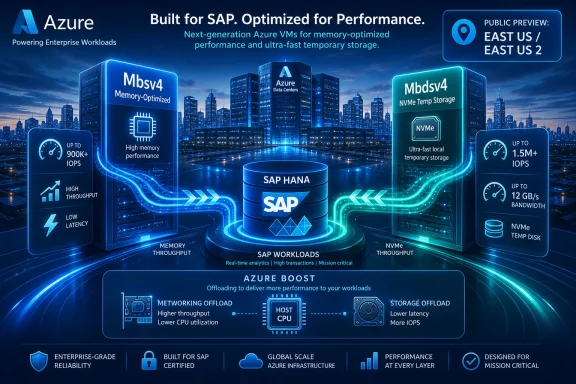
Microsoft’s documentation describes two branches of the family: Mbsv4 and Mbdsv4. The Mbsv4 line is the memory-focused option, while Mbdsv4 adds substantial local NVMe temporary storage for workloads that benefit from data being close to the VM. Both are based on 6th-generation Intel Xeon Scalable processors and sit inside Azure’s M-series portfolio, the part of Azure already associated with high-memory workloads such as SAP HANA, large relational databases, analytics platforms, and other systems that punish ordinary VM sizing assumptions.
The more interesting story is storage. Microsoft says the new series delivers higher remote disk storage performance than previous generations, with support for very high IOPS and bandwidth when paired with Azure’s faster disk offerings. A Microsoft Tech Community post previewing the Mbv4 direction last year said the upcoming Standard_M304bs_4_v4 size reached 780,000 IOPS and 16 GBps of remote storage throughput in lab testing, a 20 percent IOPS improvement and 60 percent bandwidth improvement over the Mbv3 demonstration baseline.
That is the kind of language SAP architects notice. Memory capacity gets the procurement conversation started, but storage behavior often determines whether a migration feels heroic or reckless. Database savepoints, log writes, backups, restores, batch jobs, analytics bursts, and maintenance windows all care about I/O in ways that marketing summaries can flatten into “performance.”
For ordinary applications, a few percentage points of overhead or jitter may disappear into autoscaling. SAP systems are less forgiving. If a core database tier is sized for peak business processes, it needs repeatable behavior, not just impressive benchmark bursts.
That makes Azure Boost more than an infrastructure footnote. Microsoft’s argument is that by moving more of the storage and networking plumbing out of the general-purpose host path, Azure can give demanding VMs better throughput, lower latency, and improved efficiency. The claim is especially relevant for the Mbv4 series because these machines are aimed at enterprises trying to consolidate heavy workloads without accepting the old trade-off between cloud flexibility and bare-metal-like predictability.
There is also a competitive subtext. AWS, Google Cloud, Oracle Cloud Infrastructure, and specialized hosting providers all court SAP customers with variations on the same message: we can run your mission-critical systems without forcing you to redesign everything at once. Azure Boost lets Microsoft say that its infrastructure layer is evolving in ways that directly address the complaints that used to keep the biggest databases out of multitenant clouds.
Diskless VM sizes make sense when customers want to rely on remote managed disks rather than local temporary storage. For SAP and database environments, that can simplify certain persistence models and disaster-recovery designs, especially when the workload’s data durability is tied to managed disk, replication, backup, and application-level high availability rather than ephemeral local media.
The Mbdsv4 branch, by contrast, is for cases where local NVMe storage can be useful for temporary data, caching, scratch space, or workload-specific performance patterns. That does not mean every SAP environment should chase local storage. In fact, for many enterprise architects, the existence of both options is the real feature.
Microsoft is effectively acknowledging that large customers do not all want the same VM shape. Some want maximum memory and remote storage performance. Others want local NVMe capacity for data-heavy operations. Still others want to avoid paying for local disk they will not use. The new family gives Microsoft more ways to fit into those architecture reviews without telling the customer to compromise before the sizing exercise has even begun.
SAP landscapes are rarely spun up casually in a test subscription and forgotten by Friday. They are tied to network topology, identity, licensing, backup policy, recovery objectives, compliance requirements, and sometimes physical proximity to factories, warehouses, or regional users. A preview limited to two U.S. regions is therefore not a green light for broad deployment. It is an invitation for targeted validation.
For enterprises already invested in Azure, the preview window is where infrastructure teams should test the claims that matter to their own systems. Synthetic benchmarks are useful, but SAP migrations live or die by actual workload behavior: month-end close, peak transaction windows, database maintenance, backup duration, failover timing, and the ugly edge cases that only appear after years of customization.
Microsoft’s preview status also means buyers should treat the SKU as promising but not final. Pricing, regional availability, certification details, operational limits, quota behavior, and support guidance can all evolve before general availability. For a development sandbox, that is background noise. For a production SAP estate, it is the difference between a lab success and a board-level migration plan.
That is why these VM announcements carry more strategic weight than their names suggest. Mbv4 is not just a bigger virtual machine. It is another brick in Microsoft’s argument that Azure can host the operational core of the enterprise, not merely the new cloud-native apps orbiting it.
The Azure Center for SAP solutions, SAP-aware deployment tooling, high-availability guidance, and specialized VM families all point in the same direction. Microsoft wants the SAP conversation to move from “Can Azure run it?” to “Which Azure pattern should we use?” That shift is subtle but powerful. Once the buyer accepts Azure as a credible default for SAP, Microsoft can compete on integration, commercial agreements, hybrid identity, and existing enterprise relationships.
Still, SAP customers are not easily dazzled. Many have already lived through years of performance tuning, storage migrations, support escalations, database growth surprises, and hardware refresh cycles. They will read the Mbv4 announcement less as a breakthrough and more as another data point in a long evaluation: does Azure now offer enough headroom, enough resilience, and enough operational clarity to justify moving more of the estate?
In SAP environments, performance and reliability are intertwined. A storage slowdown can become an application backlog. A network hiccup can affect replication. A maintenance event can collide with a business process. The promise of better infrastructure resiliency is therefore not a separate checkbox from throughput; it is part of the same operational argument.
Trusted boot and memory protection features also fit into this frame. Enterprises running SAP are typically running sensitive financial, customer, supply-chain, and employee data. Security features at the VM platform level do not eliminate the need for OS hardening, patching, access control, encryption, logging, and application-layer governance, but they give security teams more assurances that the foundation is not lagging behind the workload’s importance.
The danger, as always, is that cloud security language can become too broad to be useful. “Enhanced security” means little unless architects map the feature to a control, a compliance requirement, or a threat model. For Windows and Azure administrators, the practical question is not whether Mbv4 sounds more secure. It is whether the new VM family fits the organization’s baseline for trusted launch, boot integrity, encryption, monitoring, and incident response.
That complexity reflects the market Microsoft is serving. Enterprise infrastructure buyers do not simply ask for “a big VM.” They ask whether the VM has local storage, whether the storage is NVMe, whether the CPU generation is certified or preferred, whether the region has capacity, whether the instance supports a specific disk type, whether the quota can be raised, whether the operating system image is supported, and whether the configuration aligns with SAP notes and vendor guidance.
For sysadmins, this is where cloud begins to resemble the hardware procurement cycles it was supposed to replace. The form factor is virtual, but the sizing conversation remains stubbornly physical. CPU architecture, memory ratios, storage buses, network bandwidth, and failure domains still matter.
The difference is that the refresh cycle now arrives as a cloud SKU preview rather than a pallet of servers in a datacenter loading dock. That can be liberating, but it can also hide risk behind an API call. A VM family can exist in documentation and still be constrained by region, subscription quota, preview access, certification status, or capacity.
There is also the ordinary reality of cloud capacity. High-end memory and storage-optimized VMs require specialized hardware, and specialized hardware is never distributed evenly everywhere on day one. Customers interested in Mbv4 should expect quota conversations, capacity planning, and close coordination with Microsoft account teams if they want to do serious testing.
That does not weaken the announcement. It simply places it in the correct category. This is the phase where Microsoft proves the platform to selected workloads and where early customers discover whether the published performance envelope matches the messy reality of their estates.
The organizations that benefit most from the preview will be the ones that bring disciplined test plans. Running a benchmark and declaring victory will not be enough. The right test includes real database copies, representative batch jobs, backup and restore exercises, failover drills, monitoring baselines, and cost comparisons against the current generation.
Azure VM advances for SAP also affect the broader Windows and Microsoft ecosystem because they strengthen Azure as the default enterprise platform. If the database tier moves or expands in Azure, surrounding systems often follow. Monitoring lands in Azure Monitor or third-party tools integrated with it. Identity decisions flow through Microsoft’s cloud stack. Backup, security posture management, policy enforcement, and cost governance become Azure conversations.
For Windows administrators, the implication is career-level practical. The line between “server admin,” “cloud engineer,” “SAP Basis team,” and “security operations” keeps blurring. A new SAP-focused VM family may not change what sits on your laptop tomorrow, but it changes the gravitational pull of the infrastructure estate you are asked to support.
It also reinforces the need to understand Azure’s VM families beyond the common D, E, and B series used for ordinary workloads. The expensive failures in cloud operations often come from mis-sizing the unusual systems: the ones with unmovable maintenance windows, unfriendly licensing models, and executives who notice when they are slow.
A serious comparison has to include reserved capacity or savings plans, storage type, disk count, backup storage, inter-region replication, network egress, operating system licensing, SAP licensing implications, support costs, migration services, monitoring, and the internal labor required to operate the platform. Faster storage can reduce batch windows, but it can also tempt teams into more expensive disk configurations. More memory can consolidate systems, but it can also increase the blast radius of a single architecture decision.
This is where the preview should be treated as a negotiation with reality. Microsoft can provide the platform, but customers still have to prove whether the new shape lowers total cost or merely shifts spending into a different column. A workload that performs beautifully on Mbv4 may still be too expensive if it is oversized, poorly scheduled, or surrounded by inefficient storage design.
The flip side is that raw VM cost can understate the value of performance. If a faster SAP environment shortens financial close, reduces operational delays, improves analytics freshness, or avoids a hardware refresh, the business case may not look like a simple infrastructure savings exercise. The relevant question is not “Is Mbv4 cheaper?” It is “What business constraint does this remove, and what does that constraint currently cost?”
Hyperscalers do not merely compete by buying newer processors. They compete by deciding which parts of the platform to offload, which VM families to prioritize, which regions receive capacity first, and which workloads get specialized engineering. Azure Boost, M-series refreshes, AMD and Intel VM updates, local NVMe options, and disk performance improvements are all pieces of that platform competition.
SAP is one of the places where the abstraction cracks. The customer may love cloud elasticity in theory, but the workload still demands something close to old-school infrastructure confidence. It wants known performance, known failure behavior, known maintenance practices, and known support paths.
That is why Mbv4 is important even if only a subset of Azure customers will ever deploy it. It signals where Microsoft believes the next cloud battleground sits: not only in AI accelerators or developer platforms, but in the expensive, conservative systems that still run the enterprise.
The preview should be read as a chance to validate, not a reason to assume. SAP infrastructure decisions deserve skepticism because the cost of being wrong is high. But skepticism cuts both ways: refusing to revisit old assumptions can be just as expensive as chasing every new SKU.
Here is the short version for teams deciding whether to pay attention:
That distinction matters because SAP workloads do not move like ordinary cloud applications. They are often the center of financial close, manufacturing, logistics, billing, and compliance. When Microsoft adds a new VM family for SAP, the pitch is not merely “faster compute.” It is a promise that the cloud can absorb the weight of systems enterprises once assumed would remain close to the metal.
 Microsoft Is Selling Throughput, Not Just Bigger Memory
The headline feature of Mbv4 is not a single dazzling number. It is the combination of memory-optimized and storage-optimized variants aimed at the bottlenecks that appear when large enterprise databases stop being merely large and start becoming operationally immovable.Microsoft’s documentation describes two branches of the family: Mbsv4 and Mbdsv4. The Mbsv4 line is the memory-focused option, while Mbdsv4 adds substantial local NVMe temporary storage for workloads that benefit from data being close to the VM. Both are based on 6th-generation Intel Xeon Scalable processors and sit inside Azure’s M-series portfolio, the part of Azure already associated with high-memory workloads such as SAP HANA, large relational databases, analytics platforms, and other systems that punish ordinary VM sizing assumptions.
The more interesting story is storage. Microsoft says the new series delivers higher remote disk storage performance than previous generations, with support for very high IOPS and bandwidth when paired with Azure’s faster disk offerings. A Microsoft Tech Community post previewing the Mbv4 direction last year said the upcoming Standard_M304bs_4_v4 size reached 780,000 IOPS and 16 GBps of remote storage throughput in lab testing, a 20 percent IOPS improvement and 60 percent bandwidth improvement over the Mbv3 demonstration baseline.
That is the kind of language SAP architects notice. Memory capacity gets the procurement conversation started, but storage behavior often determines whether a migration feels heroic or reckless. Database savepoints, log writes, backups, restores, batch jobs, analytics bursts, and maintenance windows all care about I/O in ways that marketing summaries can flatten into “performance.”
Azure Boost Becomes the Quiet Centerpiece
Microsoft is also tying Mbv4 closely to Azure Boost, its architecture for offloading virtualization, networking, and storage tasks away from the host CPU and onto dedicated hardware and software components. In plain English, Azure Boost is Microsoft’s answer to a problem every hyperscaler faces: customers want VM performance to feel predictable even though the VM is still running inside a giant shared cloud platform.For ordinary applications, a few percentage points of overhead or jitter may disappear into autoscaling. SAP systems are less forgiving. If a core database tier is sized for peak business processes, it needs repeatable behavior, not just impressive benchmark bursts.
That makes Azure Boost more than an infrastructure footnote. Microsoft’s argument is that by moving more of the storage and networking plumbing out of the general-purpose host path, Azure can give demanding VMs better throughput, lower latency, and improved efficiency. The claim is especially relevant for the Mbv4 series because these machines are aimed at enterprises trying to consolidate heavy workloads without accepting the old trade-off between cloud flexibility and bare-metal-like predictability.
There is also a competitive subtext. AWS, Google Cloud, Oracle Cloud Infrastructure, and specialized hosting providers all court SAP customers with variations on the same message: we can run your mission-critical systems without forcing you to redesign everything at once. Azure Boost lets Microsoft say that its infrastructure layer is evolving in ways that directly address the complaints that used to keep the biggest databases out of multitenant clouds.
The Diskless Option Is a Cost Argument in Disguise
One of the more practical details in the preview is that Mbv4 comes in disk-based and diskless configurations. That may sound like an implementation choice, but it is really a budgeting and architecture choice.Diskless VM sizes make sense when customers want to rely on remote managed disks rather than local temporary storage. For SAP and database environments, that can simplify certain persistence models and disaster-recovery designs, especially when the workload’s data durability is tied to managed disk, replication, backup, and application-level high availability rather than ephemeral local media.
The Mbdsv4 branch, by contrast, is for cases where local NVMe storage can be useful for temporary data, caching, scratch space, or workload-specific performance patterns. That does not mean every SAP environment should chase local storage. In fact, for many enterprise architects, the existence of both options is the real feature.
Microsoft is effectively acknowledging that large customers do not all want the same VM shape. Some want maximum memory and remote storage performance. Others want local NVMe capacity for data-heavy operations. Still others want to avoid paying for local disk they will not use. The new family gives Microsoft more ways to fit into those architecture reviews without telling the customer to compromise before the sizing exercise has even begun.
Public Preview Means the Real Work Has Barely Started
The preview is currently limited to East US and East US 2, according to Petri and Microsoft’s documentation. That regional constraint is normal for Azure previews, but it is more consequential for SAP than for many other workloads.SAP landscapes are rarely spun up casually in a test subscription and forgotten by Friday. They are tied to network topology, identity, licensing, backup policy, recovery objectives, compliance requirements, and sometimes physical proximity to factories, warehouses, or regional users. A preview limited to two U.S. regions is therefore not a green light for broad deployment. It is an invitation for targeted validation.
For enterprises already invested in Azure, the preview window is where infrastructure teams should test the claims that matter to their own systems. Synthetic benchmarks are useful, but SAP migrations live or die by actual workload behavior: month-end close, peak transaction windows, database maintenance, backup duration, failover timing, and the ugly edge cases that only appear after years of customization.
Microsoft’s preview status also means buyers should treat the SKU as promising but not final. Pricing, regional availability, certification details, operational limits, quota behavior, and support guidance can all evolve before general availability. For a development sandbox, that is background noise. For a production SAP estate, it is the difference between a lab success and a board-level migration plan.
SAP Is the Prize Because SAP Is the Anchor
Microsoft’s focus on SAP is not accidental. SAP systems are among the stickiest workloads in enterprise IT, and winning them can pull a long tail of surrounding infrastructure into the same cloud: identity services, integration middleware, analytics, data lakes, monitoring, backup, security tooling, and developer platforms.That is why these VM announcements carry more strategic weight than their names suggest. Mbv4 is not just a bigger virtual machine. It is another brick in Microsoft’s argument that Azure can host the operational core of the enterprise, not merely the new cloud-native apps orbiting it.
The Azure Center for SAP solutions, SAP-aware deployment tooling, high-availability guidance, and specialized VM families all point in the same direction. Microsoft wants the SAP conversation to move from “Can Azure run it?” to “Which Azure pattern should we use?” That shift is subtle but powerful. Once the buyer accepts Azure as a credible default for SAP, Microsoft can compete on integration, commercial agreements, hybrid identity, and existing enterprise relationships.
Still, SAP customers are not easily dazzled. Many have already lived through years of performance tuning, storage migrations, support escalations, database growth surprises, and hardware refresh cycles. They will read the Mbv4 announcement less as a breakthrough and more as another data point in a long evaluation: does Azure now offer enough headroom, enough resilience, and enough operational clarity to justify moving more of the estate?
The Performance Story Is Also a Reliability Story
Microsoft says the Mbv4 platform includes infrastructure enhancements intended to reduce the impact of hardware and network failures. That line deserves attention because high-end VM customers do not buy only for speed. They buy for fewer bad nights.In SAP environments, performance and reliability are intertwined. A storage slowdown can become an application backlog. A network hiccup can affect replication. A maintenance event can collide with a business process. The promise of better infrastructure resiliency is therefore not a separate checkbox from throughput; it is part of the same operational argument.
Trusted boot and memory protection features also fit into this frame. Enterprises running SAP are typically running sensitive financial, customer, supply-chain, and employee data. Security features at the VM platform level do not eliminate the need for OS hardening, patching, access control, encryption, logging, and application-layer governance, but they give security teams more assurances that the foundation is not lagging behind the workload’s importance.
The danger, as always, is that cloud security language can become too broad to be useful. “Enhanced security” means little unless architects map the feature to a control, a compliance requirement, or a threat model. For Windows and Azure administrators, the practical question is not whether Mbv4 sounds more secure. It is whether the new VM family fits the organization’s baseline for trusted launch, boot integrity, encryption, monitoring, and incident response.
The Naming Is Messy Because the Market Is Messy
Azure VM names have long been a kind of infrastructure taxonomy that only specialists pretend to enjoy. Mbsv4 and Mbdsv4 are not consumer-friendly labels, and they are not meant to be. They encode a world where memory, local disk, generation, processor platform, and storage characteristics all have to be packed into a name short enough to fit into deployment templates.That complexity reflects the market Microsoft is serving. Enterprise infrastructure buyers do not simply ask for “a big VM.” They ask whether the VM has local storage, whether the storage is NVMe, whether the CPU generation is certified or preferred, whether the region has capacity, whether the instance supports a specific disk type, whether the quota can be raised, whether the operating system image is supported, and whether the configuration aligns with SAP notes and vendor guidance.
For sysadmins, this is where cloud begins to resemble the hardware procurement cycles it was supposed to replace. The form factor is virtual, but the sizing conversation remains stubbornly physical. CPU architecture, memory ratios, storage buses, network bandwidth, and failure domains still matter.
The difference is that the refresh cycle now arrives as a cloud SKU preview rather than a pallet of servers in a datacenter loading dock. That can be liberating, but it can also hide risk behind an API call. A VM family can exist in documentation and still be constrained by region, subscription quota, preview access, certification status, or capacity.
East US and East US 2 Are a Preview, Not a Deployment Strategy
The initial regional availability in East US and East US 2 will be useful for many U.S.-based customers, but it should not be mistaken for global readiness. Large SAP deployments often need region-pair planning, disaster recovery targets, latency-sensitive integration, and data residency analysis. Two preview regions give Microsoft a controlled rollout; they do not answer every enterprise architecture question.There is also the ordinary reality of cloud capacity. High-end memory and storage-optimized VMs require specialized hardware, and specialized hardware is never distributed evenly everywhere on day one. Customers interested in Mbv4 should expect quota conversations, capacity planning, and close coordination with Microsoft account teams if they want to do serious testing.
That does not weaken the announcement. It simply places it in the correct category. This is the phase where Microsoft proves the platform to selected workloads and where early customers discover whether the published performance envelope matches the messy reality of their estates.
The organizations that benefit most from the preview will be the ones that bring disciplined test plans. Running a benchmark and declaring victory will not be enough. The right test includes real database copies, representative batch jobs, backup and restore exercises, failover drills, monitoring baselines, and cost comparisons against the current generation.
Windows Shops Should Care Even When SAP Runs on Linux
Many SAP HANA deployments run on Linux, but that does not make this announcement irrelevant to WindowsForum readers. In most enterprises, SAP does not exist in isolation. It talks to Windows Server systems, Active Directory or Microsoft Entra ID, SQL Server estates, file services, integration layers, reporting tools, endpoint workflows, and administrator desktops.Azure VM advances for SAP also affect the broader Windows and Microsoft ecosystem because they strengthen Azure as the default enterprise platform. If the database tier moves or expands in Azure, surrounding systems often follow. Monitoring lands in Azure Monitor or third-party tools integrated with it. Identity decisions flow through Microsoft’s cloud stack. Backup, security posture management, policy enforcement, and cost governance become Azure conversations.
For Windows administrators, the implication is career-level practical. The line between “server admin,” “cloud engineer,” “SAP Basis team,” and “security operations” keeps blurring. A new SAP-focused VM family may not change what sits on your laptop tomorrow, but it changes the gravitational pull of the infrastructure estate you are asked to support.
It also reinforces the need to understand Azure’s VM families beyond the common D, E, and B series used for ordinary workloads. The expensive failures in cloud operations often come from mis-sizing the unusual systems: the ones with unmovable maintenance windows, unfriendly licensing models, and executives who notice when they are slow.
The Economics Will Decide More Than the Spec Sheet
Microsoft’s announcement emphasizes performance, scalability, and cost effectiveness, but the public materials do not turn that phrase into a universal business case. They cannot. For SAP customers, cost depends on far more than the hourly VM price.A serious comparison has to include reserved capacity or savings plans, storage type, disk count, backup storage, inter-region replication, network egress, operating system licensing, SAP licensing implications, support costs, migration services, monitoring, and the internal labor required to operate the platform. Faster storage can reduce batch windows, but it can also tempt teams into more expensive disk configurations. More memory can consolidate systems, but it can also increase the blast radius of a single architecture decision.
This is where the preview should be treated as a negotiation with reality. Microsoft can provide the platform, but customers still have to prove whether the new shape lowers total cost or merely shifts spending into a different column. A workload that performs beautifully on Mbv4 may still be too expensive if it is oversized, poorly scheduled, or surrounded by inefficient storage design.
The flip side is that raw VM cost can understate the value of performance. If a faster SAP environment shortens financial close, reduces operational delays, improves analytics freshness, or avoids a hardware refresh, the business case may not look like a simple infrastructure savings exercise. The relevant question is not “Is Mbv4 cheaper?” It is “What business constraint does this remove, and what does that constraint currently cost?”
Microsoft’s Cloud Hardware Race Is Now an Enterprise Software Race
The Mbv4 preview fits into a broader pattern across Azure: Microsoft is refreshing VM lines with newer CPUs, NVMe support, higher storage performance, and infrastructure offloads while trying to make those changes visible to enterprise software buyers. That is a hardware race, but not in the old sense.Hyperscalers do not merely compete by buying newer processors. They compete by deciding which parts of the platform to offload, which VM families to prioritize, which regions receive capacity first, and which workloads get specialized engineering. Azure Boost, M-series refreshes, AMD and Intel VM updates, local NVMe options, and disk performance improvements are all pieces of that platform competition.
SAP is one of the places where the abstraction cracks. The customer may love cloud elasticity in theory, but the workload still demands something close to old-school infrastructure confidence. It wants known performance, known failure behavior, known maintenance practices, and known support paths.
That is why Mbv4 is important even if only a subset of Azure customers will ever deploy it. It signals where Microsoft believes the next cloud battleground sits: not only in AI accelerators or developer platforms, but in the expensive, conservative systems that still run the enterprise.
The Preview Gives SAP Teams a New Test, Not a Shortcut
The concrete lesson from the Mbv4 launch is not that every SAP customer should immediately plan a migration. It is that Microsoft has added a more credible high-performance option for customers already pushing against the limits of earlier Azure VM families.The preview should be read as a chance to validate, not a reason to assume. SAP infrastructure decisions deserve skepticism because the cost of being wrong is high. But skepticism cuts both ways: refusing to revisit old assumptions can be just as expensive as chasing every new SKU.
Here is the short version for teams deciding whether to pay attention:
- Microsoft’s Mbv4 preview is aimed at SAP, relational databases, analytics platforms, and other memory- or storage-intensive workloads that need more than ordinary Azure VM families provide.
- The Mbsv4 variant focuses on memory-optimized scenarios, while Mbdsv4 adds local NVMe temporary storage for workloads that can use local high-performance storage effectively.
- Microsoft’s published materials and prior Tech Community preview point to major remote storage improvements over Mbv3, including higher IOPS and bandwidth ceilings.
- The preview is initially limited to East US and East US 2, so global production planning still depends on future regional expansion, quota availability, and general-availability terms.
- Enterprises should test real SAP workload patterns rather than relying on headline throughput figures, because database behavior, backup windows, failover, and storage design determine the actual outcome.
- The most important business question is whether Mbv4 removes a real performance, scaling, or refresh-cycle constraint, not whether it looks impressive on a spec sheet.
References
- Primary source: Petri IT Knowledgebase
Published: Mon, 06 Jul 2026 16:25:19 GMT
Microsoft Launches Mbv4 VMs for SAP Workloads on Azure
Microsoft has introduced the Mbv4 VM series in Azure public preview, offering enhanced storage, scalability, and performance for SAP workloads. petri.com
- Official source: learn.microsoft.com
Mbdsv4 size series (Preview) - Azure Virtual Machines | Microsoft Learn
Information on and specifications of the Mbdsv4-series sizeslearn.microsoft.com - Related coverage: redmondmag.com
Microsoft Previews New Mbv4 Virtual Machines for SAP Workloads on Azure -- Redmondmag.com
New Azure VM series is designed to support memory-intensive SAP applications with improved performance and scalability.redmondmag.com - Official source: techcommunity.microsoft.com
- Official source: azure.microsoft.com
- Related coverage: docs.azure.cn
Ddsv4 size series - Azure Virtual Machines | Azure Docs
Information on and specifications of the Ddsv4-series sizesdocs.azure.cn
- Official source: cdn-dynmedia-1.microsoft.com
- Related coverage: amd.com
- Official source: download.microsoft.com
- Related coverage: blogs.sw.siemens.com
- Related coverage: cloud.kapostcontent.net