

Walmart regional load manager Leo Garcia used AI training offered through the retailer to build an internal app that helps truck drivers find nearby return loads, reduce “empty miles,” and get home on schedule, according to reporting from Business Insider later summarized by BGR on July 6, 2026. The story matters because it is not another abstract boardroom promise about artificial intelligence “transforming work.” It is a small, practical example of a worker close to the problem using AI to shave waste out of a sprawling logistics machine. That is the version of workplace AI most companies say they want — and the one employees are least likely to fear.
The striking thing about Garcia’s app is not that Walmart is using AI. Walmart has spent years describing itself as a technology company that happens to sell groceries, clothes, televisions, pharmacy items, and almost everything else. Its scale practically demands algorithmic help.
What makes this example different is where the idea appears to have come from. Garcia was not parachuted in from a consulting firm to “AI-enable” transportation. He had been a Walmart truck driver himself for more than five years before becoming a regional load manager, according to Business Insider’s reporting.
That background matters. The problem he chose was not vague productivity. It was the painfully specific logistics headache known as empty miles — the miles a truck travels without a paying or useful load attached. For a driver, those miles can mean wasted time, delay, uncertainty, and a later trip home. For Walmart, they mean fuel, labor, equipment use, and opportunity cost.
This is why the story cuts through so much AI theater. The app was not pitched as a synthetic executive assistant, a chatbot with a mascot, or a way to replace a dispatch team wholesale. It helped answer a narrow operational question: when a planned pickup falls apart, is there another useful load nearby that gets the driver moving in the right direction?
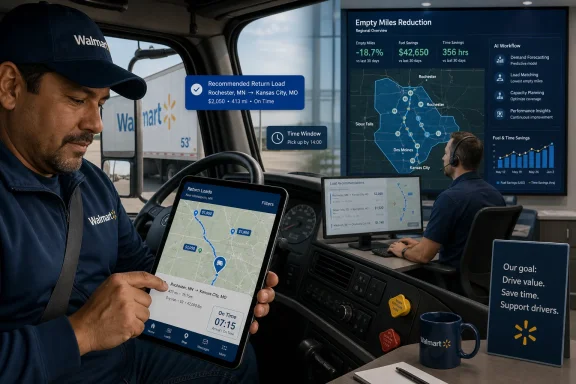
Garcia’s app reportedly searches a specific geographic area and surfaces five ideal loads a driver can pick up on the way home. That is not magic; it is structured decision support. The system is useful because it compresses the search space quickly enough to help a human make a better call while the real-world situation is still recoverable.
The example described by BGR is almost comically ordinary, which is why it is persuasive. A driver expected to pick up a load, only to learn it would not be ready for three hours. Instead of waiting around or heading home empty, the driver used Garcia’s tool to find another load five miles away that was ready and headed to the same destination.
There is no grand futurism in that sequence. There is a missed pickup, a nearby alternative, and a worker who gets home on time. That is exactly the sort of mundane friction that large enterprises spend billions failing to remove.
The Garcia story gives that strategy a proof point. It suggests that AI literacy can be useful even when the employee is not a professional developer. The app is described as a product of training, domain expertise, and what the industry now casually calls “vibe coding” — using AI-assisted tools to help build software without following the traditional path of formal software engineering.
That phrase deserves some caution. Vibe coding can produce brittle tools if companies mistake a working demo for production software. Logistics systems need reliability, access controls, audit trails, data quality, and integration with existing workflows. A clever internal app can quickly become a liability if it starts influencing transportation decisions without proper oversight.
But the better lesson is not that every employee should become an amateur app developer overnight. It is that employees closest to operational pain often know what to automate before headquarters does. AI lowers the cost of turning that knowledge into prototypes.
Garcia’s app is an unusually strong example for the optimistic camp because the immediate beneficiary is visible. The driver gets a better return option. The load manager gets a faster answer. The company reduces waste. The customer-facing supply chain becomes more resilient without obviously removing a job from the process.
That does not settle the larger argument. A tool that helps one dispatcher make better decisions could eventually let a company manage more freight with fewer planners. An app that reduces idle time could increase expectations for utilization. A system that begins as an assistive recommendation engine can become a performance yardstick.
The difference lies in governance. If AI tools are used to improve scheduling, reduce avoidable delays, and respect human constraints, employees may experience them as genuinely helpful. If those same tools become opaque scoring systems that punish workers for conditions outside their control, the trust evaporates.
That is why the “five ideal loads” detail is more important than it looks. AI does not need to invent a new logistics theory to be valuable here. It needs to surface a short, usable set of options quickly enough for a human operator to act. The best enterprise AI often looks less like a genius and more like a competent analyst who never gets tired of checking the board.
This also explains why transportation is fertile ground for employee-built tools. Drivers and load managers live with the exceptions: the late pickup, the wrong trailer, the load that is ready but invisible to the person who needs it, the trip home that should be simple but isn’t. Central planning systems are good at intended workflows. Workers are good at spotting the gaps between intended workflows and Tuesday afternoon.
The promise of AI in that setting is not that it replaces reality with automation. It is that it gives workers a faster way to interrogate reality.
Reducing empty miles is intuitively good. A truck traveling without useful freight consumes fuel and driver time while producing no equivalent logistics value. If an AI-assisted tool helps avoid that, it can reduce emissions and improve asset utilization.
But the environmental accounting is not automatic. AI systems run on infrastructure, and large-scale deployment can carry energy and water costs depending on where and how models are trained and served. A small internal routing app is unlikely to resemble the footprint of training a frontier model, but the larger corporate AI boom still depends on data centers, chips, cooling, and electricity.
The honest position is that both things can be true. AI can be wasteful at the infrastructure layer and waste-reducing at the operations layer. The test is whether the operational savings are real, measured, and durable — not merely used as a green halo around whatever a company wanted to deploy anyway.
A former driver knew why a three-hour delay mattered. A regional load manager knew where the decision bottleneck lived. The AI course supplied enough capability to build something useful, or at least useful enough to demonstrate the shape of a solution.
That is a very different model from the standard enterprise rollout. Instead of announcing a platform and searching for adoption, Walmart appears to have created a pathway where an employee could identify a problem and build around it. The company still has to decide whether such tools become official, supported, secure, and scalable. But the origin story is telling.
It suggests that AI adoption may work best when it is less like digital transformation and more like shop-floor process improvement. The tools are new, but the principle is old: give capable workers a way to fix the irritations they understand better than management does.
That does not mean companies should shut it down. It means they need a path from prototype to production. An AI-assisted app that helps drivers find loads should eventually pass through the same questions any operational system would face: Who owns it? What data does it access? How are recommendations logged? What happens when it is wrong? Can a human override it? Is it fair to drivers across regions and shifts?
For IT pros, this is the familiar problem of shadow IT wearing an AI badge. The old answer — block everything until central IT approves it — rarely survives contact with business urgency. The better answer is to provide sanctioned tools, secure sandboxes, review processes, and clear escalation paths for promising internal projects.
Garcia’s app sounds like the kind of project companies should encourage. But encouraging it responsibly means treating employee-built AI as software, not as a novelty.
For truck drivers, time is not an abstraction. Long-haul schedules affect family life, sleep, stress, retention, and safety. A tool that prevents an unnecessary wait or avoids a deadhead return can change the texture of a workweek.
That does not make the technology benevolent by default. The same data that helps protect a driver’s schedule could be used to squeeze it. The same optimization engine that finds a better backhaul could be tuned to maximize asset use at the expense of predictable rest. Technology reflects the incentive structure around it.
Still, “home on time” is the right target. If companies want employees to believe AI is for them rather than aimed at them, they need to optimize for outcomes workers can actually feel.
But the backlash will not disappear because a few examples are useful. Workers are not irrational for fearing AI. Many have watched previous waves of automation arrive with reassuring language and leave behind tighter monitoring, reduced staffing, or worse jobs with better dashboards.
That is why companies should resist the temptation to turn Garcia’s app into a simple public-relations mascot. The lesson is not “AI is good, actually.” The lesson is that AI becomes easier to defend when it is specific, accountable, and rooted in worker experience.
The public does not need another generic promise that AI will “unlock potential.” It needs examples where the unlocked potential is not just quarterly margin expansion.
That shift can be powerful. It can also be messy. The organizations that benefit will be the ones that create guardrails without smothering initiative. The organizations that suffer will either ban everything useful or let every department build fragile workflows no one can support.
This has direct implications for Microsoft shops. Windows endpoints, Microsoft 365 tenants, identity systems, data-loss-prevention policies, Power Platform environments, endpoint management, and security monitoring will all become part of the employee-AI story. The next “small app” may not come from the dev team. It may come from logistics, HR, finance, field service, or a store manager who learned just enough to automate a recurring pain point.
The question for IT is not whether this will happen. It is whether it will happen inside governed systems or in the browser tabs, personal accounts, and unmanaged automations workers reach for when official channels are too slow.
That is a lower bar than the industry usually sets for itself, and a better one. If AI cannot reliably solve practical, bounded, measurable problems, the bigger promises are just theater. If it can, the benefits will show up first in places like dispatch boards, maintenance queues, inventory exceptions, and support workflows.
The concrete lessons are refreshingly grounded:
 The Best AI Story at Walmart Starts in the Cab, Not the C-Suite
The striking thing about Garcia’s app is not that Walmart is using AI. Walmart has spent years describing itself as a technology company that happens to sell groceries, clothes, televisions, pharmacy items, and almost everything else. Its scale practically demands algorithmic help.What makes this example different is where the idea appears to have come from. Garcia was not parachuted in from a consulting firm to “AI-enable” transportation. He had been a Walmart truck driver himself for more than five years before becoming a regional load manager, according to Business Insider’s reporting.
That background matters. The problem he chose was not vague productivity. It was the painfully specific logistics headache known as empty miles — the miles a truck travels without a paying or useful load attached. For a driver, those miles can mean wasted time, delay, uncertainty, and a later trip home. For Walmart, they mean fuel, labor, equipment use, and opportunity cost.
This is why the story cuts through so much AI theater. The app was not pitched as a synthetic executive assistant, a chatbot with a mascot, or a way to replace a dispatch team wholesale. It helped answer a narrow operational question: when a planned pickup falls apart, is there another useful load nearby that gets the driver moving in the right direction?
“Empty Miles” Are the Kind of Boring Problem AI Was Built to Attack
A lot of public AI discussion focuses on spectacular use cases: writing code, generating video, replacing call-center scripts, summarizing inboxes, or building autonomous agents that promise to do everything short of making coffee. Logistics is less glamorous, but it is often where automation produces the cleanest returns. Trucks, routes, pickups, delivery windows, and driver schedules create a dense optimization problem that punishes slow decisions.Garcia’s app reportedly searches a specific geographic area and surfaces five ideal loads a driver can pick up on the way home. That is not magic; it is structured decision support. The system is useful because it compresses the search space quickly enough to help a human make a better call while the real-world situation is still recoverable.
The example described by BGR is almost comically ordinary, which is why it is persuasive. A driver expected to pick up a load, only to learn it would not be ready for three hours. Instead of waiting around or heading home empty, the driver used Garcia’s tool to find another load five miles away that was ready and headed to the same destination.
There is no grand futurism in that sequence. There is a missed pickup, a nearby alternative, and a worker who gets home on time. That is exactly the sort of mundane friction that large enterprises spend billions failing to remove.
Training Workers Is More Radical Than Buying Tools
Walmart’s broader AI strategy has been framed around giving employees access to training and tools rather than keeping AI sealed inside a central engineering organization. CIO Dive has reported that Walmart wants to equip its workforce with AI skills across roles, while Fortune has described its partnership with Google around AI certification for associates in the U.S. and Canada. Walmart has also publicly promoted AI-powered associate tools through its own corporate channels.The Garcia story gives that strategy a proof point. It suggests that AI literacy can be useful even when the employee is not a professional developer. The app is described as a product of training, domain expertise, and what the industry now casually calls “vibe coding” — using AI-assisted tools to help build software without following the traditional path of formal software engineering.
That phrase deserves some caution. Vibe coding can produce brittle tools if companies mistake a working demo for production software. Logistics systems need reliability, access controls, audit trails, data quality, and integration with existing workflows. A clever internal app can quickly become a liability if it starts influencing transportation decisions without proper oversight.
But the better lesson is not that every employee should become an amateur app developer overnight. It is that employees closest to operational pain often know what to automate before headquarters does. AI lowers the cost of turning that knowledge into prototypes.
The Worker-Friendly AI Narrative Has to Survive Contact With Payroll
This is also where the story gets politically interesting. Walmart, like every major employer, is trying to tell a version of the AI story that does not sound like a layoff memo written in innovation-speak. Executives across industries now insist AI will augment employees, reduce drudgery, and make work better. Workers have learned to listen for what comes after the word “efficiency.”Garcia’s app is an unusually strong example for the optimistic camp because the immediate beneficiary is visible. The driver gets a better return option. The load manager gets a faster answer. The company reduces waste. The customer-facing supply chain becomes more resilient without obviously removing a job from the process.
That does not settle the larger argument. A tool that helps one dispatcher make better decisions could eventually let a company manage more freight with fewer planners. An app that reduces idle time could increase expectations for utilization. A system that begins as an assistive recommendation engine can become a performance yardstick.
The difference lies in governance. If AI tools are used to improve scheduling, reduce avoidable delays, and respect human constraints, employees may experience them as genuinely helpful. If those same tools become opaque scoring systems that punish workers for conditions outside their control, the trust evaporates.
Walmart’s Logistics Scale Makes Small Wins Look Large
Walmart’s transportation network is the kind of environment where a small improvement can matter. The company moves enormous volumes of goods through a national web of suppliers, distribution centers, stores, clubs, and fulfillment operations. A single better decision is nice; thousands of better decisions compound.That is why the “five ideal loads” detail is more important than it looks. AI does not need to invent a new logistics theory to be valuable here. It needs to surface a short, usable set of options quickly enough for a human operator to act. The best enterprise AI often looks less like a genius and more like a competent analyst who never gets tired of checking the board.
This also explains why transportation is fertile ground for employee-built tools. Drivers and load managers live with the exceptions: the late pickup, the wrong trailer, the load that is ready but invisible to the person who needs it, the trip home that should be simple but isn’t. Central planning systems are good at intended workflows. Workers are good at spotting the gaps between intended workflows and Tuesday afternoon.
The promise of AI in that setting is not that it replaces reality with automation. It is that it gives workers a faster way to interrogate reality.
The Environmental Story Is More Complicated Than the Feel-Good Version
BGR frames Garcia’s project against the darker side of AI, including concerns about water use by data centers and job displacement. That contrast is fair, but it should not let any company off the hook. AI can reduce waste in one part of the economy while increasing resource demand somewhere else.Reducing empty miles is intuitively good. A truck traveling without useful freight consumes fuel and driver time while producing no equivalent logistics value. If an AI-assisted tool helps avoid that, it can reduce emissions and improve asset utilization.
But the environmental accounting is not automatic. AI systems run on infrastructure, and large-scale deployment can carry energy and water costs depending on where and how models are trained and served. A small internal routing app is unlikely to resemble the footprint of training a frontier model, but the larger corporate AI boom still depends on data centers, chips, cooling, and electricity.
The honest position is that both things can be true. AI can be wasteful at the infrastructure layer and waste-reducing at the operations layer. The test is whether the operational savings are real, measured, and durable — not merely used as a green halo around whatever a company wanted to deploy anyway.
The Real Innovation Is Letting the Front Line Name the Problem
Most enterprise software fails culturally before it fails technically. Tools arrive from above, ask workers to change habits, and solve a problem executives can describe but employees do not recognize. The Garcia example flips that sequence.A former driver knew why a three-hour delay mattered. A regional load manager knew where the decision bottleneck lived. The AI course supplied enough capability to build something useful, or at least useful enough to demonstrate the shape of a solution.
That is a very different model from the standard enterprise rollout. Instead of announcing a platform and searching for adoption, Walmart appears to have created a pathway where an employee could identify a problem and build around it. The company still has to decide whether such tools become official, supported, secure, and scalable. But the origin story is telling.
It suggests that AI adoption may work best when it is less like digital transformation and more like shop-floor process improvement. The tools are new, but the principle is old: give capable workers a way to fix the irritations they understand better than management does.
The Risk Is a Thousand Unmanaged Micro-Apps
There is a shadow side to employee-led AI development. If every department begins generating internal apps, workflows, scripts, and decision aids, companies can quickly create a hidden software estate. Some of it will be brilliant. Some of it will be insecure, duplicative, undocumented, or dependent on one person who eventually changes jobs.That does not mean companies should shut it down. It means they need a path from prototype to production. An AI-assisted app that helps drivers find loads should eventually pass through the same questions any operational system would face: Who owns it? What data does it access? How are recommendations logged? What happens when it is wrong? Can a human override it? Is it fair to drivers across regions and shifts?
For IT pros, this is the familiar problem of shadow IT wearing an AI badge. The old answer — block everything until central IT approves it — rarely survives contact with business urgency. The better answer is to provide sanctioned tools, secure sandboxes, review processes, and clear escalation paths for promising internal projects.
Garcia’s app sounds like the kind of project companies should encourage. But encouraging it responsibly means treating employee-built AI as software, not as a novelty.
“Getting Home On Time” Is a Better Metric Than “Productivity”
The phrase that makes this story work is not “AI app.” It is “home on time.” That is a human outcome, and it is more concrete than the usual enterprise language about productivity gains. Workers are right to distrust productivity talk when it usually means doing more with less.For truck drivers, time is not an abstraction. Long-haul schedules affect family life, sleep, stress, retention, and safety. A tool that prevents an unnecessary wait or avoids a deadhead return can change the texture of a workweek.
That does not make the technology benevolent by default. The same data that helps protect a driver’s schedule could be used to squeeze it. The same optimization engine that finds a better backhaul could be tuned to maximize asset use at the expense of predictable rest. Technology reflects the incentive structure around it.
Still, “home on time” is the right target. If companies want employees to believe AI is for them rather than aimed at them, they need to optimize for outcomes workers can actually feel.
The AI Backlash Will Not Be Beaten by Slogans
There is a reason positive AI stories like this travel. The public has absorbed months of headlines about job cuts, copyright fights, deepfakes, hallucinations, surveillance, data-center expansion, and executive overpromising. A practical tool that helps a truck driver avoid a pointless delay feels like evidence from another universe.But the backlash will not disappear because a few examples are useful. Workers are not irrational for fearing AI. Many have watched previous waves of automation arrive with reassuring language and leave behind tighter monitoring, reduced staffing, or worse jobs with better dashboards.
That is why companies should resist the temptation to turn Garcia’s app into a simple public-relations mascot. The lesson is not “AI is good, actually.” The lesson is that AI becomes easier to defend when it is specific, accountable, and rooted in worker experience.
The public does not need another generic promise that AI will “unlock potential.” It needs examples where the unlocked potential is not just quarterly margin expansion.
Where WindowsForum Readers Should Pay Attention
For IT administrators, developers, and technically minded managers, the Walmart story is not really about trucking. It is about the next wave of software creation inside large organizations. AI coding assistants and low-code tools are making it easier for non-engineers to build operational tools that used to require a ticket, a backlog, and a fiscal-year prioritization meeting.That shift can be powerful. It can also be messy. The organizations that benefit will be the ones that create guardrails without smothering initiative. The organizations that suffer will either ban everything useful or let every department build fragile workflows no one can support.
This has direct implications for Microsoft shops. Windows endpoints, Microsoft 365 tenants, identity systems, data-loss-prevention policies, Power Platform environments, endpoint management, and security monitoring will all become part of the employee-AI story. The next “small app” may not come from the dev team. It may come from logistics, HR, finance, field service, or a store manager who learned just enough to automate a recurring pain point.
The question for IT is not whether this will happen. It is whether it will happen inside governed systems or in the browser tabs, personal accounts, and unmanaged automations workers reach for when official channels are too slow.
The Garcia App Shows What AI Has to Prove Next
The Walmart example is useful precisely because it is narrow. It does not require anyone to believe in artificial general intelligence, autonomous companies, or a future where every employee has a synthetic coworker. It asks whether AI can help a knowledgeable worker make one better operational decision at the right moment.That is a lower bar than the industry usually sets for itself, and a better one. If AI cannot reliably solve practical, bounded, measurable problems, the bigger promises are just theater. If it can, the benefits will show up first in places like dispatch boards, maintenance queues, inventory exceptions, and support workflows.
The concrete lessons are refreshingly grounded:
- Walmart’s example shows that AI training is more credible when employees use it to solve problems they already understand from firsthand experience.
- Reducing empty miles is a practical logistics win because it can save time, fuel, equipment capacity, and driver frustration at the same time.
- Worker-friendly AI needs outcomes employees can feel, such as getting home on schedule, rather than abstract productivity claims.
- Employee-built AI tools need governance, security review, documentation, and a path to production before they become operational dependencies.
- The best enterprise AI projects will probably look small at first because they will target specific bottlenecks rather than attempt to reinvent entire jobs.
References
- Primary source: bgr.com
Published: Mon, 06 Jul 2026 13:47:00 GMT
Loading…
www.bgr.com - Related coverage: tech.yahoo.com
Loading…
tech.yahoo.com - Related coverage: aol.com
Loading…
www.aol.com - Related coverage: pluang.com
Loading…
pluang.com - Related coverage: corporate.walmart.com
Loading…
corporate.walmart.com - Related coverage: trendhunter.com
Loading…
www.trendhunter.com