

Hybrid cloud companies are driving enterprise IT growth in 2026 by giving organizations a practical operating model that spans public cloud, private infrastructure, edge sites, and regulated data environments without forcing every workload into a single destination. The market story is no longer “cloud versus data center.” It is about who controls the connective tissue between them. As SNS Insider frames it, hybrid cloud has become the architecture of compromise for enterprises that want AI, analytics, security, sovereignty, and cost discipline at the same time.
That compromise is now the center of the enterprise cloud business. The first cloud era rewarded migration; the current one rewards placement. Banks, hospitals, manufacturers, retailers, public agencies, and energy companies are not asking whether cloud is useful. They are asking where a workload should run, who governs it, how much latency it can tolerate, and whether an auditor will accept the answer.
The old cloud sales pitch assumed gravity worked in one direction: applications would move from corporate data centers into hyperscale platforms, and the enterprise estate would eventually simplify. That was always cleaner in slide decks than in reality. Legacy databases, mainframe-adjacent processes, industrial control systems, regulated records, latency-sensitive applications, and sunk investments in virtualization kept the data center alive.
Hybrid cloud won because it stopped treating that persistence as failure. It gave enterprises a way to modernize around reality rather than wait for a perfect migration window that might never arrive. In that sense, hybrid cloud is not a half-step to public cloud; it is the architecture that emerged when public cloud met enterprise constraints.
SNS Insider’s market estimate — valuing the hybrid cloud market at $133.27 billion in 2025 and projecting it to reach $653.45 billion by 2035 at a 17.31 percent compound annual growth rate — captures the scale of that shift. Forecasts should always be read as directional rather than prophetic, but the direction is hard to miss. Hybrid cloud is where cloud providers now fight for the workloads that matter most: regulated, persistent, operationally critical, and increasingly AI-driven.
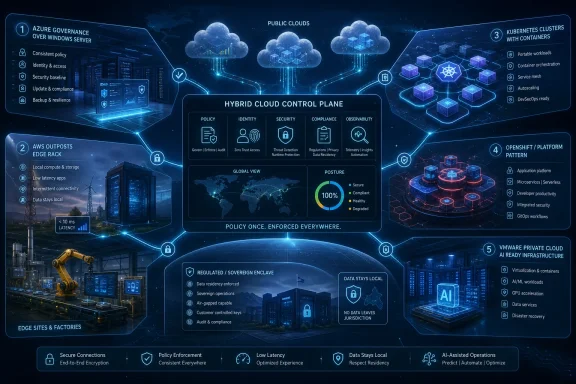
The most important change is that hybrid cloud is no longer sold primarily as a disaster recovery story. It is now sold as an operating model. The winning vendors are not merely offering a bridge between environments; they are trying to become the control plane for enterprise IT.
Azure Arc is the centerpiece of that strategy. Microsoft describes Arc as a way to manage servers, Kubernetes clusters, databases, and services across on-premises environments, edge locations, and other public clouds through Azure’s management plane. That positioning matters because it turns Azure from a destination into a governance layer. For administrators, the promise is not just “move to Azure,” but “use Azure to see and control what you already have.”
This is why Microsoft has been careful to tie Arc to security, policy, observability, and compliance rather than only to deployment. Azure Policy, Microsoft Defender for Cloud, Azure Monitor, update management, inventory, and extensions all become part of the hybrid pitch. In a world where enterprises are struggling with fragmentation, the vendor that can make scattered infrastructure look like a managed estate has leverage.
The WindowsForum audience should pay attention to the Windows Server angle in particular. Azure Arc-enabled servers can bring Azure-style management to Windows and Linux machines outside Azure, including physical servers and virtual machines in corporate data centers or other clouds. For shops with aging Windows Server footprints, Arc also plays into Microsoft’s Extended Security Updates strategy, which makes the cloud control plane relevant even when the workload itself remains on-premises.
At Ignite 2024, Microsoft pushed this idea further with Azure Local, a rebranding and expansion of its distributed infrastructure play. Microsoft presented Azure Local as cloud infrastructure for distributed locations, enabled by Azure Arc, aimed at edge sites, branch offices, factories, and regulated environments that cannot simply push everything to a public region. TechTarget described the offering as cloud-connected software for running Azure compute, networking, storage, and application services in edge or hybrid cloud environments.
The bigger strategic move is Microsoft’s phrase adaptive cloud. It is vendor language, but it is not empty vendor language. Microsoft is trying to define hybrid cloud as one consistent application, operations, and security model across Azure, on-premises systems, edge devices, and Kubernetes platforms. If Arc succeeds, Azure becomes less a place and more a layer.
That is also why Microsoft’s hybrid story is inseparable from AI. Enterprises want to use generative AI and machine learning against sensitive data, but they often cannot move that data freely. Microsoft’s answer is to bring Azure services, Azure AI patterns, Kubernetes operations, and governance closer to where the data lives. The company’s 2026 sovereign cloud messaging, including Azure Local Disconnected and local Microsoft 365 capabilities for controlled environments, reflects the same pressure: AI demand is rising fastest in places where data movement is most constrained.
Microsoft’s weakness is the flip side of its strength. Arc can become another management plane in an estate that already has too many. Licensing, service dependencies, Azure subscription design, identity integration, and governance models all require planning. But for enterprises already standardized on Microsoft, Azure Arc is one of the most credible attempts to make hybrid cloud feel less like a patchwork and more like a platform.
AWS Outposts remains the flagship expression of that strategy. It brings AWS-managed infrastructure into customer sites, allowing organizations to run selected AWS services on-premises while tying operations back to an AWS Region. For workloads that need local execution but still want AWS tooling, billing, support, and service consistency, Outposts is a powerful answer.
The Kubernetes story is equally important. Amazon EKS Anywhere and EKS on Outposts reflect how central Kubernetes has become to hybrid cloud design. AWS documentation emphasizes deployment options that span Regions, Local Zones, Wavelength Zones, Outposts, and on-premises infrastructure. The point is not just location flexibility; it is the ability to keep using familiar EKS patterns across different environments.
AWS is also strongest where hybrid cloud meets edge computing. Manufacturing plants, telecom deployments, retail sites, healthcare facilities, media pipelines, and logistics operations increasingly need compute near the point of data generation. AWS has spent years building a vocabulary of edge and distributed infrastructure: Outposts, Local Zones, Wavelength, Snow family devices, IoT services, and managed Kubernetes options. Not every enterprise needs every piece, but the portfolio is broad.
AWS’s challenge is that it remains culturally and architecturally centered on AWS. That is not a criticism so much as a design principle. AWS hybrid offerings are most compelling when the enterprise wants AWS everywhere. They are less naturally suited to organizations whose political or technical goal is symmetrical multi-cloud governance across Azure, Google Cloud, private VMware estates, and sovereign clouds.
For many customers, that is perfectly acceptable. The hybrid cloud market is not one market but several. Some enterprises want a neutral abstraction layer. Others want their preferred hyperscaler to follow them into the data center. AWS is built for the second camp, and that camp is large.
The cost conversation is more complicated. AWS hybrid infrastructure can solve latency and residency problems, but it does not magically simplify financial governance. Hardware commitments, data transfer patterns, regional dependencies, support models, and service availability all matter. The rise of FinOps has made this painfully clear: hybrid cloud is not cheaper by default. It is cheaper only when placement, utilization, and governance are disciplined.
Still, AWS remains one of the top hybrid cloud companies because it has something most rivals cannot match: the gravitational pull of the largest public cloud ecosystem. For enterprises already building heavily on AWS, hybrid offerings reduce the number of reasons to look elsewhere. That is exactly the point.
Google Distributed Cloud is the current umbrella for much of that thinking. Google describes it as a way to extend Google Cloud infrastructure and AI on-premises, with options for edge and air-gapped environments. The air-gapped option is particularly important for public sector, defense, financial services, and other regulated customers that need cloud-like capabilities without continuous connectivity or unrestricted data movement.
The former Anthos branding helped establish Google’s hybrid identity, even if the naming sometimes confused buyers. The underlying argument remains consistent: use Kubernetes and a common developer experience to modernize applications across cloud, on-premises, and edge. In a market where many enterprises fear lock-in, Google’s open-source-inflected pitch has obvious appeal.
Google also has a credible AI story for hybrid cloud. The company’s strength in data, analytics, and machine learning gives it a strong hand when customers want to run AI near governed data or at edge locations. Google Distributed Cloud’s positioning around AI, data security, and Kubernetes-based consistency is aimed directly at enterprises that want modern development patterns without surrendering locality.
But Google’s challenge is enterprise incumbency. Microsoft has the Windows and identity estate. AWS has the cloud infrastructure lead. IBM has Red Hat and consulting depth. Broadcom has the VMware installed base. Google often has to win by being architecturally persuasive rather than operationally inevitable.
That can be enough, especially in organizations that have already committed to Kubernetes as the common denominator. The more an enterprise sees Kubernetes as its portability layer, the more Google’s hybrid story resonates. The less mature its platform engineering function is, the harder that story can be to operationalize.
Google’s hybrid cloud role is therefore not simply “third hyperscaler.” It is the vendor pushing hardest on the idea that hybrid cloud should be cloud-native by design, not a set of managed appliances bolted to old infrastructure. That is an important argument, even for enterprises that ultimately choose a different platform.
OpenShift is the key. It gives IBM a way to talk about hybrid cloud that is not limited to IBM Cloud. Red Hat OpenShift can run on-premises, in public clouds, and in managed forms across different providers. That makes IBM’s pitch less about winning every workload into its own cloud and more about helping enterprises build a consistent application platform wherever workloads need to live.
That distinction matters in regulated and legacy-heavy industries. IBM’s customers often include banks, insurers, governments, healthcare organizations, and large industrial firms with complex histories. These are not greenfield cloud-native startups. They have mainframes, compliance teams, procurement constraints, and decades of application dependencies. IBM’s hybrid cloud message is built for that reality.
The AI layer is now being folded into the same argument. IBM’s watsonx portfolio and Red Hat AI offerings are increasingly presented as tools for bringing AI development and inference into hybrid environments. IBM’s 2026 announcements around Red Hat AI Inference and OpenShift Virtualization Service on IBM Cloud show how the company is tying AI, virtualization, and hybrid operations together.
OpenShift Virtualization is particularly worth watching. Broadcom’s VMware changes have made many enterprises re-examine virtualization strategy, even if most are not ready to abandon VMware overnight. Red Hat’s ability to run virtual machines and containers under a Kubernetes-oriented platform gives IBM a timely opening. It lets customers talk about modernization without pretending every workload can be refactored immediately.
IBM’s advantage is that it understands enterprise inertia. Its disadvantage is that it sometimes appears less central to the developer imagination than AWS, Azure, or Google Cloud. Hybrid cloud buyers, however, are not only developers. They are CIOs, infrastructure leaders, risk officers, platform teams, and procurement committees trying to reduce architectural chaos.
That is where IBM remains formidable. The company sells not just technology but transformation machinery: consulting, integration, support, governance, and industry-specific expertise. In hybrid cloud, that machinery still matters because the hard part is rarely installing Kubernetes. The hard part is changing how a large organization builds, secures, funds, audits, and operates software across many environments.
Broadcom’s strategy has been to concentrate VMware around VMware Cloud Foundation. In June 2025, Broadcom announced the general availability of VMware Cloud Foundation 9.0, positioning it as a modern private cloud platform spanning data centers, edge environments, managed cloud infrastructure, service providers, and hyperscalers. In 2026, Broadcom followed with VMware Cloud Foundation 9.1, emphasizing secure and cost-effective infrastructure for production AI.
The pitch is blunt: private cloud is not dead; it is where serious enterprise AI, sovereignty, security, and cost control will often live. Broadcom argues that VCF can combine public-cloud-like agility with the control and economics of on-premises infrastructure. That message lands with organizations worried about runaway public cloud bills, sensitive data, GPU utilization, and regulatory exposure.
VMware Private AI Foundation with NVIDIA and related private AI services are central to this repositioning. Enterprises want to run AI models near sensitive data, and many do not want every prompt, embedding, document, or inference path traveling through a public cloud service. VMware’s installed base gives Broadcom a route to those workloads, especially in companies already comfortable running mission-critical systems on VMware infrastructure.
But Broadcom’s VMware era has also created real customer anxiety. Reporting from outlets such as TechRadar and ITPro has described partner disruption, licensing changes, and cloud service provider unease following Broadcom’s acquisition. European cloud provider groups have been especially vocal about the effects on VMware partners and customer choice. Broadcom argues that its changes simplify the portfolio and focus investment, but many customers have experienced the transition as expensive and disruptive.
That tension defines VMware’s hybrid cloud position in 2026. Technically, VMware Cloud Foundation is one of the most important private cloud platforms in the market. Commercially, Broadcom has given customers reasons to evaluate alternatives. Both statements are true.
For enterprises, the practical question is not whether VMware still matters. It does. The question is whether VMware remains the default private cloud layer or becomes one strategic option among several. Red Hat, Nutanix, Azure Local, public-cloud edge appliances, and bare-metal Kubernetes platforms all benefit from any uncertainty around VMware licensing and partner strategy.
Still, Broadcom has one asset rivals would love to own: the enterprise virtualization footprint. If VCF becomes the standard landing zone for private AI and regulated workloads, Broadcom will have turned a mature infrastructure business into a renewed hybrid cloud growth engine. If customers conclude that the commercial risk outweighs the technical continuity, VMware’s dominance will erode gradually rather than suddenly.
What unites them is the battle for the control plane. Whoever controls identity, policy, deployment, observability, security posture, cost reporting, and lifecycle management becomes the strategic vendor. Compute location matters, but management location may matter more.
This is why hybrid cloud is not merely an infrastructure procurement category. It determines how enterprises organize IT. A company that standardizes on Azure Arc will make different staffing, monitoring, and compliance decisions than one that standardizes on OpenShift or VCF. A company that goes deep on AWS Outposts will accept a different operational model than one pursuing multi-cloud neutrality.
The rise of Kubernetes did not eliminate this battle. It intensified it. Kubernetes gives enterprises a common application substrate, but it does not solve identity, secrets, networking, storage, backup, policy, vulnerability management, software supply chain security, or cost allocation by itself. Vendors compete by filling those gaps, and each gap becomes a point of strategic dependence.
FinOps adds another layer. Hybrid cloud was once sold partly as a way to avoid overcommitting to public cloud. But distributed infrastructure can make cost visibility harder, not easier. Enterprises now need to understand not only cloud consumption but also private infrastructure depreciation, software subscriptions, managed service fees, network costs, GPU utilization, and labor overhead.
That is why the most successful hybrid cloud programs tend to be governed like product platforms, not infrastructure projects. They define supported patterns, approved landing zones, identity models, observability standards, security baselines, and cost accountability. Without that discipline, hybrid cloud becomes a polite name for sprawl.
Data location is now a strategic question. If an AI system needs access to medical records, trading data, defense information, manufacturing telemetry, or customer support archives, the organization must decide where inference happens, where training or fine-tuning occurs, where logs are stored, and who can inspect the pipeline. Public cloud AI services are powerful, but they are not always acceptable for every dataset or jurisdiction.
That is why every major hybrid cloud vendor now talks about sovereign cloud, private AI, edge AI, or regulated AI. Microsoft has Azure Local and sovereign cloud initiatives. Google has Distributed Cloud with air-gapped options. IBM has watsonx and Red Hat AI across hybrid environments. Broadcom has VMware Private AI Foundation. AWS has its own distributed infrastructure and edge portfolio for customers that want AWS services closer to controlled data.
The result is a reversal of a decade-old assumption. For years, enterprises moved data to cloud services to access advanced capabilities. Increasingly, vendors are trying to move capabilities to the data. That is the essence of the new hybrid cloud market.
This does not mean public cloud loses. In many cases, public cloud remains the best place to train, experiment, scale, and integrate. But production AI will often be split across environments. Sensitive data may stay local, model services may run in a controlled private cloud, analytics may burst into public cloud, and edge devices may perform low-latency inference before forwarding selected data upstream.
That architecture is complicated. It is also exactly the kind of complexity large enterprises are willing to pay vendors to tame.
Microsoft’s advantage in this audience is obvious. Azure Arc, Defender for Cloud, Windows Server management, Azure Monitor, Entra integration, and Extended Security Updates create a natural path for Windows administrators to extend cloud governance over familiar systems. If the organization is already invested in Microsoft 365 and Azure, the administrative learning curve is real but logical.
But Windows shops should not assume Microsoft is the only relevant player. VMware remains central in many Windows Server estates. AWS hosts a large amount of Windows workload migration. Google Cloud has made progress with enterprise workloads and Kubernetes-based modernization. IBM and Red Hat matter where Windows workloads coexist with Linux, mainframe, Java, and container platforms.
The real operational question is where the organization wants standardization. Standardizing on Microsoft security and governance is different from standardizing on Kubernetes portability. Standardizing on VMware private cloud is different from standardizing on hyperscaler-native services. Each choice reduces some complexity while increasing dependency somewhere else.
Administrators should also watch the virtualization transition carefully. Many enterprises have years of tooling built around VMware. Broadcom’s changes have encouraged some organizations to evaluate alternatives, but migration is not trivial. Moving a virtualization estate is not like changing a SaaS subscription; it affects backup, networking, storage, templates, monitoring, automation, licensing, skills, and disaster recovery.
For IT pros, hybrid cloud growth means the job is becoming less about managing a single environment and more about managing consistency across many. PowerShell, Azure CLI, Terraform, Ansible, Kubernetes tooling, policy-as-code, identity governance, and observability platforms are no longer specialist extras. They are becoming the ordinary language of enterprise operations.
AWS solves the fear of leaving the dominant cloud operating model. Its hybrid story says customers can keep using AWS patterns even when workloads need to sit on-premises, at the edge, or near users. That resonates with cloud-native teams and enterprises already committed to AWS services.
Google solves the fear of proprietary stagnation. Its hybrid story says Kubernetes, open platforms, and distributed cloud infrastructure can give enterprises consistency without reducing every decision to one provider’s stack. That resonates with platform teams that prize portability and modern application design.
IBM and Red Hat solve the fear of transformation without a bridge. Their hybrid story says enterprises can modernize incrementally across old and new systems using OpenShift, automation, consulting, and industry knowledge. That resonates with complex organizations whose hardest problems are organizational as much as technical.
Broadcom’s VMware solves the fear of losing control. Its hybrid story says private cloud can still deliver agility, AI readiness, sovereignty, and cost discipline on infrastructure the enterprise controls. That resonates with organizations that trust VMware technically, even if they are rethinking the commercial relationship.
The market is large enough for all five because enterprise fear is not uniform. A hospital, a bank, a defense contractor, a retailer, and a software company may all say “hybrid cloud,” but they often mean different risk models. The best vendor is the one aligned with the risk the organization is actually trying to reduce.
That sounds obvious, but enterprise IT has spent years turning placement into ideology. Cloud-first became cloud-only in some organizations. Data center skepticism became cloud resistance in others. The strongest hybrid cloud strategies reject both extremes.
A mature hybrid cloud program treats public cloud, private cloud, edge, and on-premises infrastructure as placement options inside one governed portfolio. It does not give every team unlimited freedom to improvise. It creates paved roads, then measures whether those roads deliver.
This is where the top vendors will be judged over the next decade. Not by how many services they list, but by how consistently they can enforce policy, identity, security, observability, automation, and cost control across environments. Hybrid cloud is not won by having the most boxes on an architecture diagram. It is won by making the diagram operable.
That is also where customers should be skeptical of marketing. “Unified” often means unified only inside a vendor’s preferred world. “Open” often still comes with commercial dependencies. “Cloud-like” does not always mean elastic, automated, or cheap. “Sovereign” can mean anything from strict local control to a lightly modified regional hosting arrangement.
The practical enterprise buyer should press vendors on failure modes. What happens when the connection to the public region drops? How are policies enforced locally? Can workloads move without rewriting identity and networking? How are logs retained? Who patches the stack? What happens to licensing if the architecture changes? Can cost be allocated by application, team, and environment?
The hybrid cloud market is growing because these questions are hard. The vendors that answer them plainly will earn more trust than those that hide complexity behind diagrams.
That combination explains why hybrid cloud has become commercially attractive again. It is not nostalgia for the data center. It is recognition that enterprise computing is becoming more distributed, not less. Edge sites, sovereign clouds, private AI clusters, public cloud regions, SaaS platforms, and traditional systems all have roles to play.
For Microsoft, the opportunity is to make Azure Arc and Azure Local the connective tissue for enterprises already living in the Microsoft ecosystem. For AWS, it is to extend AWS’s operating model wherever customers need it. For Google, it is to turn Kubernetes and distributed cloud into the cleanest path to modern applications. For IBM and Red Hat, it is to help conservative enterprises modernize without pretending legacy constraints do not exist. For Broadcom, it is to prove VMware Cloud Foundation can remain the private cloud standard in a more skeptical market.
The winners will not necessarily be the vendors with the purest architecture. They will be the vendors that enterprises trust to operate through audits, outages, budget reviews, acquisitions, AI experiments, and platform migrations. Hybrid cloud is not bought once. It is lived with.
That compromise is now the center of the enterprise cloud business. The first cloud era rewarded migration; the current one rewards placement. Banks, hospitals, manufacturers, retailers, public agencies, and energy companies are not asking whether cloud is useful. They are asking where a workload should run, who governs it, how much latency it can tolerate, and whether an auditor will accept the answer.
 Hybrid Cloud Has Become the Default, Not the Detour
The old cloud sales pitch assumed gravity worked in one direction: applications would move from corporate data centers into hyperscale platforms, and the enterprise estate would eventually simplify. That was always cleaner in slide decks than in reality. Legacy databases, mainframe-adjacent processes, industrial control systems, regulated records, latency-sensitive applications, and sunk investments in virtualization kept the data center alive.Hybrid cloud won because it stopped treating that persistence as failure. It gave enterprises a way to modernize around reality rather than wait for a perfect migration window that might never arrive. In that sense, hybrid cloud is not a half-step to public cloud; it is the architecture that emerged when public cloud met enterprise constraints.
SNS Insider’s market estimate — valuing the hybrid cloud market at $133.27 billion in 2025 and projecting it to reach $653.45 billion by 2035 at a 17.31 percent compound annual growth rate — captures the scale of that shift. Forecasts should always be read as directional rather than prophetic, but the direction is hard to miss. Hybrid cloud is where cloud providers now fight for the workloads that matter most: regulated, persistent, operationally critical, and increasingly AI-driven.
The most important change is that hybrid cloud is no longer sold primarily as a disaster recovery story. It is now sold as an operating model. The winning vendors are not merely offering a bridge between environments; they are trying to become the control plane for enterprise IT.
Microsoft Turns Azure Arc Into the Management Layer for the Messy Enterprise
Microsoft’s hybrid cloud advantage starts with a simple fact: many enterprises already run Microsoft deep in the stack. Windows Server, Active Directory, SQL Server, Microsoft 365, Defender, Intune, Entra, and System Center have shaped enterprise administration for decades. Azure did not have to replace that world to matter; it had to govern it.Azure Arc is the centerpiece of that strategy. Microsoft describes Arc as a way to manage servers, Kubernetes clusters, databases, and services across on-premises environments, edge locations, and other public clouds through Azure’s management plane. That positioning matters because it turns Azure from a destination into a governance layer. For administrators, the promise is not just “move to Azure,” but “use Azure to see and control what you already have.”
This is why Microsoft has been careful to tie Arc to security, policy, observability, and compliance rather than only to deployment. Azure Policy, Microsoft Defender for Cloud, Azure Monitor, update management, inventory, and extensions all become part of the hybrid pitch. In a world where enterprises are struggling with fragmentation, the vendor that can make scattered infrastructure look like a managed estate has leverage.
The WindowsForum audience should pay attention to the Windows Server angle in particular. Azure Arc-enabled servers can bring Azure-style management to Windows and Linux machines outside Azure, including physical servers and virtual machines in corporate data centers or other clouds. For shops with aging Windows Server footprints, Arc also plays into Microsoft’s Extended Security Updates strategy, which makes the cloud control plane relevant even when the workload itself remains on-premises.
At Ignite 2024, Microsoft pushed this idea further with Azure Local, a rebranding and expansion of its distributed infrastructure play. Microsoft presented Azure Local as cloud infrastructure for distributed locations, enabled by Azure Arc, aimed at edge sites, branch offices, factories, and regulated environments that cannot simply push everything to a public region. TechTarget described the offering as cloud-connected software for running Azure compute, networking, storage, and application services in edge or hybrid cloud environments.
The bigger strategic move is Microsoft’s phrase adaptive cloud. It is vendor language, but it is not empty vendor language. Microsoft is trying to define hybrid cloud as one consistent application, operations, and security model across Azure, on-premises systems, edge devices, and Kubernetes platforms. If Arc succeeds, Azure becomes less a place and more a layer.
That is also why Microsoft’s hybrid story is inseparable from AI. Enterprises want to use generative AI and machine learning against sensitive data, but they often cannot move that data freely. Microsoft’s answer is to bring Azure services, Azure AI patterns, Kubernetes operations, and governance closer to where the data lives. The company’s 2026 sovereign cloud messaging, including Azure Local Disconnected and local Microsoft 365 capabilities for controlled environments, reflects the same pressure: AI demand is rising fastest in places where data movement is most constrained.
Microsoft’s weakness is the flip side of its strength. Arc can become another management plane in an estate that already has too many. Licensing, service dependencies, Azure subscription design, identity integration, and governance models all require planning. But for enterprises already standardized on Microsoft, Azure Arc is one of the most credible attempts to make hybrid cloud feel less like a patchwork and more like a platform.
Amazon Web Services Extends the Cloud Without Letting Go of the Region
AWS approaches hybrid cloud from a different philosophical starting point. Microsoft often begins with the installed enterprise base; AWS begins with the public cloud operating model. The question AWS asks is not how to preserve the data center, but how to extend AWS infrastructure, APIs, and services closer to customers when latency, residency, or local processing demands require it.AWS Outposts remains the flagship expression of that strategy. It brings AWS-managed infrastructure into customer sites, allowing organizations to run selected AWS services on-premises while tying operations back to an AWS Region. For workloads that need local execution but still want AWS tooling, billing, support, and service consistency, Outposts is a powerful answer.
The Kubernetes story is equally important. Amazon EKS Anywhere and EKS on Outposts reflect how central Kubernetes has become to hybrid cloud design. AWS documentation emphasizes deployment options that span Regions, Local Zones, Wavelength Zones, Outposts, and on-premises infrastructure. The point is not just location flexibility; it is the ability to keep using familiar EKS patterns across different environments.
AWS is also strongest where hybrid cloud meets edge computing. Manufacturing plants, telecom deployments, retail sites, healthcare facilities, media pipelines, and logistics operations increasingly need compute near the point of data generation. AWS has spent years building a vocabulary of edge and distributed infrastructure: Outposts, Local Zones, Wavelength, Snow family devices, IoT services, and managed Kubernetes options. Not every enterprise needs every piece, but the portfolio is broad.
AWS’s challenge is that it remains culturally and architecturally centered on AWS. That is not a criticism so much as a design principle. AWS hybrid offerings are most compelling when the enterprise wants AWS everywhere. They are less naturally suited to organizations whose political or technical goal is symmetrical multi-cloud governance across Azure, Google Cloud, private VMware estates, and sovereign clouds.
For many customers, that is perfectly acceptable. The hybrid cloud market is not one market but several. Some enterprises want a neutral abstraction layer. Others want their preferred hyperscaler to follow them into the data center. AWS is built for the second camp, and that camp is large.
The cost conversation is more complicated. AWS hybrid infrastructure can solve latency and residency problems, but it does not magically simplify financial governance. Hardware commitments, data transfer patterns, regional dependencies, support models, and service availability all matter. The rise of FinOps has made this painfully clear: hybrid cloud is not cheaper by default. It is cheaper only when placement, utilization, and governance are disciplined.
Still, AWS remains one of the top hybrid cloud companies because it has something most rivals cannot match: the gravitational pull of the largest public cloud ecosystem. For enterprises already building heavily on AWS, hybrid offerings reduce the number of reasons to look elsewhere. That is exactly the point.
Google Makes Kubernetes the Center of Gravity
Google’s hybrid cloud strategy has always leaned on a different claim: the future should be open, containerized, and Kubernetes-native. That makes sense. Google helped create Kubernetes, and Google Cloud has repeatedly used that heritage to argue that enterprise modernization should not be trapped inside one provider’s proprietary control plane.Google Distributed Cloud is the current umbrella for much of that thinking. Google describes it as a way to extend Google Cloud infrastructure and AI on-premises, with options for edge and air-gapped environments. The air-gapped option is particularly important for public sector, defense, financial services, and other regulated customers that need cloud-like capabilities without continuous connectivity or unrestricted data movement.
The former Anthos branding helped establish Google’s hybrid identity, even if the naming sometimes confused buyers. The underlying argument remains consistent: use Kubernetes and a common developer experience to modernize applications across cloud, on-premises, and edge. In a market where many enterprises fear lock-in, Google’s open-source-inflected pitch has obvious appeal.
Google also has a credible AI story for hybrid cloud. The company’s strength in data, analytics, and machine learning gives it a strong hand when customers want to run AI near governed data or at edge locations. Google Distributed Cloud’s positioning around AI, data security, and Kubernetes-based consistency is aimed directly at enterprises that want modern development patterns without surrendering locality.
But Google’s challenge is enterprise incumbency. Microsoft has the Windows and identity estate. AWS has the cloud infrastructure lead. IBM has Red Hat and consulting depth. Broadcom has the VMware installed base. Google often has to win by being architecturally persuasive rather than operationally inevitable.
That can be enough, especially in organizations that have already committed to Kubernetes as the common denominator. The more an enterprise sees Kubernetes as its portability layer, the more Google’s hybrid story resonates. The less mature its platform engineering function is, the harder that story can be to operationalize.
Google’s hybrid cloud role is therefore not simply “third hyperscaler.” It is the vendor pushing hardest on the idea that hybrid cloud should be cloud-native by design, not a set of managed appliances bolted to old infrastructure. That is an important argument, even for enterprises that ultimately choose a different platform.
IBM and Red Hat Sell Hybrid Cloud as an Operating Philosophy
IBM has spent years telling the market that hybrid cloud is its strategic center. That message became much more credible after IBM acquired Red Hat. Without Red Hat, IBM’s hybrid story risked sounding like a services-led response to hyperscaler growth. With Red Hat OpenShift, IBM gained a platform that many enterprises already viewed as a serious foundation for containerized workloads across environments.OpenShift is the key. It gives IBM a way to talk about hybrid cloud that is not limited to IBM Cloud. Red Hat OpenShift can run on-premises, in public clouds, and in managed forms across different providers. That makes IBM’s pitch less about winning every workload into its own cloud and more about helping enterprises build a consistent application platform wherever workloads need to live.
That distinction matters in regulated and legacy-heavy industries. IBM’s customers often include banks, insurers, governments, healthcare organizations, and large industrial firms with complex histories. These are not greenfield cloud-native startups. They have mainframes, compliance teams, procurement constraints, and decades of application dependencies. IBM’s hybrid cloud message is built for that reality.
The AI layer is now being folded into the same argument. IBM’s watsonx portfolio and Red Hat AI offerings are increasingly presented as tools for bringing AI development and inference into hybrid environments. IBM’s 2026 announcements around Red Hat AI Inference and OpenShift Virtualization Service on IBM Cloud show how the company is tying AI, virtualization, and hybrid operations together.
OpenShift Virtualization is particularly worth watching. Broadcom’s VMware changes have made many enterprises re-examine virtualization strategy, even if most are not ready to abandon VMware overnight. Red Hat’s ability to run virtual machines and containers under a Kubernetes-oriented platform gives IBM a timely opening. It lets customers talk about modernization without pretending every workload can be refactored immediately.
IBM’s advantage is that it understands enterprise inertia. Its disadvantage is that it sometimes appears less central to the developer imagination than AWS, Azure, or Google Cloud. Hybrid cloud buyers, however, are not only developers. They are CIOs, infrastructure leaders, risk officers, platform teams, and procurement committees trying to reduce architectural chaos.
That is where IBM remains formidable. The company sells not just technology but transformation machinery: consulting, integration, support, governance, and industry-specific expertise. In hybrid cloud, that machinery still matters because the hard part is rarely installing Kubernetes. The hard part is changing how a large organization builds, secures, funds, audits, and operates software across many environments.
Broadcom’s VMware Bet Makes Private Cloud Strategic Again
No hybrid cloud discussion can ignore VMware, even after Broadcom’s acquisition turned the VMware ecosystem into one of the industry’s most controversial stories. VMware remains deeply embedded in enterprise data centers. For many organizations, “private cloud” still means vSphere, vSAN, NSX, and the operational habits built around them.Broadcom’s strategy has been to concentrate VMware around VMware Cloud Foundation. In June 2025, Broadcom announced the general availability of VMware Cloud Foundation 9.0, positioning it as a modern private cloud platform spanning data centers, edge environments, managed cloud infrastructure, service providers, and hyperscalers. In 2026, Broadcom followed with VMware Cloud Foundation 9.1, emphasizing secure and cost-effective infrastructure for production AI.
The pitch is blunt: private cloud is not dead; it is where serious enterprise AI, sovereignty, security, and cost control will often live. Broadcom argues that VCF can combine public-cloud-like agility with the control and economics of on-premises infrastructure. That message lands with organizations worried about runaway public cloud bills, sensitive data, GPU utilization, and regulatory exposure.
VMware Private AI Foundation with NVIDIA and related private AI services are central to this repositioning. Enterprises want to run AI models near sensitive data, and many do not want every prompt, embedding, document, or inference path traveling through a public cloud service. VMware’s installed base gives Broadcom a route to those workloads, especially in companies already comfortable running mission-critical systems on VMware infrastructure.
But Broadcom’s VMware era has also created real customer anxiety. Reporting from outlets such as TechRadar and ITPro has described partner disruption, licensing changes, and cloud service provider unease following Broadcom’s acquisition. European cloud provider groups have been especially vocal about the effects on VMware partners and customer choice. Broadcom argues that its changes simplify the portfolio and focus investment, but many customers have experienced the transition as expensive and disruptive.
That tension defines VMware’s hybrid cloud position in 2026. Technically, VMware Cloud Foundation is one of the most important private cloud platforms in the market. Commercially, Broadcom has given customers reasons to evaluate alternatives. Both statements are true.
For enterprises, the practical question is not whether VMware still matters. It does. The question is whether VMware remains the default private cloud layer or becomes one strategic option among several. Red Hat, Nutanix, Azure Local, public-cloud edge appliances, and bare-metal Kubernetes platforms all benefit from any uncertainty around VMware licensing and partner strategy.
Still, Broadcom has one asset rivals would love to own: the enterprise virtualization footprint. If VCF becomes the standard landing zone for private AI and regulated workloads, Broadcom will have turned a mature infrastructure business into a renewed hybrid cloud growth engine. If customers conclude that the commercial risk outweighs the technical continuity, VMware’s dominance will erode gradually rather than suddenly.
The Market Is Really About Control Planes
The phrase “hybrid cloud company” can be misleading because the leading vendors are not all selling the same thing. Microsoft sells a management and governance extension of Azure. AWS sells AWS infrastructure and services beyond the region. Google sells Kubernetes-centered consistency. IBM sells OpenShift-backed enterprise transformation. Broadcom sells private cloud continuity and control through VMware Cloud Foundation.What unites them is the battle for the control plane. Whoever controls identity, policy, deployment, observability, security posture, cost reporting, and lifecycle management becomes the strategic vendor. Compute location matters, but management location may matter more.
This is why hybrid cloud is not merely an infrastructure procurement category. It determines how enterprises organize IT. A company that standardizes on Azure Arc will make different staffing, monitoring, and compliance decisions than one that standardizes on OpenShift or VCF. A company that goes deep on AWS Outposts will accept a different operational model than one pursuing multi-cloud neutrality.
The rise of Kubernetes did not eliminate this battle. It intensified it. Kubernetes gives enterprises a common application substrate, but it does not solve identity, secrets, networking, storage, backup, policy, vulnerability management, software supply chain security, or cost allocation by itself. Vendors compete by filling those gaps, and each gap becomes a point of strategic dependence.
FinOps adds another layer. Hybrid cloud was once sold partly as a way to avoid overcommitting to public cloud. But distributed infrastructure can make cost visibility harder, not easier. Enterprises now need to understand not only cloud consumption but also private infrastructure depreciation, software subscriptions, managed service fees, network costs, GPU utilization, and labor overhead.
That is why the most successful hybrid cloud programs tend to be governed like product platforms, not infrastructure projects. They define supported patterns, approved landing zones, identity models, observability standards, security baselines, and cost accountability. Without that discipline, hybrid cloud becomes a polite name for sprawl.
AI Has Made Data Location a Board-Level Issue
The sudden acceleration of enterprise AI has changed the hybrid cloud conversation more than any single product release. AI workloads are hungry for data, compute, governance, and trust. They expose weaknesses in architecture that enterprises could previously tolerate.Data location is now a strategic question. If an AI system needs access to medical records, trading data, defense information, manufacturing telemetry, or customer support archives, the organization must decide where inference happens, where training or fine-tuning occurs, where logs are stored, and who can inspect the pipeline. Public cloud AI services are powerful, but they are not always acceptable for every dataset or jurisdiction.
That is why every major hybrid cloud vendor now talks about sovereign cloud, private AI, edge AI, or regulated AI. Microsoft has Azure Local and sovereign cloud initiatives. Google has Distributed Cloud with air-gapped options. IBM has watsonx and Red Hat AI across hybrid environments. Broadcom has VMware Private AI Foundation. AWS has its own distributed infrastructure and edge portfolio for customers that want AWS services closer to controlled data.
The result is a reversal of a decade-old assumption. For years, enterprises moved data to cloud services to access advanced capabilities. Increasingly, vendors are trying to move capabilities to the data. That is the essence of the new hybrid cloud market.
This does not mean public cloud loses. In many cases, public cloud remains the best place to train, experiment, scale, and integrate. But production AI will often be split across environments. Sensitive data may stay local, model services may run in a controlled private cloud, analytics may burst into public cloud, and edge devices may perform low-latency inference before forwarding selected data upstream.
That architecture is complicated. It is also exactly the kind of complexity large enterprises are willing to pay vendors to tame.
Windows Shops Should Read Hybrid Cloud as an Operations Story
For Windows-heavy organizations, hybrid cloud can sound like a cloud architect’s abstraction until it touches patching, identity, endpoint security, SQL Server, file services, backup, and compliance. Then it becomes very concrete. The hybrid cloud vendor decision affects daily administration.Microsoft’s advantage in this audience is obvious. Azure Arc, Defender for Cloud, Windows Server management, Azure Monitor, Entra integration, and Extended Security Updates create a natural path for Windows administrators to extend cloud governance over familiar systems. If the organization is already invested in Microsoft 365 and Azure, the administrative learning curve is real but logical.
But Windows shops should not assume Microsoft is the only relevant player. VMware remains central in many Windows Server estates. AWS hosts a large amount of Windows workload migration. Google Cloud has made progress with enterprise workloads and Kubernetes-based modernization. IBM and Red Hat matter where Windows workloads coexist with Linux, mainframe, Java, and container platforms.
The real operational question is where the organization wants standardization. Standardizing on Microsoft security and governance is different from standardizing on Kubernetes portability. Standardizing on VMware private cloud is different from standardizing on hyperscaler-native services. Each choice reduces some complexity while increasing dependency somewhere else.
Administrators should also watch the virtualization transition carefully. Many enterprises have years of tooling built around VMware. Broadcom’s changes have encouraged some organizations to evaluate alternatives, but migration is not trivial. Moving a virtualization estate is not like changing a SaaS subscription; it affects backup, networking, storage, templates, monitoring, automation, licensing, skills, and disaster recovery.
For IT pros, hybrid cloud growth means the job is becoming less about managing a single environment and more about managing consistency across many. PowerShell, Azure CLI, Terraform, Ansible, Kubernetes tooling, policy-as-code, identity governance, and observability platforms are no longer specialist extras. They are becoming the ordinary language of enterprise operations.
The Five Leaders Are Powerful Because They Solve Different Fears
Microsoft solves the fear of unmanaged sprawl. Its hybrid story says Azure can govern what the enterprise already runs, from Windows Server to Kubernetes to edge infrastructure. That resonates with organizations trying to impose order without rewriting their entire estate.AWS solves the fear of leaving the dominant cloud operating model. Its hybrid story says customers can keep using AWS patterns even when workloads need to sit on-premises, at the edge, or near users. That resonates with cloud-native teams and enterprises already committed to AWS services.
Google solves the fear of proprietary stagnation. Its hybrid story says Kubernetes, open platforms, and distributed cloud infrastructure can give enterprises consistency without reducing every decision to one provider’s stack. That resonates with platform teams that prize portability and modern application design.
IBM and Red Hat solve the fear of transformation without a bridge. Their hybrid story says enterprises can modernize incrementally across old and new systems using OpenShift, automation, consulting, and industry knowledge. That resonates with complex organizations whose hardest problems are organizational as much as technical.
Broadcom’s VMware solves the fear of losing control. Its hybrid story says private cloud can still deliver agility, AI readiness, sovereignty, and cost discipline on infrastructure the enterprise controls. That resonates with organizations that trust VMware technically, even if they are rethinking the commercial relationship.
The market is large enough for all five because enterprise fear is not uniform. A hospital, a bank, a defense contractor, a retailer, and a software company may all say “hybrid cloud,” but they often mean different risk models. The best vendor is the one aligned with the risk the organization is actually trying to reduce.
The Winners Will Be the Vendors That Make Placement Boring
Hybrid cloud is maturing when workload placement stops being a religious argument. The question should not be whether public cloud is better than private cloud, or whether Kubernetes is purer than managed services. The question should be where a workload best satisfies performance, cost, security, compliance, resilience, and developer velocity.That sounds obvious, but enterprise IT has spent years turning placement into ideology. Cloud-first became cloud-only in some organizations. Data center skepticism became cloud resistance in others. The strongest hybrid cloud strategies reject both extremes.
A mature hybrid cloud program treats public cloud, private cloud, edge, and on-premises infrastructure as placement options inside one governed portfolio. It does not give every team unlimited freedom to improvise. It creates paved roads, then measures whether those roads deliver.
This is where the top vendors will be judged over the next decade. Not by how many services they list, but by how consistently they can enforce policy, identity, security, observability, automation, and cost control across environments. Hybrid cloud is not won by having the most boxes on an architecture diagram. It is won by making the diagram operable.
That is also where customers should be skeptical of marketing. “Unified” often means unified only inside a vendor’s preferred world. “Open” often still comes with commercial dependencies. “Cloud-like” does not always mean elastic, automated, or cheap. “Sovereign” can mean anything from strict local control to a lightly modified regional hosting arrangement.
The practical enterprise buyer should press vendors on failure modes. What happens when the connection to the public region drops? How are policies enforced locally? Can workloads move without rewriting identity and networking? How are logs retained? Who patches the stack? What happens to licensing if the architecture changes? Can cost be allocated by application, team, and environment?
The hybrid cloud market is growing because these questions are hard. The vendors that answer them plainly will earn more trust than those that hide complexity behind diagrams.
The Enterprise Cloud Race Has Moved From Migration to Governance
The next phase of hybrid cloud will be shaped by three pressures: AI, regulation, and cost. AI pushes compute closer to sensitive data. Regulation pushes data and operations into defined jurisdictions. Cost pressure pushes enterprises to reconsider which workloads deserve public cloud elasticity and which belong on private or dedicated infrastructure.That combination explains why hybrid cloud has become commercially attractive again. It is not nostalgia for the data center. It is recognition that enterprise computing is becoming more distributed, not less. Edge sites, sovereign clouds, private AI clusters, public cloud regions, SaaS platforms, and traditional systems all have roles to play.
For Microsoft, the opportunity is to make Azure Arc and Azure Local the connective tissue for enterprises already living in the Microsoft ecosystem. For AWS, it is to extend AWS’s operating model wherever customers need it. For Google, it is to turn Kubernetes and distributed cloud into the cleanest path to modern applications. For IBM and Red Hat, it is to help conservative enterprises modernize without pretending legacy constraints do not exist. For Broadcom, it is to prove VMware Cloud Foundation can remain the private cloud standard in a more skeptical market.
The winners will not necessarily be the vendors with the purest architecture. They will be the vendors that enterprises trust to operate through audits, outages, budget reviews, acquisitions, AI experiments, and platform migrations. Hybrid cloud is not bought once. It is lived with.
The Short List for a Long Hybrid Decade
The hybrid cloud market is best understood as a contest over enterprise control, not a simple ranking of infrastructure vendors. The five companies most worth watching are powerful because each has a different route into the enterprise estate.- Microsoft is strongest where Azure governance, Windows Server, security tooling, and enterprise identity already shape the operating model.
- AWS is strongest where companies want the AWS cloud experience extended into local, edge, or regulated environments without abandoning AWS-native services.
- Google Cloud is strongest where Kubernetes, distributed infrastructure, and open application patterns are central to the modernization strategy.
- IBM and Red Hat are strongest where enterprises need OpenShift, consulting depth, automation, and incremental modernization across complex legacy estates.
- Broadcom’s VMware is strongest where private cloud continuity, virtualization depth, and production AI control matter more than public cloud elasticity.
References
- Primary source: SNS Insider
Published: 2026-07-06T10:40:14.672681
Loading…
www.snsinsider.com - Official source: learn.microsoft.com
Loading…
learn.microsoft.com - Official source: techcommunity.microsoft.com
Loading…
techcommunity.microsoft.com - Related coverage: techradar.com
Loading…
www.techradar.com - Related coverage: itpro.com
Loading…
www.itpro.com - Official source: info.microsoft.com
Loading…
info.microsoft.com
- Related coverage: desktoptocloud.com
Loading…
desktoptocloud.com - Related coverage: databridgemarketresearch.com
Loading…
www.databridgemarketresearch.com - Related coverage: tenable.com
Loading…
www.tenable.com - Related coverage: techtarget.com
Loading…
www.techtarget.com - Related coverage: newsroom.ibm.com
Loading…
newsroom.ibm.com - Official source: cloud.google.com
Loading…
cloud.google.com - Related coverage: ibm.com
Loading…
www.ibm.com - Related coverage: blogs.vmware.com
Loading…
blogs.vmware.com - Related coverage: investors.broadcom.com
Loading…
investors.broadcom.com