

AMD is shipping its Ryzen AI Halo developer platform with a choice of Windows 11 or a custom Debian-based Linux image called AMD Ryzen AI Developer Platform 1 “Rex,” according to Phoronix’s July 6 review of the Ryzen AI Max+ 395 mini PC. That is a small detail with outsized meaning. AMD is not merely selling a fast Strix Halo box to developers; it is trying to reduce the distance between “this hardware is theoretically good for local AI” and “a developer can actually make something run on it.” For Windows users and IT shops, the surprise is not that AMD supports Linux, but that AMD appears to understand that Linux is where much of the AI developer workflow now lives.
For years, AMD’s client hardware story has been stronger than its developer-platform story. The silicon often looked compelling on paper, especially when AMD could combine many Zen cores, capable integrated graphics, and aggressive memory bandwidth in a package that Intel struggled to match. The software experience, however, usually required the user to assemble the pieces: kernel, firmware, Mesa, ROCm, Python stack, model-serving framework, and enough forum archaeology to discover which combination was blessed this month.
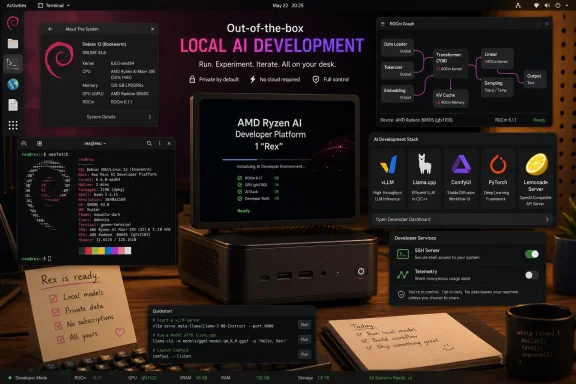
Phoronix’s discovery that the Ryzen AI Halo system boots into “AMD Ryzen AI Developer Platform 1 ‘Rex’” rather than a generic Ubuntu LTS install matters because it suggests AMD is no longer comfortable outsourcing that first impression. The desktop is GNOME-based, the distribution is Debian-derived, and the machine arrives with ROCm 7.13 preview plus common AI packages such as vLLM, ComfyUI, Llama.cpp, PyTorch, and AMD’s Lemonade Server. That is not just a preload; it is a statement of editorial control over the developer experience.
The familiar Linux answer would have been to ship Ubuntu, add a few repositories, and let the target audience fend for itself. Many developers would have managed. But the AI workstation market is no longer composed only of kernel-fluent researchers willing to patch their way through hardware enablement. It now includes application developers, Windows-first power users, small businesses, students, consultants, and enterprise prototyping teams who want local inference without becoming unpaid distribution maintainers.
The result is an AMD-branded Linux that feels less like a hobbyist courtesy and more like a platform move. It is still early, still niche, and still tied to one expensive developer box. But it answers a question AMD has too often left hanging: if the company wants developers to take ROCm and local AI seriously on client-class hardware, who owns the experience when the box is powered on?
That hardware configuration is not subtle. A 16-core, 32-thread CPU, a large integrated GPU, an NPU rated for client AI work, and a unified-memory pool give AMD a story that differs from the discrete-GPU workstation pitch. Instead of asking developers to build a tower around a high-end accelerator, AMD is selling a compact appliance-like machine that can run serious local AI experiments without the noise, size, and power profile of a traditional workstation.
But AI hardware is only as impressive as the software path that exposes it. The local AI crowd has learned this lesson the hard way. A spec sheet can promise TOPS, memory capacity, and GPU compute; a developer still has to discover whether PyTorch sees the device, whether ROCm supports the GPU cleanly, whether model-serving tools are built with the right acceleration path, and whether a driver update breaks yesterday’s working setup.
That is why the OS is central to the product rather than a footnote. Phoronix’s account describes an “AMD Ryzen AI Developer Center” that surfaces installed apps and offers GUI controls for ROCm-related tooling, Llama.cpp, vLLM, Node.js, Visual Studio Code installation, telemetry choices, graphics performance settings, LED controls, SSH access, and credentials. None of those items is revolutionary in isolation. Together, they turn a bag of parts into something closer to a developer appliance.
The appliance framing is important because AMD is competing against ecosystems, not just chips. Nvidia’s advantage in AI has never been limited to CUDA performance. It is also documentation, assumptions embedded in open-source projects, vendor support, prebuilt containers, tutorials, and the sheer probability that a random model repo was tested first on Nvidia hardware. AMD cannot benchmark its way out of that alone.
That conservative base gives AMD room to build something vendor-specific without looking like it is inventing an operating system for vanity. “Based on Debian” tells developers that familiar package management, system layout, and community expectations still apply. The AMD layer then becomes a curated integration surface rather than a black box.
There is also a politics-of-Linux angle here. Hardware vendors that ship their own Linux images can trigger suspicion, especially when the image feels like a thin wrapper around proprietary tooling or a support shortcut that will age badly. AMD has a better chance of avoiding that trap if the distribution remains recognizably Debian and if the value comes from enablement rather than lock-in.
The danger, of course, is fragmentation. Every vendor-specific AI Linux image creates another support target, another set of package versions, and another place where upstream documentation may not quite apply. If “Rex” becomes the only pleasant way to use AMD’s own AI stack on Strix Halo, AMD will have solved one problem by creating another. The healthier outcome is that the distribution functions as a reference implementation: a working recipe that AMD, users, and downstream distributions can inspect, reproduce, and improve.
That is the line AMD must walk. A polished out-of-box image is good. A sealed garden around Linux AI development would be self-defeating. The best version of Ryzen AI Developer Platform is not a distro that replaces Debian, Ubuntu, Fedora, or Arch for AMD users; it is a vendor-maintained proof that the hardware and software stack can work cleanly when assembled with intent.
A GUI that installs or manages Llama.cpp, vLLM, ROCm components, Node.js, ComfyUI, PyTorch, Visual Studio Code, SSH settings, telemetry toggles, graphics profiles, and device lighting is a productivity tool, not a surrender to beginners. Developers who prefer the shell can ignore it. Everyone else gets a map of the supported path.
That distinction matters for WindowsForum readers because many Windows power users are Linux-capable without being Linux-native. They may use WSL, deploy Linux servers, manage containers, or occasionally dual-boot, but they do not necessarily want their AI workstation to begin with a weekend of dependency work. For that audience, a GUI can make Linux feel like a deliberate AMD-supported option rather than a dare.
The remote access panel is especially pragmatic. AI developer boxes often end up headless, tucked under a desk, shared in a lab, or accessed from a laptop. Making SSH easy to enable and credential handling visible is not glamorous, but it reduces friction in the exact place where local AI systems become small infrastructure nodes rather than personal desktops.
The telemetry toggle is also smart, assuming it behaves as advertised. Developers are increasingly sensitive to vendor data collection, particularly on systems used for proprietary models, internal datasets, or security research. Surfacing telemetry control in the first-party tool signals that AMD knows trust is part of the developer platform, not an afterthought buried in a privacy statement.
But the story Phoronix uncovered shows where the action is. The custom OS, the curated open-source AI stack, the ROCm preview build, the GNOME desktop, and the developer center all revolve around Linux. Windows is supported; Linux is being shaped.
That is not a slight against Windows so much as an admission about where modern AI tooling matures first. Local LLM projects, model-serving frameworks, inference libraries, and GPU compute experiments usually begin in Linux environments. Windows can host plenty of this work, especially through WSL or native ports, but the path of least resistance for serious AI tinkering still tends to run through Linux.
Microsoft knows this, which is why WSL exists and why the company has spent years making Linux a first-class citizen on Windows rather than pretending developers will return exclusively to Win32. AMD’s move fits the same reality from the hardware side. If the developer stack lives in Linux, then the hardware vendor has to care about Linux as a shipped product, not merely as a compatibility checkbox.
For IT departments, this creates a more nuanced procurement question. A Windows 11 configuration may be easier to domain-join, secure with familiar endpoint tools, and hand to users who live in Microsoft 365. A Linux configuration may offer the cleaner AI stack and better alignment with open-source model workflows. The real competition is not simply Windows versus Linux; it is whether AMD can make either path feel officially supported rather than improvised.
The Ryzen AI Developer Platform gives ROCm a controlled client showcase. Shipping ROCm 7.13 preview preinstalled is not just a convenience; it is AMD saying, “This is the stack we want you to try on this hardware.” That matters because the local AI market is full of users who do not distinguish between “ROCm as a compute platform” and “my attempt to install ROCm failed on Tuesday.” The user experience becomes the brand.
Bundling vLLM, Llama.cpp, ComfyUI, PyTorch, and Lemonade Server is equally important because those names map to actual developer behavior. Nobody buys an AI box to admire a driver stack. They buy it to run models, serve endpoints, test agents, build workflows, generate images, fine-tune experiments, and discover where local hardware is enough.
The inclusion of both lower-level and application-level tooling suggests AMD is trying to address multiple layers of the stack at once. Llama.cpp appeals to the local inference and quantization crowd. vLLM speaks to serving and throughput. ComfyUI speaks to generative image workflows. PyTorch remains the lingua franca for model development. Lemonade Server is AMD’s attempt to wrap some of this in a more accessible local AI service layer.
The challenge is that preinstallation does not equal ecosystem dominance. Nvidia’s moat is reinforced every time a GitHub project assumes CUDA, every time a tutorial says “install the Nvidia container toolkit,” and every time a model optimization lands first for green hardware. AMD’s Debian image can lower the first wall, but it cannot by itself rewrite the habits of the AI software world.
In the worse future, the custom image becomes a support island. It works well on day one, receives unclear updates, diverges from upstream packaging, and leaves users wondering whether they should trust AMD’s image, their preferred distribution, or a container stack maintained by the community. That kind of ambiguity would undermine the very confidence the platform is meant to create.
AMD can avoid the trap by being boring in the right ways. It should document what is changed from Debian, how ROCm packages are maintained, how security updates flow, how long the OS image is supported, and whether users can reinstall or reproduce the environment from public repositories. Developers do not need every implementation detail to be exciting. They need the maintenance story to be legible.
Security is not a footnote here. A developer box preloaded with remote access tooling, model servers, web UIs, and AI frameworks can quickly become exposed infrastructure if configured carelessly. The more AMD makes these systems appliance-like, the more it must think like an appliance vendor: patch cadence, default network posture, credential handling, update notifications, and clean rollback paths all matter.
Enterprise IT will ask sharper questions than reviewers. Can the Linux image be managed at scale? Are there signed repositories? What is the vulnerability response process? Can telemetry be disabled and audited? Can the system be rebuilt from a known-good image? If AMD wants Ryzen AI Halo to move beyond enthusiasts and review benches, those answers need to be as polished as the desktop launcher.
This category exists because the cloud is powerful but not always convenient. Developers want to prototype without meter anxiety. Businesses want to test workflows without uploading sensitive material. Researchers want repeatable local environments. Hobbyists want models that run on hardware they own. Security teams want to inspect tools before they enter production networks.
AMD’s design speaks directly to that impulse. A compact Strix Halo machine with 128GB of unified memory is attractive because many AI workloads are memory-bound before they are compute-bound. The ability to keep large models resident locally, even if performance varies by framework and quantization, changes what a small office or individual developer can attempt.
The Windows angle is still valuable. A machine that can be purchased with Windows 11 has an easier path into environments where Linux-only appliances are treated as exceptions. But the Linux option being more than a generic install makes the product feel more complete. AMD is effectively saying that local AI development is a workload with its own operating environment, not just a benchmark category.
That is the same strategic terrain Nvidia has been cultivating with its own developer systems and software stack. AMD does not need to imitate Nvidia feature-for-feature, but it does need to offer a coherent alternative. Ryzen AI Developer Platform is one way to say that AMD’s alternative is not merely cheaper hardware or more memory; it is a more integrated on-ramp for developers who want local AI on x86.
This is where AMD’s historical software reputation will follow it into the room. Enthusiasts are willing to praise AMD for open-source driver work and Linux kernel engagement, but AI developers have also seen AMD support matrices that feel narrower than the marketing. If “Rex” is stable, transparent, and updated regularly, it can soften that skepticism. If it becomes another brittle vendor image, it will reinforce it.
The naming also matters more than it should. Calling it AMD Ryzen AI Developer Platform 1 gives the impression of a productized software track, not a one-off factory image. The codename “Rex” is charming, but the version number is the real promise. Version 1 implies version 2, upgrades, release notes, and accountability.
AMD should embrace that implication. Publish changelogs. Explain which ROCm preview builds are supported and why. Show developers how to recover the system. Provide container recipes. Clarify whether the same stack can be installed on other Strix Halo machines, such as Framework Desktop or other Ryzen AI Max+ 395 systems, even if official support remains limited to AMD’s developer platform.
That last point could become contentious. If AMD’s best Linux AI experience is locked to an AMD-branded mini PC while similar Strix Halo systems must reconstruct it manually, the community will push back. If AMD uses the Halo box as the canonical reference while allowing the broader ecosystem to benefit, it can turn one product launch into a wider AMD client AI story.
Windows users already live in this hybrid world. They run Windows 11 on the desktop, Linux in WSL, containers in development environments, remote shells into servers, and browser-based tools that hide where the compute happens. An AMD mini PC that can ship with Windows or a curated Debian image fits that pattern. The boundary between desktop PC and development appliance is getting blurry.
This also affects how Microsoft’s own AI PC messaging lands. Microsoft has emphasized NPUs, Copilot experiences, and Windows integration, while much of the grassroots local AI community has been focused on GPUs, memory capacity, and Linux-first tooling. AMD’s Halo platform sits between those worlds. It can be a Windows 11 AI PC, but its most interesting developer story currently appears to be Linux.
That tension is not necessarily bad for Microsoft. Windows remains a strong host environment, and WSL gives Microsoft a bridge into Linux workflows. But AMD’s move is a reminder that the most demanding AI developers will not wait for a Windows-native abstraction if the Linux stack gives them better access sooner. They will use whatever environment makes the hardware useful.
The practical consequence is that Windows-centric IT teams may need to become more comfortable evaluating Linux images as part of client hardware procurement. Not every AI workstation will be a managed Windows endpoint. Some will be small Linux appliances sitting beside Windows laptops, reachable over SSH or a web UI, running models locally for teams that still do most of their daily work in Windows.
The unresolved question is whether AMD will support the experience with the seriousness it deserves.
 AMD Stops Pretending the Operating System Is Somebody Else’s Problem
For years, AMD’s client hardware story has been stronger than its developer-platform story. The silicon often looked compelling on paper, especially when AMD could combine many Zen cores, capable integrated graphics, and aggressive memory bandwidth in a package that Intel struggled to match. The software experience, however, usually required the user to assemble the pieces: kernel, firmware, Mesa, ROCm, Python stack, model-serving framework, and enough forum archaeology to discover which combination was blessed this month.Phoronix’s discovery that the Ryzen AI Halo system boots into “AMD Ryzen AI Developer Platform 1 ‘Rex’” rather than a generic Ubuntu LTS install matters because it suggests AMD is no longer comfortable outsourcing that first impression. The desktop is GNOME-based, the distribution is Debian-derived, and the machine arrives with ROCm 7.13 preview plus common AI packages such as vLLM, ComfyUI, Llama.cpp, PyTorch, and AMD’s Lemonade Server. That is not just a preload; it is a statement of editorial control over the developer experience.
The familiar Linux answer would have been to ship Ubuntu, add a few repositories, and let the target audience fend for itself. Many developers would have managed. But the AI workstation market is no longer composed only of kernel-fluent researchers willing to patch their way through hardware enablement. It now includes application developers, Windows-first power users, small businesses, students, consultants, and enterprise prototyping teams who want local inference without becoming unpaid distribution maintainers.
The result is an AMD-branded Linux that feels less like a hobbyist courtesy and more like a platform move. It is still early, still niche, and still tied to one expensive developer box. But it answers a question AMD has too often left hanging: if the company wants developers to take ROCm and local AI seriously on client-class hardware, who owns the experience when the box is powered on?
Strix Halo Needed More Than Benchmarks
The Ryzen AI Max+ 395, better known by its Strix Halo lineage, is exactly the sort of chip that invites ambitious claims. AMD’s developer platform pairs it with 128GB of LPDDR5x unified memory and Radeon 8060S graphics, while AMD’s own materials position Ryzen AI Halo as a compact AI developer system available with Linux or Windows 11. Reviews from Phoronix and LTT Labs both describe a mini PC built around the Zen 5 Ryzen AI Max+ 395, with LTT Labs noting that its Linux unit ran AMD Ryzen AI Developer Platform 1 based on Debian 13.4.That hardware configuration is not subtle. A 16-core, 32-thread CPU, a large integrated GPU, an NPU rated for client AI work, and a unified-memory pool give AMD a story that differs from the discrete-GPU workstation pitch. Instead of asking developers to build a tower around a high-end accelerator, AMD is selling a compact appliance-like machine that can run serious local AI experiments without the noise, size, and power profile of a traditional workstation.
But AI hardware is only as impressive as the software path that exposes it. The local AI crowd has learned this lesson the hard way. A spec sheet can promise TOPS, memory capacity, and GPU compute; a developer still has to discover whether PyTorch sees the device, whether ROCm supports the GPU cleanly, whether model-serving tools are built with the right acceleration path, and whether a driver update breaks yesterday’s working setup.
That is why the OS is central to the product rather than a footnote. Phoronix’s account describes an “AMD Ryzen AI Developer Center” that surfaces installed apps and offers GUI controls for ROCm-related tooling, Llama.cpp, vLLM, Node.js, Visual Studio Code installation, telemetry choices, graphics performance settings, LED controls, SSH access, and credentials. None of those items is revolutionary in isolation. Together, they turn a bag of parts into something closer to a developer appliance.
The appliance framing is important because AMD is competing against ecosystems, not just chips. Nvidia’s advantage in AI has never been limited to CUDA performance. It is also documentation, assumptions embedded in open-source projects, vendor support, prebuilt containers, tutorials, and the sheer probability that a random model repo was tested first on Nvidia hardware. AMD cannot benchmark its way out of that alone.
Debian Is the Conservative Choice With a Subversive Effect
AMD’s apparent choice of Debian as the base is more interesting than it first appears. Ubuntu would have been the predictable move because Ubuntu dominates many AI tutorials, cloud images, and workstation guides. Debian is less fashionable in AI marketing, but it carries a reputation for stability, community legitimacy, and long-term maintainability.That conservative base gives AMD room to build something vendor-specific without looking like it is inventing an operating system for vanity. “Based on Debian” tells developers that familiar package management, system layout, and community expectations still apply. The AMD layer then becomes a curated integration surface rather than a black box.
There is also a politics-of-Linux angle here. Hardware vendors that ship their own Linux images can trigger suspicion, especially when the image feels like a thin wrapper around proprietary tooling or a support shortcut that will age badly. AMD has a better chance of avoiding that trap if the distribution remains recognizably Debian and if the value comes from enablement rather than lock-in.
The danger, of course, is fragmentation. Every vendor-specific AI Linux image creates another support target, another set of package versions, and another place where upstream documentation may not quite apply. If “Rex” becomes the only pleasant way to use AMD’s own AI stack on Strix Halo, AMD will have solved one problem by creating another. The healthier outcome is that the distribution functions as a reference implementation: a working recipe that AMD, users, and downstream distributions can inspect, reproduce, and improve.
That is the line AMD must walk. A polished out-of-box image is good. A sealed garden around Linux AI development would be self-defeating. The best version of Ryzen AI Developer Platform is not a distro that replaces Debian, Ubuntu, Fedora, or Arch for AMD users; it is a vendor-maintained proof that the hardware and software stack can work cleanly when assembled with intent.
The GUI Is Not an Insult to Developers
The most telling part of Phoronix’s report may be the Ryzen AI Developer Center. Linux veterans often treat graphical setup tools as training wheels, but that misses the target audience for this machine. A $4,000-ish AI developer mini PC is not only for people who enjoy debugging udev rules before breakfast.A GUI that installs or manages Llama.cpp, vLLM, ROCm components, Node.js, ComfyUI, PyTorch, Visual Studio Code, SSH settings, telemetry toggles, graphics profiles, and device lighting is a productivity tool, not a surrender to beginners. Developers who prefer the shell can ignore it. Everyone else gets a map of the supported path.
That distinction matters for WindowsForum readers because many Windows power users are Linux-capable without being Linux-native. They may use WSL, deploy Linux servers, manage containers, or occasionally dual-boot, but they do not necessarily want their AI workstation to begin with a weekend of dependency work. For that audience, a GUI can make Linux feel like a deliberate AMD-supported option rather than a dare.
The remote access panel is especially pragmatic. AI developer boxes often end up headless, tucked under a desk, shared in a lab, or accessed from a laptop. Making SSH easy to enable and credential handling visible is not glamorous, but it reduces friction in the exact place where local AI systems become small infrastructure nodes rather than personal desktops.
The telemetry toggle is also smart, assuming it behaves as advertised. Developers are increasingly sensitive to vendor data collection, particularly on systems used for proprietary models, internal datasets, or security research. Surfacing telemetry control in the first-party tool signals that AMD knows trust is part of the developer platform, not an afterthought buried in a privacy statement.
Windows 11 Is Still in the Product, but Linux Owns the Narrative
AMD is not abandoning Windows here. The Ryzen AI Halo developer platform can be ordered with Windows 11, and that is an important differentiator against Linux-only AI appliances. Windows remains the default desktop environment for many developers, corporate users, creators, and buyers who expect mainstream peripheral support and familiar management tools.But the story Phoronix uncovered shows where the action is. The custom OS, the curated open-source AI stack, the ROCm preview build, the GNOME desktop, and the developer center all revolve around Linux. Windows is supported; Linux is being shaped.
That is not a slight against Windows so much as an admission about where modern AI tooling matures first. Local LLM projects, model-serving frameworks, inference libraries, and GPU compute experiments usually begin in Linux environments. Windows can host plenty of this work, especially through WSL or native ports, but the path of least resistance for serious AI tinkering still tends to run through Linux.
Microsoft knows this, which is why WSL exists and why the company has spent years making Linux a first-class citizen on Windows rather than pretending developers will return exclusively to Win32. AMD’s move fits the same reality from the hardware side. If the developer stack lives in Linux, then the hardware vendor has to care about Linux as a shipped product, not merely as a compatibility checkbox.
For IT departments, this creates a more nuanced procurement question. A Windows 11 configuration may be easier to domain-join, secure with familiar endpoint tools, and hand to users who live in Microsoft 365. A Linux configuration may offer the cleaner AI stack and better alignment with open-source model workflows. The real competition is not simply Windows versus Linux; it is whether AMD can make either path feel officially supported rather than improvised.
ROCm Gets a Desktop Showcase It Badly Needed
ROCm has long been AMD’s answer to CUDA, and it has long carried the burden of comparison. In data centers, AMD has made real progress with Instinct accelerators and major cloud deployments. On workstations and client systems, the experience has often felt more conditional: supported on this GPU, with that kernel, on this distribution, for this framework, if the package versions line up.The Ryzen AI Developer Platform gives ROCm a controlled client showcase. Shipping ROCm 7.13 preview preinstalled is not just a convenience; it is AMD saying, “This is the stack we want you to try on this hardware.” That matters because the local AI market is full of users who do not distinguish between “ROCm as a compute platform” and “my attempt to install ROCm failed on Tuesday.” The user experience becomes the brand.
Bundling vLLM, Llama.cpp, ComfyUI, PyTorch, and Lemonade Server is equally important because those names map to actual developer behavior. Nobody buys an AI box to admire a driver stack. They buy it to run models, serve endpoints, test agents, build workflows, generate images, fine-tune experiments, and discover where local hardware is enough.
The inclusion of both lower-level and application-level tooling suggests AMD is trying to address multiple layers of the stack at once. Llama.cpp appeals to the local inference and quantization crowd. vLLM speaks to serving and throughput. ComfyUI speaks to generative image workflows. PyTorch remains the lingua franca for model development. Lemonade Server is AMD’s attempt to wrap some of this in a more accessible local AI service layer.
The challenge is that preinstallation does not equal ecosystem dominance. Nvidia’s moat is reinforced every time a GitHub project assumes CUDA, every time a tutorial says “install the Nvidia container toolkit,” and every time a model optimization lands first for green hardware. AMD’s Debian image can lower the first wall, but it cannot by itself rewrite the habits of the AI software world.
A Vendor Linux Can Be a Bridge or a Trap
There are two possible futures for AMD Ryzen AI Developer Platform. In the better one, it becomes a reference platform that accelerates upstream support. AMD validates kernels, firmware, ROCm builds, and AI packages on Strix Halo-class hardware, then pushes fixes outward so that Debian, Ubuntu, Fedora, Arch, and other distributions inherit a better AMD experience.In the worse future, the custom image becomes a support island. It works well on day one, receives unclear updates, diverges from upstream packaging, and leaves users wondering whether they should trust AMD’s image, their preferred distribution, or a container stack maintained by the community. That kind of ambiguity would undermine the very confidence the platform is meant to create.
AMD can avoid the trap by being boring in the right ways. It should document what is changed from Debian, how ROCm packages are maintained, how security updates flow, how long the OS image is supported, and whether users can reinstall or reproduce the environment from public repositories. Developers do not need every implementation detail to be exciting. They need the maintenance story to be legible.
Security is not a footnote here. A developer box preloaded with remote access tooling, model servers, web UIs, and AI frameworks can quickly become exposed infrastructure if configured carelessly. The more AMD makes these systems appliance-like, the more it must think like an appliance vendor: patch cadence, default network posture, credential handling, update notifications, and clean rollback paths all matter.
Enterprise IT will ask sharper questions than reviewers. Can the Linux image be managed at scale? Are there signed repositories? What is the vulnerability response process? Can telemetry be disabled and audited? Can the system be rebuilt from a known-good image? If AMD wants Ryzen AI Halo to move beyond enthusiasts and review benches, those answers need to be as polished as the desktop launcher.
The Local AI Workstation Is Becoming Its Own Category
The Ryzen AI Halo system lands in a market that is still trying to name itself. It is not a gaming PC, though Strix Halo’s integrated graphics make gaming comparisons inevitable. It is not a classic workstation, though the CPU and memory configuration invite workstation workloads. It is not a server, though many buyers will run it headless. It is not a thin client to the cloud, because the whole point is to keep meaningful AI work local.This category exists because the cloud is powerful but not always convenient. Developers want to prototype without meter anxiety. Businesses want to test workflows without uploading sensitive material. Researchers want repeatable local environments. Hobbyists want models that run on hardware they own. Security teams want to inspect tools before they enter production networks.
AMD’s design speaks directly to that impulse. A compact Strix Halo machine with 128GB of unified memory is attractive because many AI workloads are memory-bound before they are compute-bound. The ability to keep large models resident locally, even if performance varies by framework and quantization, changes what a small office or individual developer can attempt.
The Windows angle is still valuable. A machine that can be purchased with Windows 11 has an easier path into environments where Linux-only appliances are treated as exceptions. But the Linux option being more than a generic install makes the product feel more complete. AMD is effectively saying that local AI development is a workload with its own operating environment, not just a benchmark category.
That is the same strategic terrain Nvidia has been cultivating with its own developer systems and software stack. AMD does not need to imitate Nvidia feature-for-feature, but it does need to offer a coherent alternative. Ryzen AI Developer Platform is one way to say that AMD’s alternative is not merely cheaper hardware or more memory; it is a more integrated on-ramp for developers who want local AI on x86.
The Real Test Begins After the Review Image Ages
Launch images always look better than long-term ownership. The real test for AMD’s Debian-based platform will come after the first kernel regression, the first ROCm packaging change, the first PyTorch compatibility snag, the first security update that touches a dependency, and the first user who wants to upgrade the base system without breaking AMD’s additions.This is where AMD’s historical software reputation will follow it into the room. Enthusiasts are willing to praise AMD for open-source driver work and Linux kernel engagement, but AI developers have also seen AMD support matrices that feel narrower than the marketing. If “Rex” is stable, transparent, and updated regularly, it can soften that skepticism. If it becomes another brittle vendor image, it will reinforce it.
The naming also matters more than it should. Calling it AMD Ryzen AI Developer Platform 1 gives the impression of a productized software track, not a one-off factory image. The codename “Rex” is charming, but the version number is the real promise. Version 1 implies version 2, upgrades, release notes, and accountability.
AMD should embrace that implication. Publish changelogs. Explain which ROCm preview builds are supported and why. Show developers how to recover the system. Provide container recipes. Clarify whether the same stack can be installed on other Strix Halo machines, such as Framework Desktop or other Ryzen AI Max+ 395 systems, even if official support remains limited to AMD’s developer platform.
That last point could become contentious. If AMD’s best Linux AI experience is locked to an AMD-branded mini PC while similar Strix Halo systems must reconstruct it manually, the community will push back. If AMD uses the Halo box as the canonical reference while allowing the broader ecosystem to benefit, it can turn one product launch into a wider AMD client AI story.
Windows Users Should Read This as an AI Platform Story, Not a Linux Curiosity
For WindowsForum’s audience, the temptation is to file this under “interesting Linux news.” That would be too narrow. The Ryzen AI Developer Platform is really about how client computing changes when AI development becomes local, hardware-accelerated, and messy enough that the OS vendor, chip vendor, and framework maintainers all become part of the same experience.Windows users already live in this hybrid world. They run Windows 11 on the desktop, Linux in WSL, containers in development environments, remote shells into servers, and browser-based tools that hide where the compute happens. An AMD mini PC that can ship with Windows or a curated Debian image fits that pattern. The boundary between desktop PC and development appliance is getting blurry.
This also affects how Microsoft’s own AI PC messaging lands. Microsoft has emphasized NPUs, Copilot experiences, and Windows integration, while much of the grassroots local AI community has been focused on GPUs, memory capacity, and Linux-first tooling. AMD’s Halo platform sits between those worlds. It can be a Windows 11 AI PC, but its most interesting developer story currently appears to be Linux.
That tension is not necessarily bad for Microsoft. Windows remains a strong host environment, and WSL gives Microsoft a bridge into Linux workflows. But AMD’s move is a reminder that the most demanding AI developers will not wait for a Windows-native abstraction if the Linux stack gives them better access sooner. They will use whatever environment makes the hardware useful.
The practical consequence is that Windows-centric IT teams may need to become more comfortable evaluating Linux images as part of client hardware procurement. Not every AI workstation will be a managed Windows endpoint. Some will be small Linux appliances sitting beside Windows laptops, reachable over SSH or a web UI, running models locally for teams that still do most of their daily work in Windows.
AMD’s “Rex” Bet Comes Down to Trust
The most concrete lesson from Phoronix’s report is that AMD seems to understand the cost of first-run failure. If a developer boots an expensive AI box and immediately has to solve ROCm installation, framework compatibility, SSH setup, and model-serving configuration, the hardware has already lost emotional ground. A polished Debian-based image gives AMD a chance to make the first hour feel intentional.The unresolved question is whether AMD will support the experience with the seriousness it deserves.
- AMD is shipping the Ryzen AI Halo developer platform with either Windows 11 or a custom Debian-based Linux environment called AMD Ryzen AI Developer Platform 1 “Rex.”
- Phoronix found that the Linux configuration includes a GNOME desktop, an AMD Ryzen AI Developer Center, ROCm 7.13 preview, and common AI tools including Llama.cpp, vLLM, ComfyUI, PyTorch, and Lemonade Server.
- The GUI layer matters because local AI hardware is now being bought by developers and teams that want acceleration without manually assembling every dependency.
- The Debian base could be a strength if AMD treats it as a transparent reference platform rather than a vendor silo.
- The platform’s long-term credibility will depend on updates, documentation, security posture, and whether the broader Strix Halo ecosystem benefits from the work.
- For Windows users, the news is a sign that serious AI PC workflows will increasingly span Windows, Linux, WSL, remote access, and appliance-like local compute.
References
- Primary source: Phoronix
Published: Mon, 06 Jul 2026 15:00:00 GMT
Loading…
www.phoronix.com - Related coverage: techradar.com
GMKtec turned its AI mini PC into a tower and nearly quadrupled the price along the way | TechRadar
From $900 in 2024 to $3,600 in 2026 — GMKtec mini PCs are getting pricierwww.techradar.com - Related coverage: amd.com
Loading…
www.amd.com - Related coverage: cnx-software.com
Loading…
www.cnx-software.com - Related coverage: pcvenus.com
Loading…
pcvenus.com - Related coverage: tomshardware.com
AMD challenges Nvidia's DGX Spark with $3,999 Ryzen AI Halo with Windows 11 support — Strix Halo desktop undercuts Nvidia by $700, packs 128GB of unified memory | Tom's Hardware
The AI mini PC supports both Linux and Windows 11.www.tomshardware.com