

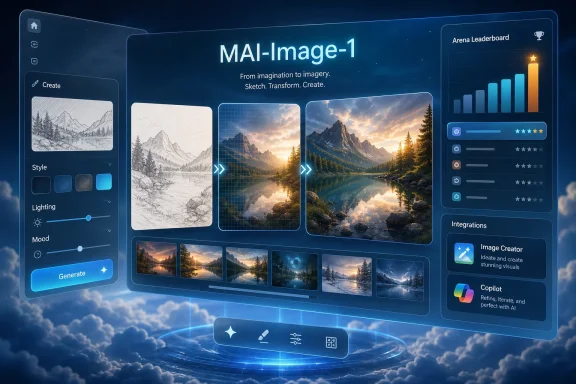
Microsoft announced MAI-Image-1 on October 13, 2025, as its first entirely in-house text-to-image model, initially placing it in the top 10 on LMArena before adding it to select Microsoft products, including Bing Image Creator and Copilot experiences, in November 2025. The model was not merely another image generator in a crowded market; it was Microsoft putting a stake in the ground after years of being seen, fairly or not, as the world’s most successful OpenAI reseller. As Microsoft AI’s own announcement made clear, MAI-Image-1 was designed to prove that Redmond can build creative models itself, not just wrap someone else’s breakthrough in a familiar productivity interface. That makes the launch less about pretty pictures than about strategic independence.
For most Windows users, Microsoft’s AI era has felt inseparable from OpenAI. Bing Chat, Copilot, Designer, and image creation inside Microsoft’s consumer ecosystem all arrived under the long shadow of DALL-E, GPT, and the multibillion-dollar OpenAI partnership that gave Microsoft an early lead over Google, Amazon, and nearly every other enterprise software vendor.
MAI-Image-1 changes the optics. Microsoft AI described it as the company’s first image generation model developed entirely in-house, and that phrase matters. It is corporate positioning, yes, but it is also a signal to customers, investors, regulators, and competitors that Microsoft does not intend to remain permanently dependent on one outside lab for the models that animate its products.
The company’s initial boast was not that MAI-Image-1 was the best image model in the world. It was that the model debuted in the top 10 text-to-image systems on LMArena, a public arena-style benchmark where users compare outputs. That is a careful claim: strong enough to matter, modest enough to avoid promising supremacy.
This is how Microsoft tends to enter markets it wants to own. It rarely needs to win the first benchmark outright. It needs something good enough to embed everywhere.
But no company the size of Microsoft wants its most important product layer controlled entirely by another firm. That is especially true when the product layer is not a feature but an operating logic: AI in Windows, AI in Office, AI in search, AI in developer tools, AI in customer support, AI in security operations, and AI in cloud workflows.
The first wave of Microsoft’s AI strategy was about speed. The second wave is about control. MAI-Image-1 belongs to that second wave, alongside earlier in-house efforts such as MAI-Voice-1 and MAI-1-preview, which Microsoft AI announced in 2025 as part of its broader push into homegrown models.
That does not mean Microsoft is breaking with OpenAI. The reality is more pragmatic and more Microsoft-like: use partner models where they are best, build internal models where cost, latency, integration, safety policy, or product differentiation demands it. In that world, OpenAI remains essential, but no longer singular.
Still, Microsoft’s top-10 debut mattered because it cleared the first credibility hurdle. MAI-Image-1 did not arrive as an internal science project or a half-hidden preview buried in a developer console. It arrived as a model Microsoft could publicly compare with the broader image-generation field.
Microsoft’s announcement emphasized photorealistic imagery, lighting, reflections, landscapes, speed, and avoidance of repetitive or generic AI styling. Those are not random talking points. They target the two complaints that have dogged image generators since their mainstream rise: outputs that look plausibly impressive at first glance but collapse under scrutiny, and outputs that converge toward the same glossy synthetic aesthetic.
The company also said it incorporated feedback from creative professionals and focused evaluation on real-world creative use cases. That framing is designed to reassure the very people most skeptical of AI image tools: photographers, designers, illustrators, marketers, and art directors who do not want another toy that produces three good thumbnails and a dozen uncanny failures.
That is the Microsoft advantage in miniature. Midjourney can cultivate an artistic community. OpenAI can define what frontier generation looks like. Google can flood consumer imagination through Gemini and viral effects. Microsoft can put image generation where work already happens.
That matters more than it sounds. A model embedded in Bing Image Creator is a consumer feature. A model embedded across Copilot, Designer, PowerPoint, Word, Teams, and eventually Azure workflows becomes infrastructure. It becomes something a marketing team uses without opening a specialist tool, something a product manager uses inside a deck, something a small business uses to draft campaign assets, and something an IT administrator has to govern.
This is why MAI-Image-1 is a WindowsForum story as much as an AI-lab story. Microsoft’s creative AI ambitions will not stay confined to a web demo. If the company follows its usual playbook, the model family will become part of the everyday Microsoft stack, surfaced through Windows, Edge, Microsoft 365, and Azure services in ways that blur the line between operating system feature and cloud-hosted creative engine.
That is where Microsoft has leverage. Its AI products sit inside identity, compliance, licensing, and tenant-management systems that IT departments already understand. If Microsoft can offer an image model that is good enough and easier to govern than a standalone consumer tool, many organizations will choose the integrated option even if an independent rival occasionally produces better art.
The unresolved question is how much Microsoft will disclose. Technical details around MAI-Image-1 remained limited at launch. Microsoft described goals and strengths but did not publish the kind of deep model documentation that would settle questions about training data, opt-outs, provenance, or evaluation methodology.
That gap is not unique to Microsoft. The image-generation industry still lives in a fog of partial disclosure, litigation anxiety, benchmark theater, and safety claims that are difficult for outsiders to audit. But Microsoft’s enterprise brand raises the bar. A company selling AI into regulated organizations cannot rely forever on “trust us” as a model card.
Sora is best understood as part of OpenAI’s broader push into video and multimodal generation, where temporal coherence and cinematic control matter as much as still-image fidelity. Google’s image tools benefit from Gemini distribution, Android reach, Search visibility, and the company’s enormous AI research base. Midjourney remains culturally influential among creators. Adobe has its own advantage in professional creative workflows through Firefly and Creative Cloud. Black Forest Labs, Stability AI, Ideogram, and others keep pressure on the field from different angles.
Microsoft’s likely bet is not to beat each of them on their home turf. It is to win through ubiquity, acceptable quality, enterprise controls, and integration. That is less glamorous than topping every leaderboard, but it is often how Microsoft turns a late or middle entry into a durable business.
The catch is that image generation is brutally visible. A mediocre chatbot can sometimes hide behind plausible prose. A mediocre image model cannot hide a mangled hand, unreadable sign, warped logo, or uncanny face. Creative users judge instantly, and they remember failures.
That is risky. If MAI-Image-1 had been obviously inferior, it would have reinforced the idea that Microsoft still needs OpenAI for the good stuff. But Microsoft apparently judged the model strong enough to sit in the same menu as those alternatives, letting users select whichever model matched their creative goals.
Choice also gives Microsoft a learning loop. Different prompts, user preferences, failure patterns, and repeat usage can tell the company where its model performs well and where partner models still dominate. That feedback can then inform future MAI models.
By mid-2026, Microsoft AI’s own model pages already pointed beyond MAI-Image-1 to newer image models, including MAI-Image-2.5. That does not make the first model irrelevant. It makes it the opening move in a line of models, the proof that Microsoft could ship and iterate rather than simply announce.
That is why Microsoft’s model branding may remain secondary. The company can expose model choice to power users while abstracting it away for everyone else. In Microsoft 365, the user experience will likely be “make this slide more visual,” not “select diffusion transformer variant number three.”
For Windows enthusiasts, the more interesting question is where this ends up locally versus in the cloud. MAI-Image-1 is not being presented as a local Windows model. It is a cloud AI service, shaped by Azure economics and Microsoft’s consumer AI distribution. But the rise of Copilot+ PCs and NPUs means Microsoft will keep looking for ways to split AI tasks between device and cloud.
Image generation remains compute-hungry, especially at high quality. But editing, previewing, prompt assistance, content classification, and lightweight transformations may increasingly happen on-device. The model that starts in Bing can still influence the Windows shell, Photos, Paint, Clipchamp, and Designer over time.
If Microsoft makes MAI image models available through Azure with clear pricing, predictable latency, tenant controls, and compliance hooks, the model becomes more than a Copilot feature. It becomes a programmable media engine for line-of-business applications, design automation, synthetic training data workflows, e-commerce imagery, internal communications, and customer-facing creative tools.
That will also sharpen the naming issue. Azure customers need to know what model they are calling, what it costs, what it stores, what safety filters apply, and how outputs may be used. Microsoft can blur model identity in consumer products; developers need specificity.
The likely future is a tiered catalog. Microsoft can offer premium partner models, cheaper in-house models, specialized image-editing models, fast preview models, and enterprise-safe defaults. MAI-Image-1’s strategic purpose was to make that catalog credible.
For professional users, this is not academic. A generated image used in a campaign, presentation, advertisement, product mockup, or publication can carry brand and legal risk. Enterprises will want indemnity, auditability, content credentials, and policy controls, not just photorealism.
Microsoft has a stronger incentive than many AI startups to make those concerns boring. Its customers include governments, schools, hospitals, banks, manufacturers, and large corporations that cannot run their visual communications strategy on vibes. If MAI models become part of Microsoft 365 and Azure, procurement departments will ask questions that hobbyist communities often skip.
The company’s best path is transparency plus tooling. Content credentials, provenance metadata, admin controls, prompt and output policies, and clear commercial-use terms will matter as much as benchmark scores. The model may win attention with lighting and textures, but it will win enterprise deployment with governance.
If Microsoft embeds image generation into productivity software, it risks industrializing that sameness. Every quarterly deck could sprout the same synthetic gradients. Every internal newsletter could acquire the same smiling non-person. Every small business campaign could look like it was assembled from the same latent-space stock drawer.
But this is also where Microsoft can differentiate. If MAI models are tuned for practical creative workflows rather than spectacle, they can help users make drafts, variations, visual references, and placeholders without pretending that every output is finished art. The healthiest version of this technology is not a machine that replaces taste; it is a machine that accelerates iteration for people who still exercise taste.
That distinction will be hard to preserve at scale. The cheaper and easier image generation becomes, the more organizations will use it to fill space rather than say something. Microsoft cannot solve bad taste with a model update, but it can design tools that reward refinement over one-click sludge.
That is a supply-chain issue. In the AI era, models are not just software components. They are strategic dependencies. They determine cost structure, latency, user experience, safety behavior, and feature feasibility.
Microsoft learned the value of owning platforms through Windows, Office, Exchange, SQL Server, Azure, and Active Directory. It also learned the cost of missing them in mobile and social. Generative AI sits somewhere between those worlds: a platform shift that Microsoft caught early through partnership but cannot fully own unless it builds more of the stack itself.
MAI-Image-1 is therefore less a finished product than a capability marker. It tells the market that Microsoft AI can ship a competitive creative model, integrate it into real products, and keep iterating.
 Microsoft Finally Picks Up Its Own Brush
For most Windows users, Microsoft’s AI era has felt inseparable from OpenAI. Bing Chat, Copilot, Designer, and image creation inside Microsoft’s consumer ecosystem all arrived under the long shadow of DALL-E, GPT, and the multibillion-dollar OpenAI partnership that gave Microsoft an early lead over Google, Amazon, and nearly every other enterprise software vendor.MAI-Image-1 changes the optics. Microsoft AI described it as the company’s first image generation model developed entirely in-house, and that phrase matters. It is corporate positioning, yes, but it is also a signal to customers, investors, regulators, and competitors that Microsoft does not intend to remain permanently dependent on one outside lab for the models that animate its products.
The company’s initial boast was not that MAI-Image-1 was the best image model in the world. It was that the model debuted in the top 10 text-to-image systems on LMArena, a public arena-style benchmark where users compare outputs. That is a careful claim: strong enough to matter, modest enough to avoid promising supremacy.
This is how Microsoft tends to enter markets it wants to own. It rarely needs to win the first benchmark outright. It needs something good enough to embed everywhere.
The OpenAI Partnership Was Always a Bridge, Not a Destination
Microsoft’s OpenAI deal was one of the defining platform moves of the generative AI boom. It gave Microsoft frontier AI access when most of the industry was still treating large language models as either research curiosities or expensive demos. Copilot became the distribution layer; Azure became the infrastructure story; OpenAI became the magic engine behind the curtain.But no company the size of Microsoft wants its most important product layer controlled entirely by another firm. That is especially true when the product layer is not a feature but an operating logic: AI in Windows, AI in Office, AI in search, AI in developer tools, AI in customer support, AI in security operations, and AI in cloud workflows.
The first wave of Microsoft’s AI strategy was about speed. The second wave is about control. MAI-Image-1 belongs to that second wave, alongside earlier in-house efforts such as MAI-Voice-1 and MAI-1-preview, which Microsoft AI announced in 2025 as part of its broader push into homegrown models.
That does not mean Microsoft is breaking with OpenAI. The reality is more pragmatic and more Microsoft-like: use partner models where they are best, build internal models where cost, latency, integration, safety policy, or product differentiation demands it. In that world, OpenAI remains essential, but no longer singular.
A Top-10 Image Model Is a Business Claim Wearing a Benchmark Hat
LMArena rankings are useful, but they are not destiny. Arena-style comparisons capture preference signals from users, often across prompts that may or may not resemble professional work. They are valuable for judging broad appeal, but they do not answer every question an enterprise buyer or creative team will ask.Still, Microsoft’s top-10 debut mattered because it cleared the first credibility hurdle. MAI-Image-1 did not arrive as an internal science project or a half-hidden preview buried in a developer console. It arrived as a model Microsoft could publicly compare with the broader image-generation field.
Microsoft’s announcement emphasized photorealistic imagery, lighting, reflections, landscapes, speed, and avoidance of repetitive or generic AI styling. Those are not random talking points. They target the two complaints that have dogged image generators since their mainstream rise: outputs that look plausibly impressive at first glance but collapse under scrutiny, and outputs that converge toward the same glossy synthetic aesthetic.
The company also said it incorporated feedback from creative professionals and focused evaluation on real-world creative use cases. That framing is designed to reassure the very people most skeptical of AI image tools: photographers, designers, illustrators, marketers, and art directors who do not want another toy that produces three good thumbnails and a dozen uncanny failures.
The Real Product Is Not the Model, It Is the Placement
The most important line in Microsoft’s announcement was not about architecture. It was the November 2025 update saying MAI-Image-1 had begun launching into select Microsoft products, including Bing Image Creator and Copilot Audio Expressions, with availability in countries that can access Bing Image Creator and Copilot Labs.That is the Microsoft advantage in miniature. Midjourney can cultivate an artistic community. OpenAI can define what frontier generation looks like. Google can flood consumer imagination through Gemini and viral effects. Microsoft can put image generation where work already happens.
That matters more than it sounds. A model embedded in Bing Image Creator is a consumer feature. A model embedded across Copilot, Designer, PowerPoint, Word, Teams, and eventually Azure workflows becomes infrastructure. It becomes something a marketing team uses without opening a specialist tool, something a product manager uses inside a deck, something a small business uses to draft campaign assets, and something an IT administrator has to govern.
This is why MAI-Image-1 is a WindowsForum story as much as an AI-lab story. Microsoft’s creative AI ambitions will not stay confined to a web demo. If the company follows its usual playbook, the model family will become part of the everyday Microsoft stack, surfaced through Windows, Edge, Microsoft 365, and Azure services in ways that blur the line between operating system feature and cloud-hosted creative engine.
“Creative Safety” Is the Enterprise Sales Pitch
Microsoft’s source article highlights creative quality, but the more durable pitch is control. Enterprises do not merely ask whether an image model can generate a convincing astronaut chef in golden light. They ask where prompts go, how content filters work, whether outputs are logged, what data can be retained, how copyright risk is handled, and whether usage can be governed through existing admin tooling.That is where Microsoft has leverage. Its AI products sit inside identity, compliance, licensing, and tenant-management systems that IT departments already understand. If Microsoft can offer an image model that is good enough and easier to govern than a standalone consumer tool, many organizations will choose the integrated option even if an independent rival occasionally produces better art.
The unresolved question is how much Microsoft will disclose. Technical details around MAI-Image-1 remained limited at launch. Microsoft described goals and strengths but did not publish the kind of deep model documentation that would settle questions about training data, opt-outs, provenance, or evaluation methodology.
That gap is not unique to Microsoft. The image-generation industry still lives in a fog of partial disclosure, litigation anxiety, benchmark theater, and safety claims that are difficult for outsiders to audit. But Microsoft’s enterprise brand raises the bar. A company selling AI into regulated organizations cannot rely forever on “trust us” as a model card.
The Competition Is Not Standing Still
The source article frames MAI-Image-1 against OpenAI’s Sora and Google’s Nano Banana, the latter a popular nickname associated with Google’s Gemini-based image generation features. That comparison captures the consumer buzz, but it also slightly distorts the competitive field.Sora is best understood as part of OpenAI’s broader push into video and multimodal generation, where temporal coherence and cinematic control matter as much as still-image fidelity. Google’s image tools benefit from Gemini distribution, Android reach, Search visibility, and the company’s enormous AI research base. Midjourney remains culturally influential among creators. Adobe has its own advantage in professional creative workflows through Firefly and Creative Cloud. Black Forest Labs, Stability AI, Ideogram, and others keep pressure on the field from different angles.
Microsoft’s likely bet is not to beat each of them on their home turf. It is to win through ubiquity, acceptable quality, enterprise controls, and integration. That is less glamorous than topping every leaderboard, but it is often how Microsoft turns a late or middle entry into a durable business.
The catch is that image generation is brutally visible. A mediocre chatbot can sometimes hide behind plausible prose. A mediocre image model cannot hide a mangled hand, unreadable sign, warped logo, or uncanny face. Creative users judge instantly, and they remember failures.
The Bing Image Creator Move Shows Microsoft’s Quiet Confidence
When Microsoft added MAI-Image-1 as an option in Bing Image Creator alongside DALL-E 3 and GPT-4o image generation, it did something strategically useful: it let users compare Microsoft’s work against the partner models that helped establish the product category.That is risky. If MAI-Image-1 had been obviously inferior, it would have reinforced the idea that Microsoft still needs OpenAI for the good stuff. But Microsoft apparently judged the model strong enough to sit in the same menu as those alternatives, letting users select whichever model matched their creative goals.
Choice also gives Microsoft a learning loop. Different prompts, user preferences, failure patterns, and repeat usage can tell the company where its model performs well and where partner models still dominate. That feedback can then inform future MAI models.
By mid-2026, Microsoft AI’s own model pages already pointed beyond MAI-Image-1 to newer image models, including MAI-Image-2.5. That does not make the first model irrelevant. It makes it the opening move in a line of models, the proof that Microsoft could ship and iterate rather than simply announce.
Windows Users Will Feel This as a Feature, Not a Model Name
Most people will never care whether an image came from MAI-Image-1, DALL-E, GPT-4o, Gemini, or some future internal Microsoft model. They will care whether the button in Copilot produces the slide background, product mockup, avatar, diagram, social tile, or invitation they had in mind.That is why Microsoft’s model branding may remain secondary. The company can expose model choice to power users while abstracting it away for everyone else. In Microsoft 365, the user experience will likely be “make this slide more visual,” not “select diffusion transformer variant number three.”
For Windows enthusiasts, the more interesting question is where this ends up locally versus in the cloud. MAI-Image-1 is not being presented as a local Windows model. It is a cloud AI service, shaped by Azure economics and Microsoft’s consumer AI distribution. But the rise of Copilot+ PCs and NPUs means Microsoft will keep looking for ways to split AI tasks between device and cloud.
Image generation remains compute-hungry, especially at high quality. But editing, previewing, prompt assistance, content classification, and lightweight transformations may increasingly happen on-device. The model that starts in Bing can still influence the Windows shell, Photos, Paint, Clipchamp, and Designer over time.
Developers Should Watch Azure More Closely Than Bing
The original source material says API access was planned for 2026 through Azure OpenAI Service, though Microsoft’s own later model materials point toward Azure AI Foundry as the place where newer MAI models are being positioned. The exact packaging matters because developers and enterprises buy platforms, not press releases.If Microsoft makes MAI image models available through Azure with clear pricing, predictable latency, tenant controls, and compliance hooks, the model becomes more than a Copilot feature. It becomes a programmable media engine for line-of-business applications, design automation, synthetic training data workflows, e-commerce imagery, internal communications, and customer-facing creative tools.
That will also sharpen the naming issue. Azure customers need to know what model they are calling, what it costs, what it stores, what safety filters apply, and how outputs may be used. Microsoft can blur model identity in consumer products; developers need specificity.
The likely future is a tiered catalog. Microsoft can offer premium partner models, cheaper in-house models, specialized image-editing models, fast preview models, and enterprise-safe defaults. MAI-Image-1’s strategic purpose was to make that catalog credible.
The Copyright Question Does Not Disappear Because the Logo Is Microsoft’s
Every major image generator lives under the same cloud: what was it trained on, who consented, what compensation exists, and how closely outputs can resemble protected work. Microsoft’s announcement emphasized data selection and creative feedback, but did not resolve the broader industry debate.For professional users, this is not academic. A generated image used in a campaign, presentation, advertisement, product mockup, or publication can carry brand and legal risk. Enterprises will want indemnity, auditability, content credentials, and policy controls, not just photorealism.
Microsoft has a stronger incentive than many AI startups to make those concerns boring. Its customers include governments, schools, hospitals, banks, manufacturers, and large corporations that cannot run their visual communications strategy on vibes. If MAI models become part of Microsoft 365 and Azure, procurement departments will ask questions that hobbyist communities often skip.
The company’s best path is transparency plus tooling. Content credentials, provenance metadata, admin controls, prompt and output policies, and clear commercial-use terms will matter as much as benchmark scores. The model may win attention with lighting and textures, but it will win enterprise deployment with governance.
The “AI Slop” Problem Is Now Microsoft’s Problem Too
Microsoft’s announcement says the company paid attention to avoiding repetitive or generically stylized outputs. That is a polite way of acknowledging a cultural backlash. The internet is now saturated with AI images that look expensive and empty: glossy faces, impossible interiors, fake product shots, overcooked fantasy scenes, sentimental clickbait, and visual sameness masquerading as creativity.If Microsoft embeds image generation into productivity software, it risks industrializing that sameness. Every quarterly deck could sprout the same synthetic gradients. Every internal newsletter could acquire the same smiling non-person. Every small business campaign could look like it was assembled from the same latent-space stock drawer.
But this is also where Microsoft can differentiate. If MAI models are tuned for practical creative workflows rather than spectacle, they can help users make drafts, variations, visual references, and placeholders without pretending that every output is finished art. The healthiest version of this technology is not a machine that replaces taste; it is a machine that accelerates iteration for people who still exercise taste.
That distinction will be hard to preserve at scale. The cheaper and easier image generation becomes, the more organizations will use it to fill space rather than say something. Microsoft cannot solve bad taste with a model update, but it can design tools that reward refinement over one-click sludge.
The First MAI Image Model Was Really a Declaration of Supply-Chain Independence
The most important audience for MAI-Image-1 may not be artists or casual Bing users. It may be Microsoft’s own product groups. Once a company has an internal model that is competitive enough, product teams can plan features without waiting on an outside provider’s roadmap, rate limits, pricing decisions, or policy changes.That is a supply-chain issue. In the AI era, models are not just software components. They are strategic dependencies. They determine cost structure, latency, user experience, safety behavior, and feature feasibility.
Microsoft learned the value of owning platforms through Windows, Office, Exchange, SQL Server, Azure, and Active Directory. It also learned the cost of missing them in mobile and social. Generative AI sits somewhere between those worlds: a platform shift that Microsoft caught early through partnership but cannot fully own unless it builds more of the stack itself.
MAI-Image-1 is therefore less a finished product than a capability marker. It tells the market that Microsoft AI can ship a competitive creative model, integrate it into real products, and keep iterating.
Redmond’s Image Bet Comes With Practical Consequences
The launch is easy to overhype and too important to dismiss. For WindowsForum readers, the useful view is neither fanfare nor cynicism, but operational clarity: Microsoft is building more of its own AI stack, and image generation is now part of that project.- Microsoft announced MAI-Image-1 on October 13, 2025, as its first image generation model developed entirely in-house.
- Microsoft said the model debuted in the top 10 text-to-image models on LMArena and emphasized photorealism, lighting, landscapes, speed, and creative flexibility.
- Microsoft began adding MAI-Image-1 to select products in November 2025, including Bing Image Creator and Copilot Audio Expressions.
- The model’s strategic value is not only image quality but Microsoft’s ability to reduce dependence on outside AI suppliers.
- IT teams should watch governance, licensing, logging, content safety, copyright posture, and Azure availability more closely than launch-demo image quality.
- The broader MAI model family has already moved beyond MAI-Image-1, making the first release a foundation rather than the final destination.
References
- Primary source: The Eastleigh Voice
Published: 2026-07-06T22:50:13.077228
Loading…
eastleighvoice.co.ke - Official source: microsoft.ai
- Related coverage: tomsguide.com
Microsoft debuts MAI-Image-1, its first in-house AI image generator | Tom's Guide
Microsoft has launched its first in-house image generation tool, and it's already landed a top spot in the LMArena.www.tomsguide.com - Related coverage: business-standard.com
Microsoft unveils in-house image generation model in pivot away from OpenAI | Tech News - Business Standard
Microsoft unveils MAI-Image-1, its first fully in-house text-to-image AI model, now available for public testing on LMArenawww.business-standard.com
- Related coverage: windowscentral.com
MAI‑Image‑1 arrives on Bing — can Microsoft’s custom AI image generator dethrone DALL·E 3?” | Windows Central
You can now create images using Microsoft's first custom image creator directly from its Bing Image Creator app or Copilot Audio Expression.www.windowscentral.com - Related coverage: searchengineworld.com
Loading…
www.searchengineworld.com

- Official source: microsoft.com
Loading…
www.microsoft.com - Related coverage: techspot.com
Loading…
www.techspot.com - Related coverage: marktechpost.com
Loading…
www.marktechpost.com - Related coverage: tecnobits.com
Loading…
tecnobits.com - Related coverage: techradar.com
MAI‑Image‑1 puts Microsoft in the AI art game – this time, with its own brush | TechRadar
The new model promises speed, photorealism, and fewer “AI-style” cliches, all inside Copilot and Bing.www.techradar.com - Related coverage: axios.com
Microsoft debuts Scout agent, homegrown reasoning model
Microsoft is seeking to show it is a serious player in AI.www.axios.com
- Related coverage: tapflare.com
Loading…
tapflare.com
