

Analytics Insight published a July 7, 2026 roundup of AI visibility tracking platforms for SEO, Google AI Overviews, AI Mode, and generative engine optimization, naming tools such as Profound, AthenaHQ, Peec AI, Otterly.AI, Ahrefs Brand Radar, Semrush AI Toolkit, Nightwatch, SE Ranking, Rankshift, and Dageno AI. The list is useful, but the bigger story is not which dashboard wins this quarter. It is that search measurement is being rebuilt around answers, citations, and brand presence in systems that do not behave like old-fashioned search results. For marketers, publishers, software vendors, and IT service firms, the new ranking question is no longer simply “Where do we appear?” but “Does the machine remember us when the user never clicks?”
For two decades, search engine optimization had a mostly stable bargain. A business created pages, Google indexed them, users saw a ranked list, and analytics software translated that exchange into impressions, rankings, clicks, conversions, and revenue. The process was imperfect, often gamed, and sometimes maddening, but it was measurable enough to build a profession around it.
AI search breaks that bargain. Google’s AI Overviews, Google AI Mode, ChatGPT search, Perplexity, Gemini, Claude, and Microsoft Copilot increasingly synthesize answers directly inside the interface. OpenAI described ChatGPT search as a way to provide timely answers with links to web sources, while Google’s Search team has framed AI Mode as a deeper, Gemini-powered search experience for more complex queries.
That framing matters because these systems do not merely rearrange the search results page. They compress discovery, evaluation, and recommendation into a single generated response. If an AI answer says a particular backup product, law firm, managed service provider, or cybersecurity vendor is worth considering, that mention may carry commercial value even if no traditional click occurs.
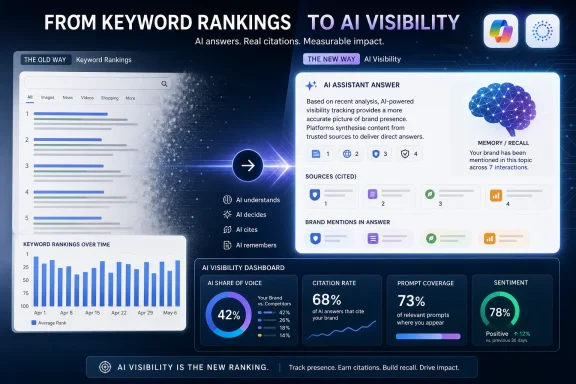
Analytics Insight’s roundup captures this market shift by emphasizing metrics such as brand mentions, citations, prompt coverage, competitor visibility, sentiment, and AI Share of Voice. Those are not cosmetic add-ons to SEO. They are an admission that the old unit of search visibility — the ranked page — is no longer enough.
That is a very different job from checking whether a page ranks third for “best endpoint protection for small business.” A conventional rank tracker can query Google, log the result, and compare movement over time. An AI visibility tool has to test prompts, variants, locations, models, citation behavior, and answer language — all while the underlying systems change frequently.
This is why platforms such as Profound and AthenaHQ are being pitched to enterprises rather than casual bloggers. Large companies do not merely want to know whether they appeared in an answer. They want to know whether the answer was favorable, whether competitors appeared first, whether the citation came from their own domain or a third-party publisher, and whether the pattern changed after a product launch, content refresh, analyst report, or reputation event.
In that sense, AI visibility tracking looks less like old SEO software and more like a hybrid of search analytics, media monitoring, brand intelligence, and competitive research. The dashboard is not just watching the SERP. It is watching the machine’s learned public narrative.
That is why the Analytics Insight list leans heavily on tools that monitor Google AI Overviews and AI Mode. For many businesses, Google’s AI layer is the first place where AI search becomes impossible to ignore. A brand may not care whether a niche chatbot mentions it, but it will care if Google summarizes a buying journey before users ever reach organic results.
The difficult part is that Google’s AI results are dynamic. They vary by query phrasing, location, user context, source availability, and system updates. A company may be cited for one version of a question and absent from another nearly identical version. That variability makes AI tracking both valuable and dangerous: valuable because humans cannot manually monitor it at scale, dangerous because weak tooling can create a false sense of precision.
This is where marketers need to be careful. “AI Share of Voice” sounds authoritative, but it is only as good as the prompt set, sampling method, platform coverage, and refresh rate behind it. A vendor that tests a narrow bundle of generic prompts may produce a comforting chart while missing the long-tail questions that actually shape buyer behavior.
For a large vendor, the question is rarely “Are we mentioned?” It is “Are we mentioned in the right category, against the right competitors, in the right markets, with the right description?” If Copilot describes a security platform as legacy, if ChatGPT recommends competitors for a procurement query, or if Google AI Overviews cite outdated third-party pages, the issue becomes strategic rather than tactical.
AthenaHQ, as described by Analytics Insight, attacks the attribution problem more directly. Its appeal is not simply that it tracks visibility, but that it tries to connect AI mentions and citations to business outcomes. That is the hard edge of the category, because marketers will eventually ask whether AI visibility predicts pipeline, conversions, branded search lift, or referral traffic.
The industry is still early in proving those relationships. AI answers may influence buyers without producing clean referral data. A user can read an AI-generated recommendation, open a new tab, search the brand name, and convert later through a channel that looks unrelated. Traditional attribution already struggled with messy customer journeys; AI makes the mess harder to see.
Ahrefs says Brand Radar tracks brand visibility across AI answers and other influence channels, while its help material describes prompt-based monitoring across major AI platforms. Semrush describes its AI Visibility Toolkit as a way to connect traditional SEO with AI visibility, including Google AI Overviews, AI Mode, Gemini, and ChatGPT.
That integration is powerful. A marketer can compare old and new visibility signals in one environment: the keyword that used to drive traffic, the AI Overview that now summarizes the topic, the competitors named in the answer, and the sources being cited. This helps teams avoid treating AI optimization as a mystical new discipline detached from normal content strategy.
But the incumbents also face a risk. If AI visibility becomes a checkbox inside a sprawling SEO suite, teams may underinvest in the deeper analysis required. A brand mention in an AI answer is not automatically good news. The answer may describe the company inaccurately, cite a weak source, omit a key product, or recommend the brand in a context that does not match its positioning.
That middle of the market may be where the most experimentation happens. Agencies need client-ready reports. SaaS startups need to understand whether AI systems understand their category. Local businesses want to know whether AI answers name them when users ask for services nearby. Publishers want to know whether they are being cited or merely scraped into invisibility.
The appeal of focused tools is speed. They can ship prompt tracking, alerting, citation analysis, and competitor comparisons without dragging users through a full SEO suite. The danger is fragmentation. A business may end up using one tool for Google AI Overviews, another for ChatGPT, another for Perplexity, and another for conventional rankings.
That fragmentation will not last forever. The category is likely to consolidate, either through acquisitions or through larger SEO platforms copying the best specialist features. Until then, the best tool depends less on brand prestige than on the questions a team actually needs answered.
The practical version of GEO is not magic. It means publishing clear, authoritative, well-structured information that AI systems can retrieve, understand, and trust. It means making product pages, documentation, comparisons, case studies, author bios, schema markup, and third-party mentions consistent enough that models do not have to guess what a company does.
It also means accepting that a brand’s own website is only part of the answer. AI systems often lean on review sites, media coverage, documentation, forums, Reddit threads, knowledge bases, and other public sources. A company that polishes its homepage but ignores stale documentation, angry community threads, or outdated comparison pages may discover that AI search reflects the messier public record.
For WindowsForum readers, this should sound familiar. Microsoft’s ecosystem has long rewarded documentation quality, community trust, and third-party validation. Whether the subject is Windows deployment, endpoint management, Azure migration, or Copilot adoption, AI systems are more likely to surface sources that appear consistent, specific, and corroborated.
Brand mentions matter when they show whether an AI system includes a company in the buyer’s mental shortlist. Citation rate matters when it reveals whether a company’s own content is trusted as a source or whether third-party pages control the narrative. Prompt coverage matters when it shows which real customer questions trigger visibility and which leave the brand absent.
Competitor visibility may be the most immediately actionable metric. If a rival appears consistently in AI-generated answers for “best zero trust tools for mid-sized companies” or “top accounting software for manufacturers,” the losing brand can inspect the cited sources, content gaps, and category language. That is closer to competitive intelligence than old rank tracking.
Sentiment is trickier. AI-generated sentiment can be unstable, and automated scoring often misses nuance. Still, if a model repeatedly describes a company as expensive, complex, outdated, risky, or best suited only for large enterprises, marketing teams should treat that as a signal worth investigating.
This creates a measurement paradox. The market needs AI tracking precisely because AI answers are unstable, but that instability makes tracking hard to standardize. A dashboard may show declining visibility when the real cause is a model update, a prompt sampling change, a temporary retrieval issue, or a shift in the tool’s own methodology.
Vendors should therefore be judged by transparency. Serious platforms should explain which AI systems they query, how often they refresh results, how prompts are generated, how locations are handled, how citations are counted, and how they distinguish a passing mention from a meaningful recommendation. Without that, AI Share of Voice risks becoming the new “domain authority”: useful as a directional signal, dangerous when treated as a law of physics.
Businesses should also keep humans in the loop. If an AI tracker flags a drop in visibility, someone should read the actual answers. The wording matters. A brand that appears third in a generated paragraph may still be strongly recommended; a brand that appears first may be mentioned only as a comparison point.
This is especially relevant for managed service providers, independent software vendors, cybersecurity firms, training companies, and consultants that sell into Microsoft-heavy environments. If an IT admin asks Copilot for guidance on endpoint backup, patch management, Windows 11 migration, Microsoft 365 hardening, or Azure cost control, the answer may shape which vendors get investigated.
That does not mean Copilot instantly replaces procurement research. Enterprise buyers still read documentation, talk to peers, evaluate security claims, and run pilots. But AI answers can define the starting set. In crowded categories, being absent from the starting set is commercially painful.
The Microsoft ecosystem also has an unusually rich web of public documentation, support articles, Learn pages, forums, GitHub repositories, partner pages, and community discussions. AI systems can draw from all of that. Companies that want visibility in Microsoft-adjacent AI answers need to think beyond marketing copy and invest in technical clarity, supportability, and public credibility.
A local service business cares about different AI answers than a global software vendor. A cybersecurity startup needs to know whether it appears in high-intent comparison prompts. A publisher needs to know whether AI answers cite its reporting or paraphrase the topic without sending traffic. A Windows consultancy needs to know whether Copilot, ChatGPT, and Google AI Mode surface its expertise when admins ask implementation questions.
The buying process should therefore start with a prompt map. List the questions customers ask before they know your brand, while comparing vendors, during procurement, and after purchase. Then test which platforms influence those moments. A tool that does not monitor the relevant prompts and AI systems is not a bargain, no matter how polished the dashboard looks.
Teams should also ask whether they need monitoring, diagnosis, or optimization. Monitoring tells you what happened. Diagnosis explains why. Optimization suggests what to change. The best platforms are moving toward all three, but many still excel at only one.
This will also create new internal politics. SEO teams will own part of the workflow, but brand teams will care about sentiment, communications teams will care about media citations, product marketing will care about category language, and executives will care about competitive share. IT may be pulled in when the visibility problem touches documentation systems, content management, analytics integration, or data governance.
There is also a security and compliance dimension. Regulated businesses will want to know if AI systems are giving outdated, noncompliant, or misleading descriptions of their services. Healthcare, finance, legal, and enterprise software firms cannot treat AI-generated misinformation as a quirky edge case if it affects customer decisions.
The winners in this category will be the tools that make AI visibility operational rather than theatrical. A useful platform should help a team decide what content to update, which third-party sources matter, which prompts are strategically important, and whether changes actually moved the market’s AI-mediated understanding.
The concrete lessons from the current crop of AI visibility tools are already clear:
 Search Has Moved From Blue Links to Borrowed Authority
For two decades, search engine optimization had a mostly stable bargain. A business created pages, Google indexed them, users saw a ranked list, and analytics software translated that exchange into impressions, rankings, clicks, conversions, and revenue. The process was imperfect, often gamed, and sometimes maddening, but it was measurable enough to build a profession around it.AI search breaks that bargain. Google’s AI Overviews, Google AI Mode, ChatGPT search, Perplexity, Gemini, Claude, and Microsoft Copilot increasingly synthesize answers directly inside the interface. OpenAI described ChatGPT search as a way to provide timely answers with links to web sources, while Google’s Search team has framed AI Mode as a deeper, Gemini-powered search experience for more complex queries.
That framing matters because these systems do not merely rearrange the search results page. They compress discovery, evaluation, and recommendation into a single generated response. If an AI answer says a particular backup product, law firm, managed service provider, or cybersecurity vendor is worth considering, that mention may carry commercial value even if no traditional click occurs.
Analytics Insight’s roundup captures this market shift by emphasizing metrics such as brand mentions, citations, prompt coverage, competitor visibility, sentiment, and AI Share of Voice. Those are not cosmetic add-ons to SEO. They are an admission that the old unit of search visibility — the ranked page — is no longer enough.
The New SEO Dashboard Is Really a Memory Test
The most important phrase in the AI visibility market is not “ranking.” It is recall. These tools are trying to answer whether large language models and AI search systems retrieve, cite, summarize, or recommend a brand when users ask commercially meaningful questions.That is a very different job from checking whether a page ranks third for “best endpoint protection for small business.” A conventional rank tracker can query Google, log the result, and compare movement over time. An AI visibility tool has to test prompts, variants, locations, models, citation behavior, and answer language — all while the underlying systems change frequently.
This is why platforms such as Profound and AthenaHQ are being pitched to enterprises rather than casual bloggers. Large companies do not merely want to know whether they appeared in an answer. They want to know whether the answer was favorable, whether competitors appeared first, whether the citation came from their own domain or a third-party publisher, and whether the pattern changed after a product launch, content refresh, analyst report, or reputation event.
In that sense, AI visibility tracking looks less like old SEO software and more like a hybrid of search analytics, media monitoring, brand intelligence, and competitive research. The dashboard is not just watching the SERP. It is watching the machine’s learned public narrative.
Google’s AI Mode Turns the Pressure Up
Google remains the gravitational center of search, so its AI push gives this category urgency. Google introduced AI Overviews broadly in 2024 and later expanded AI Mode as a more immersive AI search experience. In Google’s own product writing, AI Mode is not presented as a side experiment; it is a new way to handle complex, multi-part queries using Gemini and Google’s information systems.That is why the Analytics Insight list leans heavily on tools that monitor Google AI Overviews and AI Mode. For many businesses, Google’s AI layer is the first place where AI search becomes impossible to ignore. A brand may not care whether a niche chatbot mentions it, but it will care if Google summarizes a buying journey before users ever reach organic results.
The difficult part is that Google’s AI results are dynamic. They vary by query phrasing, location, user context, source availability, and system updates. A company may be cited for one version of a question and absent from another nearly identical version. That variability makes AI tracking both valuable and dangerous: valuable because humans cannot manually monitor it at scale, dangerous because weak tooling can create a false sense of precision.
This is where marketers need to be careful. “AI Share of Voice” sounds authoritative, but it is only as good as the prompt set, sampling method, platform coverage, and refresh rate behind it. A vendor that tests a narrow bundle of generic prompts may produce a comforting chart while missing the long-tail questions that actually shape buyer behavior.
The Enterprise Tools Are Selling Confidence, Not Just Coverage
Analytics Insight identifies Profound as a strong enterprise option because it supports major AI search surfaces and can track thousands of prompts across industries and regions. That positioning makes sense. Enterprises have the most to lose from invisible AI answers because they operate across product lines, geographies, and buyer personas.For a large vendor, the question is rarely “Are we mentioned?” It is “Are we mentioned in the right category, against the right competitors, in the right markets, with the right description?” If Copilot describes a security platform as legacy, if ChatGPT recommends competitors for a procurement query, or if Google AI Overviews cite outdated third-party pages, the issue becomes strategic rather than tactical.
AthenaHQ, as described by Analytics Insight, attacks the attribution problem more directly. Its appeal is not simply that it tracks visibility, but that it tries to connect AI mentions and citations to business outcomes. That is the hard edge of the category, because marketers will eventually ask whether AI visibility predicts pipeline, conversions, branded search lift, or referral traffic.
The industry is still early in proving those relationships. AI answers may influence buyers without producing clean referral data. A user can read an AI-generated recommendation, open a new tab, search the brand name, and convert later through a channel that looks unrelated. Traditional attribution already struggled with messy customer journeys; AI makes the mess harder to see.
Ahrefs and Semrush Want AI Tracking to Become Just Another SEO Layer
The arrival of Ahrefs Brand Radar and Semrush AI Toolkit is important because these companies already sit inside many marketing departments. They do not have to convince users that search measurement matters. They only have to convince them that AI visibility belongs in the same workflow as keyword research, backlink analysis, content audits, and competitor monitoring.Ahrefs says Brand Radar tracks brand visibility across AI answers and other influence channels, while its help material describes prompt-based monitoring across major AI platforms. Semrush describes its AI Visibility Toolkit as a way to connect traditional SEO with AI visibility, including Google AI Overviews, AI Mode, Gemini, and ChatGPT.
That integration is powerful. A marketer can compare old and new visibility signals in one environment: the keyword that used to drive traffic, the AI Overview that now summarizes the topic, the competitors named in the answer, and the sources being cited. This helps teams avoid treating AI optimization as a mystical new discipline detached from normal content strategy.
But the incumbents also face a risk. If AI visibility becomes a checkbox inside a sprawling SEO suite, teams may underinvest in the deeper analysis required. A brand mention in an AI answer is not automatically good news. The answer may describe the company inaccurately, cite a weak source, omit a key product, or recommend the brand in a context that does not match its positioning.
Smaller Tools Are Winning on Focus and Speed
Not every business needs an enterprise command center. Analytics Insight points to Otterly.AI as a simpler entry point for freelancers, consultants, and small agencies, while Peec AI is framed as a fast-growing GEO platform with a clean dashboard. Tools such as Nightwatch, SE Ranking, Rankshift, and Dageno AI occupy the practical middle ground: less sprawling than enterprise intelligence platforms, more AI-specific than traditional rank trackers.That middle of the market may be where the most experimentation happens. Agencies need client-ready reports. SaaS startups need to understand whether AI systems understand their category. Local businesses want to know whether AI answers name them when users ask for services nearby. Publishers want to know whether they are being cited or merely scraped into invisibility.
The appeal of focused tools is speed. They can ship prompt tracking, alerting, citation analysis, and competitor comparisons without dragging users through a full SEO suite. The danger is fragmentation. A business may end up using one tool for Google AI Overviews, another for ChatGPT, another for Perplexity, and another for conventional rankings.
That fragmentation will not last forever. The category is likely to consolidate, either through acquisitions or through larger SEO platforms copying the best specialist features. Until then, the best tool depends less on brand prestige than on the questions a team actually needs answered.
GEO Is a Useful Term With a Marketing Problem
Generative engine optimization, or GEO, is the industry’s attempt to name the work of becoming visible in AI-generated answers. The term is useful because it separates AI answer visibility from conventional SEO. It is also awkward because it invites the same hype cycle that turned SEO into a swamp of miracle tactics.The practical version of GEO is not magic. It means publishing clear, authoritative, well-structured information that AI systems can retrieve, understand, and trust. It means making product pages, documentation, comparisons, case studies, author bios, schema markup, and third-party mentions consistent enough that models do not have to guess what a company does.
It also means accepting that a brand’s own website is only part of the answer. AI systems often lean on review sites, media coverage, documentation, forums, Reddit threads, knowledge bases, and other public sources. A company that polishes its homepage but ignores stale documentation, angry community threads, or outdated comparison pages may discover that AI search reflects the messier public record.
For WindowsForum readers, this should sound familiar. Microsoft’s ecosystem has long rewarded documentation quality, community trust, and third-party validation. Whether the subject is Windows deployment, endpoint management, Azure migration, or Copilot adoption, AI systems are more likely to surface sources that appear consistent, specific, and corroborated.
The Metrics That Matter Are the Ones That Survive a Budget Meeting
The new AI tracking vocabulary can sound abstract: prompt coverage, citation share, answer sentiment, model visibility, AI Share of Voice. The useful test is whether each metric can drive a decision. If it cannot, it is dashboard decoration.Brand mentions matter when they show whether an AI system includes a company in the buyer’s mental shortlist. Citation rate matters when it reveals whether a company’s own content is trusted as a source or whether third-party pages control the narrative. Prompt coverage matters when it shows which real customer questions trigger visibility and which leave the brand absent.
Competitor visibility may be the most immediately actionable metric. If a rival appears consistently in AI-generated answers for “best zero trust tools for mid-sized companies” or “top accounting software for manufacturers,” the losing brand can inspect the cited sources, content gaps, and category language. That is closer to competitive intelligence than old rank tracking.
Sentiment is trickier. AI-generated sentiment can be unstable, and automated scoring often misses nuance. Still, if a model repeatedly describes a company as expensive, complex, outdated, risky, or best suited only for large enterprises, marketing teams should treat that as a signal worth investigating.
The Accuracy Problem Cannot Be Hand-Waved Away
AI visibility tools inherit the uncertainty of the systems they monitor. Generative search answers can change across time, region, account state, phrasing, and model version. They can cite sources inconsistently. They can also generate claims that are not fully supported by the pages they reference, a problem that researchers continue to study in AI Overviews and other answer engines.This creates a measurement paradox. The market needs AI tracking precisely because AI answers are unstable, but that instability makes tracking hard to standardize. A dashboard may show declining visibility when the real cause is a model update, a prompt sampling change, a temporary retrieval issue, or a shift in the tool’s own methodology.
Vendors should therefore be judged by transparency. Serious platforms should explain which AI systems they query, how often they refresh results, how prompts are generated, how locations are handled, how citations are counted, and how they distinguish a passing mention from a meaningful recommendation. Without that, AI Share of Voice risks becoming the new “domain authority”: useful as a directional signal, dangerous when treated as a law of physics.
Businesses should also keep humans in the loop. If an AI tracker flags a drop in visibility, someone should read the actual answers. The wording matters. A brand that appears third in a generated paragraph may still be strongly recommended; a brand that appears first may be mentioned only as a comparison point.
The Windows Angle Is Copilot, Bing, and the Enterprise Buyer
For WindowsForum’s audience, the AI search story is not just about marketing teams chasing Google. Microsoft Copilot sits at the intersection of search, productivity software, enterprise identity, and Windows itself. As Copilot experiences become more embedded across Microsoft’s ecosystem, the way Microsoft’s AI surfaces vendors, documentation, support answers, and product recommendations will matter to IT decision-making.This is especially relevant for managed service providers, independent software vendors, cybersecurity firms, training companies, and consultants that sell into Microsoft-heavy environments. If an IT admin asks Copilot for guidance on endpoint backup, patch management, Windows 11 migration, Microsoft 365 hardening, or Azure cost control, the answer may shape which vendors get investigated.
That does not mean Copilot instantly replaces procurement research. Enterprise buyers still read documentation, talk to peers, evaluate security claims, and run pilots. But AI answers can define the starting set. In crowded categories, being absent from the starting set is commercially painful.
The Microsoft ecosystem also has an unusually rich web of public documentation, support articles, Learn pages, forums, GitHub repositories, partner pages, and community discussions. AI systems can draw from all of that. Companies that want visibility in Microsoft-adjacent AI answers need to think beyond marketing copy and invest in technical clarity, supportability, and public credibility.
The Best Tool Is the One That Matches the Search Reality You Actually Face
Analytics Insight’s business-size breakdown is sensible: smaller operators may start with Otterly.AI and Google Search Console, growing businesses may combine SE Ranking and Ahrefs, agencies may lean toward Peec AI or Nightwatch, mid-sized SaaS companies may prefer Ahrefs and Semrush, and enterprises may evaluate Profound and AthenaHQ. But tool selection should begin with search behavior, not company size.A local service business cares about different AI answers than a global software vendor. A cybersecurity startup needs to know whether it appears in high-intent comparison prompts. A publisher needs to know whether AI answers cite its reporting or paraphrase the topic without sending traffic. A Windows consultancy needs to know whether Copilot, ChatGPT, and Google AI Mode surface its expertise when admins ask implementation questions.
The buying process should therefore start with a prompt map. List the questions customers ask before they know your brand, while comparing vendors, during procurement, and after purchase. Then test which platforms influence those moments. A tool that does not monitor the relevant prompts and AI systems is not a bargain, no matter how polished the dashboard looks.
Teams should also ask whether they need monitoring, diagnosis, or optimization. Monitoring tells you what happened. Diagnosis explains why. Optimization suggests what to change. The best platforms are moving toward all three, but many still excel at only one.
The AI Visibility Stack Is Becoming a New Layer of IT and Marketing Infrastructure
The deeper implication of this market is that search visibility is becoming infrastructure. Just as companies eventually standardized on analytics, rank tracking, tag management, and customer data platforms, many will add AI visibility monitoring to the regular operating stack. That will be especially true in sectors where trust, comparison, and recommendation drive revenue.This will also create new internal politics. SEO teams will own part of the workflow, but brand teams will care about sentiment, communications teams will care about media citations, product marketing will care about category language, and executives will care about competitive share. IT may be pulled in when the visibility problem touches documentation systems, content management, analytics integration, or data governance.
There is also a security and compliance dimension. Regulated businesses will want to know if AI systems are giving outdated, noncompliant, or misleading descriptions of their services. Healthcare, finance, legal, and enterprise software firms cannot treat AI-generated misinformation as a quirky edge case if it affects customer decisions.
The winners in this category will be the tools that make AI visibility operational rather than theatrical. A useful platform should help a team decide what content to update, which third-party sources matter, which prompts are strategically important, and whether changes actually moved the market’s AI-mediated understanding.
The Dashboards Are New, but the Discipline Is Familiar
AI search has made visibility harder to measure, but it has not repealed the basics of trust. The brands most likely to perform well in generated answers are those that publish clear information, earn credible mentions, maintain accurate documentation, and explain their products in language customers actually use. The difference is that the audience now includes machines summarizing those signals at scale.The concrete lessons from the current crop of AI visibility tools are already clear:
- Businesses should track AI answers separately from traditional rankings because a brand can lose clicks while gaining influence inside generated responses.
- Teams should evaluate tools by platform coverage, prompt methodology, citation tracking, refresh frequency, and transparency rather than by dashboard polish alone.
- Enterprise buyers should pay close attention to attribution features because AI mentions without business context are difficult to defend in a budget meeting.
- Smaller teams should start with a narrow set of high-value prompts before paying for broad monitoring they may not know how to use.
- SEO, communications, product marketing, and documentation teams should treat AI visibility as a shared responsibility rather than a single-channel metric.
- Human review remains essential because generated answers can be unstable, nuanced, or wrong in ways that aggregate scores may hide.
References
- Primary source: Analytics Insight
Published: 2026-07-07T04:00:13.081844
Loading…
www.analyticsinsight.net - Related coverage: blog.google
Expanding AI Overviews and introducing AI Mode
AI Mode is a new generative AI experiment in Google Search.blog.google
- Related coverage: techradar.com
Loading…
www.techradar.com - Related coverage: search.google
Loading…
search.google