

Vanessa Gordon, a mother of two, is trying to manage her 8- and 12-year-old children’s use of Snapchat on her own phone after a Christmas filter game turned into a recurring after-school demand for access. The story, reported by NewsAnyway, is small in scale but large in implication: this is what platform policy looks like when it lands in a kitchen, a hallway, and a parent’s unlocked handset. Gordon is not debating whether her children should own phones. She is confronting the more awkward modern question: what happens when children start using phone-native social software before the family has formally crossed the “first phone” threshold?
For years, parents treated the first smartphone as the decisive moment. Before the device, there was childhood; after the device, there was messaging, social media, group chats, location sharing, and the long administrative tail of parental controls. That boundary was always more psychological than technical, but it at least gave families a visible line to argue over.
Gordon’s household shows why that line is weakening. Her children do not own phones, yet Snapchat has entered the home through her device, first as a shared toy and then as a recurring social ritual. The app did not arrive as a dark-web temptation or a secret download. It arrived as face filters, games, novelty, and the irresistible silliness of seeing the family transformed on screen.
That matters because many of the debates around children and social platforms still assume a clean sequence: child gets device, child creates account, parent enables controls, platform applies teen settings. Real life is messier. A child can learn the rhythms of an app before owning the hardware that normally anchors it.
The result is a new parental gray zone. Gordon is not managing an independent Snapchat account in the conventional sense; she is managing mediated access through her own phone. But the child’s experience of the platform — anticipation, social checking, novelty seeking, and the pull of replies — is already forming.
The platform also offers Family Center for parents and teens, but that tool is designed for users aged 13 to 17 and for parents or caregivers aged 18 and older. Snapchat describes it as a way for parents to see who their teen is friends with, who they have recently communicated with, group-chat membership, recently added friends, privacy settings, and location information when shared. It is explicitly not a tool for reading private conversations.
That design reflects the compromise most major platforms now want to sell: more visibility for parents without turning the app into a surveillance console. In principle, it respects adolescent privacy while giving adults enough metadata to notice risky patterns. In practice, it does little for an 8-year-old who likes filters or a 12-year-old who wants to know whether friends sent a new Snap after school.
This is where the platform’s clean age threshold collides with family improvisation. Gordon can say, truthfully, that Snapchat is not for her children yet. But her children have already experienced enough of it to know what they are being denied.
That is the trap. Age limits are useful as external authority, but they are not the same thing as product containment. Once the app has become a shared family entertainment object, the parent has to reassert a boundary around something the family previously introduced as harmless fun.
That is not incidental. Snapchat’s genius has always been that it makes the camera feel like a playground before it makes the network feel like infrastructure. A child does not need to understand streaks, private messaging, location sharing, or audience dynamics to understand a funny lens. The first hook is creative and immediate.
For Sarah, 8, that may still be the main attraction. She is reportedly more restrained, drawn by the novelty of new filters. That pattern is easier for a parent to supervise because the activity remains visibly local: open the app, make a silly image, save it to the parent’s phone, close the app.
Ben, 12, is different. He is not merely asking for the camera. He is asking whether friends have sent anything new. That shift turns the phone from a toy into a social mailbox, and it changes the parental problem from “how much screen time?” to “what social expectation is being trained?”
The distinction is crucial. Creative play can be bounded by time, place, and supervision. Social checking is harder because the stimulus is elsewhere. The phone becomes a portal to other children’s timing, other families’ rules, and the ambient pressure of not wanting to be absent.
In an enterprise, IT administrators would call this controlled access, limited permissions, data retention, and disabled external publishing. At home, it looks like a mother standing nearby while a child borrows a phone. The difference is vocabulary, not function.
The burden is obvious. Platform controls can automate some restrictions once a teen is old enough to use the service, but Gordon’s children are below that threshold. She cannot outsource judgment to Family Center because, by Snapchat’s own rules, this is not yet a legitimate teen account scenario. She has to be the age gate, the session timer, the content moderator, and the network firewall.
That arrangement can work in short bursts, and Gordon appears to be doing the responsible version of it. But it is labor-intensive. It depends on her availability, consistency, and willingness to absorb the emotional friction every time the answer is “not now.”
This is the hidden cost of child safety online. Companies publish policies; parents enforce reality. The policy says “13.” The child says “just one more.” The parent has to translate a legal and product boundary into a domestic one.
The American Academy of Pediatrics has moved away from treating all screen minutes as equal. Its guidance emphasizes the quality of media use, family context, sleep, physical activity, and the displacement of healthier routines. That is a more demanding standard than simply counting minutes.
Gordon’s approach reflects both eras of advice. She uses time limits because time still matters. But she is also watching what the habit replaces: decompression after school, reading, outdoor play, boredom, and the slower social work of friendships that do not depend on instant replies.
That is the more mature version of the screen-time conversation. The risk is not that a 20-minute supervised Snapchat session automatically harms a child. The risk is that the first instinct after school becomes checking for digital social proof before doing anything else.
For Ben, the after-school reach for the phone is the flashing indicator. It suggests that Snapchat is becoming part of the transition ritual between school and home. Parents know these rituals matter because they harden quickly. What begins as “Can I see if someone sent something?” can become the default emotional landing pad for the afternoon.
That may sound quaint, but it is probably closer to effective media parenting than most dashboard-based solutions. The point is not to romanticize analog life or pretend that libraries and beaches can defeat social media. The point is that children need attractive alternatives before a phone fills the empty space.
A rule without replacement becomes a dare. A denied app with nowhere else for the child’s energy to go becomes more desirable, not less. Gordon appears to understand that the answer to a compelling digital environment is not merely prohibition; it is a competing schedule.
The library and beach also solve a problem that software controls cannot. They change the physical context. A child on a beach with patchy signal is not simply a child being blocked from Snapchat. He is a child whose body, attention, and surroundings are being pulled into a different mode.
That distinction is easy to miss in policy debates. Parents are often told to configure settings, review privacy menus, and discuss online safety. They should do those things. But sometimes the most powerful control is still leaving the house.
This is where parental resolve becomes complicated. Saying no to a toy is one thing. Saying no to a social channel can feel like making your child absent from a room where friendships are being maintained. The fear is not just tantrums; it is exclusion.
Gordon is right to take that seriously. Children do not experience peer communication as a policy problem. They experience it as belonging. If a group chat, Snap exchange, or running joke becomes part of the social fabric, the child outside it can feel punished for a decision made by adults.
But inclusion is not a trump card. It is possible for a tool to provide social access while also accelerating pressures a child is not ready to manage. The fact that peers have an app does not prove the app is developmentally appropriate; it proves only that other families have made a different trade-off.
That is the parent’s uncomfortable job: to distinguish genuine isolation from ordinary frustration. A child can be temporarily annoyed and still be protected. A child can also be meaningfully excluded, and a rigid parent can miss it. There is no universal switch that resolves that tension.
That does not mean the parental answer must automatically change. Thirteen is a compliance threshold, not a developmental guarantee. It tells a company when it may generally allow an account under its rules; it does not tell a family when a particular child is ready for messaging, posting, friend management, or the emotional mechanics of social feedback.
This is one of the weaknesses of platform age limits. They are necessary, but they can create false finality. Before 13, parents can point to the rule. After 13, the conversation shifts from eligibility to readiness, and readiness is harder to explain to a child who has been counting down to a birthday.
Family Center may help at that stage, but it will not settle the matter. Snapchat’s parental tools provide visibility into connections and recent communications, not full knowledge of context or intent. They are guardrails, not a substitute for judgment.
For Gordon, the real decision will not be whether Ben can technically have Snapchat. It will be whether the family can define terms that preserve trust without pretending the app is harmless. That is a harder contract than a simple yes or no.
The partial nature is not always a flaw. Teenagers do deserve some privacy, and a system that lets parents silently read every message would create its own risks. But partial control is often marketed with a confidence that exceeds what the tools actually provide.
Parents are left managing the gap between platform language and household reality. “Family Center” sounds comprehensive. In practice, it is a defined set of visibility features for eligible teen accounts. It does not solve underage use, shared-device access, peer pressure, or the practical problem of a child repeatedly asking for a parent’s phone.
This is familiar territory for IT professionals. A management console is only as good as the environment it actually governs. Shadow IT exists at home too, except the unauthorized user may be a child at the kitchen counter and the unmanaged device may be the parent’s own phone.
The lesson is not that parental tools are useless. It is that they should be treated as one layer in a broader system: family rules, device ownership decisions, account eligibility, physical routines, and repeated conversations about why the boundary exists.
That “before” period is more consequential than many parents assume. It is when children learn what an app is for, how often it should be checked, what kind of emotional reward it provides, and whether access is something negotiated minute by minute. By the time the official account arrives, the appetite may already be trained.
This is why supervised access can be both sensible and risky. It is sensible because it keeps the parent present and prevents secretive use. It is risky because even controlled exposure can normalize the app as part of daily life. The answer depends on whether the parent is using supervision as a bridge to literacy or as a pressure valve that quietly expands.
Gordon seems alert to that danger. Her restrictions are not merely about avoiding bad content. They are about slowing the pace at which Snapchat becomes ordinary. She is trying to preserve the idea that access is conditional, not ambient.
That distinction may be the most valuable thing a parent can teach. The modern internet trains children to experience availability as entitlement. A family rule that says “not all available things are yours to use whenever you want” is not anti-technology. It is basic digital citizenship.
That is where more families are heading. The first-phone debate will not disappear, but it is no longer enough, because apps now enter children’s lives through parents’ devices, school friends, shared tablets, game consoles, browsers, and borrowed moments. The next phase of digital parenting will be less about finding the perfect age for a device and more about recognizing the first signs of dependency before ownership makes them harder to unwind.
 The First Phone Is No Longer the First Gate
For years, parents treated the first smartphone as the decisive moment. Before the device, there was childhood; after the device, there was messaging, social media, group chats, location sharing, and the long administrative tail of parental controls. That boundary was always more psychological than technical, but it at least gave families a visible line to argue over.Gordon’s household shows why that line is weakening. Her children do not own phones, yet Snapchat has entered the home through her device, first as a shared toy and then as a recurring social ritual. The app did not arrive as a dark-web temptation or a secret download. It arrived as face filters, games, novelty, and the irresistible silliness of seeing the family transformed on screen.
That matters because many of the debates around children and social platforms still assume a clean sequence: child gets device, child creates account, parent enables controls, platform applies teen settings. Real life is messier. A child can learn the rhythms of an app before owning the hardware that normally anchors it.
The result is a new parental gray zone. Gordon is not managing an independent Snapchat account in the conventional sense; she is managing mediated access through her own phone. But the child’s experience of the platform — anticipation, social checking, novelty seeking, and the pull of replies — is already forming.
Snapchat’s Age Line Is Clear, but Family Life Is Not
Snapchat’s public position is straightforward. The company says the minimum age to use Snapchat is 13, with higher minimums possible in some jurisdictions, and its parent-facing safety materials state that if Snap determines an account belongs to someone under 13, the account is terminated and associated data is deleted. That policy puts both of Gordon’s children outside the normal eligibility boundary.The platform also offers Family Center for parents and teens, but that tool is designed for users aged 13 to 17 and for parents or caregivers aged 18 and older. Snapchat describes it as a way for parents to see who their teen is friends with, who they have recently communicated with, group-chat membership, recently added friends, privacy settings, and location information when shared. It is explicitly not a tool for reading private conversations.
That design reflects the compromise most major platforms now want to sell: more visibility for parents without turning the app into a surveillance console. In principle, it respects adolescent privacy while giving adults enough metadata to notice risky patterns. In practice, it does little for an 8-year-old who likes filters or a 12-year-old who wants to know whether friends sent a new Snap after school.
This is where the platform’s clean age threshold collides with family improvisation. Gordon can say, truthfully, that Snapchat is not for her children yet. But her children have already experienced enough of it to know what they are being denied.
That is the trap. Age limits are useful as external authority, but they are not the same thing as product containment. Once the app has become a shared family entertainment object, the parent has to reassert a boundary around something the family previously introduced as harmless fun.
Filters Are the Soft Launch of Social Media
The most revealing part of Gordon’s story is that the entry point was not messaging. It was filters, backgrounds, a basketball game, and a cup-and-ball challenge. In other words, Snapchat arrived less like a social network than like a camera toy.That is not incidental. Snapchat’s genius has always been that it makes the camera feel like a playground before it makes the network feel like infrastructure. A child does not need to understand streaks, private messaging, location sharing, or audience dynamics to understand a funny lens. The first hook is creative and immediate.
For Sarah, 8, that may still be the main attraction. She is reportedly more restrained, drawn by the novelty of new filters. That pattern is easier for a parent to supervise because the activity remains visibly local: open the app, make a silly image, save it to the parent’s phone, close the app.
Ben, 12, is different. He is not merely asking for the camera. He is asking whether friends have sent anything new. That shift turns the phone from a toy into a social mailbox, and it changes the parental problem from “how much screen time?” to “what social expectation is being trained?”
The distinction is crucial. Creative play can be bounded by time, place, and supervision. Social checking is harder because the stimulus is elsewhere. The phone becomes a portal to other children’s timing, other families’ rules, and the ambient pressure of not wanting to be absent.
The Parent Becomes the Operating System
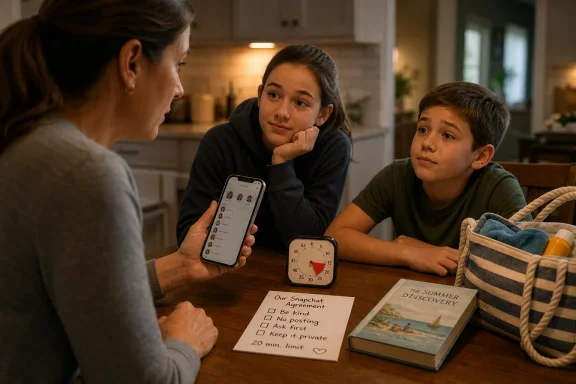
Gordon’s rules are precise: supervised use, short sessions of around 20 minutes, no free messaging, no posting, and photos saved only to her phone. Those are not casual preferences. They are the human equivalent of a device-management policy.In an enterprise, IT administrators would call this controlled access, limited permissions, data retention, and disabled external publishing. At home, it looks like a mother standing nearby while a child borrows a phone. The difference is vocabulary, not function.
The burden is obvious. Platform controls can automate some restrictions once a teen is old enough to use the service, but Gordon’s children are below that threshold. She cannot outsource judgment to Family Center because, by Snapchat’s own rules, this is not yet a legitimate teen account scenario. She has to be the age gate, the session timer, the content moderator, and the network firewall.
That arrangement can work in short bursts, and Gordon appears to be doing the responsible version of it. But it is labor-intensive. It depends on her availability, consistency, and willingness to absorb the emotional friction every time the answer is “not now.”
This is the hidden cost of child safety online. Companies publish policies; parents enforce reality. The policy says “13.” The child says “just one more.” The parent has to translate a legal and product boundary into a domestic one.
Screen Time Was the Easy Argument
The familiar screen-time debate is not absent here. Common Sense Media’s 2021 census found that tweens aged 8 to 12 averaged 5 hours and 33 minutes of entertainment screen media per day, a figure widely cited in pediatric discussions. That number is startling, but it can also flatten the issue.The American Academy of Pediatrics has moved away from treating all screen minutes as equal. Its guidance emphasizes the quality of media use, family context, sleep, physical activity, and the displacement of healthier routines. That is a more demanding standard than simply counting minutes.
Gordon’s approach reflects both eras of advice. She uses time limits because time still matters. But she is also watching what the habit replaces: decompression after school, reading, outdoor play, boredom, and the slower social work of friendships that do not depend on instant replies.
That is the more mature version of the screen-time conversation. The risk is not that a 20-minute supervised Snapchat session automatically harms a child. The risk is that the first instinct after school becomes checking for digital social proof before doing anything else.
For Ben, the after-school reach for the phone is the flashing indicator. It suggests that Snapchat is becoming part of the transition ritual between school and home. Parents know these rituals matter because they harden quickly. What begins as “Can I see if someone sent something?” can become the default emotional landing pad for the afternoon.
The Beach Is a Better Parental Control Than the Toggle
Gordon’s counter-programming is striking because it is not primarily technical. She takes the children to the library on Monday and Wednesday evenings, especially when it rains. On dry days, she takes them to the beach, where weak or absent mobile signal becomes an ally rather than an inconvenience.That may sound quaint, but it is probably closer to effective media parenting than most dashboard-based solutions. The point is not to romanticize analog life or pretend that libraries and beaches can defeat social media. The point is that children need attractive alternatives before a phone fills the empty space.
A rule without replacement becomes a dare. A denied app with nowhere else for the child’s energy to go becomes more desirable, not less. Gordon appears to understand that the answer to a compelling digital environment is not merely prohibition; it is a competing schedule.
The library and beach also solve a problem that software controls cannot. They change the physical context. A child on a beach with patchy signal is not simply a child being blocked from Snapchat. He is a child whose body, attention, and surroundings are being pulled into a different mode.
That distinction is easy to miss in policy debates. Parents are often told to configure settings, review privacy menus, and discuss online safety. They should do those things. But sometimes the most powerful control is still leaving the house.
Inclusion Is the Hardest Argument to Refuse
The strongest case children make for social apps is rarely technological. It is social. Some of Ben’s friends have phones; some of Sarah’s classmates do too. Even if phones are not carried at school, the knowledge that other children can message freely changes the emotional landscape.This is where parental resolve becomes complicated. Saying no to a toy is one thing. Saying no to a social channel can feel like making your child absent from a room where friendships are being maintained. The fear is not just tantrums; it is exclusion.
Gordon is right to take that seriously. Children do not experience peer communication as a policy problem. They experience it as belonging. If a group chat, Snap exchange, or running joke becomes part of the social fabric, the child outside it can feel punished for a decision made by adults.
But inclusion is not a trump card. It is possible for a tool to provide social access while also accelerating pressures a child is not ready to manage. The fact that peers have an app does not prove the app is developmentally appropriate; it proves only that other families have made a different trade-off.
That is the parent’s uncomfortable job: to distinguish genuine isolation from ordinary frustration. A child can be temporarily annoyed and still be protected. A child can also be meaningfully excluded, and a rigid parent can miss it. There is no universal switch that resolves that tension.
Thirteen Is a Threshold, Not a Magic Spell
The obvious future pressure point is Ben’s 13th birthday. Once he reaches Snapchat’s minimum age, the external reason for refusal becomes less clean. The platform will no longer say, in the same simple way, that he is too young to be there.That does not mean the parental answer must automatically change. Thirteen is a compliance threshold, not a developmental guarantee. It tells a company when it may generally allow an account under its rules; it does not tell a family when a particular child is ready for messaging, posting, friend management, or the emotional mechanics of social feedback.
This is one of the weaknesses of platform age limits. They are necessary, but they can create false finality. Before 13, parents can point to the rule. After 13, the conversation shifts from eligibility to readiness, and readiness is harder to explain to a child who has been counting down to a birthday.
Family Center may help at that stage, but it will not settle the matter. Snapchat’s parental tools provide visibility into connections and recent communications, not full knowledge of context or intent. They are guardrails, not a substitute for judgment.
For Gordon, the real decision will not be whether Ben can technically have Snapchat. It will be whether the family can define terms that preserve trust without pretending the app is harmless. That is a harder contract than a simple yes or no.
The Industry Keeps Selling Parents Partial Control
Snapchat is not unusual in offering a supervision product that stops short of full parental command. TikTok, Instagram, YouTube, Google, Apple, Microsoft, and game platforms all operate somewhere on the same spectrum: dashboards, age settings, content filters, screen-time controls, purchase approvals, location settings, and reporting tools. They are useful, but they are partial.The partial nature is not always a flaw. Teenagers do deserve some privacy, and a system that lets parents silently read every message would create its own risks. But partial control is often marketed with a confidence that exceeds what the tools actually provide.
Parents are left managing the gap between platform language and household reality. “Family Center” sounds comprehensive. In practice, it is a defined set of visibility features for eligible teen accounts. It does not solve underage use, shared-device access, peer pressure, or the practical problem of a child repeatedly asking for a parent’s phone.
This is familiar territory for IT professionals. A management console is only as good as the environment it actually governs. Shadow IT exists at home too, except the unauthorized user may be a child at the kitchen counter and the unmanaged device may be the parent’s own phone.
The lesson is not that parental tools are useless. It is that they should be treated as one layer in a broader system: family rules, device ownership decisions, account eligibility, physical routines, and repeated conversations about why the boundary exists.
The Real Risk Is Habit Formation Before Accountability
The most important word in Gordon’s story is not Snapchat. It is “before.” Before her children own phones. Before her son turns 13. Before Family Center applies. Before independent posting or messaging is allowed. Before the family has formally entered the teen social-media era.That “before” period is more consequential than many parents assume. It is when children learn what an app is for, how often it should be checked, what kind of emotional reward it provides, and whether access is something negotiated minute by minute. By the time the official account arrives, the appetite may already be trained.
This is why supervised access can be both sensible and risky. It is sensible because it keeps the parent present and prevents secretive use. It is risky because even controlled exposure can normalize the app as part of daily life. The answer depends on whether the parent is using supervision as a bridge to literacy or as a pressure valve that quietly expands.
Gordon seems alert to that danger. Her restrictions are not merely about avoiding bad content. They are about slowing the pace at which Snapchat becomes ordinary. She is trying to preserve the idea that access is conditional, not ambient.
That distinction may be the most valuable thing a parent can teach. The modern internet trains children to experience availability as entitlement. A family rule that says “not all available things are yours to use whenever you want” is not anti-technology. It is basic digital citizenship.
Gordon’s Kitchen-Table Policy Is the One More Families Will Need
The practical lessons from Gordon’s situation are not glamorous, but they are concrete. They also apply well beyond Snapchat because the same pattern repeats across social apps, games, messaging services, and AI-enabled companions. The first exposure often looks playful; the durable habit often turns social.- Parents should treat shared use on an adult’s phone as real platform exposure, not as a harmless category outside normal social-media rules.
- Snapchat’s 13-year minimum age gives parents a clear boundary for underage children, but it does not remove the need to explain and enforce that boundary at home.
- Supervised short sessions are more defensible when they block messaging, posting, and independent friend management rather than merely limiting the clock.
- Family Center can provide useful visibility for eligible teens, but it is not designed for children under 13 and should not be mistaken for a complete safety system.
- Offline routines work best when they are appealing in their own right, because boredom plus prohibition tends to make the forbidden app more powerful.
- The 13th birthday should begin a readiness conversation, not automatically end the family’s restrictions.
That is where more families are heading. The first-phone debate will not disappear, but it is no longer enough, because apps now enter children’s lives through parents’ devices, school friends, shared tablets, game consoles, browsers, and borrowed moments. The next phase of digital parenting will be less about finding the perfect age for a device and more about recognizing the first signs of dependency before ownership makes them harder to unwind.
References
- Primary source: News Anyway
Published: 2026-07-06T18:10:14.466257
Loading…
www.newsanyway.com - Related coverage: help.snapchat.com
Loading…
help.snapchat.com - Related coverage: parents.snapchat.com
Loading…
parents.snapchat.com - Related coverage: educators.snapchat.com
Loading…
educators.snapchat.com - Related coverage: swracademy.org
Loading…
www.swracademy.org