

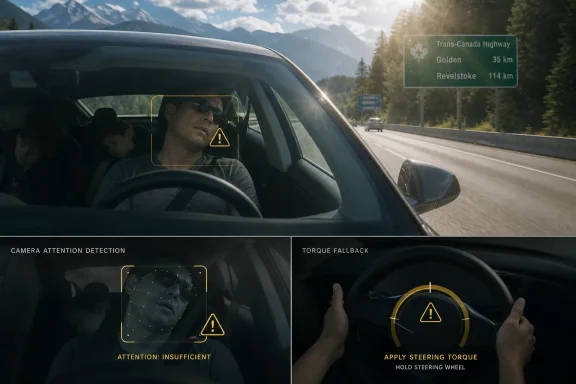
A Tesla driver was reportedly filmed on Sunday, July 5, 2026, apparently asleep while a Tesla travelled at roughly 100 km/h on British Columbia’s Highway 1 between Golden and Revelstoke, with two children also appearing to be asleep in the vehicle. Electrek, citing local reporting from Castanet and follow-up coverage by KelownaNow, framed the incident around the obvious engineering question: why did the car’s driver-monitoring system not force a meaningful intervention? The answer is less comforting than either Tesla’s critics or its fans tend to admit. This was not simply a story about one reckless driver; it was a story about the brittle boundary between “supervised” automation and human beings who behave exactly as tired, trusting, distracted humans do.
The modern Tesla driver-assistance stack rests on a bargain. The car can steer, accelerate, brake, change lanes in some circumstances, and perform increasingly polished automated maneuvers, but the driver remains legally and practically responsible for supervision. Tesla calls its most advanced consumer package Full Self-Driving (Supervised), and that parenthetical is doing a vast amount of legal and moral work.
The Highway 1 video, as described by Castanet and Electrek, shows why that bargain is unstable. A system marketed with the vocabulary of autonomy still depends on a person being awake, oriented, and ready to take over immediately. If the driver is asleep, the distinction between Level 2 assistance and higher-level automation may remain clear to lawyers and engineers, but it is meaningless to the physics of a two-ton vehicle moving at highway speed.
Tesla’s defense has always been that the driver must monitor the car. That is true, and it matters. But when a product’s foreseeable misuse is literally people treating it as more capable than it is, the monitoring system is not a side feature. It is the product’s last line of defense.
There is some nuance here. Tesla’s current owner documentation says the cabin camera can monitor attentiveness even when the driver is wearing sunglasses and does not require full visibility of the eyes. Earlier Tesla release notes and owner-facing language around vision-based monitoring, however, described conditions in which the system needed clear visibility of the driver’s eyes and could fall back to steering-wheel checks when sunglasses, low-brim hats, poor lighting, or occlusion got in the way.
That ambiguity is itself revealing. If the system’s capabilities vary by software version, vehicle hardware, lighting, eyewear, camera view, region, or feature state, then the public understanding of “driver monitoring” becomes dangerously imprecise. A driver hears that the car watches for attention. An engineer knows that the car may be inferring attention under degraded conditions. Those are not the same thing.
This is why steering-wheel nags have always been a weak foundation for advanced driver assistance. A hand resting on the wheel is not supervision. A driver slumped against the seat is not supervision. A cheap defeat device, a weighted grip, or even an unconscious body position can potentially satisfy a check that was never designed to understand the driver’s cognitive state.
Tesla is not alone in wrestling with this problem, but Tesla made the problem more consequential by shipping a highly capable Level 2 system under a brand name that continues to suggest more than the legal fine print allows. The better FSD gets at handling ordinary roads, the more likely some drivers are to over-trust it. Competence, paradoxically, increases misuse risk.
That legal distinction protects Tesla from the claim that it is selling a driverless consumer car. It also creates a public-facing contradiction. If the driver must supervise continuously, then the system has to be designed around the reality that some drivers will not. If the system is powerful enough to continue at highway speed while a driver appears asleep, the monitoring layer becomes the feature that separates assistance from an unattended experiment.
The RCMP investigation reported by KelownaNow may determine what happened in this specific case. But enforcement after the fact cannot solve the design problem. A ticket, charge, or warning may punish one driver; it does not prevent the next tired driver from discovering that the car will keep going longer than it should.
That is why the sunglasses issue is not a trivial edge case. Sunglasses are not an exotic adversarial attack. They are normal driving gear, especially on bright summer highways in western Canada. If a monitoring system’s performance materially changes because of eyewear, head angle, glare, cabin lighting, or camera obstruction, then its limits need to be treated as central safety facts, not buried operational caveats.
Electrek also highlighted an awkward software-design irony: recent Tesla behavior reportedly suggests enabling FSD when drowsiness is detected. If accurately characterized, that is the wrong instinct. A drowsy driver does not need more confidence in automation; a drowsy driver needs escalating intervention, reduced risk, and eventually a safe stop.
This does not mean Tesla’s monitoring is useless. It likely prevents many casual lapses, phone glances, and inattentive moments. But systems designed to keep honest drivers honest are not enough when the foreseeable risk includes deliberate defeat, fatigue, misplaced trust, and the powerful human tendency to adapt to automation.
The aviation industry learned this lesson slowly and painfully. Automation changes the operator’s job from direct control to supervision, and supervision is often harder to sustain than control. Cars compress that problem into a far messier environment, with less training, more distraction, and almost no cultural expectation that the “operator” has professional obligations.
Both statements can be technically compatible, but together they create a dangerous social signal. The marketing invites confidence; the legal language assigns blame. The product experience sits in between, where drivers decide how much attention they actually need to pay.
That is where the Highway 1 incident lands. If a Tesla can appear to continue smoothly while its driver sleeps, supporters may argue that the software prevented an immediate crash. Critics will argue that the same capability enabled the risk to persist. Both are partly right, which is precisely why the safety design has to be more aggressive than a warning chime and a torque prompt.
That is a hard engineering problem, especially on roads with narrow shoulders, construction zones, mountain grades, snow, wildlife, and unpredictable human drivers. Highway 1 between Golden and Revelstoke is not a sterile test track. But difficulty is not an excuse for pretending that attention warnings are equivalent to attention enforcement.
Tesla has the technical talent and fleet scale to do better. It can fuse cabin camera data, steering input, vehicle behavior, navigation context, driver interaction, and escalating response logic. The uncomfortable question is not whether perfect prevention is possible. It is whether Tesla is willing to make misuse more inconvenient, even when that makes FSD feel less magical.
 Tesla’s Safety Net Is Only as Strong as the Human It Assumes
The modern Tesla driver-assistance stack rests on a bargain. The car can steer, accelerate, brake, change lanes in some circumstances, and perform increasingly polished automated maneuvers, but the driver remains legally and practically responsible for supervision. Tesla calls its most advanced consumer package Full Self-Driving (Supervised), and that parenthetical is doing a vast amount of legal and moral work.The Highway 1 video, as described by Castanet and Electrek, shows why that bargain is unstable. A system marketed with the vocabulary of autonomy still depends on a person being awake, oriented, and ready to take over immediately. If the driver is asleep, the distinction between Level 2 assistance and higher-level automation may remain clear to lawyers and engineers, but it is meaningless to the physics of a two-ton vehicle moving at highway speed.
Tesla’s defense has always been that the driver must monitor the car. That is true, and it matters. But when a product’s foreseeable misuse is literally people treating it as more capable than it is, the monitoring system is not a side feature. It is the product’s last line of defense.
The Sunglasses Detail Turns a Viral Clip Into a Systems Failure
Electrek’s key claim is that the driver appeared to be wearing large sunglasses, which may have impaired Tesla’s cabin-camera-based attentiveness checks. That detail matters because Tesla’s newer monitoring strategy relies heavily on the cabin camera mounted above the rearview mirror, while fallback behavior can still involve steering-wheel torque prompts when the system cannot confidently assess attention.There is some nuance here. Tesla’s current owner documentation says the cabin camera can monitor attentiveness even when the driver is wearing sunglasses and does not require full visibility of the eyes. Earlier Tesla release notes and owner-facing language around vision-based monitoring, however, described conditions in which the system needed clear visibility of the driver’s eyes and could fall back to steering-wheel checks when sunglasses, low-brim hats, poor lighting, or occlusion got in the way.
That ambiguity is itself revealing. If the system’s capabilities vary by software version, vehicle hardware, lighting, eyewear, camera view, region, or feature state, then the public understanding of “driver monitoring” becomes dangerously imprecise. A driver hears that the car watches for attention. An engineer knows that the car may be inferring attention under degraded conditions. Those are not the same thing.
Steering-Wheel Nagging Was Never Real Driver Monitoring
The fallback problem is that torque sensing is a crude proxy for consciousness. It can tell that force is being applied to the steering wheel. It cannot reliably tell whether the person applying that force is alert, looking forward, comprehending the scene, or capable of taking control within a second or two.This is why steering-wheel nags have always been a weak foundation for advanced driver assistance. A hand resting on the wheel is not supervision. A driver slumped against the seat is not supervision. A cheap defeat device, a weighted grip, or even an unconscious body position can potentially satisfy a check that was never designed to understand the driver’s cognitive state.
Tesla is not alone in wrestling with this problem, but Tesla made the problem more consequential by shipping a highly capable Level 2 system under a brand name that continues to suggest more than the legal fine print allows. The better FSD gets at handling ordinary roads, the more likely some drivers are to over-trust it. Competence, paradoxically, increases misuse risk.
British Columbia’s Legal Line Makes the Marketing Gap Harder to Ignore
The incident took place in British Columbia, where automated-vehicle rules add another layer of tension. Electrek notes that Tesla’s FSD (Supervised) is available in Canada, while British Columbia’s Motor Vehicle Act prohibits operation of Level 3, Level 4, or Level 5 automated vehicles on public roads unless authorized. Tesla’s system remains Level 2, which means the driver is responsible at all times.That legal distinction protects Tesla from the claim that it is selling a driverless consumer car. It also creates a public-facing contradiction. If the driver must supervise continuously, then the system has to be designed around the reality that some drivers will not. If the system is powerful enough to continue at highway speed while a driver appears asleep, the monitoring layer becomes the feature that separates assistance from an unattended experiment.
The RCMP investigation reported by KelownaNow may determine what happened in this specific case. But enforcement after the fact cannot solve the design problem. A ticket, charge, or warning may punish one driver; it does not prevent the next tired driver from discovering that the car will keep going longer than it should.
The Drowsiness Warning Points at the Same Blind Spot
Tesla also offers Driver Drowsiness Warning, a separate safety feature that uses the cabin camera to look for signs such as eye closure and head position. In principle, that should be exactly the kind of feature that catches a driver before a viral video does. In practice, any camera-based drowsiness system depends on what the camera can actually see and classify.That is why the sunglasses issue is not a trivial edge case. Sunglasses are not an exotic adversarial attack. They are normal driving gear, especially on bright summer highways in western Canada. If a monitoring system’s performance materially changes because of eyewear, head angle, glare, cabin lighting, or camera obstruction, then its limits need to be treated as central safety facts, not buried operational caveats.
Electrek also highlighted an awkward software-design irony: recent Tesla behavior reportedly suggests enabling FSD when drowsiness is detected. If accurately characterized, that is the wrong instinct. A drowsy driver does not need more confidence in automation; a drowsy driver needs escalating intervention, reduced risk, and eventually a safe stop.
The Doll-Head Problem Is the Same Problem in Disguise
Electrek connected the Canadian incident to reports of Tesla drivers in China using cheap plastic doll heads to fool the cabin camera into detecting an attentive face. Whether that particular abuse is widespread or merely viral, it captures the deeper issue. Driver monitoring that can be spoofed by a fake face or degraded by covered eyes is not yet a robust answer to automation complacency.This does not mean Tesla’s monitoring is useless. It likely prevents many casual lapses, phone glances, and inattentive moments. But systems designed to keep honest drivers honest are not enough when the foreseeable risk includes deliberate defeat, fatigue, misplaced trust, and the powerful human tendency to adapt to automation.
The aviation industry learned this lesson slowly and painfully. Automation changes the operator’s job from direct control to supervision, and supervision is often harder to sustain than control. Cars compress that problem into a far messier environment, with less training, more distraction, and almost no cultural expectation that the “operator” has professional obligations.
Tesla Wants Credit for Autonomy Without Owning the Autonomy Problem
Tesla’s public posture around FSD has always had two voices. One voice tells customers and investors that the technology is approaching autonomy, that software will unlock enormous value, and that the car is learning to drive itself. The other voice, deployed after crashes and regulatory scrutiny, says the driver is responsible because the system is supervised.Both statements can be technically compatible, but together they create a dangerous social signal. The marketing invites confidence; the legal language assigns blame. The product experience sits in between, where drivers decide how much attention they actually need to pay.
That is where the Highway 1 incident lands. If a Tesla can appear to continue smoothly while its driver sleeps, supporters may argue that the software prevented an immediate crash. Critics will argue that the same capability enabled the risk to persist. Both are partly right, which is precisely why the safety design has to be more aggressive than a warning chime and a torque prompt.
The Car Should Treat Sleep as a Failure State, Not a Coaching Moment
The path forward is not mysterious. If a car cannot confirm driver attention during Level 2 operation, it should escalate quickly and predictably. Warnings should become speed reduction, hazard signaling, lane-centering conservatism, and ultimately a minimal-risk maneuver when safe. The system should not continue indefinitely on the assumption that supervision might return.That is a hard engineering problem, especially on roads with narrow shoulders, construction zones, mountain grades, snow, wildlife, and unpredictable human drivers. Highway 1 between Golden and Revelstoke is not a sterile test track. But difficulty is not an excuse for pretending that attention warnings are equivalent to attention enforcement.
Tesla has the technical talent and fleet scale to do better. It can fuse cabin camera data, steering input, vehicle behavior, navigation context, driver interaction, and escalating response logic. The uncomfortable question is not whether perfect prevention is possible. It is whether Tesla is willing to make misuse more inconvenient, even when that makes FSD feel less magical.
The Highway 1 Clip Leaves Tesla With Fewer Easy Answers
The most concrete lessons from this incident are not anti-EV, anti-Tesla, or anti-automation. They are anti-pretending. Driver assistance can save lives, but only if its limits are treated as design requirements rather than public-relations footnotes.- Tesla’s FSD (Supervised) remains a Level 2 driver-assistance system, which means the human driver must be awake, attentive, and ready to intervene at all times.
- Camera-based driver monitoring is stronger than steering-wheel torque checks, but it still depends on visibility, classification confidence, and software behavior.
- Sunglasses, hats, lighting, posture, and camera obstruction are not edge cases; they are everyday conditions that safety systems must handle conservatively.
- A fallback to steering-wheel torque cannot prove that a driver is conscious, looking at the road, or capable of taking over.
- The more capable FSD becomes, the more important it is for Tesla to prevent over-trust rather than merely warn against it.
- Regulators and police can punish misuse after an incident, but only vehicle design can reduce the odds that misuse continues at highway speed.
References
- Primary source: Electrek
Published: Mon, 06 Jul 2026 14:03:00 GMT
Tesla driver caught asleep at 100 km/h — how monitoring failed | Electrek
A Tesla driver was filmed apparently asleep at 100 km/h on a BC highway with two kids aboard. Here's why Tesla's driver monitoring didn't stop it.electrek.co - Related coverage: tesla.com
Loading…
www.tesla.com - Related coverage: techspot.com
Tesla now uses its vehicles' in-cabin camera to monitor drivers | TechSpot
The release notes for Tesla's 2021.4.15.11 software update read: "The cabin camera above your rearview mirror can now detect and alert driver inattentiveness while Autopilot is engaged....www.techspot.com - Related coverage: castanetkamloops.net
Video: Asleep behind the wheel? - Castanet.net
A video appears to show a driver fast asleep behind the wheel of a Tesla travelling on the Trans-Canada Highway between Golden and Revelstoke. https://www.castanet.net/news/Salmon-Arm/623334/Video-Tesla-driver-appears-fast-asleep-behind-the-wheel-on-Highway-1-between-Golden-and-Revelstokewww.castanetkamloops.net - Related coverage: ground.news
%22 d=%22M44,140.1h42.8V272H54.9c0-0.1,0-103.8,0-103.8H44V140.1z M44,1c28.4,0,42.6,16.2,42.6,42.2v66.1H54.9V43.8 c0-7.2-3.1-11.7-10.6-11.7c-7,0-10.6,4.2-10.6,11.7c0,0,0,228.1,0,228.2H0.2c0-0.5,0-228.8,0-228.8C0.1,16.8,14.8,1,44,1L44,1z%22/><style>path { fill: %23262626 } @media (prefers-color-scheme: dark) { path { fill: %23EEEFE9 } }</style></svg>)
Tesla driver appears fast asleep behind the wheel on Highway 1 between Golden and Revelstoke
A family travelling on the Trans-Canada Highway between Alberta and B.C. on Sunday afternoon couldn't believe their eyes. They came across a Tesla on Highway 1 between Golden and Revelstoke, with the driver apparently asleep behind the wheel. Not only that, but there were also two sleeping...
ground.news
- Related coverage: kelownanow.com
VIDEO: Police investigating footage of BC Tesla driver asleep at the wheel on Hwy 1
Viral footage of a woman appearing fast asleep behind the wheel of a Tesla as it cruised around 100 km/h on a major BC Interior highway... www.kelownanow.com
- Related coverage: teslaoracle.com
Tesla FSD update v12.5.4 adds ASS for HW3 cars and enables sunglasses for attention monitoring (Release Notes) - Tesla Oracle
FSD v12.5.4 OTA update (2024.27.25) brings Actually Smart Summon (ASS) to legacy HW3 Tesla cars, improves attention monitoring with sunglasses, and more. www.teslaoracle.com
- Related coverage: techxplore.com