

An independent review matters for evaluating IWIHOST.NET in 2026 because the provider is advertising budget VPS plans with KVM virtualization, NVMe storage, ECC memory, global locations, and bandwidth limits that require verification before buyers commit to production workloads. The headline specs are attractive, especially for Linux users who want inexpensive infrastructure without moving into hyperscaler pricing. But in hosting, the distance between a tariff table and a reliable server can be the difference between a bargain and a migration weekend. The real story is not whether IWIHOST.NET looks competitive on paper; it is whether customers know which claims to test before the invoice becomes annual.
The budget VPS market in 2026 is no longer defined by whether a provider can offer a virtual machine for a few dollars a month. That part has been commoditized. The serious questions now sit underneath the monthly price: what virtualization layer is used, what kind of storage backs the instance, how bandwidth is measured, which operating systems are actually available, and whether the support operation behaves like infrastructure support or a mailbox with a timer attached.
According to IWIHOST.NET’s own website and an independent review distributed through OpenPR, the provider’s VPS lineup is built around KVM virtualization, NVMe storage, ECC memory, and a 500 Mb/s port. Those are the right nouns for the modern low-cost VPS buyer. KVM suggests stronger isolation than older container-style VPS products, NVMe implies better disk performance than legacy SATA SSD storage, and ECC memory is a reliability signal normally associated with server-grade hardware.
But the presence of the right nouns is not the same thing as an independently measured service. Hosting companies have learned to market infrastructure in the language of enterprise computing while selling it at hobbyist prices. That is not automatically suspicious, but it does make review work necessary. A plan table can tell you what is being offered; only testing and careful reading can tell you what is being delivered.
IWIHOST.NET’s positioning is familiar: affordable virtual private servers for developers, site owners, small businesses, VPN users, bots, staging environments, and more demanding workloads as customers move up the stack. That is a broad pitch. It can be true only if the lower tiers are not oversold into sluggishness and the higher tiers provide enough predictable CPU, disk, and network behavior to justify using them for real work.
The listed U.S. pricing starts with a Core plan at $4.99 per month for 1 vCore, 1 GB ECC RAM, and 10 GB NVMe storage. The next tiers step through 2 GB, 4 GB, 8 GB, 12 GB, 16 GB, 24 GB, 32 GB, and 48 GB RAM configurations, with the largest published U.S. plan shown at $94.99 per month for 24 vCores, 48 GB RAM, and 400 GB NVMe storage. That spread gives the lineup a coherent ladder: small experiments at the bottom, multi-service VPS deployments at the top.
For WindowsForum.com readers, the operating system detail is especially important. The review notes that Linux appears available across the VPS range, while Windows and custom ISO installation begin at the Armor tier. That means the true entry price for Windows Server use is not the cheapest plan on the page. Anyone pricing a remote Windows environment, .NET test host, RDP-accessible admin box, or custom ISO workflow should start the comparison at the tier where those options actually become available.
The hardware claims also need to be read with the usual VPS caveat: virtual CPUs are not the same thing as dedicated cores unless a provider explicitly says so and proves it contractually. KVM gives each VM a strong virtualization boundary, but it does not guarantee that neighboring customers are not contending for the same underlying processor, storage queue, or network uplink. This is where a review matters, because the tariff page tells you the shape of the product, not the contention model behind it.
That is not necessarily a bad policy. For many websites, APIs, monitoring tools, dev environments, small databases, and private services, 30 TB is a generous monthly allowance. A small business WordPress site or a developer’s staging machine is unlikely to approach that threshold unless something unusual is happening.
The issue is that “500 Mb/s port” and “500 Mb/s up to 30 TB, then 100 Mb/s” are not the same commercial promise. The first sounds like a standing capacity claim; the second is a burstable allocation with a high monthly ceiling and a throttled fallback. Buyers who run backups, mirrors, media libraries, public downloads, CDN origin services, game update distribution, or file-heavy automation should treat the 30 TB threshold as a central buying criterion, not a footnote.
This is also where “unlimited” and “high bandwidth” language across the hosting industry has trained buyers badly. A capped high-speed allowance can be perfectly reasonable if it is explicit. What matters is whether the customer models the workload honestly. A VPS that is excellent for a control panel and a dozen client sites may be the wrong choice for a public file node, even if both fit comfortably inside the same monthly price.
But global location menus can also conceal variability. A provider may use different upstream networks, facilities, hardware pools, or operational partners in different regions. A VPS in Germany, Canada, the United States, or the Netherlands may not behave identically simply because the same logo and plan name appear above it.
For developers and sysadmins, the practical move is to test in the exact region where the workload will live. A cheap U.S. plan performing well does not prove a European node will have the same disk latency, route quality, or support behavior. Likewise, a poor result in one location may not condemn the entire provider, but it should slow any long-term purchase.
The review’s value is that it frames global availability as a claim to be validated, not a feature to be accepted at face value. For a personal VPN or test environment, a less-than-perfect route may be tolerable. For production traffic, database replication, game servers, VoIP-adjacent services, or latency-sensitive admin workflows, the location badge matters less than traceroutes, packet loss, and sustained throughput.
NVMe storage is similarly meaningful. In the right configuration, NVMe-backed VPS storage can make package installs, database operations, container image pulls, log processing, and web application workloads feel dramatically faster than older disk-backed or SATA SSD environments. For small VPS users, storage responsiveness often matters more than raw CPU count.
ECC memory is a reliability-oriented feature, and its presence in the marketing suggests the provider wants to signal server-grade infrastructure rather than bargain-bin desktop hardware. That matters to cautious buyers, particularly those using VPS instances for business-facing services. Still, ECC is a component-level claim; it does not tell us whether the host has redundant storage, disciplined maintenance windows, effective monitoring, or a mature incident response process.
That is the central tension in the IWIHOST.NET review. The provider is advertising the right foundation. The review is right to say that these claims should not be mistaken for independent performance results. Good components increase the odds of good hosting, but they do not eliminate the need to test the service as a whole.
The review states that Windows and custom ISO installation begin at the Armor plan level. If that remains accurate at purchase time, then Windows buyers should ignore the lowest advertised monthly price when calculating affordability. The relevant number is the first plan that supports their operating system requirement.
This matters because Windows Server generally wants more memory and storage than a minimal Linux deployment. A 1 GB Linux VPS can run a lean Nginx stack, a monitoring agent, a small bot, or a WireGuard endpoint. A Windows Server environment with Remote Desktop, updates, antivirus, logging, and application services can become uncomfortable quickly if undersized.
For WindowsForum.com readers, the sensible interpretation is straightforward: IWIHOST.NET may be more interesting as a low-cost Linux VPS provider than as the absolute cheapest Windows VPS option. That does not make it poor for Windows, but it changes the comparison. The buyer should evaluate the Armor tier and above, not the teaser entry plan.
Provisioning speed is easy to verify: order a server and time it. Support responsiveness is only slightly harder: contact support before buying, ask a specific technical question, and judge whether the answer is fast, accurate, and written by someone who understands the product. Uptime, DDoS handling, and facility redundancy are harder to evaluate from the outside, which is why independent monitoring and short initial billing periods matter.
The phrase “99.9 percent uptime” sounds reassuring, but it still permits roughly 43 minutes of downtime in a 30-day month before the mathematical threshold is breached. Even then, the real question is what the guarantee provides if the service misses the mark. Some hosts offer service credits with tight reporting conditions; others use uptime language as a marketing comfort blanket.
DDoS protection is another area where buyers should ask what is protected, at what scale, and under what conditions. “DDoS protection at the data center level” can mean many things, from basic filtering to sophisticated mitigation. A Minecraft server, a public VPN endpoint, or a controversial forum will have very different exposure than a private development machine.
The review’s recommendation to start monthly is the right one. A discount is not worth much if the buyer discovers after two weeks that the chosen location has poor routing, the CPU is oversubscribed, the refund policy is narrow, or the support team is slow on the exact issue that matters. Monthly billing buys the customer an exit ramp.
That is especially true for smaller or lesser-known providers. The hyperscalers are expensive and sometimes infuriating, but their operational patterns are widely documented. Budget VPS providers vary more dramatically. Some are excellent niche operators with lean costs and responsive staff; others are thin wrappers around rented infrastructure, templates, and hope.
The best initial test is not a synthetic benchmark alone. Benchmarks are useful, but they can be gamed by timing and node luck. A better trial includes the actual workload: install the real stack, restore a backup, run updates, test reboots, measure disk behavior, check network paths, open a support ticket, and watch the VPS over several days.
Company identity matters in hosting because customers are handing over data, infrastructure credentials, and sometimes business continuity to a third party. A named entity, a jurisdiction, and a support address are basic trust markers. They are not proof of operational maturity.
A Delaware registration also does not tell a buyer where servers are physically operated, which upstream providers are used, how abuse is handled, whether backups are included, or how customer data is treated during suspension, cancellation, or legal requests. Those questions live in terms of service, privacy policy, support practice, and lived customer experience.
That is why the review’s cautious tone is appropriate. IWIHOST.NET may be a perfectly viable budget VPS option for many workloads. But the existence of a company record and polished plan table should be the beginning of diligence, not the end.
Mid-range plans are more interesting for WordPress, small databases, Dockerized services, low-traffic business sites, and modest application hosting. Here, the NVMe and memory allocations become meaningful, but so do backup strategy and monitoring. A cheap VPS can be production infrastructure, but it should not be the only copy of anything important.
Higher-tier plans invite more caution. Once a customer is paying for 8, 12, 16, or more vCores, the comparison set expands beyond bargain VPS hosts into root servers, dedicated servers, regional cloud providers, and managed platforms. At that level, support quality, CPU consistency, storage durability, and network transparency matter more than the headline monthly price.
The right mental model is blast radius. The less independently verified a provider is, the smaller the initial blast radius should be. Put a test app there before a revenue-critical database. Put a replica there before the only copy. Put a monitoring node there before the system being monitored.
A fair reading is that IWIHOST.NET looks competitive on paper. The combination of KVM, NVMe, ECC RAM, low entry pricing, global locations, Bitcoin payment support, and a visible bandwidth policy gives it a plausible place in the market. The same fair reading says that uptime, support response, DDoS protection, route quality, and real storage performance remain unproven until customers test them.
The practical conclusions are narrow but important:
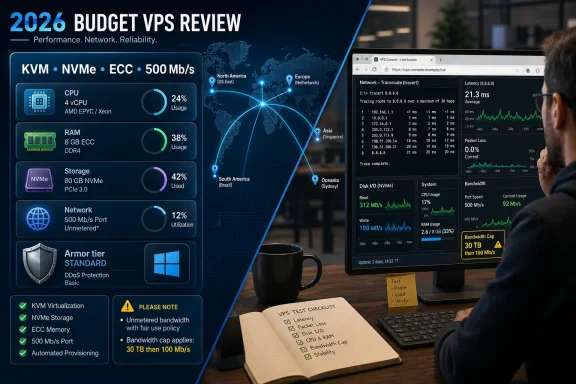 Budget VPS Hosting Has Become a Market of Fine Print
The budget VPS market in 2026 is no longer defined by whether a provider can offer a virtual machine for a few dollars a month. That part has been commoditized. The serious questions now sit underneath the monthly price: what virtualization layer is used, what kind of storage backs the instance, how bandwidth is measured, which operating systems are actually available, and whether the support operation behaves like infrastructure support or a mailbox with a timer attached.According to IWIHOST.NET’s own website and an independent review distributed through OpenPR, the provider’s VPS lineup is built around KVM virtualization, NVMe storage, ECC memory, and a 500 Mb/s port. Those are the right nouns for the modern low-cost VPS buyer. KVM suggests stronger isolation than older container-style VPS products, NVMe implies better disk performance than legacy SATA SSD storage, and ECC memory is a reliability signal normally associated with server-grade hardware.
But the presence of the right nouns is not the same thing as an independently measured service. Hosting companies have learned to market infrastructure in the language of enterprise computing while selling it at hobbyist prices. That is not automatically suspicious, but it does make review work necessary. A plan table can tell you what is being offered; only testing and careful reading can tell you what is being delivered.
IWIHOST.NET’s positioning is familiar: affordable virtual private servers for developers, site owners, small businesses, VPN users, bots, staging environments, and more demanding workloads as customers move up the stack. That is a broad pitch. It can be true only if the lower tiers are not oversold into sluggishness and the higher tiers provide enough predictable CPU, disk, and network behavior to justify using them for real work.
The Specs Are Good Enough to Deserve Scrutiny
The most credible part of IWIHOST.NET’s pitch is that its technical baseline appears consistent across the VPS lineup. The provider lists KVM, NVMe, ECC RAM, and a 500 Mb/s port across plans ranging from small entry-level instances to larger configurations. On paper, that is a cleaner story than hosts that reserve the good storage or serious virtualization for expensive tiers.The listed U.S. pricing starts with a Core plan at $4.99 per month for 1 vCore, 1 GB ECC RAM, and 10 GB NVMe storage. The next tiers step through 2 GB, 4 GB, 8 GB, 12 GB, 16 GB, 24 GB, 32 GB, and 48 GB RAM configurations, with the largest published U.S. plan shown at $94.99 per month for 24 vCores, 48 GB RAM, and 400 GB NVMe storage. That spread gives the lineup a coherent ladder: small experiments at the bottom, multi-service VPS deployments at the top.
For WindowsForum.com readers, the operating system detail is especially important. The review notes that Linux appears available across the VPS range, while Windows and custom ISO installation begin at the Armor tier. That means the true entry price for Windows Server use is not the cheapest plan on the page. Anyone pricing a remote Windows environment, .NET test host, RDP-accessible admin box, or custom ISO workflow should start the comparison at the tier where those options actually become available.
The hardware claims also need to be read with the usual VPS caveat: virtual CPUs are not the same thing as dedicated cores unless a provider explicitly says so and proves it contractually. KVM gives each VM a strong virtualization boundary, but it does not guarantee that neighboring customers are not contending for the same underlying processor, storage queue, or network uplink. This is where a review matters, because the tariff page tells you the shape of the product, not the contention model behind it.
The 500 Mb/s Port Is Not the Whole Bandwidth Story
The bandwidth line is the clearest example of why reviews are useful. IWIHOST.NET advertises a 500 Mb/s port, but the provider’s own terms on the plan page say that speed applies for the first 30 TB of monthly data transfer. After that, the speed drops to 100 Mb/s until the beginning of the next month.That is not necessarily a bad policy. For many websites, APIs, monitoring tools, dev environments, small databases, and private services, 30 TB is a generous monthly allowance. A small business WordPress site or a developer’s staging machine is unlikely to approach that threshold unless something unusual is happening.
The issue is that “500 Mb/s port” and “500 Mb/s up to 30 TB, then 100 Mb/s” are not the same commercial promise. The first sounds like a standing capacity claim; the second is a burstable allocation with a high monthly ceiling and a throttled fallback. Buyers who run backups, mirrors, media libraries, public downloads, CDN origin services, game update distribution, or file-heavy automation should treat the 30 TB threshold as a central buying criterion, not a footnote.
This is also where “unlimited” and “high bandwidth” language across the hosting industry has trained buyers badly. A capped high-speed allowance can be perfectly reasonable if it is explicit. What matters is whether the customer models the workload honestly. A VPS that is excellent for a control panel and a dozen client sites may be the wrong choice for a public file node, even if both fit comfortably inside the same monthly price.
Global Locations Are Useful Only If the Network Holds Up
IWIHOST.NET promotes availability in roughly 40 countries, according to the review and provider-stated information. That is a major part of the pitch, especially for users who care about latency, jurisdiction, regional SEO, VPN endpoints, monitoring agents, or placing infrastructure close to customers. In a market where many budget hosts cluster around a handful of data centers, broad location choice is genuinely valuable.But global location menus can also conceal variability. A provider may use different upstream networks, facilities, hardware pools, or operational partners in different regions. A VPS in Germany, Canada, the United States, or the Netherlands may not behave identically simply because the same logo and plan name appear above it.
For developers and sysadmins, the practical move is to test in the exact region where the workload will live. A cheap U.S. plan performing well does not prove a European node will have the same disk latency, route quality, or support behavior. Likewise, a poor result in one location may not condemn the entire provider, but it should slow any long-term purchase.
The review’s value is that it frames global availability as a claim to be validated, not a feature to be accepted at face value. For a personal VPN or test environment, a less-than-perfect route may be tolerable. For production traffic, database replication, game servers, VoIP-adjacent services, or latency-sensitive admin workflows, the location badge matters less than traceroutes, packet loss, and sustained throughput.
KVM, NVMe, and ECC Are Signals, Not Guarantees
KVM virtualization is a strong starting point for a VPS provider. It generally offers full virtualization, better kernel control, and broader operating system compatibility than container-based approaches. It is also the virtualization layer that makes custom ISO support and Windows installation more plausible.NVMe storage is similarly meaningful. In the right configuration, NVMe-backed VPS storage can make package installs, database operations, container image pulls, log processing, and web application workloads feel dramatically faster than older disk-backed or SATA SSD environments. For small VPS users, storage responsiveness often matters more than raw CPU count.
ECC memory is a reliability-oriented feature, and its presence in the marketing suggests the provider wants to signal server-grade infrastructure rather than bargain-bin desktop hardware. That matters to cautious buyers, particularly those using VPS instances for business-facing services. Still, ECC is a component-level claim; it does not tell us whether the host has redundant storage, disciplined maintenance windows, effective monitoring, or a mature incident response process.
That is the central tension in the IWIHOST.NET review. The provider is advertising the right foundation. The review is right to say that these claims should not be mistaken for independent performance results. Good components increase the odds of good hosting, but they do not eliminate the need to test the service as a whole.
Windows Users Need to Price the Real Starting Line
The Windows angle deserves special attention because Windows VPS buyers are often comparing apples, oranges, and licensing traps. A Linux VPS at $4.99 per month is easy to understand. A Windows-capable VPS may involve a higher starting tier, licensing terms, different resource expectations, and sometimes a provider’s willingness to support custom installation media.The review states that Windows and custom ISO installation begin at the Armor plan level. If that remains accurate at purchase time, then Windows buyers should ignore the lowest advertised monthly price when calculating affordability. The relevant number is the first plan that supports their operating system requirement.
This matters because Windows Server generally wants more memory and storage than a minimal Linux deployment. A 1 GB Linux VPS can run a lean Nginx stack, a monitoring agent, a small bot, or a WireGuard endpoint. A Windows Server environment with Remote Desktop, updates, antivirus, logging, and application services can become uncomfortable quickly if undersized.
For WindowsForum.com readers, the sensible interpretation is straightforward: IWIHOST.NET may be more interesting as a low-cost Linux VPS provider than as the absolute cheapest Windows VPS option. That does not make it poor for Windows, but it changes the comparison. The buyer should evaluate the Armor tier and above, not the teaser entry plan.
Support Claims Are Where Marketing Meets Reality
IWIHOST.NET promotes support response times under 15 minutes, provisioning within 30 minutes, DDoS protection, a 99.9 percent uptime guarantee, and TIER III+ facilities with N+1 redundancy, according to the review and provider materials. Those are consequential claims. They are also exactly the kind of claims that should remain in the “provider-stated” category until tested.Provisioning speed is easy to verify: order a server and time it. Support responsiveness is only slightly harder: contact support before buying, ask a specific technical question, and judge whether the answer is fast, accurate, and written by someone who understands the product. Uptime, DDoS handling, and facility redundancy are harder to evaluate from the outside, which is why independent monitoring and short initial billing periods matter.
The phrase “99.9 percent uptime” sounds reassuring, but it still permits roughly 43 minutes of downtime in a 30-day month before the mathematical threshold is breached. Even then, the real question is what the guarantee provides if the service misses the mark. Some hosts offer service credits with tight reporting conditions; others use uptime language as a marketing comfort blanket.
DDoS protection is another area where buyers should ask what is protected, at what scale, and under what conditions. “DDoS protection at the data center level” can mean many things, from basic filtering to sophisticated mitigation. A Minecraft server, a public VPN endpoint, or a controversial forum will have very different exposure than a private development machine.
The Monthly Plan Is the Due Diligence Tool
IWIHOST.NET advertises discounts for three-month, six-month, and annual billing terms, including a 15 percent annual discount on the plan table reviewed. That is standard hosting economics. Providers want predictable revenue, and customers like shaving a little off the bill.The review’s recommendation to start monthly is the right one. A discount is not worth much if the buyer discovers after two weeks that the chosen location has poor routing, the CPU is oversubscribed, the refund policy is narrow, or the support team is slow on the exact issue that matters. Monthly billing buys the customer an exit ramp.
That is especially true for smaller or lesser-known providers. The hyperscalers are expensive and sometimes infuriating, but their operational patterns are widely documented. Budget VPS providers vary more dramatically. Some are excellent niche operators with lean costs and responsive staff; others are thin wrappers around rented infrastructure, templates, and hope.
The best initial test is not a synthetic benchmark alone. Benchmarks are useful, but they can be gamed by timing and node luck. A better trial includes the actual workload: install the real stack, restore a backup, run updates, test reboots, measure disk behavior, check network paths, open a support ticket, and watch the VPS over several days.
The Delaware Company Detail Is Useful, But Not Sufficient
The review identifies the company behind IWIHOST.NET as GLOGAMING LLC, with a Wilmington, Delaware address and a registration number. That gives buyers something concrete to record, and it is better than a hosting brand with no visible operator. The site also lists email support and appears available in English and Russian.Company identity matters in hosting because customers are handing over data, infrastructure credentials, and sometimes business continuity to a third party. A named entity, a jurisdiction, and a support address are basic trust markers. They are not proof of operational maturity.
A Delaware registration also does not tell a buyer where servers are physically operated, which upstream providers are used, how abuse is handled, whether backups are included, or how customer data is treated during suspension, cancellation, or legal requests. Those questions live in terms of service, privacy policy, support practice, and lived customer experience.
That is why the review’s cautious tone is appropriate. IWIHOST.NET may be a perfectly viable budget VPS option for many workloads. But the existence of a company record and polished plan table should be the beginning of diligence, not the end.
Cheap Infrastructure Is Best When It Has a Small Blast Radius
The strongest use case for IWIHOST.NET’s lower tiers is the same use case that makes budget VPS hosting attractive in general: workloads that benefit from isolation, root access, and predictable monthly pricing, but do not justify enterprise cloud complexity. Personal VPNs, uptime monitors, lightweight bots, small web apps, development sandboxes, and staging environments fit that mold.Mid-range plans are more interesting for WordPress, small databases, Dockerized services, low-traffic business sites, and modest application hosting. Here, the NVMe and memory allocations become meaningful, but so do backup strategy and monitoring. A cheap VPS can be production infrastructure, but it should not be the only copy of anything important.
Higher-tier plans invite more caution. Once a customer is paying for 8, 12, 16, or more vCores, the comparison set expands beyond bargain VPS hosts into root servers, dedicated servers, regional cloud providers, and managed platforms. At that level, support quality, CPU consistency, storage durability, and network transparency matter more than the headline monthly price.
The right mental model is blast radius. The less independently verified a provider is, the smaller the initial blast radius should be. Put a test app there before a revenue-critical database. Put a replica there before the only copy. Put a monitoring node there before the system being monitored.
The Review Turns IWIHOST.NET From a Price Table Into a Test Plan
The useful thing about the independent review is not that it declares IWIHOST.NET good or bad. It does something more valuable: it turns the provider’s sales claims into a checklist of things a serious buyer can validate. That is how hosting reviews should work in 2026, especially in the budget VPS tier where the market is noisy and the differences between providers are often operational rather than cosmetic.A fair reading is that IWIHOST.NET looks competitive on paper. The combination of KVM, NVMe, ECC RAM, low entry pricing, global locations, Bitcoin payment support, and a visible bandwidth policy gives it a plausible place in the market. The same fair reading says that uptime, support response, DDoS protection, route quality, and real storage performance remain unproven until customers test them.
The practical conclusions are narrow but important:
- Customers should test the smallest plan that realistically fits the workload for one month before buying a longer term.
- Windows users should price from the Armor tier or whichever current plan first supports Windows and custom ISO installation.
- Bandwidth-heavy users should treat the 30 TB high-speed transfer threshold as a core limit rather than a minor detail.
- Production users should run their own uptime, disk, and network checks in the exact server location they intend to use.
- Buyers should contact support before ordering and judge the specificity of the answer, not just the response time.
- Customers should confirm refund terms, backup responsibilities, abuse policies, and service guarantees before trusting the platform with important data.