

On July 1, 2026, the United Nations’ Independent International Scientific Panel on Artificial Intelligence released a preliminary report intended to frame the inaugural Global Dialogue on AI Governance in Geneva on July 6 and 7. The document is supposed to be a baseline for governments, not another vendor slide deck. Yet the critique published by Flying Penguin argues that the report’s own handling of evidence illustrates the integrity crisis it claims to diagnose. That is the uncomfortable point: a UN report about AI trust appears to have stumbled over trust itself.
For years, AI safety arguments have tended to split into two camps: the spectacular and the operational. The spectacular side talks about runaway systems, existential risk, and science-fiction-adjacent futures. The operational side talks about broken translations, bad labels, brittle classifiers, poisoned datasets, hallucinated confidence, and automated decisions that fail in ways humans are too impressed or too rushed to challenge.
The UN report, according to the Flying Penguin analysis, lands squarely in the second camp when it discusses the relationship between linguistic fluency and factuality. That matters because modern AI does not merely produce errors. It produces errors wrapped in the visual and rhetorical form of competence.
For WindowsForum readers, this is not an abstract problem. Every sysadmin has seen the danger of a tool that returns a plausible answer faster than a human can verify it. Every security engineer has learned that confidence and correctness are different properties. AI systems collapse that distinction for ordinary users by making wrong answers feel finished.
The most damning example cited in the critique is medical translation. The report reportedly discusses Tigrinya machine-translation failures in clinical contexts serving millions of speakers, including renderings that turned smallpox into syphilis, gonorrhoea into diabetes, and intravenous antibiotics into intravenous insecticides. That is not a chatbot embarrassment. That is an integrity failure with a casualty class.
This is why the author’s long-running focus on integrity deserves attention even if one rejects the self-mythologizing tone of the post. Confidentiality asks whether the wrong person saw the data. Availability asks whether the system stayed up. Integrity asks whether the thing the system produced can be trusted. AI turns that third question into the main event.
This is not nitpicking about citation style. Cyber capability claims are among the easiest parts of the AI debate to overstate and among the hardest for outsiders to verify. A company can say its model found old vulnerabilities, discovered new exploit chains, or outperformed rival systems, but the public often sees only the curated version: the successful run, the polished benchmark, the responsible-disclosure framing, the graph with the dramatic slope.
The UN report apparently understands this in theory. The critique notes that page 15 warns about a structural problem in AI assurance: safety evaluation methods are often designed by the companies being evaluated, and public confidence depends on developer goodwill. That is the diagnosis. But the cybercapabilities section, as described, then reproduces the disease.
This is where the issue becomes bigger than Anthropic. OpenAI, Google DeepMind, Meta, Microsoft, Anthropic, xAI, and the rest all have incentives to define their own danger in marketable terms. Too little danger and the product looks ordinary. Too much danger and regulators may intervene. The sweet spot is a controlled spectacle: powerful enough to demand deference, responsible enough to avoid restriction.
A public scientific assessment cannot accept that bargain. Its job is not to amplify vendor claims because they are interesting. Its job is to ask whether the claims survive adversarial review, independent replication, and dissenting interpretation. A UN panel that warns against developer-controlled assurance and then builds a showcase box from developer-adjacent material is not merely making a sourcing mistake. It is demonstrating the governance failure it was convened to help solve.
That kind of announcement is almost engineered to travel. It has everything policymakers notice: frontier AI, national security, critical infrastructure, responsible disclosure, secret capabilities, and a vendor positioning itself as both the source of risk and the provider of safety. It is the perfect governance object because it invites the state to sit beside the company rather than above it.
But the governance question is not whether Mythos is impressive. It may well be. The question is whether public institutions should treat a vendor’s controlled demonstration as evidence of a scientific frontier. That is a much higher bar.
Flying Penguin argues that the UN panel failed that test by freezing the record around Anthropic’s April launch framing. The critique says the panel did not incorporate later independent criticism, did not include contrary evidence, and did not even account for Anthropic’s own subsequent updates in a way that would weaken or contextualize the original claims. The result, if fair, is a report that is stale in precisely the direction most favorable to the vendor.
That is how policy gets warped. Not by a lie in the old-fashioned sense, but by a timing window. A claim launches, press coverage builds, institutions cite it, and by the time the independent checks arrive, the first version has already become the official one.
In cybersecurity, we know this pattern too well. The first write-up of a vulnerability often shapes the myth of the bug long after patches, reproductions, and postmortems complicate the story. AI governance is now learning the same lesson under worse conditions, because the vendors are not merely disclosing bugs. They are disclosing their own alleged ability to discover them.
AISLE’s own framing was narrower than some internet commentary. It did not claim to match Mythos on every dimension, especially autonomous exploit generation. It did claim that a small external team produced comparable externally validated findings in a codebase Anthropic had used as a showcase target. That is exactly the sort of disagreement a scientific panel should preserve.
The difference matters because Anthropic’s public story appears to depend partly on frontier exclusivity: a uniquely capable model found vulnerabilities that ordinary systems would miss. If open-weight or lower-cost systems can reproduce enough of the showcase result, the policy meaning changes. The problem is no longer “one frontier vendor has a uniquely dangerous model.” It becomes “capability is diffusing, and governance cannot depend on a few trusted labs.”
That distinction is not academic. If the risk is concentrated, governments may focus on licensing, lab audits, and controlled access to frontier systems. If the risk is distributed, they need vulnerability intake capacity, secure-by-design software investment, disclosure norms, defensive tooling, procurement rules, and liability regimes that assume many actors can automate bug discovery. The wrong evidence base leads to the wrong control surface.
Flying Penguin is especially harsh about claims involving an old OpenBSD flaw allegedly used to illustrate frontier capability. The critique says that claim has been undermined by reproduction with cheaper open models. Whether every detail of that rebuttal holds up is less important than the procedural failure: the UN’s mandate was to document scientific consensus and disagreement, not to pick the cleanest vendor narrative and print it.
A preliminary report does not need to settle every dispute. It does need to show the dispute exists. In fast-moving AI security research, a missing disagreement is not a footnote problem. It is a map problem. It tells delegates the terrain is flatter than it is.
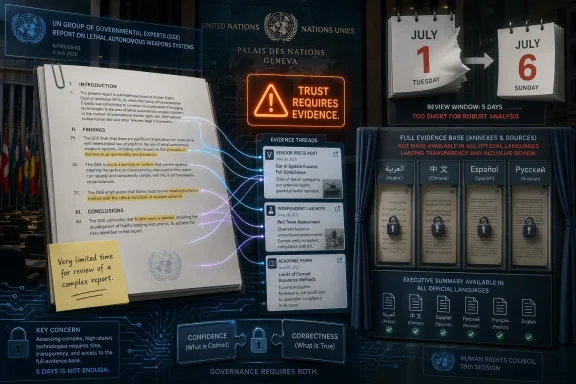
This is the kind of institutional design flaw that can look harmless from inside a multilingual bureaucracy. Translation takes time. Full reports are long. Summaries are meant for policymakers. Nobody sat down and said, “Let’s deprive Spanish, Arabic, Chinese, and Russian readers of context.”
But integrity failures rarely require malice. They require asymmetry. If one audience gets the claims and another gets the evidentiary scaffolding, those audiences are not reading the same report. They are receiving different epistemic products under the same UN branding.
The irony is hard to miss because the report itself apparently discusses language exclusion as a serious AI risk. Machine translation failures in clinical settings show that language access is not a courtesy. It is a safety property. Yet the report’s own publication pattern, as described, creates a hierarchy between conclusion and verification.
For government readers, this matters. A ministry official reading only the summary in Arabic, Chinese, Russian, or Spanish may encounter polished conclusions without the full machinery of uncertainty. That official may not see the concessions about evidence gaps or the fine print around economic projections. They may not see the complete reference trail needed to evaluate whether a cybercapability claim rests on independent analysis or vendor material.
This is not simply a UN problem. It is a problem for every global technology debate conducted in English and exported as consensus. AI systems already amplify dominant-language knowledge. AI governance must not do the same thing at the level of policy evidence.
Five days is enough time to read a report. It is not enough time to test one. It is certainly not enough time for member states, civil society, technical experts, and smaller delegations to evaluate cyber claims, compare source trails, translate caveats, and solicit dissenting views from independent researchers.
That timing matters because AI governance is not a seminar exercise. Delegates arrive with unequal technical capacity. Large countries and wealthy blocs can throw experts at a document overnight. Smaller states may rely more heavily on summaries, UN framing, and vendor-friendly interpretations packaged as consensus. A short review period magnifies existing asymmetries.
Flying Penguin adds an awkward calendar detail: the Glasswing announcement reportedly promised a 90-day public accountability report, and by the author’s count that promise came due on July 6, the opening day of the Geneva dialogue. The critique says Anthropic had issued an interim May update with aggregate self-reported numbers and a June system card, but not the kind of public accounting that would allow the UN’s use of the claim to be stress-tested.
The larger point is not whether a 90-day deadline should be counted exactly that way. It is that the UN report and the Geneva meeting sat on top of a moving evidence base. When the evidence is moving, the institution must slow down the policy use of claims or clearly mark them provisional. Otherwise, the first polished version wins.
This is a familiar failure mode in enterprise IT. A vendor ships a security white paper before the independent audits land. Procurement teams read the white paper because the buying cycle is now. By the time the audit complicates the claims, the architecture is already chosen. The UN is operating at a different scale, but the mechanism is the same.
Modern societies routinely govern systems they do not fully understand. Steam boilers were regulated before thermodynamics was popularly understood. Food safety laws evolved before every chemical pathway was mapped. Maritime safety improved through inspection, liability, and hard rules before shipbuilders could model every disaster scenario. Governance often begins not with perfect comprehension, but with access, recordkeeping, auditability, and consequences for false claims.
AI vendors benefit when governance is framed as a comprehension problem. If the state must fully understand frontier systems before it can act, then the state will always be late. The models change too quickly, the training data is too opaque, and the relevant behaviors emerge under conditions no lab can exhaustively enumerate.
A better frame is inspectability. Regulators do not need metaphysical certainty about what a model “knows” to demand incident reporting, evaluation transparency, independent testing access, provenance records, red-team disclosure rules, and penalties for material misrepresentation. They do not need to resolve every debate about open source to require that public-sector deployments meet measurable safety and accountability thresholds.
For Windows administrators, this distinction maps cleanly onto operational reality. You do not need to understand every line of firmware in a fleet of laptops to require secure boot, patch compliance, logging, inventory, and vendor attestations. You do not need to understand every branch of a cloud provider’s control plane to demand contractual audit rights and incident notification. Governance under uncertainty is normal because uncertainty is the default operating condition of complex systems.
The danger of “we must understand first” is that it becomes a polite veto. It lets vendors say, in effect, “Come back when you can describe our system as well as we can.” But that is exactly backwards. The less independently understood a system is, the stronger the case for external assurance.
This is the unpleasant recursion at the center of the debate. AI systems generate fluent statements that users may overtrust. Vendors generate fluent safety claims that policymakers may overtrust. Institutions generate fluent reports that governments may overtrust. At each layer, the form of authority can outrun the evidence beneath it.
The UN panel is not wrong to move quickly. The field is moving quickly, and governments need shared baselines. A preliminary report is better than a vacuum, especially when national regulatory approaches are fragmenting and the largest AI companies operate across borders faster than lawmaking bodies can respond.
But speed does not excuse weak sourcing. In fact, speed makes sourcing more important. When a report is preliminary, released days before a global dialogue, and likely to be read through summaries by busy officials, every unsupported or vendor-dependent claim carries extra weight.
The correct standard is not perfection. The correct standard is visible uncertainty. A scientific panel can say Anthropic claims X, independent critics dispute Y, AISLE reports Z, and the panel has not yet resolved the disagreement. That would be useful. What it cannot safely do is turn contested claims into neutral-sounding assessment without preserving the contest.
That urgency is justified to a point. Automated vulnerability discovery is a real development. AI-assisted exploit generation, patch analysis, fuzzing, code review, and reverse engineering will change both offensive and defensive security work. The question is whether those changes are being described with enough precision.
There is a difference between finding a bug and exploiting it. There is a difference between reproducing a known vulnerability and discovering a novel one. There is a difference between a lab run with curated context and a general capability available to a random operator. There is a difference between “frontier-only” and “diffusing into open models.” Governance depends on those distinctions.
Vendor announcements tend to compress them because compression makes for a better story. A responsible scientific report should expand them again. It should separate discovery, triage, exploitability, automation level, required human expertise, cost, reproducibility, and independent validation. Otherwise, “AI found a 27-year-old bug” becomes policy fog.
Security professionals should also be wary of the “trusted gatekeeper” storyline. If a vendor says its dangerous model will be shared only with selected defenders, that may be prudent in the short term. But it also turns access into influence. The vendor becomes a quasi-regulatory actor, deciding who gets defensive capability and who remains dependent on secondhand claims.
That is not a stable public-interest model. Defensive security cannot depend on a priesthood of frontier labs distributing blessings. It needs reproducible methods, validated findings, coordinated disclosure channels, and public institutions capable of evaluating claims without becoming dependent on the claimants.
AI is importing that lesson into knowledge work. The output looks like language, but the risk often behaves like code. It can execute indirectly by shaping a user’s decision, a doctor’s treatment, a developer’s patch, a SOC analyst’s triage, or a minister’s policy memo.
That is why the UN report’s alleged integrity failures are not merely diplomatic inside baseball. If governments normalize vendor-sourced AI claims at the global level, enterprises will see the same pattern trickle down into procurement, compliance frameworks, cyber-insurance questionnaires, and public-sector technology mandates. The standards set in Geneva will eventually echo in boardrooms and IT departments.
A weak evidentiary norm becomes a tax on defenders. If every major AI security claim must be re-litigated by under-resourced teams after it has already acquired institutional authority, the advantage goes to the organizations with the largest communications departments. That is not science. It is narrative ops.
The right lesson from the Windows security era is not that vendors are always wrong. Microsoft itself became a more serious security company through painful transparency, structured response, and external pressure. The lesson is that trust improves when claims are tested under conditions the claimant does not fully control.
None of that requires a grand theory of consciousness. None requires solving alignment. None requires waiting for perfect model interpretability. It requires the old machinery of governance: records, disagreement, access, time, and accountability.
That is the right instinct. AI policy discourse is overstocked with abstractions and understocked with process rules. The most important safeguards are often boring enough to be dismissed until they fail. Who gets to submit evidence? Who checks it? Who translates it? Who sees the caveats? How long do governments have to review it? What happens when a vendor claim is later contradicted?
Those questions decide whether AI governance becomes public oversight or a rotating stage for companies to perform responsibility. If the UN wants to avoid the second outcome, it needs rules that make vendor capture harder by default.
One obvious rule is that no capability claim should enter a UN scientific assessment on vendor citation alone. Another is that contested claims must be marked as contested in the same language and format as the claim itself. A third is that preliminary reports should distinguish between evidence that has been independently reproduced and evidence that has merely been publicly asserted.
These are not anti-industry rules. They are pro-credibility rules. Serious vendors should want them because they separate real advances from marketing inflation. Serious governments should want them because they reduce the chance of building policy on a demo.
For policymakers, administrators, and security teams watching from outside Geneva, the useful conclusions are concrete:
 The UN Finally Names the Problem Security People Have Been Warning About
For years, AI safety arguments have tended to split into two camps: the spectacular and the operational. The spectacular side talks about runaway systems, existential risk, and science-fiction-adjacent futures. The operational side talks about broken translations, bad labels, brittle classifiers, poisoned datasets, hallucinated confidence, and automated decisions that fail in ways humans are too impressed or too rushed to challenge.The UN report, according to the Flying Penguin analysis, lands squarely in the second camp when it discusses the relationship between linguistic fluency and factuality. That matters because modern AI does not merely produce errors. It produces errors wrapped in the visual and rhetorical form of competence.
For WindowsForum readers, this is not an abstract problem. Every sysadmin has seen the danger of a tool that returns a plausible answer faster than a human can verify it. Every security engineer has learned that confidence and correctness are different properties. AI systems collapse that distinction for ordinary users by making wrong answers feel finished.
The most damning example cited in the critique is medical translation. The report reportedly discusses Tigrinya machine-translation failures in clinical contexts serving millions of speakers, including renderings that turned smallpox into syphilis, gonorrhoea into diabetes, and intravenous antibiotics into intravenous insecticides. That is not a chatbot embarrassment. That is an integrity failure with a casualty class.
This is why the author’s long-running focus on integrity deserves attention even if one rejects the self-mythologizing tone of the post. Confidentiality asks whether the wrong person saw the data. Availability asks whether the system stayed up. Integrity asks whether the thing the system produced can be trusted. AI turns that third question into the main event.
A Scientific Panel Cannot Borrow Its Evidence From the Sales Department
The first alleged failure is the most serious because it goes to the report’s institutional credibility. Flying Penguin says the UN report’s “Dangerous cybercapabilities” box relies on three sources for Anthropic’s Mythos and Project Glasswing claims: Anthropic’s own Frontier Red Team page, Anthropic’s Glasswing announcement, and a Mozilla blog post written by a Glasswing participant. If that description is accurate, the report did not triangulate a claim. It laundered a vendor narrative through a UN document.This is not nitpicking about citation style. Cyber capability claims are among the easiest parts of the AI debate to overstate and among the hardest for outsiders to verify. A company can say its model found old vulnerabilities, discovered new exploit chains, or outperformed rival systems, but the public often sees only the curated version: the successful run, the polished benchmark, the responsible-disclosure framing, the graph with the dramatic slope.
The UN report apparently understands this in theory. The critique notes that page 15 warns about a structural problem in AI assurance: safety evaluation methods are often designed by the companies being evaluated, and public confidence depends on developer goodwill. That is the diagnosis. But the cybercapabilities section, as described, then reproduces the disease.
This is where the issue becomes bigger than Anthropic. OpenAI, Google DeepMind, Meta, Microsoft, Anthropic, xAI, and the rest all have incentives to define their own danger in marketable terms. Too little danger and the product looks ordinary. Too much danger and regulators may intervene. The sweet spot is a controlled spectacle: powerful enough to demand deference, responsible enough to avoid restriction.
A public scientific assessment cannot accept that bargain. Its job is not to amplify vendor claims because they are interesting. Its job is to ask whether the claims survive adversarial review, independent replication, and dissenting interpretation. A UN panel that warns against developer-controlled assurance and then builds a showcase box from developer-adjacent material is not merely making a sourcing mistake. It is demonstrating the governance failure it was convened to help solve.
Mythos Became a Governance Test Before It Became a Security Test
Anthropic’s Project Glasswing arrived in April 2026 with a dramatic premise: a powerful unreleased model, Claude Mythos Preview, had capabilities too dangerous for general availability but useful enough to share with selected defensive partners. Trade press coverage from ITPro and TechRadar described Anthropic’s initiative as a consortium involving major technology and security companies, while later reporting from the Associated Press said Mythos had been tested against government systems through the project.That kind of announcement is almost engineered to travel. It has everything policymakers notice: frontier AI, national security, critical infrastructure, responsible disclosure, secret capabilities, and a vendor positioning itself as both the source of risk and the provider of safety. It is the perfect governance object because it invites the state to sit beside the company rather than above it.
But the governance question is not whether Mythos is impressive. It may well be. The question is whether public institutions should treat a vendor’s controlled demonstration as evidence of a scientific frontier. That is a much higher bar.
Flying Penguin argues that the UN panel failed that test by freezing the record around Anthropic’s April launch framing. The critique says the panel did not incorporate later independent criticism, did not include contrary evidence, and did not even account for Anthropic’s own subsequent updates in a way that would weaken or contextualize the original claims. The result, if fair, is a report that is stale in precisely the direction most favorable to the vendor.
That is how policy gets warped. Not by a lie in the old-fashioned sense, but by a timing window. A claim launches, press coverage builds, institutions cite it, and by the time the independent checks arrive, the first version has already become the official one.
In cybersecurity, we know this pattern too well. The first write-up of a vulnerability often shapes the myth of the bug long after patches, reproductions, and postmortems complicate the story. AI governance is now learning the same lesson under worse conditions, because the vendors are not merely disclosing bugs. They are disclosing their own alleged ability to discover them.
The Missing Disagreement Is the Story
The second alleged failure is omission. Flying Penguin points to AISLE’s reproduction work, published in spring 2026, as contrary evidence that should have appeared in any serious account of the Mythos claims. AISLE reported that it matched Anthropic on FreeBSD zero-day counts in the same release cycle, with three FreeBSD advisories credited to AISLE and three AI-attributed FreeBSD advisories credited to Anthropic when counting Anthropic’s March NFS advisory.AISLE’s own framing was narrower than some internet commentary. It did not claim to match Mythos on every dimension, especially autonomous exploit generation. It did claim that a small external team produced comparable externally validated findings in a codebase Anthropic had used as a showcase target. That is exactly the sort of disagreement a scientific panel should preserve.
The difference matters because Anthropic’s public story appears to depend partly on frontier exclusivity: a uniquely capable model found vulnerabilities that ordinary systems would miss. If open-weight or lower-cost systems can reproduce enough of the showcase result, the policy meaning changes. The problem is no longer “one frontier vendor has a uniquely dangerous model.” It becomes “capability is diffusing, and governance cannot depend on a few trusted labs.”
That distinction is not academic. If the risk is concentrated, governments may focus on licensing, lab audits, and controlled access to frontier systems. If the risk is distributed, they need vulnerability intake capacity, secure-by-design software investment, disclosure norms, defensive tooling, procurement rules, and liability regimes that assume many actors can automate bug discovery. The wrong evidence base leads to the wrong control surface.
Flying Penguin is especially harsh about claims involving an old OpenBSD flaw allegedly used to illustrate frontier capability. The critique says that claim has been undermined by reproduction with cheaper open models. Whether every detail of that rebuttal holds up is less important than the procedural failure: the UN’s mandate was to document scientific consensus and disagreement, not to pick the cleanest vendor narrative and print it.
A preliminary report does not need to settle every dispute. It does need to show the dispute exists. In fast-moving AI security research, a missing disagreement is not a footnote problem. It is a map problem. It tells delegates the terrain is flatter than it is.
Six Languages for the Message, Two for the Evidence
The third failure is subtler and, in some ways, more revealing. According to the critique, the executive summary of the UN report is available in all six official UN languages, while the full report is available only in English and French. That means the high-level conclusions travel widely, while the references, caveats, evidence gaps, footnotes, and disclaimers travel less widely.This is the kind of institutional design flaw that can look harmless from inside a multilingual bureaucracy. Translation takes time. Full reports are long. Summaries are meant for policymakers. Nobody sat down and said, “Let’s deprive Spanish, Arabic, Chinese, and Russian readers of context.”
But integrity failures rarely require malice. They require asymmetry. If one audience gets the claims and another gets the evidentiary scaffolding, those audiences are not reading the same report. They are receiving different epistemic products under the same UN branding.
The irony is hard to miss because the report itself apparently discusses language exclusion as a serious AI risk. Machine translation failures in clinical settings show that language access is not a courtesy. It is a safety property. Yet the report’s own publication pattern, as described, creates a hierarchy between conclusion and verification.
For government readers, this matters. A ministry official reading only the summary in Arabic, Chinese, Russian, or Spanish may encounter polished conclusions without the full machinery of uncertainty. That official may not see the concessions about evidence gaps or the fine print around economic projections. They may not see the complete reference trail needed to evaluate whether a cybercapability claim rests on independent analysis or vendor material.
This is not simply a UN problem. It is a problem for every global technology debate conducted in English and exported as consensus. AI systems already amplify dominant-language knowledge. AI governance must not do the same thing at the level of policy evidence.
Geneva Was Given a Briefing When It Needed a Review Period
The fourth failure is timing. The preliminary report was released on July 1, and the inaugural Global Dialogue on AI Governance convened in Geneva on July 6 and 7. The UN Office at Geneva described the event as the first global dialogue under the General Assembly process, and Reuters reported that the 40-member panel’s preliminary assessment would feed into those discussions.Five days is enough time to read a report. It is not enough time to test one. It is certainly not enough time for member states, civil society, technical experts, and smaller delegations to evaluate cyber claims, compare source trails, translate caveats, and solicit dissenting views from independent researchers.
That timing matters because AI governance is not a seminar exercise. Delegates arrive with unequal technical capacity. Large countries and wealthy blocs can throw experts at a document overnight. Smaller states may rely more heavily on summaries, UN framing, and vendor-friendly interpretations packaged as consensus. A short review period magnifies existing asymmetries.
Flying Penguin adds an awkward calendar detail: the Glasswing announcement reportedly promised a 90-day public accountability report, and by the author’s count that promise came due on July 6, the opening day of the Geneva dialogue. The critique says Anthropic had issued an interim May update with aggregate self-reported numbers and a June system card, but not the kind of public accounting that would allow the UN’s use of the claim to be stress-tested.
The larger point is not whether a 90-day deadline should be counted exactly that way. It is that the UN report and the Geneva meeting sat on top of a moving evidence base. When the evidence is moving, the institution must slow down the policy use of claims or clearly mark them provisional. Otherwise, the first polished version wins.
This is a familiar failure mode in enterprise IT. A vendor ships a security white paper before the independent audits land. Procurement teams read the white paper because the buying cycle is now. By the time the audit complicates the claims, the architecture is already chosen. The UN is operating at a different scale, but the mechanism is the same.
“We Cannot Govern What We Cannot Understand” Is Too Convenient
The bonus failure in the critique targets the Secretary-General’s framing that the world cannot govern what it cannot understand. As rhetoric, it is appealing. As policy, it can be a trap.Modern societies routinely govern systems they do not fully understand. Steam boilers were regulated before thermodynamics was popularly understood. Food safety laws evolved before every chemical pathway was mapped. Maritime safety improved through inspection, liability, and hard rules before shipbuilders could model every disaster scenario. Governance often begins not with perfect comprehension, but with access, recordkeeping, auditability, and consequences for false claims.
AI vendors benefit when governance is framed as a comprehension problem. If the state must fully understand frontier systems before it can act, then the state will always be late. The models change too quickly, the training data is too opaque, and the relevant behaviors emerge under conditions no lab can exhaustively enumerate.
A better frame is inspectability. Regulators do not need metaphysical certainty about what a model “knows” to demand incident reporting, evaluation transparency, independent testing access, provenance records, red-team disclosure rules, and penalties for material misrepresentation. They do not need to resolve every debate about open source to require that public-sector deployments meet measurable safety and accountability thresholds.
For Windows administrators, this distinction maps cleanly onto operational reality. You do not need to understand every line of firmware in a fleet of laptops to require secure boot, patch compliance, logging, inventory, and vendor attestations. You do not need to understand every branch of a cloud provider’s control plane to demand contractual audit rights and incident notification. Governance under uncertainty is normal because uncertainty is the default operating condition of complex systems.
The danger of “we must understand first” is that it becomes a polite veto. It lets vendors say, in effect, “Come back when you can describe our system as well as we can.” But that is exactly backwards. The less independently understood a system is, the stronger the case for external assurance.
The Real AI Integrity Crisis Is Institutional, Not Merely Technical
It is tempting to read this fight as one blogger versus one UN report versus one AI lab. That would miss the larger story. The integrity crisis in AI is not confined to model outputs. It now extends to the institutions trying to evaluate model outputs.This is the unpleasant recursion at the center of the debate. AI systems generate fluent statements that users may overtrust. Vendors generate fluent safety claims that policymakers may overtrust. Institutions generate fluent reports that governments may overtrust. At each layer, the form of authority can outrun the evidence beneath it.
The UN panel is not wrong to move quickly. The field is moving quickly, and governments need shared baselines. A preliminary report is better than a vacuum, especially when national regulatory approaches are fragmenting and the largest AI companies operate across borders faster than lawmaking bodies can respond.
But speed does not excuse weak sourcing. In fact, speed makes sourcing more important. When a report is preliminary, released days before a global dialogue, and likely to be read through summaries by busy officials, every unsupported or vendor-dependent claim carries extra weight.
The correct standard is not perfection. The correct standard is visible uncertainty. A scientific panel can say Anthropic claims X, independent critics dispute Y, AISLE reports Z, and the panel has not yet resolved the disagreement. That would be useful. What it cannot safely do is turn contested claims into neutral-sounding assessment without preserving the contest.
Cybersecurity Should Resist Being Cast as AI Theater
The cyber angle deserves special scrutiny because security is where AI companies can most easily borrow urgency. Say a model writes poems and governments shrug. Say a model finds zero-days in OpenBSD, FreeBSD, browsers, or government systems, and suddenly every official in the room leans forward.That urgency is justified to a point. Automated vulnerability discovery is a real development. AI-assisted exploit generation, patch analysis, fuzzing, code review, and reverse engineering will change both offensive and defensive security work. The question is whether those changes are being described with enough precision.
There is a difference between finding a bug and exploiting it. There is a difference between reproducing a known vulnerability and discovering a novel one. There is a difference between a lab run with curated context and a general capability available to a random operator. There is a difference between “frontier-only” and “diffusing into open models.” Governance depends on those distinctions.
Vendor announcements tend to compress them because compression makes for a better story. A responsible scientific report should expand them again. It should separate discovery, triage, exploitability, automation level, required human expertise, cost, reproducibility, and independent validation. Otherwise, “AI found a 27-year-old bug” becomes policy fog.
Security professionals should also be wary of the “trusted gatekeeper” storyline. If a vendor says its dangerous model will be shared only with selected defenders, that may be prudent in the short term. But it also turns access into influence. The vendor becomes a quasi-regulatory actor, deciding who gets defensive capability and who remains dependent on secondhand claims.
That is not a stable public-interest model. Defensive security cannot depend on a priesthood of frontier labs distributing blessings. It needs reproducible methods, validated findings, coordinated disclosure channels, and public institutions capable of evaluating claims without becoming dependent on the claimants.
The Windows World Has Seen This Movie Before
WindowsForum readers do not need to be convinced that trust boundaries matter. The history of Microsoft’s ecosystem is, in part, a history of learning the hard way that convenience without verification becomes attack surface. Macro malware, unsigned drivers, ActiveX controls, supply-chain attacks, certificate abuse, and cloud identity compromises all taught the same lesson in different dialects.AI is importing that lesson into knowledge work. The output looks like language, but the risk often behaves like code. It can execute indirectly by shaping a user’s decision, a doctor’s treatment, a developer’s patch, a SOC analyst’s triage, or a minister’s policy memo.
That is why the UN report’s alleged integrity failures are not merely diplomatic inside baseball. If governments normalize vendor-sourced AI claims at the global level, enterprises will see the same pattern trickle down into procurement, compliance frameworks, cyber-insurance questionnaires, and public-sector technology mandates. The standards set in Geneva will eventually echo in boardrooms and IT departments.
A weak evidentiary norm becomes a tax on defenders. If every major AI security claim must be re-litigated by under-resourced teams after it has already acquired institutional authority, the advantage goes to the organizations with the largest communications departments. That is not science. It is narrative ops.
The right lesson from the Windows security era is not that vendors are always wrong. Microsoft itself became a more serious security company through painful transparency, structured response, and external pressure. The lesson is that trust improves when claims are tested under conditions the claimant does not fully control.
The Geneva Fix Was Boring, Which Is Why It Matters
Flying Penguin’s proposed remedy is refreshingly procedural: ask who sourced the cybercapabilities box, require non-vendor corroboration for future capability claims, include AISLE-style contrary evidence, translate the full evidentiary record into all six UN languages, and give member states a real review period before the next major dialogue.None of that requires a grand theory of consciousness. None requires solving alignment. None requires waiting for perfect model interpretability. It requires the old machinery of governance: records, disagreement, access, time, and accountability.
That is the right instinct. AI policy discourse is overstocked with abstractions and understocked with process rules. The most important safeguards are often boring enough to be dismissed until they fail. Who gets to submit evidence? Who checks it? Who translates it? Who sees the caveats? How long do governments have to review it? What happens when a vendor claim is later contradicted?
Those questions decide whether AI governance becomes public oversight or a rotating stage for companies to perform responsibility. If the UN wants to avoid the second outcome, it needs rules that make vendor capture harder by default.
One obvious rule is that no capability claim should enter a UN scientific assessment on vendor citation alone. Another is that contested claims must be marked as contested in the same language and format as the claim itself. A third is that preliminary reports should distinguish between evidence that has been independently reproduced and evidence that has merely been publicly asserted.
These are not anti-industry rules. They are pro-credibility rules. Serious vendors should want them because they separate real advances from marketing inflation. Serious governments should want them because they reduce the chance of building policy on a demo.
The Report’s Integrity Lesson Is Sharper Than Its Authors Intended
The practical reading of this episode is not that the UN panel should be dismissed. It is that its preliminary report should be treated as preliminary in the strongest possible sense. It is a starting point, not a settlement. Its most valuable contribution may be that it accidentally demonstrates how easily AI governance can reproduce AI’s own integrity failures.For policymakers, administrators, and security teams watching from outside Geneva, the useful conclusions are concrete:
- The UN’s preliminary AI report appears to correctly identify integrity risks in AI systems, especially the danger that fluent outputs can obscure factual failure.
- The report’s treatment of Anthropic’s Mythos and Project Glasswing claims, as criticized by Flying Penguin, shows why vendor-controlled evidence should not stand alone in public scientific assessments.
- Independent reproduction work from groups such as AISLE should be included when governments assess whether AI cyber capabilities are frontier-exclusive or broadly diffusing.
- Summaries translated into more languages than the underlying evidence can create a trust gap, especially when the report itself discusses language exclusion as a safety risk.
- A five-day window between publication and global deliberation is too short for meaningful technical review by member states and civil society.
- The next annual report should foreground disagreement, source quality, and review time as core governance requirements, not editorial afterthoughts.
References
- Primary source: flyingpenguin.com
Published: 2026-07-07T10:00:32.038012
Loading…
www.flyingpenguin.com - Related coverage: investing.com
Loading…
www.investing.com - Related coverage: techscurrent.com
Loading…
techscurrent.com - Related coverage: boesl.org
Loading…
boesl.org - Related coverage: un.org
Loading…
www.un.org - Related coverage: sourcedwire.com
Loading…
sourcedwire.com