

Microsoft is facing a proposed class-action lawsuit filed July 1, 2026, in federal court in Wisconsin by residents near its Fairwater AI datacenter in Mount Pleasant, who allege the facility emits unreasonable, excessive, persistent noise that interferes with sleep, property use, and home values. The case, first surfaced locally by the Wisconsin Examiner and Wisconsin Public Radio and later picked up by Windows Central, turns one of Microsoft’s most celebrated AI infrastructure projects into a neighborhood nuisance fight. That is not a side story to the AI boom. It is the AI boom arriving at the property line.
The complaint does not ask a court to decide whether artificial intelligence is useful, inevitable, or overhyped. It asks something more concrete: when a hyperscale AI facility hums loudly enough for nearby residents to claim they cannot sleep or enjoy their yards, who pays for the externality? Microsoft says its noise levels comply with local ordinances and that mitigation work has already resolved the issue for some neighbors. The lawsuit says the problem is persistent, invasive, and inadequately controlled.
Fairwater was introduced by Microsoft in September 2025 with the sort of language that has become standard in the AI infrastructure race: largest, most advanced, most powerful. Microsoft described the Mount Pleasant campus as an AI datacenter built around huge clusters of NVIDIA Blackwell GPUs, high-speed networking, and enough compute density to train and run frontier-scale models.
That framing matters because the case is not about an ordinary server room with a few noisy chillers. Fairwater is part of a new class of AI datacenter, closer in industrial character to a power-hungry factory than the invisible “cloud” metaphor still used in product marketing. The racks are dense, the cooling demands are severe, and the networking fabric is designed to make vast numbers of GPUs behave like a single machine.
Windows Central’s report notes Microsoft’s claim that each rack can process 865,000 tokens per second, a figure Microsoft and NVIDIA have used to showcase the facility’s AI throughput. That is an impressive number for customers and investors. For neighbors, the more relevant metric may be the tonal, constant sound allegedly produced by the cooling systems needed to keep that hardware running.
The lawsuit’s central allegation is straightforward: Microsoft allegedly failed to use proper industrial practices to absorb, capture, mitigate, or prevent sound from escaping the facility. Plaintiffs describe a low hum, including alleged infrasound qualities, that they say is not adequately captured by standard decibel measurements. In nuisance law, the lived effect can matter as much as the meter reading.
Mount Pleasant is a reminder that the cloud has fences, fans, substations, concrete pads, backup systems, lighting, truck traffic, and neighbors. AI has made that physicality harder to hide because the economics of the current boom reward ever-larger clusters of accelerators. More compute means more power conversion, more heat, more cooling, and more mechanical systems running for longer periods.
The Fairwater dispute also lands in a community already familiar with industrial development controversy. The land in Mount Pleasant is tied to the broader Foxconn-era development story in Wisconsin, where large-scale promises of manufacturing transformation collided with local displacement, public subsidy debate, and shifting corporate plans. Microsoft’s arrival gave the area a different kind of technology project, but not a lighter one.
That history does not decide the lawsuit. It does, however, explain why residents may be less inclined to treat disruption as the temporary cost of progress. When communities are asked to absorb one industrial pivot after another, patience becomes a finite resource.
That statement is important because it shows Microsoft is not denying that neighbors heard something. The company’s argument is more technical and procedural: it identified the source, measured it, adjusted operations, and is continuing to improve the site. It also says the facility meets local ordinance requirements.
The legal problem for Microsoft is that compliance with an ordinance does not always end a nuisance dispute. A facility can be lawful and still become the subject of litigation if plaintiffs persuade a court that the use unreasonably interferes with neighboring property. That is especially true when the alleged harm is continuous, nighttime, tonal, or difficult to escape indoors.
The harder public-relations problem is that “we meet the ordinance” is rarely satisfying to someone who says a low mechanical hum is invading their bedroom at night. Datacenter operators like measurable standards because they can be engineered against. Residents experience the result as a condition of life, not a compliance spreadsheet.
Power demand is abstract until it appears on a bill or grid planning document. Water consumption is often debated through permitting, sustainability reports, and municipal negotiations. Noise is different. It is present at dinner, in the backyard, through a closed window, and at 2 a.m.
AI facilities intensify this issue because they are built for enormous sustained workloads. Training runs and inference demand do not necessarily respect ordinary business hours. The machines are valuable precisely because they can run continuously, and the thermal management systems must keep pace.
The industry’s answer will be better engineering: quieter fans, acoustic barriers, liquid cooling, smarter workload placement, sound modeling, and more careful site design. Those measures matter. But the Wisconsin lawsuit suggests the policy answer may be just as important: communities need to know what they are approving before the racks arrive, not after the hum begins.
The plaintiffs’ reference to a low hum and infrasound-like qualities points to a known gap between simple loudness measurements and human annoyance. A sound can be technically moderate and still be disruptive if it is tonal, persistent, low-frequency, or hard to mask. Anyone who has lived near a transformer, industrial fan, or idling engine knows the difference between a loud sound and an inescapable one.
This is where the case could become more interesting than a routine neighborhood complaint. If the court battle turns on how to measure AI datacenter noise, it may expose a mismatch between legacy industrial standards and modern compute infrastructure. A datacenter that passes a conventional test at the property line may still generate a persistent acoustic signature that residents experience as unreasonable.
For IT pros, that sounds like somebody else’s zoning problem. It is not. If public opposition grows, datacenter siting becomes slower, permitting gets harder, mitigation costs rise, and capacity planning becomes less predictable. The physical constraints of AI infrastructure eventually become service constraints for the software world built on top of it.
Scale, however, changes the social contract. A small commercial facility can sometimes disappear into the background. A 1.2 million-square-foot AI campus cannot. It changes traffic patterns, utility planning, land use, light levels, emergency planning, and the acoustic environment.
The lawsuit reportedly seeks to represent residents within roughly 1.5 miles of the site, including more than 1,000 households. That proposed class has not been certified, and Microsoft will have opportunities to challenge the claims. Still, the geographic scope illustrates the core issue: a single AI facility can create a zone of impact far beyond its parcel boundaries.
The industry likes to talk about datacenters as regional economic development. That argument is not baseless; these projects bring construction jobs, tax base, technical training partnerships, and infrastructure investment. But residents do not live inside regional economic models. They live next to the fans.
Every time Microsoft pushes more AI into Windows workflows, Office documents, enterprise search, endpoint management, or developer environments, it increases the importance of facilities like Fairwater. The user-facing magic depends on backend density. The backend density depends on communities accepting the physical footprint.
That does not mean Windows users should reject AI features because a datacenter is noisy. It means the cost of those features is not limited to subscription pricing, telemetry debates, or GPU procurement. There is a civic layer to the AI stack, and it includes people who may never open Copilot but still live with the infrastructure that makes it possible.
For administrators, this is another reminder that “cloud” risk is not only about uptime, data residency, compliance, or vendor lock-in. It is also about the resilience of the infrastructure supply chain, including whether hyperscalers can continue building at the pace their roadmaps assume. Local opposition is now part of that risk model.
But early does not mean insignificant. Lawsuits are also signals, and this one signals that AI infrastructure is moving from planning-board abstraction into household experience. The industry can no longer assume that communities will accept datacenter expansion as clean, quiet economic development simply because it lacks smokestacks.
The reporting from Wisconsin Public Radio, the Wisconsin Examiner, Tom’s Hardware, and Windows Central all points to the same tension: Microsoft says it has acted and will continue to act; residents suing the company say the disturbance is serious enough to merit damages and class treatment. Both positions can be true in part. A company can mitigate a problem while residents argue the original impact caused harm and the remaining risk is unacceptable.
That ambiguity is exactly why the case matters. The future of AI infrastructure will not be decided only by chip supply, model efficiency, or Microsoft’s capital expenditure plans. It will also be decided by whether local governments and residents believe the trade is worth it.
The complaint does not ask a court to decide whether artificial intelligence is useful, inevitable, or overhyped. It asks something more concrete: when a hyperscale AI facility hums loudly enough for nearby residents to claim they cannot sleep or enjoy their yards, who pays for the externality? Microsoft says its noise levels comply with local ordinances and that mitigation work has already resolved the issue for some neighbors. The lawsuit says the problem is persistent, invasive, and inadequately controlled.
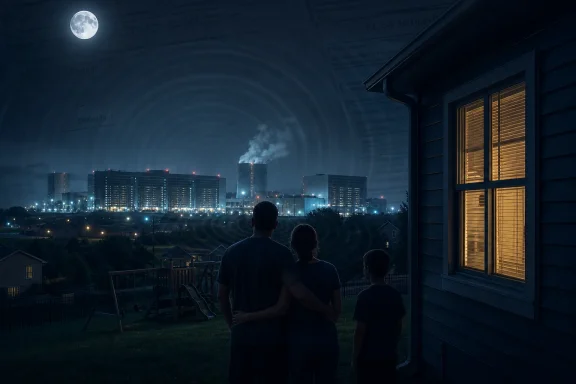 Microsoft’s AI Superfactory Meets the People Next Door
Fairwater was introduced by Microsoft in September 2025 with the sort of language that has become standard in the AI infrastructure race: largest, most advanced, most powerful. Microsoft described the Mount Pleasant campus as an AI datacenter built around huge clusters of NVIDIA Blackwell GPUs, high-speed networking, and enough compute density to train and run frontier-scale models.That framing matters because the case is not about an ordinary server room with a few noisy chillers. Fairwater is part of a new class of AI datacenter, closer in industrial character to a power-hungry factory than the invisible “cloud” metaphor still used in product marketing. The racks are dense, the cooling demands are severe, and the networking fabric is designed to make vast numbers of GPUs behave like a single machine.
Windows Central’s report notes Microsoft’s claim that each rack can process 865,000 tokens per second, a figure Microsoft and NVIDIA have used to showcase the facility’s AI throughput. That is an impressive number for customers and investors. For neighbors, the more relevant metric may be the tonal, constant sound allegedly produced by the cooling systems needed to keep that hardware running.
The lawsuit’s central allegation is straightforward: Microsoft allegedly failed to use proper industrial practices to absorb, capture, mitigate, or prevent sound from escaping the facility. Plaintiffs describe a low hum, including alleged infrasound qualities, that they say is not adequately captured by standard decibel measurements. In nuisance law, the lived effect can matter as much as the meter reading.
The Complaint Turns “Cloud” Infrastructure Back Into Real Estate
For years, the tech industry has benefited from the cloud’s rhetorical trick. Workloads “move to the cloud,” data “lives in the cloud,” and AI models are “served from the cloud.” The phrase makes infrastructure feel weightless, as if computation happens somewhere abstract and frictionless.Mount Pleasant is a reminder that the cloud has fences, fans, substations, concrete pads, backup systems, lighting, truck traffic, and neighbors. AI has made that physicality harder to hide because the economics of the current boom reward ever-larger clusters of accelerators. More compute means more power conversion, more heat, more cooling, and more mechanical systems running for longer periods.
The Fairwater dispute also lands in a community already familiar with industrial development controversy. The land in Mount Pleasant is tied to the broader Foxconn-era development story in Wisconsin, where large-scale promises of manufacturing transformation collided with local displacement, public subsidy debate, and shifting corporate plans. Microsoft’s arrival gave the area a different kind of technology project, but not a lighter one.
That history does not decide the lawsuit. It does, however, explain why residents may be less inclined to treat disruption as the temporary cost of progress. When communities are asked to absorb one industrial pivot after another, patience becomes a finite resource.
Microsoft Says the Meters and Mitigations Tell a Different Story
Microsoft’s public position is that it investigated the sound, conducted tests, and put mitigations in place. In a June 18, 2026 update on its local datacenter site, the company said several neighbors confirmed what independent monitoring showed: that mitigations had fully resolved the issue. Microsoft also said it would continue short-term mitigation work and install additional sound-reduction components over the following months.That statement is important because it shows Microsoft is not denying that neighbors heard something. The company’s argument is more technical and procedural: it identified the source, measured it, adjusted operations, and is continuing to improve the site. It also says the facility meets local ordinance requirements.
The legal problem for Microsoft is that compliance with an ordinance does not always end a nuisance dispute. A facility can be lawful and still become the subject of litigation if plaintiffs persuade a court that the use unreasonably interferes with neighboring property. That is especially true when the alleged harm is continuous, nighttime, tonal, or difficult to escape indoors.
The harder public-relations problem is that “we meet the ordinance” is rarely satisfying to someone who says a low mechanical hum is invading their bedroom at night. Datacenter operators like measurable standards because they can be engineered against. Residents experience the result as a condition of life, not a compliance spreadsheet.
The AI Boom Has a Cooling Problem That Is Also a Civic Problem
The Fairwater lawsuit fits a broader pattern around datacenter expansion. The first wave of public concern focused on electricity demand. The second focused on water use, especially in regions where evaporative cooling competes with local conservation concerns. Noise is now becoming the third pressure point, and it may be the most intimate.Power demand is abstract until it appears on a bill or grid planning document. Water consumption is often debated through permitting, sustainability reports, and municipal negotiations. Noise is different. It is present at dinner, in the backyard, through a closed window, and at 2 a.m.
AI facilities intensify this issue because they are built for enormous sustained workloads. Training runs and inference demand do not necessarily respect ordinary business hours. The machines are valuable precisely because they can run continuously, and the thermal management systems must keep pace.
The industry’s answer will be better engineering: quieter fans, acoustic barriers, liquid cooling, smarter workload placement, sound modeling, and more careful site design. Those measures matter. But the Wisconsin lawsuit suggests the policy answer may be just as important: communities need to know what they are approving before the racks arrive, not after the hum begins.
The Ordinance Defense May Not Be Enough
Microsoft’s claim that it complies with local noise ordinances may turn out to be legally significant. It may also be incomplete. Local ordinances often rely on decibel thresholds, time-of-day limits, zoning categories, or measurement methods that were not necessarily written with AI-scale datacenters in mind.The plaintiffs’ reference to a low hum and infrasound-like qualities points to a known gap between simple loudness measurements and human annoyance. A sound can be technically moderate and still be disruptive if it is tonal, persistent, low-frequency, or hard to mask. Anyone who has lived near a transformer, industrial fan, or idling engine knows the difference between a loud sound and an inescapable one.
This is where the case could become more interesting than a routine neighborhood complaint. If the court battle turns on how to measure AI datacenter noise, it may expose a mismatch between legacy industrial standards and modern compute infrastructure. A datacenter that passes a conventional test at the property line may still generate a persistent acoustic signature that residents experience as unreasonable.
For IT pros, that sounds like somebody else’s zoning problem. It is not. If public opposition grows, datacenter siting becomes slower, permitting gets harder, mitigation costs rise, and capacity planning becomes less predictable. The physical constraints of AI infrastructure eventually become service constraints for the software world built on top of it.
Fairwater’s Promise Was Scale; Its Risk Is Also Scale
Microsoft did not build Fairwater to be modest. The company’s own messaging has emphasized massive GPU counts, extraordinary throughput, and an architecture capable of handling frontier AI workloads. That scale is the point of the investment.Scale, however, changes the social contract. A small commercial facility can sometimes disappear into the background. A 1.2 million-square-foot AI campus cannot. It changes traffic patterns, utility planning, land use, light levels, emergency planning, and the acoustic environment.
The lawsuit reportedly seeks to represent residents within roughly 1.5 miles of the site, including more than 1,000 households. That proposed class has not been certified, and Microsoft will have opportunities to challenge the claims. Still, the geographic scope illustrates the core issue: a single AI facility can create a zone of impact far beyond its parcel boundaries.
The industry likes to talk about datacenters as regional economic development. That argument is not baseless; these projects bring construction jobs, tax base, technical training partnerships, and infrastructure investment. But residents do not live inside regional economic models. They live next to the fans.
Windows Users Are in This Story Whether They Know It or Not
At first glance, a datacenter noise lawsuit in Wisconsin may seem distant from the concerns of Windows users. It is not. Microsoft’s AI infrastructure underpins the company’s current strategy across Windows, Azure, Microsoft 365, GitHub, developer tools, security products, and Copilot-branded services.Every time Microsoft pushes more AI into Windows workflows, Office documents, enterprise search, endpoint management, or developer environments, it increases the importance of facilities like Fairwater. The user-facing magic depends on backend density. The backend density depends on communities accepting the physical footprint.
That does not mean Windows users should reject AI features because a datacenter is noisy. It means the cost of those features is not limited to subscription pricing, telemetry debates, or GPU procurement. There is a civic layer to the AI stack, and it includes people who may never open Copilot but still live with the infrastructure that makes it possible.
For administrators, this is another reminder that “cloud” risk is not only about uptime, data residency, compliance, or vendor lock-in. It is also about the resilience of the infrastructure supply chain, including whether hyperscalers can continue building at the pace their roadmaps assume. Local opposition is now part of that risk model.
The Lawsuit Is Early, but the Signal Is Loud
The lawsuit was filed on July 1, 2026, so the legal record is still thin. Microsoft has not lost the case. The plaintiffs have not proven their claims. Proposed class actions often narrow, settle, or fail before reaching the sweeping result implied by the complaint.But early does not mean insignificant. Lawsuits are also signals, and this one signals that AI infrastructure is moving from planning-board abstraction into household experience. The industry can no longer assume that communities will accept datacenter expansion as clean, quiet economic development simply because it lacks smokestacks.
The reporting from Wisconsin Public Radio, the Wisconsin Examiner, Tom’s Hardware, and Windows Central all points to the same tension: Microsoft says it has acted and will continue to act; residents suing the company say the disturbance is serious enough to merit damages and class treatment. Both positions can be true in part. A company can mitigate a problem while residents argue the original impact caused harm and the remaining risk is unacceptable.
That ambiguity is exactly why the case matters. The future of AI infrastructure will not be decided only by chip supply, model efficiency, or Microsoft’s capital expenditure plans. It will also be decided by whether local governments and residents believe the trade is worth it.
The Hum Around Fairwater Carries a Warning for Redmond
This case leaves Microsoft and the broader AI infrastructure industry with several concrete lessons.- Microsoft’s Fairwater datacenter is now not only an AI showcase but also a test case for how hyperscale compute projects handle neighborhood-level impacts.
- The lawsuit filed on July 1, 2026, alleges private nuisance and negligence tied to persistent noise, while Microsoft says its monitoring and mitigation work have addressed the issue.
- Compliance with local ordinances may not fully settle disputes over low-frequency, tonal, or continuous sound that residents say affects sleep and property enjoyment.
- AI datacenters are likely to face increasing scrutiny over noise alongside the already familiar fights over electricity demand, water use, land use, and public incentives.
- Windows and Azure customers may experience these fights indirectly as datacenter siting, permitting, and mitigation costs become part of the real-world limits on AI capacity.
References
- Primary source: Windows Central
Published: 2026-07-07T14:38:08.265859
Loading…
www.windowscentral.com - Related coverage: tomshardware.com
Loading…
www.tomshardware.com - Official source: blogs.microsoft.com
Inside the world’s most powerful AI datacenter - The Official Microsoft Blog
This week we have introduced a wave of purpose-built datacenters and infrastructure investments we are making around the world to support the global adoption of cutting-edge AI workloads and cloud services. Today in Wisconsin we introduced Fairwater, our newest US AI datacenter, the largest and...blogs.microsoft.com - Related coverage: wpr.org
Loading…
www.wpr.org - Related coverage: wisconsinexaminer.com
Loading…
wisconsinexaminer.com - Official source: news.microsoft.com
Microsoft Builds World’s Most Powerful AI Datacenter - Microsoft Switzerland News Center
Microsoft is building the world’s most powerful AI datacenter in Mount Pleasant, Wisconsin. The Fairwater facility will deliver 10 times the performance of today’s fastest supercomputer, enabling AI training and inference workloads at a level never before seen, powered by hundreds of thousands...news.microsoft.com
- Related coverage: techtimes.com
Loading…
www.techtimes.com - Related coverage: crn.com
Loading…
www.crn.com - Related coverage: cbs58.com
Loading…
www.cbs58.com - Official source: local.microsoft.com
Loading…
local.microsoft.com - Related coverage: spectrumnews1.com
Loading…
spectrumnews1.com - Related coverage: tomshw.it
Loading…
www.tomshw.it - Related coverage: cdn.baxtel.com
Loading…
cdn.baxtel.com