

La Tienda de las Licencias is a Spanish online reseller operated by MYA WIFI S.L.U. that markets discounted Windows, Office, server, SQL, Microsoft 365, and security software licenses internationally, grounding its business model in the European Union’s 2012 UsedSoft v. Oracle ruling on resale rights. The company’s pitch is simple: genuine software, emailed quickly, at prices that make Microsoft’s retail store look like a luxury boutique. The harder story is that “activates successfully” and “licensed cleanly enough for every buyer’s risk profile” are not always the same thing. That distinction is where bargain software becomes less like a checkout trick and more like a test of how much legal, operational, and compliance ambiguity users are willing to tolerate.
There is a reason stories about cheap Windows and Office keys travel so well. Microsoft has turned Windows activation into background plumbing for most consumers, yet the moment someone builds a PC, refurbishes a laptop, spins up a lab box, or tries to equip a small office, the sticker shock returns. A Windows 11 Pro license and a current Office package can feel less like software and more like a tax on being legitimate.
That frustration creates the market La Tienda de las Licencias is addressing. According to the company’s own promotional material distributed through Barchart, the shop sells genuine licenses delivered by email within minutes, has fulfilled more than 70,000 orders across more than 30 countries, and holds a high eKomi customer-review score. It also says the store is independent, not an authorized Microsoft partner, with Panda Security named as an exception where it claims authorized reseller status.
That independence matters. Microsoft’s public anti-piracy guidance has long warned buyers to be cautious about standalone product keys and to prefer genuine software preinstalled on PCs or purchased from authorized resellers. The company’s position is not subtle: a product key is not automatically the same thing as a transferable license right.
Still, the existence of legal resale markets in Europe is not imaginary. The Court of Justice of the European Union’s 2012 judgment in UsedSoft v. Oracle did say that software authors could not simply block resale of certain “used” software licenses once distribution rights had been exhausted in the EU. That ruling is the cornerstone of the European second-hand software trade, and it is why shops like La Tienda de las Licencias can make a legal argument that would sound absurd in many other jurisdictions.
The interesting part is not that a Spanish reseller claims to have found a loophole. It is that the loophole is not really a loophole at all. It is a collision between software companies’ preferred subscription-and-control model and a European legal tradition that still treats some digital goods as things people can own, exhaust, and resell.
That was a very European answer to a very modern problem. The software industry had spent decades trying to move customers away from ownership language and toward license language. Europe, in effect, said: not so fast. If the economic reality looks like a sale of a perpetual right to use a copy of software, the vendor may not be able to prohibit resale just because the contract says so.
But this was not a blanket blessing for every $9 Windows key on the internet. The ruling came with conditions. The original buyer’s license had to be placed on the market in the EU. The license had to involve a right to use the software for an unlimited period. The original holder could not keep using the software after resale. The reseller could not necessarily carve up a larger license in ways that changed the character of the original grant.
Those details are not legal trivia. They are the whole ballgame. A legitimate used-software transaction is not simply “someone emailed me a key and Windows activated.” It depends on provenance, transferability, exhaustion, and whether the rights being resold correspond to the thing the buyer thinks they are buying.
That is why La Tienda de las Licencias’ positioning is more careful than the usual gray-market key shop. Its promotional copy leans heavily on the EU ruling, identifies the operating company, discloses that it is independent, and avoids pretending to be Microsoft. In a sector full of sellers wearing borrowed trust signals, that candor is meaningful.
It does not remove the buyer’s need to understand what is being purchased. It simply means the conversation starts from a more serious place than “mystery key from a marketplace vendor.” For WindowsForum readers, that difference matters — especially for administrators who know that licensing pain usually arrives months later, during an audit, a reinstall, or a hardware migration.
This is the uncomfortable truth beneath the entire bargain-software economy. To a home user, “it activated” often feels like the end of the story. To an IT department, it is only the beginning. Procurement records, invoices, license type, transfer rights, and proof that the previous owner stopped using the software can matter as much as the activation screen.
Microsoft itself has repeatedly warned that standalone keys can be misleading. Its guidance distinguishes between software, licenses, certificates of authenticity, and product keys, and it cautions that keys separated from the rights or hardware they were intended to accompany may not represent a valid license. That warning is not just corporate rent-seeking, even if Microsoft also has a strong financial incentive to keep buyers in official channels.
Recent U.S. enforcement actions show why the distinction matters. Technology outlets including Windows Central and TechRadar reported this year on a Florida case involving trafficking in Microsoft Certificate of Authenticity labels and product keys, where prosecutors described labels and keys being sold apart from the licensed software or hardware they were meant to accompany. The facts of that case are not the same as a European used-license resale model, but the lesson is blunt: genuine-looking artifacts can circulate outside legitimate licensing rights.
That is the trap for buyers. “Genuine” can mean several things. It can mean the software binaries are real. It can mean the key was originally issued by Microsoft. It can mean the license right is transferable and properly transferred. Those are related concepts, but they are not interchangeable.
La Tienda de las Licencias is betting that its resale framework satisfies the third meaning, not merely the first two. For consumers and small businesses, the question is whether the company provides enough documentation to make that claim useful if something goes wrong. A bargain is much easier to defend when it arrives with a clear invoice, identifiable seller, product edition, license type, and support path.
For many users, Microsoft software feels free because it came with the machine, came from work, came from school, or came through a subscription they forgot they were paying for. The moment they need a license directly, the psychology changes. A home-built PC needs Windows. A sole proprietor wants Word and Excel without an annual subscription. A refurbished laptop needs to be made useful without blowing the hardware budget.
That is where La Tienda de las Licencias’ pitch lands. It is not selling glamour. It is selling the relief of not paying retail for software most buyers regard as infrastructure. The shop’s claimed catalog — Windows 10 Pro, Windows 11 Pro, Office 2021, Office 2024, Microsoft 365, Windows Server 2022 and 2025, SQL Server, and antivirus products — maps almost perfectly to the pain points of small IT budgets.
The inclusion of server and SQL products raises the stakes. A consumer Windows key that later fails is irritating. A server deployment with questionable licensing can become a business problem. Administrators buying for production environments need more than a successful activation; they need defensible records and clarity on whether support, downgrade rights, client access licenses, and edition terms match the environment.
That does not mean discounted licensing is inherently reckless. Used software has a long-standing place in European IT procurement, particularly for organizations trying to reduce costs on perpetual licenses. Some enterprises have deliberately used second-hand software markets as a budget tool. But mature buyers treat those purchases as procurement events, not impulse buys.
The best argument for La Tienda de las Licencias is that it brings a more formal face to a market often dominated by anonymous sellers. The best argument against relying on it casually is that Microsoft licensing has always been a swamp, and a lower price does not drain it.
A shop that says “we are independent and operating under EU resale rules” is making a testable claim. A shop that vaguely implies Microsoft blessing while selling keys at a fraction of retail is asking buyers not to notice the contradiction. La Tienda de las Licencias appears to understand that its credibility comes from legal theory, delivery reliability, and customer service rather than vendor authorization.
Still, buyers should read that independence plainly. Microsoft is not behind the counter. If a key fails, if a license is challenged, or if an installation path becomes complicated, the reseller is the first line of recourse. That makes the store’s refund policy, support responsiveness, and documentation more important than the shiny promise of instant delivery.
The eKomi rating cited in the company’s material is relevant but not definitive. Customer reviews usually measure the visible part of the experience: Did the email arrive? Did the key activate? Did support answer? They are less reliable at measuring whether a license would withstand a later compliance challenge or a complex enterprise audit.
That distinction is not meant to dismiss thousands of satisfied buyers. It is meant to keep the evidence in the right box. Fast delivery and good reviews support the claim that the storefront works. They do not, by themselves, prove the legal history of every license sold.
For individual users, that may be enough. For businesses, particularly those with regulated environments or outside auditors, it is not. A company that saves money on a server license but cannot later explain where the license came from has not saved money; it has moved cost from procurement to risk.
The company says it serves customers internationally, including Latin American markets with local-currency payment options. That is commercially smart. Software pricing can be especially painful in countries where exchange rates turn U.S. or European retail pricing into a major household or small-business expense. A legal-looking European resale market will naturally attract buyers far beyond Europe.
But legality does not always travel cleanly. A transaction that is defensible under EU exhaustion doctrine may sit differently under another jurisdiction’s software contract rules. Even within Europe, the details of how a license was first sold, transferred, and documented remain important. Outside Europe, buyers may have fewer assurances that the same resale theory would protect them.
This is where the “pocket change” framing becomes a little too breezy. Cheap software is not automatically suspicious, but extreme discounts should encourage more diligence, not less. The lower the price, the more buyers should ask what exact right is being sold, how the seller sourced it, and what happens if activation or support fails later.
There is also the question of cloud-linked products. Perpetual desktop software fits the used-license story more naturally than subscription services. Microsoft 365, by design, is not merely a static copy of software; it is a continuing service relationship. Any reseller offering Microsoft 365 at unusually low prices deserves extra scrutiny about plan type, tenant control, renewal terms, and whether the buyer is getting a proper account relationship rather than access mediated through someone else’s arrangement.
For Windows and Office perpetual licenses, the resale story is easier to understand. For modern cloud services, the boundary between license, service, account, and subscription is much harder to collapse into a simple second-hand sale. That is not an accusation against this store; it is a warning about the category.
Used-license resellers are awkward because they preserve an older idea: that software can be purchased, held, and transferred. That idea is increasingly unfashionable in Redmond and across the software industry, but it has not disappeared. In Europe, at least, the law has preserved space for it.
This tension explains why the cheap-license market feels both legitimate and faintly illicit. It is not necessarily illicit in the legal sense. It is illicit in the cultural sense: it violates the subscription-era expectation that software vendors should remain in permanent control of distribution and monetization. A second-hand software license is a small act of resistance against account-based computing.
That resistance has practical appeal. A Windows 11 Pro key for a lab machine, an Office 2021 license for a parent’s PC, or a discounted copy of Windows Server for a test environment can make the difference between using legitimate software and drifting toward piracy. In that sense, reputable secondary markets may reduce harm. They give price-sensitive users an option other than cracks, activators, and malware-ridden downloads.
But the same market also attracts bad actors because the product is easy to misrepresent. A string of characters can be sold instantly, globally, and repeatedly. The buyer may not know whether the key is retail, OEM, volume, region-bound, stolen, previously used, split from a larger agreement, or fully transferable. That information asymmetry is the gray market’s native habitat.
La Tienda de las Licencias is trying to stand on the cleaner side of that divide. The question for buyers is not whether second-hand software can be legal. In Europe, it can. The question is whether this particular transaction supplies enough evidence that the key, the license right, and the buyer’s intended use all line up.
That does not make caution obsolete. Users should avoid running third-party activation tools, scripts, or patched installers. They should download Windows and Office from Microsoft’s official channels, enter the license through standard activation flows, and keep invoices and emails. The software should never require disabling security protections or installing a mystery executable.
For businesses, the bar is higher. A company buying even a handful of discounted licenses should ask for documentation that identifies the seller, the product, the license type, and the transfer basis. If the purchase is for production servers, regulated workloads, or client-facing systems, legal and procurement review is not overkill. It is basic hygiene.
The hardest cases are small businesses that are too budget-constrained for enterprise licensing but too exposed to treat compliance as a hobby. Those buyers are exactly the target market for discounted software, and they are also the ones least likely to have licensing specialists on staff. A reseller that wants to serve them responsibly should make documentation obvious rather than hidden behind support tickets.
This is also where Microsoft’s own complexity deserves blame. The company’s licensing maze has trained generations of users to treat activation as the only comprehensible truth. Retail, OEM, volume, MAK, KMS, digital entitlement, subscription, device-based licensing, user-based licensing — the vocabulary practically invites shortcuts.
A cleaner licensing world would leave less room for ambiguity. Until then, shops like La Tienda de las Licencias will keep flourishing because they offer a simple answer to a problem Microsoft has made expensive and confusing.
That history is why this story resonates. La Tienda de las Licencias is not merely selling keys; it is selling absolution. It tells buyers they can avoid piracy without paying retail, that the bargain is not dirty, and that European law has already settled the moral question. For many users, that is a powerful message.
But the market’s reputation problem did not come from nowhere. The internet is full of sellers that blur the line between legitimate surplus, regional arbitrage, volume-license abuse, stolen keys, and outright fraud. Some keys activate because Microsoft’s systems are permissive at first. Some keys fail later. Some keys remain technically functional while leaving the buyer with no meaningful license defense.
That is why the key question is provenance. Not vibes, not reviews, not a gold badge, and not the satisfying green checkmark on an activation screen. Provenance is the chain of facts that connects Microsoft’s original license grant to the current buyer’s right to use the software. If a reseller cannot explain that chain in commercially reasonable terms, the discount is doing too much work.
La Tienda de las Licencias’ public pitch gives buyers more to work with than many competitors. It names the company, invokes a specific EU legal basis, describes its international footprint, and acknowledges its independent status. Those are good signs. They are not a substitute for product-level documentation.
The mature position is neither “all cheap keys are scams” nor “activation proves legality.” The mature position is that second-hand software can be legitimate, but the burden of clarity rises as the price falls and the deployment becomes more important.
But instant delivery also compresses the moment when buyers should pause. The faster a transaction feels, the easier it is to treat licensing as a commodity. That is fine for buying a game code from an official platform. It is less fine for acquiring software rights whose legitimacy may depend on the history of a previous transaction.
A responsible buyer should treat the post-purchase email as the beginning of recordkeeping. Save the invoice. Save the product description. Save any license-transfer statement. Record which device received which key. If the reseller provides documentation about EU exhaustion or prior license retirement, keep it with procurement records.
This advice may sound excessive for a single home PC, but it is second nature to good IT teams. Asset management is not bureaucracy for its own sake. It is how an organization avoids discovering, years later, that nobody knows why a server is licensed, who bought Office for a department, or whether a Windows installation can be moved to replacement hardware.
The same principle applies to support. If a reseller advertises instant delivery, the more important question is how it handles the minority of cases that are not instant success stories. Does support respond when activation fails? Does it replace invalid keys? Does it refund? Does it distinguish between user error, edition mismatch, and license failure?
The value of a discounted software reseller is therefore not just the discount. It is the combination of price, documentation, support, and legal theory. Remove any one of those, and the bargain starts to look less like procurement and more like gambling.
But Microsoft also has legitimate reasons to police software distribution. Stolen keys, abused volume agreements, counterfeit certificates, and account-based scams hurt buyers as well as Microsoft. A user who buys a bad key is not sticking it to Redmond; they are often paying a middleman for nothing durable.
The company’s warnings about standalone keys therefore deserve to be read with two thoughts in mind. First, Microsoft is protecting revenue and channel control. Second, Microsoft is also describing real failure modes that buyers encounter every day. Both can be true.
This is what makes the European used-license market so interesting. It does not deny Microsoft’s right to sell software. It limits Microsoft’s ability to control every downstream transaction after a qualifying first sale. That is not piracy. It is a legal boundary around vendor power.
The industry has responded over time by moving more value into subscriptions, cloud services, and account-linked entitlements where resale is harder or impossible. That shift is not only about product improvement. It is also about reducing the amount of software that can meaningfully enter a second-hand market. The cloud is a technical architecture, but it is also a licensing strategy.
Seen that way, La Tienda de las Licencias is less an oddball shop than a remnant of a contested future. It exists because there are still enough perpetual licenses, enough price-sensitive buyers, and enough legal oxygen in Europe to sustain resale. Whether that remains true a decade from now is an open question.
At the same time, the existence of a legal resale doctrine does not convert every discounted key into a clean license. Microsoft’s own guidance, recent enforcement reporting, and the long history of abused product keys all point to the same warning: activation is evidence, not proof. The more serious the deployment, the more documentation matters.
For Windows enthusiasts, the store may be attractive for lab machines, rebuilds, and personal systems where the buyer is comfortable with reseller support rather than Microsoft channel assurance. For sysadmins, it belongs in the category of potentially useful procurement options that require policy, paperwork, and approval. For enterprises, especially those already under volume or cloud agreements, the savings may not justify the compliance complexity.
The fairest conclusion is that La Tienda de las Licencias is not selling magic. It is selling a legal and commercial interpretation of software ownership that Europe still permits in meaningful ways. That interpretation can be valuable, but it is not frictionless.
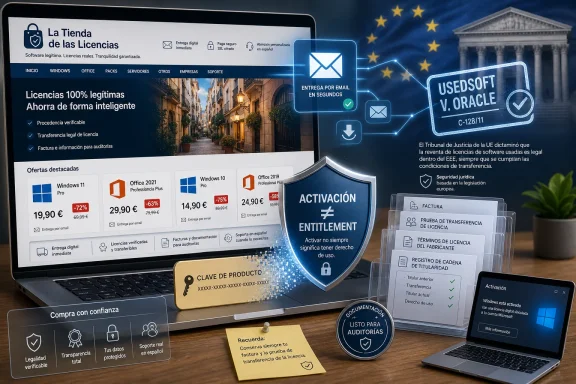 The Bargain Is Real, but So Is the Fine Print
There is a reason stories about cheap Windows and Office keys travel so well. Microsoft has turned Windows activation into background plumbing for most consumers, yet the moment someone builds a PC, refurbishes a laptop, spins up a lab box, or tries to equip a small office, the sticker shock returns. A Windows 11 Pro license and a current Office package can feel less like software and more like a tax on being legitimate.That frustration creates the market La Tienda de las Licencias is addressing. According to the company’s own promotional material distributed through Barchart, the shop sells genuine licenses delivered by email within minutes, has fulfilled more than 70,000 orders across more than 30 countries, and holds a high eKomi customer-review score. It also says the store is independent, not an authorized Microsoft partner, with Panda Security named as an exception where it claims authorized reseller status.
That independence matters. Microsoft’s public anti-piracy guidance has long warned buyers to be cautious about standalone product keys and to prefer genuine software preinstalled on PCs or purchased from authorized resellers. The company’s position is not subtle: a product key is not automatically the same thing as a transferable license right.
Still, the existence of legal resale markets in Europe is not imaginary. The Court of Justice of the European Union’s 2012 judgment in UsedSoft v. Oracle did say that software authors could not simply block resale of certain “used” software licenses once distribution rights had been exhausted in the EU. That ruling is the cornerstone of the European second-hand software trade, and it is why shops like La Tienda de las Licencias can make a legal argument that would sound absurd in many other jurisdictions.
The interesting part is not that a Spanish reseller claims to have found a loophole. It is that the loophole is not really a loophole at all. It is a collision between software companies’ preferred subscription-and-control model and a European legal tradition that still treats some digital goods as things people can own, exhaust, and resell.
Europe Made Software Ownership Awkward Again
The UsedSoft case is one of those legal decisions that looks narrow until the entire industry realizes it has teeth. Oracle had distributed software to customers under licenses, and UsedSoft built a business around reselling those licenses. The court concluded that, under certain conditions, the copyright holder’s distribution right could be exhausted after the first sale in the EU, even where the software had been downloaded rather than handed over on a disc.That was a very European answer to a very modern problem. The software industry had spent decades trying to move customers away from ownership language and toward license language. Europe, in effect, said: not so fast. If the economic reality looks like a sale of a perpetual right to use a copy of software, the vendor may not be able to prohibit resale just because the contract says so.
But this was not a blanket blessing for every $9 Windows key on the internet. The ruling came with conditions. The original buyer’s license had to be placed on the market in the EU. The license had to involve a right to use the software for an unlimited period. The original holder could not keep using the software after resale. The reseller could not necessarily carve up a larger license in ways that changed the character of the original grant.
Those details are not legal trivia. They are the whole ballgame. A legitimate used-software transaction is not simply “someone emailed me a key and Windows activated.” It depends on provenance, transferability, exhaustion, and whether the rights being resold correspond to the thing the buyer thinks they are buying.
That is why La Tienda de las Licencias’ positioning is more careful than the usual gray-market key shop. Its promotional copy leans heavily on the EU ruling, identifies the operating company, discloses that it is independent, and avoids pretending to be Microsoft. In a sector full of sellers wearing borrowed trust signals, that candor is meaningful.
It does not remove the buyer’s need to understand what is being purchased. It simply means the conversation starts from a more serious place than “mystery key from a marketplace vendor.” For WindowsForum readers, that difference matters — especially for administrators who know that licensing pain usually arrives months later, during an audit, a reinstall, or a hardware migration.
Activation Is Not the Same as Entitlement
Microsoft’s activation systems are designed to determine whether a product key can unlock software on a given device. They are not a full legal audit of how that key entered the buyer’s hands. That gap is why cheap-key markets are so persistent. A key can work technically while still being questionable contractually.This is the uncomfortable truth beneath the entire bargain-software economy. To a home user, “it activated” often feels like the end of the story. To an IT department, it is only the beginning. Procurement records, invoices, license type, transfer rights, and proof that the previous owner stopped using the software can matter as much as the activation screen.
Microsoft itself has repeatedly warned that standalone keys can be misleading. Its guidance distinguishes between software, licenses, certificates of authenticity, and product keys, and it cautions that keys separated from the rights or hardware they were intended to accompany may not represent a valid license. That warning is not just corporate rent-seeking, even if Microsoft also has a strong financial incentive to keep buyers in official channels.
Recent U.S. enforcement actions show why the distinction matters. Technology outlets including Windows Central and TechRadar reported this year on a Florida case involving trafficking in Microsoft Certificate of Authenticity labels and product keys, where prosecutors described labels and keys being sold apart from the licensed software or hardware they were meant to accompany. The facts of that case are not the same as a European used-license resale model, but the lesson is blunt: genuine-looking artifacts can circulate outside legitimate licensing rights.
That is the trap for buyers. “Genuine” can mean several things. It can mean the software binaries are real. It can mean the key was originally issued by Microsoft. It can mean the license right is transferable and properly transferred. Those are related concepts, but they are not interchangeable.
La Tienda de las Licencias is betting that its resale framework satisfies the third meaning, not merely the first two. For consumers and small businesses, the question is whether the company provides enough documentation to make that claim useful if something goes wrong. A bargain is much easier to defend when it arrives with a clear invoice, identifiable seller, product edition, license type, and support path.
Microsoft’s Retail Pricing Created the Oxygen for This Market
It is tempting to frame cheap software resellers as strange little side streets off the legitimate software economy. In reality, they are a predictable response to Microsoft’s own pricing architecture. Windows is both ubiquitous and strangely expensive when purchased outside the OEM channel. Office has become a subscription nudge machine, with perpetual versions still available but increasingly framed as legacy-style purchases.For many users, Microsoft software feels free because it came with the machine, came from work, came from school, or came through a subscription they forgot they were paying for. The moment they need a license directly, the psychology changes. A home-built PC needs Windows. A sole proprietor wants Word and Excel without an annual subscription. A refurbished laptop needs to be made useful without blowing the hardware budget.
That is where La Tienda de las Licencias’ pitch lands. It is not selling glamour. It is selling the relief of not paying retail for software most buyers regard as infrastructure. The shop’s claimed catalog — Windows 10 Pro, Windows 11 Pro, Office 2021, Office 2024, Microsoft 365, Windows Server 2022 and 2025, SQL Server, and antivirus products — maps almost perfectly to the pain points of small IT budgets.
The inclusion of server and SQL products raises the stakes. A consumer Windows key that later fails is irritating. A server deployment with questionable licensing can become a business problem. Administrators buying for production environments need more than a successful activation; they need defensible records and clarity on whether support, downgrade rights, client access licenses, and edition terms match the environment.
That does not mean discounted licensing is inherently reckless. Used software has a long-standing place in European IT procurement, particularly for organizations trying to reduce costs on perpetual licenses. Some enterprises have deliberately used second-hand software markets as a budget tool. But mature buyers treat those purchases as procurement events, not impulse buys.
The best argument for La Tienda de las Licencias is that it brings a more formal face to a market often dominated by anonymous sellers. The best argument against relying on it casually is that Microsoft licensing has always been a swamp, and a lower price does not drain it.
The Spanish Store’s Smartest Move Is Admitting What It Is Not
One of the more notable details in the Barchart-distributed source material is the company’s explicit statement that it is not an authorized Microsoft partner or official distributor for the major brands it sells, except for Panda Security. That disclosure may sound like a weakness, but editorially it is the strongest part of the pitch. It avoids the fake-official posture that has poisoned trust in software key sellers for years.A shop that says “we are independent and operating under EU resale rules” is making a testable claim. A shop that vaguely implies Microsoft blessing while selling keys at a fraction of retail is asking buyers not to notice the contradiction. La Tienda de las Licencias appears to understand that its credibility comes from legal theory, delivery reliability, and customer service rather than vendor authorization.
Still, buyers should read that independence plainly. Microsoft is not behind the counter. If a key fails, if a license is challenged, or if an installation path becomes complicated, the reseller is the first line of recourse. That makes the store’s refund policy, support responsiveness, and documentation more important than the shiny promise of instant delivery.
The eKomi rating cited in the company’s material is relevant but not definitive. Customer reviews usually measure the visible part of the experience: Did the email arrive? Did the key activate? Did support answer? They are less reliable at measuring whether a license would withstand a later compliance challenge or a complex enterprise audit.
That distinction is not meant to dismiss thousands of satisfied buyers. It is meant to keep the evidence in the right box. Fast delivery and good reviews support the claim that the storefront works. They do not, by themselves, prove the legal history of every license sold.
For individual users, that may be enough. For businesses, particularly those with regulated environments or outside auditors, it is not. A company that saves money on a server license but cannot later explain where the license came from has not saved money; it has moved cost from procurement to risk.
The Geography of Legality Is Not a Footnote
The biggest danger in global coverage of La Tienda de las Licencias is flattening the legal context. The UsedSoft ruling is an EU decision. It matters enormously inside the European legal framework, but it is not a magic wand for every buyer in every country. A Spanish seller can operate under EU principles; an international buyer still has to consider local law, contract terms, and practical enforcement realities.The company says it serves customers internationally, including Latin American markets with local-currency payment options. That is commercially smart. Software pricing can be especially painful in countries where exchange rates turn U.S. or European retail pricing into a major household or small-business expense. A legal-looking European resale market will naturally attract buyers far beyond Europe.
But legality does not always travel cleanly. A transaction that is defensible under EU exhaustion doctrine may sit differently under another jurisdiction’s software contract rules. Even within Europe, the details of how a license was first sold, transferred, and documented remain important. Outside Europe, buyers may have fewer assurances that the same resale theory would protect them.
This is where the “pocket change” framing becomes a little too breezy. Cheap software is not automatically suspicious, but extreme discounts should encourage more diligence, not less. The lower the price, the more buyers should ask what exact right is being sold, how the seller sourced it, and what happens if activation or support fails later.
There is also the question of cloud-linked products. Perpetual desktop software fits the used-license story more naturally than subscription services. Microsoft 365, by design, is not merely a static copy of software; it is a continuing service relationship. Any reseller offering Microsoft 365 at unusually low prices deserves extra scrutiny about plan type, tenant control, renewal terms, and whether the buyer is getting a proper account relationship rather than access mediated through someone else’s arrangement.
For Windows and Office perpetual licenses, the resale story is easier to understand. For modern cloud services, the boundary between license, service, account, and subscription is much harder to collapse into a simple second-hand sale. That is not an accusation against this store; it is a warning about the category.
The Used-Software Market Is a Rebellion Against Subscription Gravity
Microsoft would prefer a world where customers rent the future. Windows becomes an update channel. Office becomes Microsoft 365. Identity, storage, compliance, endpoint management, and AI features all get bundled into recurring relationships. The customer does not buy a box; the customer enters an orbit.Used-license resellers are awkward because they preserve an older idea: that software can be purchased, held, and transferred. That idea is increasingly unfashionable in Redmond and across the software industry, but it has not disappeared. In Europe, at least, the law has preserved space for it.
This tension explains why the cheap-license market feels both legitimate and faintly illicit. It is not necessarily illicit in the legal sense. It is illicit in the cultural sense: it violates the subscription-era expectation that software vendors should remain in permanent control of distribution and monetization. A second-hand software license is a small act of resistance against account-based computing.
That resistance has practical appeal. A Windows 11 Pro key for a lab machine, an Office 2021 license for a parent’s PC, or a discounted copy of Windows Server for a test environment can make the difference between using legitimate software and drifting toward piracy. In that sense, reputable secondary markets may reduce harm. They give price-sensitive users an option other than cracks, activators, and malware-ridden downloads.
But the same market also attracts bad actors because the product is easy to misrepresent. A string of characters can be sold instantly, globally, and repeatedly. The buyer may not know whether the key is retail, OEM, volume, region-bound, stolen, previously used, split from a larger agreement, or fully transferable. That information asymmetry is the gray market’s native habitat.
La Tienda de las Licencias is trying to stand on the cleaner side of that divide. The question for buyers is not whether second-hand software can be legal. In Europe, it can. The question is whether this particular transaction supplies enough evidence that the key, the license right, and the buyer’s intended use all line up.
Home Users Can Treat This as a Deal, but Businesses Need a Paper Trail
For a home user activating a single PC, the calculus is fairly straightforward. If the seller is identifiable, the payment method offers recourse, the edition is clear, and the key activates normally, many buyers will consider the risk acceptable. The realistic downside is usually inconvenience: a failed activation, a blocked key, a support exchange, or the need to buy again through official channels.That does not make caution obsolete. Users should avoid running third-party activation tools, scripts, or patched installers. They should download Windows and Office from Microsoft’s official channels, enter the license through standard activation flows, and keep invoices and emails. The software should never require disabling security protections or installing a mystery executable.
For businesses, the bar is higher. A company buying even a handful of discounted licenses should ask for documentation that identifies the seller, the product, the license type, and the transfer basis. If the purchase is for production servers, regulated workloads, or client-facing systems, legal and procurement review is not overkill. It is basic hygiene.
The hardest cases are small businesses that are too budget-constrained for enterprise licensing but too exposed to treat compliance as a hobby. Those buyers are exactly the target market for discounted software, and they are also the ones least likely to have licensing specialists on staff. A reseller that wants to serve them responsibly should make documentation obvious rather than hidden behind support tickets.
This is also where Microsoft’s own complexity deserves blame. The company’s licensing maze has trained generations of users to treat activation as the only comprehensible truth. Retail, OEM, volume, MAK, KMS, digital entitlement, subscription, device-based licensing, user-based licensing — the vocabulary practically invites shortcuts.
A cleaner licensing world would leave less room for ambiguity. Until then, shops like La Tienda de las Licencias will keep flourishing because they offer a simple answer to a problem Microsoft has made expensive and confusing.
The Cheapest Key Is Not Always the Cheapest Outcome
The Windows community has a long memory for activation drama. People remember Windows Genuine Advantage. They remember volume keys that worked until they didn’t. They remember OEM stickers, refurbisher programs, and the weird emotional split between wanting to pay for software and feeling punished for doing so.That history is why this story resonates. La Tienda de las Licencias is not merely selling keys; it is selling absolution. It tells buyers they can avoid piracy without paying retail, that the bargain is not dirty, and that European law has already settled the moral question. For many users, that is a powerful message.
But the market’s reputation problem did not come from nowhere. The internet is full of sellers that blur the line between legitimate surplus, regional arbitrage, volume-license abuse, stolen keys, and outright fraud. Some keys activate because Microsoft’s systems are permissive at first. Some keys fail later. Some keys remain technically functional while leaving the buyer with no meaningful license defense.
That is why the key question is provenance. Not vibes, not reviews, not a gold badge, and not the satisfying green checkmark on an activation screen. Provenance is the chain of facts that connects Microsoft’s original license grant to the current buyer’s right to use the software. If a reseller cannot explain that chain in commercially reasonable terms, the discount is doing too much work.
La Tienda de las Licencias’ public pitch gives buyers more to work with than many competitors. It names the company, invokes a specific EU legal basis, describes its international footprint, and acknowledges its independent status. Those are good signs. They are not a substitute for product-level documentation.
The mature position is neither “all cheap keys are scams” nor “activation proves legality.” The mature position is that second-hand software can be legitimate, but the burden of clarity rises as the price falls and the deployment becomes more important.
The Real Test Comes After the Checkout Email
The company’s claim of automated email delivery within minutes is exactly what modern buyers expect. Digital software should not require waiting for a box, a courier, or a sales representative. If La Tienda de las Licencias has reduced the used-license transaction to an instant checkout flow, that is an operational achievement.But instant delivery also compresses the moment when buyers should pause. The faster a transaction feels, the easier it is to treat licensing as a commodity. That is fine for buying a game code from an official platform. It is less fine for acquiring software rights whose legitimacy may depend on the history of a previous transaction.
A responsible buyer should treat the post-purchase email as the beginning of recordkeeping. Save the invoice. Save the product description. Save any license-transfer statement. Record which device received which key. If the reseller provides documentation about EU exhaustion or prior license retirement, keep it with procurement records.
This advice may sound excessive for a single home PC, but it is second nature to good IT teams. Asset management is not bureaucracy for its own sake. It is how an organization avoids discovering, years later, that nobody knows why a server is licensed, who bought Office for a department, or whether a Windows installation can be moved to replacement hardware.
The same principle applies to support. If a reseller advertises instant delivery, the more important question is how it handles the minority of cases that are not instant success stories. Does support respond when activation fails? Does it replace invalid keys? Does it refund? Does it distinguish between user error, edition mismatch, and license failure?
The value of a discounted software reseller is therefore not just the discount. It is the combination of price, documentation, support, and legal theory. Remove any one of those, and the bargain starts to look less like procurement and more like gambling.
The Microsoft Angle Is More Complicated Than “Greedy Vendor Versus Clever Reseller”
It would be easy to cast Microsoft as the villain in this story: a trillion-dollar company trying to keep prices high while scrappy resellers help ordinary users. There is some truth in that framing, especially when retail pricing pushes users toward sketchier alternatives. Microsoft benefits from a licensing system so complex that many customers give up and overpay.But Microsoft also has legitimate reasons to police software distribution. Stolen keys, abused volume agreements, counterfeit certificates, and account-based scams hurt buyers as well as Microsoft. A user who buys a bad key is not sticking it to Redmond; they are often paying a middleman for nothing durable.
The company’s warnings about standalone keys therefore deserve to be read with two thoughts in mind. First, Microsoft is protecting revenue and channel control. Second, Microsoft is also describing real failure modes that buyers encounter every day. Both can be true.
This is what makes the European used-license market so interesting. It does not deny Microsoft’s right to sell software. It limits Microsoft’s ability to control every downstream transaction after a qualifying first sale. That is not piracy. It is a legal boundary around vendor power.
The industry has responded over time by moving more value into subscriptions, cloud services, and account-linked entitlements where resale is harder or impossible. That shift is not only about product improvement. It is also about reducing the amount of software that can meaningfully enter a second-hand market. The cloud is a technical architecture, but it is also a licensing strategy.
Seen that way, La Tienda de las Licencias is less an oddball shop than a remnant of a contested future. It exists because there are still enough perpetual licenses, enough price-sensitive buyers, and enough legal oxygen in Europe to sustain resale. Whether that remains true a decade from now is an open question.
The WindowsForum Reader Should See the Bargain and the Boundary
The practical read is not hard, but it is easy to oversimplify. La Tienda de las Licencias appears to be presenting itself as a more transparent participant in the discounted software market than the anonymous key shops that litter search results. Its reliance on the EU UsedSoft framework gives the business a legal argument that buyers should understand before dismissing the prices as impossible.At the same time, the existence of a legal resale doctrine does not convert every discounted key into a clean license. Microsoft’s own guidance, recent enforcement reporting, and the long history of abused product keys all point to the same warning: activation is evidence, not proof. The more serious the deployment, the more documentation matters.
For Windows enthusiasts, the store may be attractive for lab machines, rebuilds, and personal systems where the buyer is comfortable with reseller support rather than Microsoft channel assurance. For sysadmins, it belongs in the category of potentially useful procurement options that require policy, paperwork, and approval. For enterprises, especially those already under volume or cloud agreements, the savings may not justify the compliance complexity.
The fairest conclusion is that La Tienda de las Licencias is not selling magic. It is selling a legal and commercial interpretation of software ownership that Europe still permits in meaningful ways. That interpretation can be valuable, but it is not frictionless.
The Cheap-License Story Has Five Rules Worth Remembering
The lesson here is not that everyone should rush to a Spanish storefront for Windows keys. It is that the second-hand software market is real, legally significant, and still risky enough to reward careful buyers. The bargain works best when the buyer understands both the court ruling behind it and the licensing ambiguity that can survive a successful activation.- A genuine product key can activate real Microsoft software without automatically proving that the buyer holds a clean, transferable license right.
- The EU’s UsedSoft v. Oracle ruling supports resale of certain used software licenses, but only under conditions that make provenance and prior-use termination important.
- La Tienda de las Licencias’ disclosure that it is an independent reseller, not an authorized Microsoft partner, is a useful transparency signal rather than a minor detail.
- Home users may mainly be weighing convenience and refund risk, while businesses must also weigh auditability, procurement records, and compliance exposure.
- Buyers should download software only from official vendor sources, avoid third-party activators, and keep invoices, product descriptions, and transfer documentation.
- The deeper market force is Microsoft’s shift toward subscriptions and account-based services, which makes perpetual transferable software feel increasingly like an endangered species.
References
- Primary source: barchart.com
Published: 2026-07-07T09:40:11.947431
The Quiet Spanish Shop That Legally Sells Windows and Office for Pocket Change
An independent reseller called La Tienda de las Licencias has spent years doing something that sounds too good to be legal — and is. La Tienda de las Licencias sells genuine software licenses, delivered by email within minutes. For many users and bus...www.barchart.com
- Official source: microsoft.com
How To Tell - Shop
www.microsoft.com
- Related coverage: officeandwin.store
Windows Activation Fraud Crackdown Intensifies as Microsoft Targets Unauthorized Key Resellers | OfficeandWin Tech
Windows Activation Fraud Crackdown Intensifies as Microsoft Targets Unauthorized Key Resellers. Analysis, impact, and what it means for technology users anofficeandwin.store - Related coverage: mylegitkeys.com
Are Third-Party Windows Key Sites Legit? How To Buy Genuine Keys Safely | MyLegitKeys
How to spot a reliable Microsoft product key vendor vs a scam. We explain what makes a software key reseller trustworthy and why MyLegitKeys is a safe choice.mylegitkeys.com - Related coverage: techspot.com
Those cheap Windows and Office keys might come from a federal crime | TechSpot
The US Department of Justice says 52-year-old Heidi Richards of Brandon, Florida, who ran Trinity Software Distribution, has been sentenced to 22 months in federal prison after...www.techspot.com - Related coverage: windowscentral.com
Florida woman jailed and fined for Microsoft license fraud | Windows Central
Heidi Richards is sentenced to 22 months in prison for a massive Microsoft license fraud scheme.www.windowscentral.com
- Related coverage: computercity.com
Is It Safe to Buy a Windows License Online? Assessing Digital Purchase Security - ComputerCity
Purchasing a Windows license online can raise concerns about safety and legitimacy. It's vital to understand that a license key is necessary to use Windowscomputercity.com - Related coverage: thesoftwarekings.com
Are Cheap Windows Keys Legal? The Honest Answer
Are $15 Windows keys legal? Yes, when they're genuine Retail. Here's how to tell legitimate cheap keys from scams, what to avoid, and what to buy.thesoftwarekings.com - Related coverage: solvingdad.com
Are cheap Windows license keys from third-party sites legitimate? - Solving Dad
Are cheap Windows license keys safe and legal? Learn the risks, activation issues, scams, and how to avoid fake Windows licensessolvingdad.com