

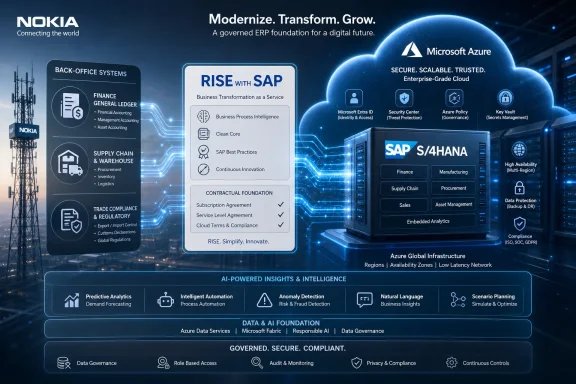
Nokia signed a multi-year agreement with SAP, announced July 2026 and concluded at the end of 2025, to move its SAP S/4HANA environment into a RISE with SAP transformation model hosted on Microsoft Azure. The deal is not a flashy consumer launch, but it is the sort of enterprise plumbing decision that quietly determines how AI actually reaches large companies. As reported by MENAFN from SAP’s announcement and echoed by SAP-focused outlets including Portal ERP and regional technology press, Nokia is choosing a managed cloud ERP path rather than treating modernization as a one-off migration. That choice says as much about the state of enterprise AI as it does about Nokia.
The obvious headline is that Nokia, SAP, and Microsoft are tying cloud ERP to AI-driven transformation. The less obvious story is that the most important AI deployments in large enterprises may begin far from chatbots, copilots, and public demos. They begin with finance records, warehouse flows, trade compliance, procurement data, master data governance, and the painfully slow replacement of legacy ERP sprawl.
Nokia has spent years recasting itself for the AI infrastructure era, with connectivity, networking, and cloud-scale demand all central to its public positioning. But an AI-era company still has to close its books, manage suppliers, move inventory, comply with trade rules, and make decisions from trusted operational data. If those systems remain fragmented, AI becomes a presentation-layer trick over unreliable foundations.
That is why this agreement matters. Nokia is not merely renting cloud capacity for SAP workloads. It is putting its ERP modernization inside a formal RISE with SAP journey, with SAP operating and managing the S/4HANA environment in the cloud and Microsoft Azure supplying the hyperscale foundation.
This is the enterprise version of a truth Windows administrators already know: the operating environment shapes the applications above it. If the platform is fragmented, patched unevenly, and governed inconsistently, every higher-level promise becomes harder to keep.
That language can sound like vendor fog, but in ERP it points to something concrete. A migration of this kind forces decisions about which customizations survive, which processes become standardized, which datasets become authoritative, and which operating responsibilities shift from internal teams to SAP and its cloud partner. That is where the real cost and value live.
SAP’s Manos Raptopoulos framed the deal as a business-led transformation with a structured roadmap, integrated toolchain, and continuous access to innovation. The key phrase is clean core, SAP’s preferred shorthand for keeping the core ERP system closer to standard so updates, cloud services, and AI features can be adopted without years of custom-code archaeology.
For IT pros, that is both attractive and uncomfortable. A clean core promises fewer brittle integrations and a cleaner path to updates. It also means old exceptions, custom workflows, and “we have always done it this way” processes lose some of their political shelter.
This fits a broader Microsoft-SAP pattern. Microsoft’s Azure blog and SAP News Center have both described expanded efforts around RISE with SAP on Azure, including programs intended to give customers closer technical support, migration guidance, and escalation paths. The sales pitch is clear: if ERP is moving to managed cloud, Microsoft wants Azure to be the default landing zone for the world’s biggest business systems.
That is a strategic prize because ERP workloads are sticky. Once a global manufacturer or telecom infrastructure company standardizes critical SAP operations on a hyperscaler, the surrounding ecosystem tends to follow. Identity, analytics, security monitoring, integration services, data platforms, and AI tooling all begin orbiting the same cloud gravity well.
For Microsoft, this is also a way to turn enterprise AI from a licensing story into an infrastructure story. Copilot may get the headlines, but Azure gets the workloads, the data adjacency, and the operational dependency.
Nokia’s SAP landscape includes S/4HANA for central finance, SAP Master Data Governance, SAP Extended Warehouse Management, SAP Global Trade Services, and S/4HANA Cloud for advanced ATP. That is not a random product bundle. It maps to the places where operational decisions are made and where bad data can create expensive errors.
AI features layered onto finance, logistics, and trade workflows can help with forecasting, exception handling, process recommendations, and automation. But they can also amplify bad assumptions if the underlying data model is inconsistent. This is why SAP’s “clean core” message and Microsoft’s cloud operations pitch are joined at the hip.
The industry often talks about AI as though the limiting factor is model capability. In global ERP, the limiting factor is usually whether the company has a trustworthy operational substrate. Nokia’s move suggests that enterprise AI adoption will be less about turning on a magic assistant and more about forcing a long-delayed reckoning with business process debt.
The agreement also builds on existing work with SAP and Microsoft. Nokia already operates parts of its SAP landscape on Azure, according to the announcement, and has been consolidating multiple ERP systems into a unified S/4HANA landscape as part of its next-generation ERP program. In other words, the new agreement formalizes and accelerates a direction already underway.
That continuity makes the deal more credible than the usual “digital transformation” boilerplate. Enterprises do not wake up one morning and decide to move their core ERP to the cloud because a vendor used the phrase “AI-driven.” They do it after years of technical debt, consolidation work, budget cycles, executive pressure, and operational negotiation.
The multi-year nature of the agreement is also a reminder that cloud ERP is not a weekend migration. For a company with Nokia’s footprint, business-critical workloads, and regulatory exposure, the transformation has to survive regional requirements, latency constraints, security reviews, integration dependencies, and the basic reality that the business cannot stop while IT modernizes the engine.
But simplification has a shadow. Moving core ERP into a managed cloud model can reduce internal infrastructure burden while increasing dependency on vendor roadmaps, commercial terms, cloud architecture choices, and support relationships. The organization may escape one form of complexity only to inherit another.
This is not necessarily a reason to avoid the model. For many enterprises, running heavily customized legacy ERP across fragmented environments is already the worst of both worlds: expensive, slow to change, and difficult to secure. The question is whether the new managed model gives the customer enough leverage, transparency, and architectural flexibility over time.
For WindowsForum readers, the analogy is familiar. Centralized cloud management can improve security posture, standardize deployment, and reduce local maintenance. It can also turn every outage, licensing change, or roadmap shift into a dependency event. The right answer is not nostalgia for the old stack; it is sober governance of the new one.
For CIOs and boards, hyperscaler selection is partly a technical decision and partly a risk decision. Azure brings proximity to Microsoft identity, security, productivity, data, and AI services that many enterprises already use. That existing footprint can make Azure the path of least resistance for SAP modernization.
SAP and Microsoft have been tightening this story for years. The more SAP pushes RISE and cloud ERP, the more Microsoft can position Azure as a preferred enterprise landing zone. The more Microsoft pushes AI and cloud-native operations, the more SAP can argue that ERP modernization is the gateway to business AI.
Nokia’s deal sits neatly inside that flywheel. It gives SAP a high-profile transformation customer, Microsoft a major Azure ERP anchor, and Nokia a managed path away from ERP fragmentation. Everyone gets a strategic narrative; the hard part is execution.
In practice, they are now the same conversation. AI in the enterprise cannot mature unless the systems of record are modern enough to expose reliable data, enforce governance, and absorb continuous updates. ERP transformation cannot justify its cost unless it unlocks more than infrastructure savings.
That is why SAP is emphasizing embedded AI in its cloud applications rather than presenting AI as a bolt-on. The company wants customers to believe that adopting RISE and moving toward cloud ERP is the route to ongoing AI capability. Microsoft, meanwhile, wants the underlying cloud, data, and productivity stack to make Azure the natural place for those capabilities to run.
Nokia’s role is revealing because it is not a startup looking for a greenfield architecture. It is a mature global company with decades of SAP usage, complex supply chains, finance requirements, and technical operations. If AI-driven transformation is real for companies like Nokia, it will arrive through the modernization of systems that were never designed for the AI era.
When SAP workloads move onto Azure, IT departments often have to think across boundaries that used to be separate. Identity architects, security teams, network engineers, SAP Basis administrators, compliance teams, and Windows endpoint managers all become part of the same operational fabric. The back office and the Microsoft cloud stack are no longer distant domains.
That matters because the failure modes are shared. Conditional access policies, privileged identity management, network segmentation, monitoring, incident response, and data loss prevention all become part of the ERP risk model. A cloud ERP environment is only as resilient as the operational practices around it.
For sysadmins and IT pros, the lesson is not that everyone needs to become an SAP expert. It is that Microsoft-centered enterprise administration increasingly touches workloads that once lived in specialized silos. Azure’s success in SAP modernization pulls more of the enterprise core into the orbit of Microsoft operations.
Those goals align, but they are not identical. Nokia will measure success in operational simplicity, resilience, business agility, and the ability to adopt AI without destabilizing core processes. SAP will measure success in cloud adoption, standardization, and long-term customer commitment to its cloud portfolio. Microsoft will measure success in Azure consumption, strategic account depth, and the surrounding cloud services pulled into the deal.
The best enterprise partnerships work when these incentives reinforce each other. The worst ones work well for vendors while customers absorb complexity under the banner of transformation. Nokia’s scale gives it negotiating power, but execution will still depend on governance, architecture, and the discipline to avoid recreating old complexity in a new cloud wrapper.
That is the real test of RISE with SAP on Azure. If the model genuinely reduces operational drag and makes AI capabilities safer to adopt, it will justify the transformation language. If it merely shifts complexity from owned infrastructure to managed dependency, customers will discover that cloud ERP can be just as political and brittle as the systems it replaced.
 Nokia’s AI Story Starts in the Back Office
The obvious headline is that Nokia, SAP, and Microsoft are tying cloud ERP to AI-driven transformation. The less obvious story is that the most important AI deployments in large enterprises may begin far from chatbots, copilots, and public demos. They begin with finance records, warehouse flows, trade compliance, procurement data, master data governance, and the painfully slow replacement of legacy ERP sprawl.Nokia has spent years recasting itself for the AI infrastructure era, with connectivity, networking, and cloud-scale demand all central to its public positioning. But an AI-era company still has to close its books, manage suppliers, move inventory, comply with trade rules, and make decisions from trusted operational data. If those systems remain fragmented, AI becomes a presentation-layer trick over unreliable foundations.
That is why this agreement matters. Nokia is not merely renting cloud capacity for SAP workloads. It is putting its ERP modernization inside a formal RISE with SAP journey, with SAP operating and managing the S/4HANA environment in the cloud and Microsoft Azure supplying the hyperscale foundation.
This is the enterprise version of a truth Windows administrators already know: the operating environment shapes the applications above it. If the platform is fragmented, patched unevenly, and governed inconsistently, every higher-level promise becomes harder to keep.
RISE With SAP Is a Contract for Discipline
SAP describes RISE with SAP as a business transformation framework rather than a point product, and in this case the distinction is important. Nokia is not simply moving an old ERP estate from one data center to another. The company is adopting a structured methodology covering processes, data, applications, and operating models.That language can sound like vendor fog, but in ERP it points to something concrete. A migration of this kind forces decisions about which customizations survive, which processes become standardized, which datasets become authoritative, and which operating responsibilities shift from internal teams to SAP and its cloud partner. That is where the real cost and value live.
SAP’s Manos Raptopoulos framed the deal as a business-led transformation with a structured roadmap, integrated toolchain, and continuous access to innovation. The key phrase is clean core, SAP’s preferred shorthand for keeping the core ERP system closer to standard so updates, cloud services, and AI features can be adopted without years of custom-code archaeology.
For IT pros, that is both attractive and uncomfortable. A clean core promises fewer brittle integrations and a cleaner path to updates. It also means old exceptions, custom workflows, and “we have always done it this way” processes lose some of their political shelter.
Microsoft Wins When ERP Becomes Cloud Infrastructure
Microsoft’s role in the Nokia agreement is not incidental. Azure will host Nokia’s SAP S/4HANA environment, and Microsoft will work with SAP and Nokia on migration and optimization. That makes Azure more than a commodity compute layer; it becomes part of the operating model for one of Nokia’s most critical enterprise systems.This fits a broader Microsoft-SAP pattern. Microsoft’s Azure blog and SAP News Center have both described expanded efforts around RISE with SAP on Azure, including programs intended to give customers closer technical support, migration guidance, and escalation paths. The sales pitch is clear: if ERP is moving to managed cloud, Microsoft wants Azure to be the default landing zone for the world’s biggest business systems.
That is a strategic prize because ERP workloads are sticky. Once a global manufacturer or telecom infrastructure company standardizes critical SAP operations on a hyperscaler, the surrounding ecosystem tends to follow. Identity, analytics, security monitoring, integration services, data platforms, and AI tooling all begin orbiting the same cloud gravity well.
For Microsoft, this is also a way to turn enterprise AI from a licensing story into an infrastructure story. Copilot may get the headlines, but Azure gets the workloads, the data adjacency, and the operational dependency.
The AI Promise Depends on the Data Nobody Wants to Clean
The announcement repeatedly invokes AI-enabled functionality embedded in SAP’s cloud applications. That is now standard enterprise software language, but Nokia’s case shows the less glamorous prerequisite: data discipline. AI in ERP is only useful if the system understands the company’s products, customers, suppliers, shipments, contracts, inventory, and financial structures with enough consistency to automate decisions.Nokia’s SAP landscape includes S/4HANA for central finance, SAP Master Data Governance, SAP Extended Warehouse Management, SAP Global Trade Services, and S/4HANA Cloud for advanced ATP. That is not a random product bundle. It maps to the places where operational decisions are made and where bad data can create expensive errors.
AI features layered onto finance, logistics, and trade workflows can help with forecasting, exception handling, process recommendations, and automation. But they can also amplify bad assumptions if the underlying data model is inconsistent. This is why SAP’s “clean core” message and Microsoft’s cloud operations pitch are joined at the hip.
The industry often talks about AI as though the limiting factor is model capability. In global ERP, the limiting factor is usually whether the company has a trustworthy operational substrate. Nokia’s move suggests that enterprise AI adoption will be less about turning on a magic assistant and more about forcing a long-delayed reckoning with business process debt.
Nokia Is Buying a Path, Not Just a Platform
Nokia’s own statement, attributed to Marek Očkay, VP and global head of IT procurement and vendor management, emphasizes a structured and future-ready path for business growth. That wording matters because ERP transformation is rarely a single destination. The implementation is a journey of sequencing: finance first, logistics next, master data governance throughout, AI capabilities adopted progressively rather than all at once.The agreement also builds on existing work with SAP and Microsoft. Nokia already operates parts of its SAP landscape on Azure, according to the announcement, and has been consolidating multiple ERP systems into a unified S/4HANA landscape as part of its next-generation ERP program. In other words, the new agreement formalizes and accelerates a direction already underway.
That continuity makes the deal more credible than the usual “digital transformation” boilerplate. Enterprises do not wake up one morning and decide to move their core ERP to the cloud because a vendor used the phrase “AI-driven.” They do it after years of technical debt, consolidation work, budget cycles, executive pressure, and operational negotiation.
The multi-year nature of the agreement is also a reminder that cloud ERP is not a weekend migration. For a company with Nokia’s footprint, business-critical workloads, and regulatory exposure, the transformation has to survive regional requirements, latency constraints, security reviews, integration dependencies, and the basic reality that the business cannot stop while IT modernizes the engine.
The Real Risk Is Operational Lock-In Disguised as Simplification
There is an obvious upside to Nokia’s choice. SAP manages the S/4HANA cloud environment, Azure supplies global scale and resilience, and Nokia’s internal teams can spend less energy on infrastructure mechanics and more on business outcomes. That is the pitch every CIO wants to believe.But simplification has a shadow. Moving core ERP into a managed cloud model can reduce internal infrastructure burden while increasing dependency on vendor roadmaps, commercial terms, cloud architecture choices, and support relationships. The organization may escape one form of complexity only to inherit another.
This is not necessarily a reason to avoid the model. For many enterprises, running heavily customized legacy ERP across fragmented environments is already the worst of both worlds: expensive, slow to change, and difficult to secure. The question is whether the new managed model gives the customer enough leverage, transparency, and architectural flexibility over time.
For WindowsForum readers, the analogy is familiar. Centralized cloud management can improve security posture, standardize deployment, and reduce local maintenance. It can also turn every outage, licensing change, or roadmap shift into a dependency event. The right answer is not nostalgia for the old stack; it is sober governance of the new one.
Azure Becomes the Boardroom’s Safe Choice
Microsoft Azure’s selection gives Nokia a familiar enterprise cloud foundation with global reach, security services, and a deep SAP partnership. That is precisely why Azure is attractive for large SAP estates. The platform is not merely selling virtual machines; it is selling reassurance.For CIOs and boards, hyperscaler selection is partly a technical decision and partly a risk decision. Azure brings proximity to Microsoft identity, security, productivity, data, and AI services that many enterprises already use. That existing footprint can make Azure the path of least resistance for SAP modernization.
SAP and Microsoft have been tightening this story for years. The more SAP pushes RISE and cloud ERP, the more Microsoft can position Azure as a preferred enterprise landing zone. The more Microsoft pushes AI and cloud-native operations, the more SAP can argue that ERP modernization is the gateway to business AI.
Nokia’s deal sits neatly inside that flywheel. It gives SAP a high-profile transformation customer, Microsoft a major Azure ERP anchor, and Nokia a managed path away from ERP fragmentation. Everyone gets a strategic narrative; the hard part is execution.
Enterprise AI Has Become an ERP Migration Problem
The most important thing about this agreement is that it collapses two conversations that vendors often keep separate. One conversation is about AI, copilots, agents, automation, and new user experiences. The other is about ERP migration, process standardization, master data, cloud hosting, security, and operations.In practice, they are now the same conversation. AI in the enterprise cannot mature unless the systems of record are modern enough to expose reliable data, enforce governance, and absorb continuous updates. ERP transformation cannot justify its cost unless it unlocks more than infrastructure savings.
That is why SAP is emphasizing embedded AI in its cloud applications rather than presenting AI as a bolt-on. The company wants customers to believe that adopting RISE and moving toward cloud ERP is the route to ongoing AI capability. Microsoft, meanwhile, wants the underlying cloud, data, and productivity stack to make Azure the natural place for those capabilities to run.
Nokia’s role is revealing because it is not a startup looking for a greenfield architecture. It is a mature global company with decades of SAP usage, complex supply chains, finance requirements, and technical operations. If AI-driven transformation is real for companies like Nokia, it will arrive through the modernization of systems that were never designed for the AI era.
The Windows Angle Is Governance, Not Gadgets
At first glance, this may look like a SAP-and-telecom story with only a loose Microsoft connection. But the Windows ecosystem has a direct stake in how these enterprise transformations unfold. Azure, Microsoft identity, endpoint management, security tooling, data governance, and Copilot-era workflows increasingly form one administrative surface.When SAP workloads move onto Azure, IT departments often have to think across boundaries that used to be separate. Identity architects, security teams, network engineers, SAP Basis administrators, compliance teams, and Windows endpoint managers all become part of the same operational fabric. The back office and the Microsoft cloud stack are no longer distant domains.
That matters because the failure modes are shared. Conditional access policies, privileged identity management, network segmentation, monitoring, incident response, and data loss prevention all become part of the ERP risk model. A cloud ERP environment is only as resilient as the operational practices around it.
For sysadmins and IT pros, the lesson is not that everyone needs to become an SAP expert. It is that Microsoft-centered enterprise administration increasingly touches workloads that once lived in specialized silos. Azure’s success in SAP modernization pulls more of the enterprise core into the orbit of Microsoft operations.
The Press Release Says Transformation; The Subtext Says Control
The announcement’s language is polished, but the subtext is blunt. Nokia wants a more unified ERP environment. SAP wants customers on cloud ERP where innovation and AI features can be delivered continuously. Microsoft wants Azure to host the critical workloads that define enterprise IT for the next decade.Those goals align, but they are not identical. Nokia will measure success in operational simplicity, resilience, business agility, and the ability to adopt AI without destabilizing core processes. SAP will measure success in cloud adoption, standardization, and long-term customer commitment to its cloud portfolio. Microsoft will measure success in Azure consumption, strategic account depth, and the surrounding cloud services pulled into the deal.
The best enterprise partnerships work when these incentives reinforce each other. The worst ones work well for vendors while customers absorb complexity under the banner of transformation. Nokia’s scale gives it negotiating power, but execution will still depend on governance, architecture, and the discipline to avoid recreating old complexity in a new cloud wrapper.
That is the real test of RISE with SAP on Azure. If the model genuinely reduces operational drag and makes AI capabilities safer to adopt, it will justify the transformation language. If it merely shifts complexity from owned infrastructure to managed dependency, customers will discover that cloud ERP can be just as political and brittle as the systems it replaced.
The Deal’s Quiet Lessons for Enterprise IT
Nokia’s agreement is not a consumer tech moment, and that is precisely why it deserves attention. It is a signal from the enterprise core: the AI era is being built through long, structured migrations of systems that most people never see but every large company depends on.- Nokia is moving its SAP S/4HANA environment into a RISE with SAP transformation journey hosted on Microsoft Azure.
- The agreement was concluded at the end of 2025 and announced publicly in July 2026.
- SAP will operate and manage the cloud S/4HANA environment, shifting more responsibility for ERP infrastructure away from Nokia’s internal teams.
- The transformation includes finance, logistics, master data governance, warehouse management, trade services, and advanced availability-to-promise capabilities.
- Microsoft Azure’s role strengthens the broader Microsoft-SAP push to make Azure a preferred foundation for large RISE with SAP customers.
- The AI promise depends less on flashy interfaces than on clean data, standardized processes, governed operations, and disciplined ERP modernization.
References
- Primary source: Menafn
Published: 2026-07-07T14:30:08.628458
Loading…
menafn.com - Related coverage: news.sap.com
Expanding Global RISE with SAP on Microsoft Azure Initiative | SAP News Center
SAP and Microsoft are expanding the global RISE with SAP on Microsoft Azure initiative for RISE with SAP on Microsoft Azure customers.news.sap.com - Official source: azure.microsoft.com
Loading…
azure.microsoft.com - Related coverage: portalerp.com
Loading…
portalerp.com - Related coverage: it-online.co.za
Loading…
it-online.co.za - Related coverage: nokia.com
Loading…
www.nokia.com
- Related coverage: archyde.com
Loading…
www.archyde.com - Related coverage: silicon.es
Loading…
www.silicon.es - Related coverage: ituser.es
Loading…
www.ituser.es - Related coverage: silicon-saxony.de
Loading…
silicon-saxony.de - Related coverage: telecomrevieweurope.com
Nokia Signs SAP, Microsoft Deal for Cloud Transformation - Telecom Review Europe
Nokia has signed a multi-year agreement with SAP and Microsoft to accelerate its ERP transformation by migrating to SAP S/4HANA on Microsoft Azure and expanding cloud and AI capabilitieswww.telecomrevieweurope.com - Official source: marketingassets.microsoft.com