

Microsoft said on July 6, 2026, that it will cut about 4,800 jobs globally, including roughly 3,200 roles in Xbox through fiscal 2027, while spinning out or divesting several game studios after years of costly expansion. The move is not simply another layoff notice from a Big Tech company trying to flatter margins. It is Microsoft admitting that the Xbox model it built through acquisitions, Game Pass, cloud ambitions, and multi-platform publishing has not produced the operating leverage Wall Street expected. As Reuters reported and Microsoft’s own Xbox Wire memo confirmed, the company is now choosing discipline over sprawl.
For most of the past decade, Microsoft’s answer to Xbox’s strategic weakness was scale. It bought studios, bought publishing capacity, bought communities, bought back-catalog depth, and finally bought Activision Blizzard in one of the most expensive gaming deals ever approved by regulators. The logic was straightforward: if Xbox could not consistently beat PlayStation and Nintendo with hardware, it could become the subscription-and-content layer underneath modern gaming.
That was a compelling story when capital was cheap and Game Pass still looked like Netflix-for-games before Netflix had taught everyone the limits of that comparison. But Microsoft’s July 6 reset reads like the moment the finance department caught up with the pitch deck. Xbox CEO Asha Sharma told employees the business was “not healthy,” operating at margins three to ten times lower than comparable platform and publishing businesses, according to the memo Microsoft published on Xbox Wire.
That phrasing matters because it strips away the softer language that usually surrounds gaming restructures. This was not framed as a creative reorganization or a modest prioritization exercise. Sharma described a business that entered the current console generation with a smaller install base, a higher cost structure, and growth bets that created value but did not grow fast enough.
The bluntest line in the memo may be the claim that, in a typical year, Xbox lost 64 cents for every dollar it invested across parts of its studio portfolio. That is the kind of sentence executives usually reserve for closed-door investor decks, not public-facing staff messages. Its publication signals that Microsoft wants employees, partners, and markets to understand the reset as a structural correction rather than a cyclical trim.
What it did not do was erase the core problem of Xbox hardware. Sony’s PlayStation remains culturally and commercially stronger in the premium console market, while Nintendo operates on its own planet with first-party franchises, family appeal, and hardware concepts that Microsoft has never convincingly replicated. Microsoft could buy content, but it could not buy the install base it wished it had at the start of this generation.
That is why the restructuring lands with such force. Microsoft has spent tens of billions of dollars expanding Xbox, yet it is now divesting studios and cutting thousands of roles from the same business. The company is not abandoning gaming, but it is abandoning the idea that more internal ownership automatically means more strategic control.
This is the uncomfortable lesson of the Activision era: content scale helps, but only if the surrounding business model can convert that scale into margin. Call of Duty can be huge and Xbox can still be structurally weaker than PlayStation. King can be a mobile powerhouse and Xbox can still be burdened by a platform organization Sharma says became too layered, too slow, and too fragmented.
On paper, this looks like portfolio pruning. In practice, it is a repudiation of the acquisition logic that defined Microsoft’s gaming expansion after 2018. The old message was that creative studios would benefit from Microsoft’s resources, distribution, cloud infrastructure, and subscription reach. The new message is that Microsoft is not necessarily the best owner for every kind of game studio.
That is a striking admission. Double Fine and Compulsion were exactly the sort of prestige or mid-sized creative teams that helped Xbox argue it cared about artistic breadth, not just blockbuster service games. Ninja Theory and Undead Labs were emblematic of Microsoft’s attempt to own differentiated genre franchises. Arkane, through Bethesda and ZeniMax, represented the kind of immersive-sim pedigree that made Xbox’s studio roster look more sophisticated after years of criticism.
The danger for Microsoft is not merely that beloved studios leave. It is that developers across the industry may now view an Xbox acquisition less as shelter and more as a temporary stop before another ownership cycle. Microsoft can still be a valuable platform partner, publisher, and funding source, but the romance of being “brought into Xbox” has taken a visible hit.
But subscriptions are not magic. They are margin structures. For a subscription service to transform a platform business, it must either grow fast enough to cover content costs, reduce churn enough to justify continued investment, or create secondary revenue that would not otherwise exist. Microsoft’s own reset language suggests Game Pass did not scale quickly enough to offset the weakening of Xbox’s core console economics.
The company’s move toward multi-platform distribution further complicates the story. Releasing more Xbox-owned games on PlayStation, Nintendo hardware, PC storefronts, and cloud endpoints can increase software revenue. It can also make Xbox consoles feel less essential, especially if hardware demand is already soft and prices are rising because of component costs and broader data-center-driven memory pressure.
That tradeoff is not unique to Microsoft, but Microsoft feels it more sharply because its console position is weaker. Sony can experiment with PC releases while still using PlayStation exclusives as hardware magnets. Nintendo can sell underpowered hardware at scale because its games are the platform. Microsoft’s problem is that the more rational its software strategy becomes, the less emotional pull the Xbox box may have.
Microsoft’s Chief People Officer Amy Coleman told employees that the eliminated roles were not being replaced by AI, while also acknowledging that AI is changing how work gets done. That distinction is technically important and politically fragile. A job does not have to be directly automated by a model to be squeezed by the capital demands of an AI buildout.
This is the new operating environment for Microsoft. Azure growth, OpenAI-linked services, Copilot, model hosting, and data-center expansion are now competing with every other internal priority. Gaming is not exempt because it is culturally important or consumer-facing. If anything, Xbox’s lower margins make it more exposed.
The old Microsoft could afford strategic patience in gaming because Windows, Office, enterprise licensing, and cloud growth generated the oxygen. The new Microsoft still has those engines, but AI has become a capital furnace. Every business line now has to justify not only its own costs, but the opportunity cost of money that could be poured into GPUs, data centers, and enterprise AI services.
The proposed fix is a flatter organization, with no more than five layers of management where possible and as few as three in some areas. Microsoft is also establishing a chief operating officer role with end-to-end profit-and-loss responsibility across content, hardware, platform, and services, with Helen Chiang promoted into that job. Chiang’s history with Xbox Live, Mojang, and Minecraft gives her credibility across both platform and content operations.
This matters for WindowsForum readers because Microsoft’s consumer businesses often reveal the company’s broader organizational instincts. When Microsoft grows, it tends to build elaborate matrices, overlapping mandates, and layers of review. When those structures stop producing growth, the company rediscovers accountability, individual ownership, and the virtues of fewer meetings.
The challenge is that flattening is easy to announce and hard to sustain. Large companies cut management layers during resets, then rebuild them under new names as complexity returns. If Xbox is serious about becoming faster, it will need more than a new org chart. It will need to stop treating every strategic ambiguity as a reason to create another coordinating function.
For Xbox, this is especially painful because hardware has always been both a business and a symbol. The console gave Microsoft a living-room beachhead, a developer target, a store, and a community identity. If hardware sales soften while Microsoft simultaneously pushes its games to more platforms, Xbox risks becoming a brand attached to services and publishing rather than a destination in itself.
That may be the correct economic outcome. Microsoft is a software and cloud company by instinct, and the future of gaming may indeed be more device-agnostic. But communities do not form around abstract total-addressable-market diagrams. They form around hardware, rituals, exclusives, storefronts, controllers, achievements, friends lists, and the feeling that a platform is where you play.
Microsoft now has to thread a narrow needle. It must make Xbox less dependent on console hardware without teaching loyal Xbox customers that the console no longer matters. That is a harder communications challenge than anything in the Activision regulatory fight because it goes directly to player trust.
Gaming layoffs have become grimly routine, but Microsoft’s cuts carry a particular sting because of the company’s scale and profitability. This is not a distressed publisher running out of cash. This is one of the world’s most valuable technology companies reallocating resources while continuing to spend aggressively in AI and cloud infrastructure.
That does not make the business logic false. Companies can be profitable overall and still have units that are inefficient, overbuilt, or strategically misaligned. But it does mean Microsoft should not expect much sympathy when it frames the reset as a necessary step toward a bigger future.
For laid-off workers, “focus” and “discipline” are not strategy words. They are severance meetings, immigration worries, lost projects, disrupted families, and resumes entering a market already crowded with game developers. Any serious analysis of Xbox’s reset has to hold both truths at once: Microsoft may be making a rational business correction, and the cost of that correction is being paid by people who did not set the strategy.
Microsoft tried a different path. It leaned into services, acquisitions, cloud, backward compatibility, PC integration, and eventually multi-platform publishing. There was logic in that approach, especially for a company whose corporate DNA is strongest in software platforms and enterprise-scale infrastructure.
But gaming is not enterprise software with dragons. Consumers do not buy consoles the way CIOs buy productivity suites. The most successful gaming platforms combine technology, catalog, identity, and timing in ways that are stubbornly resistant to brute-force capital.
That is why the Xbox reset feels bigger than a cost-cutting program. It is Microsoft conceding that it cannot spend its way into Nintendo’s cultural position or Sony’s console momentum. It has to build a business that reflects what Xbox actually is now, not what Microsoft hoped it would become after enough acquisitions.
But cost discipline can also mean fewer experiments, fewer niche bets, and less patience for projects that serve ecosystem goals without obvious short-term returns. Windows gaming has benefited from Microsoft’s willingness to subsidize cross-device ambitions, cloud save infrastructure, Play Anywhere, Game Pass for PC, and developer tools. If every initiative now has to prove sharper return on investment, some useful but unglamorous work may struggle.
The most likely outcome is a more pragmatic Xbox-on-Windows strategy. Microsoft will keep pushing PC Game Pass where it can show subscriber growth, keep publishing on Steam where revenue is obvious, and keep using Windows as a distribution surface for its biggest franchises. What may fade is the dream of a fully unified Xbox ecosystem in which console, PC, and cloud all feel like equal parts of one elegant platform.
That dream was always harder than Microsoft admitted. Windows is too open, Steam is too entrenched, and PC gamers are too resistant to being herded into a single Microsoft-controlled experience. A humbler Xbox strategy on PC may actually serve users better, provided Microsoft focuses on reliability, performance, mod support, launcher sanity, and fair storefront behavior.
Reach is valuable, but loyalty is what lets platforms survive ugly cycles. Nintendo has loyalty. PlayStation has loyalty. Steam has loyalty. Xbox has loyal fans too, but Microsoft has repeatedly tested them with mixed signals about exclusivity, hardware commitment, pricing, cloud priorities, and the future of its first-party studios.
The July 6 reset can either deepen that uncertainty or begin to resolve it. If Microsoft uses the restructuring to articulate a clearer Xbox identity, players may accept the painful transition. If the company simply cuts costs while continuing to speak in platform abstractions, the reset will look like another chapter in a long identity crisis.
The language in Sharma’s memo gestures toward clarity: fewer layers, more accountability, a tighter portfolio, and a return to growth in 2027. But the real test will not be the memo. It will be whether Xbox customers can look at the next two years of hardware, Game Pass, first-party releases, PC support, and cloud features and understand what Microsoft is asking them to buy into.
The report also adds that Microsoft had earlier offered voluntary buyouts to about 7% of its U.S. workforce, or roughly 9,000 employees, reinforcing that the Xbox cuts are part of a broader workforce-management push rather than an isolated gaming action.
Analysts quoted in the report framed the move less as a stock catalyst and more as evidence of capital discipline. Equisights Research CEO Parth Talsania said investors are likely to focus less on headcount reductions and more on whether Microsoft can scale AI monetization faster than AI-related costs. D.A. Davidson’s Gil Luria said Microsoft has been managing headcount down to help fund AI investments while preserving margins.
For Windows users and IT pros, the practical signal is that Microsoft’s AI infrastructure buildout is now shaping resource decisions across the company, including consumer businesses such as Xbox. The update does not change the core restructuring details, but it sharpens the financial context: Xbox is being evaluated inside a company-wide fight for capital, margin protection, and AI return on investment.
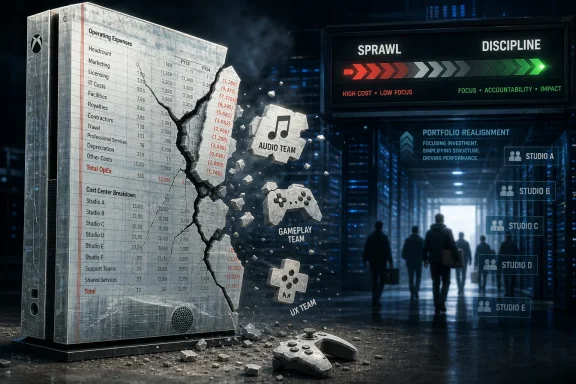 Microsoft’s Gaming Empire Finally Meets the Spreadsheet
For most of the past decade, Microsoft’s answer to Xbox’s strategic weakness was scale. It bought studios, bought publishing capacity, bought communities, bought back-catalog depth, and finally bought Activision Blizzard in one of the most expensive gaming deals ever approved by regulators. The logic was straightforward: if Xbox could not consistently beat PlayStation and Nintendo with hardware, it could become the subscription-and-content layer underneath modern gaming.That was a compelling story when capital was cheap and Game Pass still looked like Netflix-for-games before Netflix had taught everyone the limits of that comparison. But Microsoft’s July 6 reset reads like the moment the finance department caught up with the pitch deck. Xbox CEO Asha Sharma told employees the business was “not healthy,” operating at margins three to ten times lower than comparable platform and publishing businesses, according to the memo Microsoft published on Xbox Wire.
That phrasing matters because it strips away the softer language that usually surrounds gaming restructures. This was not framed as a creative reorganization or a modest prioritization exercise. Sharma described a business that entered the current console generation with a smaller install base, a higher cost structure, and growth bets that created value but did not grow fast enough.
The bluntest line in the memo may be the claim that, in a typical year, Xbox lost 64 cents for every dollar it invested across parts of its studio portfolio. That is the kind of sentence executives usually reserve for closed-door investor decks, not public-facing staff messages. Its publication signals that Microsoft wants employees, partners, and markets to understand the reset as a structural correction rather than a cyclical trim.
The Activision Deal Gave Xbox Scale, Not Escape Velocity
The Activision Blizzard acquisition was supposed to change the gravitational field around Xbox. It brought Call of Duty, World of Warcraft, Diablo, Overwatch, Candy Crush, and a massive mobile business under Microsoft’s roof. It also gave Microsoft a stronger case for Game Pass, a bigger cross-platform publishing arm, and a more credible position in mobile gaming.What it did not do was erase the core problem of Xbox hardware. Sony’s PlayStation remains culturally and commercially stronger in the premium console market, while Nintendo operates on its own planet with first-party franchises, family appeal, and hardware concepts that Microsoft has never convincingly replicated. Microsoft could buy content, but it could not buy the install base it wished it had at the start of this generation.
That is why the restructuring lands with such force. Microsoft has spent tens of billions of dollars expanding Xbox, yet it is now divesting studios and cutting thousands of roles from the same business. The company is not abandoning gaming, but it is abandoning the idea that more internal ownership automatically means more strategic control.
This is the uncomfortable lesson of the Activision era: content scale helps, but only if the surrounding business model can convert that scale into margin. Call of Duty can be huge and Xbox can still be structurally weaker than PlayStation. King can be a mobile powerhouse and Xbox can still be burdened by a platform organization Sharma says became too layered, too slow, and too fragmented.
The Studio Sell-Off Is a Philosophy Change in Disguise
The most visible part of the reset is the studio reshuffle. Compulsion Games, known for South of Midnight and We Happy Few, and Double Fine Productions, known for Psychonauts, are set to return to independent status with their intellectual property, catalogs, and runway for future games. Ninja Theory and Undead Labs have entered terms to join new ownership with funding to continue Senua and State of Decay 3. Arkane Studios in France, the studio behind Dishonored and now associated with Marvel’s Blade, is beginning required consultation with its Works Council to review strategic options.On paper, this looks like portfolio pruning. In practice, it is a repudiation of the acquisition logic that defined Microsoft’s gaming expansion after 2018. The old message was that creative studios would benefit from Microsoft’s resources, distribution, cloud infrastructure, and subscription reach. The new message is that Microsoft is not necessarily the best owner for every kind of game studio.
That is a striking admission. Double Fine and Compulsion were exactly the sort of prestige or mid-sized creative teams that helped Xbox argue it cared about artistic breadth, not just blockbuster service games. Ninja Theory and Undead Labs were emblematic of Microsoft’s attempt to own differentiated genre franchises. Arkane, through Bethesda and ZeniMax, represented the kind of immersive-sim pedigree that made Xbox’s studio roster look more sophisticated after years of criticism.
The danger for Microsoft is not merely that beloved studios leave. It is that developers across the industry may now view an Xbox acquisition less as shelter and more as a temporary stop before another ownership cycle. Microsoft can still be a valuable platform partner, publisher, and funding source, but the romance of being “brought into Xbox” has taken a visible hit.
Game Pass Was Not the Villain, but It Was Not the Savior
The lazy read is that Game Pass failed. The more accurate read is that Game Pass succeeded at some things and failed to solve others. It gave Microsoft a differentiated consumer offering, created a recurring-revenue story, and gave players a way to sample more games than they would normally buy at full price.But subscriptions are not magic. They are margin structures. For a subscription service to transform a platform business, it must either grow fast enough to cover content costs, reduce churn enough to justify continued investment, or create secondary revenue that would not otherwise exist. Microsoft’s own reset language suggests Game Pass did not scale quickly enough to offset the weakening of Xbox’s core console economics.
The company’s move toward multi-platform distribution further complicates the story. Releasing more Xbox-owned games on PlayStation, Nintendo hardware, PC storefronts, and cloud endpoints can increase software revenue. It can also make Xbox consoles feel less essential, especially if hardware demand is already soft and prices are rising because of component costs and broader data-center-driven memory pressure.
That tradeoff is not unique to Microsoft, but Microsoft feels it more sharply because its console position is weaker. Sony can experiment with PC releases while still using PlayStation exclusives as hardware magnets. Nintendo can sell underpowered hardware at scale because its games are the platform. Microsoft’s problem is that the more rational its software strategy becomes, the less emotional pull the Xbox box may have.
AI Spending Turns Every Division Into a Capital Allocation Fight
The timing of these cuts is inseparable from Microsoft’s AI spending boom. Reuters framed the layoffs against Big Tech’s enormous AI outlays, with Microsoft among the companies under pressure to prove that artificial intelligence revenue can grow faster than the infrastructure bill needed to deliver it. Microsoft’s April guidance reportedly included a $190 billion spending projection for 2026, a number that dwarfed expectations and sharpened investor attention on margins.Microsoft’s Chief People Officer Amy Coleman told employees that the eliminated roles were not being replaced by AI, while also acknowledging that AI is changing how work gets done. That distinction is technically important and politically fragile. A job does not have to be directly automated by a model to be squeezed by the capital demands of an AI buildout.
This is the new operating environment for Microsoft. Azure growth, OpenAI-linked services, Copilot, model hosting, and data-center expansion are now competing with every other internal priority. Gaming is not exempt because it is culturally important or consumer-facing. If anything, Xbox’s lower margins make it more exposed.
The old Microsoft could afford strategic patience in gaming because Windows, Office, enterprise licensing, and cloud growth generated the oxygen. The new Microsoft still has those engines, but AI has become a capital furnace. Every business line now has to justify not only its own costs, but the opportunity cost of money that could be poured into GPUs, data centers, and enterprise AI services.
A Flatter Xbox Is Also a More Accountable Xbox
Sharma’s memo did more than announce cuts. It described an organization with as many as 14 layers of management in some places and platform teams 40 percent larger than at the start of the generation, even as player base and playtime declined. That is devastating internal language because it frames Xbox’s problem as managerial as much as market-driven.The proposed fix is a flatter organization, with no more than five layers of management where possible and as few as three in some areas. Microsoft is also establishing a chief operating officer role with end-to-end profit-and-loss responsibility across content, hardware, platform, and services, with Helen Chiang promoted into that job. Chiang’s history with Xbox Live, Mojang, and Minecraft gives her credibility across both platform and content operations.
This matters for WindowsForum readers because Microsoft’s consumer businesses often reveal the company’s broader organizational instincts. When Microsoft grows, it tends to build elaborate matrices, overlapping mandates, and layers of review. When those structures stop producing growth, the company rediscovers accountability, individual ownership, and the virtues of fewer meetings.
The challenge is that flattening is easy to announce and hard to sustain. Large companies cut management layers during resets, then rebuild them under new names as complexity returns. If Xbox is serious about becoming faster, it will need more than a new org chart. It will need to stop treating every strategic ambiguity as a reason to create another coordinating function.
The Hardware Crisis Makes Xbox’s Identity Problem Worse
Sharma referred to the gaming industry’s severe hardware crisis, and that phrase should not be dismissed as executive cover. Console hardware is under pressure from multiple directions: longer upgrade cycles, higher component costs, weaker discretionary spending, PC handhelds, mobile competition, and the simple fact that many players are content with devices they already own.For Xbox, this is especially painful because hardware has always been both a business and a symbol. The console gave Microsoft a living-room beachhead, a developer target, a store, and a community identity. If hardware sales soften while Microsoft simultaneously pushes its games to more platforms, Xbox risks becoming a brand attached to services and publishing rather than a destination in itself.
That may be the correct economic outcome. Microsoft is a software and cloud company by instinct, and the future of gaming may indeed be more device-agnostic. But communities do not form around abstract total-addressable-market diagrams. They form around hardware, rituals, exclusives, storefronts, controllers, achievements, friends lists, and the feeling that a platform is where you play.
Microsoft now has to thread a narrow needle. It must make Xbox less dependent on console hardware without teaching loyal Xbox customers that the console no longer matters. That is a harder communications challenge than anything in the Activision regulatory fight because it goes directly to player trust.
The Human Cost Is Not a Footnote to Strategy
The restructuring affects about 4,800 Microsoft employees overall, or roughly 2.1 percent of the company’s global workforce. Within Xbox, about 1,600 roles are being eliminated immediately, with roughly 3,200 cuts planned through fiscal 2027. Those numbers can sound abstract until you remember that many of the people affected joined Microsoft because it presented itself as a stable home for creative work.Gaming layoffs have become grimly routine, but Microsoft’s cuts carry a particular sting because of the company’s scale and profitability. This is not a distressed publisher running out of cash. This is one of the world’s most valuable technology companies reallocating resources while continuing to spend aggressively in AI and cloud infrastructure.
That does not make the business logic false. Companies can be profitable overall and still have units that are inefficient, overbuilt, or strategically misaligned. But it does mean Microsoft should not expect much sympathy when it frames the reset as a necessary step toward a bigger future.
For laid-off workers, “focus” and “discipline” are not strategy words. They are severance meetings, immigration worries, lost projects, disrupted families, and resumes entering a market already crowded with game developers. Any serious analysis of Xbox’s reset has to hold both truths at once: Microsoft may be making a rational business correction, and the cost of that correction is being paid by people who did not set the strategy.
Sony and Nintendo Are Still the Shadows in the Room
Microsoft’s gaming problem cannot be understood without its competitors. Sony has built PlayStation into a premium gaming brand with a stronger console identity and a more consistent relationship between first-party software and hardware demand. Nintendo has stayed largely outside the Microsoft-Sony arms race by turning distinctive hardware and beloved franchises into a self-reinforcing ecosystem.Microsoft tried a different path. It leaned into services, acquisitions, cloud, backward compatibility, PC integration, and eventually multi-platform publishing. There was logic in that approach, especially for a company whose corporate DNA is strongest in software platforms and enterprise-scale infrastructure.
But gaming is not enterprise software with dragons. Consumers do not buy consoles the way CIOs buy productivity suites. The most successful gaming platforms combine technology, catalog, identity, and timing in ways that are stubbornly resistant to brute-force capital.
That is why the Xbox reset feels bigger than a cost-cutting program. It is Microsoft conceding that it cannot spend its way into Nintendo’s cultural position or Sony’s console momentum. It has to build a business that reflects what Xbox actually is now, not what Microsoft hoped it would become after enough acquisitions.
Windows Users Should Watch the Storefront, the PC, and the Cloud
For PC gamers, the Xbox reset could cut in several directions. A more focused Microsoft may improve the Windows gaming experience, rationalize Xbox app development, and reduce the internal fragmentation that has long made Microsoft’s PC gaming strategy feel less coherent than Steam’s. Sharma’s emphasis on cleaner code, shared services, and reduced vendor spend hints at an effort to simplify the platform layer.But cost discipline can also mean fewer experiments, fewer niche bets, and less patience for projects that serve ecosystem goals without obvious short-term returns. Windows gaming has benefited from Microsoft’s willingness to subsidize cross-device ambitions, cloud save infrastructure, Play Anywhere, Game Pass for PC, and developer tools. If every initiative now has to prove sharper return on investment, some useful but unglamorous work may struggle.
The most likely outcome is a more pragmatic Xbox-on-Windows strategy. Microsoft will keep pushing PC Game Pass where it can show subscriber growth, keep publishing on Steam where revenue is obvious, and keep using Windows as a distribution surface for its biggest franchises. What may fade is the dream of a fully unified Xbox ecosystem in which console, PC, and cloud all feel like equal parts of one elegant platform.
That dream was always harder than Microsoft admitted. Windows is too open, Steam is too entrenched, and PC gamers are too resistant to being herded into a single Microsoft-controlled experience. A humbler Xbox strategy on PC may actually serve users better, provided Microsoft focuses on reliability, performance, mod support, launcher sanity, and fair storefront behavior.
The Reset Gives Microsoft a Chance to Stop Confusing Reach With Loyalty
Microsoft’s recent gaming strategy often treated reach as the master metric. Put games everywhere. Grow Game Pass. Expand cloud access. Buy more studios. Make the catalog bigger. Turn Xbox from a console into an entertainment network.Reach is valuable, but loyalty is what lets platforms survive ugly cycles. Nintendo has loyalty. PlayStation has loyalty. Steam has loyalty. Xbox has loyal fans too, but Microsoft has repeatedly tested them with mixed signals about exclusivity, hardware commitment, pricing, cloud priorities, and the future of its first-party studios.
The July 6 reset can either deepen that uncertainty or begin to resolve it. If Microsoft uses the restructuring to articulate a clearer Xbox identity, players may accept the painful transition. If the company simply cuts costs while continuing to speak in platform abstractions, the reset will look like another chapter in a long identity crisis.
The language in Sharma’s memo gestures toward clarity: fewer layers, more accountability, a tighter portfolio, and a return to growth in 2027. But the real test will not be the memo. It will be whether Xbox customers can look at the next two years of hardware, Game Pass, first-party releases, PC support, and cloud features and understand what Microsoft is asking them to buy into.
The New Xbox Bargain Is Smaller, Sharper, and Less Sentimental
The concrete readout from Microsoft’s reset is narrower than the rhetoric but still substantial. Xbox is not dead, Microsoft is not leaving gaming, and the Activision deal is not being unwound. What is ending is the assumption that Xbox can keep every acquired ambition alive under one roof.- Microsoft is cutting about 4,800 jobs globally, with roughly 3,200 Xbox roles expected to disappear through fiscal 2027.
- Xbox is immediately eliminating about 1,600 positions as part of what Asha Sharma called the most significant restructure in the brand’s history.
- Compulsion Games and Double Fine Productions are expected to become independent studios with their IP, catalogs, and future-game runway.
- Ninja Theory and Undead Labs are set to move to new ownership with funding tied to Senua and State of Decay 3.
- Arkane Studios in France is entering required worker-consultation procedures to review strategic options.
- Microsoft’s broader AI infrastructure spending is increasing pressure on lower-margin businesses to prove they deserve capital.
Update: Microsoft shares fall as analysts frame Xbox cuts around AI spending (July 7, 2026)
The Honolulu Star-Advertiser’s version of the Reuters report adds a market readout: Microsoft shares were down 1.4% following the layoff announcement, after a nearly 23% decline in the first half of 2026, described as the company’s worst first-half stock performance since 2022.The report also adds that Microsoft had earlier offered voluntary buyouts to about 7% of its U.S. workforce, or roughly 9,000 employees, reinforcing that the Xbox cuts are part of a broader workforce-management push rather than an isolated gaming action.
Analysts quoted in the report framed the move less as a stock catalyst and more as evidence of capital discipline. Equisights Research CEO Parth Talsania said investors are likely to focus less on headcount reductions and more on whether Microsoft can scale AI monetization faster than AI-related costs. D.A. Davidson’s Gil Luria said Microsoft has been managing headcount down to help fund AI investments while preserving margins.
For Windows users and IT pros, the practical signal is that Microsoft’s AI infrastructure buildout is now shaping resource decisions across the company, including consumer businesses such as Xbox. The update does not change the core restructuring details, but it sharpens the financial context: Xbox is being evaluated inside a company-wide fight for capital, margin protection, and AI return on investment.
References
- Primary source: The Express Tribune
Published: 2026-07-06T19:30:08.627683
Microsoft to cut 4,800 jobs, overhaul Xbox unit
Microsoft Xbox expansion, including Activision deal, still trails Sony and Nintendo in the gaming market tribune.com.pk
- Related coverage: gamesradar.com
Microsoft is cutting 3,200 Xbox employees, and half of them will be eliminated today in "the most significant restructure in Xbox history" | GamesRadar+
"Today\u2019s decisions do not reflect their talent or dedication," new Xbox CEO says of staffwww.gamesradar.com - Related coverage: windowscentral.com
Xbox's big "reset" cuts: Compulsion, Double Fine, Undead Labs, Ninja Theory to leave Xbox — 3,200 roles to be removed | Windows Central
Xbox's expected cuts have been revealed. It'll be the single biggest staff reduction event in the platform's history — although no announced projects have been cancelled, and no studios have been closed (so far).www.windowscentral.com - Related coverage: uol.com.br
Microsoft cortará 4.800 postos de trabalho em reestruturação da unidade Xbox
6 Jul (Reuters) - A Microsoft disse nesta segunda-feira que cortará cerca de 2,1% de sua força de trabalho global, ou aproximadamente 4.800 postos de trabalho, como parte da reestruturação de suas unidades Commercial e Xbox, somando-se a uma onda de dwww.uol.com.br - Related coverage: gematsu.com
Xbox to lay off 3,200 employees, divest five studios - Gematsu
Xbox has announced a major restructuring, reducing its headcount by 3,200 employees throughout fiscal year 2027, with 1,600 roles eliminated today.www.gematsu.com - Related coverage: investing.com
Microsoft to cut 4,800 jobs, overhaul Xbox unit By Reuters
Microsoft to cut 4,800 jobs, overhaul Xbox unitwww.investing.com
- Related coverage: techspot.com
Microsoft is cutting 3,200 Xbox jobs and spinning off four game studios | TechSpot
In a public memo to Xbox employees, CEO Asha Sharma confirmed that Microsoft will eliminate approximately 3,200 positions across the gaming division between now and July 2027,...www.techspot.com - Related coverage: gameinformer.com
Xbox Parts Ways With Five Studios, Over 3,000 Layoffs Announced
Several Xbox studios will go independent or be sold off as part of a massive restructuring.gameinformer.com - Related coverage: pymnts.com
PYMNTS | Microsoft Cuts 4,800 Jobs as Xbox Unit Undergoes Restructuring
Microsoft is eliminating approximately 2.1% of its global workforce, as the software giant navigates a broader shift toward AI. www.pymnts.com
- Related coverage: techcrunch.com
Microsoft lays off nearly 5,000 employees across Xbox, commercial sales | TechCrunch
Microsoft cut around 4,800 roles, or 2.1% of its global workforce, on Monday — the latest in a series of layoffs that’s stoking fears of AI replacing jobs. The layoffs will hit Xbox and commercial sales the hardest.techcrunch.com - Related coverage: trueachievements.com
Microsoft announces mass layoffs and cuts five Xbox studios
Microsoft has announced that it will lay off 3,200 employees from the Xbox gaming division and plans to divest five Xbox Game Studios.www.trueachievements.com
- Related coverage: barlamantoday.com
Microsoft to Cut 4,800 Jobs, Restructure Xbox Division
Microsoft said Monday that it will cut about 4,800 jobs, or roughly 2.1% of its global workforce, as it overhauls its Xbox gaming division and seeks better returns after years of heavy investment, according to Reuters.barlamantoday.com - Related coverage: psu.com
Xbox Announces 'Most Significant Restructure' In Its History As It Plans To Cut 3,200 Jobs; Key Studios Including Double Fine To Be Divested - PlayStation Universe
Xbox boss Asha Sharm has confirmed plans for a major company restructure, with up to 3,200 layoffs over the next year. Meanwhile, a number of studios including Double Fine will be spun off or sold.www.psu.com - Related coverage: shacknews.com
Xbox confirms mass layoffs, Double Fine Productions and Compulsion Games to go independent | Shacknews
Ninja Theory and Undead Labs have been sold to new ownership.www.shacknews.com - Related coverage: elpais.com
- Related coverage: omni.se
Microsoft kapar 4 800 jobb – var femte får lämna Xbox
Teknikjätten Microsoft säger upp 4 800 anställda, skriver bolaget i ett pressmeddelande. Ytterligare 1 600 försvinner de närmaste tolv månaderna.omni.se - Related coverage: aftonbladet.se
Asha Sharma: 3 200 sparkas från Xbox
Ångvälten har startat. 3 200 sparkas från Xbox och fyra studior lämnar. ”Vår verksamhet är inte hälsosam”, skriver vd Asha Sharma i ett mejl som IGN tagit del awww.aftonbladet.se
- Related coverage: techxplore.com
- Related coverage: news.xbox.com
Resetting XBOX - XBOX Wire
 news.xbox.com
Last edited:
