

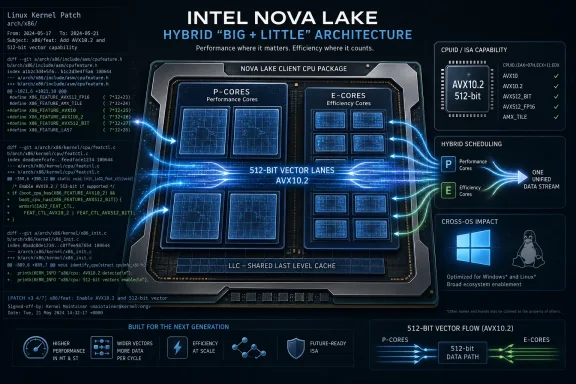
Intel’s next-generation Nova Lake client CPUs are reportedly set to restore AVX-512-class support through AVX10.2, with Linux kernel patches spotted on July 7, 2026 indicating 512-bit vector execution across both performance cores and efficiency cores. That is not a launch announcement, and Intel has not yet stood on a stage and said the words. But if the reporting from Tom’s Hardware, Guru3D, and Wccftech holds, this is more than another esoteric checkbox in a CPU feature table. It is Intel admitting, quietly and technically, that the hybrid-era retreat from wide vectors created a gap AMD was happy to occupy.
AVX-512 has always been one of those technologies that sounds too specialized to matter until suddenly it very much does. It is a set of 512-bit vector instructions meant to chew through certain kinds of parallel work: scientific computing, cryptography, compression, emulation, AI-adjacent math, media processing, database operations, and assorted workstation workloads that reward doing many small operations at once. Intel introduced the idea as a high-performance x86 differentiator, then spent years making its consumer availability inconsistent enough that developers learned not to rely on it.
That inconsistency is why the Nova Lake reports landed with more force than a normal Linux enablement patch. Tom’s Hardware framed the discovery as a return of AVX-512 to Intel’s next-gen client CPUs, with the crucial twist that both P-cores and E-cores appear to gain native 512-bit execution. Guru3D likewise described Nova Lake as bringing AVX-512 back to the Core Ultra Series 4 desktop family. Wccftech went further, arguing that this would mark the end of a roughly six-year absence from mainstream Intel client platforms.
The important word is reportedly. The evidence, as described by those outlets, comes from Linux kernel patches and the interpretation of hardware watchers, including InstLatX64 and Jaykihn, rather than from an Intel product brief. Kernel patches are often early, technical, and highly revealing, but they are not the same thing as a public SKU matrix. Intel can still segment, disable, rename, or defer features before retail silicon ships.
Still, Linux enablement has become one of the industry’s most reliable smoke signals for CPU roadmaps. If the kernel is being taught that Nova Lake supports AVX10.2 with 512-bit capability, the odds are good that Intel has at least designed the platform around that possibility. The story is not merely that AVX-512 may be back. The story is that Intel may have finally solved the architectural reason it disappeared.
The original complication was simple: Alder Lake’s P-cores could support AVX-512, while its E-cores did not. A desktop CPU cannot advertise an instruction set that only some of its cores can execute unless the operating system, firmware, scheduler, and application stack can reliably keep AVX-512 code away from incompatible cores. That is theoretically manageable in tightly controlled environments, but it is a messy proposition for mainstream Windows PCs where workloads bounce between cores and users expect the machine to behave like one coherent processor.
Early Alder Lake boards briefly made the situation even stranger. Some users found that AVX-512 could be enabled when E-cores were disabled, giving enthusiasts a tantalizing but unofficial path to a feature Intel did not want to support in that product generation. Later firmware and microcode updates closed that door. Intel’s practical answer was to remove the ambiguity: no AVX-512 on the client platform.
That decision was defensible from a product-management perspective. It was also damaging from a developer-confidence perspective. If an instruction set appears, disappears, and then becomes dependent on motherboard firmware behavior, software authors have every reason to treat it as unreliable on consumer Intel hardware.
Nova Lake’s reported change attacks that exact problem. If both P-cores and E-cores can execute the relevant AVX10.2/512-bit instructions, the scheduler no longer has to treat wide-vector code like a hazardous material. The CPU can expose a coherent feature set across the hybrid design. That is what makes this more consequential than Intel simply flipping an old feature back on.
That distinction matters because AVX-512 had become both a brand and a baggage claim. To HPC users, it meant serious throughput. To laptop designers, it could mean power and frequency concerns. To gamers, it often meant nothing. To forum veterans, it meant BIOS toggles, microcode drama, and arguments about whether Intel had removed something useful or merely cleaned up a feature nobody mainstream needed.
AVX10 gives Intel a way to say that the company is not simply reversing course. It is standardizing wide-vector support under a newer architectural umbrella. If Nova Lake indeed supports AVX10.2 with 512-bit execution on both core types, Intel can present the move as a forward-looking convergence rather than an apology for the Alder Lake era.
That framing will only work if the implementation is real and consistent. Developers do not care whether the marketing slide says AVX-512 or AVX10 if the practical result is a feature they can detect, dispatch to, and trust. The x86 ecosystem already has enough runtime checks, code paths, and compatibility gates. What matters is whether a Core Ultra desktop chip can run the advertised instructions on every core that Windows or Linux might schedule.
This is where Intel’s silence becomes interesting. The company has spent the past several years trying to restore confidence in its client roadmap after delays, rebrands, and uneven generational gains. A clean AVX10.2 story for Nova Lake would give Intel a technical talking point that AMD cannot easily dismiss. But announcing it too early would also invite questions about power behavior, clocks, thermals, SKU segmentation, and whether mobile chips get the same treatment.
That changed the competitive story. For years, AVX-512 was treated as one of Intel’s specialized weapons, particularly in Xeon and workstation-adjacent contexts. Then AMD became the vendor offering it broadly on consumer desktops while Intel’s mainstream Core line did not. In a market where Intel still owned plenty of mindshare, that inversion was embarrassing.
Wccftech pointed to Linux RAID bandwidth testing in which AVX-512 could produce large gains on AMD’s Ryzen 9 9950X versus narrower AVX code paths. The exact uplift depends heavily on workload, implementation, memory subsystem, and compiler behavior, so it would be reckless to turn one benchmark table into a universal promise. But the broader point is sound: AVX-512 is not a purely academic feature when modern software can exploit it.
The most immediate beneficiaries are not ordinary web browsing or lightweight office tasks. They are users who already care about instruction sets: developers compiling specialized code, researchers running numerical kernels, homelab users doing storage or encryption-heavy work, emulation fans, media professionals, and workstation buyers trying to squeeze more throughput from a desktop-class machine. Those are not the entire PC market, but they are exactly the kinds of users who shape enthusiast sentiment and buying advice.
Intel knows this audience matters. It is the audience that reads kernel mailing lists, watches microcode updates, compares ISA flags, and remembers when a feature vanished. Winning it back requires more than better benchmark bars in games. It requires convincing technically literate buyers that Intel’s platform capabilities are predictable again.
For Linux users, that process is a feature, not a leak. Kernel support arriving early means the platform has a chance to work properly when hardware ships. It also means advanced users get a partial view into what the CPU can do. That view is imperfect, but it is often more technically honest than product marketing.
Tom’s Hardware emphasized that Intel has not officially announced native AVX-512 support for Nova Lake. That caveat should stay attached to the story until Intel confirms retail behavior. Kernel patches can identify intended support, but they do not guarantee that every Core Ultra Series 4 desktop SKU will expose the same capability, nor that mobile variants will behave identically.
The Linux angle also matters for WindowsForum readers because Windows is not isolated from the same architectural realities. If the hardware can execute 512-bit vector instructions across all core types, Windows scheduling becomes simpler too. If the support is fragmented, Windows inherits the same class of problem that helped kill AVX-512 on Alder Lake client parts.
Microsoft’s Thread Director integration, Intel’s firmware, and application-level dispatch libraries all sit between silicon capability and user-visible performance. The return of AVX-512-class execution is not a magic switch. It is a platform contract, and every layer has to honor it.
If Nova Lake’s P-cores and E-cores both gain native 512-bit capability, Intel would be making a more aggressive move than merely restoring compatibility. It would mean the smaller cores are not being treated as second-class citizens for wide-vector code. That is the architectural shift needed to make hybrid CPUs less awkward for developers.
There is a catch, because there is always a catch. Wide-vector execution can increase power density and may affect boost behavior under sustained workloads. Intel’s older AVX-512 implementations were often associated with frequency offsets under heavy use, especially in server contexts. A client CPU that supports the feature broadly still has to manage heat, battery life, and clock behavior without surprising users.
This is where Nova Lake could become genuinely interesting. Intel’s E-cores have evolved from background-task helpers into substantial throughput engines. Giving them AVX10.2/512 capability would suggest that Intel sees future client workloads as more parallel, more heterogeneous, and more demanding than the old split between “big cores for hard work” and “little cores for housekeeping.”
That would also fit the broader direction of the PC. AI inference, local media processing, compression, storage acceleration, and developer workloads are no longer confined to workstations. The client CPU is being asked to coexist with NPUs and GPUs, but it still needs strong scalar and vector capabilities for the messy code that does not neatly move elsewhere.
The practical Windows impact will arrive unevenly. Some professional applications already include optimized paths for Intel and AMD vector extensions. Some open-source libraries used inside Windows applications will gain support as compilers and maintainers adapt. Some software will ignore the feature for years because broad compatibility still matters more than peak throughput.
For sysadmins, the more interesting question is fleet predictability. A company buying hundreds of desktops or mobile workstations wants to know whether a workload behaves consistently across SKUs. If Intel reintroduces wide vectors only on selected models, IT departments will need to watch the fine print. If the feature is broad across Nova Lake client parts, it becomes easier to standardize.
There is also a virtualization angle. Homelab and workstation users often pass CPU features into VMs or containers. Inconsistent ISA support can complicate migration, especially when moving workloads between Intel and AMD hosts. A more uniform AVX10/AVX-512 landscape across future x86 client CPUs would reduce one source of friction, though enterprise virtualization platforms will still expose features conservatively.
For gamers, the effect is likely to be indirect. Most games will not suddenly gain massive frame-rate improvements because Nova Lake can run 512-bit vector instructions. But the surrounding ecosystem — engines, asset pipelines, decompression routines, emulator performance, streaming tools, and creator workloads — may benefit in ways that matter to the same enthusiast machines used for gaming.
AMD exploited that opening by being boring in the best possible way. Zen 4 arrived with AVX-512 support, Zen 5 continued the direction, and software authors could increasingly assume that modern Ryzen users had access to those code paths. AMD did not need to make AVX-512 the center of its consumer marketing. The consistency itself became the message.
Intel’s opportunity with Nova Lake is to reset that narrative. If AVX10.2/512 is exposed consistently across P-cores and E-cores, Intel can claim that the hybrid design has matured past its early compromises. That is a much stronger claim than simply saying the next chip is faster.
The risk is that Intel treats the feature as another segmentation lever. If some desktop chips have it, some mobile chips do not, some OEM firmware hides it, and some power modes throttle it into irrelevance, the old confusion returns. Enthusiasts will test it, developers will document it, and the market will learn quickly whether the return is real.
This is why Intel’s eventual messaging matters. The company should not bury AVX10.2 in a footnote if the feature is broadly supported. Nor should it overpromise universal acceleration. The honest pitch is that Nova Lake may restore a coherent vector capability to Intel client CPUs, giving developers and power users a stable target again.
The most credible near-term wins are in libraries and tools that already know how to use AVX-512 on AMD or older Intel platforms. Compression, decompression, hashing, encryption, video processing, numerical computing, and some storage operations are natural candidates. Developers who already maintain multiple SIMD paths can add or re-enable Intel client dispatch with less work than starting from scratch.
Compilers will play a role, but automatic vectorization is not magic. Hand-tuned libraries still matter. So do runtime dispatch frameworks that can choose between SSE, AVX2, AVX-512, AVX10, and vendor-specific behaviors. A CPU feature is only as useful as the software stack’s ability to select it safely.
There is also a power-performance question that reviewers will need to test carefully. A benchmark that shows a large throughput gain under AVX-512 may also draw more power, change boost clocks, or alter thermal behavior. That tradeoff may be perfectly acceptable on a desktop workstation and less attractive in a thin laptop.
The best reviews of Nova Lake will not stop at “does the CPUID flag appear?” They will measure sustained clocks, package power, thermals, mixed workloads, scheduler behavior, and performance on both Windows and Linux. They will also test whether E-cores really participate cleanly in AVX10.2 workloads or whether the implementation hides caveats under the hood.
Restoring AVX-512-class support on Nova Lake would not solve all of that. It would not by itself fix process competitiveness, GPU strategy, laptop efficiency, or pricing. But it would show that Intel is still willing to put serious architectural capability into client CPUs rather than reserving the interesting bits for Xeon.
That matters because the desktop is no longer just a gaming appliance. Enthusiast PCs are development machines, local AI testbeds, creator workstations, virtualization hosts, NAS boxes, and everything-in-one labs. A richer instruction set gives those users more room to extract value from the CPU they already bought.
The timing also aligns with Intel’s need to make Nova Lake feel like more than another incremental generation. Core Ultra branding has already blurred the old generational ladder. Users have been asked to track Meteor Lake, Arrow Lake, Lunar Lake, Panther Lake, and Nova Lake across mobile and desktop contexts. A tangible architectural restoration is easier to understand than another abstract claim about platform balance.
If Intel can say, credibly, that hybrid client CPUs now support wide vectors across all cores, it gives Nova Lake a cleaner enthusiast hook. Not every buyer needs it. But the buyers who do need it are loud, technical, and influential.
 Intel’s Missing Instruction Set Becomes News Again
AVX-512 has always been one of those technologies that sounds too specialized to matter until suddenly it very much does. It is a set of 512-bit vector instructions meant to chew through certain kinds of parallel work: scientific computing, cryptography, compression, emulation, AI-adjacent math, media processing, database operations, and assorted workstation workloads that reward doing many small operations at once. Intel introduced the idea as a high-performance x86 differentiator, then spent years making its consumer availability inconsistent enough that developers learned not to rely on it.That inconsistency is why the Nova Lake reports landed with more force than a normal Linux enablement patch. Tom’s Hardware framed the discovery as a return of AVX-512 to Intel’s next-gen client CPUs, with the crucial twist that both P-cores and E-cores appear to gain native 512-bit execution. Guru3D likewise described Nova Lake as bringing AVX-512 back to the Core Ultra Series 4 desktop family. Wccftech went further, arguing that this would mark the end of a roughly six-year absence from mainstream Intel client platforms.
The important word is reportedly. The evidence, as described by those outlets, comes from Linux kernel patches and the interpretation of hardware watchers, including InstLatX64 and Jaykihn, rather than from an Intel product brief. Kernel patches are often early, technical, and highly revealing, but they are not the same thing as a public SKU matrix. Intel can still segment, disable, rename, or defer features before retail silicon ships.
Still, Linux enablement has become one of the industry’s most reliable smoke signals for CPU roadmaps. If the kernel is being taught that Nova Lake supports AVX10.2 with 512-bit capability, the odds are good that Intel has at least designed the platform around that possibility. The story is not merely that AVX-512 may be back. The story is that Intel may have finally solved the architectural reason it disappeared.
Alder Lake Turned AVX-512 Into a Scheduling Problem
To understand why this matters, it helps to revisit the awkwardness of Alder Lake. Intel’s 12th-generation Core processors brought the modern hybrid design to the desktop, pairing large performance cores with smaller efficiency cores. That design worked well enough to become Intel’s mainstream client template, but it collided with AVX-512 in a way that exposed the limits of mixing asymmetric cores under one consumer operating system.The original complication was simple: Alder Lake’s P-cores could support AVX-512, while its E-cores did not. A desktop CPU cannot advertise an instruction set that only some of its cores can execute unless the operating system, firmware, scheduler, and application stack can reliably keep AVX-512 code away from incompatible cores. That is theoretically manageable in tightly controlled environments, but it is a messy proposition for mainstream Windows PCs where workloads bounce between cores and users expect the machine to behave like one coherent processor.
Early Alder Lake boards briefly made the situation even stranger. Some users found that AVX-512 could be enabled when E-cores were disabled, giving enthusiasts a tantalizing but unofficial path to a feature Intel did not want to support in that product generation. Later firmware and microcode updates closed that door. Intel’s practical answer was to remove the ambiguity: no AVX-512 on the client platform.
That decision was defensible from a product-management perspective. It was also damaging from a developer-confidence perspective. If an instruction set appears, disappears, and then becomes dependent on motherboard firmware behavior, software authors have every reason to treat it as unreliable on consumer Intel hardware.
Nova Lake’s reported change attacks that exact problem. If both P-cores and E-cores can execute the relevant AVX10.2/512-bit instructions, the scheduler no longer has to treat wide-vector code like a hazardous material. The CPU can expose a coherent feature set across the hybrid design. That is what makes this more consequential than Intel simply flipping an old feature back on.
AVX10 Is Intel’s Face-Saving Path Back to AVX-512
Intel does not necessarily need to market this as “AVX-512 is back,” even if that is how the enthusiast press will describe it. The cleaner story is AVX10, Intel’s attempt to converge the company’s vector instruction strategy after years of fragmentation. Intel’s own AVX10 materials describe a future in which the AVX-512 family is rationalized into a more consistent, scalable vector ISA across product lines.That distinction matters because AVX-512 had become both a brand and a baggage claim. To HPC users, it meant serious throughput. To laptop designers, it could mean power and frequency concerns. To gamers, it often meant nothing. To forum veterans, it meant BIOS toggles, microcode drama, and arguments about whether Intel had removed something useful or merely cleaned up a feature nobody mainstream needed.
AVX10 gives Intel a way to say that the company is not simply reversing course. It is standardizing wide-vector support under a newer architectural umbrella. If Nova Lake indeed supports AVX10.2 with 512-bit execution on both core types, Intel can present the move as a forward-looking convergence rather than an apology for the Alder Lake era.
That framing will only work if the implementation is real and consistent. Developers do not care whether the marketing slide says AVX-512 or AVX10 if the practical result is a feature they can detect, dispatch to, and trust. The x86 ecosystem already has enough runtime checks, code paths, and compatibility gates. What matters is whether a Core Ultra desktop chip can run the advertised instructions on every core that Windows or Linux might schedule.
This is where Intel’s silence becomes interesting. The company has spent the past several years trying to restore confidence in its client roadmap after delays, rebrands, and uneven generational gains. A clean AVX10.2 story for Nova Lake would give Intel a technical talking point that AMD cannot easily dismiss. But announcing it too early would also invite questions about power behavior, clocks, thermals, SKU segmentation, and whether mobile chips get the same treatment.
AMD Made the Absence Harder to Ignore
Intel’s AVX-512 retreat might have mattered less if AMD had stayed away from the feature. Instead, AMD implemented AVX-512 support across Zen 4 and Zen 5 client chips, giving Ryzen an unexpected advantage in workloads that use it well. AMD’s approach did not always rely on physically 512-bit-wide execution units in the same way Intel’s older high-end implementations did, but for software compatibility and many real workloads, the effect was enough.That changed the competitive story. For years, AVX-512 was treated as one of Intel’s specialized weapons, particularly in Xeon and workstation-adjacent contexts. Then AMD became the vendor offering it broadly on consumer desktops while Intel’s mainstream Core line did not. In a market where Intel still owned plenty of mindshare, that inversion was embarrassing.
Wccftech pointed to Linux RAID bandwidth testing in which AVX-512 could produce large gains on AMD’s Ryzen 9 9950X versus narrower AVX code paths. The exact uplift depends heavily on workload, implementation, memory subsystem, and compiler behavior, so it would be reckless to turn one benchmark table into a universal promise. But the broader point is sound: AVX-512 is not a purely academic feature when modern software can exploit it.
The most immediate beneficiaries are not ordinary web browsing or lightweight office tasks. They are users who already care about instruction sets: developers compiling specialized code, researchers running numerical kernels, homelab users doing storage or encryption-heavy work, emulation fans, media professionals, and workstation buyers trying to squeeze more throughput from a desktop-class machine. Those are not the entire PC market, but they are exactly the kinds of users who shape enthusiast sentiment and buying advice.
Intel knows this audience matters. It is the audience that reads kernel mailing lists, watches microcode updates, compares ISA flags, and remembers when a feature vanished. Winning it back requires more than better benchmark bars in games. It requires convincing technically literate buyers that Intel’s platform capabilities are predictable again.
The Linux Patch Trail Is a Roadmap Written in Code
There is a reason this story broke through Linux patches rather than a glossy launch deck. Modern CPU launches increasingly begin as scattered enablement work: compiler patches, kernel IDs, scheduler updates, power-management hooks, graphics driver additions, and firmware references. By the time the company announces the product, the open-source ecosystem has often been preparing for it for months.For Linux users, that process is a feature, not a leak. Kernel support arriving early means the platform has a chance to work properly when hardware ships. It also means advanced users get a partial view into what the CPU can do. That view is imperfect, but it is often more technically honest than product marketing.
Tom’s Hardware emphasized that Intel has not officially announced native AVX-512 support for Nova Lake. That caveat should stay attached to the story until Intel confirms retail behavior. Kernel patches can identify intended support, but they do not guarantee that every Core Ultra Series 4 desktop SKU will expose the same capability, nor that mobile variants will behave identically.
The Linux angle also matters for WindowsForum readers because Windows is not isolated from the same architectural realities. If the hardware can execute 512-bit vector instructions across all core types, Windows scheduling becomes simpler too. If the support is fragmented, Windows inherits the same class of problem that helped kill AVX-512 on Alder Lake client parts.
Microsoft’s Thread Director integration, Intel’s firmware, and application-level dispatch libraries all sit between silicon capability and user-visible performance. The return of AVX-512-class execution is not a magic switch. It is a platform contract, and every layer has to honor it.
Native 512-Bit Execution Would Be the Real Breakthrough
The phrase “native 512-bit execution” is doing heavy lifting in these reports. AVX-512 compatibility can exist in different implementation styles. A processor can support the instruction set while internally splitting work across narrower execution paths, or it can provide wider datapaths that complete more work per cycle. The user sees the same instruction flag, but performance, power, and frequency behavior can vary dramatically.If Nova Lake’s P-cores and E-cores both gain native 512-bit capability, Intel would be making a more aggressive move than merely restoring compatibility. It would mean the smaller cores are not being treated as second-class citizens for wide-vector code. That is the architectural shift needed to make hybrid CPUs less awkward for developers.
There is a catch, because there is always a catch. Wide-vector execution can increase power density and may affect boost behavior under sustained workloads. Intel’s older AVX-512 implementations were often associated with frequency offsets under heavy use, especially in server contexts. A client CPU that supports the feature broadly still has to manage heat, battery life, and clock behavior without surprising users.
This is where Nova Lake could become genuinely interesting. Intel’s E-cores have evolved from background-task helpers into substantial throughput engines. Giving them AVX10.2/512 capability would suggest that Intel sees future client workloads as more parallel, more heterogeneous, and more demanding than the old split between “big cores for hard work” and “little cores for housekeeping.”
That would also fit the broader direction of the PC. AI inference, local media processing, compression, storage acceleration, and developer workloads are no longer confined to workstations. The client CPU is being asked to coexist with NPUs and GPUs, but it still needs strong scalar and vector capabilities for the messy code that does not neatly move elsewhere.
Windows Users Should Care, Even If They Never Compile a Kernel
The easy reaction is to dismiss AVX-512 as a Linux and benchmark story. That would be a mistake. Windows users may not inspect/proc/cpuinfo, but they run software that uses CPU dispatch paths under the hood. If an application sees a reliable AVX-512 or AVX10 path, it can choose faster routines without asking the user to understand instruction sets.The practical Windows impact will arrive unevenly. Some professional applications already include optimized paths for Intel and AMD vector extensions. Some open-source libraries used inside Windows applications will gain support as compilers and maintainers adapt. Some software will ignore the feature for years because broad compatibility still matters more than peak throughput.
For sysadmins, the more interesting question is fleet predictability. A company buying hundreds of desktops or mobile workstations wants to know whether a workload behaves consistently across SKUs. If Intel reintroduces wide vectors only on selected models, IT departments will need to watch the fine print. If the feature is broad across Nova Lake client parts, it becomes easier to standardize.
There is also a virtualization angle. Homelab and workstation users often pass CPU features into VMs or containers. Inconsistent ISA support can complicate migration, especially when moving workloads between Intel and AMD hosts. A more uniform AVX10/AVX-512 landscape across future x86 client CPUs would reduce one source of friction, though enterprise virtualization platforms will still expose features conservatively.
For gamers, the effect is likely to be indirect. Most games will not suddenly gain massive frame-rate improvements because Nova Lake can run 512-bit vector instructions. But the surrounding ecosystem — engines, asset pipelines, decompression routines, emulator performance, streaming tools, and creator workloads — may benefit in ways that matter to the same enthusiast machines used for gaming.
Intel’s Bigger Problem Is Trust, Not Throughput
Intel can win a benchmark and still lose the argument if buyers do not trust the platform direction. AVX-512 is a perfect example. The company did not merely lack the feature on recent client chips; it created a history in which the feature was present, unofficially accessible, disabled, absent, and now possibly returning under a new ISA banner. That is not a clean developer story.AMD exploited that opening by being boring in the best possible way. Zen 4 arrived with AVX-512 support, Zen 5 continued the direction, and software authors could increasingly assume that modern Ryzen users had access to those code paths. AMD did not need to make AVX-512 the center of its consumer marketing. The consistency itself became the message.
Intel’s opportunity with Nova Lake is to reset that narrative. If AVX10.2/512 is exposed consistently across P-cores and E-cores, Intel can claim that the hybrid design has matured past its early compromises. That is a much stronger claim than simply saying the next chip is faster.
The risk is that Intel treats the feature as another segmentation lever. If some desktop chips have it, some mobile chips do not, some OEM firmware hides it, and some power modes throttle it into irrelevance, the old confusion returns. Enthusiasts will test it, developers will document it, and the market will learn quickly whether the return is real.
This is why Intel’s eventual messaging matters. The company should not bury AVX10.2 in a footnote if the feature is broadly supported. Nor should it overpromise universal acceleration. The honest pitch is that Nova Lake may restore a coherent vector capability to Intel client CPUs, giving developers and power users a stable target again.
The Workloads Will Decide Whether the Comeback Matters
Every instruction-set comeback faces the same test: useful software. AVX-512 can be spectacular in the right workload and irrelevant in the wrong one. That is not a weakness; it is how specialized acceleration works. The danger is pretending that a wide-vector feature is a universal performance multiplier.The most credible near-term wins are in libraries and tools that already know how to use AVX-512 on AMD or older Intel platforms. Compression, decompression, hashing, encryption, video processing, numerical computing, and some storage operations are natural candidates. Developers who already maintain multiple SIMD paths can add or re-enable Intel client dispatch with less work than starting from scratch.
Compilers will play a role, but automatic vectorization is not magic. Hand-tuned libraries still matter. So do runtime dispatch frameworks that can choose between SSE, AVX2, AVX-512, AVX10, and vendor-specific behaviors. A CPU feature is only as useful as the software stack’s ability to select it safely.
There is also a power-performance question that reviewers will need to test carefully. A benchmark that shows a large throughput gain under AVX-512 may also draw more power, change boost clocks, or alter thermal behavior. That tradeoff may be perfectly acceptable on a desktop workstation and less attractive in a thin laptop.
The best reviews of Nova Lake will not stop at “does the CPUID flag appear?” They will measure sustained clocks, package power, thermals, mixed workloads, scheduler behavior, and performance on both Windows and Linux. They will also test whether E-cores really participate cleanly in AVX10.2 workloads or whether the implementation hides caveats under the hood.
The Return of AVX-512 Is Also a Return of Intel’s Old Ambition
There is a symbolic layer here that should not be ignored. Intel spent decades defining the cutting edge of x86 client computing. In recent years, the company has too often looked reactive: responding to AMD’s core counts, Apple’s efficiency story, TSMC’s manufacturing lead, and the AI industry’s shift toward accelerators that are not CPUs.Restoring AVX-512-class support on Nova Lake would not solve all of that. It would not by itself fix process competitiveness, GPU strategy, laptop efficiency, or pricing. But it would show that Intel is still willing to put serious architectural capability into client CPUs rather than reserving the interesting bits for Xeon.
That matters because the desktop is no longer just a gaming appliance. Enthusiast PCs are development machines, local AI testbeds, creator workstations, virtualization hosts, NAS boxes, and everything-in-one labs. A richer instruction set gives those users more room to extract value from the CPU they already bought.
The timing also aligns with Intel’s need to make Nova Lake feel like more than another incremental generation. Core Ultra branding has already blurred the old generational ladder. Users have been asked to track Meteor Lake, Arrow Lake, Lunar Lake, Panther Lake, and Nova Lake across mobile and desktop contexts. A tangible architectural restoration is easier to understand than another abstract claim about platform balance.
If Intel can say, credibly, that hybrid client CPUs now support wide vectors across all cores, it gives Nova Lake a cleaner enthusiast hook. Not every buyer needs it. But the buyers who do need it are loud, technical, and influential.
Nova Lake’s AVX10.2 Signal Leaves Intel With Less Room for Ambiguity
The concrete lesson from the July 7 reports is not that everyone should delay a PC purchase for Nova Lake. It is that Intel’s client CPU roadmap appears to be moving back toward a fuller x86 feature set after a messy hybrid transition. That deserves attention, but not blind faith, until Intel confirms SKU behavior and independent reviewers test shipping silicon.- Intel has not officially announced Nova Lake AVX-512 support, so the current story rests on Linux kernel patches and reporting from outlets including Tom’s Hardware, Guru3D, and Wccftech.
- The reported breakthrough is support across both P-cores and E-cores, which would remove the core-asymmetry problem that helped push AVX-512 off Intel client CPUs after Alder Lake.
- AVX10.2 gives Intel a cleaner architectural framework for restoring AVX-512-class capability without simply relitigating the branding and segmentation problems of the past.
- AMD’s Zen 4 and Zen 5 support made Intel’s absence harder to ignore, especially for developers, workstation users, and enthusiasts who run vector-heavy workloads.
- Windows users should watch for real application gains, scheduler behavior, power impact, and SKU consistency rather than assuming that an instruction-set flag automatically means faster everyday performance.
- The feature will matter most if Intel exposes it broadly, documents it clearly, and avoids turning it into another firmware-dependent enthusiast scavenger hunt.
References
- Primary source: Tom's Hardware
Published: Tue, 07 Jul 2026 14:47:47 GMT
Loading…
www.tomshardware.com - Independent coverage: www.guru3d.com
Published: Tue, 07 Jul 2026 15:05:00 GMT
Loading…
www.guru3d.com - Independent coverage: Wccftech
Published: 2026-07-07T08:10:16.887455
Loading…
wccftech.com - Related coverage: intel.com
Loading…
www.intel.com - Related coverage: club386.com
Loading…
www.club386.com - Related coverage: hwupgrade.it
Loading…
www.hwupgrade.it
- Related coverage: multiplayer.it
Loading…
multiplayer.it - Related coverage: overclock3d.net
Loading…
overclock3d.net - Related coverage: techradar.com
Linux 7.0 finally arrives with AMD Zen 6 and Intel Nova Lake support, packed with massive new performance features | TechRadar
Linux 7.0 is bringing faster file systems, better graphics, and wider hardware supportwww.techradar.com - Related coverage: intel.la
Loading…
www.intel.la - Related coverage: builders.intel.com
Loading…
builders.intel.com - Related coverage: intel.cn
Loading…
www.intel.cn - Related coverage: cdrdv2-public.intel.com
Loading…
cdrdv2-public.intel.com - Related coverage: ssd.sscc.ru
Loading…
ssd.sscc.ru