

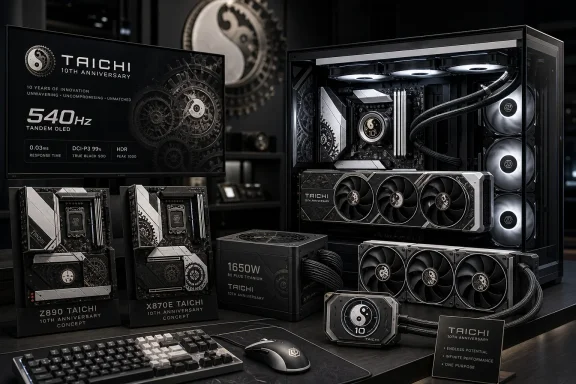
ASRock has marked the 10th anniversary of its Taichi brand with a “Decade of Mastery” showcase that includes concept versions of Z890 and X870E motherboards, a Radeon RX 9070 XT graphics card, a 540Hz OLED monitor, a 1650W Titanium PSU, and a 360mm AIO cooler. The important word is not anniversary. It is concept. As reported by Wccftech and laid out on ASRock’s own anniversary microsite, these machines are not heading to retail shelves, at least not in their commemorative form.
That makes the announcement more interesting, not less. ASRock is not merely painting a few heatsinks and calling it a celebration. It is using Taichi’s birthday to argue that a motherboard sub-brand can become a whole-system identity — the same way ROG, AORUS, MEG, and TUF long ago escaped the motherboard aisle.
Taichi began in 2016 with the X99 Taichi motherboard, a board ASRock now points to as the origin of the line’s “balanced flagship” philosophy. The brand’s visual language has always leaned on gears, symmetry, and the yin-yang metaphor: performance and stability, overclocking and practicality, premium features without quite the same swagger tax as some rivals.
The 10th anniversary concept lineup stretches that identity across nearly every major component in an enthusiast desktop. The two motherboards are the Z890 Taichi 10th Anniversary for Intel systems and the X870E Taichi 10th Anniversary for AMD systems. The graphics card is an AMD Radeon RX 9070 XT Taichi 16GB OC 10th Anniversary edition, matching the same gray, black, white, and metallic accents.
The rest of the stack is where the statement becomes more deliberate. ASRock’s Taichi TCO27QXB 10th Anniversary monitor, Taichi TC-1650T 10th Anniversary power supply, and Taichi 360 HOLO 10th Anniversary liquid cooler turn the announcement from a board-and-GPU refresh into an ecosystem sketch. It is a company saying: if you want a Taichi PC, we want that to mean the whole desk, not just the motherboard under the GPU.
Wccftech notes that ASRock has explicitly described these anniversary items as “concept products” created for the milestone, with no current plan for retail sale. That caveat is doing heavy lifting. It keeps expectations under control, but it also gives ASRock room to test design language and gauge reaction without committing to production logistics, channel pricing, warranty coverage, or inventory risk.
ASRock’s anniversary lineup walks that line carefully. The Radeon RX 9070 XT Taichi 10th Anniversary appears to be the most conventional special edition of the set: a known high-end GPU design with a commemorative exterior. The motherboards follow the same logic, taking existing flagship platforms and applying the anniversary treatment.
But the monitor, PSU, and AIO make the “concept” framing more strategic. A 1650W 80 Plus Titanium power supply is not a casual accessory, and a 540Hz Tandem OLED gaming monitor is not merely a branded mousepad with a logo. These are high-spec categories where execution matters, and where ASRock has less historical brand gravity than it does in motherboards.
Calling the lineup a concept lets ASRock show ambition without asking buyers to become beta testers. It also lets the company collect feedback from the enthusiast crowd that follows Computex-season announcements closely. If the reaction is strong, some of these ideas can surface later in more conventional retail SKUs, possibly without the anniversary badge.
That is the real function of many concept PCs and component showcases. They are not promises. They are negotiations with the market.
ASRock appears to understand that Taichi’s old identity — mechanical gears, premium boards, restrained flourishes — needed to evolve. The 10th anniversary concepts soften the older bronze-and-black look into a cleaner black, white, and gray palette. It is less steampunk motherboard, more boutique workstation-gaming hybrid.
That may disappoint some longtime Taichi fans who associate the name with its gear motifs and warmer metallic accents. But it also makes commercial sense. White and monochrome builds remain highly visible in the DIY market, and neutral colorways are easier to coordinate across cases, GPUs, coolers, PSUs, and monitors.
This is also where ASRock is following a broader industry script. Component makers have learned that users buying premium parts often want the system to photograph well. The PC is no longer hidden under a desk; it is the desk. For a brand like Taichi, coherence is no longer a bonus. It is part of the product.
That is not a criticism. GPUs are where limited editions often make the most sense. They are visible through case glass, they are expensive enough to feel like centerpieces, and their coolers offer a large canvas for industrial design.
Still, the card’s presence also highlights ASRock’s changing role in the GPU market. The company is not just a motherboard specialist moonlighting in graphics. It has spent years building out Radeon designs across Challenger, Steel Legend, Phantom Gaming, and Taichi lines. A commemorative RX 9070 XT reinforces that ASRock now wants its GPU business understood as part of a mature portfolio, not a side quest.
The choice of AMD silicon is also consistent with Taichi’s current identity. Taichi has often had a strong presence on AMD motherboard platforms, and the X870E Taichi sits naturally beside a high-end Radeon card in a themed build. ASRock is not pitching a generic anniversary box; it is pitching a recognizably ASRock enthusiast rig.
For years, motherboard makers expanded into peripherals because keyboards, mice, headsets, and monitors helped keep a brand in front of users after the PC was built. But monitors are a tougher category. Panel sourcing, firmware behavior, warranty handling, burn-in policies, color tuning, HDR performance, and input latency all matter. A logo alone will not carry a display.
That is why the Taichi monitor matters even as a concept. ASRock is attaching the Taichi name to a category where brand trust must be earned differently. A motherboard can be admired for VRM design, BIOS maturity, PCIe layout, and memory support. A monitor lives or dies by the panel experience every second it is on.
The Taichi TC-1650T power supply sends a different message. At 1650W and 80 Plus Titanium, it sits in the territory of extreme desktop builds, workstation-class GPUs, heavy transient loads, and users who would rather overbuy power capacity than calculate margins too tightly. It is not a mainstream gaming PSU. It is a statement part.
Together, the monitor and PSU say ASRock is thinking beyond the motherboard socket. The company wants Taichi to represent a complete premium stack: board, graphics, display, power, and cooling. That is exactly how larger gaming brands build lock-in without forcing users into closed ecosystems.
ASRock’s mention of a customizable block fits the current market. Builders want the cooler to be part thermal device, part display object. That does not mean performance is irrelevant, but it does mean that coolers increasingly compete on how they frame the CPU area, not just how they move heat.
For Taichi, the AIO is also a branding anchor. Motherboard heatsinks, GPU shrouds, PSU labels, and monitor stands all contribute to a theme, but the CPU block sits at the visual center of the build. If ASRock wants Taichi to become a full-system design language, the cooler is not optional.
The challenge is that the AIO market is crowded and unforgiving. Established cooling brands have earned reputations over years of pump reliability, fan acoustics, radiator performance, and warranty service. ASRock can design a beautiful pump cap, but the enthusiast community will judge the cooler by noise-normalized thermals and long-term reliability.
That is another reason the concept label is useful. It lets the company show the shape of the idea before the market asks the harder questions.
Taichi’s 10th anniversary gives ASRock a chance to write that memory down. The company’s own microsite traces the line from the original X99 Taichi through later generations, presenting the brand as an evolving flagship rather than a sequence of unrelated motherboards. That kind of storytelling matters because PC components are otherwise brutally interchangeable.
This is especially important for ASRock, which has long lived in an awkward but productive position in the motherboard market. It is big enough to compete at the high end, but it has often cultivated an image of practical engineering rather than pure spectacle. Taichi helped give the company a premium identity that did not feel like a copy of its rivals.
The anniversary concepts are therefore less about whether anyone can buy a gray-and-white RX 9070 XT next month. They are about whether users now think of Taichi as a platform family. If that idea sticks, ASRock gains something more valuable than a limited-edition sales bump.
But retailing anniversary hardware is harder than it looks. A special-edition motherboard requires production allocation, regional distribution, firmware support, packaging, replacement stock, and a price that does not alienate buyers. A special-edition GPU adds supply volatility and warranty complexity. A monitor and PSU add even more operational burden.
There is also a reputational trap. If ASRock sold a tiny number of anniversary units, scalpers and regional scarcity could turn a celebration into irritation. If it produced too many, the special edition would stop feeling special and might sit in the channel at awkward discounts. Concept status avoids both outcomes.
That does not mean the products are meaningless. In hardware, concepts often serve as design probes. A colorway, cooler treatment, OLED monitor stand, PSU casing, or pump-block idea can migrate into future retail products after the commemorative framing has done its job.
The smarter read is that ASRock is not asking buyers to chase these exact anniversary parts. It is asking them to accept Taichi as a broader premium language that can support future products.
That matters for PC builders because the best Windows desktop is still a balancing act. Firmware stability, driver behavior, power delivery, GPU thermals, display capabilities, USB reliability, and memory compatibility all intersect. A coherent brand stack can simplify choices, but it can also make buyers overvalue matching logos at the expense of independent testing.
ASRock’s Taichi pitch is appealing precisely because it feels less locked down than some vendor ecosystems. There is no suggestion that users must run a Taichi board with a Taichi GPU, Taichi PSU, Taichi cooler, and Taichi monitor. But the visual and marketing direction nudges buyers that way.
The danger is not unique to ASRock. It is the same across the enthusiast market: once components become fashion objects, the spec sheet can become secondary. A 1650W Titanium PSU may be impressive, but many systems do not need that capacity. A 540Hz OLED monitor may be extraordinary, but only certain gamers and esports use cases will exploit it fully.
The best response is not cynicism. It is discipline. Admire the design, then wait for retail specs, independent reviews, acoustic testing, firmware notes, and warranty terms.
That is not a small shift. It changes how ASRock competes. Instead of fighting only on chipset features and VRM thermals, it can compete on identity, continuity, and the promise of a coordinated high-end build. That is the playbook used by the biggest names in enthusiast hardware, and ASRock is signaling that Taichi deserves a seat at that table.
For buyers, the announcement should be treated as a preview of intent rather than a product launch. The anniversary editions may not reach stores, but their ideas almost certainly will. The more important question is which pieces become real products, and whether ASRock can match the design ambition with the long-term polish that premium ecosystems demand.
That makes the announcement more interesting, not less. ASRock is not merely painting a few heatsinks and calling it a celebration. It is using Taichi’s birthday to argue that a motherboard sub-brand can become a whole-system identity — the same way ROG, AORUS, MEG, and TUF long ago escaped the motherboard aisle.
 ASRock Turns a Motherboard Badge Into a Full-System Pitch
Taichi began in 2016 with the X99 Taichi motherboard, a board ASRock now points to as the origin of the line’s “balanced flagship” philosophy. The brand’s visual language has always leaned on gears, symmetry, and the yin-yang metaphor: performance and stability, overclocking and practicality, premium features without quite the same swagger tax as some rivals.The 10th anniversary concept lineup stretches that identity across nearly every major component in an enthusiast desktop. The two motherboards are the Z890 Taichi 10th Anniversary for Intel systems and the X870E Taichi 10th Anniversary for AMD systems. The graphics card is an AMD Radeon RX 9070 XT Taichi 16GB OC 10th Anniversary edition, matching the same gray, black, white, and metallic accents.
The rest of the stack is where the statement becomes more deliberate. ASRock’s Taichi TCO27QXB 10th Anniversary monitor, Taichi TC-1650T 10th Anniversary power supply, and Taichi 360 HOLO 10th Anniversary liquid cooler turn the announcement from a board-and-GPU refresh into an ecosystem sketch. It is a company saying: if you want a Taichi PC, we want that to mean the whole desk, not just the motherboard under the GPU.
Wccftech notes that ASRock has explicitly described these anniversary items as “concept products” created for the milestone, with no current plan for retail sale. That caveat is doing heavy lifting. It keeps expectations under control, but it also gives ASRock room to test design language and gauge reaction without committing to production logistics, channel pricing, warranty coverage, or inventory risk.
The Concept Label Is a Shield and a Trial Balloon
PC hardware vendors love limited editions because they compress several marketing goals into one object. They remind loyalists that a brand has history, give reviewers something photogenic, and create the sense that the ordinary product stack is part of a larger story. The risk is that special editions can feel cynical when the changes stop at a color swap.ASRock’s anniversary lineup walks that line carefully. The Radeon RX 9070 XT Taichi 10th Anniversary appears to be the most conventional special edition of the set: a known high-end GPU design with a commemorative exterior. The motherboards follow the same logic, taking existing flagship platforms and applying the anniversary treatment.
But the monitor, PSU, and AIO make the “concept” framing more strategic. A 1650W 80 Plus Titanium power supply is not a casual accessory, and a 540Hz Tandem OLED gaming monitor is not merely a branded mousepad with a logo. These are high-spec categories where execution matters, and where ASRock has less historical brand gravity than it does in motherboards.
Calling the lineup a concept lets ASRock show ambition without asking buyers to become beta testers. It also lets the company collect feedback from the enthusiast crowd that follows Computex-season announcements closely. If the reaction is strong, some of these ideas can surface later in more conventional retail SKUs, possibly without the anniversary badge.
That is the real function of many concept PCs and component showcases. They are not promises. They are negotiations with the market.
Taichi’s Anniversary Arrives in a Market Obsessed With Visual Coherence
The timing is not accidental. The enthusiast PC market has become increasingly aesthetic, and not only in the shallow RGB sense. Builders now plan systems around white themes, stealth black builds, fishtank cases, vertical GPUs, coordinated cable kits, LCD pump caps, and matching fans. A motherboard vendor that cannot speak this language risks being reduced to a spec table.ASRock appears to understand that Taichi’s old identity — mechanical gears, premium boards, restrained flourishes — needed to evolve. The 10th anniversary concepts soften the older bronze-and-black look into a cleaner black, white, and gray palette. It is less steampunk motherboard, more boutique workstation-gaming hybrid.
That may disappoint some longtime Taichi fans who associate the name with its gear motifs and warmer metallic accents. But it also makes commercial sense. White and monochrome builds remain highly visible in the DIY market, and neutral colorways are easier to coordinate across cases, GPUs, coolers, PSUs, and monitors.
This is also where ASRock is following a broader industry script. Component makers have learned that users buying premium parts often want the system to photograph well. The PC is no longer hidden under a desk; it is the desk. For a brand like Taichi, coherence is no longer a bonus. It is part of the product.
The GPU Is the Familiar Star, but Not the Whole Story
The Radeon RX 9070 XT Taichi 16GB OC 10th Anniversary edition is likely to draw the most attention because graphics cards remain the emotional center of enthusiast builds. ASRock already sells regular and white Taichi versions of the RX 9070 XT, so the anniversary card appears less like a new graphics platform and more like a collector-grade reinterpretation.That is not a criticism. GPUs are where limited editions often make the most sense. They are visible through case glass, they are expensive enough to feel like centerpieces, and their coolers offer a large canvas for industrial design.
Still, the card’s presence also highlights ASRock’s changing role in the GPU market. The company is not just a motherboard specialist moonlighting in graphics. It has spent years building out Radeon designs across Challenger, Steel Legend, Phantom Gaming, and Taichi lines. A commemorative RX 9070 XT reinforces that ASRock now wants its GPU business understood as part of a mature portfolio, not a side quest.
The choice of AMD silicon is also consistent with Taichi’s current identity. Taichi has often had a strong presence on AMD motherboard platforms, and the X870E Taichi sits naturally beside a high-end Radeon card in a themed build. ASRock is not pitching a generic anniversary box; it is pitching a recognizably ASRock enthusiast rig.
The Monitor and PSU Signal Bigger Ambitions Than a Birthday Party
The Taichi TCO27QXB monitor may be the most revealing product in the concept lineup. ASRock’s own Computex materials describe the display as using Tandem OLED technology with a 540Hz refresh rate and dual-mode functionality. That is a very modern spec sheet, aimed directly at high-end gaming where OLED response times and extreme refresh rates have become the new battleground.For years, motherboard makers expanded into peripherals because keyboards, mice, headsets, and monitors helped keep a brand in front of users after the PC was built. But monitors are a tougher category. Panel sourcing, firmware behavior, warranty handling, burn-in policies, color tuning, HDR performance, and input latency all matter. A logo alone will not carry a display.
That is why the Taichi monitor matters even as a concept. ASRock is attaching the Taichi name to a category where brand trust must be earned differently. A motherboard can be admired for VRM design, BIOS maturity, PCIe layout, and memory support. A monitor lives or dies by the panel experience every second it is on.
The Taichi TC-1650T power supply sends a different message. At 1650W and 80 Plus Titanium, it sits in the territory of extreme desktop builds, workstation-class GPUs, heavy transient loads, and users who would rather overbuy power capacity than calculate margins too tightly. It is not a mainstream gaming PSU. It is a statement part.
Together, the monitor and PSU say ASRock is thinking beyond the motherboard socket. The company wants Taichi to represent a complete premium stack: board, graphics, display, power, and cooling. That is exactly how larger gaming brands build lock-in without forcing users into closed ecosystems.
The AIO Cooler Completes the Visual Loop
The Taichi 360 HOLO 10th Anniversary AIO is the least surprising addition, but it may be one of the most important for the finished-build fantasy. A 360mm radiator is now the default visual shorthand for a high-end desktop, even when many CPUs do not strictly require one. The pump block is prime real estate in a glass-sided case.ASRock’s mention of a customizable block fits the current market. Builders want the cooler to be part thermal device, part display object. That does not mean performance is irrelevant, but it does mean that coolers increasingly compete on how they frame the CPU area, not just how they move heat.
For Taichi, the AIO is also a branding anchor. Motherboard heatsinks, GPU shrouds, PSU labels, and monitor stands all contribute to a theme, but the CPU block sits at the visual center of the build. If ASRock wants Taichi to become a full-system design language, the cooler is not optional.
The challenge is that the AIO market is crowded and unforgiving. Established cooling brands have earned reputations over years of pump reliability, fan acoustics, radiator performance, and warranty service. ASRock can design a beautiful pump cap, but the enthusiast community will judge the cooler by noise-normalized thermals and long-term reliability.
That is another reason the concept label is useful. It lets the company show the shape of the idea before the market asks the harder questions.
Anniversary Hardware Is Really About Brand Memory
The PC industry has always had a strange relationship with nostalgia. Enthusiasts move quickly, chasing new sockets, chipsets, GPUs, memory standards, and display interfaces. Yet the brands that last are the ones that make buyers remember a board they loved, a BIOS they trusted, or a system that ran for years without drama.Taichi’s 10th anniversary gives ASRock a chance to write that memory down. The company’s own microsite traces the line from the original X99 Taichi through later generations, presenting the brand as an evolving flagship rather than a sequence of unrelated motherboards. That kind of storytelling matters because PC components are otherwise brutally interchangeable.
This is especially important for ASRock, which has long lived in an awkward but productive position in the motherboard market. It is big enough to compete at the high end, but it has often cultivated an image of practical engineering rather than pure spectacle. Taichi helped give the company a premium identity that did not feel like a copy of its rivals.
The anniversary concepts are therefore less about whether anyone can buy a gray-and-white RX 9070 XT next month. They are about whether users now think of Taichi as a platform family. If that idea sticks, ASRock gains something more valuable than a limited-edition sales bump.
The Retail Absence Will Frustrate Collectors, but It Also Avoids a Trap
There will be a predictable reaction from some enthusiasts: if the products look good, why not sell them? That is a fair complaint. Limited editions create desire, and telling people there are “no current plans” for retail sale can feel like showing off a meal and refusing to serve it.But retailing anniversary hardware is harder than it looks. A special-edition motherboard requires production allocation, regional distribution, firmware support, packaging, replacement stock, and a price that does not alienate buyers. A special-edition GPU adds supply volatility and warranty complexity. A monitor and PSU add even more operational burden.
There is also a reputational trap. If ASRock sold a tiny number of anniversary units, scalpers and regional scarcity could turn a celebration into irritation. If it produced too many, the special edition would stop feeling special and might sit in the channel at awkward discounts. Concept status avoids both outcomes.
That does not mean the products are meaningless. In hardware, concepts often serve as design probes. A colorway, cooler treatment, OLED monitor stand, PSU casing, or pump-block idea can migrate into future retail products after the commemorative framing has done its job.
The smarter read is that ASRock is not asking buyers to chase these exact anniversary parts. It is asking them to accept Taichi as a broader premium language that can support future products.
Windows Builders Should Read This as an Ecosystem Move, Not a Shopping List
For WindowsForum readers, the practical implication is not that a new shopping cart must be assembled around unavailable hardware. It is that component vendors are continuing to move toward branded ecosystems that shape build decisions before benchmarks enter the conversation.That matters for PC builders because the best Windows desktop is still a balancing act. Firmware stability, driver behavior, power delivery, GPU thermals, display capabilities, USB reliability, and memory compatibility all intersect. A coherent brand stack can simplify choices, but it can also make buyers overvalue matching logos at the expense of independent testing.
ASRock’s Taichi pitch is appealing precisely because it feels less locked down than some vendor ecosystems. There is no suggestion that users must run a Taichi board with a Taichi GPU, Taichi PSU, Taichi cooler, and Taichi monitor. But the visual and marketing direction nudges buyers that way.
The danger is not unique to ASRock. It is the same across the enthusiast market: once components become fashion objects, the spec sheet can become secondary. A 1650W Titanium PSU may be impressive, but many systems do not need that capacity. A 540Hz OLED monitor may be extraordinary, but only certain gamers and esports use cases will exploit it fully.
The best response is not cynicism. It is discipline. Admire the design, then wait for retail specs, independent reviews, acoustic testing, firmware notes, and warranty terms.
The Taichi Birthday Gift Is a Map of ASRock’s Next Decade
The most concrete lesson from ASRock’s anniversary reveal is that Taichi has outgrown its original category. What began as a motherboard line is now being positioned as a flagship design system that can span the PC, the power chain, the cooling loop, and the display on the desk.That is not a small shift. It changes how ASRock competes. Instead of fighting only on chipset features and VRM thermals, it can compete on identity, continuity, and the promise of a coordinated high-end build. That is the playbook used by the biggest names in enthusiast hardware, and ASRock is signaling that Taichi deserves a seat at that table.
For buyers, the announcement should be treated as a preview of intent rather than a product launch. The anniversary editions may not reach stores, but their ideas almost certainly will. The more important question is which pieces become real products, and whether ASRock can match the design ambition with the long-term polish that premium ecosystems demand.
- ASRock’s 10th anniversary Taichi lineup includes concept versions of Z890 and X870E motherboards, a Radeon RX 9070 XT graphics card, a Tandem OLED monitor, a 1650W Titanium PSU, and a 360mm AIO cooler.
- ASRock has said the commemorative products are concept items for the anniversary celebration, with no current plans for retail sale.
- The announcement matters because it positions Taichi as a whole-system premium brand rather than only a motherboard family.
- The monitor, PSU, and AIO are the clearest signs that ASRock wants to compete more directly in the broader enthusiast ecosystem.
- Builders should treat the reveal as a design and strategy preview, not as a near-term buying guide.
References
- Primary source: Wccftech
Published: 2026-07-07T14:10:16.888538
Loading…
wccftech.com - Related coverage: asrock.com
Loading…
www.asrock.com - Related coverage: tweaktown.com
Loading…
www.tweaktown.com - Related coverage: technetbooks.com
Loading…
www.technetbooks.com - Related coverage: digitalcitizen.life
Loading…
www.digitalcitizen.life - Related coverage: forum.asrock.com
Loading…
forum.asrock.com