

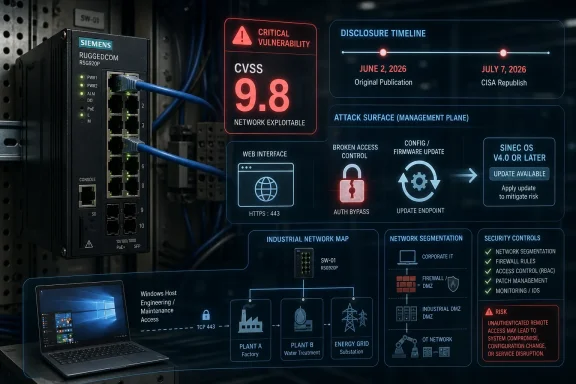
Siemens ProductCERT published SSA-253495 on June 2, 2026, and CISA republished it on July 7, 2026, warning that Siemens SINEC OS before version 4.0 on the RUGGEDCOM RST2428P industrial Ethernet switch contains multiple vulnerabilities, with the highest CVSS v3 score reaching 9.8. The fix is blunt rather than clever: Siemens says affected operators should update to the latest SINEC OS release. The bigger story is that a switch sitting in the quiet middle of operational technology networks has become another reminder that industrial security is now software supply-chain security by a different name. For WindowsForum readers who spend more time with endpoints, Hyper-V hosts, Entra tenants, and patch rings than substations or rail yards, this advisory is still worth reading because it shows how modern infrastructure risk increasingly lives in devices that administrators do not patch on a Tuesday cadence.
The affected product, Siemens’ RUGGEDCOM RST2428P, is not a consumer router or a forgotten office closet switch. Siemens describes the RST2428P line as a SINEC OS-based Layer 2 industrial Ethernet switch with up to 28 non-blocking interfaces, built for rugged environments where downtime is measured in operational consequences rather than help-desk tickets. The model named in the advisory is 6GK6242-6PA00, and the vulnerable range is every version before V4.0.
That context matters because industrial Ethernet gear often occupies a deceptively low-profile position. It may not run the process logic, own the human-machine interface, or appear on the CIO’s list of business-critical applications. But it can sit between engineering workstations, controllers, remote I/O, safety systems, cameras, time sources, and monitoring equipment — the traffic cop that everyone depends on and few people want to touch.
CISA’s republication says the affected sectors include critical manufacturing, transportation systems, energy, healthcare and public health, financial services, and government services and facilities. That sector list is broad enough to sound boilerplate, but in this case it is also plausible. Ruggedized switches are the sort of shared component that cross industry boundaries precisely because Ethernet won the industrial networking war.
The advisory’s geography is equally simple: worldwide deployment, with Siemens headquartered in Germany. That means the relevant audience is not a single national regulator, a single utility, or a single vertical. It is the familiar, messy population of asset owners, integrators, managed service providers, plant engineers, and security teams who must decide whether a firmware update belongs in next week’s outage window or next quarter’s capital project.
The chronology is also important. Siemens ProductCERT published the advisory on June 2, 2026. CISA’s page lists July 7, 2026, as its initial republication date for the Siemens advisory. For organizations that key their vulnerability workflows off CISA ICS advisories rather than vendor mailing lists, the practical clock may have started more than a month after Siemens’ original publication.
That lag is not necessarily evidence of negligence by anyone. It is a symptom of how industrial vulnerability communication works in 2026: vendor portals, CSAF feeds, national CERT mirrors, commercial scanners, sector ISACs, procurement notices, and internal risk registers all move at different speeds. A security team may learn about the same flaw from Siemens, CISA, Tenable, NVD, a national cyber center, or a consultant’s monthly report — and each source may emphasize a different slice of the risk.
The cleanest operational reading is therefore not “CISA found a new bug today.” It is “Siemens already shipped the fixed branch, and CISA has now placed the issue in the broader ICS-warning bloodstream.” That makes the advisory less of a breaking-news surprise and more of a coordination test.
The vulnerability categories named in the advisory read like a catalog of modern software failure modes: memory-buffer boundary errors, integer overflows, stack-based buffer overflows, path traversal, uncontrolled recursion, out-of-bounds reads and writes, prototype pollution, race conditions, expired pointer dereferences, null pointer dereferences, improper access control, authentication bypass, active debug code, and cross-site scripting. This is not one tidy bug with one tidy exploit story. It is a bundle of weaknesses, many of them familiar to anyone who has watched Linux distributions, browsers, JavaScript runtimes, and appliance firmware absorb years of dependency churn.
Cybersecurity authorities in Spain’s Basque Country, writing through Cyberzaintza, summarized the Siemens release as 77 vulnerabilities affecting RUGGEDCOM RST2428P versions before V4.0, including two critical, 56 high, 18 medium, and one low severity issue. That breakdown, while not present in the shorter CISA summary pasted into the public advisory text, usefully reframes the case: this is not merely “a critical vulnerability” but a maintenance cliff for a device OS branch.
One example surfaced in public vulnerability records is CVE-2025-49796, tied to XML parsing behavior that can lead to memory corruption and denial of service or undefined behavior. Another public record, CVE-2026-41918, describes affected RUGGEDCOM RST2428P versions before V4.0 and points back to Siemens’ advisory. The details vary by CVE, but the pattern is recognizable: complex network devices inherit risks from the code they embed, the parsers they expose, the web interfaces they provide, and the state-management paths that administrators rarely inspect.
For defenders, the practical lesson is that the headline CVSS score is a triage flag, not the whole file. A switch that is not internet-exposed may still be reachable from engineering laptops, jump hosts, vendor remote-access paths, compromised Windows endpoints, or a flat plant network. Conversely, a high CVSS score does not automatically mean an exploit is circulating in the wild. The right response is to inventory, segment, update, and monitor — in that order — rather than either panic or dismiss.
That is why industrial network gear increasingly experiences the same vulnerability economics as servers and desktops. The old mental model said industrial devices were special-purpose, slow-moving, and comparatively isolated. The new reality says they are still special-purpose and slow-moving, but they also run enough general-purpose software to inherit the same categories of bugs that haunt everything else.
The CISA summary’s named weaknesses are revealing. Prototype pollution, permissive regular expressions, covert timing channels, inefficient algorithmic complexity, and web-cache exposure do not sound like the old stereotype of a relay cabinet or serial gateway. They sound like software. They sound like code paths that belong to management planes, web UIs, libraries, and input processors.
That should make Windows administrators uneasy in a useful way. Many enterprises have spent the last decade professionalizing endpoint patching, browser hardening, identity governance, and vulnerability scanning. But the same rigor often stops at the boundary between IT and OT, where devices are harder to scan, windows are harder to schedule, and ownership is harder to assign.
The RST2428P advisory is a case study in that boundary problem. A Windows estate can usually answer, within hours, which machines run a vulnerable Office build or Edge version. Ask the same organization which industrial switches are on SINEC OS before V4.0, and the answer may depend on a spreadsheet last updated during commissioning, an integrator’s notes, or a network diagram that no longer matches the plant floor.
The Siemens advisory’s weakness list points repeatedly at management-plane risk. Path traversal implies file handling that can escape intended directories. Cross-site scripting implies browser-rendered administration pages. Authentication bypass and improper access control imply logic failures around who gets to do what. Sensitive information in sent data and browser-cache exposure imply confidentiality risks that can leak configuration or session material.
Those categories matter because a switch’s data plane and management plane have different security meanings. A forwarding ASIC or switching fabric may keep traffic moving, but the management plane decides who can change VLANs, mirror ports, update firmware, alter spanning tree behavior, adjust access controls, change logging targets, or reboot the box. Compromise or disruption there can become a pivot, a blindfold, or a kill switch.
In a converged environment, the risk is even more pronounced. OT networks increasingly connect to Windows jump servers, historian databases, engineering workstations, remote support gateways, domain services, backup platforms, and SIEM collectors. That connectivity is often necessary. It also means that a management-plane flaw in an industrial switch cannot be reasoned about as if it lives in a sealed cabinet.
The uncomfortable truth is that segmentation is only as strong as the devices enforcing it. If the switch that separates zones is itself vulnerable, unpatched, and reachable from a compromised administrative host, then the network diagram’s boxes and lines become aspirational. That is why CISA’s familiar guidance — minimize exposure, place control-system networks behind firewalls, isolate them from business networks, and use secure remote access — remains repetitive because it remains correct.
That friction is not an excuse to defer indefinitely. It is the reason the work must be planned instead of hand-waved. A rugged switch may be part of a redundant topology, but redundancy that has not been tested under firmware-maintenance conditions is optimism, not resilience. A configuration backup may exist, but if no one has restored it to a spare unit, it is documentation rather than recovery.
Industrial operators also face a sharper version of the “availability versus security” tradeoff. Updating a Windows laptop can inconvenience a user. Updating network infrastructure in a substation, plant, port, or hospital environment can interrupt telemetry, control, or monitoring if the process is mishandled. That is why good OT security programs treat patching as change management, not as a help-desk reflex.
Still, the existence of a difficult update path does not make the status quo safe. The advisory covers versions before V4.0, which means an organization can draw a crisp line between affected and fixed branches. That is useful. The worst vulnerability cases are the ones with vague mitigations, partial workarounds, or no patch at all. Here, the vendor’s answer is clear enough to become a measurable task: find every affected RST2428P and move it to a current release.
The complication is prioritization. If Cyberzaintza’s public summary is correct that the underlying bundle includes 77 vulnerabilities, two of them critical and dozens high severity, then this is not a single niche flaw to be buried in the next maintenance cycle. It is a reason to ask whether the organization’s entire SINEC OS lifecycle is too far behind.
For WindowsForum’s IT-pro audience, this should feel familiar. You cannot patch what you cannot see, whether the invisible asset is a local admin account, an unmanaged VM, a stale SQL Server instance, or an industrial switch behind a vendor-managed firewall. OT merely adds harsher constraints: passive discovery may be preferred, active scanning may require care, and device ownership may be split between operations, engineering, security, and outside contractors.
The RST2428P case is a good prompt to verify not only model numbers but firmware lineage. The advisory names the product order number, 6GK6242-6PA00, and the SINEC OS threshold, V4.0. An inventory that records “Siemens switch” is not good enough. An inventory that records “RUGGEDCOM RST2428P” is better. An inventory that records hardware identifier, firmware version, network zone, management IP, owner, maintenance window, backup status, and support contract is what turns a vulnerability advisory into a controlled change.
This is where IT and OT teams can usefully borrow from each other. IT has stronger tooling habits around automated inventory, vulnerability workflows, and patch compliance. OT has stronger habits around change windows, operational impact, and device-specific procedures. A mature response to this advisory needs both cultures.
A good first move is not to scan the plant indiscriminately. It is to reconcile known Siemens RUGGEDCOM assets against procurement records, switch management systems, network diagrams, passive monitoring, and site-level maintenance documentation. From there, teams can decide where careful version checks are needed and where immediate update planning is justified.
The reason these recommendations recur is that most real-world exploitation paths still need reachability. A remotely exploitable management-plane issue is far less dangerous if the management interface is accessible only from a hardened jump host, on a restricted management network, with monitored authentication, no broad workstation reachability, and no direct internet exposure. It is far more dangerous if the device’s web UI is reachable from general corporate VLANs or remote-access concentrators shared with ordinary IT assets.
The VPN language also deserves nuance. CISA notes that VPNs may themselves contain vulnerabilities and should be kept updated. That caveat is not legal padding. The past several years have shown that remote-access devices are among the most aggressively targeted enterprise systems, precisely because they sit at the boundary between attackers and internal networks.
In OT, remote access is often necessary for vendors, integrators, and thinly staffed facilities. The question is not whether remote access exists; it is whether it is brokered, logged, time-limited, patched, identity-bound, and segmented. A VPN that drops a contractor into a broad control network is not a security architecture. It is a long cable with encryption.
The Siemens guidance, as reflected in the advisory, also points operators toward Siemens’ operational guidelines for industrial security and product manuals. That matters because vendor-specific hardening guidance can include details generic advisories cannot: supported configurations, safe update paths, management-service behavior, and model-specific operational considerations. In other words, “update to V4.0” is the headline; “operate the device in a protected environment” is the enduring requirement.
Engineering workstations frequently run Windows. Historians often integrate with Windows servers and SQL databases. Remote access may depend on identity providers, endpoint security tooling, certificate infrastructure, and network appliances managed by IT. Logs from industrial switches may flow into enterprise SIEM platforms. Backups, documentation, ticketing, and incident response coordination may all depend on ordinary business systems.
That interdependence changes the meaning of an industrial switch vulnerability. The risk is not only that an attacker “hacks a switch.” It is that a compromised Windows endpoint, stolen remote-access credential, or poorly segmented admin path gives an attacker the position needed to touch vulnerable OT management interfaces. From there, the attacker may disrupt visibility, alter network behavior, harvest configuration, or create confusion during an incident.
There is also a governance angle. Many organizations have separate patch committees, risk registers, and asset-management processes for IT and OT. The Siemens advisory belongs in both. IT security teams need to know whether their network paths expose vulnerable devices; OT teams need to know whether enterprise identity, remote access, and endpoint controls reduce or increase the chance of exploitation.
The best response is not for IT to barge into OT with a scanner and a deadline. It is for both sides to build a shared view of exposure. Which Windows hosts can reach SINEC OS management interfaces? Which accounts can authenticate? Which jump boxes are required? Which firewall rules are temporary exceptions that became permanent? Which monitoring tools would show a failed login storm, a firmware change, or a configuration export?
That is useful, but it can create a fragmented picture. One team may see a CVE with a medium score. Another may see a plugin with a high score. A third may see CISA’s advisory summary with a 9.8 maximum. A fourth may see Cyberzaintza’s count of 77 vulnerabilities. All may be describing slices of the same underlying upgrade requirement.
This is where vulnerability management has to resist false precision. The question is not whether one CVE in the bundle is more interesting than another. The question is whether the device is running a vulnerable SINEC OS branch and whether its exposure makes exploitation plausible. If the answer to both is yes, the remediation path points toward V4.0 regardless of which database entry triggered the ticket.
The CSAF format is meant to help with machine-readable advisories, and Siemens’ use of ProductCERT advisories gives operators a structured place to track vendor statements. But machine-readable does not automatically mean operationally digested. Asset owners still need mapping between vendor product names, order numbers, firmware versions, installed devices, and internal owners.
This is also why CISA’s republication has value even when it is not adding new technical analysis. It turns a vendor advisory into a public-sector signal that many organizations already ingest. In environments where Siemens ProductCERT is not monitored directly, that amplification may be the difference between “known to the vendor” and “visible to the risk committee.”
A serious response should therefore ask three separate questions. First, where do we have RUGGEDCOM RST2428P devices, and what versions do they run? Second, what is the safe update plan for each site, including backups, redundancy, rollback, and operational approval? Third, how do we prevent this class of version drift from recurring?
The third question is the one most often skipped. Vulnerability advisories produce bursts of activity, but infrastructure risk is cumulative. A site that lets one industrial switch OS fall behind will likely let other switch firmware, firewall builds, Windows images, engineering tools, and vendor appliances drift too. The Siemens advisory is a chance to fix a device and inspect the process that allowed the device to become a surprise.
That process should include acceptance criteria for new equipment. If an integrator installs Siemens gear, the commissioning package should record firmware versions and update status. If a site receives a spare, the spare should be tracked. If a maintenance team replaces a failed switch under pressure, the replacement should not silently reintroduce vulnerable firmware.
This is unglamorous work. It is also the difference between vulnerability management as theater and vulnerability management as engineering.
The ownership problem is harder. Industrial switches are infrastructure, and infrastructure often belongs to everyone until it needs patching. Network teams may manage IP addresses and routing. OT engineers may own uptime. Vendors may own support procedures. Security teams may own vulnerability tickets. Site managers may own outage approval. Finance may own spares and lifecycle refresh.
That shared ownership can either become resilience or paralysis. Resilience looks like a named asset owner, a tested backup, a known maintenance window, a documented upgrade path, and a clear exception process. Paralysis looks like a ticket passed between teams because no one wants to be the person who rebooted the plant network.
The 9.8 score should be enough to break that paralysis. Not because every affected device is equally exposed, and not because exploitation is guaranteed, but because the combination of critical infrastructure deployment, management-plane weaknesses, and a vendor-provided fixed version gives organizations little room for ambiguity. If the device is in scope, the question is when and how to update, not whether the advisory matters.
A short, concrete action list follows from the advisory:
The Siemens SINEC OS advisory is not just another CVSS 9.8 item in the industrial-security feed; it is a reminder that the quiet devices binding modern infrastructure together are now fully part of the software-risk economy. The fix for affected RUGGEDCOM RST2428P switches may be a firmware update, but the durable lesson is procedural: organizations that cannot quickly find, classify, isolate, and update industrial network gear will keep discovering critical exposure one advisory at a time. As IT and OT continue to converge, the winners will not be the teams with the longest vulnerability spreadsheets, but the ones that can turn vendor warnings into controlled engineering work before attackers turn them into operational events.
 The Switch Is Small, but the Blast Radius Is Not
The affected product, Siemens’ RUGGEDCOM RST2428P, is not a consumer router or a forgotten office closet switch. Siemens describes the RST2428P line as a SINEC OS-based Layer 2 industrial Ethernet switch with up to 28 non-blocking interfaces, built for rugged environments where downtime is measured in operational consequences rather than help-desk tickets. The model named in the advisory is 6GK6242-6PA00, and the vulnerable range is every version before V4.0.That context matters because industrial Ethernet gear often occupies a deceptively low-profile position. It may not run the process logic, own the human-machine interface, or appear on the CIO’s list of business-critical applications. But it can sit between engineering workstations, controllers, remote I/O, safety systems, cameras, time sources, and monitoring equipment — the traffic cop that everyone depends on and few people want to touch.
CISA’s republication says the affected sectors include critical manufacturing, transportation systems, energy, healthcare and public health, financial services, and government services and facilities. That sector list is broad enough to sound boilerplate, but in this case it is also plausible. Ruggedized switches are the sort of shared component that cross industry boundaries precisely because Ethernet won the industrial networking war.
The advisory’s geography is equally simple: worldwide deployment, with Siemens headquartered in Germany. That means the relevant audience is not a single national regulator, a single utility, or a single vertical. It is the familiar, messy population of asset owners, integrators, managed service providers, plant engineers, and security teams who must decide whether a firmware update belongs in next week’s outage window or next quarter’s capital project.
CISA’s Republication Turns a Vendor Advisory Into an Operational Deadline
The CISA item is explicit that this is a verbatim republication of Siemens ProductCERT advisory SSA-253495 through the Common Security Advisory Framework, not a separate CISA-authored technical investigation. That distinction is not bureaucratic trivia. It tells administrators where the primary source of truth lives, and it signals that the federal agency is amplifying visibility rather than independently rewriting the vendor’s findings.The chronology is also important. Siemens ProductCERT published the advisory on June 2, 2026. CISA’s page lists July 7, 2026, as its initial republication date for the Siemens advisory. For organizations that key their vulnerability workflows off CISA ICS advisories rather than vendor mailing lists, the practical clock may have started more than a month after Siemens’ original publication.
That lag is not necessarily evidence of negligence by anyone. It is a symptom of how industrial vulnerability communication works in 2026: vendor portals, CSAF feeds, national CERT mirrors, commercial scanners, sector ISACs, procurement notices, and internal risk registers all move at different speeds. A security team may learn about the same flaw from Siemens, CISA, Tenable, NVD, a national cyber center, or a consultant’s monthly report — and each source may emphasize a different slice of the risk.
The cleanest operational reading is therefore not “CISA found a new bug today.” It is “Siemens already shipped the fixed branch, and CISA has now placed the issue in the broader ICS-warning bloodstream.” That makes the advisory less of a breaking-news surprise and more of a coordination test.
The CVSS 9.8 Number Is a Siren, Not a Root-Cause Analysis
The advisory summary provided through CISA says the Siemens SINEC OS issue set carries a vendor equipment vulnerability score of CVSS v3 9.8. That number deserves attention because 9.8 is near the top of the common scoring scale and generally signals a remotely reachable, low-complexity path to serious impact. But it should not be treated as a complete threat model.The vulnerability categories named in the advisory read like a catalog of modern software failure modes: memory-buffer boundary errors, integer overflows, stack-based buffer overflows, path traversal, uncontrolled recursion, out-of-bounds reads and writes, prototype pollution, race conditions, expired pointer dereferences, null pointer dereferences, improper access control, authentication bypass, active debug code, and cross-site scripting. This is not one tidy bug with one tidy exploit story. It is a bundle of weaknesses, many of them familiar to anyone who has watched Linux distributions, browsers, JavaScript runtimes, and appliance firmware absorb years of dependency churn.
Cybersecurity authorities in Spain’s Basque Country, writing through Cyberzaintza, summarized the Siemens release as 77 vulnerabilities affecting RUGGEDCOM RST2428P versions before V4.0, including two critical, 56 high, 18 medium, and one low severity issue. That breakdown, while not present in the shorter CISA summary pasted into the public advisory text, usefully reframes the case: this is not merely “a critical vulnerability” but a maintenance cliff for a device OS branch.
One example surfaced in public vulnerability records is CVE-2025-49796, tied to XML parsing behavior that can lead to memory corruption and denial of service or undefined behavior. Another public record, CVE-2026-41918, describes affected RUGGEDCOM RST2428P versions before V4.0 and points back to Siemens’ advisory. The details vary by CVE, but the pattern is recognizable: complex network devices inherit risks from the code they embed, the parsers they expose, the web interfaces they provide, and the state-management paths that administrators rarely inspect.
For defenders, the practical lesson is that the headline CVSS score is a triage flag, not the whole file. A switch that is not internet-exposed may still be reachable from engineering laptops, jump hosts, vendor remote-access paths, compromised Windows endpoints, or a flat plant network. Conversely, a high CVSS score does not automatically mean an exploit is circulating in the wild. The right response is to inventory, segment, update, and monitor — in that order — rather than either panic or dismiss.
Industrial Firmware Is Now a Dependency Graph Wearing a DIN Rail Bracket
The list of weakness categories is long enough to tempt readers into counting bug classes. That misses the more important point. SINEC OS, like almost every modern network-device operating system, is not a single monolithic slab of vendor-written code; it is an operating environment with web services, parsers, authentication logic, management interfaces, third-party components, protocol handlers, and device-specific integration.That is why industrial network gear increasingly experiences the same vulnerability economics as servers and desktops. The old mental model said industrial devices were special-purpose, slow-moving, and comparatively isolated. The new reality says they are still special-purpose and slow-moving, but they also run enough general-purpose software to inherit the same categories of bugs that haunt everything else.
The CISA summary’s named weaknesses are revealing. Prototype pollution, permissive regular expressions, covert timing channels, inefficient algorithmic complexity, and web-cache exposure do not sound like the old stereotype of a relay cabinet or serial gateway. They sound like software. They sound like code paths that belong to management planes, web UIs, libraries, and input processors.
That should make Windows administrators uneasy in a useful way. Many enterprises have spent the last decade professionalizing endpoint patching, browser hardening, identity governance, and vulnerability scanning. But the same rigor often stops at the boundary between IT and OT, where devices are harder to scan, windows are harder to schedule, and ownership is harder to assign.
The RST2428P advisory is a case study in that boundary problem. A Windows estate can usually answer, within hours, which machines run a vulnerable Office build or Edge version. Ask the same organization which industrial switches are on SINEC OS before V4.0, and the answer may depend on a spreadsheet last updated during commissioning, an integrator’s notes, or a network diagram that no longer matches the plant floor.
The Management Plane Is the New Attack Surface
When people hear “industrial switch,” they often think about packet forwarding. Attackers think about management. Web interfaces, remote consoles, configuration import/export, authentication workflows, logging, diagnostics, and update mechanisms all create places where malformed input can meet privileged code.The Siemens advisory’s weakness list points repeatedly at management-plane risk. Path traversal implies file handling that can escape intended directories. Cross-site scripting implies browser-rendered administration pages. Authentication bypass and improper access control imply logic failures around who gets to do what. Sensitive information in sent data and browser-cache exposure imply confidentiality risks that can leak configuration or session material.
Those categories matter because a switch’s data plane and management plane have different security meanings. A forwarding ASIC or switching fabric may keep traffic moving, but the management plane decides who can change VLANs, mirror ports, update firmware, alter spanning tree behavior, adjust access controls, change logging targets, or reboot the box. Compromise or disruption there can become a pivot, a blindfold, or a kill switch.
In a converged environment, the risk is even more pronounced. OT networks increasingly connect to Windows jump servers, historian databases, engineering workstations, remote support gateways, domain services, backup platforms, and SIEM collectors. That connectivity is often necessary. It also means that a management-plane flaw in an industrial switch cannot be reasoned about as if it lives in a sealed cabinet.
The uncomfortable truth is that segmentation is only as strong as the devices enforcing it. If the switch that separates zones is itself vulnerable, unpatched, and reachable from a compromised administrative host, then the network diagram’s boxes and lines become aspirational. That is why CISA’s familiar guidance — minimize exposure, place control-system networks behind firewalls, isolate them from business networks, and use secure remote access — remains repetitive because it remains correct.
“Just Patch It” Is Accurate, but It Is Not Sufficient
Siemens’ direct mitigation is to update to the latest version. For ordinary software, that sentence would be almost boring. For industrial infrastructure, it can imply a chain of work: compatibility checks, maintenance windows, rollback planning, vendor coordination, configuration backups, spare hardware availability, network redundancy validation, and sometimes safety reviews.That friction is not an excuse to defer indefinitely. It is the reason the work must be planned instead of hand-waved. A rugged switch may be part of a redundant topology, but redundancy that has not been tested under firmware-maintenance conditions is optimism, not resilience. A configuration backup may exist, but if no one has restored it to a spare unit, it is documentation rather than recovery.
Industrial operators also face a sharper version of the “availability versus security” tradeoff. Updating a Windows laptop can inconvenience a user. Updating network infrastructure in a substation, plant, port, or hospital environment can interrupt telemetry, control, or monitoring if the process is mishandled. That is why good OT security programs treat patching as change management, not as a help-desk reflex.
Still, the existence of a difficult update path does not make the status quo safe. The advisory covers versions before V4.0, which means an organization can draw a crisp line between affected and fixed branches. That is useful. The worst vulnerability cases are the ones with vague mitigations, partial workarounds, or no patch at all. Here, the vendor’s answer is clear enough to become a measurable task: find every affected RST2428P and move it to a current release.
The complication is prioritization. If Cyberzaintza’s public summary is correct that the underlying bundle includes 77 vulnerabilities, two of them critical and dozens high severity, then this is not a single niche flaw to be buried in the next maintenance cycle. It is a reason to ask whether the organization’s entire SINEC OS lifecycle is too far behind.
Asset Inventory Is the Patch Before the Patch
The most revealing phrase in any industrial advisory is often “all versions before.” It sounds straightforward until a defender asks, “Which versions do we actually run?” Without reliable asset inventory, the recommended update is not an action; it is an aspiration.For WindowsForum’s IT-pro audience, this should feel familiar. You cannot patch what you cannot see, whether the invisible asset is a local admin account, an unmanaged VM, a stale SQL Server instance, or an industrial switch behind a vendor-managed firewall. OT merely adds harsher constraints: passive discovery may be preferred, active scanning may require care, and device ownership may be split between operations, engineering, security, and outside contractors.
The RST2428P case is a good prompt to verify not only model numbers but firmware lineage. The advisory names the product order number, 6GK6242-6PA00, and the SINEC OS threshold, V4.0. An inventory that records “Siemens switch” is not good enough. An inventory that records “RUGGEDCOM RST2428P” is better. An inventory that records hardware identifier, firmware version, network zone, management IP, owner, maintenance window, backup status, and support contract is what turns a vulnerability advisory into a controlled change.
This is where IT and OT teams can usefully borrow from each other. IT has stronger tooling habits around automated inventory, vulnerability workflows, and patch compliance. OT has stronger habits around change windows, operational impact, and device-specific procedures. A mature response to this advisory needs both cultures.
A good first move is not to scan the plant indiscriminately. It is to reconcile known Siemens RUGGEDCOM assets against procurement records, switch management systems, network diagrams, passive monitoring, and site-level maintenance documentation. From there, teams can decide where careful version checks are needed and where immediate update planning is justified.
CISA’s Familiar Advice Is Boring Because It Is the Bedrock
CISA’s recommended practices in the advisory are familiar almost to the point of cliché: minimize network exposure for control systems, keep them off the internet, place them behind firewalls, isolate them from business networks, use secure remote access methods such as VPNs when remote access is required, and conduct impact analysis before defensive changes. The repetition can make the guidance easy to skim past. That would be a mistake.The reason these recommendations recur is that most real-world exploitation paths still need reachability. A remotely exploitable management-plane issue is far less dangerous if the management interface is accessible only from a hardened jump host, on a restricted management network, with monitored authentication, no broad workstation reachability, and no direct internet exposure. It is far more dangerous if the device’s web UI is reachable from general corporate VLANs or remote-access concentrators shared with ordinary IT assets.
The VPN language also deserves nuance. CISA notes that VPNs may themselves contain vulnerabilities and should be kept updated. That caveat is not legal padding. The past several years have shown that remote-access devices are among the most aggressively targeted enterprise systems, precisely because they sit at the boundary between attackers and internal networks.
In OT, remote access is often necessary for vendors, integrators, and thinly staffed facilities. The question is not whether remote access exists; it is whether it is brokered, logged, time-limited, patched, identity-bound, and segmented. A VPN that drops a contractor into a broad control network is not a security architecture. It is a long cable with encryption.
The Siemens guidance, as reflected in the advisory, also points operators toward Siemens’ operational guidelines for industrial security and product manuals. That matters because vendor-specific hardening guidance can include details generic advisories cannot: supported configurations, safe update paths, management-service behavior, and model-specific operational considerations. In other words, “update to V4.0” is the headline; “operate the device in a protected environment” is the enduring requirement.
Windows Shops Should Care Because OT Risk Rarely Stays in OT
It is tempting for Windows administrators to file this advisory under “plant floor problem.” That division is increasingly artificial. Many OT incidents begin with IT compromise, and many IT recovery plans assume networks, facilities, identity systems, and monitoring environments that OT disruptions can affect.Engineering workstations frequently run Windows. Historians often integrate with Windows servers and SQL databases. Remote access may depend on identity providers, endpoint security tooling, certificate infrastructure, and network appliances managed by IT. Logs from industrial switches may flow into enterprise SIEM platforms. Backups, documentation, ticketing, and incident response coordination may all depend on ordinary business systems.
That interdependence changes the meaning of an industrial switch vulnerability. The risk is not only that an attacker “hacks a switch.” It is that a compromised Windows endpoint, stolen remote-access credential, or poorly segmented admin path gives an attacker the position needed to touch vulnerable OT management interfaces. From there, the attacker may disrupt visibility, alter network behavior, harvest configuration, or create confusion during an incident.
There is also a governance angle. Many organizations have separate patch committees, risk registers, and asset-management processes for IT and OT. The Siemens advisory belongs in both. IT security teams need to know whether their network paths expose vulnerable devices; OT teams need to know whether enterprise identity, remote access, and endpoint controls reduce or increase the chance of exploitation.
The best response is not for IT to barge into OT with a scanner and a deadline. It is for both sides to build a shared view of exposure. Which Windows hosts can reach SINEC OS management interfaces? Which accounts can authenticate? Which jump boxes are required? Which firewall rules are temporary exceptions that became permanent? Which monitoring tools would show a failed login storm, a firmware change, or a configuration export?
The Advisory Also Exposes the Limits of Vulnerability Databases
Public vulnerability databases are already reflecting pieces of this Siemens issue set. NVD entries for individual CVEs point back to Siemens and identify RUGGEDCOM RST2428P versions before V4.0 as affected. Commercial scanning ecosystems, including Tenable’s OT plugin catalog, have also begun to represent individual flaws associated with the advisory.That is useful, but it can create a fragmented picture. One team may see a CVE with a medium score. Another may see a plugin with a high score. A third may see CISA’s advisory summary with a 9.8 maximum. A fourth may see Cyberzaintza’s count of 77 vulnerabilities. All may be describing slices of the same underlying upgrade requirement.
This is where vulnerability management has to resist false precision. The question is not whether one CVE in the bundle is more interesting than another. The question is whether the device is running a vulnerable SINEC OS branch and whether its exposure makes exploitation plausible. If the answer to both is yes, the remediation path points toward V4.0 regardless of which database entry triggered the ticket.
The CSAF format is meant to help with machine-readable advisories, and Siemens’ use of ProductCERT advisories gives operators a structured place to track vendor statements. But machine-readable does not automatically mean operationally digested. Asset owners still need mapping between vendor product names, order numbers, firmware versions, installed devices, and internal owners.
This is also why CISA’s republication has value even when it is not adding new technical analysis. It turns a vendor advisory into a public-sector signal that many organizations already ingest. In environments where Siemens ProductCERT is not monitored directly, that amplification may be the difference between “known to the vendor” and “visible to the risk committee.”
The Real Test Is Whether V4.0 Becomes the New Baseline
The phrase “before V4.0” gives Siemens customers a clean target. But a target is not a baseline until procurement, commissioning, maintenance, and audit processes enforce it. Otherwise, organizations will update the loudest sites and continue buying, deploying, or inheriting systems whose documentation lags reality.A serious response should therefore ask three separate questions. First, where do we have RUGGEDCOM RST2428P devices, and what versions do they run? Second, what is the safe update plan for each site, including backups, redundancy, rollback, and operational approval? Third, how do we prevent this class of version drift from recurring?
The third question is the one most often skipped. Vulnerability advisories produce bursts of activity, but infrastructure risk is cumulative. A site that lets one industrial switch OS fall behind will likely let other switch firmware, firewall builds, Windows images, engineering tools, and vendor appliances drift too. The Siemens advisory is a chance to fix a device and inspect the process that allowed the device to become a surprise.
That process should include acceptance criteria for new equipment. If an integrator installs Siemens gear, the commissioning package should record firmware versions and update status. If a site receives a spare, the spare should be tracked. If a maintenance team replaces a failed switch under pressure, the replacement should not silently reintroduce vulnerable firmware.
This is unglamorous work. It is also the difference between vulnerability management as theater and vulnerability management as engineering.
The Siemens Fix Is Clear; the Ownership Problem Is Not
The concrete facts are mercifully straightforward. Siemens SINEC OS before V4.0 is affected on RUGGEDCOM RST2428P model 6GK6242-6PA00. Siemens has released a newer version and recommends updating. CISA has republished the Siemens ProductCERT advisory to broaden visibility. The vulnerability classes include multiple memory-safety, input-validation, access-control, web-interface, concurrency, and resource-management weaknesses.The ownership problem is harder. Industrial switches are infrastructure, and infrastructure often belongs to everyone until it needs patching. Network teams may manage IP addresses and routing. OT engineers may own uptime. Vendors may own support procedures. Security teams may own vulnerability tickets. Site managers may own outage approval. Finance may own spares and lifecycle refresh.
That shared ownership can either become resilience or paralysis. Resilience looks like a named asset owner, a tested backup, a known maintenance window, a documented upgrade path, and a clear exception process. Paralysis looks like a ticket passed between teams because no one wants to be the person who rebooted the plant network.
The 9.8 score should be enough to break that paralysis. Not because every affected device is equally exposed, and not because exploitation is guaranteed, but because the combination of critical infrastructure deployment, management-plane weaknesses, and a vendor-provided fixed version gives organizations little room for ambiguity. If the device is in scope, the question is when and how to update, not whether the advisory matters.
The Practical Read for WindowsForum’s Crowd
For WindowsForum readers, the most useful interpretation is not that Siemens has a bad month. Every major vendor has bad months. The useful interpretation is that the management and patching discipline long applied to Windows fleets now has to extend into industrial network infrastructure without pretending that OT is just another subnet.A short, concrete action list follows from the advisory:
- Identify whether any Siemens RUGGEDCOM RST2428P switches with order number 6GK6242-6PA00 exist in your environment or in environments your team supports.
- Verify the installed SINEC OS version and treat every version before V4.0 as affected.
- Plan an update to the latest Siemens-released version using site-approved OT change management, configuration backups, and rollback procedures.
- Restrict access to SINEC OS management interfaces so they are reachable only from approved administrative paths, not broad corporate or remote-access networks.
- Review firewall, VPN, jump-host, and identity controls to ensure a compromised Windows endpoint cannot casually reach industrial switch management.
- Feed the advisory into both IT and OT vulnerability processes so it does not disappear between organizational boundaries.
The Siemens SINEC OS advisory is not just another CVSS 9.8 item in the industrial-security feed; it is a reminder that the quiet devices binding modern infrastructure together are now fully part of the software-risk economy. The fix for affected RUGGEDCOM RST2428P switches may be a firmware update, but the durable lesson is procedural: organizations that cannot quickly find, classify, isolate, and update industrial network gear will keep discovering critical exposure one advisory at a time. As IT and OT continue to converge, the winners will not be the teams with the longest vulnerability spreadsheets, but the ones that can turn vendor warnings into controlled engineering work before attackers turn them into operational events.
References
- Primary source: CISA
Published: 2026-07-07T12:00:00+00:00

Siemens SINEC OS | CISA
www.cisa.gov
- Related coverage: cert-portal.siemens.com
- Related coverage: cyber.gc.ca
[Control systems] Siemens security advisory (AV26-540) - Canadian Centre for Cyber Security
[Control systems] Siemens security advisory (AV26-540)www.cyber.gc.ca - Related coverage: vulners.com
Siemens RUGGEDCOM RST2428P Improper Input Validation (CVE-... - vulnerability database | Vulners.com
In the Linux kernel, the following vulnerability has been resolved:mm/page_alloc: prevent pcp corruption with SMP=n The kernel testrobot has reported: BUG: spinlock trylock failure on UP on CPU#0,kcompactd0/28 lock: 0xffff888807e35ef0, .magic: dea...vulners.com - Related coverage: cache.industry.siemens.com
- Related coverage: support.industry.siemens.com