

On July 8, 2026, ChosunBiz reported that research chiefs at eight major Korean securities firms still expect South Korea’s semiconductor-led KOSPI rally to continue, arguing that fears of an AI capital-spending slowdown are premature. The story is ostensibly about Korean equities, but the deeper issue is the same one now sitting under every Windows workstation refresh, cloud migration plan, AI PC pitch, and data-center budget: whether the AI infrastructure boom is a durable computing cycle or merely the most expensive inventory build in tech history. For WindowsForum readers, the useful question is not whether Samsung Electronics and SK hynix are good trades this quarter. It is whether the memory-and-compute supply chain that now powers Copilot, Azure AI, local inference, and every “AI-ready” PC roadmap is being built on demand that can survive its own cost.
ChosunBiz’s survey lands at a moment when the market is trying to distinguish a pause from a peak. Korean semiconductor stocks have carried much of the KOSPI’s 2026 momentum, and when sentiment cools, investors immediately ask whether hyperscalers have bought too much AI hardware too quickly. The analysts quoted by ChosunBiz say the answer, for now, is no: OpenAI IPO timing, Apple pricing chatter, and Meta’s reported plans to lease idle AI computing capacity may be unsettling, but they do not yet amount to evidence that the AI build-out has structurally turned.
The Korean market has become one of the cleanest public gauges of the AI hardware cycle because Samsung Electronics and SK hynix sit close to the pressure point. Nvidia may dominate the public imagination of AI accelerators, but high-bandwidth memory, advanced DRAM, packaging capacity, and leading-edge supply discipline are what decide how many real systems can be shipped, powered, and monetized. If Wall Street talks about GPUs, Seoul talks about the memory stack that lets those GPUs behave like data-center products rather than expensive silicon trophies.
That is why the ChosunBiz survey matters beyond the KOSPI. The eight research chiefs surveyed by the outlet — from KB, Shinyoung, Mirae Asset, Daishin, Samsung, Kiwoom, Meritz, and Hana — are effectively being asked whether the AI server cycle has already entered its digestion phase. Their answer is cautiously bullish: the recent correction looks more like profit-taking and crowded positioning than a fundamental break in demand.
The distinction matters because markets often collapse different risks into the same red number on a screen. A stock can fall because earnings are deteriorating, because investors were overleveraged, because a trade became too crowded, or because a macro scare arrived at the wrong time. ChosunBiz quotes Hana Securities’ Hwang Seung-taek arguing that the recent semiconductor pullback reflects profit-taking, reduced crowding, and leveraged-product flows more than damage to fundamentals.
That is a technical-market explanation, but it has practical implications. If the selloff is merely positioning, then enterprise buyers should not expect sudden relief in memory pricing, HBM availability, or AI server lead times. If the selloff is the first sign of a demand break, then every vendor promising a smooth AI PC and AI server ramp has a harder story to tell.
For Windows users and administrators, this may sound remote until you trace the chain. Microsoft’s ability to put Copilot features into Windows, Microsoft 365, GitHub, Security Copilot, Azure, and Windows management tooling depends on available compute. Azure’s ability to rent AI capacity depends on servers. Those servers depend on accelerators, memory, networking, storage, power, and cooling. Korean memory suppliers are not an optional sidebar in that chain; they are part of the reason the AI cloud either scales or bottlenecks.
ChosunBiz quotes Shinyoung Securities’ Kim Hak-kyun saying the most important things to watch are hyperscaler earnings releases and capital-spending plans. That is more useful than watching every AI startup headline. The AI economy may be noisy at the application layer, but the infrastructure layer reveals conviction in dollars, fabs, wafers, substrates, racks, and power contracts.
This is also where the skeptics have their best argument. If hyperscalers are spending ahead of proven revenue, then the hardware cycle may be vulnerable to even small changes in executive confidence. A cloud company does not need to abandon AI for suppliers to feel pain; it merely needs to slow the growth rate of orders, stretch delivery schedules, or prioritize utilization over expansion.
But the ChosunBiz piece argues that the market has not yet seen that turn. Meta’s reported move to lease idle AI computing resources, for example, can be read two ways. Bears see underused infrastructure. Kim at Shinyoung sees a change in how data centers are used, not proof that Meta will stop buying AI semiconductors. Both readings can be true in part: better utilization may coexist with continued buying if demand is uneven across customers, regions, model types, and deployment windows.
The difference is not semantic. In traditional cloud computing, excess capacity is not automatically a sign of failed demand; it is part of how cloud operators smooth utilization, support peak workloads, and monetize sunk investments. AI infrastructure may follow a similar path, particularly as training, fine-tuning, inference, synthetic data generation, and enterprise batch workloads run on different schedules.
That does not mean every GPU cluster will produce attractive returns. The AI boom has already created a strange mismatch: end users ask whether Copilot features justify their subscriptions, while vendors ask whether they can obtain enough compute to serve future demand. Somewhere between those two questions sits the possibility that the industry is simultaneously supply-constrained in premium configurations and overbuilt in less desirable ones.
This is where memory suppliers occupy a more defensible position than many application-layer AI companies. Whether the winning model is a frontier lab, an enterprise deployment, a sovereign AI cluster, or a cloud API, the system still needs high-performance memory. HBM is not immune to cycles, but it is closer to the physical bottleneck than a chatbot wrapper or a speculative AI workflow startup.
The ChosunBiz survey captures that confidence. Daishin Securities’ Yang Ji-hwan describes concerns about the AI CAPEX rally as a “recurring exam question” over the past three years. His argument is that companies which have already spent heavily will continue investing competitively to maximize performance and avoid wasting sunk costs. That is a classic infrastructure-cycle logic: once the arms race begins, stopping can be more expensive than continuing.
ChosunBiz does not ignore this. Kim Hak-kyun cautions that semiconductors remain cyclical and that investors should assess new data on three- and six-month horizons rather than assuming five uninterrupted years of growth. That caveat is the most important line in the piece because it separates a serious bull case from cheerleading.
The current cycle is different from older memory booms because demand is less dependent on consumer replacement behavior. A weak PC cycle can hurt DRAM and NAND. A smartphone slump can hurt mobile memory. But AI clusters create concentrated, high-value demand for specialized memory that is often committed through longer-term supply arrangements. That improves visibility for suppliers, but it also concentrates risk around a smaller number of very large buyers.
In plain English: AI may make the memory cycle stronger, but also narrower. If Microsoft, Amazon, Google, Meta, and a handful of others keep spending, the cycle has legs. If those companies pause, the pain propagates quickly because the same customers anchor the demand assumptions for accelerators, HBM, advanced packaging, power gear, networking, and data-center construction.
That is why Kiwoom Securities’ Lee Jong-hyung, as quoted by ChosunBiz, argues that concentration in semiconductors should not automatically be read as a market risk when semiconductors account for roughly 90 percent of this year’s KOSPI operating-profit growth. He is making a market-structure point: if the earnings are really there, concentration is not inherently irrational. Still, for an index, a supply chain, or an IT budget, concentration always deserves respect.
For consumer Windows users, that shows up as AI PCs, NPUs, Copilot integrations, Recall-style local context features, and heavier expectations for memory and storage. For enterprise administrators, it shows up as Microsoft 365 Copilot licensing decisions, Azure AI consumption, endpoint refresh planning, security automation, and governance headaches around where inference runs. For developers, it shows up as coding assistants, local model experimentation, GPU workstation demand, and cloud bills that can grow faster than user adoption.
If AI infrastructure spending keeps rising, Microsoft and its OEM partners will continue to have incentives to normalize AI-capable hardware as the default Windows baseline. That does not mean every PC needs workstation-class silicon, but it does mean the definition of an acceptable business laptop keeps creeping upward. Memory capacity, local inference support, and battery-efficient acceleration become procurement features rather than enthusiast luxuries.
If AI CAPEX slows sharply, the story changes. Vendors would still ship AI branding, but cloud-side feature rollouts could become more rationed, enterprise pricing could harden, and some promised capabilities might arrive more slowly or with stricter eligibility. The AI PC would not disappear, but the pressure to prove local value would increase because unlimited cloud inference would no longer be an assumption hiding behind the product demo.
For Korea’s stock market, that engine is earnings growth from semiconductor leaders and their supply chain. For enterprise IT, it is the belief that AI will justify a new round of spending on cloud services, endpoints, developer tools, security platforms, and data infrastructure. Both bets may be rational, but neither is diversified in the way its marketing sometimes suggests.
The Windows enterprise stack is especially exposed to this dynamic because Microsoft is trying to attach AI value to nearly every layer of its portfolio. Windows becomes an AI endpoint. Microsoft 365 becomes an AI workspace. Azure becomes the AI factory floor. Defender and Sentinel become AI-assisted security platforms. GitHub becomes an AI development environment. The result is coherent as strategy, but it depends on the same macro assumption: customers will keep paying for AI capacity because the productivity gains will eventually show up.
That is still being tested. Many organizations are in the awkward middle stage where pilots are impressive, broad deployments are messy, governance is incomplete, and cost attribution is politically sensitive. This is not a refutation of AI. It is how enterprise platforms usually become real. The problem is that the infrastructure build-out is happening at data-center speed while organizational adoption happens at committee speed.
Markets hate that mismatch. They want proof that demand will arrive on schedule. Administrators know better: the deployment curve for any new platform is jagged, full of compliance reviews, training gaps, integration delays, and budget fights.
KB Securities’ Kim Dong-Won, according to ChosunBiz, warned that prolonged rate hikes could reduce AI investment. Mirae Asset’s Park Yeon-joo also pointed to inflation and interest rates as risk factors. Their caveat is straightforward: even if AI demand is strategically important, financing conditions affect how quickly companies can execute enormous CAPEX plans.
There is a second-order effect for enterprises. If higher rates pressure hyperscalers, they may become less willing to absorb AI infrastructure costs in pursuit of market share. That could mean higher prices, more disciplined quotas, less generous bundling, or slower regional expansion. The user may experience this not as a macro event but as a licensing conversation.
Still, the analysts’ base case is that rates alone will not stop AI investment. Kim argues the supply shortage could persist through 2028, while Park says AI investment is essential enough that macro variables may matter less over time. That is a strong claim, but it reflects the strategic psychology of the moment: no major platform company wants to be remembered as the one that underinvested during the formation of the AI stack.
The risk is not that AI suddenly becomes unimportant. The risk is that the market has priced in a perfect handoff from infrastructure build-out to profitable utilization. If that handoff takes longer than expected, suppliers can still be fundamentally important and temporarily overvalued.
That is why SK hynix and Samsung loom so large in the story. SK hynix has been widely viewed as a leader in HBM supply, while Samsung has been working to strengthen its position in newer HBM generations and advanced packaging. ChosunBiz’s broader coverage this year has repeatedly framed the Korean chip race around HBM capacity, qualification, and AI memory demand.
For WindowsForum readers, HBM may seem like data-center exotica, because it is not the DDR5 in a desktop build or the LPDDR in a thin-and-light laptop. But the economics of premium memory can spill across the broader market. When suppliers allocate wafers, engineering attention, and packaging capacity toward AI memory, conventional DRAM and other components can tighten. That can affect server pricing, workstation configurations, OEM margins, and eventually the value proposition of memory-heavy local AI workloads.
There is also a geopolitical angle. AI infrastructure is increasingly treated as national capability, not merely commercial capacity. South Korea’s memory giants therefore occupy a position similar to Taiwan’s foundry ecosystem: they are corporate actors, but also strategic infrastructure for allies, cloud platforms, and AI developers. When Korean analysts debate whether the AI CAPEX boom is intact, they are also debating the durability of a national industrial advantage.
The bull case is that long-term supply contracts and structurally higher AI memory content reduce the boom-bust violence of old memory cycles. The bear case is that suppliers are still suppliers: if customers digest inventory, delay deployments, or shift architectures, pricing power can evaporate faster than executives expect.
That matters because the health of AI CAPEX shapes the software roadmap. If hyperscalers keep investing, vendors can keep blending local and cloud inference in ways that feel seamless to users. If capacity becomes constrained or more expensive, vendors will have stronger incentives to push smaller models locally, restrict premium features, or segment AI capabilities more aggressively by subscription tier.
Windows is a natural battleground for this hybrid model. Microsoft wants the operating system to know more, anticipate more, summarize more, and act more. Some of that can happen locally, especially as NPUs improve. But enterprise-grade reasoning over documents, mail, meetings, code, identity, security telemetry, and business systems remains a cloud-and-graph problem.
The semiconductor rally therefore contains a hidden software assumption. Investors are not only betting that SK hynix and Samsung can sell more memory. They are betting that Microsoft and its peers can turn that infrastructure into sticky services that customers keep using after the novelty fades. The hardware cycle buys time; the software cycle has to justify it.
But nervousness is still rational. AI infrastructure is being built before the industry has fully settled the revenue model. Consumer AI is popular but not always profitable. Enterprise AI is promising but administratively slow. Developer AI is sticky but competitive. Search AI is strategically necessary but margin-challenging. Cloud AI is in demand, but customers are learning to watch token costs and model selection with the same suspicion they once reserved for surprise storage fees.
This is the uncomfortable middle of a platform transition. The old world knows AI is important. The new world has not yet produced stable unit economics everywhere. Hardware suppliers benefit early because everyone needs capacity to experiment, compete, and avoid falling behind. The question is whether the second wave of demand is driven by proven returns rather than fear.
Korean semiconductor stocks are therefore less a pure AI enthusiasm trade than a deadline trade. Hyperscalers will soon report earnings and update CAPEX guidance. If they reaffirm spending, the analysts surveyed by ChosunBiz will look prescient. If they hedge, the market will immediately revisit whether the AI memory cycle is merely early or already extended.
For IT departments, that means procurement strategy should avoid both panic and complacency. Buying every AI-branded device immediately is as foolish as assuming current hardware baselines will remain comfortable through 2028. The better approach is to map workloads, identify where local acceleration matters, and avoid locking into configurations that will age poorly as Windows and Microsoft 365 features become more AI-dependent.
For enthusiasts and workstation buyers, the signal is similar. Memory capacity and bandwidth are becoming more important, not less. Local models, developer tools, content creation, and AI-assisted workflows reward systems with headroom. The old habit of treating RAM as the easiest place to save money is aging badly.
For Microsoft, the stakes are sharper. The company’s AI strategy depends on making intelligence feel ambient without making cost feel punitive. That requires both cloud scale and endpoint capability. If the semiconductor cycle remains strong, Microsoft gets room to push. If it wobbles, the company will have to be more disciplined about which AI experiences are genuinely useful and which are demos looking for a budget line.
ChosunBiz’s survey lands at a moment when the market is trying to distinguish a pause from a peak. Korean semiconductor stocks have carried much of the KOSPI’s 2026 momentum, and when sentiment cools, investors immediately ask whether hyperscalers have bought too much AI hardware too quickly. The analysts quoted by ChosunBiz say the answer, for now, is no: OpenAI IPO timing, Apple pricing chatter, and Meta’s reported plans to lease idle AI computing capacity may be unsettling, but they do not yet amount to evidence that the AI build-out has structurally turned.
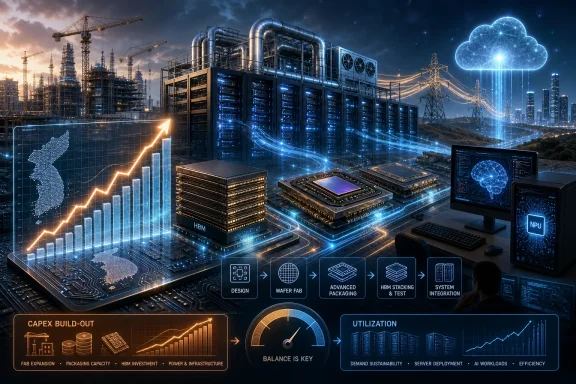 Korea’s Chip Rally Is Really a Referendum on AI Infrastructure
The Korean market has become one of the cleanest public gauges of the AI hardware cycle because Samsung Electronics and SK hynix sit close to the pressure point. Nvidia may dominate the public imagination of AI accelerators, but high-bandwidth memory, advanced DRAM, packaging capacity, and leading-edge supply discipline are what decide how many real systems can be shipped, powered, and monetized. If Wall Street talks about GPUs, Seoul talks about the memory stack that lets those GPUs behave like data-center products rather than expensive silicon trophies.That is why the ChosunBiz survey matters beyond the KOSPI. The eight research chiefs surveyed by the outlet — from KB, Shinyoung, Mirae Asset, Daishin, Samsung, Kiwoom, Meritz, and Hana — are effectively being asked whether the AI server cycle has already entered its digestion phase. Their answer is cautiously bullish: the recent correction looks more like profit-taking and crowded positioning than a fundamental break in demand.
The distinction matters because markets often collapse different risks into the same red number on a screen. A stock can fall because earnings are deteriorating, because investors were overleveraged, because a trade became too crowded, or because a macro scare arrived at the wrong time. ChosunBiz quotes Hana Securities’ Hwang Seung-taek arguing that the recent semiconductor pullback reflects profit-taking, reduced crowding, and leveraged-product flows more than damage to fundamentals.
That is a technical-market explanation, but it has practical implications. If the selloff is merely positioning, then enterprise buyers should not expect sudden relief in memory pricing, HBM availability, or AI server lead times. If the selloff is the first sign of a demand break, then every vendor promising a smooth AI PC and AI server ramp has a harder story to tell.
The Hyperscaler CAPEX Line Is the Only Chart That Matters
ChosunBiz’s analysts repeatedly return to one variable: hyperscaler capital expenditure. That is the right focus. AI optimism has many narratives — productivity, search replacement, coding automation, enterprise copilots, robotics, sovereign AI — but the semiconductor earnings cycle is driven by purchase orders, and those purchase orders flow from the infrastructure budgets of Microsoft, Amazon, Google, Meta, Oracle, and their peers.For Windows users and administrators, this may sound remote until you trace the chain. Microsoft’s ability to put Copilot features into Windows, Microsoft 365, GitHub, Security Copilot, Azure, and Windows management tooling depends on available compute. Azure’s ability to rent AI capacity depends on servers. Those servers depend on accelerators, memory, networking, storage, power, and cooling. Korean memory suppliers are not an optional sidebar in that chain; they are part of the reason the AI cloud either scales or bottlenecks.
ChosunBiz quotes Shinyoung Securities’ Kim Hak-kyun saying the most important things to watch are hyperscaler earnings releases and capital-spending plans. That is more useful than watching every AI startup headline. The AI economy may be noisy at the application layer, but the infrastructure layer reveals conviction in dollars, fabs, wafers, substrates, racks, and power contracts.
This is also where the skeptics have their best argument. If hyperscalers are spending ahead of proven revenue, then the hardware cycle may be vulnerable to even small changes in executive confidence. A cloud company does not need to abandon AI for suppliers to feel pain; it merely needs to slow the growth rate of orders, stretch delivery schedules, or prioritize utilization over expansion.
But the ChosunBiz piece argues that the market has not yet seen that turn. Meta’s reported move to lease idle AI computing resources, for example, can be read two ways. Bears see underused infrastructure. Kim at Shinyoung sees a change in how data centers are used, not proof that Meta will stop buying AI semiconductors. Both readings can be true in part: better utilization may coexist with continued buying if demand is uneven across customers, regions, model types, and deployment windows.
“Idle Compute” Is Not the Same Thing as a Dead Cycle
The phrase idle AI computing has become a useful Rorschach test. To skeptics, it suggests the industry built too much capacity before customers knew what to do with it. To bulls, it suggests an emerging wholesale market in AI infrastructure, where companies with massive clusters become both users and sellers of compute.The difference is not semantic. In traditional cloud computing, excess capacity is not automatically a sign of failed demand; it is part of how cloud operators smooth utilization, support peak workloads, and monetize sunk investments. AI infrastructure may follow a similar path, particularly as training, fine-tuning, inference, synthetic data generation, and enterprise batch workloads run on different schedules.
That does not mean every GPU cluster will produce attractive returns. The AI boom has already created a strange mismatch: end users ask whether Copilot features justify their subscriptions, while vendors ask whether they can obtain enough compute to serve future demand. Somewhere between those two questions sits the possibility that the industry is simultaneously supply-constrained in premium configurations and overbuilt in less desirable ones.
This is where memory suppliers occupy a more defensible position than many application-layer AI companies. Whether the winning model is a frontier lab, an enterprise deployment, a sovereign AI cluster, or a cloud API, the system still needs high-performance memory. HBM is not immune to cycles, but it is closer to the physical bottleneck than a chatbot wrapper or a speculative AI workflow startup.
The ChosunBiz survey captures that confidence. Daishin Securities’ Yang Ji-hwan describes concerns about the AI CAPEX rally as a “recurring exam question” over the past three years. His argument is that companies which have already spent heavily will continue investing competitively to maximize performance and avoid wasting sunk costs. That is a classic infrastructure-cycle logic: once the arms race begins, stopping can be more expensive than continuing.
The Memory Cycle Has Changed, But It Has Not Been Abolished
There is a danger in calling AI demand “structural” too casually. Semiconductor history is full of investors discovering, repeatedly, that structural demand does not repeal cyclicality. PCs were structural. Smartphones were structural. Cloud was structural. Each still produced inventory corrections, pricing collapses, and painful periods for suppliers that mistimed capacity.ChosunBiz does not ignore this. Kim Hak-kyun cautions that semiconductors remain cyclical and that investors should assess new data on three- and six-month horizons rather than assuming five uninterrupted years of growth. That caveat is the most important line in the piece because it separates a serious bull case from cheerleading.
The current cycle is different from older memory booms because demand is less dependent on consumer replacement behavior. A weak PC cycle can hurt DRAM and NAND. A smartphone slump can hurt mobile memory. But AI clusters create concentrated, high-value demand for specialized memory that is often committed through longer-term supply arrangements. That improves visibility for suppliers, but it also concentrates risk around a smaller number of very large buyers.
In plain English: AI may make the memory cycle stronger, but also narrower. If Microsoft, Amazon, Google, Meta, and a handful of others keep spending, the cycle has legs. If those companies pause, the pain propagates quickly because the same customers anchor the demand assumptions for accelerators, HBM, advanced packaging, power gear, networking, and data-center construction.
That is why Kiwoom Securities’ Lee Jong-hyung, as quoted by ChosunBiz, argues that concentration in semiconductors should not automatically be read as a market risk when semiconductors account for roughly 90 percent of this year’s KOSPI operating-profit growth. He is making a market-structure point: if the earnings are really there, concentration is not inherently irrational. Still, for an index, a supply chain, or an IT budget, concentration always deserves respect.
Windows Is Downstream From the Same Supply Shock
The Windows ecosystem is not separate from this story. It is one of the places where the AI hardware cycle eventually becomes visible to normal buyers. The same infrastructure thesis behind Korean semiconductor optimism underpins Microsoft’s push to make AI a platform feature rather than a web destination.For consumer Windows users, that shows up as AI PCs, NPUs, Copilot integrations, Recall-style local context features, and heavier expectations for memory and storage. For enterprise administrators, it shows up as Microsoft 365 Copilot licensing decisions, Azure AI consumption, endpoint refresh planning, security automation, and governance headaches around where inference runs. For developers, it shows up as coding assistants, local model experimentation, GPU workstation demand, and cloud bills that can grow faster than user adoption.
If AI infrastructure spending keeps rising, Microsoft and its OEM partners will continue to have incentives to normalize AI-capable hardware as the default Windows baseline. That does not mean every PC needs workstation-class silicon, but it does mean the definition of an acceptable business laptop keeps creeping upward. Memory capacity, local inference support, and battery-efficient acceleration become procurement features rather than enthusiast luxuries.
If AI CAPEX slows sharply, the story changes. Vendors would still ship AI branding, but cloud-side feature rollouts could become more rationed, enterprise pricing could harden, and some promised capabilities might arrive more slowly or with stricter eligibility. The AI PC would not disappear, but the pressure to prove local value would increase because unlimited cloud inference would no longer be an assumption hiding behind the product demo.
The KOSPI’s Narrow Rally Mirrors the Enterprise AI Bet
One uncomfortable implication of the ChosunBiz survey is that the KOSPI rally appears highly dependent on semiconductors. That makes Korea a useful mirror for enterprise AI adoption. In both cases, the headline optimism rests on a narrow but powerful engine.For Korea’s stock market, that engine is earnings growth from semiconductor leaders and their supply chain. For enterprise IT, it is the belief that AI will justify a new round of spending on cloud services, endpoints, developer tools, security platforms, and data infrastructure. Both bets may be rational, but neither is diversified in the way its marketing sometimes suggests.
The Windows enterprise stack is especially exposed to this dynamic because Microsoft is trying to attach AI value to nearly every layer of its portfolio. Windows becomes an AI endpoint. Microsoft 365 becomes an AI workspace. Azure becomes the AI factory floor. Defender and Sentinel become AI-assisted security platforms. GitHub becomes an AI development environment. The result is coherent as strategy, but it depends on the same macro assumption: customers will keep paying for AI capacity because the productivity gains will eventually show up.
That is still being tested. Many organizations are in the awkward middle stage where pilots are impressive, broad deployments are messy, governance is incomplete, and cost attribution is politically sensitive. This is not a refutation of AI. It is how enterprise platforms usually become real. The problem is that the infrastructure build-out is happening at data-center speed while organizational adoption happens at committee speed.
Markets hate that mismatch. They want proof that demand will arrive on schedule. Administrators know better: the deployment curve for any new platform is jagged, full of compliance reviews, training gaps, integration delays, and budget fights.
Rate Anxiety Is the One Macro Variable That Can Still Bite
ChosunBiz’s analysts identify U.S. interest rates and inflation as risks, and that deserves more weight than a passing mention. AI infrastructure is capital-intensive in the old-fashioned sense. It requires land, buildings, grid connections, cooling systems, networking, accelerators, memory, storage, and long depreciation schedules. The more expensive capital becomes, the harder it is to justify speculative overbuild.KB Securities’ Kim Dong-Won, according to ChosunBiz, warned that prolonged rate hikes could reduce AI investment. Mirae Asset’s Park Yeon-joo also pointed to inflation and interest rates as risk factors. Their caveat is straightforward: even if AI demand is strategically important, financing conditions affect how quickly companies can execute enormous CAPEX plans.
There is a second-order effect for enterprises. If higher rates pressure hyperscalers, they may become less willing to absorb AI infrastructure costs in pursuit of market share. That could mean higher prices, more disciplined quotas, less generous bundling, or slower regional expansion. The user may experience this not as a macro event but as a licensing conversation.
Still, the analysts’ base case is that rates alone will not stop AI investment. Kim argues the supply shortage could persist through 2028, while Park says AI investment is essential enough that macro variables may matter less over time. That is a strong claim, but it reflects the strategic psychology of the moment: no major platform company wants to be remembered as the one that underinvested during the formation of the AI stack.
The risk is not that AI suddenly becomes unimportant. The risk is that the market has priced in a perfect handoff from infrastructure build-out to profitable utilization. If that handoff takes longer than expected, suppliers can still be fundamentally important and temporarily overvalued.
HBM Turns Memory From Commodity Into Strategic Ammunition
High-bandwidth memory is the star of this cycle because AI workloads are brutally constrained by data movement. Accelerators need to feed enormous amounts of data quickly, and HBM does that by stacking memory close to compute through advanced packaging. It is expensive, technically demanding, and difficult to expand overnight.That is why SK hynix and Samsung loom so large in the story. SK hynix has been widely viewed as a leader in HBM supply, while Samsung has been working to strengthen its position in newer HBM generations and advanced packaging. ChosunBiz’s broader coverage this year has repeatedly framed the Korean chip race around HBM capacity, qualification, and AI memory demand.
For WindowsForum readers, HBM may seem like data-center exotica, because it is not the DDR5 in a desktop build or the LPDDR in a thin-and-light laptop. But the economics of premium memory can spill across the broader market. When suppliers allocate wafers, engineering attention, and packaging capacity toward AI memory, conventional DRAM and other components can tighten. That can affect server pricing, workstation configurations, OEM margins, and eventually the value proposition of memory-heavy local AI workloads.
There is also a geopolitical angle. AI infrastructure is increasingly treated as national capability, not merely commercial capacity. South Korea’s memory giants therefore occupy a position similar to Taiwan’s foundry ecosystem: they are corporate actors, but also strategic infrastructure for allies, cloud platforms, and AI developers. When Korean analysts debate whether the AI CAPEX boom is intact, they are also debating the durability of a national industrial advantage.
The bull case is that long-term supply contracts and structurally higher AI memory content reduce the boom-bust violence of old memory cycles. The bear case is that suppliers are still suppliers: if customers digest inventory, delay deployments, or shift architectures, pricing power can evaporate faster than executives expect.
The AI PC Story Needs the Data Center More Than Vendors Admit
The AI PC has been marketed as a local computing story, but it remains deeply tied to cloud AI economics. NPUs make sense for latency, privacy, battery life, and cost control, yet many of the most compelling assistant experiences still depend on cloud-scale models, enterprise data integration, and constant service updates. The endpoint is becoming smarter, but it is not replacing the data center.That matters because the health of AI CAPEX shapes the software roadmap. If hyperscalers keep investing, vendors can keep blending local and cloud inference in ways that feel seamless to users. If capacity becomes constrained or more expensive, vendors will have stronger incentives to push smaller models locally, restrict premium features, or segment AI capabilities more aggressively by subscription tier.
Windows is a natural battleground for this hybrid model. Microsoft wants the operating system to know more, anticipate more, summarize more, and act more. Some of that can happen locally, especially as NPUs improve. But enterprise-grade reasoning over documents, mail, meetings, code, identity, security telemetry, and business systems remains a cloud-and-graph problem.
The semiconductor rally therefore contains a hidden software assumption. Investors are not only betting that SK hynix and Samsung can sell more memory. They are betting that Microsoft and its peers can turn that infrastructure into sticky services that customers keep using after the novelty fades. The hardware cycle buys time; the software cycle has to justify it.
The Market Is Right to Be Nervous, Even If the Bulls Are Right
The ChosunBiz analysts are persuasive when they say a few negative headlines do not prove the AI cycle has peaked. OpenAI’s reported IPO timing, Apple pricing speculation, or Meta’s compute-leasing plans are not enough to overturn the CAPEX story. Markets often overreact to symbols because symbols are easier to trade than depreciation schedules.But nervousness is still rational. AI infrastructure is being built before the industry has fully settled the revenue model. Consumer AI is popular but not always profitable. Enterprise AI is promising but administratively slow. Developer AI is sticky but competitive. Search AI is strategically necessary but margin-challenging. Cloud AI is in demand, but customers are learning to watch token costs and model selection with the same suspicion they once reserved for surprise storage fees.
This is the uncomfortable middle of a platform transition. The old world knows AI is important. The new world has not yet produced stable unit economics everywhere. Hardware suppliers benefit early because everyone needs capacity to experiment, compete, and avoid falling behind. The question is whether the second wave of demand is driven by proven returns rather than fear.
Korean semiconductor stocks are therefore less a pure AI enthusiasm trade than a deadline trade. Hyperscalers will soon report earnings and update CAPEX guidance. If they reaffirm spending, the analysts surveyed by ChosunBiz will look prescient. If they hedge, the market will immediately revisit whether the AI memory cycle is merely early or already extended.
Seoul’s Signal for Redmond, OEMs, and IT Buyers
The practical lesson is not to treat Korean semiconductor sentiment as a distant financial story. It is one of the earliest signals for the cost and availability assumptions behind the next two years of Windows computing. AI features do not float above the supply chain; they are constrained by it.For IT departments, that means procurement strategy should avoid both panic and complacency. Buying every AI-branded device immediately is as foolish as assuming current hardware baselines will remain comfortable through 2028. The better approach is to map workloads, identify where local acceleration matters, and avoid locking into configurations that will age poorly as Windows and Microsoft 365 features become more AI-dependent.
For enthusiasts and workstation buyers, the signal is similar. Memory capacity and bandwidth are becoming more important, not less. Local models, developer tools, content creation, and AI-assisted workflows reward systems with headroom. The old habit of treating RAM as the easiest place to save money is aging badly.
For Microsoft, the stakes are sharper. The company’s AI strategy depends on making intelligence feel ambient without making cost feel punitive. That requires both cloud scale and endpoint capability. If the semiconductor cycle remains strong, Microsoft gets room to push. If it wobbles, the company will have to be more disciplined about which AI experiences are genuinely useful and which are demos looking for a budget line.
The Useful Reading of This Rally Is Neither Euphoria Nor Doom
The ChosunBiz survey points to a market that has not lost faith in AI semiconductors, but it also reveals the exact conditions under which that faith could weaken. The story is not that AI demand is guaranteed. It is that the evidence of a true turn has not yet arrived.- The Korean semiconductor pullback described by ChosunBiz appears to be driven more by positioning, profit-taking, and concern about crowded trades than by confirmed deterioration in chip fundamentals.
- Hyperscaler CAPEX guidance remains the decisive near-term indicator for AI memory demand, because cloud and platform companies are the buyers setting the pace.
- Meta’s reported interest in leasing idle AI compute can be read as utilization optimization rather than proof that AI hardware demand has collapsed.
- Semiconductors remain cyclical even when AI demand is structural, so three- and six-month data points matter more than heroic five-year assumptions.
- Windows users and IT departments should treat the AI chip cycle as a practical signal for future device requirements, cloud AI pricing, and enterprise deployment timelines.
- Interest rates and inflation remain credible risks because the AI build-out is capital-intensive, even if major platform companies still view the spending as strategically necessary.
References
- Primary source: Chosunbiz
Published: 2026-07-07T21:10:16.007593
Korea heads say semiconductor-led KOSPI rally holds as AI CAPEX drives gains - CHOSUNBIZ
Korea heads say semiconductor-led KOSPI rally holds as AI CAPEX drives gains Research chiefs play down AI slowdown fears, saying hyperscalers spendingbiz.chosun.com - Related coverage: tomshardware.com
SK hynix to invest $712.5 billion in South Korean operations — Cheongju NAND expansion, Yongin Semiconductor Cluster for DRAM detailed | Tom's Hardware
Over the next decades.www.tomshardware.com - Related coverage: presenc.ai
Hyperscaler AI Capex Map 2026 | Presenc AI
2026 hyperscaler AI capex: Microsoft, Google, Amazon, Meta committed $300B+ combined for AI infrastructure. The flow to NVIDIA, AMD, TSMC, and utilities...presenc.ai - Related coverage: finconsult.co.kr
Samsung Electronics vs. SK hynix: AI Factory Investment, HBM Capacity and the Next Semiconductor CapEx Cycle - Finconsult Insights
An in-depth comparison of Samsung Electronics and SK hynix investment strategies for AI semiconductors, HBM, advanced packaging and AI factories.www.finconsult.co.kr - Related coverage: siliconanalysts.com
SK Hynix and Samsung: HBM4 Readiness, 1c DRAM Scaling, and What the 2026 Capacity Race Really Means | Silicon Analysts
SK Hynix is targeting an ~8x ramp in 1c DRAM production while Samsung pursues a ~50% HBM capacity expansion — two very different bets on where AI memory demand goes next. We break down the qualification timelines, capex logic, and supply implications.siliconanalysts.com
- Related coverage: cbiz.chosun.com
- Related coverage: inverseone.com