

Samsung Electronics said on July 7, 2026, that it expects second-quarter operating profit of about 89.4 trillion won on consolidated sales of about 171 trillion won, a record preliminary result driven overwhelmingly by AI-related memory demand. The number is so large that it briefly makes the rest of the technology industry look like it is operating on a different scale. But the real story is not that Samsung had a good quarter. It is that the AI buildout has turned memory — usually the most cyclical and brutal corner of the chip business — into the toll road for the modern computing economy.
As reported by Chosun Ilbo and echoed in Samsung’s own earnings guidance, the company’s profit now sits in the same conversation as the largest quarterly hauls ever posted by Apple, Nvidia, and the oil majors. Tekedia, citing analyst expectations before the guidance landed, framed the moment as an AI windfall that rewrites chip economics. That framing is right, but it needs a caveat: this is not merely a Samsung victory lap. It is a warning that the cost structure of everything from AI servers to Windows laptops may be changing underneath users’ feet.
The conventional version of the Samsung story is easy to tell. AI data centers need high-bandwidth memory, server DRAM, and fast storage. Samsung makes those things at enormous scale. Prices rise, margins expand, and a company that suffered through the last memory downturn suddenly produces one of the most profitable quarters in corporate history.
That version is true, but too tidy. Memory has always been a boom-and-bust business because suppliers tend to overbuild in good times and flood the market just as demand cools. What makes this cycle different is that the buyer is no longer just the smartphone or PC customer refreshing on a predictable consumer cadence. The buyer is the hyperscaler, the cloud AI platform, the GPU cluster operator, and the enterprise trying to make inference cheap enough to deploy everywhere.
Chosun Ilbo reported that Samsung’s Device Solutions business, which includes memory semiconductors, is estimated by securities-industry sources to have generated operating profit in the 90 trillion won range by itself. If that estimate holds when Samsung publishes full divisional results, it would mean the rest of the company was not merely secondary to the chip business; it was financially submerged by it. Samsung Electronics, the conglomerate that consumers know through Galaxy phones, OLED televisions, appliances, and SSDs, has temporarily become a memory-pricing machine with consumer electronics attached.
The operating margin figure is the shocker. Chosun Ilbo reported a preliminary operating margin of 52 percent for the company overall. That would be extraordinary for almost any hardware company, and it is especially striking for Samsung, which usually blends high-margin semiconductor operations with lower-margin phones, televisions, appliances, displays, and component businesses. In other words, AI did not simply improve Samsung’s profits. It overwhelmed the normal arithmetic of Samsung Electronics.
High-bandwidth memory gets the attention because it sits physically close to AI accelerators and determines how effectively those accelerators can be fed. But the broader memory market is being pulled upward by a more diffuse force. AI inference, retrieval-augmented generation, vector search, synthetic data pipelines, and agentic workflows all consume conventional DRAM and storage in ways that are less glamorous than HBM and no less consequential.
Tekedia’s analysis points to this second-order effect: as AI shifts from training runs to persistent deployment, memory demand expands beyond the specialized accelerator stack. A chatbot answering a single prompt is one workload. An agent that searches files, calls tools, reads business databases, maintains context, generates code, and then validates its own output is another. The latter does not just require more GPU time; it requires larger memory pools, faster storage, and more resilient server infrastructure.
That matters for Windows users and administrators because Microsoft’s AI strategy depends on exactly this stack. Copilot in Windows, Microsoft 365 Copilot, Azure AI services, local AI features on Copilot+ PCs, developer assistants, security copilots, and enterprise automation all assume that memory and storage will be abundant enough to make AI feel ambient. Samsung’s quarter suggests the opposite tension: demand is so strong that abundance is being rationed through price.
The AI cycle is different in scale, but not immune to physics or finance. Samsung and SK Hynix can add capacity, Micron can chase margins, and equipment suppliers can feed the expansion. The question is not whether more bits will be produced. The question is whether AI demand will grow fast enough, and profitably enough, to absorb the new capacity without triggering the familiar memory hangover.
Chosun Ilbo noted that some securities-industry sources expect Samsung’s operating profit to surge this year and continue rising into 2027, with cumulative operating profit over two years approaching 1,000 trillion won. That is the kind of forecast that tends to appear near the top of a cycle, not because it is necessarily wrong, but because linear extrapolation is most seductive when every data point points upward. The danger for Samsung is not that AI demand vanishes. The danger is that supply arrives just as cloud customers become more disciplined.
Tekedia flagged the same tension through the lens of hyperscaler capital expenditure. If cloud providers are allocating an ever-larger share of spending to AI memory and AI infrastructure, investors will eventually ask whether the services built on top of that infrastructure generate enough revenue to justify the buildout. The AI industry can tolerate astonishing infrastructure spending while growth narratives are intact. It becomes less forgiving when customers ask whether the monthly bill for inference produces measurable productivity.
That scale also gives Samsung a broader product portfolio than some rivals. SK Hynix has been widely viewed as the early HBM leader in the Nvidia era, while Samsung has had to fight for position in the most coveted slices of the AI accelerator supply chain. But when the boom spreads from HBM into server DRAM, NAND, SSDs, and enterprise storage, Samsung’s breadth becomes more valuable. The company does not need to win every HBM socket to profit from the AI data-center wave.
Yet scale cuts both ways. Memory fabs are not software subscriptions; they are massive, expensive, long-lived commitments. If Samsung and its peers overbuild, the same production base that produces windfall profits during shortages can produce brutal losses during oversupply. That is why this quarter should be read less as proof that Samsung has escaped cyclicality and more as proof that the cycle’s amplitude has become enormous.
The industry’s current confidence rests on the assumption that AI will keep soaking up capacity. That assumption may prove correct. But the more capacity is justified by AI forecasts rather than confirmed AI revenue, the more the memory industry starts to resemble a leveraged bet on the business model of generative AI itself.
The Galaxy business has always depended on Samsung’s vertical integration story. The company designs phones, makes displays, supplies memory, builds storage, and can coordinate across the stack in ways few rivals can match. In normal times, that is an advantage. In this market, internal supply does not magically erase opportunity cost. A DRAM chip used in a phone is a DRAM chip not sold into a ravenous server market at extraordinary margins.
That is the AI tax on consumer hardware. Even if Samsung can source internally, the market value of memory has risen. Handset margins must either absorb that increase or pass it on to customers. Tekedia reported that analysts see pressure on Samsung’s mobile division from higher semiconductor costs, potentially requiring more device price increases if memory prices continue climbing.
Windows PC makers face the same issue. Laptops, desktops, workstations, gaming rigs, and small-business PCs all depend on DRAM and NAND pricing. The AI data center may be the premium buyer, but the consumer and enterprise PC channels still need modules, SSDs, and supply predictability. If memory suppliers prioritize high-margin server demand, the downstream PC market gets the leftovers at a higher price.
The PC market is entering this squeeze at an awkward moment. Microsoft and its partners are trying to sell users on AI-capable PCs, neural processing units, local models, recall-style indexing, on-device image generation, and more persistent background intelligence. Those features work better with more memory and faster storage. But the global economics of AI are pushing memory prices in the wrong direction for affordable upgrades.
The result may be a bifurcated Windows hardware market. Premium Copilot+ PCs and creator workstations may absorb higher memory costs because buyers already expect elevated prices. Mainstream laptops may instead see vendors hold price points by trimming RAM, reducing SSD capacity, soldering memory more aggressively, or making the better configuration tiers disproportionately expensive. Anyone who remembers the long era of 8GB Windows laptops knows how this movie plays.
There is also a server-side implication for Windows shops. Organizations running Hyper-V clusters, SQL Server workloads, VDI, Azure Stack HCI, local AI pilots, or private inference systems are all exposed to memory pricing. Even companies that do not think of themselves as AI buyers may be competing indirectly with AI buyers for the same DRAM supply. Procurement teams will notice this before end users do.
That tension is not unique to Samsung. Every diversified technology company eventually confronts the politics of uneven success. Cloud subsidizes devices. Ads subsidize moonshots. Enterprise software subsidizes consumer experiments. At Samsung, the division between memory and devices is especially sharp because the units are economically connected: the winning business is raising input costs for the struggling one.
Tekedia noted that Samsung had reached a wage agreement with semiconductor workers and that analyst attention has turned to how bonus provisions may affect reported profit. That may sound like accounting detail, but it is also a labor-market signal. Semiconductor engineers, fab workers, and memory specialists know they are sitting at the center of the AI boom. Companies that want to retain them will have to share more of the upside.
For investors, bonuses can look like margin leakage. For workers, they look like recognition that the record quarter did not materialize from abstract “AI demand” alone. For the broader industry, they are one more reminder that the AI infrastructure race is constrained not only by wafers, tools, electricity, and water, but by human expertise concentrated in a few companies and regions.
That does not mean Samsung has become the new Nvidia. Nvidia controls a software ecosystem, accelerator roadmap, networking stack, and developer platform that give it pricing power far beyond a commodity supplier. Samsung’s power is different. It is capacity power, materials power, and timing power. In a shortage, those can be just as lucrative.
The distinction matters because software-like margins in hardware usually attract skepticism. Nvidia’s margins are defended by CUDA, platform lock-in, and the difficulty of matching its full-stack offering. Samsung’s margins are defended by scarcity. Scarcity can last a long time, especially when demand is exploding and supply takes years to build. But scarcity is not the same as a moat.
Still, dismissing memory as “commodity” in this environment misses the point. A commodity that every AI system needs, that only a few companies can supply at scale, and that customers must secure years in advance is not behaving like a commodity. It is behaving like strategic infrastructure.
South Korea’s role is now even more central. Samsung and SK Hynix together occupy a commanding position in global memory supply, while Micron remains the major U.S. counterweight. Taiwan’s TSMC may define leading-edge foundry manufacturing, but the AI system is not built on logic alone. If memory supply is constrained, the entire AI stack slows down.
For enterprise buyers, this means supply-chain risk is no longer limited to GPUs. A data-center plan can be derailed by HBM availability, server DRAM pricing, SSD supply, power delivery, cooling equipment, or advanced packaging bottlenecks. IT planning that treats AI infrastructure as a normal server refresh with a different accelerator card is already outdated.
For policymakers, Samsung’s profit is a signal that memory capacity deserves the same strategic scrutiny as foundry capacity. A country can subsidize AI research, build sovereign cloud projects, and encourage domestic model development. But without reliable access to memory, those ambitions depend on the same handful of suppliers everyone else is chasing.
That distortion creates winners and losers inside the same company. Samsung’s chip division benefits when DRAM and NAND prices rise. Samsung’s phone division suffers. A cloud provider may secure enough memory to expand AI services, then raise prices on customers to protect margins. A Windows laptop buyer may pay more for 32GB of RAM because an AI cluster somewhere consumed the supply curve.
This is what a platform shift looks like before it becomes tidy. The early internet distorted telecom markets. Smartphones distorted display, sensor, battery, and flash markets. Cloud computing distorted server, storage, and networking markets. AI is now distorting memory, power, cooling, and land markets. Samsung’s profit is simply the cleanest number attached to the mess.
The question for the next year is whether this distortion stabilizes into a new equilibrium or snaps back. If AI services generate enough revenue, memory suppliers may enjoy a structurally richer market than they had in the PC-and-smartphone era. If AI spending gets ahead of monetization, the memory industry may discover that it built capacity for a demand curve that was real but not infinite.
If Samsung were firing on all cylinders, this quarter would look even more formidable. Memory would be booming, foundry would be taking high-end AI accelerator orders, System LSI would be designing must-have components, and Galaxy devices would be using AI features to defend margins. Instead, the picture appears lopsided. Samsung is winning enormously where the market is tightest and still struggling where execution and ecosystem position matter most.
That lopsidedness is not fatal. In fact, it may be the normal shape of a conglomerate during a platform transition. But it does mean Samsung’s record profit should not be mistaken for proof that every Samsung strategy is working. The company has a spectacular memory cycle, not a universal solution to its competitive problems.
The risk is complacency. When one division produces historic cash flow, management can be tempted to let the cash obscure weaker businesses. The better use of this windfall is to invest through the cycle: advanced packaging, foundry competitiveness, HBM leadership, software-defined memory systems, enterprise SSD reliability, and device strategies that do not collapse when component costs rise.
But eventually, AI infrastructure has to become less of a land grab and more of a business. Microsoft, Google, Amazon, Meta, OpenAI partners, enterprise software vendors, and device makers all need usage and revenue to catch up with investment. If that happens, Samsung’s record quarter may be remembered as an early marker of a durable computing shift. If it does not, it may be remembered as the peak of an unusually violent memory cycle.
For Windows users, this business-model question will arrive disguised as product decisions. Will Copilot features remain bundled, or become more aggressively monetized? Will local AI requirements push mainstream PCs to 16GB, 24GB, or 32GB as the practical floor? Will enterprises pay for AI add-ons broadly, or restrict them to selected roles? Will cloud AI costs fall fast enough to make always-on assistants economically sane?
Memory pricing sits underneath all of those questions. The software may be branded as intelligence, but it runs on hardware. If the hardware supply chain is expensive, the intelligence will not be free.
As reported by Chosun Ilbo and echoed in Samsung’s own earnings guidance, the company’s profit now sits in the same conversation as the largest quarterly hauls ever posted by Apple, Nvidia, and the oil majors. Tekedia, citing analyst expectations before the guidance landed, framed the moment as an AI windfall that rewrites chip economics. That framing is right, but it needs a caveat: this is not merely a Samsung victory lap. It is a warning that the cost structure of everything from AI servers to Windows laptops may be changing underneath users’ feet.
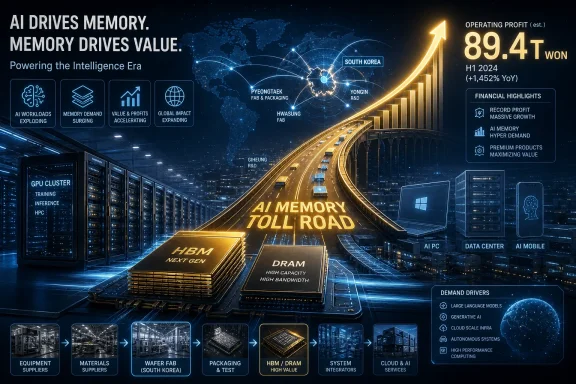 Samsung Did Not Just Beat Expectations; It Repriced the Memory Business
The conventional version of the Samsung story is easy to tell. AI data centers need high-bandwidth memory, server DRAM, and fast storage. Samsung makes those things at enormous scale. Prices rise, margins expand, and a company that suffered through the last memory downturn suddenly produces one of the most profitable quarters in corporate history.That version is true, but too tidy. Memory has always been a boom-and-bust business because suppliers tend to overbuild in good times and flood the market just as demand cools. What makes this cycle different is that the buyer is no longer just the smartphone or PC customer refreshing on a predictable consumer cadence. The buyer is the hyperscaler, the cloud AI platform, the GPU cluster operator, and the enterprise trying to make inference cheap enough to deploy everywhere.
Chosun Ilbo reported that Samsung’s Device Solutions business, which includes memory semiconductors, is estimated by securities-industry sources to have generated operating profit in the 90 trillion won range by itself. If that estimate holds when Samsung publishes full divisional results, it would mean the rest of the company was not merely secondary to the chip business; it was financially submerged by it. Samsung Electronics, the conglomerate that consumers know through Galaxy phones, OLED televisions, appliances, and SSDs, has temporarily become a memory-pricing machine with consumer electronics attached.
The operating margin figure is the shocker. Chosun Ilbo reported a preliminary operating margin of 52 percent for the company overall. That would be extraordinary for almost any hardware company, and it is especially striking for Samsung, which usually blends high-margin semiconductor operations with lower-margin phones, televisions, appliances, displays, and component businesses. In other words, AI did not simply improve Samsung’s profits. It overwhelmed the normal arithmetic of Samsung Electronics.
AI Has Moved the Bottleneck From Compute to Everything Around Compute
For the last three years, the AI infrastructure conversation has revolved around GPUs. Nvidia became the emblem of the boom because its accelerators were the scarce, expensive, and indispensable part of training frontier models. But the Samsung quarter is a reminder that accelerators are only the most visible part of the system. A modern AI server is a memory system with compute attached as much as it is a compute system with memory attached.High-bandwidth memory gets the attention because it sits physically close to AI accelerators and determines how effectively those accelerators can be fed. But the broader memory market is being pulled upward by a more diffuse force. AI inference, retrieval-augmented generation, vector search, synthetic data pipelines, and agentic workflows all consume conventional DRAM and storage in ways that are less glamorous than HBM and no less consequential.
Tekedia’s analysis points to this second-order effect: as AI shifts from training runs to persistent deployment, memory demand expands beyond the specialized accelerator stack. A chatbot answering a single prompt is one workload. An agent that searches files, calls tools, reads business databases, maintains context, generates code, and then validates its own output is another. The latter does not just require more GPU time; it requires larger memory pools, faster storage, and more resilient server infrastructure.
That matters for Windows users and administrators because Microsoft’s AI strategy depends on exactly this stack. Copilot in Windows, Microsoft 365 Copilot, Azure AI services, local AI features on Copilot+ PCs, developer assistants, security copilots, and enterprise automation all assume that memory and storage will be abundant enough to make AI feel ambient. Samsung’s quarter suggests the opposite tension: demand is so strong that abundance is being rationed through price.
The Old Semiconductor Cycle Is Still There, But It Has a New Customer
It is tempting to declare the memory cycle dead every time a boom looks structural. The industry has heard this before. PCs were supposed to make DRAM permanently valuable. Smartphones were supposed to smooth the cycle. Cloud computing was supposed to absorb every wafer. Each time, capital spending caught up, inventories rose, and pricing power eventually cracked.The AI cycle is different in scale, but not immune to physics or finance. Samsung and SK Hynix can add capacity, Micron can chase margins, and equipment suppliers can feed the expansion. The question is not whether more bits will be produced. The question is whether AI demand will grow fast enough, and profitably enough, to absorb the new capacity without triggering the familiar memory hangover.
Chosun Ilbo noted that some securities-industry sources expect Samsung’s operating profit to surge this year and continue rising into 2027, with cumulative operating profit over two years approaching 1,000 trillion won. That is the kind of forecast that tends to appear near the top of a cycle, not because it is necessarily wrong, but because linear extrapolation is most seductive when every data point points upward. The danger for Samsung is not that AI demand vanishes. The danger is that supply arrives just as cloud customers become more disciplined.
Tekedia flagged the same tension through the lens of hyperscaler capital expenditure. If cloud providers are allocating an ever-larger share of spending to AI memory and AI infrastructure, investors will eventually ask whether the services built on top of that infrastructure generate enough revenue to justify the buildout. The AI industry can tolerate astonishing infrastructure spending while growth narratives are intact. It becomes less forgiving when customers ask whether the monthly bill for inference produces measurable productivity.
Samsung’s Scale Is an Advantage Until It Becomes a Commitment
Samsung’s advantage in this moment is brutally simple: it can make a lot of memory. Chosun Ilbo reported that Samsung’s monthly DRAM wafer production capacity is estimated at 650,000 to 700,000 wafers, ahead of SK Hynix and more than double Micron’s output. In a shortage, that scale converts directly into leverage. Customers who need guaranteed supply do not negotiate with Samsung as if it were a commodity vendor; they negotiate with it as one of the few companies that can keep an AI roadmap alive.That scale also gives Samsung a broader product portfolio than some rivals. SK Hynix has been widely viewed as the early HBM leader in the Nvidia era, while Samsung has had to fight for position in the most coveted slices of the AI accelerator supply chain. But when the boom spreads from HBM into server DRAM, NAND, SSDs, and enterprise storage, Samsung’s breadth becomes more valuable. The company does not need to win every HBM socket to profit from the AI data-center wave.
Yet scale cuts both ways. Memory fabs are not software subscriptions; they are massive, expensive, long-lived commitments. If Samsung and its peers overbuild, the same production base that produces windfall profits during shortages can produce brutal losses during oversupply. That is why this quarter should be read less as proof that Samsung has escaped cyclicality and more as proof that the cycle’s amplitude has become enormous.
The industry’s current confidence rests on the assumption that AI will keep soaking up capacity. That assumption may prove correct. But the more capacity is justified by AI forecasts rather than confirmed AI revenue, the more the memory industry starts to resemble a leveraged bet on the business model of generative AI itself.
The Smartphone Business Is Now Paying the AI Tax
Samsung’s awkward internal contradiction is that the same memory prices enriching its semiconductor division are squeezing its device businesses. Chosun Ilbo reported that Samsung’s smartphone business is expected to post its first-ever quarterly loss, with the DX division under pressure from rising component costs and weak demand in televisions and home appliances. If confirmed in full earnings, that would be a symbolic reversal for one of the world’s dominant handset makers.The Galaxy business has always depended on Samsung’s vertical integration story. The company designs phones, makes displays, supplies memory, builds storage, and can coordinate across the stack in ways few rivals can match. In normal times, that is an advantage. In this market, internal supply does not magically erase opportunity cost. A DRAM chip used in a phone is a DRAM chip not sold into a ravenous server market at extraordinary margins.
That is the AI tax on consumer hardware. Even if Samsung can source internally, the market value of memory has risen. Handset margins must either absorb that increase or pass it on to customers. Tekedia reported that analysts see pressure on Samsung’s mobile division from higher semiconductor costs, potentially requiring more device price increases if memory prices continue climbing.
Windows PC makers face the same issue. Laptops, desktops, workstations, gaming rigs, and small-business PCs all depend on DRAM and NAND pricing. The AI data center may be the premium buyer, but the consumer and enterprise PC channels still need modules, SSDs, and supply predictability. If memory suppliers prioritize high-margin server demand, the downstream PC market gets the leftovers at a higher price.
Windows PCs Will Feel the Shock Through RAM, SSDs, and AI Branding
For WindowsForum readers, the Samsung news is not a distant Korean corporate earnings story. It is a leading indicator for the parts bin. When DRAM and NAND prices rise sharply, the effect eventually shows up in laptop configurations, SSD street prices, workstation quotes, and the eternal OEM game of shipping base models with barely enough memory to survive the next Windows feature update.The PC market is entering this squeeze at an awkward moment. Microsoft and its partners are trying to sell users on AI-capable PCs, neural processing units, local models, recall-style indexing, on-device image generation, and more persistent background intelligence. Those features work better with more memory and faster storage. But the global economics of AI are pushing memory prices in the wrong direction for affordable upgrades.
The result may be a bifurcated Windows hardware market. Premium Copilot+ PCs and creator workstations may absorb higher memory costs because buyers already expect elevated prices. Mainstream laptops may instead see vendors hold price points by trimming RAM, reducing SSD capacity, soldering memory more aggressively, or making the better configuration tiers disproportionately expensive. Anyone who remembers the long era of 8GB Windows laptops knows how this movie plays.
There is also a server-side implication for Windows shops. Organizations running Hyper-V clusters, SQL Server workloads, VDI, Azure Stack HCI, local AI pilots, or private inference systems are all exposed to memory pricing. Even companies that do not think of themselves as AI buyers may be competing indirectly with AI buyers for the same DRAM supply. Procurement teams will notice this before end users do.
The Bonus Fight Shows the Human Cost of a One-Division Boom
Record profit does not automatically create corporate harmony. Chosun Ilbo reported growing internal tension over Samsung’s performance bonuses, with memory-division employees receiving larger incentives than staff in smartphones, TVs, and appliances. The symbolism is hard to miss: one part of Samsung is minting money, while another reportedly faces losses and morale problems.That tension is not unique to Samsung. Every diversified technology company eventually confronts the politics of uneven success. Cloud subsidizes devices. Ads subsidize moonshots. Enterprise software subsidizes consumer experiments. At Samsung, the division between memory and devices is especially sharp because the units are economically connected: the winning business is raising input costs for the struggling one.
Tekedia noted that Samsung had reached a wage agreement with semiconductor workers and that analyst attention has turned to how bonus provisions may affect reported profit. That may sound like accounting detail, but it is also a labor-market signal. Semiconductor engineers, fab workers, and memory specialists know they are sitting at the center of the AI boom. Companies that want to retain them will have to share more of the upside.
For investors, bonuses can look like margin leakage. For workers, they look like recognition that the record quarter did not materialize from abstract “AI demand” alone. For the broader industry, they are one more reminder that the AI infrastructure race is constrained not only by wafers, tools, electricity, and water, but by human expertise concentrated in a few companies and regions.
Nvidia Built the Stage, but Memory Vendors Are Collecting at the Door
Nvidia remains the defining company of the AI era, but Samsung’s quarter complicates the hierarchy. Chosun Ilbo compared Samsung’s preliminary operating profit with Nvidia’s recent quarterly operating profit and Apple’s previous high-water marks, arguing that Samsung surpassed both among major private technology companies. Whether one adjusts for exchange rates, fiscal calendars, or accounting categories, the broader point stands: memory vendors are no longer peripheral beneficiaries of the AI boom.That does not mean Samsung has become the new Nvidia. Nvidia controls a software ecosystem, accelerator roadmap, networking stack, and developer platform that give it pricing power far beyond a commodity supplier. Samsung’s power is different. It is capacity power, materials power, and timing power. In a shortage, those can be just as lucrative.
The distinction matters because software-like margins in hardware usually attract skepticism. Nvidia’s margins are defended by CUDA, platform lock-in, and the difficulty of matching its full-stack offering. Samsung’s margins are defended by scarcity. Scarcity can last a long time, especially when demand is exploding and supply takes years to build. But scarcity is not the same as a moat.
Still, dismissing memory as “commodity” in this environment misses the point. A commodity that every AI system needs, that only a few companies can supply at scale, and that customers must secure years in advance is not behaving like a commodity. It is behaving like strategic infrastructure.
The Geopolitics of Memory Are Becoming Harder to Ignore
Samsung’s quarter also lands in a world where semiconductor supply chains are increasingly political. Governments have spent years worrying about leading-edge logic, foundry concentration, and advanced packaging. Memory has sometimes received less public attention because it was not the bottleneck that dominated headlines. The AI boom changes that.South Korea’s role is now even more central. Samsung and SK Hynix together occupy a commanding position in global memory supply, while Micron remains the major U.S. counterweight. Taiwan’s TSMC may define leading-edge foundry manufacturing, but the AI system is not built on logic alone. If memory supply is constrained, the entire AI stack slows down.
For enterprise buyers, this means supply-chain risk is no longer limited to GPUs. A data-center plan can be derailed by HBM availability, server DRAM pricing, SSD supply, power delivery, cooling equipment, or advanced packaging bottlenecks. IT planning that treats AI infrastructure as a normal server refresh with a different accelerator card is already outdated.
For policymakers, Samsung’s profit is a signal that memory capacity deserves the same strategic scrutiny as foundry capacity. A country can subsidize AI research, build sovereign cloud projects, and encourage domestic model development. But without reliable access to memory, those ambitions depend on the same handful of suppliers everyone else is chasing.
The AI Boom Is Starting to Distort the Rest of Tech
One reason this Samsung quarter feels so consequential is that it shows AI demand reshaping markets that were not supposed to be AI markets. Smartphones are affected. PCs are affected. Enterprise storage is affected. Cloud capex is affected. Labor negotiations are affected. Equity valuations are affected. The blast radius is wide because memory is everywhere.That distortion creates winners and losers inside the same company. Samsung’s chip division benefits when DRAM and NAND prices rise. Samsung’s phone division suffers. A cloud provider may secure enough memory to expand AI services, then raise prices on customers to protect margins. A Windows laptop buyer may pay more for 32GB of RAM because an AI cluster somewhere consumed the supply curve.
This is what a platform shift looks like before it becomes tidy. The early internet distorted telecom markets. Smartphones distorted display, sensor, battery, and flash markets. Cloud computing distorted server, storage, and networking markets. AI is now distorting memory, power, cooling, and land markets. Samsung’s profit is simply the cleanest number attached to the mess.
The question for the next year is whether this distortion stabilizes into a new equilibrium or snaps back. If AI services generate enough revenue, memory suppliers may enjoy a structurally richer market than they had in the PC-and-smartphone era. If AI spending gets ahead of monetization, the memory industry may discover that it built capacity for a demand curve that was real but not infinite.
A Record Quarter Does Not Fix Samsung’s Weak Spots
Samsung’s headline profit should not obscure its strategic problems. Chosun Ilbo reported estimated losses in System LSI and foundry, where Samsung continues to face pressure from TSMC in advanced manufacturing. That matters because the AI boom is not only a memory story. It is also a custom silicon story, an advanced packaging story, and a foundry execution story.If Samsung were firing on all cylinders, this quarter would look even more formidable. Memory would be booming, foundry would be taking high-end AI accelerator orders, System LSI would be designing must-have components, and Galaxy devices would be using AI features to defend margins. Instead, the picture appears lopsided. Samsung is winning enormously where the market is tightest and still struggling where execution and ecosystem position matter most.
That lopsidedness is not fatal. In fact, it may be the normal shape of a conglomerate during a platform transition. But it does mean Samsung’s record profit should not be mistaken for proof that every Samsung strategy is working. The company has a spectacular memory cycle, not a universal solution to its competitive problems.
The risk is complacency. When one division produces historic cash flow, management can be tempted to let the cash obscure weaker businesses. The better use of this windfall is to invest through the cycle: advanced packaging, foundry competitiveness, HBM leadership, software-defined memory systems, enterprise SSD reliability, and device strategies that do not collapse when component costs rise.
The Real Test Arrives When Customers Ask AI to Pay for Itself
The AI infrastructure boom has so far been funded by a mix of fear, ambition, and balance-sheet strength. Cloud providers do not want to fall behind. Enterprises do not want to miss a productivity shift. Investors have rewarded companies that can credibly claim a central role in AI infrastructure. That combination has supported extraordinary spending.But eventually, AI infrastructure has to become less of a land grab and more of a business. Microsoft, Google, Amazon, Meta, OpenAI partners, enterprise software vendors, and device makers all need usage and revenue to catch up with investment. If that happens, Samsung’s record quarter may be remembered as an early marker of a durable computing shift. If it does not, it may be remembered as the peak of an unusually violent memory cycle.
For Windows users, this business-model question will arrive disguised as product decisions. Will Copilot features remain bundled, or become more aggressively monetized? Will local AI requirements push mainstream PCs to 16GB, 24GB, or 32GB as the practical floor? Will enterprises pay for AI add-ons broadly, or restrict them to selected roles? Will cloud AI costs fall fast enough to make always-on assistants economically sane?
Memory pricing sits underneath all of those questions. The software may be branded as intelligence, but it runs on hardware. If the hardware supply chain is expensive, the intelligence will not be free.
The Number That Should Make PC Buyers Look Twice
Samsung’s 89.4 trillion won quarter is not just a trophy statistic; it is a market signal with practical consequences. The clearest lessons are not complicated, but they are easy to ignore while the AI narrative is still glowing.- Samsung’s preliminary second-quarter result shows that AI memory demand has become one of the most powerful profit engines in global technology.
- The same memory-price surge helping Samsung’s chip division is likely to pressure smartphones, PCs, servers, and storage buyers.
- Windows PC makers may respond to higher DRAM and NAND costs by raising configuration prices, trimming base specs, or widening the gap between entry-level and premium models.
- Enterprise IT teams should treat memory and SSD pricing as strategic planning variables, not routine procurement details, especially for virtualization, database, VDI, and AI workloads.
- Samsung’s record profit does not erase its weaker foundry, smartphone, and consumer-electronics challenges.
- The durability of this boom depends on whether AI services produce enough revenue to justify the infrastructure spending now driving memory shortages.
References
- Primary source: 조선일보
Published: Tue, 07 Jul 2026 20:37:52 GMT
Loading…
www.chosun.com - Independent coverage: Tekedia
Published: 2026-07-07T07:10:16.020259
Loading…
www.tekedia.com - Related coverage: news.samsung.com
Loading…
news.samsung.com - Related coverage: bitmart.com
Loading…
www.bitmart.com - Related coverage: sammobile.com
Loading…
www.sammobile.com - Related coverage: news.sbs.co.kr
Loading…
news.sbs.co.kr
- Related coverage: kucoin.com
Loading…
www.kucoin.com - Related coverage: sekbernews.id
Loading…
www.sekbernews.id - Related coverage: thenextweb.com
Loading…
thenextweb.com - Related coverage: datacenterdynamics.com
Loading…
www.datacenterdynamics.com - Related coverage: androidcentral.com
Loading…
www.androidcentral.com - Related coverage: images.samsung.com
Loading…
images.samsung.com - Related coverage: image.samsungsds.com
Loading…
image.samsungsds.com