

Microsoft’s Snapdragon X2-powered Surface Pro and Surface Laptop will go on sale in Malaysia on July 23, 2026, with early-bird orders opening July 8 through authorised retailers including All IT Hypermarket, Harvey Norman, PC Image, Senheng, SNS Network and Thunder Match Technology. BusinessToday Malaysia’s report gives Microsoft a clean local launch story: faster Arm silicon, longer battery claims, and AI hardware that is no longer being treated as a science project. The more interesting story is that Surface is again being used as Microsoft’s argument for what Windows PCs should become, not merely as another premium laptop line. In Malaysia, as in other markets, that argument now begins at RM6,999.
The new Malaysian Surface launch matters because it turns Microsoft’s AI PC story from a keynote abstraction into a purchase decision. A Surface Pro starting at RM6,999, a 13.8-inch Surface Laptop starting at RM7,399, and a 15-inch Surface Laptop starting at RM7,799 are not impulse buys. They are premium Windows machines being sold on the promise that local AI processing, Arm efficiency, and better graphics performance can justify the price.
BusinessToday Malaysia reports that Microsoft will open early-bird registration on July 8 ahead of the July 23 availability date. The retailers named in the report are mainstream Malaysian channels, which tells us Microsoft is not positioning these machines as obscure developer hardware. This is a consumer and professional play, even if the early adopters will skew toward buyers who already understand what an NPU is supposed to do.
That is a subtle but important shift. The first wave of Copilot+ PCs was about proving that Windows on Arm could finally be fast enough, compatible enough, and power-efficient enough to deserve a second look. This wave is about making the AI PC label feel normal at the top end of the Windows market.
The danger for Microsoft is that “AI PC” still risks sounding like a sticker on the box rather than a reason to upgrade. Surface gives the company its best chance to close that gap, because Microsoft controls the hardware story, the Windows story, and the Copilot story. If the message still feels vague on Surface, it will feel even vaguer everywhere else.
That matters because Microsoft has spent years trying to escape the memory of earlier Windows-on-Arm efforts. Surface RT was too limited. Surface Pro X was elegant but compromised. The 2024 Snapdragon X Elite generation finally made Arm-based Windows PCs feel credible for a much larger audience, but credibility is not the same thing as dominance.
Snapdragon X2 is supposed to move the conversation from “Can it run my stuff?” to “Is this the better default Windows laptop?” That is an ambitious jump. Intel and AMD are not standing still, and enterprise IT departments still tend to trust x86 compatibility until proven otherwise.
But the Surface launch suggests Microsoft thinks the compatibility argument is now survivable. The company is no longer hiding Arm in a niche product or presenting it as a special case. It is putting Snapdragon X2 into the mainstream Surface Pro and Surface Laptop families and asking buyers to treat them as premium Windows PCs first, Arm machines second.
For now, the everyday value of the NPU remains uneven. Background effects, automatic framing, image-generation features, local summarisation, and future Copilot experiences can all benefit from local inference. But many users will still judge the machine by web browsing, Office, battery life, thermals, app compatibility, and whether their printer driver behaves.
That is why the NPU is both strategically important and commercially awkward. Microsoft is selling a future-facing capability before every mainstream workflow fully depends on it. The bet is that buying a premium PC without enough local AI acceleration will soon feel like buying a laptop without a webcam did after 2020.
The Surface hardware is therefore doing two jobs. It must be good enough as a laptop or tablet today, and it must make buyers feel protected against the AI features Microsoft plans to add tomorrow. That is a difficult balance, because a future-proofing argument only works if the present-day machine is already excellent.
That has always been the Surface Pro bargain. Microsoft sells the dream of one device that can be tablet, notebook, sketchpad, and meeting machine. The buyer then discovers that the keyboard and pen are not incidental extras but part of the real experience.
Still, the Surface Pro remains the product that best explains why Microsoft makes computers at all. It is not simply a detachable Windows tablet. It is a form-factor argument aimed at the rest of the PC industry. The Surface Pro says Windows should not be trapped inside the traditional clamshell.
The Snapdragon X2 generation could make that argument stronger. A thinner, quieter, longer-lasting detachable makes more sense than a detachable that behaves like a laptop trying to survive in tablet clothing. If the new chip delivers the efficiency Microsoft is claiming, the Surface Pro becomes less of a compromise and more of a coherent design.
BusinessToday Malaysia says the Surface Laptop will come in 13.8-inch and 15-inch versions, with up to 20 hours and 19 hours of battery life respectively. Microsoft also claims up to 58 percent better graphics performance than the previous generation. Those are meaningful claims if they hold up in real workloads, especially for buyers who want a premium Windows laptop that can handle creative software, multitasking, and AI-assisted work without dragging a charger everywhere.
The 13.8-inch model is arguably the heart of the lineup. It is large enough to be a serious work machine, small enough for travel, and familiar enough for buyers who do not want the Surface Pro’s kickstand-and-keyboard lifestyle. The 15-inch model, meanwhile, gives Microsoft a stronger pitch to users who want more screen without leaving the Surface design language.
The challenge is that “better than last year” is not the same as “better than everything else at this price.” At RM7,399 and RM7,799, buyers will compare these machines against premium Windows ultrabooks, MacBooks, and business laptops with long procurement histories. Surface needs more than elegance; it needs proof.
If AI hardware remains concentrated in expensive machines, it risks becoming a feature for executives, developers, consultants, and creators rather than a baseline for the Windows installed base. Microsoft needs scale for its AI platform ambitions. Surface can create the halo, but it cannot create the whole market.
There is also a practical retail issue. A buyer walking into Harvey Norman or Senheng may understand battery life, screen size, storage, and price. They may not understand why an NPU changes the useful life of a PC. Microsoft and its retail partners will need to explain the value without drowning shoppers in acronyms.
That is harder than it sounds. “AI-powered PC” has already been overused by the industry. The phrase now needs to be attached to specific experiences users can see: better calls, faster creative workflows, responsive local assistants, privacy-preserving on-device processing, and battery life that does not collapse when those features are active.
Affinity’s presence is also a reminder that the premium laptop fight is partly cultural. Apple has long owned mindshare among many designers, photographers, and video-adjacent professionals. Microsoft cannot win that audience with Copilot branding alone. It needs credible creative software, good displays, pen input where relevant, and performance that does not feel like a footnote.
The Surface Pro’s optional OLED panel and pen support make sense in that context. So does the claimed graphics uplift for the Surface Laptop. Microsoft wants these devices to look like machines for people making things, not just people attending Teams calls.
But the pinned-app strategy can cut both ways. If Affinity feels genuinely tuned for the hardware, it strengthens the Surface proposition. If it feels like promotional shelf space in the Start menu, users will treat it as another example of Windows trying to monetize attention.
For many users, the answer will now be yes. Web apps, Microsoft 365, Teams, Edge, many creative tools, and a growing list of native Arm64 applications make the day-to-day experience far less exotic than it used to be. Emulation has improved, and the ordinary productivity user may rarely notice the architecture.
For IT departments, the answer is more complicated. Legacy VPN clients, endpoint security tools, device management agents, old line-of-business applications, accounting software, plug-ins, and peripheral utilities can still turn architecture into a procurement headache. The fact that a machine is fast in benchmarks does not mean it is safe to deploy across a messy fleet.
That is where Surface carries a heavier burden than most OEM devices. Microsoft’s own hardware sets expectations for what Windows supports well. If a Surface Laptop on Snapdragon X2 cannot glide through enterprise edge cases, customers will not blame Qualcomm alone. They will blame Windows.
Battery life is where the AI PC pitch becomes tangible. Users may not immediately care whether a model runs locally or in the cloud, but they do care whether a laptop survives a flight, a conference day, or a long stretch of meetings. If Snapdragon X2 delivers strong performance without behaving like a space heater, Microsoft has a compelling story.
The difficulty is that battery life varies wildly by workload. Local video playback, web browsing, Teams calls, photo editing, AI features, screen brightness, display type, and background management tools all change the outcome. An OLED Surface Pro used for creative work will not necessarily resemble the test scenario behind the headline number.
That does not make Microsoft’s claim meaningless. It simply means the real-world reviews matter. In the premium segment, buyers do not merely want a big number; they want confidence that the machine will behave predictably.
This is a launch aimed at buyers who already want a high-end Windows machine or who are curious enough about Copilot+ PCs to pay for the newest platform. It is not a mass-market reset. Malaysia will still have plenty of cheaper Windows laptops, and many will be good enough for students, families, and office users.
But Surface has rarely been about unit volume alone. Its purpose is to establish a design and platform direction that OEMs can follow, undercut, or reinterpret. The Malaysian launch extends that signal into a market where Windows remains deeply relevant across consumer, education, and business environments.
The timing also matters. By July 2026, the industry has had enough time to move beyond the first wave of AI PC hype. Buyers are now entitled to ask what these machines do better, not merely what chips they contain. Microsoft’s answer is becoming more concrete, but it still has to survive contact with daily use.
For enthusiasts, Snapdragon X2 machines will be fascinating precisely because they sit at the intersection of performance, efficiency, and compatibility. They invite testing. They invite benchmark charts, app lists, driver experiments, gaming attempts, and edge-case discoveries.
For administrators, the conversation is less romantic. They will want to know whether deployment images work cleanly, whether security tools are native, whether help desks can support mixed architectures, and whether procurement can avoid surprise incompatibilities. A premium Surface machine that delights reviewers can still be a cautious pilot inside enterprise IT.
That is why Microsoft’s Surface push should not be judged only by launch-day excitement. The real test is whether these devices become boring in the best possible way. A successful Arm-based Surface is one that users stop describing as Arm-based.
Microsoft’s Malaysian Surface launch is a useful snapshot of the Windows PC market in 2026: ambitious, expensive, technically more credible than before, and still carrying the burden of proving that “AI PC” means more than a faster way to drain a battery. If Snapdragon X2 Surface devices deliver the promised efficiency and compatibility, they will strengthen Microsoft’s case that the next era of Windows hardware is already here. If they do not, the industry will have another premium reminder that the future of the PC is never won on a spec sheet alone.
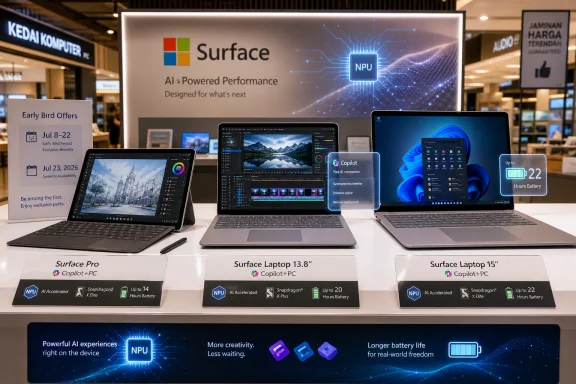 Microsoft Brings the Copilot+ Pitch to a Real Retail Shelf
The new Malaysian Surface launch matters because it turns Microsoft’s AI PC story from a keynote abstraction into a purchase decision. A Surface Pro starting at RM6,999, a 13.8-inch Surface Laptop starting at RM7,399, and a 15-inch Surface Laptop starting at RM7,799 are not impulse buys. They are premium Windows machines being sold on the promise that local AI processing, Arm efficiency, and better graphics performance can justify the price.BusinessToday Malaysia reports that Microsoft will open early-bird registration on July 8 ahead of the July 23 availability date. The retailers named in the report are mainstream Malaysian channels, which tells us Microsoft is not positioning these machines as obscure developer hardware. This is a consumer and professional play, even if the early adopters will skew toward buyers who already understand what an NPU is supposed to do.
That is a subtle but important shift. The first wave of Copilot+ PCs was about proving that Windows on Arm could finally be fast enough, compatible enough, and power-efficient enough to deserve a second look. This wave is about making the AI PC label feel normal at the top end of the Windows market.
The danger for Microsoft is that “AI PC” still risks sounding like a sticker on the box rather than a reason to upgrade. Surface gives the company its best chance to close that gap, because Microsoft controls the hardware story, the Windows story, and the Copilot story. If the message still feels vague on Surface, it will feel even vaguer everywhere else.
Snapdragon X2 Is the Real Launch Feature
The headline spec is not the OLED display, the camera, or even the claimed battery life. It is Qualcomm’s Snapdragon X2 platform, which Microsoft is using across the new Surface Pro and Surface Laptop range. Microsoft’s own Devices Blog introduced the refreshed Surface Pro and Surface Laptop in June as Snapdragon X2 machines, while BusinessToday Malaysia says the Malaysian units will use Snapdragon X2 Plus and Snapdragon X2 Elite processors.That matters because Microsoft has spent years trying to escape the memory of earlier Windows-on-Arm efforts. Surface RT was too limited. Surface Pro X was elegant but compromised. The 2024 Snapdragon X Elite generation finally made Arm-based Windows PCs feel credible for a much larger audience, but credibility is not the same thing as dominance.
Snapdragon X2 is supposed to move the conversation from “Can it run my stuff?” to “Is this the better default Windows laptop?” That is an ambitious jump. Intel and AMD are not standing still, and enterprise IT departments still tend to trust x86 compatibility until proven otherwise.
But the Surface launch suggests Microsoft thinks the compatibility argument is now survivable. The company is no longer hiding Arm in a niche product or presenting it as a special case. It is putting Snapdragon X2 into the mainstream Surface Pro and Surface Laptop families and asking buyers to treat them as premium Windows PCs first, Arm machines second.
The NPU Has Become the New Spec-Sheet Battleground
The devices include dedicated neural processing units, or NPUs, to accelerate AI tasks locally while handing heavier workloads to the cloud. That hybrid pitch is central to the current Copilot+ PC strategy. Microsoft wants users to believe that the best Windows experience will increasingly depend on having AI acceleration available on the device itself.For now, the everyday value of the NPU remains uneven. Background effects, automatic framing, image-generation features, local summarisation, and future Copilot experiences can all benefit from local inference. But many users will still judge the machine by web browsing, Office, battery life, thermals, app compatibility, and whether their printer driver behaves.
That is why the NPU is both strategically important and commercially awkward. Microsoft is selling a future-facing capability before every mainstream workflow fully depends on it. The bet is that buying a premium PC without enough local AI acceleration will soon feel like buying a laptop without a webcam did after 2020.
The Surface hardware is therefore doing two jobs. It must be good enough as a laptop or tablet today, and it must make buyers feel protected against the AI features Microsoft plans to add tomorrow. That is a difficult balance, because a future-proofing argument only works if the present-day machine is already excellent.
Surface Pro Remains Microsoft’s Most Persuasive Compromise
The 13-inch Surface Pro in Malaysia will offer an optional OLED display, up to 15.5 hours of battery life, and a 1440p Quad HD ultrawide front-facing camera with automatic framing, according to BusinessToday Malaysia. It also supports the optional Surface Pro Flex Keyboard and Surface Slim Pen. In classic Surface fashion, the most interesting version of the product is also the one that likely requires accessories to become the machine people imagine when they see the marketing images.That has always been the Surface Pro bargain. Microsoft sells the dream of one device that can be tablet, notebook, sketchpad, and meeting machine. The buyer then discovers that the keyboard and pen are not incidental extras but part of the real experience.
Still, the Surface Pro remains the product that best explains why Microsoft makes computers at all. It is not simply a detachable Windows tablet. It is a form-factor argument aimed at the rest of the PC industry. The Surface Pro says Windows should not be trapped inside the traditional clamshell.
The Snapdragon X2 generation could make that argument stronger. A thinner, quieter, longer-lasting detachable makes more sense than a detachable that behaves like a laptop trying to survive in tablet clothing. If the new chip delivers the efficiency Microsoft is claiming, the Surface Pro becomes less of a compromise and more of a coherent design.
The Surface Laptop Is Where Microsoft Must Beat Normal
The Surface Laptop has a less exotic job. It must be a great clamshell laptop. That sounds easier than the Surface Pro’s mission, but it is commercially harder because the competition is brutal and the form factor is mature.BusinessToday Malaysia says the Surface Laptop will come in 13.8-inch and 15-inch versions, with up to 20 hours and 19 hours of battery life respectively. Microsoft also claims up to 58 percent better graphics performance than the previous generation. Those are meaningful claims if they hold up in real workloads, especially for buyers who want a premium Windows laptop that can handle creative software, multitasking, and AI-assisted work without dragging a charger everywhere.
The 13.8-inch model is arguably the heart of the lineup. It is large enough to be a serious work machine, small enough for travel, and familiar enough for buyers who do not want the Surface Pro’s kickstand-and-keyboard lifestyle. The 15-inch model, meanwhile, gives Microsoft a stronger pitch to users who want more screen without leaving the Surface design language.
The challenge is that “better than last year” is not the same as “better than everything else at this price.” At RM7,399 and RM7,799, buyers will compare these machines against premium Windows ultrabooks, MacBooks, and business laptops with long procurement histories. Surface needs more than elegance; it needs proof.
The Malaysia Pricing Reveals the Premium AI PC Problem
The Malaysian starting prices make one thing obvious: Microsoft is not trying to democratise AI PCs with these Surface models. It is trying to define the premium tier. That is a defensible strategy for Surface, but it also exposes a broader problem for the Copilot+ PC category.If AI hardware remains concentrated in expensive machines, it risks becoming a feature for executives, developers, consultants, and creators rather than a baseline for the Windows installed base. Microsoft needs scale for its AI platform ambitions. Surface can create the halo, but it cannot create the whole market.
There is also a practical retail issue. A buyer walking into Harvey Norman or Senheng may understand battery life, screen size, storage, and price. They may not understand why an NPU changes the useful life of a PC. Microsoft and its retail partners will need to explain the value without drowning shoppers in acronyms.
That is harder than it sounds. “AI-powered PC” has already been overused by the industry. The phrase now needs to be attached to specific experiences users can see: better calls, faster creative workflows, responsive local assistants, privacy-preserving on-device processing, and battery life that does not collapse when those features are active.
The Affinity Bundle Is a Quiet Shot at Creative Buyers
BusinessToday Malaysia notes that the devices come with the Affinity creative software suite pinned to the Windows 11 Start menu and optimised for Surface hardware. That detail deserves more attention than it will probably get. Microsoft is not merely saying these PCs can run AI features; it is trying to associate them with real creative work.Affinity’s presence is also a reminder that the premium laptop fight is partly cultural. Apple has long owned mindshare among many designers, photographers, and video-adjacent professionals. Microsoft cannot win that audience with Copilot branding alone. It needs credible creative software, good displays, pen input where relevant, and performance that does not feel like a footnote.
The Surface Pro’s optional OLED panel and pen support make sense in that context. So does the claimed graphics uplift for the Surface Laptop. Microsoft wants these devices to look like machines for people making things, not just people attending Teams calls.
But the pinned-app strategy can cut both ways. If Affinity feels genuinely tuned for the hardware, it strengthens the Surface proposition. If it feels like promotional shelf space in the Start menu, users will treat it as another example of Windows trying to monetize attention.
Windows on Arm Is Past the Demo Stage, Not Past the Trust Stage
The biggest technical question around these machines is not whether Snapdragon X2 is fast. Early reporting from outlets such as TechSpot, TechRadar, and Tom’s Hardware has treated the X2 Surface refresh as a serious performance upgrade, with Microsoft emphasizing better graphics and longer battery life. The harder question is whether buyers trust Arm-based Windows enough to make it their main machine.For many users, the answer will now be yes. Web apps, Microsoft 365, Teams, Edge, many creative tools, and a growing list of native Arm64 applications make the day-to-day experience far less exotic than it used to be. Emulation has improved, and the ordinary productivity user may rarely notice the architecture.
For IT departments, the answer is more complicated. Legacy VPN clients, endpoint security tools, device management agents, old line-of-business applications, accounting software, plug-ins, and peripheral utilities can still turn architecture into a procurement headache. The fact that a machine is fast in benchmarks does not mean it is safe to deploy across a messy fleet.
That is where Surface carries a heavier burden than most OEM devices. Microsoft’s own hardware sets expectations for what Windows supports well. If a Surface Laptop on Snapdragon X2 cannot glide through enterprise edge cases, customers will not blame Qualcomm alone. They will blame Windows.
Battery Life Is the Claim Everyone Will Test First
Microsoft’s claimed battery numbers are attractive: up to 15.5 hours for Surface Pro, up to 20 hours for the 13.8-inch Surface Laptop, and up to 19 hours for the 15-inch Surface Laptop, according to BusinessToday Malaysia. Those figures are exactly the kind of numbers that make Arm-based Windows machines appealing. They are also exactly the kind of numbers buyers should treat as best-case claims until independent testing arrives.Battery life is where the AI PC pitch becomes tangible. Users may not immediately care whether a model runs locally or in the cloud, but they do care whether a laptop survives a flight, a conference day, or a long stretch of meetings. If Snapdragon X2 delivers strong performance without behaving like a space heater, Microsoft has a compelling story.
The difficulty is that battery life varies wildly by workload. Local video playback, web browsing, Teams calls, photo editing, AI features, screen brightness, display type, and background management tools all change the outcome. An OLED Surface Pro used for creative work will not necessarily resemble the test scenario behind the headline number.
That does not make Microsoft’s claim meaningless. It simply means the real-world reviews matter. In the premium segment, buyers do not merely want a big number; they want confidence that the machine will behave predictably.
The Retail Window Is Short, but the Strategy Is Long
The early-bird period from July 8 to July 22 gives Microsoft and its retail partners a two-week runway before official availability on July 23. BusinessToday Malaysia says promotions will vary by retailer, which is typical for launches that depend on channel partners rather than a single direct-sales moment. The promotions may help soften the premium pricing, but they are unlikely to change the fundamental audience.This is a launch aimed at buyers who already want a high-end Windows machine or who are curious enough about Copilot+ PCs to pay for the newest platform. It is not a mass-market reset. Malaysia will still have plenty of cheaper Windows laptops, and many will be good enough for students, families, and office users.
But Surface has rarely been about unit volume alone. Its purpose is to establish a design and platform direction that OEMs can follow, undercut, or reinterpret. The Malaysian launch extends that signal into a market where Windows remains deeply relevant across consumer, education, and business environments.
The timing also matters. By July 2026, the industry has had enough time to move beyond the first wave of AI PC hype. Buyers are now entitled to ask what these machines do better, not merely what chips they contain. Microsoft’s answer is becoming more concrete, but it still has to survive contact with daily use.
The Compatibility Conversation Has Changed Shape
A few years ago, the objection to Windows on Arm was blunt: it might not run what you need. Today the objection is narrower but still real: it might not run everything you need in the way your current workflow expects. That distinction is progress, but it is not victory.For enthusiasts, Snapdragon X2 machines will be fascinating precisely because they sit at the intersection of performance, efficiency, and compatibility. They invite testing. They invite benchmark charts, app lists, driver experiments, gaming attempts, and edge-case discoveries.
For administrators, the conversation is less romantic. They will want to know whether deployment images work cleanly, whether security tools are native, whether help desks can support mixed architectures, and whether procurement can avoid surprise incompatibilities. A premium Surface machine that delights reviewers can still be a cautious pilot inside enterprise IT.
That is why Microsoft’s Surface push should not be judged only by launch-day excitement. The real test is whether these devices become boring in the best possible way. A successful Arm-based Surface is one that users stop describing as Arm-based.
The Malaysian Launch Makes the AI PC Pitch Less Abstract
There are several concrete facts Windows buyers should take from this launch before getting swept up in the branding.- The new Surface Pro and Surface Laptop arrive in Malaysia on July 23, 2026, with early-bird orders running from July 8 through July 22.
- The Malaysian lineup is built around Qualcomm’s Snapdragon X2 Plus and Snapdragon X2 Elite processors, making Arm performance and efficiency central to Microsoft’s pitch.
- The Surface Pro starts at RM6,999, while the 13.8-inch and 15-inch Surface Laptop models start at RM7,399 and RM7,799 respectively.
- Microsoft is claiming up to 15.5 hours of battery life for Surface Pro and up to 20 hours for the smaller Surface Laptop, but independent workload testing will matter more than headline figures.
- The devices’ NPUs are important for Microsoft’s long-term Copilot+ strategy, but buyers should still evaluate app compatibility, accessory costs, warranty support, and real workflow benefits.
- The Affinity creative software placement shows Microsoft wants these machines judged as creator and productivity devices, not merely as Copilot demo hardware.
Microsoft’s Malaysian Surface launch is a useful snapshot of the Windows PC market in 2026: ambitious, expensive, technically more credible than before, and still carrying the burden of proving that “AI PC” means more than a faster way to drain a battery. If Snapdragon X2 Surface devices deliver the promised efficiency and compatibility, they will strengthen Microsoft’s case that the next era of Windows hardware is already here. If they do not, the industry will have another premium reminder that the future of the PC is never won on a spec sheet alone.
References
- Primary source: BusinessToday Malaysia
Published: Wed, 08 Jul 2026 06:45:42 GMT
Loading…
www.businesstoday.com.my - Related coverage: techradar.com
Loading…
www.techradar.com - Related coverage: techspot.com
Microsoft refreshes Surface Pro and Surface Laptop with Snapdragon X2 chips, longer battery life, and higher prices | TechSpot
The new Surface Pro is the 13-inch 12th Edition model, while the Surface Laptop is now in its 8th Edition and remains available in 13.8-inch and 15-inch...www.techspot.com - Official source: news.microsoft.com
Loading…
news.microsoft.com - Related coverage: gizmochina.com
Microsoft launches new Surface Pro and Surface Laptop with Snapdragon X2 chips - Gizmochina
Microsoft launches Surface Pro 13-inch and Surface Laptop with Snapdragon X2 chips, AI-ready 80 TOPS NPU, OLED option, and prices starting at $1,499. www.gizmochina.com
- Related coverage: qualcomm.com
Loading…
www.qualcomm.com
- Official source: blogs.windows.com
Introducing the next Surface Pro and Surface Laptop, built for performance and flexibility
For more than 13 years, Surface has been shaped by the people who use it. Architects sketch buildings, developers train models, students build startups and field engineers solve problems that rarely make headlines. We didn't intend to design for onblogs.windows.com - Related coverage: notebookcheck.net
New Microsoft Surface PCs launching with Qualcomm Snapdragon X2 in 2026 - Notebookcheck News
Microsoft has released Surface Laptop 8 and Surface Pro 12 devices globally. At the same time, the company has confirmed that Qualcomm Snapdragon X2 models are coming, but not until 'later this year'. www.notebookcheck.net
- Related coverage: technave.com
Loading…
technave.com - Related coverage: tomshardware.com
Microsoft debuts Surface Pro and Surface Laptop with new jade green color and Qualcomm Snapdragon X2 chips — refreshed devices start at $1,499 with 16GB of RAM | Tom's Hardware
The Laptop features Microsoft's new haptic touchpad.www.tomshardware.com - Related coverage: gizbot.com
Microsoft Launches Surface Pro 12 and Surface Laptop 8 With Snapdragon X2 Chips - Gizbot News
Microsoft has launched the Surface Pro 12 and Surface Laptop 8 with Snapdragon X2 chips, starting at $1,499 and $1,599. Heres whats new across both devices.www.gizbot.com - Related coverage: mobigyaan.com
Loading…
www.mobigyaan.com - Official source: cdn-dynmedia-1.microsoft.com
- Official source: microsoft.com
Surface Pro for Business Fact Sheet May 2024
</rdf:Alt> </dc:description> <dc:creator><rdf:Seq><rdf:li>Joseph Galbraith (MBO Partners, Inc.)www.microsoft.com