

Transcard has partnered with Coretek to build an AI-driven payments intelligence foundation on Microsoft Azure and Microsoft Fabric, with financing recommendations embedded directly into Transcard’s existing Insight Tab for buyers and suppliers. That is the direct news outcome from Technology Record’s Summer 2026 customer story: Transcard is not presenting AI as a separate chatbot or side dashboard, but as a recommendation layer inside the payment workflow itself.
The change matters because Transcard’s platform already sits at the point where buyers and suppliers manage transactions, payment terms, and financing choices. By working with Coretek, Transcard is using Azure, Microsoft Fabric, APIs, and AI models to turn that transaction context into tailored financing guidance. The reported goal is to help customers receive relevant recommendations — including options such as buy now, pay later — without forcing them to leave the workflow where those decisions are already being made.
For payment platforms, that shifts the competitive question from “Can you move money?” to “Can you help customers decide what the money should do next?” Transcard’s move is best understood as an embedded-intelligence play: use the existing payment experience as the delivery surface for AI-driven recommendations, rather than asking users to consult a separate analytics tool after the fact.
The important word in this story is not “AI.” It is “embedded.”
Transcard, according to Technology Record, provides embedded payment solutions that streamline transactions between buyers and suppliers. That gives the company a natural vantage point over commercial activity: who buys, who supplies, transaction size, payment behavior, and the financing choices that shape cash flow and supplier relationships. The opportunity is not simply to analyze financial data in isolation. It is to surface useful guidance inside the same workflow where financing decisions are already being considered.
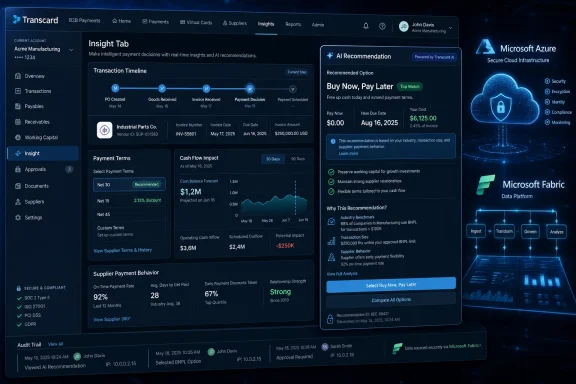
That is why the Insight Tab matters. Technology Record reports that Transcard wanted insights to appear naturally within its Insight Tab without disrupting existing workflows. In enterprise software, this is often the difference between an AI feature that gets demo applause and one that has a real chance of being used. If the user has to leave the transaction path, open another dashboard, interpret a separate recommendation, and then translate that back into action, the AI has already lost much of its practical value.
Coretek’s role was to design and implement the foundation that could make those recommendations possible. The crisp version of the workflow is this: Coretek migrated Transcard’s financial data into Microsoft Fabric, developed AI models that analyze buyer and supplier profiles, exposed the resulting insights through APIs, and embedded those recommendations directly into the Insight Tab on an Azure-based architecture. Technology Record describes Azure’s compliance and governance features as part of the secure foundation for handling financial data while supporting growth.
The result, as described by the source material, is not merely a smarter reporting layer. It is a repositioning of the payments platform as a place where customers can receive financing guidance while they are already working with payment information. Buyers and suppliers are not just seeing that a transaction happened; they are being shown context-aware recommendations intended to support cash-flow and financing decisions.
That wording is important. The provided facts support the existence of an AI-driven foundation and embedded recommendations. They do not provide quantified adoption, return on investment, performance improvement, or measured cash-flow gains. This is a customer story about architecture, product direction, and embedded guidance — not a published benchmark.
The more concrete challenge was timing and placement. Transcard’s business challenge, as described in the source material, was to evaluate key characteristics such as industry, transaction size, and supplier payment behaviors in order to recommend tailored financing options. Those variables are not abstract analytics dimensions; they are signals that help determine whether a financing suggestion is relevant to a particular buyer-supplier situation.
A recommendation to consider a financing option only matters if it arrives when the customer can still act on it. A model may identify a useful pattern, a data platform may unify the records, and a dashboard may visualize the output, but if the recommendation is detached from the payment workflow, it becomes another destination in an already crowded enterprise environment.
Transcard and Coretek appear to have designed against that problem. The use of APIs to embed recommendations into the Insight Tab is not a minor implementation detail; it is the mechanism that turns AI from analysis into product behavior. The recommendation appears where the user is already working, which means it can inform the financing decision without requiring a new process.
Jeff Kaufman, executive vice president of AI and data insights at Transcard, framed the project in direct terms for a customer story. “Coretek helped us solve a real problem,” he said, according to Technology Record. “Embedding AI-driven recommendations directly into our platform creates real value for our end customers and strengthens the experience we deliver.”
That quote is doing more work than the usual partner-marketing endorsement. Kaufman is not praising AI as a novelty. He is saying the value comes from embedding recommendations directly into the platform. In other words, the model matters, but the workflow matters more.
For IT readers, this is the practical takeaway: embedded APIs inside the existing workflow usually matter more than a separate dashboard or chatbot because they reduce handoff friction. A dashboard asks users to go somewhere else, interpret a result, and decide how to apply it. A chatbot may answer questions, but it can still sit outside the operational flow. An API-delivered recommendation inside the Insight Tab can appear at the decision point, under the application’s existing identity, access, logging, and governance model. That is what makes the feature feel like part of the product instead of an adjacent experiment.
Coretek migrated Transcard’s financial data into Microsoft Fabric, enabling advanced analytics and AI readiness. That phrase — AI readiness — implies that the challenge was not just to run a model but to create a data environment where models could be applied and extended under a governed architecture.
For WindowsForum readers who live closer to infrastructure, identity, compliance, and application operations than to marketing claims, the lesson is familiar: AI features are downstream of data plumbing. If buyer and supplier profiles, transaction characteristics, payment behaviors, and financing outcomes are fragmented across systems, an AI-driven recommendation can become shallow, inconsistent, or hard to trust. If the data foundation is unified and governed, the recommendation has a better chance of being relevant and defensible.
Technology Record says the solution combined advanced data services, APIs, and intelligent recommendations. That combination is the point. Microsoft Fabric provides the analytics and AI-oriented data platform. Azure provides the cloud foundation and compliance and governance features. APIs provide the product integration path. The AI models provide the recommendation logic. None of those layers is sufficient alone.
This is also why the story is more significant than a single feature announcement. Microsoft has been positioning its cloud ecosystem around the idea that data, governance, analytics, and AI should not be separate enterprise projects. Transcard’s use case shows what that can look like in a payment orchestration context: the cloud is not merely hosting the application, and the data platform is not merely storing records. Together, they are being used to alter the product experience itself.
The migration into Microsoft Fabric also gives Transcard a path toward future AI use cases, which Technology Record identifies as a requirement. The first visible application in the source material is tailored financing guidance, including recommendations such as buy now, pay later. Once the data foundation and API delivery pattern exist, Transcard may be able to extend the same approach into additional recommendation, risk, cash-flow, or supplier-management scenarios.
The caveat is essential: the source material does not claim those future services already exist. It says the Azure architecture supports rapid growth and future AI use cases. The current reported achievement is the establishment of an AI-driven foundation and embedded recommendations for financing guidance. Any broader AI expansion remains future potential unless and until Transcard ships and describes those capabilities.
Technology Record says embedded AI enhances the customer experience by providing faster, more personalized guidance without adding complexity, allowing customers to make smarter financing decisions in real time. That claim should be read as the stated product intent rather than as a quantified performance result. The source material does not provide hard numbers showing how much faster decisions became or how much outcomes improved.
The user experience design choice is nevertheless important. Transcard did not, according to the source material, create a separate AI portal that users must visit. Coretek exposed insights through APIs that embed recommendations directly into the Insight Tab. That is the product strategy: keep the customer inside the existing workflow and make the workflow more intelligent.
This matters because embedded finance and embedded intelligence are converging. A payment platform that only executes instructions may become less differentiated over time than one that also helps customers evaluate financing options. If a supplier can receive guidance relevant to payment behavior, or a buyer can see financing options tailored to transaction size and business context, the platform becomes more than infrastructure. It becomes part of the decision-making process.
That does not mean every recommendation will be accepted. Nor does the source material say the AI makes autonomous financing decisions. The reported function is recommendation: models analyze buyer and supplier profiles and recommend solutions like buy now, pay later. The human user or business process remains in the loop, at least as described.
But recommendation is still meaningful. In commercial software, the default option, the surfaced suggestion, and the contextually timed prompt can shape behavior. If Transcard can keep those prompts trustworthy, relevant, and well governed, it can influence not only how customers pay but how they think about liquidity and supplier relationships.
The table is simple, but the strategic shift is not. Transcard is trying to move from being only a system of execution to being a system of recommendation. For buyers and suppliers, that could make the payment platform feel less like a back-office tool and more like a financial decision assistant built into daily operations.
That phrase may sound consumer-coded, but the business context here is different. Transcard’s users are buyers and suppliers managing commercial transactions, payment terms, cash flow, and relationships. In that environment, a financing recommendation is not about nudging someone through an online checkout. It is about helping counterparties consider payment structures that may affect working capital, supplier satisfaction, and the timing of cash movement.
The fact pattern identifies Transcard’s business challenge as recommending tailored financing options based on industry, transaction size, and supplier payment behaviors. Those are sensible variables because B2B payment decisions are rarely one-size-fits-all. A financing option that fits a large transaction in one industry may be inappropriate for a smaller transaction in another. A supplier with one payment history may require different handling than a supplier with a more predictable pattern.
What is notable is that the AI use case is framed around context-aware insight, not generic prediction. Technology Record says buyers and suppliers receive context-aware insights intended to improve cash flow and financing outcomes. In practice, that means the system’s value depends on whether it can translate transaction and profile data into recommendations that users perceive as relevant to the immediate commercial relationship.
This is also where governance becomes inseparable from product quality. Financial recommendations are sensitive even when they are not final decisions. Users need to trust that the recommendation is based on appropriate data, that the data is protected, and that the system can scale without eroding control. Technology Record says the architecture is built on Azure’s compliance and governance features and is intended to ensure financial data remains safe while supporting growth.
For IT leaders, that is the enterprise AI bargain. The business wants increasingly personalized recommendations. Security and compliance teams want tighter control over data. Product teams want a frictionless user experience. The architecture has to satisfy all three or the feature becomes either too risky, too weak, or too annoying to use.
That is a broad statement, but in this setting it is not ornamental. Payment orchestration involves sensitive business relationships and financial data. Once AI recommendations are generated from buyer and supplier profiles, transaction size, industry, and supplier payment behaviors, the system is no longer merely storing or moving payment-related data; it is using that data to influence financing guidance.
This is where admins and architects should pay attention. AI readiness is not just about making data available to models. It is about making the right data available under the right controls, with a delivery mechanism that does not leak, overexpose, or misapply sensitive context. A recommendation embedded in a user interface can look deceptively simple; behind it is a chain of ingestion, transformation, model logic, API access, identity, authorization, logging, and governance.
Technology Record’s customer story presents Azure’s compliance and governance features as the security foundation. That framing is consistent with the needs of a financial-data use case, but it also leaves open the practical burden on implementers. Cloud governance features do not govern by magic. They must be configured, mapped to the organization’s risk model, and maintained as the AI surface area expands.
The most immediate risk in projects like this is not necessarily a dramatic breach scenario. It is recommendation sprawl. A successful first use case creates demand for more AI-driven services. More services require more data connections, more APIs, more model outputs, and more users. Without disciplined governance, the scalability that makes the architecture attractive can also increase complexity.
That is why the “future AI use cases” language matters. Transcard wanted scalability not just for rapid growth but for future AI use cases, according to the source material. A strong foundation can make those future expansions easier to evaluate and manage. A weak foundation can also make expansion easier — but in the dangerous sense, where teams can add features faster than security, compliance, and product accountability can review them.
That decision turns the AI layer into something the product can consume, not merely something analysts can observe. It allows recommendations to be embedded directly into the Insight Tab, which Technology Record describes as central to the frictionless user experience. Without that API layer, Transcard might still have had AI models and analytics, but the intelligence would have remained one step removed from the user’s workflow.
For enterprise IT, this is the difference between a data science project and a productized AI capability. A model that outputs recommendations into a notebook, report, or dashboard is useful to a limited audience. A model whose recommendations are served through governed APIs can become part of the application experience. It can be versioned, secured, monitored, and integrated into user journeys.
The API decision also creates a cleaner separation of concerns. Data and model teams can focus on generating high-quality insights. Application teams can focus on how those insights appear in the Insight Tab. Security and platform teams can focus on access, governance, and compliance. That does not make the project easy, but it makes it architecturally legible.
It also gives Transcard room to evolve. If the company continues co-innovating with Coretek and Microsoft, as Technology Record says, the recommendation layer could potentially support more than one use case over time. The same general pattern — governed data foundation, model-driven insight, API delivery, embedded workflow — can be reused if the business identifies additional financing or trade-related scenarios.
The caution is that APIs can make weak recommendations travel faster, too. If the model logic is poor, if the data quality is uneven, or if the recommendation context is misunderstood, embedding the output in the interface may amplify the problem. The closer AI gets to a user’s decision point, the more important validation, monitoring, and feedback become.
That is not an argument against embedded AI. It is an argument against treating the interface as the finish line. For Transcard, the Insight Tab is where the customer sees the value. For the teams operating the system, the real work continues behind the tab.
Coretek did not simply advise Transcard to “use AI.” According to Technology Record, it designed and implemented an AI-driven foundation on Microsoft Azure, migrated financial data into Microsoft Fabric, developed models that analyze buyer and supplier profiles, and exposed insights through APIs into the Insight Tab. That is a full-stack transformation pattern.
This is a reminder that the current AI wave has not eliminated classic integration work. It has made integration more consequential. The model may be the visible innovation, but the success of the project depends on whether the surrounding systems can deliver trusted data, secure access, timely recommendations, and a product experience that does not disrupt the customer.
It also explains why Microsoft’s partner ecosystem remains central to enterprise AI adoption. Customers may buy into Azure, Microsoft Fabric, and Microsoft’s broader AI cloud positioning, but implementation still requires translation into a specific business workflow. In Transcard’s case, that workflow is payment orchestration between buyers and suppliers, with financing recommendations surfaced in an existing Insight Tab.
The story also shows the emerging shape of AI consulting. The valuable partner is not merely the one that can build a model. It is the one that can identify the point of leverage in the business process and connect the technical architecture to that point. Here, the point of leverage is the financing decision made around a transaction.
That is why Kaufman’s “real problem” quote matters. The real problem was not “we need AI.” The real problem was how to recommend tailored financing options based on industry, transaction size, and supplier payment behaviors, while keeping the experience natural and secure. Coretek’s value, as presented by Transcard, was in solving that product-and-platform problem rather than delivering AI as a standalone experiment.
There are no specific performance numbers in the provided source material. We are not told how many customers are using the embedded recommendations, how recommendation quality is measured, what adoption looks like inside the Insight Tab, or how much cash-flow improvement buyers and suppliers have seen. The article says the insights are intended to improve cash flow and financing outcomes, but it does not quantify those improvements.
There is also no detailed explanation of model governance. The source material says Azure’s compliance and governance features are part of the secure architecture, but it does not specify what review processes, model monitoring, audit mechanisms, or human oversight patterns are in place. For a financial recommendation system, those details would be highly relevant to risk teams and enterprise customers.
The story also does not say how buy now, pay later recommendations are evaluated against customer suitability, supplier preferences, or broader financing constraints. It says models analyze buyer and supplier profiles to recommend solutions like buy now, pay later. That is enough to describe the use case, but not enough to judge the system’s decision quality.
None of those omissions invalidates the project. They simply mark the boundary between a customer story and a technical case study. Technology Record tells us what Transcard, Coretek, and Microsoft Azure were used to build. It does not fully tell us how the system is governed day to day or how success is measured over time.
For IT leaders, that boundary is useful. The story should be read as evidence of a pattern, not as a complete implementation blueprint. The pattern is strong: consolidate financial data in Microsoft Fabric, use Azure as the secure and scalable platform, generate AI-driven recommendations, and embed them through APIs into the existing product experience. The implementation details still require hard questioning before any organization copies the approach.
The Transcard-Coretek project highlights several areas Microsoft-centric IT teams should watch.
First, Fabric is increasingly positioned as more than a reporting or analytics destination. In this story, it is the place where financial data is prepared for AI-driven recommendations. That matters because many organizations still treat analytics platforms as downstream systems used after operational work is complete. Transcard’s example points in the other direction: analytics and AI outputs can feed back into the operational product.
Second, Azure governance is part of the product story, not merely the hosting story. When AI is used to generate financial recommendations, infrastructure decisions become customer-experience decisions. Identity boundaries, data access rules, API controls, monitoring, and compliance posture all influence whether the recommendation layer can be trusted.
Third, APIs are the bridge between AI and usability. IT teams should not evaluate AI projects only by asking whether a model exists or whether a data platform has been deployed. They should ask how the insight reaches the user, what system consumes it, what controls surround it, and whether the recommendation arrives inside a workflow where it can actually matter.
Fourth, future use cases should be treated as a governance planning issue. Technology Record says the architecture is intended to support future AI use cases, but that should not be read as a blank check. Every new recommendation type may require new data access, new review procedures, new user-interface choices, and new risk analysis. The foundation can accelerate future work, but it should also impose discipline on that work.
That checklist is deliberately practical because the Transcard story is not primarily about AI spectacle. It is about putting recommendations into a workflow where buyers and suppliers already operate. The more deeply AI is embedded into business software, the more ordinary IT disciplines matter: access control, data quality, monitoring, change management, and incident response.
This sequence is the cleanest way to read the news. The key change is not that Transcard adopted AI in the abstract. The change is that Transcard, with Coretek, built an Azure and Fabric foundation that lets financing recommendations appear inside the Insight Tab through APIs.
The first wave of enterprise AI enthusiasm often centered on chat interfaces, copilots, and standalone assistants. Those experiences can be useful, but they are not the only way AI enters software. In many business systems, the more durable AI feature may be a recommendation, a prioritization, a warning, or a next-best action embedded into a screen that users already depend on.
That is what makes the Transcard story worth watching. The Insight Tab is not described as a novelty interface. It is the place where Transcard wanted customers to receive guidance without disrupting their existing work. That design instinct is likely to become more important as organizations move past experimentation and ask which AI features actually belong in production workflows.
For Microsoft, the story also reinforces the role of Azure and Fabric as the enterprise substrate for applied AI. The value proposition is not simply that cloud infrastructure can host models. It is that cloud infrastructure, governed data, analytics services, APIs, and application integration can combine to change how a business process works.
For Coretek, the story reinforces the integrator’s role in making that combination practical. AI may be the headline, but the actual work involves architecture, migration, modeling, API exposure, security, and product integration. That is not a small lift, and it is not solved by deploying a generic assistant on top of disconnected data.
For Transcard, the near-term significance is clearer: the company can present its payments platform as more than a transaction engine. It can point to embedded, AI-driven financing recommendations as part of the product experience. That does not prove measurable financial improvement by itself, but it does mark a meaningful product direction.
The strongest part of the story is the delivery model. The AI is not being positioned as a separate destination. It is being wired into the place where users already work. For enterprise IT and product teams, that is the lesson to take seriously. AI features are most likely to matter when they are connected to governed data, exposed through secure integration points, and delivered at the moment of decision.
The story should not be overstated. The available facts do not include quantified adoption, ROI, model accuracy, or measured cash-flow improvement. They also do not describe the full governance model behind the recommendations. Those are open questions for any buyer or technical evaluator.
But the direction is clear. Transcard and Coretek are using Microsoft’s cloud and data stack to move payments intelligence closer to the transaction itself. If the architecture is governed well and the recommendations prove useful over time, the Insight Tab could become more than a place to view payment-related information. It could become a practical advisory surface for financing decisions.
That is the clean argument the customer story points toward: the next stage of enterprise AI will not be defined only by who has the most impressive model or the most visible chatbot. It will be defined by who can put trustworthy intelligence into the workflow at the exact point where a business decision is made.
The change matters because Transcard’s platform already sits at the point where buyers and suppliers manage transactions, payment terms, and financing choices. By working with Coretek, Transcard is using Azure, Microsoft Fabric, APIs, and AI models to turn that transaction context into tailored financing guidance. The reported goal is to help customers receive relevant recommendations — including options such as buy now, pay later — without forcing them to leave the workflow where those decisions are already being made.
For payment platforms, that shifts the competitive question from “Can you move money?” to “Can you help customers decide what the money should do next?” Transcard’s move is best understood as an embedded-intelligence play: use the existing payment experience as the delivery surface for AI-driven recommendations, rather than asking users to consult a separate analytics tool after the fact.
 Transcard Is Turning Payments Into Advice
The important word in this story is not “AI.” It is “embedded.”Transcard, according to Technology Record, provides embedded payment solutions that streamline transactions between buyers and suppliers. That gives the company a natural vantage point over commercial activity: who buys, who supplies, transaction size, payment behavior, and the financing choices that shape cash flow and supplier relationships. The opportunity is not simply to analyze financial data in isolation. It is to surface useful guidance inside the same workflow where financing decisions are already being considered.
That is why the Insight Tab matters. Technology Record reports that Transcard wanted insights to appear naturally within its Insight Tab without disrupting existing workflows. In enterprise software, this is often the difference between an AI feature that gets demo applause and one that has a real chance of being used. If the user has to leave the transaction path, open another dashboard, interpret a separate recommendation, and then translate that back into action, the AI has already lost much of its practical value.
Coretek’s role was to design and implement the foundation that could make those recommendations possible. The crisp version of the workflow is this: Coretek migrated Transcard’s financial data into Microsoft Fabric, developed AI models that analyze buyer and supplier profiles, exposed the resulting insights through APIs, and embedded those recommendations directly into the Insight Tab on an Azure-based architecture. Technology Record describes Azure’s compliance and governance features as part of the secure foundation for handling financial data while supporting growth.
The result, as described by the source material, is not merely a smarter reporting layer. It is a repositioning of the payments platform as a place where customers can receive financing guidance while they are already working with payment information. Buyers and suppliers are not just seeing that a transaction happened; they are being shown context-aware recommendations intended to support cash-flow and financing decisions.
That wording is important. The provided facts support the existence of an AI-driven foundation and embedded recommendations. They do not provide quantified adoption, return on investment, performance improvement, or measured cash-flow gains. This is a customer story about architecture, product direction, and embedded guidance — not a published benchmark.
What Changed: The Recommendation Now Lives in the Workflow
Enterprise AI stories often begin with the same ritual phrase: large amounts of data. That is present here too. Technology Record says advanced AI models were needed to analyze large amounts of financial data, and Coretek moved that data into Microsoft Fabric to support advanced analytics and AI readiness.The more concrete challenge was timing and placement. Transcard’s business challenge, as described in the source material, was to evaluate key characteristics such as industry, transaction size, and supplier payment behaviors in order to recommend tailored financing options. Those variables are not abstract analytics dimensions; they are signals that help determine whether a financing suggestion is relevant to a particular buyer-supplier situation.
A recommendation to consider a financing option only matters if it arrives when the customer can still act on it. A model may identify a useful pattern, a data platform may unify the records, and a dashboard may visualize the output, but if the recommendation is detached from the payment workflow, it becomes another destination in an already crowded enterprise environment.
Transcard and Coretek appear to have designed against that problem. The use of APIs to embed recommendations into the Insight Tab is not a minor implementation detail; it is the mechanism that turns AI from analysis into product behavior. The recommendation appears where the user is already working, which means it can inform the financing decision without requiring a new process.
Jeff Kaufman, executive vice president of AI and data insights at Transcard, framed the project in direct terms for a customer story. “Coretek helped us solve a real problem,” he said, according to Technology Record. “Embedding AI-driven recommendations directly into our platform creates real value for our end customers and strengthens the experience we deliver.”
That quote is doing more work than the usual partner-marketing endorsement. Kaufman is not praising AI as a novelty. He is saying the value comes from embedding recommendations directly into the platform. In other words, the model matters, but the workflow matters more.
For IT readers, this is the practical takeaway: embedded APIs inside the existing workflow usually matter more than a separate dashboard or chatbot because they reduce handoff friction. A dashboard asks users to go somewhere else, interpret a result, and decide how to apply it. A chatbot may answer questions, but it can still sit outside the operational flow. An API-delivered recommendation inside the Insight Tab can appear at the decision point, under the application’s existing identity, access, logging, and governance model. That is what makes the feature feel like part of the product instead of an adjacent experiment.
Microsoft Fabric Becomes the Staging Ground for Financial AI
The Microsoft angle is easy to understate because Azure is now the default substrate for many enterprise transformation stories. But in this case, the pairing of Microsoft Azure and Microsoft Fabric is central to the architecture Technology Record describes.Coretek migrated Transcard’s financial data into Microsoft Fabric, enabling advanced analytics and AI readiness. That phrase — AI readiness — implies that the challenge was not just to run a model but to create a data environment where models could be applied and extended under a governed architecture.
For WindowsForum readers who live closer to infrastructure, identity, compliance, and application operations than to marketing claims, the lesson is familiar: AI features are downstream of data plumbing. If buyer and supplier profiles, transaction characteristics, payment behaviors, and financing outcomes are fragmented across systems, an AI-driven recommendation can become shallow, inconsistent, or hard to trust. If the data foundation is unified and governed, the recommendation has a better chance of being relevant and defensible.
Technology Record says the solution combined advanced data services, APIs, and intelligent recommendations. That combination is the point. Microsoft Fabric provides the analytics and AI-oriented data platform. Azure provides the cloud foundation and compliance and governance features. APIs provide the product integration path. The AI models provide the recommendation logic. None of those layers is sufficient alone.
This is also why the story is more significant than a single feature announcement. Microsoft has been positioning its cloud ecosystem around the idea that data, governance, analytics, and AI should not be separate enterprise projects. Transcard’s use case shows what that can look like in a payment orchestration context: the cloud is not merely hosting the application, and the data platform is not merely storing records. Together, they are being used to alter the product experience itself.
The migration into Microsoft Fabric also gives Transcard a path toward future AI use cases, which Technology Record identifies as a requirement. The first visible application in the source material is tailored financing guidance, including recommendations such as buy now, pay later. Once the data foundation and API delivery pattern exist, Transcard may be able to extend the same approach into additional recommendation, risk, cash-flow, or supplier-management scenarios.
The caveat is essential: the source material does not claim those future services already exist. It says the Azure architecture supports rapid growth and future AI use cases. The current reported achievement is the establishment of an AI-driven foundation and embedded recommendations for financing guidance. Any broader AI expansion remains future potential unless and until Transcard ships and describes those capabilities.
The Workflow Is the Product
Enterprise software vendors have spent years telling customers that AI will make work faster. The more interesting claim in Transcard’s case is that AI can make the product less fragmented.Technology Record says embedded AI enhances the customer experience by providing faster, more personalized guidance without adding complexity, allowing customers to make smarter financing decisions in real time. That claim should be read as the stated product intent rather than as a quantified performance result. The source material does not provide hard numbers showing how much faster decisions became or how much outcomes improved.
The user experience design choice is nevertheless important. Transcard did not, according to the source material, create a separate AI portal that users must visit. Coretek exposed insights through APIs that embed recommendations directly into the Insight Tab. That is the product strategy: keep the customer inside the existing workflow and make the workflow more intelligent.
This matters because embedded finance and embedded intelligence are converging. A payment platform that only executes instructions may become less differentiated over time than one that also helps customers evaluate financing options. If a supplier can receive guidance relevant to payment behavior, or a buyer can see financing options tailored to transaction size and business context, the platform becomes more than infrastructure. It becomes part of the decision-making process.
That does not mean every recommendation will be accepted. Nor does the source material say the AI makes autonomous financing decisions. The reported function is recommendation: models analyze buyer and supplier profiles and recommend solutions like buy now, pay later. The human user or business process remains in the loop, at least as described.
But recommendation is still meaningful. In commercial software, the default option, the surfaced suggestion, and the contextually timed prompt can shape behavior. If Transcard can keep those prompts trustworthy, relevant, and well governed, it can influence not only how customers pay but how they think about liquidity and supplier relationships.
| Platform posture | Primary function | Data foundation | Insight delivery | Customer-facing outcome |
|---|---|---|---|---|
| Traditional payment processing | Streamline transactions between buyers and suppliers | Financial data used mainly to support payment workflows | Separate analysis or manual interpretation | Transactions are processed, but financing guidance is limited |
| Transcard’s AI-powered direction | Deliver AI-powered insights alongside payments | Financial data migrated into Microsoft Fabric for analytics and AI readiness | APIs embed recommendations directly into the Insight Tab | More personalized guidance for cash-flow and financing decisions, as described in the customer story |
Buy Now, Pay Later Moves Into the B2B Recommendation Layer
The most concrete example in the source material is buy now, pay later. Coretek developed models that analyze buyer and supplier profiles to recommend solutions like buy now, pay later, according to Technology Record.That phrase may sound consumer-coded, but the business context here is different. Transcard’s users are buyers and suppliers managing commercial transactions, payment terms, cash flow, and relationships. In that environment, a financing recommendation is not about nudging someone through an online checkout. It is about helping counterparties consider payment structures that may affect working capital, supplier satisfaction, and the timing of cash movement.
The fact pattern identifies Transcard’s business challenge as recommending tailored financing options based on industry, transaction size, and supplier payment behaviors. Those are sensible variables because B2B payment decisions are rarely one-size-fits-all. A financing option that fits a large transaction in one industry may be inappropriate for a smaller transaction in another. A supplier with one payment history may require different handling than a supplier with a more predictable pattern.
What is notable is that the AI use case is framed around context-aware insight, not generic prediction. Technology Record says buyers and suppliers receive context-aware insights intended to improve cash flow and financing outcomes. In practice, that means the system’s value depends on whether it can translate transaction and profile data into recommendations that users perceive as relevant to the immediate commercial relationship.
This is also where governance becomes inseparable from product quality. Financial recommendations are sensitive even when they are not final decisions. Users need to trust that the recommendation is based on appropriate data, that the data is protected, and that the system can scale without eroding control. Technology Record says the architecture is built on Azure’s compliance and governance features and is intended to ensure financial data remains safe while supporting growth.
For IT leaders, that is the enterprise AI bargain. The business wants increasingly personalized recommendations. Security and compliance teams want tighter control over data. Product teams want a frictionless user experience. The architecture has to satisfy all three or the feature becomes either too risky, too weak, or too annoying to use.
Security Is Not a Checkbox When the Data Is Financial
The source material does not provide a deep technical breakdown of Transcard’s security controls, and it would be a mistake to invent one. What it does say is that Coretek built a secure architecture on Azure’s compliance and governance features to ensure financial data remains safe while supporting growth.That is a broad statement, but in this setting it is not ornamental. Payment orchestration involves sensitive business relationships and financial data. Once AI recommendations are generated from buyer and supplier profiles, transaction size, industry, and supplier payment behaviors, the system is no longer merely storing or moving payment-related data; it is using that data to influence financing guidance.
This is where admins and architects should pay attention. AI readiness is not just about making data available to models. It is about making the right data available under the right controls, with a delivery mechanism that does not leak, overexpose, or misapply sensitive context. A recommendation embedded in a user interface can look deceptively simple; behind it is a chain of ingestion, transformation, model logic, API access, identity, authorization, logging, and governance.
Technology Record’s customer story presents Azure’s compliance and governance features as the security foundation. That framing is consistent with the needs of a financial-data use case, but it also leaves open the practical burden on implementers. Cloud governance features do not govern by magic. They must be configured, mapped to the organization’s risk model, and maintained as the AI surface area expands.
The most immediate risk in projects like this is not necessarily a dramatic breach scenario. It is recommendation sprawl. A successful first use case creates demand for more AI-driven services. More services require more data connections, more APIs, more model outputs, and more users. Without disciplined governance, the scalability that makes the architecture attractive can also increase complexity.
That is why the “future AI use cases” language matters. Transcard wanted scalability not just for rapid growth but for future AI use cases, according to the source material. A strong foundation can make those future expansions easier to evaluate and manage. A weak foundation can also make expansion easier — but in the dangerous sense, where teams can add features faster than security, compliance, and product accountability can review them.
APIs Are the Quiet Architecture Decision That Makes the AI Usable
The story’s most understated technical detail may be its most important: insights are exposed through APIs.That decision turns the AI layer into something the product can consume, not merely something analysts can observe. It allows recommendations to be embedded directly into the Insight Tab, which Technology Record describes as central to the frictionless user experience. Without that API layer, Transcard might still have had AI models and analytics, but the intelligence would have remained one step removed from the user’s workflow.
For enterprise IT, this is the difference between a data science project and a productized AI capability. A model that outputs recommendations into a notebook, report, or dashboard is useful to a limited audience. A model whose recommendations are served through governed APIs can become part of the application experience. It can be versioned, secured, monitored, and integrated into user journeys.
The API decision also creates a cleaner separation of concerns. Data and model teams can focus on generating high-quality insights. Application teams can focus on how those insights appear in the Insight Tab. Security and platform teams can focus on access, governance, and compliance. That does not make the project easy, but it makes it architecturally legible.
It also gives Transcard room to evolve. If the company continues co-innovating with Coretek and Microsoft, as Technology Record says, the recommendation layer could potentially support more than one use case over time. The same general pattern — governed data foundation, model-driven insight, API delivery, embedded workflow — can be reused if the business identifies additional financing or trade-related scenarios.
The caution is that APIs can make weak recommendations travel faster, too. If the model logic is poor, if the data quality is uneven, or if the recommendation context is misunderstood, embedding the output in the interface may amplify the problem. The closer AI gets to a user’s decision point, the more important validation, monitoring, and feedback become.
That is not an argument against embedded AI. It is an argument against treating the interface as the finish line. For Transcard, the Insight Tab is where the customer sees the value. For the teams operating the system, the real work continues behind the tab.
Coretek’s Role Shows Why AI Projects Are Becoming Systems Integration Projects Again
The customer story positions Coretek as the Microsoft AI Cloud provider that helped Transcard unlock new value for clients. That phrasing is partner-story language, but the underlying point is valid: enterprise AI is often less about a single model than about stitching together cloud architecture, data migration, analytics, application integration, and governance.Coretek did not simply advise Transcard to “use AI.” According to Technology Record, it designed and implemented an AI-driven foundation on Microsoft Azure, migrated financial data into Microsoft Fabric, developed models that analyze buyer and supplier profiles, and exposed insights through APIs into the Insight Tab. That is a full-stack transformation pattern.
This is a reminder that the current AI wave has not eliminated classic integration work. It has made integration more consequential. The model may be the visible innovation, but the success of the project depends on whether the surrounding systems can deliver trusted data, secure access, timely recommendations, and a product experience that does not disrupt the customer.
It also explains why Microsoft’s partner ecosystem remains central to enterprise AI adoption. Customers may buy into Azure, Microsoft Fabric, and Microsoft’s broader AI cloud positioning, but implementation still requires translation into a specific business workflow. In Transcard’s case, that workflow is payment orchestration between buyers and suppliers, with financing recommendations surfaced in an existing Insight Tab.
The story also shows the emerging shape of AI consulting. The valuable partner is not merely the one that can build a model. It is the one that can identify the point of leverage in the business process and connect the technical architecture to that point. Here, the point of leverage is the financing decision made around a transaction.
That is why Kaufman’s “real problem” quote matters. The real problem was not “we need AI.” The real problem was how to recommend tailored financing options based on industry, transaction size, and supplier payment behaviors, while keeping the experience natural and secure. Coretek’s value, as presented by Transcard, was in solving that product-and-platform problem rather than delivering AI as a standalone experiment.
The Customer Story Leaves Some Questions Unanswered
Technology Record’s account is positive, concise, and clearly written as a customer success story. It gives enough detail to understand the architecture and business intent, but it does not provide every metric an IT buyer or skeptical admin would want.There are no specific performance numbers in the provided source material. We are not told how many customers are using the embedded recommendations, how recommendation quality is measured, what adoption looks like inside the Insight Tab, or how much cash-flow improvement buyers and suppliers have seen. The article says the insights are intended to improve cash flow and financing outcomes, but it does not quantify those improvements.
There is also no detailed explanation of model governance. The source material says Azure’s compliance and governance features are part of the secure architecture, but it does not specify what review processes, model monitoring, audit mechanisms, or human oversight patterns are in place. For a financial recommendation system, those details would be highly relevant to risk teams and enterprise customers.
The story also does not say how buy now, pay later recommendations are evaluated against customer suitability, supplier preferences, or broader financing constraints. It says models analyze buyer and supplier profiles to recommend solutions like buy now, pay later. That is enough to describe the use case, but not enough to judge the system’s decision quality.
None of those omissions invalidates the project. They simply mark the boundary between a customer story and a technical case study. Technology Record tells us what Transcard, Coretek, and Microsoft Azure were used to build. It does not fully tell us how the system is governed day to day or how success is measured over time.
For IT leaders, that boundary is useful. The story should be read as evidence of a pattern, not as a complete implementation blueprint. The pattern is strong: consolidate financial data in Microsoft Fabric, use Azure as the secure and scalable platform, generate AI-driven recommendations, and embed them through APIs into the existing product experience. The implementation details still require hard questioning before any organization copies the approach.
Where Windows and Microsoft-Centric IT Teams Should Pay Attention
This is not a Windows desktop story, but it is very much a Microsoft ecosystem story. Microsoft Fabric and Azure are becoming the places where many organizations will attempt to operationalize AI against business data. That means the work will land on the desks of cloud architects, identity admins, security engineers, data platform teams, compliance owners, and application developers.The Transcard-Coretek project highlights several areas Microsoft-centric IT teams should watch.
First, Fabric is increasingly positioned as more than a reporting or analytics destination. In this story, it is the place where financial data is prepared for AI-driven recommendations. That matters because many organizations still treat analytics platforms as downstream systems used after operational work is complete. Transcard’s example points in the other direction: analytics and AI outputs can feed back into the operational product.
Second, Azure governance is part of the product story, not merely the hosting story. When AI is used to generate financial recommendations, infrastructure decisions become customer-experience decisions. Identity boundaries, data access rules, API controls, monitoring, and compliance posture all influence whether the recommendation layer can be trusted.
Third, APIs are the bridge between AI and usability. IT teams should not evaluate AI projects only by asking whether a model exists or whether a data platform has been deployed. They should ask how the insight reaches the user, what system consumes it, what controls surround it, and whether the recommendation arrives inside a workflow where it can actually matter.
Fourth, future use cases should be treated as a governance planning issue. Technology Record says the architecture is intended to support future AI use cases, but that should not be read as a blank check. Every new recommendation type may require new data access, new review procedures, new user-interface choices, and new risk analysis. The foundation can accelerate future work, but it should also impose discipline on that work.
Admin Checklist: Questions to Ask Before Copying the Pattern
For organizations looking at Transcard’s approach as a model, the right response is not to copy the buzzwords. It is to interrogate the architecture and the workflow.| Area | Question for IT and product teams | Why it matters |
|---|---|---|
| Workflow fit | Where will the recommendation appear in the user’s existing process? | AI has more practical value when it appears at the decision point rather than in a separate destination |
| Data foundation | Which systems provide the buyer, supplier, transaction, and payment-behavior data? | Recommendation quality depends on the completeness and reliability of the source data |
| Governance | Who can access the data, model outputs, APIs, and recommendation history? | Financial guidance requires tight control over sensitive context |
| API design | How are recommendations exposed, versioned, secured, and monitored? | APIs turn model output into product behavior and therefore need operational discipline |
| Human oversight | Who reviews recommendation logic, exceptions, and customer feedback? | Embedded recommendations can influence business decisions even when they are not autonomous |
| Measurement | What will count as success, and how will it be measured without overclaiming? | Adoption, accuracy, user trust, and business outcomes need evidence, not assumptions |
| Future expansion | What additional AI use cases are planned, and what new risks do they introduce? | A scalable foundation should make governance easier, not optional |
A Short Timeline of the Reported Shift
| Stage | What happened | Significance |
|---|---|---|
| Existing platform context | Transcard provides embedded payment solutions for buyers and suppliers | The company already operates close to transaction and financing workflows |
| Business challenge | Transcard wanted tailored financing recommendations based on factors such as industry, transaction size, and supplier payment behaviors | The goal was contextual guidance, not generic analytics |
| Coretek engagement | Coretek partnered with Transcard to design and implement an AI-driven foundation on Microsoft Azure | The project became a cloud, data, AI, and integration effort |
| Data foundation | Financial data was migrated into Microsoft Fabric | Fabric became the analytics and AI-readiness layer |
| Recommendation layer | AI models were developed to analyze buyer and supplier profiles and recommend financing options such as buy now, pay later | The reported use case became embedded financing guidance |
| Product integration | Insights were exposed through APIs and embedded into the Insight Tab | The recommendation moved into the existing customer workflow |
| Future direction | The architecture is described as supporting rapid growth and future AI use cases | Future expansion is possible, but the source does not claim those additional services already exist |
The Bigger Signal: AI Is Moving From Sidecar to System Behavior
The Transcard project fits a broader enterprise pattern: AI is moving from sidecar experiences into system behavior.The first wave of enterprise AI enthusiasm often centered on chat interfaces, copilots, and standalone assistants. Those experiences can be useful, but they are not the only way AI enters software. In many business systems, the more durable AI feature may be a recommendation, a prioritization, a warning, or a next-best action embedded into a screen that users already depend on.
That is what makes the Transcard story worth watching. The Insight Tab is not described as a novelty interface. It is the place where Transcard wanted customers to receive guidance without disrupting their existing work. That design instinct is likely to become more important as organizations move past experimentation and ask which AI features actually belong in production workflows.
For Microsoft, the story also reinforces the role of Azure and Fabric as the enterprise substrate for applied AI. The value proposition is not simply that cloud infrastructure can host models. It is that cloud infrastructure, governed data, analytics services, APIs, and application integration can combine to change how a business process works.
For Coretek, the story reinforces the integrator’s role in making that combination practical. AI may be the headline, but the actual work involves architecture, migration, modeling, API exposure, security, and product integration. That is not a small lift, and it is not solved by deploying a generic assistant on top of disconnected data.
For Transcard, the near-term significance is clearer: the company can present its payments platform as more than a transaction engine. It can point to embedded, AI-driven financing recommendations as part of the product experience. That does not prove measurable financial improvement by itself, but it does mark a meaningful product direction.
The Bottom Line
The news is straightforward: Transcard partnered with Coretek to build an AI foundation on Microsoft Azure and Microsoft Fabric, then used APIs to embed financing recommendations into the Insight Tab. The reported outcome is a payments experience that can surface tailored guidance for buyers and suppliers inside the existing workflow.The strongest part of the story is the delivery model. The AI is not being positioned as a separate destination. It is being wired into the place where users already work. For enterprise IT and product teams, that is the lesson to take seriously. AI features are most likely to matter when they are connected to governed data, exposed through secure integration points, and delivered at the moment of decision.
The story should not be overstated. The available facts do not include quantified adoption, ROI, model accuracy, or measured cash-flow improvement. They also do not describe the full governance model behind the recommendations. Those are open questions for any buyer or technical evaluator.
But the direction is clear. Transcard and Coretek are using Microsoft’s cloud and data stack to move payments intelligence closer to the transaction itself. If the architecture is governed well and the recommendations prove useful over time, the Insight Tab could become more than a place to view payment-related information. It could become a practical advisory surface for financing decisions.
That is the clean argument the customer story points toward: the next stage of enterprise AI will not be defined only by who has the most impressive model or the most visible chatbot. It will be defined by who can put trustworthy intelligence into the workflow at the exact point where a business decision is made.
References
- Primary source: Technology Record
Published: 2026-07-08T13:30:17.236799
Coretek’s AI-driven insights transform payment...
Transcard is a provider of embedded payment solutions that streamline transactions between buyers and suppliers. As part of its innovation...www.technologyrecord.com