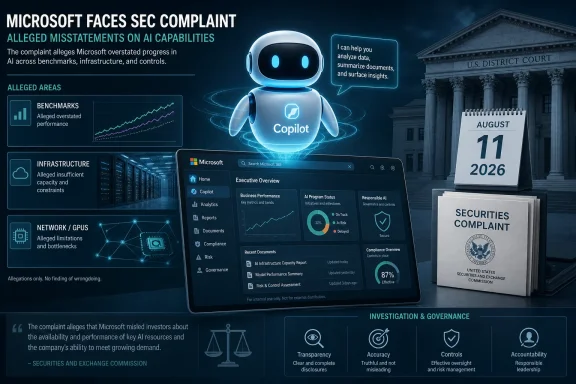
A Microsoft securities class action filed in the Western District of Washington covers investors who bought Microsoft common stock from May 1, 2025, through January 28, 2026, and alleges the company misled the market about Copilot adoption, AI costs, and Azure capacity pressure. The latest investor alert from Bragar Eagel & Squire is not the lawsuit itself so much as a recruitment flare around it, pointing potential lead plaintiffs toward an August 11, 2026, deadline. But the complaint’s real significance is broader than one law firm’s press release: it is an early legal test of whether Wall Street’s AI enthusiasm can be converted into securities liability when the bill for GPUs arrives faster than the revenue story.
The class action, as described by Bragar Eagel & Squire and other investor-side law firms including Levi & Korsinsky, Kessler Topaz, and The Rosen Law Firm, alleges that Microsoft’s public statements during the class period painted too rosy a picture of Copilot’s commercial traction and the economics behind its AI buildout. The complaint reportedly targets a span ending on January 28, 2026, the day Microsoft reported fiscal second-quarter results and investors got a sharper look at the scale of AI-related capital spending.
That timing matters. January 28 was not a day when Microsoft looked weak in the traditional sense. The company reported $81.3 billion in quarterly revenue, Microsoft Cloud revenue of $51.5 billion, and strong growth across cloud and AI-adjacent businesses, according to Microsoft’s own investor materials.
Yet the market’s reaction was more complicated because Microsoft also disclosed capital expenditures of $37.5 billion, with roughly two-thirds tied to short-lived assets such as GPUs and CPUs, according to the company’s earnings call. In plain English, Microsoft was telling investors that AI demand was real, but also that satisfying it required an extraordinary hardware burn rate.
The lawsuit tries to pull those two threads together. It alleges that Copilot was not merely an expensive success story, but a product family facing brand-positioning, user-experience, usage, data-silo, compute-capacity, organizational, and interoperability problems. It also alleges that Microsoft had to divert GPU and CPU capacity away from Azure demand to improve Copilot and related AI research and development.
That is the hinge of the case. The plaintiffs are not simply arguing that Microsoft spent too much on AI. They are arguing that Microsoft’s AI spending and cloud capacity constraints were tied to undisclosed weakness in the very products management was using to justify the spending.
That is why securities cases like this are difficult. Plaintiffs must do more than show that a product disappointed, a strategy became more expensive, or investors later wished they had modeled margins differently. They must show that Microsoft made materially false or misleading statements, or omitted information it had a duty to disclose, and that investors were harmed when the truth emerged.
The complaint’s allegations about Copilot adoption may therefore become the central battleground. If plaintiffs can point to internal data showing weak conversion from Microsoft 365 commercial seats to paid Copilot subscriptions while executives publicly emphasized adoption momentum, the case gets more interesting. If the evidence is mostly hindsight, competitive gossip, and post-earnings share-price disappointment, Microsoft will argue this is a classic attempt to convert market volatility into securities fraud.
The distinction matters for WindowsForum readers because enterprise software adoption is rarely linear. A tool can be strategically important, technically uneven, heavily promoted, and still not legally misrepresented. The courtroom question is not whether sysadmins grumbled about Copilot, whether procurement departments balked at per-seat pricing, or whether Gemini and ChatGPT Enterprise gained ground. The question is whether Microsoft knew a materially different story than the one it told investors.
The lawsuit attacks that premise at its weakest point. Copilot’s advantage was supposed to be context. Because Microsoft controls Outlook, Teams, Word, Excel, SharePoint, Entra, Graph, and much of the endpoint and identity stack, it should theoretically deliver more useful work-grounded answers than a standalone chatbot.
But context is also where enterprise AI gets messy. Permissions, stale SharePoint sites, bad document hygiene, fragmented tenants, legacy file shares, and overexposed data can turn a promising assistant into a governance project. For IT teams, the problem is not just whether the model can summarize a document; it is whether the assistant can be trusted to surface the right information, respect access boundaries, avoid hallucinated confidence, and fit workflows without creating more review work than it saves.
The complaint’s references to data siloing and interoperability problems land because they match a familiar enterprise reality. Microsoft’s ecosystem is integrated, but not magically clean. A company that has spent years accumulating Teams channels, OneDrive folders, third-party SaaS connectors, stale groups, and inconsistent labels does not become AI-ready because a license is assigned.
That is where the investor story and the admin story converge. Copilot adoption is not simply a sales motion. It depends on information architecture, identity hygiene, endpoint posture, user training, and management’s willingness to measure productivity gains honestly. If those prerequisites were slowing paid conversion, plaintiffs will try to argue that Microsoft’s public optimism left investors with the wrong impression.
Azure is not merely another Microsoft division. It is the growth platform that supports enterprise workloads, AI training and inference, databases, analytics, developer services, and Microsoft’s own first-party products. When Azure capacity is constrained, the implications ripple outward: customers wait, regions tighten, quota requests become strategic, and the cost of serving both internal and external AI demand rises.
Microsoft acknowledged in its January earnings call that it had to balance incoming supply against growing Azure demand, first-party AI usage across services such as Microsoft 365 Copilot and GitHub Copilot, AI R&D allocation, and replacement of aging server and networking equipment. That is not the same as admitting the complaint’s theory. But it does confirm the underlying business tension: there are only so many GPUs, racks, power contracts, networking fabrics, and deployment teams to go around.
This is the part of the AI boom that marketing slides tend to flatten. “AI demand” sounds abstract until it becomes data-center capex, depreciation schedules, supply commitments, memory pricing exposure, and regional capacity planning. For cloud customers, the concern is not whether Microsoft believes in AI. The concern is whether AI’s internal appetite competes with the same infrastructure enterprises expect Azure to provide.
That tension will become more visible across the industry. Microsoft is hardly alone; Amazon, Google, Meta, Oracle, and others are all navigating the same compute scramble. But Microsoft’s case is distinctive because Copilot is both a customer-facing product and a consumer of the infrastructure that also powers Azure’s broader growth.
Microsoft’s public AI strategy has also never depended solely on one proprietary model. The company has used OpenAI models, its own Microsoft AI models, small language models, Azure AI Foundry, and partnerships across the model ecosystem. In practice, Microsoft has tried to make the model layer more interchangeable while making the Microsoft 365 and Azure control plane more valuable.
That does not make the benchmark allegation irrelevant. If Microsoft told investors its AI capabilities were best-in-class while internal testing showed a competitive gap material enough to affect Copilot adoption, plaintiffs will argue that the market deserved to know. But if the benchmark issue turns into a narrow debate over which leaderboard mattered on which date, it may be less persuasive than evidence about paid seats, usage intensity, renewal behavior, and customer churn.
For enterprise IT, this is the right lens anyway. The most important Copilot question has never been “Which model wins a synthetic test?” It has been “Does this tool reliably save enough time, reduce enough toil, or unlock enough new capability to justify its license cost and governance overhead?”
That is where Microsoft has faced the hardest sell. Copilot is easy to demo and harder to operationalize. A polished summary in a keynote is one thing; a measurable productivity gain across finance, legal, engineering, support, and frontline workforces is another.
For readers who are Microsoft shareholders, the deadline is practically important. Missing it does not necessarily mean an investor is excluded from any future class recovery, but it may mean losing the chance to steer the litigation. Investors who purchased during the class period and believe they suffered losses should consult counsel rather than relying on a press release or a forum article.
For everyone else, the deadline is less important than the escalation pattern. When multiple firms circulate near-identical alerts, it can look like legal spam, but it also means the plaintiffs’ bar sees a story with enough market interest to pursue. The repetition does not prove the allegations. It does show that Microsoft’s AI disclosures have become a target-rich environment.
That should not surprise anyone watching the AI trade. For more than two years, investors rewarded companies that could plausibly attach AI to revenue growth. The next phase is harsher: companies must show that AI revenue, margins, retention, and productivity gains can justify the capital intensity. Microsoft is one of the few companies large enough to make that case credibly, which is precisely why the lawsuit matters.
The complaint is therefore less a referendum on whether Microsoft is “winning AI” than on whether the company’s public story matched internal reality during a specific nine-month window. That is a narrower legal question, but a broader market warning.
For Windows enthusiasts, Copilot has been hard to pin down because Microsoft has used the name across products with very different capabilities. Copilot in Windows, Microsoft 365 Copilot, GitHub Copilot, Security Copilot, Copilot Studio, and consumer Copilot share branding but not always expectations. That brand sprawl may be one reason the complaint’s “brand positioning” allegation resonates.
For sysadmins, the bigger issue is control. Enterprises want AI assistants that can be deployed selectively, governed centrally, logged properly, and defended in audits. If Copilot requires major cleanup of permissions, sensitivity labels, retention policies, and data boundaries before it becomes broadly useful, then adoption naturally slows. That is not necessarily a product failure; it may be a sign that AI is exposing years of unresolved information-governance debt.
For CFOs and CIOs, the question is return on spend. A $30-per-user add-on, or a higher-tier bundle that effectively folds AI into the enterprise agreement, must survive budget scrutiny. If usage is shallow or concentrated among a small slice of power users, procurement teams will push back.
That is where user sentiment becomes financially material. A product can be strategically bundled and still fail to become habitual. Microsoft’s distribution advantage gets Copilot into the room; it does not guarantee that employees keep using it after the novelty fades.
Microsoft’s January disclosure that quarterly capex reached $37.5 billion brought that physical reality into view. The company can reasonably argue that this is the price of building the next computing platform. But securities law cares about whether investors understood the risks, tradeoffs, and product realities behind that investment.
The plaintiffs’ theory is potent because it joins three anxieties that had previously been easier to separate. First, Copilot adoption may not be as frictionless as Microsoft’s distribution story implied. Second, AI infrastructure may be more expensive and capacity-constrained than investors expected. Third, internal AI priorities may compete with Azure customer demand.
Microsoft will likely argue that it disclosed plenty: AI demand was enormous, capex was rising, cloud gross margins were affected by AI infrastructure, and forward-looking statements were appropriately caveated. The company will also point to strong financial performance and continued cloud growth as evidence that investors were not misled about the business fundamentals.
Both things can be true in a practical sense. Microsoft can be a formidable AI company with enormous revenue growth and still face legal scrutiny over whether it overstated Copilot’s traction or understated the cost and capacity pressure of getting there. The law will decide the narrower issue; the market will decide whether the AI buildout remains credible.
That evidentiary discipline could be healthy. AI markets have been flooded with vague metrics: users “trying” a product, customers “using” a studio, seats “enabled,” workloads “powered by AI,” and revenue “influenced” by AI. Those phrases can be meaningful, but they can also blur the difference between experimentation and durable paid adoption.
Microsoft is not uniquely guilty of this language. The entire enterprise AI sector has leaned on activity metrics while buyers search for outcome metrics. The plaintiffs’ bar is now effectively asking whether some of that language crossed from optimistic positioning into materially misleading disclosure.
For IT pros, the lesson is to demand the same discipline internally. Do not measure Copilot success by licenses assigned or demos completed. Measure active usage, task completion, time saved, quality impact, support burden, security incidents avoided or created, and renewal intent. The same metrics that matter to a court also matter to a deployment.
If Copilot delivers, those numbers should strengthen Microsoft’s case in the market even if litigation grinds on. If the numbers are weaker than the story, this lawsuit will not be the last challenge to AI-era disclosure.
Investors should separate the procedural facts from the unresolved allegations:
 The Copilot Lawsuit Turns AI Optimism Into a Disclosure Problem
The class action, as described by Bragar Eagel & Squire and other investor-side law firms including Levi & Korsinsky, Kessler Topaz, and The Rosen Law Firm, alleges that Microsoft’s public statements during the class period painted too rosy a picture of Copilot’s commercial traction and the economics behind its AI buildout. The complaint reportedly targets a span ending on January 28, 2026, the day Microsoft reported fiscal second-quarter results and investors got a sharper look at the scale of AI-related capital spending.That timing matters. January 28 was not a day when Microsoft looked weak in the traditional sense. The company reported $81.3 billion in quarterly revenue, Microsoft Cloud revenue of $51.5 billion, and strong growth across cloud and AI-adjacent businesses, according to Microsoft’s own investor materials.
Yet the market’s reaction was more complicated because Microsoft also disclosed capital expenditures of $37.5 billion, with roughly two-thirds tied to short-lived assets such as GPUs and CPUs, according to the company’s earnings call. In plain English, Microsoft was telling investors that AI demand was real, but also that satisfying it required an extraordinary hardware burn rate.
The lawsuit tries to pull those two threads together. It alleges that Copilot was not merely an expensive success story, but a product family facing brand-positioning, user-experience, usage, data-silo, compute-capacity, organizational, and interoperability problems. It also alleges that Microsoft had to divert GPU and CPU capacity away from Azure demand to improve Copilot and related AI research and development.
That is the hinge of the case. The plaintiffs are not simply arguing that Microsoft spent too much on AI. They are arguing that Microsoft’s AI spending and cloud capacity constraints were tied to undisclosed weakness in the very products management was using to justify the spending.
Microsoft’s Defense Will Start With the Numbers, Not the Narrative
Microsoft has an obvious counterargument, even before it says a word in court: big AI spending does not automatically mean AI failure. The company’s January 2026 earnings materials showed a business still expanding at a scale most enterprise vendors can only envy. Azure and other cloud services remained a central growth engine, Microsoft 365 remained deeply embedded in business computing, and Copilot was being positioned as the interface layer across that estate.That is why securities cases like this are difficult. Plaintiffs must do more than show that a product disappointed, a strategy became more expensive, or investors later wished they had modeled margins differently. They must show that Microsoft made materially false or misleading statements, or omitted information it had a duty to disclose, and that investors were harmed when the truth emerged.
The complaint’s allegations about Copilot adoption may therefore become the central battleground. If plaintiffs can point to internal data showing weak conversion from Microsoft 365 commercial seats to paid Copilot subscriptions while executives publicly emphasized adoption momentum, the case gets more interesting. If the evidence is mostly hindsight, competitive gossip, and post-earnings share-price disappointment, Microsoft will argue this is a classic attempt to convert market volatility into securities fraud.
The distinction matters for WindowsForum readers because enterprise software adoption is rarely linear. A tool can be strategically important, technically uneven, heavily promoted, and still not legally misrepresented. The courtroom question is not whether sysadmins grumbled about Copilot, whether procurement departments balked at per-seat pricing, or whether Gemini and ChatGPT Enterprise gained ground. The question is whether Microsoft knew a materially different story than the one it told investors.
Copilot Was Always More Than a Chatbot
Microsoft’s AI strategy has depended on a simple but powerful premise: Copilot is not another app competing for attention; it is the AI layer inside the productivity, developer, security, and cloud platforms enterprises already use. That premise is why Microsoft could charge premium add-on prices, push Copilot through Microsoft 365, GitHub, Windows, Security, and Dynamics, and argue that distribution would become destiny.The lawsuit attacks that premise at its weakest point. Copilot’s advantage was supposed to be context. Because Microsoft controls Outlook, Teams, Word, Excel, SharePoint, Entra, Graph, and much of the endpoint and identity stack, it should theoretically deliver more useful work-grounded answers than a standalone chatbot.
But context is also where enterprise AI gets messy. Permissions, stale SharePoint sites, bad document hygiene, fragmented tenants, legacy file shares, and overexposed data can turn a promising assistant into a governance project. For IT teams, the problem is not just whether the model can summarize a document; it is whether the assistant can be trusted to surface the right information, respect access boundaries, avoid hallucinated confidence, and fit workflows without creating more review work than it saves.
The complaint’s references to data siloing and interoperability problems land because they match a familiar enterprise reality. Microsoft’s ecosystem is integrated, but not magically clean. A company that has spent years accumulating Teams channels, OneDrive folders, third-party SaaS connectors, stale groups, and inconsistent labels does not become AI-ready because a license is assigned.
That is where the investor story and the admin story converge. Copilot adoption is not simply a sales motion. It depends on information architecture, identity hygiene, endpoint posture, user training, and management’s willingness to measure productivity gains honestly. If those prerequisites were slowing paid conversion, plaintiffs will try to argue that Microsoft’s public optimism left investors with the wrong impression.
Azure Capacity Is the Other Half of the Complaint
The most technically consequential allegation is not about Copilot’s brand or interface. It is the claim that Microsoft needed to divert GPU and CPU capacity away from fulfilling demand for Azure services to improve Copilot and AI R&D. That allegation, if supported, cuts to the heart of Microsoft’s current business model.Azure is not merely another Microsoft division. It is the growth platform that supports enterprise workloads, AI training and inference, databases, analytics, developer services, and Microsoft’s own first-party products. When Azure capacity is constrained, the implications ripple outward: customers wait, regions tighten, quota requests become strategic, and the cost of serving both internal and external AI demand rises.
Microsoft acknowledged in its January earnings call that it had to balance incoming supply against growing Azure demand, first-party AI usage across services such as Microsoft 365 Copilot and GitHub Copilot, AI R&D allocation, and replacement of aging server and networking equipment. That is not the same as admitting the complaint’s theory. But it does confirm the underlying business tension: there are only so many GPUs, racks, power contracts, networking fabrics, and deployment teams to go around.
This is the part of the AI boom that marketing slides tend to flatten. “AI demand” sounds abstract until it becomes data-center capex, depreciation schedules, supply commitments, memory pricing exposure, and regional capacity planning. For cloud customers, the concern is not whether Microsoft believes in AI. The concern is whether AI’s internal appetite competes with the same infrastructure enterprises expect Azure to provide.
That tension will become more visible across the industry. Microsoft is hardly alone; Amazon, Google, Meta, Oracle, and others are all navigating the same compute scramble. But Microsoft’s case is distinctive because Copilot is both a customer-facing product and a consumer of the infrastructure that also powers Azure’s broader growth.
The Benchmark Allegation Is Flashy, but Adoption Is the Real Fight
The complaint also alleges that Microsoft’s flagship proprietary AI model ranked well below competitors on several benchmark tests. That claim may make headlines, but benchmark fights are often a poor proxy for enterprise software value. IT buyers care about accuracy and latency, yes, but they also care about identity integration, compliance posture, auditability, data residency, admin controls, cost predictability, and support.Microsoft’s public AI strategy has also never depended solely on one proprietary model. The company has used OpenAI models, its own Microsoft AI models, small language models, Azure AI Foundry, and partnerships across the model ecosystem. In practice, Microsoft has tried to make the model layer more interchangeable while making the Microsoft 365 and Azure control plane more valuable.
That does not make the benchmark allegation irrelevant. If Microsoft told investors its AI capabilities were best-in-class while internal testing showed a competitive gap material enough to affect Copilot adoption, plaintiffs will argue that the market deserved to know. But if the benchmark issue turns into a narrow debate over which leaderboard mattered on which date, it may be less persuasive than evidence about paid seats, usage intensity, renewal behavior, and customer churn.
For enterprise IT, this is the right lens anyway. The most important Copilot question has never been “Which model wins a synthetic test?” It has been “Does this tool reliably save enough time, reduce enough toil, or unlock enough new capability to justify its license cost and governance overhead?”
That is where Microsoft has faced the hardest sell. Copilot is easy to demo and harder to operationalize. A polished summary in a keynote is one thing; a measurable productivity gain across finance, legal, engineering, support, and frontline workforces is another.
The Lead-Plaintiff Deadline Is Procedural, but the Signal Is Strategic
Bragar Eagel & Squire’s July 6 alert emphasizes that investors have until August 11, 2026, to seek appointment as lead plaintiff. That is standard securities-class-action machinery under the Private Securities Litigation Reform Act. The lead plaintiff is typically the investor or investor group with the largest financial interest that can adequately represent the class.For readers who are Microsoft shareholders, the deadline is practically important. Missing it does not necessarily mean an investor is excluded from any future class recovery, but it may mean losing the chance to steer the litigation. Investors who purchased during the class period and believe they suffered losses should consult counsel rather than relying on a press release or a forum article.
For everyone else, the deadline is less important than the escalation pattern. When multiple firms circulate near-identical alerts, it can look like legal spam, but it also means the plaintiffs’ bar sees a story with enough market interest to pursue. The repetition does not prove the allegations. It does show that Microsoft’s AI disclosures have become a target-rich environment.
That should not surprise anyone watching the AI trade. For more than two years, investors rewarded companies that could plausibly attach AI to revenue growth. The next phase is harsher: companies must show that AI revenue, margins, retention, and productivity gains can justify the capital intensity. Microsoft is one of the few companies large enough to make that case credibly, which is precisely why the lawsuit matters.
The complaint is therefore less a referendum on whether Microsoft is “winning AI” than on whether the company’s public story matched internal reality during a specific nine-month window. That is a narrower legal question, but a broader market warning.
Windows Users Are Not the Plaintiffs, but They Are Part of the Evidence
This case is framed around shareholders, not customers. Still, Windows users, Microsoft 365 admins, and enterprise architects are part of the background against which the allegations will be judged. Copilot’s adoption story lives or dies in the daily experience of people asked to use it.For Windows enthusiasts, Copilot has been hard to pin down because Microsoft has used the name across products with very different capabilities. Copilot in Windows, Microsoft 365 Copilot, GitHub Copilot, Security Copilot, Copilot Studio, and consumer Copilot share branding but not always expectations. That brand sprawl may be one reason the complaint’s “brand positioning” allegation resonates.
For sysadmins, the bigger issue is control. Enterprises want AI assistants that can be deployed selectively, governed centrally, logged properly, and defended in audits. If Copilot requires major cleanup of permissions, sensitivity labels, retention policies, and data boundaries before it becomes broadly useful, then adoption naturally slows. That is not necessarily a product failure; it may be a sign that AI is exposing years of unresolved information-governance debt.
For CFOs and CIOs, the question is return on spend. A $30-per-user add-on, or a higher-tier bundle that effectively folds AI into the enterprise agreement, must survive budget scrutiny. If usage is shallow or concentrated among a small slice of power users, procurement teams will push back.
That is where user sentiment becomes financially material. A product can be strategically bundled and still fail to become habitual. Microsoft’s distribution advantage gets Copilot into the room; it does not guarantee that employees keep using it after the novelty fades.
The AI Boom Is Entering Its Deposition Phase
The most revealing phrase in the investor alerts is not “class action.” It is “capital expenditures.” For years, AI was sold as software magic: scalable, cloud-delivered, high-margin intelligence added to existing workflows. The 2026 version is more physical: data centers, accelerators, power, cooling, networking, leases, depreciation, and supply allocation.Microsoft’s January disclosure that quarterly capex reached $37.5 billion brought that physical reality into view. The company can reasonably argue that this is the price of building the next computing platform. But securities law cares about whether investors understood the risks, tradeoffs, and product realities behind that investment.
The plaintiffs’ theory is potent because it joins three anxieties that had previously been easier to separate. First, Copilot adoption may not be as frictionless as Microsoft’s distribution story implied. Second, AI infrastructure may be more expensive and capacity-constrained than investors expected. Third, internal AI priorities may compete with Azure customer demand.
Microsoft will likely argue that it disclosed plenty: AI demand was enormous, capex was rising, cloud gross margins were affected by AI infrastructure, and forward-looking statements were appropriately caveated. The company will also point to strong financial performance and continued cloud growth as evidence that investors were not misled about the business fundamentals.
Both things can be true in a practical sense. Microsoft can be a formidable AI company with enormous revenue growth and still face legal scrutiny over whether it overstated Copilot’s traction or understated the cost and capacity pressure of getting there. The law will decide the narrower issue; the market will decide whether the AI buildout remains credible.
The Courtroom Will Ask for Receipts the Market Often Skips
The case now moves from press-release framing to evidence. That means internal communications, sales data, adoption metrics, customer feedback, capacity-planning documents, model-performance assessments, executive briefings, and the exact wording of public statements during the class period may all matter. Securities cases are won or lost in the gap between what management knew and what management said.That evidentiary discipline could be healthy. AI markets have been flooded with vague metrics: users “trying” a product, customers “using” a studio, seats “enabled,” workloads “powered by AI,” and revenue “influenced” by AI. Those phrases can be meaningful, but they can also blur the difference between experimentation and durable paid adoption.
Microsoft is not uniquely guilty of this language. The entire enterprise AI sector has leaned on activity metrics while buyers search for outcome metrics. The plaintiffs’ bar is now effectively asking whether some of that language crossed from optimistic positioning into materially misleading disclosure.
For IT pros, the lesson is to demand the same discipline internally. Do not measure Copilot success by licenses assigned or demos completed. Measure active usage, task completion, time saved, quality impact, support burden, security incidents avoided or created, and renewal intent. The same metrics that matter to a court also matter to a deployment.
If Copilot delivers, those numbers should strengthen Microsoft’s case in the market even if litigation grinds on. If the numbers are weaker than the story, this lawsuit will not be the last challenge to AI-era disclosure.
The Copilot Trade Now Has a Legal Risk Premium
The practical meaning of this lawsuit is not that Microsoft’s AI strategy is doomed. It is that the company’s AI story is now entangled with legal discovery, shareholder expectations, and a higher standard for proving that Copilot is more than a bundle-friendly brand.Investors should separate the procedural facts from the unresolved allegations:
- The class period identified in the investor alerts runs from May 1, 2025, through January 28, 2026.
- The current lead-plaintiff deadline being promoted by Bragar Eagel & Squire and other firms is August 11, 2026.
- The lawsuit alleges that Microsoft misled investors about Copilot’s adoption, competitive position, technical and organizational problems, and the AI infrastructure spending needed to support the strategy.
- Microsoft’s January 28, 2026, earnings materials showed strong revenue and cloud growth, but also unusually large capital expenditures tied heavily to GPUs, CPUs, and AI infrastructure.
- The allegations remain unproven, and the key legal fight will be whether Microsoft’s public statements were materially misleading when measured against internal evidence.
- For enterprise customers, the case reinforces the need to evaluate Copilot through usage, governance, security, and measurable productivity outcomes rather than through Microsoft’s branding alone.
References
- Primary source: GlobeNewswire
Published: 2026-07-06T19:35:08.577474
MICROSOFT CLASS ACTION ALERT: Bragar Eagel & Squire, P.C.
Bragar Eagel & Squire, P.C. Litigation Partners Brandon Walker and Melissa Fortunato Encourage Investors Who Suffered Losses In Microsoft (MSFT) To...www.globenewswire.com - Related coverage: bfalaw.com
Microsoft Corporation Class Action Lawsuit | BFA
The Microsoft class action lawsuit asserts securities fraud claims under Sections 10(b) and 20(a) of the Securities Exchange Act of 1934 on behalf of investors in Microsoft common stock. The class action is pending in the U.S. District Court for the Westernwww.bfalaw.com
- Related coverage: zlk.com
- Related coverage: kmllp.com
Microsoft Corporation | Kirby McInerney LLP
Kirby McInerney LLP is a leading plaintiff's law firm specializing in securities fraud, antitrust, commodities, and whistleblower litigation with nearly a century of experience.www.kmllp.com - Related coverage: prnewswire.com
MSFT Deadline Alert: The Gross Law Firm Reminds Microsoft Corporation (MSFT) Investors of Securities Class Action Deadline on August 11, 2026
/PRNewswire/ -- The Gross Law Firm issues the following notice to shareholders of Microsoft Corporation (NASDAQ: MSFT). Shareholders who purchased shares of... www.prnewswire.com
- Related coverage: ktmc.com
Microsoft Corporation (NASDAQ: MSFT) Securities Fraud Class Action | New Cases | Kessler Topaz
The Microsoft Corporation class action lawsuit was filed on behalf of those who purchased or otherwise acquired Microsoft Corporation (“Microsoft”) (NASDAQ: […]www.ktmc.com

- Related coverage: 11th.com
11th.com | Investor Funds Recovery
$8.7 billion was paid to investors last year through class actions - but over 75% of investors missed their fair share. We're changing that. 11th.com
- Related coverage: morningstar.com
- Related coverage: techradar.com
Microsoft's AI spending spree is now facing a shareholder revolt after billions were poured into Copilot and cloud infrastructure | TechRadar
Microsoft's biggest AI bet yet has landed in courtwww.techradar.com - Official source: microsoft.com
2255445473
Smart city and big data connection technology concept with digital blue wavy wires with antennas on night megapolis city skyline background, double exposurewww.microsoft.com
- Related coverage: investing.com
Microsoft Q2 2026 slides: Cloud revenue tops $50B amid heavy AI spending By Investing.com
Microsoft Q2 2026 slides: Cloud revenue tops $50B amid heavy AI spendingwww.investing.com - Related coverage: marketbeat.com
Microsoft Q2 Earnings Call Highlights | MarketBeat
Microsoft (NASDAQ:MSFT) executives used the company’s fiscal 2026 second-quarter earnings call to highlight accelerating demand for cloud and artificial intelligence products, while also addressing investor questions about the pace of capital spending and the path from infrastructure investment to rwww.marketbeat.com
- Related coverage: geekwire.com
Microsoft beats expectations, cloud tops $50B as OpenAI and Anthropic deals reshape its business – GeekWire
The entrance to "Experience Center One" on Microsoft's Redmond campus. (GeekWire File Photo) Microsoft's big financial bet on artificial intelligence gotwww.geekwire.com - Related coverage: fool.com
Microsoft (MSFT) Q2 2026 Earnings Call Transcript | The Motley Fool
Microsoft (MSFT) Q2 2026 Earnings Call Transcriptwww.fool.com - Related coverage: windowscentral.com
Microsoft: OpenAI is responsible for 45% of its Azure backlog | Windows Central
Microsoft's financial earnings report reveals that OpenAI accounts for 45% of its Azure cloud computing backlog, yet Microsoft's net income jumped by $7.6 billion.www.windowscentral.com - Related coverage: elpais.com
Microsoft mejora los resultados un 60%, pero alienta la dudas sobre la inversión en IA | Economía | EL PAÍS
El gigante tecnológico disparó los gastos de capital hasta los 37.500 milloneselpais.com - Related coverage: tomsguide.com
Microsoft earnings — 'You can think of agents as the new apps,' CEO Satya Nadella | Tom's Guide
Will we finally learn whether Microsoft’s big bet on AI has paid off?www.tomsguide.com - Related coverage: itpro.com
Microsoft sued over performance of Azure business | IT Pro
A class action lawsuit filed by a Michigan pension fund claims that the company failed to tell investors the full story about the costs of its AI expansionwww.itpro.com - Official source: microsoft.gcs-web.com
- Related coverage: savest-financial.com