

Microsoft said on July 8, 2026, that it has built an internal multi-agent AI system to evaluate and harden Microsoft cloud services under the Secure Future Initiative, compressing deep security reviews from weeks of expert work into hours of automated analysis. This is not a new product, and Microsoft is explicit that it is not available as a customer-facing service. The more important claim is architectural: Microsoft is trying to make cloud hardening continuous, compositional, and fast enough for an era in which attackers can use AI to find and chain weaknesses at machine speed.
The announcement lands as both a technical disclosure and a strategic message. Microsoft is saying that traditional security review rhythms—periodic human-led assessments, isolated code scanning, and compliance checklists—are no longer adequate for hyperscale services. The company’s answer is a purpose-built AI system that reads across code, configuration, identity, runtime state, network topology, and live resources, then asks whether a service is actually defended as a system rather than merely compliant in pieces.
The most important sentence in Microsoft’s July 8 post is not the one about AI. It is the one about intent: the system was built to proactively evaluate and harden Microsoft’s own cloud infrastructure. That framing matters because Microsoft is not presenting this as another vulnerability scanner, another security copilot, or another dashboard for customers to buy. It is describing an internal control-verification machine for the company’s own production cloud.
That distinction makes the announcement more interesting, not less. Microsoft’s cloud security problem is not that it lacks scanners, logs, or human experts. It is that at Microsoft scale, the meaningful question is no longer simply “does this repository contain a bug?” but whether a live service, in its real deployed shape, has all the expected lines of defense in place and whether weak points can combine into a practical attack path.
Microsoft’s post ties the work directly to the Secure Future Initiative, the company’s broad security hardening program. SFI is the policy and engineering doctrine; this system is one way Microsoft says it is operationalizing that doctrine inside its cloud. In plain terms, the company has converted a set of security expectations into an AI-driven evaluation pipeline that can inspect services repeatedly and at greater speed than a manual review process.
That is why the company’s chosen phrase, “AI speed,” is doing more than marketing work. Microsoft is acknowledging a shift in tempo. If AI models can help defenders discover vulnerabilities, chain exploits, and generate proofs of concept, then security programs built around quarterly reviews and isolated scans will look increasingly slow. Microsoft’s argument is that the defense has to become continuous, contextual, and capable of reasoning across systems.
The practical implication for WindowsForum readers is bigger than Microsoft’s cloud alone. Windows admins, Azure architects, identity teams, and security engineers are being shown the shape of Microsoft’s future security model: not just patch faster, but verify continuously that the design assumptions behind a service still hold in production. That is a much harder discipline than running another scan.
The company says the internal system complements existing tools in Microsoft’s security ecosystem and incorporates code-level vulnerabilities, including from systems like codename MDASH. It then adds configuration, identity, network, and runtime context to assess overall service security posture. That is the core of the story: Microsoft is trying to move from vulnerability discovery to service-level risk reasoning.
That shift is subtle but important. A code scanner can tell you that a function is unsafe. A cloud posture tool can tell you that a storage setting is exposed. An identity review can tell you that a role is too broad. But serious cloud incidents often emerge when several of those individually explainable facts line up in a way that creates a path from access to impact.
Microsoft’s example is deliberately mundane: code passes review, identity configuration appears least-privilege, and network rules look correct in isolation. Yet the system may still find that a permissive service-to-service trust relationship, an overly broad token scope, and a deployment configuration exposing an internal API to an adjacent network tier together create a composite vulnerability. In other words, everything can look acceptable inside its own silo while the service as a whole is brittle.
That is the part many enterprise security programs still struggle to institutionalize. Humans can perform this kind of cross-domain reasoning, but it is expensive, slow, and dependent on rare people who understand code, identity, cloud networking, deployment architecture, and attacker behavior at the same time. Microsoft’s claim is not that AI replaces that expertise. It is that a multi-agent system can package portions of that reasoning into a repeatable review pipeline.
That division mirrors how good human review teams already operate. Someone scopes the assessment. Specialists reason about identity, network, code, detection, and isolation. Others gather evidence from repositories, cloud resources, configuration stores, and runtime systems. Microsoft’s system appears to be turning that workflow into an agentic pipeline that can be run more frequently and at greater breadth.
The evidence-gathering layer is especially important. Many AI security demonstrations stop at plausible findings. Microsoft is instead emphasizing that the system investigates across real artifacts: code repositories, infrastructure definitions, identity configurations, runtime settings, network topologies, and live resource states. That is the difference between a clever theory and a defensible finding that a security engineer can validate.
Microsoft also says the analysis agents are grounded in Microsoft’s threat intelligence, including emerging patterns and threat actor activity. That matters because compositional risk is not just about connecting any two weaknesses. It is about understanding which chains resemble real attacker behavior, which gaps are likely to be exploitable, and which missing controls make a service fragile even before a named exploit appears.
Still, the company’s disclosure leaves important details outside the frame. Microsoft does not provide the underlying models, the exact validation workflow, the volume of reviewed services, or the false-positive methodology behind its headline confirmation rate. That is not surprising for an internal security system, but it means readers should treat the announcement as a credible architecture disclosure rather than an independently benchmarked product claim.
Speed alone does not make a security process better. A bad scan run every hour is still a bad scan. But if Microsoft’s description is accurate, the system is not merely accelerating a narrow check; it is accelerating a review pattern that includes architecture profiling, control enumeration, implementation verification, defense-in-depth evaluation, gap analysis, compensating-control mapping, fix recommendations, and feedback loops from human reviewers.
That kind of compression changes what a security organization can ask. If a deep review takes weeks, teams reserve it for critical launches, major changes, or incidents. If a meaningful review takes hours, teams can run it after architectural drift, identity changes, deployment changes, new threat intelligence, or updates to internal security requirements. The review becomes less like an audit and more like a control plane.
For Microsoft, that matters because cloud services are not static. Code changes, identities accumulate permissions, network paths appear, runtime settings drift, and dependencies evolve. A review that was accurate three months ago may no longer describe the service that exists today. The company’s model attempts to shorten the distance between production reality and security assurance.
For customers, the lesson is uncomfortable. Many organizations still treat “security review completed” as a milestone rather than a state that decays. Microsoft’s post is effectively saying that the milestone model is obsolete for complex cloud environments. If your service changes continuously, your assurance process has to change continuously too.
“Frontier-ready architecture” is Microsoft’s answer to the pace of model improvement. The company says the system uses modular model interfaces so new models, enhanced planning, and execution capabilities can be integrated behind stable agent interfaces while preserving tooling, orchestration, knowledge, pipelines, reporting, and governance. In less polished language: Microsoft does not want the security platform to be rebuilt every time the model layer improves.
That is a sensible design choice because AI security systems are being built in a moving market. Today’s best model will not remain the frontier. A hard-coded system built around one model’s assumptions risks becoming obsolete quickly. By separating the model interface from the rest of the security pipeline, Microsoft is trying to make the security machinery durable even as the reasoning engines change.
“Compositional risk reasoning” is the principle most directly aimed at real cloud attacks. Microsoft says the system uses “what-if” agentic ideation to explore how individual security gaps can chain into multi-step attack paths. Its example combines a minor identity misconfiguration, an unrelated network exposure, and a missing data encryption control into a potentially serious breach path.
That is exactly where ordinary vulnerability management often fails. Teams triage findings one at a time, assign severity, and remediate based on individual scores. Attackers do not have to respect those boundaries. A low-severity identity issue plus a medium-severity network exposure plus a weak data control may be far more dangerous together than any one finding appears alone.
“Service-specific adaptation” is Microsoft’s rejection of the one-size-fits-all checklist. The system profiles a service, maps components and data flows, locates trust boundaries, and determines which controls should apply to that specific architecture and risk profile. Microsoft specifically notes that the approach can account for novel patterns, microservices architectures spanning multiple codebases, and agent-to-agent communication models.
That matters because cloud estates increasingly contain services that do not fit neat review templates. A conventional checklist can be useful, but it can also create a false sense of assurance when the architecture has evolved beyond the checklist’s assumptions. Microsoft’s system attempts to generate the review shape from the service itself rather than forcing the service into a static review form.
“Defense-in-depth evaluation” is the principle that ties the system back to SFI. Microsoft says the system asks two questions: “What vulnerabilities exist?” and “Where does this service lack multiple lines of defense?” The second question is the more forward-looking one. It means the system can flag brittle architectures even when no immediate exploit is identified.
That is a significant philosophical shift. Traditional vulnerability management often begins with known badness. Microsoft’s approach, as described, also looks for missing resilience. A service with weak network segmentation or an overly permissive admin role may deserve attention not because an exploit is already known, but because a single failure could lead to compromise.
The tree starts with fundamental security domains mapped to SFI pillars. Those domains are then decomposed into more granular controls and sub-controls. Microsoft’s identity example is useful because it descends from an abstract domain into implementation detail: identity security decomposes into password policies, OAuth token handling, and MFA enforcement, down to verifying that a service’s code correctly validates a JSON Web Token’s issuer and expiration.
That last detail is where the announcement becomes more than cloud governance language. Verifying a JSON Web Token’s issuer and expiration is not a board-level control statement. It is a concrete implementation check that can determine whether a service accepts tokens it should reject. Microsoft is saying the system can connect high-level security requirements to low-level evidence in code and configuration.
The company says the assurance tree guides evidence-gathering agents to verify that thousands of expected controls are in place and effective, or to identify where something is missing. That matters because scale is the enemy of assurance. A human review team may know what “good” looks like, but repeatedly proving that thousands of controls exist across changing services is a different kind of problem.
The tree also helps explain how Microsoft tries to avoid open-ended AI wandering. Instead of telling a model to “go find problems,” the system expresses expected defenses in a structured hierarchy and asks whether the service implements them. Microsoft summarizes the question directly: “Have all the security measures that should protect this service been properly implemented?”
That question is deceptively powerful. It changes security review from a bug hunt into a proof problem. The system is not only looking for known vulnerabilities; it is checking whether the service has the controls it should have, whether they work, and whether missing pieces combine in dangerous ways.
For enterprise defenders, the assurance tree may be the most portable idea in the announcement. Customers cannot use Microsoft’s internal system, but they can build their own control maps that tie policy to evidence. A security requirement that cannot be traced to code, configuration, identity, runtime state, or monitoring evidence is not really verified. It is merely asserted.
But the number should be read carefully. Microsoft does not disclose the denominator, the classes of issues counted, the process for confirmation, or how duplicate and severity-weighted findings are handled. That does not invalidate the claim, but it does limit what outsiders can conclude. A 90% confirmation rate inside Microsoft’s own validation workflow is not the same as an independent benchmark against a public corpus.
The more meaningful part may be the nature of the issues Microsoft says the system finds. The company reports that many are nuanced, cross-domain vulnerabilities that would not have been caught by traditional methods. It specifically points to gaps that only become apparent when considering code, configuration, and cloud resources together.
That is consistent with the larger thesis. AI is not being used here only to detect more instances of familiar bug classes. It is being used to reason about service composition. The system’s value comes from the gaps between tools: the place where code analysis, identity posture, network exposure, cloud configuration, and runtime state overlap.
This is also where Microsoft’s disclosure intersects with a broader security reality. Enterprises already own many specialized tools, but their hardest incidents often emerge from translation failures between them. The identity team sees one thing, the network team sees another, the application team sees another, and the security operations team receives telemetry without full architectural context. Microsoft is arguing that AI agents can help integrate those views into a service-level understanding.
That does not mean the human role disappears. Microsoft says its security engineering teams validate and implement the recommendations. The system generates findings and recommendations; humans confirm them, judge practical remediation, and drive durable fixes. In a mature interpretation, AI becomes the force multiplier for expert review, not the accountable owner of security decisions.
That is why the system flags missing or brittle layers even when no immediate exploit is identified. In a conventional vulnerability queue, such findings can be politically hard to prioritize. If there is no exploit, no incident, and no urgent severity label, the work competes poorly against feature delivery. Defense-in-depth evaluation changes the argument: the issue is not that compromise is guaranteed, but that the service has too little margin for failure.
Cloud services need that margin because real attacks are rarely clean. An attacker may begin with a stolen credential, an exposed internal endpoint, a mis-scoped token, or a configuration drift that nobody intended. Each individual failure may be survivable if other controls work. The danger appears when one missing layer turns a local mistake into a service-wide compromise path.
This is where Microsoft’s SFI framing becomes operationally meaningful. Secure engineering is not just about eliminating every bug before deployment. That is impossible. It is about making sure that when bugs, misconfigurations, and operational errors happen, they do not cascade. The AI system’s job, as Microsoft describes it, is to identify where the cascade risk exists before an attacker demonstrates it.
For Windows and Microsoft cloud administrators, this is a useful way to rethink familiar controls. MFA enforcement, token validation, least privilege, network segmentation, detection coverage, and tenant isolation are often discussed as separate best practices. Microsoft’s post treats them as overlapping layers whose combined absence or weakness determines real exposure.
That has practical consequences for prioritization. The riskiest item in a backlog may not be the one with the scariest label. It may be the one that removes the last remaining barrier between a compromised identity and sensitive resources. A system capable of mapping compensating controls can help identify that difference.
That leaves a gap between Microsoft’s internal capability and what customers can immediately adopt. The company is effectively saying: we built this for ourselves, the patterns will influence products over time, and customers should start applying the principles now. For organizations hoping to buy the exact same machinery, that is a disappointment. For security leaders trying to understand where Microsoft’s platform strategy is going, it is a signal.
The likely direction is clear enough. Microsoft will keep folding more AI-driven exposure assessment, control validation, and remediation guidance into its security products. The post does not name a customer product version of the internal system, and readers should not infer one. But Microsoft explicitly says the insights and patterns developed through the work will inform product improvements over time.
That phrasing matters. Microsoft is not promising parity between its internal cloud-hardening system and customer tooling. It is saying the internal work will shape the products. That could mean better exposure management, more context-aware recommendations, improved identity and configuration analysis, or new ways to reason about composite attack paths. The announcement does not specify which capabilities arrive where or when.
In the meantime, customers should treat this as a blueprint for their own governance. The core ideas are not exotic: collect evidence across domains, map services, define expected controls, verify implementation, reason about attack chains, and prioritize missing defense layers. The novelty is using AI agents to perform those tasks continuously at scale.
That is easier said than done. Most enterprises still have fragmented inventories, incomplete ownership metadata, inconsistent infrastructure-as-code adoption, uneven identity hygiene, and limited visibility into runtime state. An AI agent cannot reliably verify what the organization cannot describe or access. Microsoft’s announcement therefore raises the bar for data quality as much as for AI adoption.
Start with services, not tools. Pick a critical application or cloud workload and map its components, data flows, trust boundaries, identities, network paths, runtime settings, and dependencies. If that map cannot be produced, the organization is not ready for Microsoft-style continuous assurance. It is still in the discovery phase.
Then define the expected controls for that specific service. Generic standards are useful, but they must be translated into concrete evidence. If identity security matters, what exactly proves OAuth token handling is correct? If network segmentation matters, what evidence shows that internal APIs are not reachable from inappropriate tiers? If MFA enforcement is required, where is that enforced and how is it monitored?
Next, look for composite risk rather than isolated noncompliance. A broad role assignment may be tolerable if tightly constrained by network, detection, and approval workflows. The same role may be dangerous if paired with a reachable internal API and weak token validation. Prioritization should consider compensating controls and attack paths, not only individual control failures.
Finally, use AI where it is strongest: summarizing architecture, correlating evidence, generating hypotheses, and accelerating expert review. Do not use it as an unaccountable oracle. Microsoft’s own description keeps security engineers in the loop to confirm findings and implement remediation. Enterprises should do the same, especially in regulated or business-critical environments.
Microsoft’s “frontier-ready” principle hints at this. The company wants to benefit from new models without throwing away existing tooling, orchestration, knowledge, pipelines, reporting, and governance. That is a mature concern. In security, a more capable model is not useful if it cannot fit into approval processes, audit trails, ownership models, and remediation workflows.
The assurance tree is also a governance artifact. It defines what the system expects and why. If a service team disputes a finding, the argument can in principle move back through the tree: which requirement applies, which evidence was gathered, which implementation is missing or brittle, and which compensating controls reduce or fail to reduce risk. That is a healthier process than debating whether an AI-generated statement “sounds right.”
Reviewer feedback is another critical piece. Microsoft says the system continuously learns and improves by incorporating feedback from security reviewers and service teams, as well as evolving threat intelligence. That feedback loop is what prevents the system from freezing today’s assumptions into tomorrow’s blind spots. It also helps tune the distinction between theoretically interesting gaps and findings that merit engineering work.
This is where enterprises should be cautious. Buying or building an AI security assistant without a control framework can create more confusion than clarity. The tool may find things, but the organization may not agree on ownership, severity, compensating controls, or acceptance criteria. Microsoft’s announcement works because the AI system is embedded inside SFI’s requirements and Microsoft’s security engineering process.
That should be the durable lesson. Agentic AI may accelerate security review, but it does not remove the need for policy clarity, architecture ownership, or disciplined remediation. In fact, it makes those things more important because the review cadence increases. A weekly flood of findings is useful only if the organization has a way to decide what matters and fix it.
Whole-service understanding requires joining evidence from systems that often have different owners and different truth models. Code repositories describe intended behavior. Infrastructure definitions describe declared infrastructure. Identity configuration describes access relationships. Runtime settings describe deployed reality. Network topology describes reachability. Live resource state reveals what actually exists now. Any serious assurance system has to reconcile all of them.
Microsoft says its evidence-gathering agents investigate across precisely those domains. If that works at Microsoft scale, it is a major internal capability. It means the system can identify not just whether a control is documented, but whether it is implemented and effective in the live service context.
The hard part is that live environments are messy. Temporary exceptions become permanent. Emergency access paths linger. Legacy services use old patterns. Ownership changes. Infrastructure-as-code may not cover everything. A service may span multiple repositories and deployment systems. A model can reason only from the evidence it can retrieve and trust.
That is why Microsoft’s confirmation workflow matters. More than 90% confirmed genuine is a reassuring figure, but the real proof over time will be whether the system helps reduce exploitable exposure, not merely produce accurate findings. Microsoft’s post says it has enabled security engineering teams to proactively harden cloud services within a few months. The long-term measure will be whether this kind of continuous review materially changes incident rates, blast radius, and remediation speed.
There is also a cultural test. Service teams tend to accept findings when they trust the source, understand the evidence, and see a practical path to remediation. AI-generated recommendations that lack context are easy to ignore. Microsoft’s emphasis on compensating controls and durable fix recommendations suggests it understands that security findings must be actionable, not just technically valid.
The announcement also reflects where Microsoft is likely to steer its broader security ecosystem. Identity-aware exposure assessment, AI-assisted control verification, service-specific recommendations, and defense-in-depth scoring all align with the direction enterprise security has been moving. Microsoft is not simply describing an internal experiment; it is previewing a security philosophy that will almost certainly shape future product behavior.
For admins, the near-term value is conceptual. Stop treating cloud security as a stack of independent checks. A Windows estate tied into Microsoft cloud services depends on identities, devices, policies, tokens, APIs, network paths, and logging pipelines that interact. The riskiest failure may be the combination no single dashboard elevates.
For security teams, the message is about cadence. If attackers can use AI to enumerate, test, and chain weaknesses faster, defenders need faster assurance loops. That does not mean blindly automating remediation. It means using automation and AI to shorten the time between a service changing and the organization understanding whether the change weakened its defenses.
For IT leaders, the governance implication is immediate. AI-powered security is not a magic layer placed on top of disorder. It rewards organizations that know their assets, define their controls, maintain ownership, and keep evidence accessible. The firms that benefit most will be the ones that already have enough structure for AI to accelerate.
The announcement lands as both a technical disclosure and a strategic message. Microsoft is saying that traditional security review rhythms—periodic human-led assessments, isolated code scanning, and compliance checklists—are no longer adequate for hyperscale services. The company’s answer is a purpose-built AI system that reads across code, configuration, identity, runtime state, network topology, and live resources, then asks whether a service is actually defended as a system rather than merely compliant in pieces.
 Microsoft’s Security Bet Moves From Finding Bugs to Verifying Defenses
The most important sentence in Microsoft’s July 8 post is not the one about AI. It is the one about intent: the system was built to proactively evaluate and harden Microsoft’s own cloud infrastructure. That framing matters because Microsoft is not presenting this as another vulnerability scanner, another security copilot, or another dashboard for customers to buy. It is describing an internal control-verification machine for the company’s own production cloud.That distinction makes the announcement more interesting, not less. Microsoft’s cloud security problem is not that it lacks scanners, logs, or human experts. It is that at Microsoft scale, the meaningful question is no longer simply “does this repository contain a bug?” but whether a live service, in its real deployed shape, has all the expected lines of defense in place and whether weak points can combine into a practical attack path.
Microsoft’s post ties the work directly to the Secure Future Initiative, the company’s broad security hardening program. SFI is the policy and engineering doctrine; this system is one way Microsoft says it is operationalizing that doctrine inside its cloud. In plain terms, the company has converted a set of security expectations into an AI-driven evaluation pipeline that can inspect services repeatedly and at greater speed than a manual review process.
That is why the company’s chosen phrase, “AI speed,” is doing more than marketing work. Microsoft is acknowledging a shift in tempo. If AI models can help defenders discover vulnerabilities, chain exploits, and generate proofs of concept, then security programs built around quarterly reviews and isolated scans will look increasingly slow. Microsoft’s argument is that the defense has to become continuous, contextual, and capable of reasoning across systems.
The practical implication for WindowsForum readers is bigger than Microsoft’s cloud alone. Windows admins, Azure architects, identity teams, and security engineers are being shown the shape of Microsoft’s future security model: not just patch faster, but verify continuously that the design assumptions behind a service still hold in production. That is a much harder discipline than running another scan.
The System Is Internal, but the Message Is Aimed at Everyone Else
Microsoft is unusually clear that the system is “purpose-built” for Microsoft’s own cloud services and is not available as a customer-facing product or service. That sentence prevents one kind of misunderstanding while creating another. No, customers cannot simply turn this on in a portal and have the same internal Microsoft hardening engine review their estate. But yes, Microsoft is plainly using the disclosure to point customers toward a new operating model.The company says the internal system complements existing tools in Microsoft’s security ecosystem and incorporates code-level vulnerabilities, including from systems like codename MDASH. It then adds configuration, identity, network, and runtime context to assess overall service security posture. That is the core of the story: Microsoft is trying to move from vulnerability discovery to service-level risk reasoning.
That shift is subtle but important. A code scanner can tell you that a function is unsafe. A cloud posture tool can tell you that a storage setting is exposed. An identity review can tell you that a role is too broad. But serious cloud incidents often emerge when several of those individually explainable facts line up in a way that creates a path from access to impact.
Microsoft’s example is deliberately mundane: code passes review, identity configuration appears least-privilege, and network rules look correct in isolation. Yet the system may still find that a permissive service-to-service trust relationship, an overly broad token scope, and a deployment configuration exposing an internal API to an adjacent network tier together create a composite vulnerability. In other words, everything can look acceptable inside its own silo while the service as a whole is brittle.
That is the part many enterprise security programs still struggle to institutionalize. Humans can perform this kind of cross-domain reasoning, but it is expensive, slow, and dependent on rare people who understand code, identity, cloud networking, deployment architecture, and attacker behavior at the same time. Microsoft’s claim is not that AI replaces that expertise. It is that a multi-agent system can package portions of that reasoning into a repeatable review pipeline.
The Agent Hierarchy Reveals What Microsoft Thinks Security Review Now Requires
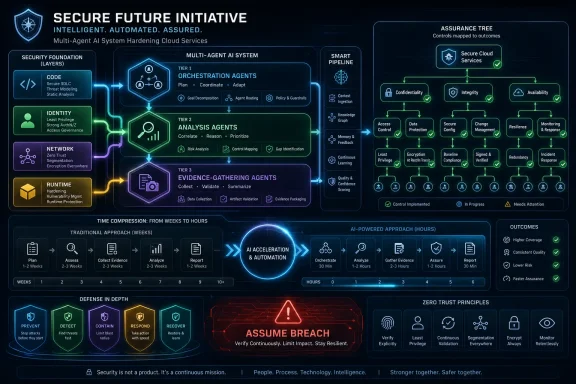
Microsoft describes the system as using a multi-tier agent hierarchy. That phrase risks sounding like AI architecture theater, but the roles Microsoft names are practical: orchestration agents, analysis agents, and evidence-gathering agents. The important point is that the system separates workflow, reasoning, and verification rather than pretending one model prompt can do everything.| Agent tier | Microsoft’s described role | Practical security function |
|---|---|---|
| Orchestration agents | Workflow management | Coordinate the review process and move tasks through the pipeline |
| Analysis agents | Security reasoning grounded in Microsoft threat intelligence | Interpret risk, evaluate attack paths, and reason about defenses |
| Evidence-gathering agents | Investigation across code repositories, infrastructure definitions, identity configurations, runtime settings, network topologies, and live resource states | Collect the proof needed to confirm whether expected controls exist and work |
The evidence-gathering layer is especially important. Many AI security demonstrations stop at plausible findings. Microsoft is instead emphasizing that the system investigates across real artifacts: code repositories, infrastructure definitions, identity configurations, runtime settings, network topologies, and live resource states. That is the difference between a clever theory and a defensible finding that a security engineer can validate.
Microsoft also says the analysis agents are grounded in Microsoft’s threat intelligence, including emerging patterns and threat actor activity. That matters because compositional risk is not just about connecting any two weaknesses. It is about understanding which chains resemble real attacker behavior, which gaps are likely to be exploitable, and which missing controls make a service fragile even before a named exploit appears.
Still, the company’s disclosure leaves important details outside the frame. Microsoft does not provide the underlying models, the exact validation workflow, the volume of reviewed services, or the false-positive methodology behind its headline confirmation rate. That is not surprising for an internal security system, but it means readers should treat the announcement as a credible architecture disclosure rather than an independently benchmarked product claim.
“Weeks Into Hours” Is the Operational Claim That Matters
Microsoft says traditional human-led security reviews can take weeks, and that its system compresses the same depth of analysis into hours. Later in the post, the company sharpens that comparison: a deep review of a complex service might span weeks of effort by multiple domain experts, while the system can achieve a thorough review in a matter of hours. That is the operational heart of the announcement.Speed alone does not make a security process better. A bad scan run every hour is still a bad scan. But if Microsoft’s description is accurate, the system is not merely accelerating a narrow check; it is accelerating a review pattern that includes architecture profiling, control enumeration, implementation verification, defense-in-depth evaluation, gap analysis, compensating-control mapping, fix recommendations, and feedback loops from human reviewers.
That kind of compression changes what a security organization can ask. If a deep review takes weeks, teams reserve it for critical launches, major changes, or incidents. If a meaningful review takes hours, teams can run it after architectural drift, identity changes, deployment changes, new threat intelligence, or updates to internal security requirements. The review becomes less like an audit and more like a control plane.
For Microsoft, that matters because cloud services are not static. Code changes, identities accumulate permissions, network paths appear, runtime settings drift, and dependencies evolve. A review that was accurate three months ago may no longer describe the service that exists today. The company’s model attempts to shorten the distance between production reality and security assurance.
For customers, the lesson is uncomfortable. Many organizations still treat “security review completed” as a milestone rather than a state that decays. Microsoft’s post is effectively saying that the milestone model is obsolete for complex cloud environments. If your service changes continuously, your assurance process has to change continuously too.
The Four Design Principles Show a Wariness of Yesterday’s Security Tools
Microsoft lists four core design principles behind the analysis pipeline: Frontier-ready architecture, Compositional risk reasoning, Service-specific adaptation, and Defense-in-depth evaluation. Read together, they are a critique of how security tooling has often been deployed. Static tools are too narrow, fixed checklists are too rigid, and single-finding severity scores miss the way attackers combine weaknesses.“Frontier-ready architecture” is Microsoft’s answer to the pace of model improvement. The company says the system uses modular model interfaces so new models, enhanced planning, and execution capabilities can be integrated behind stable agent interfaces while preserving tooling, orchestration, knowledge, pipelines, reporting, and governance. In less polished language: Microsoft does not want the security platform to be rebuilt every time the model layer improves.
That is a sensible design choice because AI security systems are being built in a moving market. Today’s best model will not remain the frontier. A hard-coded system built around one model’s assumptions risks becoming obsolete quickly. By separating the model interface from the rest of the security pipeline, Microsoft is trying to make the security machinery durable even as the reasoning engines change.
“Compositional risk reasoning” is the principle most directly aimed at real cloud attacks. Microsoft says the system uses “what-if” agentic ideation to explore how individual security gaps can chain into multi-step attack paths. Its example combines a minor identity misconfiguration, an unrelated network exposure, and a missing data encryption control into a potentially serious breach path.
That is exactly where ordinary vulnerability management often fails. Teams triage findings one at a time, assign severity, and remediate based on individual scores. Attackers do not have to respect those boundaries. A low-severity identity issue plus a medium-severity network exposure plus a weak data control may be far more dangerous together than any one finding appears alone.
“Service-specific adaptation” is Microsoft’s rejection of the one-size-fits-all checklist. The system profiles a service, maps components and data flows, locates trust boundaries, and determines which controls should apply to that specific architecture and risk profile. Microsoft specifically notes that the approach can account for novel patterns, microservices architectures spanning multiple codebases, and agent-to-agent communication models.
That matters because cloud estates increasingly contain services that do not fit neat review templates. A conventional checklist can be useful, but it can also create a false sense of assurance when the architecture has evolved beyond the checklist’s assumptions. Microsoft’s system attempts to generate the review shape from the service itself rather than forcing the service into a static review form.
“Defense-in-depth evaluation” is the principle that ties the system back to SFI. Microsoft says the system asks two questions: “What vulnerabilities exist?” and “Where does this service lack multiple lines of defense?” The second question is the more forward-looking one. It means the system can flag brittle architectures even when no immediate exploit is identified.
That is a significant philosophical shift. Traditional vulnerability management often begins with known badness. Microsoft’s approach, as described, also looks for missing resilience. A service with weak network segmentation or an overly permissive admin role may deserve attention not because an exploit is already known, but because a single failure could lead to compromise.
The Assurance Tree Turns SFI From Doctrine Into a Testable Map
Microsoft’s “assurance tree” is the most concrete concept in the post. The company describes it as a structured, hierarchical map of security controls that the system expects a service to have in place, tailored to that service’s usage and design. That is how broad SFI principles become something an automated system can verify.The tree starts with fundamental security domains mapped to SFI pillars. Those domains are then decomposed into more granular controls and sub-controls. Microsoft’s identity example is useful because it descends from an abstract domain into implementation detail: identity security decomposes into password policies, OAuth token handling, and MFA enforcement, down to verifying that a service’s code correctly validates a JSON Web Token’s issuer and expiration.
That last detail is where the announcement becomes more than cloud governance language. Verifying a JSON Web Token’s issuer and expiration is not a board-level control statement. It is a concrete implementation check that can determine whether a service accepts tokens it should reject. Microsoft is saying the system can connect high-level security requirements to low-level evidence in code and configuration.
The company says the assurance tree guides evidence-gathering agents to verify that thousands of expected controls are in place and effective, or to identify where something is missing. That matters because scale is the enemy of assurance. A human review team may know what “good” looks like, but repeatedly proving that thousands of controls exist across changing services is a different kind of problem.
The tree also helps explain how Microsoft tries to avoid open-ended AI wandering. Instead of telling a model to “go find problems,” the system expresses expected defenses in a structured hierarchy and asks whether the service implements them. Microsoft summarizes the question directly: “Have all the security measures that should protect this service been properly implemented?”
That question is deceptively powerful. It changes security review from a bug hunt into a proof problem. The system is not only looking for known vulnerabilities; it is checking whether the service has the controls it should have, whether they work, and whether missing pieces combine in dangerous ways.
For enterprise defenders, the assurance tree may be the most portable idea in the announcement. Customers cannot use Microsoft’s internal system, but they can build their own control maps that tie policy to evidence. A security requirement that cannot be traced to code, configuration, identity, runtime state, or monitoring evidence is not really verified. It is merely asserted.
The 90 Percent Confirmation Rate Is Impressive, but It Needs the Right Reading
Microsoft says that more than 90% of the system’s findings have been confirmed as genuine security issues by its security engineers. That is a strong internal quality claim. It suggests the system is not simply flooding reviewers with speculative AI output, and that the combination of context, reasoning, and evidence gathering is producing findings humans can act on.But the number should be read carefully. Microsoft does not disclose the denominator, the classes of issues counted, the process for confirmation, or how duplicate and severity-weighted findings are handled. That does not invalidate the claim, but it does limit what outsiders can conclude. A 90% confirmation rate inside Microsoft’s own validation workflow is not the same as an independent benchmark against a public corpus.
The more meaningful part may be the nature of the issues Microsoft says the system finds. The company reports that many are nuanced, cross-domain vulnerabilities that would not have been caught by traditional methods. It specifically points to gaps that only become apparent when considering code, configuration, and cloud resources together.
That is consistent with the larger thesis. AI is not being used here only to detect more instances of familiar bug classes. It is being used to reason about service composition. The system’s value comes from the gaps between tools: the place where code analysis, identity posture, network exposure, cloud configuration, and runtime state overlap.
This is also where Microsoft’s disclosure intersects with a broader security reality. Enterprises already own many specialized tools, but their hardest incidents often emerge from translation failures between them. The identity team sees one thing, the network team sees another, the application team sees another, and the security operations team receives telemetry without full architectural context. Microsoft is arguing that AI agents can help integrate those views into a service-level understanding.
That does not mean the human role disappears. Microsoft says its security engineering teams validate and implement the recommendations. The system generates findings and recommendations; humans confirm them, judge practical remediation, and drive durable fixes. In a mature interpretation, AI becomes the force multiplier for expert review, not the accountable owner of security decisions.
“Assume Breach” Becomes an Engineering Test, Not a Slogan
Microsoft explicitly ties the system to a forward-looking “assume breach” analysis. The phrase has been part of Zero Trust vocabulary for years, but it often operates as a cultural principle rather than an engineering test. Microsoft’s implementation attempts to make it concrete: if one layer fails, are there still multiple lines of defense?That is why the system flags missing or brittle layers even when no immediate exploit is identified. In a conventional vulnerability queue, such findings can be politically hard to prioritize. If there is no exploit, no incident, and no urgent severity label, the work competes poorly against feature delivery. Defense-in-depth evaluation changes the argument: the issue is not that compromise is guaranteed, but that the service has too little margin for failure.
Cloud services need that margin because real attacks are rarely clean. An attacker may begin with a stolen credential, an exposed internal endpoint, a mis-scoped token, or a configuration drift that nobody intended. Each individual failure may be survivable if other controls work. The danger appears when one missing layer turns a local mistake into a service-wide compromise path.
This is where Microsoft’s SFI framing becomes operationally meaningful. Secure engineering is not just about eliminating every bug before deployment. That is impossible. It is about making sure that when bugs, misconfigurations, and operational errors happen, they do not cascade. The AI system’s job, as Microsoft describes it, is to identify where the cascade risk exists before an attacker demonstrates it.
For Windows and Microsoft cloud administrators, this is a useful way to rethink familiar controls. MFA enforcement, token validation, least privilege, network segmentation, detection coverage, and tenant isolation are often discussed as separate best practices. Microsoft’s post treats them as overlapping layers whose combined absence or weakness determines real exposure.
That has practical consequences for prioritization. The riskiest item in a backlog may not be the one with the scariest label. It may be the one that removes the last remaining barrier between a compromised identity and sensitive resources. A system capable of mapping compensating controls can help identify that difference.
Customers Do Not Get the Engine, but They Do Get the Warning
Microsoft’s announcement includes a customer-facing pointer, but not the one some readers may want. The internal multi-agent system is not being offered as a product. Instead, Microsoft says customers can review Secure Now guidance for AI-powered security and proactive defense, and that any customer with a Microsoft Entra ID can access it. Microsoft also says Microsoft Security customers will have access to capabilities that enable them to assess exposure and take action.That leaves a gap between Microsoft’s internal capability and what customers can immediately adopt. The company is effectively saying: we built this for ourselves, the patterns will influence products over time, and customers should start applying the principles now. For organizations hoping to buy the exact same machinery, that is a disappointment. For security leaders trying to understand where Microsoft’s platform strategy is going, it is a signal.
The likely direction is clear enough. Microsoft will keep folding more AI-driven exposure assessment, control validation, and remediation guidance into its security products. The post does not name a customer product version of the internal system, and readers should not infer one. But Microsoft explicitly says the insights and patterns developed through the work will inform product improvements over time.
That phrasing matters. Microsoft is not promising parity between its internal cloud-hardening system and customer tooling. It is saying the internal work will shape the products. That could mean better exposure management, more context-aware recommendations, improved identity and configuration analysis, or new ways to reason about composite attack paths. The announcement does not specify which capabilities arrive where or when.
In the meantime, customers should treat this as a blueprint for their own governance. The core ideas are not exotic: collect evidence across domains, map services, define expected controls, verify implementation, reason about attack chains, and prioritize missing defense layers. The novelty is using AI agents to perform those tasks continuously at scale.
That is easier said than done. Most enterprises still have fragmented inventories, incomplete ownership metadata, inconsistent infrastructure-as-code adoption, uneven identity hygiene, and limited visibility into runtime state. An AI agent cannot reliably verify what the organization cannot describe or access. Microsoft’s announcement therefore raises the bar for data quality as much as for AI adoption.
Where Enterprise IT Should Copy the Pattern Without Copying the Product
The immediate temptation is to ask what tool can replicate Microsoft’s system. That is the wrong first question. The more useful question is whether your organization can express what a well-defended service should look like and prove whether real deployed services meet that standard.Start with services, not tools. Pick a critical application or cloud workload and map its components, data flows, trust boundaries, identities, network paths, runtime settings, and dependencies. If that map cannot be produced, the organization is not ready for Microsoft-style continuous assurance. It is still in the discovery phase.
Then define the expected controls for that specific service. Generic standards are useful, but they must be translated into concrete evidence. If identity security matters, what exactly proves OAuth token handling is correct? If network segmentation matters, what evidence shows that internal APIs are not reachable from inappropriate tiers? If MFA enforcement is required, where is that enforced and how is it monitored?
Next, look for composite risk rather than isolated noncompliance. A broad role assignment may be tolerable if tightly constrained by network, detection, and approval workflows. The same role may be dangerous if paired with a reachable internal API and weak token validation. Prioritization should consider compensating controls and attack paths, not only individual control failures.
Finally, use AI where it is strongest: summarizing architecture, correlating evidence, generating hypotheses, and accelerating expert review. Do not use it as an unaccountable oracle. Microsoft’s own description keeps security engineers in the loop to confirm findings and implement remediation. Enterprises should do the same, especially in regulated or business-critical environments.
Action checklist for admins
- Build or update service maps for critical workloads, including code repositories, infrastructure definitions, identity configurations, runtime settings, network paths, and live resource state.
- Translate security policy into service-specific controls that can be verified with evidence rather than asserted in documentation.
- Review identity controls for password policies, OAuth token handling, MFA enforcement, and token validation paths, including issuer and expiration checks where JSON Web Tokens are used.
- Prioritize remediation based on composite attack paths and missing defense layers, not only individual scanner severity.
- Establish a recurring review process that runs after significant code, identity, network, or deployment changes.
- Use AI-assisted analysis to accelerate evidence gathering and hypothesis generation, while keeping human security engineers accountable for validation and remediation decisions.
The Hidden Challenge Is Governance, Not Model Intelligence
The phrase “multi-agent AI system” naturally draws attention to the AI. But the less glamorous parts of Microsoft’s design may be more important: stable orchestration, control hierarchies, evidence pipelines, reviewer feedback, and governance. Without those, agentic security systems risk becoming noisy assistants that generate plausible tickets without organizational trust.Microsoft’s “frontier-ready” principle hints at this. The company wants to benefit from new models without throwing away existing tooling, orchestration, knowledge, pipelines, reporting, and governance. That is a mature concern. In security, a more capable model is not useful if it cannot fit into approval processes, audit trails, ownership models, and remediation workflows.
The assurance tree is also a governance artifact. It defines what the system expects and why. If a service team disputes a finding, the argument can in principle move back through the tree: which requirement applies, which evidence was gathered, which implementation is missing or brittle, and which compensating controls reduce or fail to reduce risk. That is a healthier process than debating whether an AI-generated statement “sounds right.”
Reviewer feedback is another critical piece. Microsoft says the system continuously learns and improves by incorporating feedback from security reviewers and service teams, as well as evolving threat intelligence. That feedback loop is what prevents the system from freezing today’s assumptions into tomorrow’s blind spots. It also helps tune the distinction between theoretically interesting gaps and findings that merit engineering work.
This is where enterprises should be cautious. Buying or building an AI security assistant without a control framework can create more confusion than clarity. The tool may find things, but the organization may not agree on ownership, severity, compensating controls, or acceptance criteria. Microsoft’s announcement works because the AI system is embedded inside SFI’s requirements and Microsoft’s security engineering process.
That should be the durable lesson. Agentic AI may accelerate security review, but it does not remove the need for policy clarity, architecture ownership, or disciplined remediation. In fact, it makes those things more important because the review cadence increases. A weekly flood of findings is useful only if the organization has a way to decide what matters and fix it.
Microsoft’s Strongest Claim Is Also Its Biggest Test
Microsoft’s strongest claim is that the system can evaluate whole services in context. That is exactly what cloud security needs. It is also extremely hard.Whole-service understanding requires joining evidence from systems that often have different owners and different truth models. Code repositories describe intended behavior. Infrastructure definitions describe declared infrastructure. Identity configuration describes access relationships. Runtime settings describe deployed reality. Network topology describes reachability. Live resource state reveals what actually exists now. Any serious assurance system has to reconcile all of them.
Microsoft says its evidence-gathering agents investigate across precisely those domains. If that works at Microsoft scale, it is a major internal capability. It means the system can identify not just whether a control is documented, but whether it is implemented and effective in the live service context.
The hard part is that live environments are messy. Temporary exceptions become permanent. Emergency access paths linger. Legacy services use old patterns. Ownership changes. Infrastructure-as-code may not cover everything. A service may span multiple repositories and deployment systems. A model can reason only from the evidence it can retrieve and trust.
That is why Microsoft’s confirmation workflow matters. More than 90% confirmed genuine is a reassuring figure, but the real proof over time will be whether the system helps reduce exploitable exposure, not merely produce accurate findings. Microsoft’s post says it has enabled security engineering teams to proactively harden cloud services within a few months. The long-term measure will be whether this kind of continuous review materially changes incident rates, blast radius, and remediation speed.
There is also a cultural test. Service teams tend to accept findings when they trust the source, understand the evidence, and see a practical path to remediation. AI-generated recommendations that lack context are easy to ignore. Microsoft’s emphasis on compensating controls and durable fix recommendations suggests it understands that security findings must be actionable, not just technically valid.
Why This Matters for WindowsForum Readers
For many WindowsForum readers, the phrase “Microsoft cloud infrastructure” may sound distant from everyday administration. It should not. Microsoft’s cloud services sit behind identity, device management, security, collaboration, development, and business workflows used across Windows environments. How Microsoft secures those services affects the trust model many organizations now depend on.The announcement also reflects where Microsoft is likely to steer its broader security ecosystem. Identity-aware exposure assessment, AI-assisted control verification, service-specific recommendations, and defense-in-depth scoring all align with the direction enterprise security has been moving. Microsoft is not simply describing an internal experiment; it is previewing a security philosophy that will almost certainly shape future product behavior.
For admins, the near-term value is conceptual. Stop treating cloud security as a stack of independent checks. A Windows estate tied into Microsoft cloud services depends on identities, devices, policies, tokens, APIs, network paths, and logging pipelines that interact. The riskiest failure may be the combination no single dashboard elevates.
For security teams, the message is about cadence. If attackers can use AI to enumerate, test, and chain weaknesses faster, defenders need faster assurance loops. That does not mean blindly automating remediation. It means using automation and AI to shorten the time between a service changing and the organization understanding whether the change weakened its defenses.
For IT leaders, the governance implication is immediate. AI-powered security is not a magic layer placed on top of disorder. It rewards organizations that know their assets, define their controls, maintain ownership, and keep evidence accessible. The firms that benefit most will be the ones that already have enough structure for AI to accelerate.
What to Carry Into the Next Security Review
Microsoft’s July 8 disclosure should be read less as a product announcement than as a warning about the new baseline for serious cloud defense. The company is saying that modern review must be service-specific, evidence-driven, and fast enough to keep up with both production change and AI-assisted attackers.- Microsoft built an internal multi-agent AI system under SFI to harden its own cloud infrastructure, not a customer-facing product.
- The system uses orchestration, analysis, and evidence-gathering agents to reason across code, configuration, identity, runtime, network, and live resource state.
- Microsoft says it compresses deep reviews from weeks into hours and that more than 90% of findings have been confirmed as genuine security issues.
- The assurance tree is the key portable idea: turn security requirements into a structured map of controls that can be verified with evidence.
- The practical lesson for enterprises is to prioritize composite attack paths and missing defense layers, not just individual scanner findings.
- Customers can access Secure Now guidance with a Microsoft Entra ID, while Microsoft Security customers are expected to receive exposure-assessment and action-oriented capabilities.
References
- Primary source: Microsoft
Published: Wed, 08 Jul 2026 17:00:00 GMT
Loading…
www.microsoft.com