

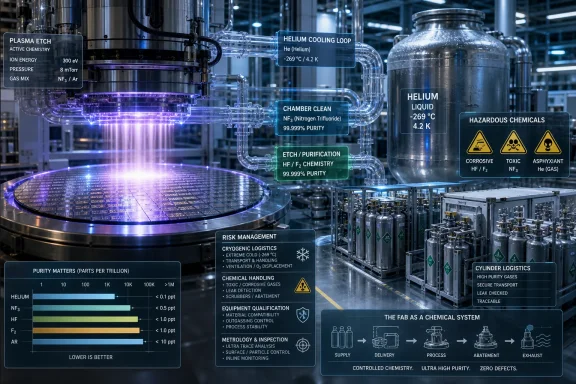
ChinaTalk’s “The Chemistry of Chips,” hosted by Jordan Schneider with Chris Miller, Aqib Zakaria, and specialty-gas veteran Carl Jackson, makes the core answer immediate: the most fragile chip input discussed in the episode is not silicon, not lithography, and not even a single “magic” material. It is the fab chemistry stack — especially helium for cooling, fluorinated gases such as NF3 for chamber cleaning, hydrofluoric acid and fluorine chemistry for etching and purification, and the bulk gases supplied through air separation units. These inputs matter because advanced fabs cannot simply swap them out when a supplier, route, package, or qualification chain breaks. For WindowsForum readers, the practical takeaway is to treat semiconductor resilience as a materials question as much as a fab-capacity question: ask hardware, cloud, and infrastructure vendors how they qualify alternate gas and chemical suppliers, how much safety stock exists for hard-to-substitute inputs, and whether their manufacturing partners have contingency plans for specialty gases, purified acids, and on-site consumables.
That is the useful shift in the episode. The chip supply chain is often described through visible bottlenecks: EUV scanners, advanced packaging, export controls, GPUs, memory, and leading-edge foundry capacity. Jackson’s point is that fabs are also continuous chemical systems. A wafer may be the starting surface, but the finished chip depends on repeated deposition, etching, cleaning, implantation, inerting, cooling, and measurement steps. Those steps require gases and chemicals that must arrive at the right purity, in the right container, under the right safety rules, and already qualified for the exact process in which they will be used.
For anyone buying Windows PCs, servers, AI accelerators, storage systems, networking gear, or cloud capacity, the actionable lesson is not to panic over one gas. It is to map the risk categories that sit underneath modern compute: cryogenic logistics, specialty-gas qualification, fluorine chemistry exposure, purified acid availability, bulk-gas infrastructure, metrology limits, and long supplier change cycles. The failure mode may not look like a broken factory. It may look like a fab full of expensive tools waiting for consumables.
The public story of semiconductors is usually told through machines, nodes, and geopolitics: ASML lithography tools, TSMC’s process leadership, Samsung’s foundry ambitions, Intel’s comeback plans, export controls, AI GPUs, and national industrial policy. ChinaTalk’s episode forces a different frame. According to Carl Jackson, co-founder and managing director of SSoT Group and a more than 25-year veteran of the specialty gas industry, “semiconductors are basically made using gas.”
That line sounds exaggerated only if chips are imagined as miniature carved objects. In a fab, the silicon wafer is the foundation, but the structures above it are repeatedly deposited, etched, doped, cleaned, and conditioned using gases and gas-derived chemistries. Jackson’s skyscraper analogy is useful: the wafer is the concrete slab, while the floors, wiring, shafts, and services are built layer by layer from a chemistry set that must behave perfectly at atomic scale.
The numbers are larger than most chip-policy conversations acknowledge. Jackson says there are probably 120-odd different chemicals entering a fab from different suppliers, with probably 60 unique chemicals going in, and that they basically all enter in gaseous form. On top of the bulk gases such as nitrogen and argon, a typical advanced fab depends on 60 or 70 different specialty process gases for deposition, ion implantation, etching, and cleaning.
That does not mean every gas has the same strategic profile. Some are made in huge industrial volumes and then purified for semiconductor use. Some are niche materials with narrow qualification windows. Some are logistically easier to reroute. Others are hard to substitute quickly because the container, purity history, shipping method, shelf life, and customer qualification are part of the product.
This is where the industry’s normal shorthand fails. “Materials” sounds like a spreadsheet category, but each line item has its own geology, purification technology, cylinder design, transportation rules, safety regime, qualification history, and geopolitical exposure. A fab can spend billions on equipment and still be slowed by a missing or out-of-spec molecule.
For WindowsForum readers, the practical categories to watch are:
The point is not that every enterprise procurement team needs to become a semiconductor chemistry lab. It is that chip resilience is no longer just a question of which foundry makes a processor. It is also a question of whether that foundry and its suppliers can keep the chemical system running.
The useful lesson is not to attach the whole chip-supply story to one geography or one route. The episode’s more durable point is that helium has a risk profile unlike ordinary industrial inputs. Jackson describes its transport as moving product in “the world’s most expensive thermos flask” at -269°C. That description explains why the supply chain is inelastic: helium logistics depend on specialized cryogenic equipment, not generic shipping capacity.
Jackson also says conventional gas cylinders might cost around $50, while helium packages can cost around $1 million each. He adds that suppliers have a 45-day window to get helium from production to consumption before losses become a problem. That makes helium less like a commodity sitting indefinitely in a warehouse and more like a timed logistics operation. When production, shipping, or container repositioning breaks, buyers cannot simply summon unlimited substitute volume from a spot market.
This matters for WindowsForum readers because the semiconductor supply chain sits underneath nearly every computing trend that now gets discussed as software. AI PCs need CPUs, NPUs, GPUs, memory, SSD controllers, power-management chips, networking silicon, and server-side accelerators. Cloud AI services depend on fabs that depend on stable process cooling. A helium problem will not show up as a Windows error message, but it can eventually show up as higher component costs, constrained server capacity, delayed hardware refreshes, or altered procurement timing.
The procurement question is concrete: if a vendor claims supply-chain resilience, ask whether that statement covers only wafer starts and final assembly, or whether it also covers cryogenic gases. Useful questions include:
That is not a critique of fabs. It is an explanation of why they work. The job of semiconductor manufacturing is to build and remove structures at nearly impossible precision. To etch straight features through complex layers, or to implant dopants into silicon with exact depth and angle, the process needs aggressive chemistry under strict control.
Silane is the simplest example. Jackson says silicon gets deposited via a gas called silane. The industry needs silicon in gas form because chip structures cannot be built by attaching visible chunks of silicon to a wafer. But silane is dangerous. If it leaks, Jackson says current safety protocol can be counterintuitive: “if it’s leaking, leave it to leak,” because intervention can create an ignition risk worse than letting the leak react into silicon oxide.
Hydrofluoric acid, or HF, is another. Jackson identifies HF as the chemical people fear most, not necessarily because it is the only dangerous substance in the fab supply chain, but because it is used in meaningful volumes and is especially unforgiving. HF starts as fluorspar dug from the ground, becomes industrial-grade HF at 3 nines purity, and then must be purified for semiconductor use to 6, 7, or 8 nines through distillation and additional specialized steps.
Ion implantation adds a different kind of intensity. Jackson says fabs fire boron, phosphorus, or arsenic into the silicon wafer at 400 kilometers a second. The molecule disintegrates on impact, leaving behind the electrical change the transistor needs. A process that looks calm from a visitor window is, at the atomic level, closer to controlled ballistics than ordinary assembly.
Even nitrogen, the benign workhorse of clean environments, carries risk. Air is mostly nitrogen, but higher nitrogen concentration can displace oxygen and create asphyxiation hazards. Jackson notes that nitrogen asphyxiation, rather than the most exotic fab chemicals, is among the common safety issues.
This is why the industry’s safety record is both impressive and easy to misunderstand. Jackson says there are barely any incidents these days and almost no reportable fab-side incidents across the worldwide industry in a year. That does not mean the chemistry is safe in ordinary terms. It means fabs, gas suppliers, logistics providers, and toolmakers have built an extraordinary control system around dangerous materials.
For enterprise buyers, that distinction matters. A supply chain can be safe and still brittle. The same procedures that make routine operations reliable can make emergency rerouting hard. A fab cannot simply swap a gas source the way an office swaps a toner supplier. It must qualify materials, validate purity, preserve container compatibility, maintain recipe integrity, and stay inside safety and storage limits.
A better vendor conversation starts with the hardest-to-substitute categories:
At those levels, the difficulty starts to shift from making the material to proving what is in it. Jordan Schneider jokes that the measurement problem begins to sound almost quantum, where the tool itself becomes part of the uncertainty. Jackson’s more practical point is that analytical instruments capable of measuring parts-per-trillion impurities are extremely expensive and require scarce expertise.
This is one of the least appreciated cost drivers in advanced manufacturing. The industry often talks as though “purer” is automatically better, and customers understandably push suppliers toward higher purity as nodes shrink and devices become more complex. But Jackson describes a tension between statistical process control demands and demonstrated process necessity. Customers may demand another nine of purity because quality data points that way, while suppliers see little evidence the process actually needs it.
The toolmaker sits in the middle. Jackson says recipes are typically developed by the toolmaker, which specifies the chemistry and purity needed to make a device with performance guarantees. The fab then improves and optimizes those recipes. That creates a system in which a materials supplier can be forced to meet requirements that are scientifically plausible, commercially painful, and not always clearly tied to yield.
This should sound familiar to anyone who has managed enterprise hardware qualification. Requirements can become self-reinforcing. Once a platform is validated against a particular component, firmware level, driver package, or security baseline, changing it becomes expensive even if the replacement is nominally equivalent. In semiconductor gases, that problem is amplified by chemistry, purity, safety, and process yield.
The irony is that the gas may be cheap relative to the chip and still strategically priceless. Jackson says gases are typically talked about as around 10% of a chip’s bill of materials. He gives the same rough 10% figure when thinking about the value share in a Tesla. But the more important question is not the percentage. It is which of the 60 gases a fab can live without. Jackson’s answer is zero.
This table is the part of the episode that should travel into procurement and infrastructure planning. The question is not “Will there be a chip shortage?” The better question is “Which invisible inputs would stop the specific chips, accelerators, SSDs, NICs, or servers we depend on?”
That included specialty gases. Jackson describes an earlier market that was more geographically segmented by chemistry specialty. Japan historically excelled in fluorinated gases, with probably 15 different fluorine-based chemicals and chemistries used in semiconductors. The major industrial gas companies — Linde, Air Products, and Air Liquide — supplied much of the broader portfolio, anchored by long-term bulk gas relationships and air separation units.
China’s approach changed that structure. NF3 is the cleanest example. Jackson says that when the push began, China did not have NF3 capability and had to import it. Provincial programs then developed capacity in parallel, creating massive overcapacity. Chinese domestic NF3 consumption is about 8,000 tonnes, while Jackson says one producer in one province in China is making 55,000 tonnes a year.
That is not normal market development as a Western chemical supplier would usually describe it. Western chemical companies typically build plants after customer due diligence, volume commitments, and profitability modeling. Jackson’s description of the Chinese model is different: if the directive is to build capacity, capacity gets built, even if multiple regions duplicate the effort.
The result is a semiconductor gas industry that looks less like a support sector and more like strategic infrastructure. China has developed the capability to make almost everything internally and in parallel with the rest of the world. That does not mean every Chinese material is automatically qualified for every leading-edge fab. It does mean that China has built options where others still have dependencies.
This is a crucial distinction. The United States often measures semiconductor resilience by fab announcements. China appears, in Jackson’s telling, to have measured it by ecosystem completeness. A fab is the visible symbol; the gas plant, purifier, autoclave, cylinder fleet, metrology lab, and qualification team are the foundation.
For readers evaluating technology suppliers, that distinction changes the due-diligence list. It is not enough to know that a chip is made in a friendly geography or assembled in a diversified location. The more granular questions are:
Taiwan has no natural resources for many of these inputs, faces water constraints, sits in seismic zone 4, and carries obvious geopolitical risk. Its strength came from industrial strategy, manufacturing culture, customer trust, and the genius of pioneers such as Morris Chang. But if one were choosing a location from scratch for a globally critical, chemically dependent manufacturing base, Taiwan’s natural endowment would not be the argument for it.
Jackson’s strongest claim is that Taiwan is 100% reliant on Chinese supply chains today. He gives a direct example: if China restricted NF3 exports, Taiwanese fabs would shut down. That is a narrower and more actionable risk than the usual discussion of blockade or invasion. It suggests that Beijing would not need to physically hit fabs to create semiconductor disruption; it could target the chemical preconditions under which fabs operate.
That does not mean such a restriction is imminent. It does mean the semiconductor world should stop treating materials as secondary to equipment. Export controls have trained policymakers to focus on tools, advanced chips, and compute capability. China’s leverage may sit further upstream, where a low-cost input has a high-value failure mode.
The episode’s nuance is that there is no single “gas risk.” There are gas-specific risk curves. Jackson says NF3 can be easier to move when packages and capacity exist. Helium is harder because the packages are expensive, the logistics are specialized, and the product loses value over time. HF has a different risk curve again because fluorspar sourcing, purification, safety, and storage limits all matter.
That is the most useful framework for WindowsForum readers: do not ask whether the world is “short of semiconductor gases” in the abstract. Ask which gas, for which fab, in which package, at which purity, with which qualified alternate supplier, and under which contractual or regulatory constraints.
2024 — The episode refers to recent semiconductor-materials risk in the context of supply-chain sensitivity, but the broader lesson is gas-specific: some inputs are easier to reroute, while helium, HF, NF3, and on-site bulk gases each have distinct constraints.
July 8, 2026 — ChinaTalk’s “The Chemistry of Chips” put helium cooling, fluorinated gases, HF purification, China’s gas buildout, Taiwan’s dependencies, and the missing materials layer of Western chip policy into one direct conversation.
The U.S. has put major political and financial attention on fabs. That solves part of the problem: geography, capacity, workforce, and manufacturing presence matter. But a domestic fab still needs daily flows of ultra-pure gases, purified HF, NF3 or other cleaning chemistries, silane and deposition gases, and bulk nitrogen and argon from air separation units. If those supply chains remain thin, imported, underqualified, or dependent on a small number of suppliers, the fab is more resilient than an offshore-only model but less resilient than the headline suggests.
The on-site bulk gas model gives a partial exception. Major fabs need huge volumes of nitrogen, argon, and related gases, which are typically supplied by air separation units built next to the fab. Jackson says these relationships often run 15 to 20 years, with fifteen years becoming the norm. Air separation units can cost $50 million to $60 million or more, stand 30 to 40 meters high, and feed a fab 24/7 for 15 years.
That part of the system is local by necessity. You cannot economically truck in the nitrogen volumes a fab needs. The plant is built next to the customer, tied into permanent infrastructure, and operated under a long-term relationship.
The specialty-gas side is different. It is often governed by shorter, rolling contracts and harsher price competition. These materials may arrive from multiple countries, with limited safety stock and narrow storage permissions. Jackson says all materials typically arrive on site with barely any safety stock, and HF can be stored only in quantities needed for roughly the next month of production.
That makes just-in-time manufacturing look miraculous until it fails. The industry has become so good at delivering lethal, ultra-pure, reactive materials exactly when needed that fabs have not had to build much slack. Reliability becomes its own trap. When a real disruption occurs, there is no easy buffer.
The actionable policy agenda is therefore not “build fewer fabs.” It is “finish the stack.” A forward-looking U.S. resilience plan should distinguish between what fab subsidies already address and what remains exposed:
For policymakers, the recommendation is specific: treat specialty gases, purified acids, air separation units, cylinder fleets, and metrology labs as semiconductor infrastructure. For enterprise buyers, the recommendation is parallel: treat vendor resilience claims as incomplete unless they include materials and consumables.
That is good procurement in the short run. It is dangerous industrial strategy in the long run. Jackson says the race to the bottom means companies such as Air Liquide, Linde, and Merck have less money for R&D and may be less prepared for the next materials required by toolmakers developing new recipes. If the industry needs new gases for future nodes, the supply chains may not be ready when the tools are.
This is the same pattern seen across other mature technology markets. Standardization drives costs down, which expands adoption, which narrows margins, which reduces exploratory investment. Eventually the market discovers that the boring supplier was also the innovation engine. In chip gases, that discovery could arrive as a node transition delayed not by lithography but by materials readiness.
The problem is made worse by the qualification burden. A new material is not simply invented, manufactured, and sold. It must be purified, packaged, transported, measured, handled safely, qualified in tools, integrated into recipes, validated by fabs, and supplied reliably at scale. Every step costs money before volume is guaranteed.
China’s overcapacity changes the economics further. If Chinese suppliers can sell above domestic needs at very low incremental cost, global prices fall. That benefits buyers immediately but can weaken the economics for non-Chinese suppliers that are expected to maintain high-cost R&D, safety, metrology, and redundancy.
The policy answer should not be blank-check protectionism. It should be targeted resilience. Governments and large customers can ask where single-point failure risks exist, which materials have no realistic short-term substitutes, which suppliers maintain R&D capability, and which inputs require public-private coordination because the private market underprices resilience.
Procurement teams can translate that into practical requirements:
For enterprise PC buyers:
That network includes helium cooling, NF3 cleaning, HF purification, silane deposition, nitrogen inerting, argon supply, air separation units, specialized containers, analytical instruments, and long qualification cycles. None of those items has the glamour of EUV or the market visibility of GPUs. But each can become decisive if it is missing, impure, unqualified, unsafe to store, or impossible to transport in time.
For WindowsForum’s audience, the forward-looking close is straightforward: the next era of computing resilience will not be secured only by more fabs, more chips, or more export controls. It will also require boring, technical, entity-dense work in the materials basement: qualifying alternate gas suppliers, investing in purification and metrology, building robust air separation infrastructure, preserving R&D at specialty-chemical firms, and asking vendors harder questions before the next shortage.
A modern Windows PC, AI server, or cloud region begins far upstream of the device a user touches. It begins with gases and chemicals moving through a disciplined, dangerous, highly qualified system. If that system is resilient, the rest of the computing stack has a chance. If it is fragile, the most advanced chip roadmap in the world can still be stopped by chemistry.
That is the useful shift in the episode. The chip supply chain is often described through visible bottlenecks: EUV scanners, advanced packaging, export controls, GPUs, memory, and leading-edge foundry capacity. Jackson’s point is that fabs are also continuous chemical systems. A wafer may be the starting surface, but the finished chip depends on repeated deposition, etching, cleaning, implantation, inerting, cooling, and measurement steps. Those steps require gases and chemicals that must arrive at the right purity, in the right container, under the right safety rules, and already qualified for the exact process in which they will be used.
For anyone buying Windows PCs, servers, AI accelerators, storage systems, networking gear, or cloud capacity, the actionable lesson is not to panic over one gas. It is to map the risk categories that sit underneath modern compute: cryogenic logistics, specialty-gas qualification, fluorine chemistry exposure, purified acid availability, bulk-gas infrastructure, metrology limits, and long supplier change cycles. The failure mode may not look like a broken factory. It may look like a fab full of expensive tools waiting for consumables.
 The Chip Industry’s Quietest Bottleneck Is Not Silicon
The public story of semiconductors is usually told through machines, nodes, and geopolitics: ASML lithography tools, TSMC’s process leadership, Samsung’s foundry ambitions, Intel’s comeback plans, export controls, AI GPUs, and national industrial policy. ChinaTalk’s episode forces a different frame. According to Carl Jackson, co-founder and managing director of SSoT Group and a more than 25-year veteran of the specialty gas industry, “semiconductors are basically made using gas.”That line sounds exaggerated only if chips are imagined as miniature carved objects. In a fab, the silicon wafer is the foundation, but the structures above it are repeatedly deposited, etched, doped, cleaned, and conditioned using gases and gas-derived chemistries. Jackson’s skyscraper analogy is useful: the wafer is the concrete slab, while the floors, wiring, shafts, and services are built layer by layer from a chemistry set that must behave perfectly at atomic scale.
The numbers are larger than most chip-policy conversations acknowledge. Jackson says there are probably 120-odd different chemicals entering a fab from different suppliers, with probably 60 unique chemicals going in, and that they basically all enter in gaseous form. On top of the bulk gases such as nitrogen and argon, a typical advanced fab depends on 60 or 70 different specialty process gases for deposition, ion implantation, etching, and cleaning.
That does not mean every gas has the same strategic profile. Some are made in huge industrial volumes and then purified for semiconductor use. Some are niche materials with narrow qualification windows. Some are logistically easier to reroute. Others are hard to substitute quickly because the container, purity history, shipping method, shelf life, and customer qualification are part of the product.
This is where the industry’s normal shorthand fails. “Materials” sounds like a spreadsheet category, but each line item has its own geology, purification technology, cylinder design, transportation rules, safety regime, qualification history, and geopolitical exposure. A fab can spend billions on equipment and still be slowed by a missing or out-of-spec molecule.
For WindowsForum readers, the practical categories to watch are:
| Supply-chain risk category | What it means in fab operations | Why substitution is hard | Questions buyers and operators should ask vendors |
|---|---|---|---|
| Cryogenic logistics | Helium and other gases may require specialized storage, transport, and loss management | Containers, routing, and delivery timing are part of the supply chain | Does your foundry or manufacturing partner have qualified alternate helium supply and logistics capacity? |
| Specialty-gas qualification | Process gases must be validated in tools and recipes | A nominally similar gas may not behave identically at required purity | How many qualified suppliers exist for the highest-risk process gases? |
| Fluorine chemistry exposure | NF3, HF, and other fluorinated chemistries support cleaning, etching, and purification | Upstream minerals, purification steps, and safety rules create chokepoints | Which fluorinated inputs are single-region or single-supplier dependent? |
| Bulk-gas infrastructure | Nitrogen, argon, and related gases are often supplied by on-site air separation units | These are capital-intensive, site-specific, long-term systems | Are on-site gas plants redundant, contractually secure, and physically protected? |
| Purity and metrology | Materials must be made and measured at extreme purity | Proving impurity levels may require expensive equipment and scarce expertise | Can suppliers document purity, lot history, and metrology capability at the required level? |
| Qualification cycle length | Supplier changes require validation before production use | Emergency substitution may introduce yield, safety, or reliability risk | How long would it take to qualify an alternate source for each critical input? |
| Safety and storage limits | Toxic, reactive, or asphyxiating materials may have strict handling limits | Large inventories may be impractical or impermissible | What safety-stock levels are realistic for HF, silane, NF3, helium, and other high-risk inputs? |
Helium Shows Why “Small” Inputs Can Become Fab-Risk Events
Helium is the cleanest example in the episode of a hidden dependency becoming strategically visible. Jackson says helium is used by every semiconductor manufacturer in every fab in every location in the world, primarily for cooling. Many fab processes look quiet from outside the tool, but they are thermally demanding and require careful cooling to remain stable.The useful lesson is not to attach the whole chip-supply story to one geography or one route. The episode’s more durable point is that helium has a risk profile unlike ordinary industrial inputs. Jackson describes its transport as moving product in “the world’s most expensive thermos flask” at -269°C. That description explains why the supply chain is inelastic: helium logistics depend on specialized cryogenic equipment, not generic shipping capacity.
Jackson also says conventional gas cylinders might cost around $50, while helium packages can cost around $1 million each. He adds that suppliers have a 45-day window to get helium from production to consumption before losses become a problem. That makes helium less like a commodity sitting indefinitely in a warehouse and more like a timed logistics operation. When production, shipping, or container repositioning breaks, buyers cannot simply summon unlimited substitute volume from a spot market.
This matters for WindowsForum readers because the semiconductor supply chain sits underneath nearly every computing trend that now gets discussed as software. AI PCs need CPUs, NPUs, GPUs, memory, SSD controllers, power-management chips, networking silicon, and server-side accelerators. Cloud AI services depend on fabs that depend on stable process cooling. A helium problem will not show up as a Windows error message, but it can eventually show up as higher component costs, constrained server capacity, delayed hardware refreshes, or altered procurement timing.
The procurement question is concrete: if a vendor claims supply-chain resilience, ask whether that statement covers only wafer starts and final assembly, or whether it also covers cryogenic gases. Useful questions include:
- Which helium sources are qualified for the fabs producing the relevant chips?
- Are cryogenic transport packages dedicated, shared, or vulnerable to repositioning delays?
- Does the fab have realistic emergency allocation plans for cooling gases?
- Are alternate suppliers already qualified, or merely theoretically available?
- How long could production continue under constrained helium logistics before tool availability, recipe stability, or output is affected?
Fabs Are Continuous Chemical Systems
The semiconductor industry’s public image is clean, white, and silent. Bunny suits, polished floors, robot wafer carriers, and filtered air suggest sterility. Jackson’s description is more industrial: “Almost everything in this toolkit is lethal. It either poisons you, explodes instantly upon contact with air, or can kill you quickly or slowly.”That is not a critique of fabs. It is an explanation of why they work. The job of semiconductor manufacturing is to build and remove structures at nearly impossible precision. To etch straight features through complex layers, or to implant dopants into silicon with exact depth and angle, the process needs aggressive chemistry under strict control.
Silane is the simplest example. Jackson says silicon gets deposited via a gas called silane. The industry needs silicon in gas form because chip structures cannot be built by attaching visible chunks of silicon to a wafer. But silane is dangerous. If it leaks, Jackson says current safety protocol can be counterintuitive: “if it’s leaking, leave it to leak,” because intervention can create an ignition risk worse than letting the leak react into silicon oxide.
Hydrofluoric acid, or HF, is another. Jackson identifies HF as the chemical people fear most, not necessarily because it is the only dangerous substance in the fab supply chain, but because it is used in meaningful volumes and is especially unforgiving. HF starts as fluorspar dug from the ground, becomes industrial-grade HF at 3 nines purity, and then must be purified for semiconductor use to 6, 7, or 8 nines through distillation and additional specialized steps.
Ion implantation adds a different kind of intensity. Jackson says fabs fire boron, phosphorus, or arsenic into the silicon wafer at 400 kilometers a second. The molecule disintegrates on impact, leaving behind the electrical change the transistor needs. A process that looks calm from a visitor window is, at the atomic level, closer to controlled ballistics than ordinary assembly.
Even nitrogen, the benign workhorse of clean environments, carries risk. Air is mostly nitrogen, but higher nitrogen concentration can displace oxygen and create asphyxiation hazards. Jackson notes that nitrogen asphyxiation, rather than the most exotic fab chemicals, is among the common safety issues.
This is why the industry’s safety record is both impressive and easy to misunderstand. Jackson says there are barely any incidents these days and almost no reportable fab-side incidents across the worldwide industry in a year. That does not mean the chemistry is safe in ordinary terms. It means fabs, gas suppliers, logistics providers, and toolmakers have built an extraordinary control system around dangerous materials.
For enterprise buyers, that distinction matters. A supply chain can be safe and still brittle. The same procedures that make routine operations reliable can make emergency rerouting hard. A fab cannot simply swap a gas source the way an office swaps a toner supplier. It must qualify materials, validate purity, preserve container compatibility, maintain recipe integrity, and stay inside safety and storage limits.
A better vendor conversation starts with the hardest-to-substitute categories:
- Helium for cooling: difficult because cryogenic logistics, specialized packages, and time-to-consumption constraints matter.
- NF3 for chamber cleaning: difficult because tool recipes, qualification, and export exposure can matter even when capacity exists somewhere else.
- HF and purified fluorine chemistry: difficult because upstream fluorspar, purification, safety, and storage constraints compound one another.
- Silane and other reactive deposition gases: difficult because safe packaging, leak behavior, and supplier qualification are inseparable from the product.
- Bulk nitrogen and argon: difficult because the supply model is usually site-specific and tied to on-site air separation units rather than simple trucking.
Purity Is Becoming a Measurement Problem as Much as a Manufacturing Problem
The episode’s most useful technical section is not the danger narrative; it is the purity discussion. Jackson says the silicon wafer sits at the extreme, with 11 nines purity, and that only two companies in the world currently can achieve that. For gases, parts-per-million impurity is now a basic requirement. Some gases are reaching parts per billion, and some even get into parts per trillion.At those levels, the difficulty starts to shift from making the material to proving what is in it. Jordan Schneider jokes that the measurement problem begins to sound almost quantum, where the tool itself becomes part of the uncertainty. Jackson’s more practical point is that analytical instruments capable of measuring parts-per-trillion impurities are extremely expensive and require scarce expertise.
This is one of the least appreciated cost drivers in advanced manufacturing. The industry often talks as though “purer” is automatically better, and customers understandably push suppliers toward higher purity as nodes shrink and devices become more complex. But Jackson describes a tension between statistical process control demands and demonstrated process necessity. Customers may demand another nine of purity because quality data points that way, while suppliers see little evidence the process actually needs it.
The toolmaker sits in the middle. Jackson says recipes are typically developed by the toolmaker, which specifies the chemistry and purity needed to make a device with performance guarantees. The fab then improves and optimizes those recipes. That creates a system in which a materials supplier can be forced to meet requirements that are scientifically plausible, commercially painful, and not always clearly tied to yield.
This should sound familiar to anyone who has managed enterprise hardware qualification. Requirements can become self-reinforcing. Once a platform is validated against a particular component, firmware level, driver package, or security baseline, changing it becomes expensive even if the replacement is nominally equivalent. In semiconductor gases, that problem is amplified by chemistry, purity, safety, and process yield.
The irony is that the gas may be cheap relative to the chip and still strategically priceless. Jackson says gases are typically talked about as around 10% of a chip’s bill of materials. He gives the same rough 10% figure when thinking about the value share in a Tesla. But the more important question is not the percentage. It is which of the 60 gases a fab can live without. Jackson’s answer is zero.
| Material or gas family | Main fab role | Supply-chain profile | Practical risk | Reader takeaway |
|---|---|---|---|---|
| Helium | Cooling | Cryogenic logistics; expensive packages; limited time from production to consumption | Hard to replace quickly when logistics break | Ask whether alternate supply and transport packages are already qualified |
| NF3 | Chamber cleaning, described by Jackson as “the janitor of the semiconductor world” | Specialty gas tied to tool cleaning and process continuity | Export limits or supplier disruption could affect fab operations if alternatives are not qualified | Ask how many qualified NF3 suppliers exist for relevant fabs |
| HF and fluorspar-derived fluorine chemistry | Etching and fluorine-based processes | Industrial HF must be purified from lower grades to semiconductor grades | Upstream mineral, purification, safety, and storage constraints can stack together | Ask about purified HF sourcing, safety stock, and supplier qualification |
| Nitrogen and argon | Bulk inerting and fab environments | Usually produced by on-site air separation units near the fab | Reliable when infrastructure is stable, but capital-intensive and site-specific | Ask whether on-site bulk-gas systems have redundancy and long-term operating support |
| Silane | Silicon deposition | Dangerous, reactive specialty gas | Safe handling and container behavior are part of operational reliability | Ask whether supplier changes require tool or recipe requalification |
| Metrology capability | Purity verification | Requires specialized analytical instruments and expertise | A supplier may claim purity but struggle to prove it at required limits | Ask whether suppliers can document lot-level purity and impurity measurement |
China Did Not Just Build Fabs; It Built the Chemical Basement
The sharpest geopolitical argument in the ChinaTalk episode is that China’s semiconductor policy has been more vertically complete than America’s. Jackson says Big Fund 1 kicked off around 2014 and that about $120 billion has been invested in the broader infrastructure ecosystem. The important point is not only the amount, but the target: China set out to domesticate the entire ecosystem all at once.That included specialty gases. Jackson describes an earlier market that was more geographically segmented by chemistry specialty. Japan historically excelled in fluorinated gases, with probably 15 different fluorine-based chemicals and chemistries used in semiconductors. The major industrial gas companies — Linde, Air Products, and Air Liquide — supplied much of the broader portfolio, anchored by long-term bulk gas relationships and air separation units.
China’s approach changed that structure. NF3 is the cleanest example. Jackson says that when the push began, China did not have NF3 capability and had to import it. Provincial programs then developed capacity in parallel, creating massive overcapacity. Chinese domestic NF3 consumption is about 8,000 tonnes, while Jackson says one producer in one province in China is making 55,000 tonnes a year.
That is not normal market development as a Western chemical supplier would usually describe it. Western chemical companies typically build plants after customer due diligence, volume commitments, and profitability modeling. Jackson’s description of the Chinese model is different: if the directive is to build capacity, capacity gets built, even if multiple regions duplicate the effort.
The result is a semiconductor gas industry that looks less like a support sector and more like strategic infrastructure. China has developed the capability to make almost everything internally and in parallel with the rest of the world. That does not mean every Chinese material is automatically qualified for every leading-edge fab. It does mean that China has built options where others still have dependencies.
This is a crucial distinction. The United States often measures semiconductor resilience by fab announcements. China appears, in Jackson’s telling, to have measured it by ecosystem completeness. A fab is the visible symbol; the gas plant, purifier, autoclave, cylinder fleet, metrology lab, and qualification team are the foundation.
For readers evaluating technology suppliers, that distinction changes the due-diligence list. It is not enough to know that a chip is made in a friendly geography or assembled in a diversified location. The more granular questions are:
- Are critical gases sourced domestically, regionally, or globally?
- Are the suppliers qualified at the exact process node and tool set?
- Are alternate suppliers already running production lots, or only listed as emergency candidates?
- Which materials still depend on Chinese capacity, Chinese upstream inputs, or Chinese packaging?
- Which consumables are locked into single-supplier qualification because changing them would risk yield?
- Does the vendor’s supply-chain disclosure include chemicals, or only wafers, packaging, and assembly?
Taiwan’s Risk Is Not Only Military
The most provocative sentence in the episode is Jackson’s assessment of Taiwan: “arguably the single worst location you could pick for semiconductor fabs.” He says this as someone who lives there and loves the country, which makes the comment more pointed rather than less. His reasoning is not a simplistic geopolitical slogan. It is a supply-chain diagnosis.Taiwan has no natural resources for many of these inputs, faces water constraints, sits in seismic zone 4, and carries obvious geopolitical risk. Its strength came from industrial strategy, manufacturing culture, customer trust, and the genius of pioneers such as Morris Chang. But if one were choosing a location from scratch for a globally critical, chemically dependent manufacturing base, Taiwan’s natural endowment would not be the argument for it.
Jackson’s strongest claim is that Taiwan is 100% reliant on Chinese supply chains today. He gives a direct example: if China restricted NF3 exports, Taiwanese fabs would shut down. That is a narrower and more actionable risk than the usual discussion of blockade or invasion. It suggests that Beijing would not need to physically hit fabs to create semiconductor disruption; it could target the chemical preconditions under which fabs operate.
That does not mean such a restriction is imminent. It does mean the semiconductor world should stop treating materials as secondary to equipment. Export controls have trained policymakers to focus on tools, advanced chips, and compute capability. China’s leverage may sit further upstream, where a low-cost input has a high-value failure mode.
The episode’s nuance is that there is no single “gas risk.” There are gas-specific risk curves. Jackson says NF3 can be easier to move when packages and capacity exist. Helium is harder because the packages are expensive, the logistics are specialized, and the product loses value over time. HF has a different risk curve again because fluorspar sourcing, purification, safety, and storage limits all matter.
That is the most useful framework for WindowsForum readers: do not ask whether the world is “short of semiconductor gases” in the abstract. Ask which gas, for which fab, in which package, at which purity, with which qualified alternate supplier, and under which contractual or regulatory constraints.
Timeline
Around 2014 — Jackson says Big Fund 1 kicked off, and China began pushing not only fabs but the broader semiconductor infrastructure ecosystem, including materials and gases.2024 — The episode refers to recent semiconductor-materials risk in the context of supply-chain sensitivity, but the broader lesson is gas-specific: some inputs are easier to reroute, while helium, HF, NF3, and on-site bulk gases each have distinct constraints.
July 8, 2026 — ChinaTalk’s “The Chemistry of Chips” put helium cooling, fluorinated gases, HF purification, China’s gas buildout, Taiwan’s dependencies, and the missing materials layer of Western chip policy into one direct conversation.
The U.S. Has Addressed Fabs More Directly Than Consumables
Jackson’s comparison between China’s Big Fund and U.S. semiconductor policy is not that American fab policy is useless. The forward-looking issue is narrower and more practical: building domestic fab capacity does not automatically build domestic resilience in specialty gases, purified acids, cryogenic logistics, metrology, and on-site consumables.The U.S. has put major political and financial attention on fabs. That solves part of the problem: geography, capacity, workforce, and manufacturing presence matter. But a domestic fab still needs daily flows of ultra-pure gases, purified HF, NF3 or other cleaning chemistries, silane and deposition gases, and bulk nitrogen and argon from air separation units. If those supply chains remain thin, imported, underqualified, or dependent on a small number of suppliers, the fab is more resilient than an offshore-only model but less resilient than the headline suggests.
The on-site bulk gas model gives a partial exception. Major fabs need huge volumes of nitrogen, argon, and related gases, which are typically supplied by air separation units built next to the fab. Jackson says these relationships often run 15 to 20 years, with fifteen years becoming the norm. Air separation units can cost $50 million to $60 million or more, stand 30 to 40 meters high, and feed a fab 24/7 for 15 years.
That part of the system is local by necessity. You cannot economically truck in the nitrogen volumes a fab needs. The plant is built next to the customer, tied into permanent infrastructure, and operated under a long-term relationship.
The specialty-gas side is different. It is often governed by shorter, rolling contracts and harsher price competition. These materials may arrive from multiple countries, with limited safety stock and narrow storage permissions. Jackson says all materials typically arrive on site with barely any safety stock, and HF can be stored only in quantities needed for roughly the next month of production.
That makes just-in-time manufacturing look miraculous until it fails. The industry has become so good at delivering lethal, ultra-pure, reactive materials exactly when needed that fabs have not had to build much slack. Reliability becomes its own trap. When a real disruption occurs, there is no easy buffer.
The actionable policy agenda is therefore not “build fewer fabs.” It is “finish the stack.” A forward-looking U.S. resilience plan should distinguish between what fab subsidies already address and what remains exposed:
| Layer | What fab-focused policy helps solve | What remains missing |
|---|---|---|
| Fab location | Domestic wafer capacity, workforce development, local construction, geopolitical diversification | Daily dependence on gases, acids, cylinders, purification, and tool-qualified consumables |
| Bulk gases | On-site air separation units can be built with new fabs | Redundancy, maintenance continuity, physical resilience, and long-term operating contracts still matter |
| Specialty gases | Some supplier co-location may follow fab investment | Qualification of alternate sources, domestic purification, and package availability require explicit planning |
| Fluorine chemistry | Demand from domestic fabs can justify local investment | Fluorspar sourcing, HF purification, NF3 capacity, safety permitting, and storage limits remain separate problems |
| Metrology | Fab investment increases demand for quality systems | Parts-per-billion and parts-per-trillion measurement capability needs skilled people and expensive instruments |
| Emergency resilience | Domestic fabs reduce some overseas exposure | Safety stock, rerouting plans, and cross-qualified suppliers must be designed before a crisis |
The R&D Death Spiral Hides Inside Procurement Savings
The episode also points to a less visible problem: price pressure can hollow out future materials innovation. Jackson says specialty gases are increasingly commoditized. If a customer demands silane at six nines purity from every supplier, differentiation becomes difficult. A supplier can compete on reliability, qualification history, and price, but the buyer sees less reason to pay a premium.That is good procurement in the short run. It is dangerous industrial strategy in the long run. Jackson says the race to the bottom means companies such as Air Liquide, Linde, and Merck have less money for R&D and may be less prepared for the next materials required by toolmakers developing new recipes. If the industry needs new gases for future nodes, the supply chains may not be ready when the tools are.
This is the same pattern seen across other mature technology markets. Standardization drives costs down, which expands adoption, which narrows margins, which reduces exploratory investment. Eventually the market discovers that the boring supplier was also the innovation engine. In chip gases, that discovery could arrive as a node transition delayed not by lithography but by materials readiness.
The problem is made worse by the qualification burden. A new material is not simply invented, manufactured, and sold. It must be purified, packaged, transported, measured, handled safely, qualified in tools, integrated into recipes, validated by fabs, and supplied reliably at scale. Every step costs money before volume is guaranteed.
China’s overcapacity changes the economics further. If Chinese suppliers can sell above domestic needs at very low incremental cost, global prices fall. That benefits buyers immediately but can weaken the economics for non-Chinese suppliers that are expected to maintain high-cost R&D, safety, metrology, and redundancy.
The policy answer should not be blank-check protectionism. It should be targeted resilience. Governments and large customers can ask where single-point failure risks exist, which materials have no realistic short-term substitutes, which suppliers maintain R&D capability, and which inputs require public-private coordination because the private market underprices resilience.
Procurement teams can translate that into practical requirements:
- Identify top materials whose loss would stop production rather than merely raise cost.
- Require vendors to distinguish qualified alternates from theoretical alternates.
- Ask whether supplier qualification is active, expired, or never completed.
- Separate commodity price savings from resilience risk.
- Track whether suppliers invest in metrology and R&D, not only capacity.
- Ask whether safety-stock limits are physical, legal, contractual, or financial.
- Require incident-response plans for gases and chemicals, not only chips and finished goods.
What WindowsForum Readers Should Do With This
Most readers cannot influence semiconductor industrial policy directly. They can, however, make better technology decisions by recognizing where chip risk actually lives. The old procurement checklist asked about CPU generation, RAM, storage, firmware support, TPMs, driver stability, warranty coverage, and lifecycle. The new checklist should add supply-chain depth.For enterprise PC buyers:
- Ask OEMs which processors, SSD controllers, Wi-Fi chipsets, and power-management components have second-source options.
- Avoid locking every department into a single configuration if equivalent platforms can reduce concentration risk.
- Time refresh cycles with awareness that component constraints can arrive months after upstream materials disruption.
- Maintain approved alternates for desktops, laptops, docks, monitors, and networking gear before shortages appear.
- Ask cloud and hardware vendors whether accelerator supply assumptions depend on one foundry, one package technology, or one memory stack.
- Request resilience language that includes gases, chemicals, and consumables, not only wafer capacity.
- Consider phased deployments rather than all-at-once refreshes when hardware supply is tight.
- Track whether critical workloads can move across instance types or hardware generations if one accelerator family becomes constrained.
- Maintain visibility into SSD, memory, networking, and power-component lead times.
- Prequalify alternate motherboards, NICs, storage SKUs, and mini-PC platforms.
- Avoid promising fixed hardware configurations for long periods unless suppliers provide credible continuity commitments.
- Treat unusually cheap component offers cautiously if they depend on fragile or opaque sourcing.
- Add materials resilience to supply-chain questionnaires.
- Ask whether suppliers have qualified alternate fabs or only alternate final-assembly sites.
- Require notification if a major upstream process material becomes constrained.
- Favor vendors that can explain their semiconductor dependency map in operational terms.
- Build visibility into specialty gases, purified acids, cylinder packages, metrology, and on-site bulk-gas plants.
- Support domestic or allied capability where qualification cycles are long and substitution is difficult.
- Encourage pre-crisis qualification of alternate suppliers.
- Treat air separation units and consumables as part of semiconductor infrastructure planning.
- Avoid measuring success only by fab announcements.
The Stack Beneath the Stack
The best part of ChinaTalk’s episode is that it makes the semiconductor supply chain less abstract. Chips are not just designed, taped out, patterned, packaged, and shipped. They are grown, etched, cleaned, cooled, implanted, purified, measured, and kept alive by a network of gases and chemicals that most end users never see.That network includes helium cooling, NF3 cleaning, HF purification, silane deposition, nitrogen inerting, argon supply, air separation units, specialized containers, analytical instruments, and long qualification cycles. None of those items has the glamour of EUV or the market visibility of GPUs. But each can become decisive if it is missing, impure, unqualified, unsafe to store, or impossible to transport in time.
For WindowsForum’s audience, the forward-looking close is straightforward: the next era of computing resilience will not be secured only by more fabs, more chips, or more export controls. It will also require boring, technical, entity-dense work in the materials basement: qualifying alternate gas suppliers, investing in purification and metrology, building robust air separation infrastructure, preserving R&D at specialty-chemical firms, and asking vendors harder questions before the next shortage.
A modern Windows PC, AI server, or cloud region begins far upstream of the device a user touches. It begins with gases and chemicals moving through a disciplined, dangerous, highly qualified system. If that system is resilient, the rest of the computing stack has a chance. If it is fragile, the most advanced chip roadmap in the world can still be stopped by chemistry.
References
- Primary source: ChinaTalk | Jordan Schneider
Published: Wed, 08 Jul 2026 10:45:36 GMT
- Related coverage: news.samsung.com
Samsung Electronics to Receive up to $6.4 Billion in Direct Funding under the CHIPS and Science Act
Samsung Electronics today welcomed U.S. Secretary of Commerce Gina Raimondo to its new semiconductor manufacturing facility in Taylor, Texas, at an event to announce up to $6.4 billion in direct funding to Samsung as part of the CHIPS and Science Act. Samsung Semiconductor CEO Kye Hyun Kyung and...news.samsung.com
- Related coverage: tomshardware.com
AMD CEO says U.S.-made TSMC chips are more expensive, but worth it — costs 'more than 5% but less than 20%' higher than Taiwan-sourced alternative | Tom's Hardware
The U.S.'s push for domestic chip manufacturing is bearing fruit.www.tomshardware.com - Related coverage: axios.com
TSMC to make 30% of top chips in U.S. - Axios Phoenix
TSMC's CEO told investors the company's Phoenix investment scope will create "an independent leading-edge semiconductor manufacturing cluster in the U.S."www.axios.com
- Related coverage: ipc.mit.edu