

Samsung’s Galaxy Watch 8 makes the stronger Android-watch longevity case against Google’s Pixel Watch 4 because it combines comparable water and dust protection with a tougher MIL-STD-810H durability rating and a longer software-support track record. The Pixel Watch 4 is not flimsy, and its repairability gives Google one important counterpunch. But if the question is which Android watch is more likely to remain useful, supported, and physically intact for longer, Samsung has built the cleaner argument. The larger story is that smartwatch lifespan is no longer just about glass, batteries, or bezels; it is about how long a vendor keeps the device inside the living software ecosystem that made it worth buying in the first place.
BGR’s comparison of Samsung and Google wearables lands on a conclusion that will feel familiar to anyone who has watched the Android phone market mature: the spec sheet matters, but the support calendar may matter more. Samsung’s modern Galaxy Watch line, especially the Galaxy Watch 8, looks more robust on paper, while Google’s Pixel Watch 4 answers with serviceability rather than brute-force certification. That is a real philosophical split. Samsung is selling endurance as engineering; Google is selling endurance as recoverability.
The uncomfortable truth for buyers is that both companies are operating inside a category with a built-in expiration date. A smartwatch can often be nursed along for years, but its battery will not age gracefully forever, and its value falls quickly once health features, security patches, and platform updates stop arriving. A watch that still turns on but no longer gets meaningful software support is not dead in the mechanical sense. It is simply becoming less of the device you originally paid for.
The Galaxy Watch 8 and Pixel Watch 4 are close enough in class that the comparison is useful rather than theatrical. Both are mainstream Android smartwatches running in the Wear OS universe, both are meant for daily health and notification use, and both carry the sort of water and dust claims buyers now expect from premium wrist computers. At first glance, this should be a draw.
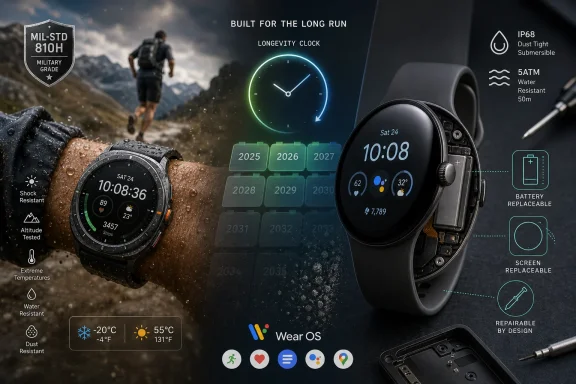
It is not. The Galaxy Watch 8’s advantage begins with a durability profile that goes beyond the shared baseline. Both watches have an IP68 rating, and both are rated at 5ATM, but Samsung adds MIL-STD-810H to the Galaxy Watch 8. That extra line on the spec sheet is easy to dismiss as marketing shorthand until you consider the category: these are devices strapped to wrists, dragged across doorframes, worn during workouts, exposed to sweat, water, temperature swings, travel, and the daily indignities of human clumsiness.
BGR frames Samsung’s edge around the Galaxy Watch 8 being built to withstand everything from shock and vibration to rapid temperature shifts. That matters because “durability” in a smartwatch is not a single event. It is not just whether the device survives one drop or one swim. It is whether it can absorb the accumulated punishment of being worn all day, every day, while still remaining attractive and functional enough that the owner does not start browsing replacements after year two.
Google’s Pixel Watch 4 is described as effectively waterproof and dust-resistant, and that should not be minimized. For most users, IP68 and 5ATM are the ratings that cover the realistic hazards: rain, handwashing, workouts, dust, and ordinary water exposure. The Pixel Watch 4 is not being positioned as a delicate dress watch pretending to be a fitness device.
But Samsung’s advantage is that it speaks to a wider range of abuse. The Galaxy Watch 8’s MIL-STD-810H claim means Samsung can point to U.S. Department of Defense guidelines for durability in extreme environments. The listed stressors in the source material include extreme temperatures, vibration, salt fog, dust, sand, and Florida humidity. That last phrase is almost comic in its specificity, but anyone who has watched electronics suffer through heat, moisture, and sweat knows the joke has teeth.
The practical point is not that every buyer needs a military-grade smartwatch. The practical point is that wrist devices live in harsher conditions than phones. A phone spends much of its life in a pocket, bag, desk, or charger. A watch lives outside the body’s armor. It hits things first.
That sounds decisive until it is not. Water and dust resistance ratings are useful because they establish a minimum expectation, but they are also among the most commonly misunderstood parts of consumer electronics marketing. Buyers see IP68 and hear “waterproof.” Vendors tend to say “water-resistant,” and for good reason.
The distinction matters over time. Seals age. Adhesives weaken. A watch that shrugs off a pool day in its first month may not behave identically after years of heat cycles, knocks, repairs, and wear. Google’s own support language for Pixel Watch devices, as reflected in its official documentation, is careful about this: water and dust resistance are not permanent conditions and can diminish or be lost over time through normal wear, damage, repair, or disassembly. That is not a Pixel-specific embarrassment; it is the physics of tiny sealed electronics.
This is why the shared IP68 and 5ATM ratings do not settle the Samsung-versus-Google question. They establish that both watches are competent for everyday exposure. They do not prove that both watches will age equally well after years of being worn through workouts, showers, hot weather, cold commutes, and accidental impacts.
Samsung’s additional durability claim therefore changes the shape of the comparison. If both watches start from the same water and dust baseline, the device with a broader shock, vibration, temperature, humidity, sand, and salt-fog story gets the benefit of the doubt on physical resilience. The Galaxy Watch 8 does not merely say, “I can handle water.” It says, “I was designed for more hostile conditions than the ones your spec-sheet comparison initially noticed.”
The table is the story in miniature: the watches are similar where buyers expect them to be similar, and different where long-term ownership begins to hurt. Google gives you a better story if something breaks and can be repaired. Samsung gives you a better story if you want the thing not to break, and to keep receiving major software attention for longer.
Still, skepticism should not become blindness. In this comparison, the Galaxy Watch 8’s MIL-STD-810H rating is meaningful because it is additive. Samsung is not using it in place of IP68 or 5ATM. It sits on top of those ratings, expanding the durability conversation beyond water and dust.
That distinction is important. IP ratings are narrow by design. They do not tell you much about vibration. They do not tell you much about rapid temperature shifts. They do not tell you whether a device is better suited to being knocked around in travel, outdoor work, or hard exercise. MIL-STD-810H is not a guarantee that your watch will survive every accident, but it signals that Samsung designed and tested around a wider set of environmental stresses.
BGR’s phrasing is colorful but directionally right: this is where the Samsung watch’s “durability bells and whistles” begin to separate it from Google’s device. If you are a desk worker who mostly uses a smartwatch for notifications, sleep tracking, and step counts, the difference may never matter. If you are a runner, cyclist, tradesperson, field worker, frequent traveler, or someone whose devices lead hard lives, the extra margin becomes more persuasive.
This is also where Samsung’s broader wearable identity helps. Galaxy Watches have often been more conventional in shape than Google’s Pixel Watch line, which has leaned heavily into a distinctive rounded-glass aesthetic. The source material notes that some reviewers have been concerned about the Pixel Watch 4’s curved display breaking and that users have reported easy scratching. That does not make the Pixel Watch 4 a bad watch, but it does underline the trade-off: Google’s design language is elegant, while Samsung’s pitch is easier to square with rough use.
There is a lesson here for the wider Android ecosystem. Wear OS watches are no longer novelty accessories. They are health sensors, payment devices, workout companions, alarm clocks, navigation screens, and sometimes emergency tools. The more jobs a smartwatch takes on, the more durability stops being a niche concern and becomes part of the basic value proposition.
Repairability changes the moral calculus of ownership. A smartwatch with a tired battery can be maddening: still useful, still paired, still familiar, but increasingly unable to make it through the day. A cracked or badly scratched screen can have the same effect. The device is not obsolete because its processor failed; it is obsolete because the economics or logistics of repair are poor.
Google deserves credit if the Pixel Watch 4 makes those two failure points more serviceable. Battery and screen replacement address the most obvious long-term hardware problems in a smartwatch. Batteries age chemically. Screens take impacts. If users can replace both, the Pixel Watch 4 has a path to a longer life even without Samsung’s tougher headline durability rating.
But repairability is not the same as durability. This is the central weakness in Google’s position. A watch that is easier to fix after damage may still be more likely to need fixing. A watch that can receive a new battery may still lose platform relevance when updates stop. Serviceability can extend the life of hardware, but it cannot fully compensate for a shorter software promise.
This is where the smartwatch market differs from traditional watches. A mechanical watch can be serviced for decades because its core purpose remains stable: tell time, look good, keep working. A smartwatch is a small networked computer with sensors, apps, radios, security assumptions, and cloud-linked features. Its usefulness depends on a chain of software commitments that the owner does not control.
That does not make repairability cosmetic. It makes it necessary but insufficient. Google is attacking one of the biggest sustainability and ownership problems in wearables, and that matters. But the Pixel Watch 4 still has to be judged against the software horizon Google provides for the category.
Samsung’s advantage here is blunt: one extra year of software updates. The Galaxy Watch 4, released in 2021, received the One UI 8 update in December 2025, rounding out support to four years. That example matters because it is not theoretical. It shows Samsung carrying an older Wear OS watch to a final major update deep into its ownership cycle.
Google promises “at least” three years of updates for Pixel watches. The phrase “at least” sounds open-ended, and in some contexts it would invite optimism. But the original Pixel Watch, released in 2022, received its last update in 2025. That tracks the three-year promise rather than exceeding it.
This is where Samsung’s lead becomes more consequential than the MIL-STD-810H badge. A year is a long time in wearable software. It can mean another cycle of health features, another security window, another round of compatibility with phones and services, and another year before the owner has to decide whether the watch is becoming legacy hardware.
For WindowsForum readers, the analogy to PCs is obvious. A computer does not become useless the day it stops receiving a feature update, but the ownership experience changes. Risk management changes. App support changes. The device moves from “current” to “aging,” and then from “aging” to “why are we still relying on this?” Smartwatches compress that lifecycle into a smaller, more personal device.
The frustrating part is that smartwatch makers have trained buyers to think in annual launch cycles while asking them to pay prices that imply multi-year ownership. If a watch costs enough to feel like a real device rather than an accessory, three years of updates feels thin. Four years is better, though still modest compared with the support horizons now associated with leading smartphones.
A late-life update can be a gift and a burden. Older hardware may not run new software as smoothly as newer models. Bugs that are tolerable on a phone can feel more intrusive on a watch because the interaction model is smaller, faster, and more glance-based. If a wearable becomes laggy or unreliable, users notice immediately.
But the fact that Samsung pushed the update, then addressed problems, is still evidence of support. It means the company did not simply abandon a four-year-old device at the edge of its promise. The Galaxy Watch 4 example gives Samsung’s current longevity pitch credibility because it shows the company paying down the support obligation in public.
That matters for the Galaxy Watch 8. Buyers do not know exactly how their new watch will feel years from now, but they can look at how the company treated the previous generation when it aged. Samsung’s record with the Galaxy Watch 4 suggests that the company is willing to carry older wearables further than Google has so far carried the original Pixel Watch.
Google’s counterpoint is predictability. A three-year promise is clear, and “at least” leaves theoretical room for more. But the original Pixel Watch’s last update in 2025 makes the conservative interpretation look like the correct one. Buyers should assume three years unless Google proves otherwise with an actual older device.
2022 — Google released the original Pixel Watch, starting the first real test of Google’s Pixel-branded smartwatch update commitment.
2025 — The original Pixel Watch received its last update, matching Google’s promise of “at least” three years of Pixel Watch updates.
December 2025 — Samsung delivered the One UI 8 update to the Galaxy Watch 4, rounding out support to four years for the 2021 smartwatch.
The timeline shows why this comparison is more than a spec-sheet duel between two current watches. Samsung and Google have both now given buyers real-world evidence of what their promises look like at the end of a product’s supported life. Samsung stretched to four years. Google stopped at three.
There are reasonable technical explanations. Watches have smaller batteries, tighter thermal envelopes, less performance headroom, and more constrained interfaces. Wear OS updates must balance Google’s platform work, vendor customizations, sensor stacks, companion apps, and health features. Supporting a watch for many years may be harder than supporting a phone in some respects.
But buyers do not experience excuses; they experience replacement pressure. They see a device that tracks sleep, heart rate, workouts, notifications, payments, and apps. They charge it every day or two. They wear it more consistently than almost any other piece of technology they own. Then, after three years, they are told the software story is effectively over.
That gap between intimacy and support length is what makes smartwatch longevity feel unusually personal. A phone can sit on a table. A laptop can be docked. A watch is worn against the skin. It collects health data. It wakes you up. It nudges you to move. When support ends, the loss feels less like a spec downgrade and more like a trusted tool aging out.
Samsung has not solved this problem; it has merely set a better Android-watch benchmark. Four years is superior to three, but it is not luxurious. If the industry wants smartwatches to be seen as durable personal devices rather than semi-disposable accessories, support windows need to keep expanding.
That is a meaningful split because users do not all wear watches the same way. Someone who works outdoors, travels frequently, runs trails, or routinely bumps devices against equipment should care about Samsung’s durability margin. A Galaxy Watch 8 with IP68, 5ATM, and MIL-STD-810H is simply making more promises about the physical world.
A user who babies hardware but hates disposable design may see the Pixel Watch 4 differently. If the watch can have its screen and battery replaced, it may avoid the most wasteful fate in consumer electronics: being discarded because one predictable component wore out. Repairability is an ownership feature, not a footnote.
Still, the software gap keeps pulling the argument back toward Samsung. Repairing a screen in year four is less compelling if the device’s software support ended in year three. Replacing a battery is less satisfying if the watch is already missing the newest platform features. Hardware repair extends the vessel; software support keeps the vessel worth sailing.
This is the part of the comparison that manufacturers prefer to blur. Durability, repairability, and updates are often marketed separately, as if each were an independent virtue. For owners, they are one equation. A long-lasting smartwatch needs to survive physically, remain repairable enough to justify maintenance, and stay supported long enough that repairs are rational.
The first lesson is to treat the support clock as a procurement spec. For phones and PCs, IT teams already think this way. A device’s useful life is defined not only by whether it powers on, but by how long it receives security and platform maintenance. Smartwatches should be judged by the same logic, especially when they interact with work phones, accounts, notifications, or health programs.
The second lesson is to separate environmental risk from repair risk. If devices are going to users in rough physical conditions, Samsung’s Galaxy Watch 8 has the stronger case because of its MIL-STD-810H rating on top of IP68 and 5ATM. If the deployment is office-based and repair logistics are the bigger concern, Pixel Watch 4’s replaceable battery and screen deserve attention.
The third lesson is to avoid assuming that “at least” means “probably more.” Google’s Pixel Watch support language leaves room in theory, but the original Pixel Watch example shows buyers should plan around three years. Samsung’s Galaxy Watch 4 example gives buyers a concrete four-year precedent.
Imagine a Galaxy Watch with Samsung’s ruggedness ratings and Google’s clearer battery-and-screen serviceability. Or imagine a Pixel Watch that keeps its elegant design and repair path but adds a broader environmental durability claim and a longer support window. That is the direction the category should move, because smartwatch buyers are no longer experimenting. They are replacing older devices and asking what will last.
This is also where regulators, right-to-repair advocates, and consumer expectations are all pushing in the same direction. Wearables are small, but they are not exempt from the broader argument about sustainable electronics. If a device contains a sealed battery, a fragile screen, personal data, health sensors, and a networked operating system, then its maker should have a serious answer for both repair and updates.
Samsung’s answer is stronger today because it covers more of the ownership lifecycle. The Galaxy Watch 8 is rated for IP68 and 5ATM like the Pixel Watch 4, then adds MIL-STD-810H. Samsung also has the Galaxy Watch 4 support example: a 2021 watch receiving One UI 8 in December 2025. That gives buyers a reason to believe the company is thinking beyond the launch year.
Google’s answer is incomplete but not unserious. The Pixel Watch 4’s battery and screen replacement story addresses the most common hardware-aging problems. The trouble is that a three-year update baseline weakens the value of that repairability. A watch that is easier to repair should also be worth repairing for longer.
Samsung’s edge over Google in Android-watch longevity is not overwhelming because Google has failed at hardware; it exists because Samsung currently tells a more complete story about what happens after the first year of ownership. The next stage of the wearable market should not be another race to add marginal sensors or prettier watch faces. It should be a race to build watches that survive the wrist, justify repair, and remain supported long enough that buyers can stop treating a tiny computer as a three-year rental.
BGR’s comparison of Samsung and Google wearables lands on a conclusion that will feel familiar to anyone who has watched the Android phone market mature: the spec sheet matters, but the support calendar may matter more. Samsung’s modern Galaxy Watch line, especially the Galaxy Watch 8, looks more robust on paper, while Google’s Pixel Watch 4 answers with serviceability rather than brute-force certification. That is a real philosophical split. Samsung is selling endurance as engineering; Google is selling endurance as recoverability.
The uncomfortable truth for buyers is that both companies are operating inside a category with a built-in expiration date. A smartwatch can often be nursed along for years, but its battery will not age gracefully forever, and its value falls quickly once health features, security patches, and platform updates stop arriving. A watch that still turns on but no longer gets meaningful software support is not dead in the mechanical sense. It is simply becoming less of the device you originally paid for.
 Samsung Wins the Longevity Argument Before the Battery Even Enters the Room
The Galaxy Watch 8 and Pixel Watch 4 are close enough in class that the comparison is useful rather than theatrical. Both are mainstream Android smartwatches running in the Wear OS universe, both are meant for daily health and notification use, and both carry the sort of water and dust claims buyers now expect from premium wrist computers. At first glance, this should be a draw.It is not. The Galaxy Watch 8’s advantage begins with a durability profile that goes beyond the shared baseline. Both watches have an IP68 rating, and both are rated at 5ATM, but Samsung adds MIL-STD-810H to the Galaxy Watch 8. That extra line on the spec sheet is easy to dismiss as marketing shorthand until you consider the category: these are devices strapped to wrists, dragged across doorframes, worn during workouts, exposed to sweat, water, temperature swings, travel, and the daily indignities of human clumsiness.
BGR frames Samsung’s edge around the Galaxy Watch 8 being built to withstand everything from shock and vibration to rapid temperature shifts. That matters because “durability” in a smartwatch is not a single event. It is not just whether the device survives one drop or one swim. It is whether it can absorb the accumulated punishment of being worn all day, every day, while still remaining attractive and functional enough that the owner does not start browsing replacements after year two.
Google’s Pixel Watch 4 is described as effectively waterproof and dust-resistant, and that should not be minimized. For most users, IP68 and 5ATM are the ratings that cover the realistic hazards: rain, handwashing, workouts, dust, and ordinary water exposure. The Pixel Watch 4 is not being positioned as a delicate dress watch pretending to be a fitness device.
But Samsung’s advantage is that it speaks to a wider range of abuse. The Galaxy Watch 8’s MIL-STD-810H claim means Samsung can point to U.S. Department of Defense guidelines for durability in extreme environments. The listed stressors in the source material include extreme temperatures, vibration, salt fog, dust, sand, and Florida humidity. That last phrase is almost comic in its specificity, but anyone who has watched electronics suffer through heat, moisture, and sweat knows the joke has teeth.
The practical point is not that every buyer needs a military-grade smartwatch. The practical point is that wrist devices live in harsher conditions than phones. A phone spends much of its life in a pocket, bag, desk, or charger. A watch lives outside the body’s armor. It hits things first.
Water Resistance Is the Shared Baseline, Not the Deciding Factor
The Galaxy Watch 8 and Pixel Watch 4 both carry IP68 ratings. In the source material’s phrasing, that means they can withstand dust and can be immersed in water at depths of at least 1 meter for 30 minutes. Both are also rated at 5ATM, which indicates pressure resistance to a depth of 164 feet.That sounds decisive until it is not. Water and dust resistance ratings are useful because they establish a minimum expectation, but they are also among the most commonly misunderstood parts of consumer electronics marketing. Buyers see IP68 and hear “waterproof.” Vendors tend to say “water-resistant,” and for good reason.
The distinction matters over time. Seals age. Adhesives weaken. A watch that shrugs off a pool day in its first month may not behave identically after years of heat cycles, knocks, repairs, and wear. Google’s own support language for Pixel Watch devices, as reflected in its official documentation, is careful about this: water and dust resistance are not permanent conditions and can diminish or be lost over time through normal wear, damage, repair, or disassembly. That is not a Pixel-specific embarrassment; it is the physics of tiny sealed electronics.
This is why the shared IP68 and 5ATM ratings do not settle the Samsung-versus-Google question. They establish that both watches are competent for everyday exposure. They do not prove that both watches will age equally well after years of being worn through workouts, showers, hot weather, cold commutes, and accidental impacts.
Samsung’s additional durability claim therefore changes the shape of the comparison. If both watches start from the same water and dust baseline, the device with a broader shock, vibration, temperature, humidity, sand, and salt-fog story gets the benefit of the doubt on physical resilience. The Galaxy Watch 8 does not merely say, “I can handle water.” It says, “I was designed for more hostile conditions than the ones your spec-sheet comparison initially noticed.”
| Longevity factor | Samsung Galaxy Watch 8 | Google Pixel Watch 4 | Practical meaning |
|---|---|---|---|
| Dust/water rating | IP68 | IP68 | Both cover mainstream dust and water exposure |
| Immersion claim stated | At least 1 meter for 30 minutes | At least 1 meter for 30 minutes | Neither should be treated as permanently waterproof |
| Pressure rating | 5ATM | 5ATM | Both are rated to 164 feet of pressure resistance |
| Ruggedness rating | MIL-STD-810H | Not stated in the source comparison | Samsung has the stronger durability certification case |
| Repairability | Not the advantage highlighted | Battery and screen can be replaced | Google’s best longevity argument is serviceability |
| Software support pattern | One extra year | “At least” three years | Samsung has the stronger update-lifespan argument |
MIL-STD-810H Is Not Magic, but It Is Not Nothing
Consumer tech buyers have become understandably cynical about durability badges. “Military-grade” has been attached to everything from phone cases to backpacks, sometimes with more enthusiasm than precision. It is a phrase that invites skepticism because it can sound like a sticker applied after the marketing department ran out of adjectives.Still, skepticism should not become blindness. In this comparison, the Galaxy Watch 8’s MIL-STD-810H rating is meaningful because it is additive. Samsung is not using it in place of IP68 or 5ATM. It sits on top of those ratings, expanding the durability conversation beyond water and dust.
That distinction is important. IP ratings are narrow by design. They do not tell you much about vibration. They do not tell you much about rapid temperature shifts. They do not tell you whether a device is better suited to being knocked around in travel, outdoor work, or hard exercise. MIL-STD-810H is not a guarantee that your watch will survive every accident, but it signals that Samsung designed and tested around a wider set of environmental stresses.
BGR’s phrasing is colorful but directionally right: this is where the Samsung watch’s “durability bells and whistles” begin to separate it from Google’s device. If you are a desk worker who mostly uses a smartwatch for notifications, sleep tracking, and step counts, the difference may never matter. If you are a runner, cyclist, tradesperson, field worker, frequent traveler, or someone whose devices lead hard lives, the extra margin becomes more persuasive.
This is also where Samsung’s broader wearable identity helps. Galaxy Watches have often been more conventional in shape than Google’s Pixel Watch line, which has leaned heavily into a distinctive rounded-glass aesthetic. The source material notes that some reviewers have been concerned about the Pixel Watch 4’s curved display breaking and that users have reported easy scratching. That does not make the Pixel Watch 4 a bad watch, but it does underline the trade-off: Google’s design language is elegant, while Samsung’s pitch is easier to square with rough use.
There is a lesson here for the wider Android ecosystem. Wear OS watches are no longer novelty accessories. They are health sensors, payment devices, workout companions, alarm clocks, navigation screens, and sometimes emergency tools. The more jobs a smartwatch takes on, the more durability stops being a niche concern and becomes part of the basic value proposition.
Google’s Best Counterargument Is That Broken Parts Can Be Replaced
The Pixel Watch 4’s strongest longevity claim is not that it is tougher than the Galaxy Watch 8. It is that if something terrible happens, the battery and the screen can be replaced. In a category where tiny glued-together devices have often been treated as semi-disposable, that is a serious advantage.Repairability changes the moral calculus of ownership. A smartwatch with a tired battery can be maddening: still useful, still paired, still familiar, but increasingly unable to make it through the day. A cracked or badly scratched screen can have the same effect. The device is not obsolete because its processor failed; it is obsolete because the economics or logistics of repair are poor.
Google deserves credit if the Pixel Watch 4 makes those two failure points more serviceable. Battery and screen replacement address the most obvious long-term hardware problems in a smartwatch. Batteries age chemically. Screens take impacts. If users can replace both, the Pixel Watch 4 has a path to a longer life even without Samsung’s tougher headline durability rating.
But repairability is not the same as durability. This is the central weakness in Google’s position. A watch that is easier to fix after damage may still be more likely to need fixing. A watch that can receive a new battery may still lose platform relevance when updates stop. Serviceability can extend the life of hardware, but it cannot fully compensate for a shorter software promise.
This is where the smartwatch market differs from traditional watches. A mechanical watch can be serviced for decades because its core purpose remains stable: tell time, look good, keep working. A smartwatch is a small networked computer with sensors, apps, radios, security assumptions, and cloud-linked features. Its usefulness depends on a chain of software commitments that the owner does not control.
That does not make repairability cosmetic. It makes it necessary but insufficient. Google is attacking one of the biggest sustainability and ownership problems in wearables, and that matters. But the Pixel Watch 4 still has to be judged against the software horizon Google provides for the category.
The Software Clock Is the One That Actually Ends Ownership
The harder truth in BGR’s comparison is that software support may matter more than physical durability. A smartwatch can survive bumps and water, but once it exits the update stream, it begins to drift away from the platform that gives it meaning. Health features stop arriving. Interface improvements pass it by. Security fixes end. Compatibility becomes less certain.Samsung’s advantage here is blunt: one extra year of software updates. The Galaxy Watch 4, released in 2021, received the One UI 8 update in December 2025, rounding out support to four years. That example matters because it is not theoretical. It shows Samsung carrying an older Wear OS watch to a final major update deep into its ownership cycle.
Google promises “at least” three years of updates for Pixel watches. The phrase “at least” sounds open-ended, and in some contexts it would invite optimism. But the original Pixel Watch, released in 2022, received its last update in 2025. That tracks the three-year promise rather than exceeding it.
This is where Samsung’s lead becomes more consequential than the MIL-STD-810H badge. A year is a long time in wearable software. It can mean another cycle of health features, another security window, another round of compatibility with phones and services, and another year before the owner has to decide whether the watch is becoming legacy hardware.
For WindowsForum readers, the analogy to PCs is obvious. A computer does not become useless the day it stops receiving a feature update, but the ownership experience changes. Risk management changes. App support changes. The device moves from “current” to “aging,” and then from “aging” to “why are we still relying on this?” Smartwatches compress that lifecycle into a smaller, more personal device.
The frustrating part is that smartwatch makers have trained buyers to think in annual launch cycles while asking them to pay prices that imply multi-year ownership. If a watch costs enough to feel like a real device rather than an accessory, three years of updates feels thin. Four years is better, though still modest compared with the support horizons now associated with leading smartphones.
Samsung’s Galaxy Watch 4 Example Matters Because It Was Messy
The Galaxy Watch 4’s December 2025 One UI 8 update is an important data point not because it proves Samsung is perfect, but because it proves Samsung stayed engaged. The source material notes that after the 2021 watch struggled to run the latest version of the OS, Samsung followed with a major fix a month later. That detail complicates the simple victory lap.A late-life update can be a gift and a burden. Older hardware may not run new software as smoothly as newer models. Bugs that are tolerable on a phone can feel more intrusive on a watch because the interaction model is smaller, faster, and more glance-based. If a wearable becomes laggy or unreliable, users notice immediately.
But the fact that Samsung pushed the update, then addressed problems, is still evidence of support. It means the company did not simply abandon a four-year-old device at the edge of its promise. The Galaxy Watch 4 example gives Samsung’s current longevity pitch credibility because it shows the company paying down the support obligation in public.
That matters for the Galaxy Watch 8. Buyers do not know exactly how their new watch will feel years from now, but they can look at how the company treated the previous generation when it aged. Samsung’s record with the Galaxy Watch 4 suggests that the company is willing to carry older wearables further than Google has so far carried the original Pixel Watch.
Google’s counterpoint is predictability. A three-year promise is clear, and “at least” leaves theoretical room for more. But the original Pixel Watch’s last update in 2025 makes the conservative interpretation look like the correct one. Buyers should assume three years unless Google proves otherwise with an actual older device.
Timeline
2021 — Samsung released the Galaxy Watch 4, the older model that later became the key example of the company’s four-year wearable support pattern.2022 — Google released the original Pixel Watch, starting the first real test of Google’s Pixel-branded smartwatch update commitment.
2025 — The original Pixel Watch received its last update, matching Google’s promise of “at least” three years of Pixel Watch updates.
December 2025 — Samsung delivered the One UI 8 update to the Galaxy Watch 4, rounding out support to four years for the 2021 smartwatch.
The timeline shows why this comparison is more than a spec-sheet duel between two current watches. Samsung and Google have both now given buyers real-world evidence of what their promises look like at the end of a product’s supported life. Samsung stretched to four years. Google stopped at three.
Android’s Watch Problem Is That Phones Have Raised Expectations
BGR’s source material points out an awkward contrast: Pixel phones typically lead the pack when it comes to OS support, but Pixel watches do not receive the same kind of long runway. That tension is increasingly hard to defend. If Google can make long support a pillar of its phone identity, smartwatch buyers will naturally ask why their wrist computer gets a shorter deal.There are reasonable technical explanations. Watches have smaller batteries, tighter thermal envelopes, less performance headroom, and more constrained interfaces. Wear OS updates must balance Google’s platform work, vendor customizations, sensor stacks, companion apps, and health features. Supporting a watch for many years may be harder than supporting a phone in some respects.
But buyers do not experience excuses; they experience replacement pressure. They see a device that tracks sleep, heart rate, workouts, notifications, payments, and apps. They charge it every day or two. They wear it more consistently than almost any other piece of technology they own. Then, after three years, they are told the software story is effectively over.
That gap between intimacy and support length is what makes smartwatch longevity feel unusually personal. A phone can sit on a table. A laptop can be docked. A watch is worn against the skin. It collects health data. It wakes you up. It nudges you to move. When support ends, the loss feels less like a spec downgrade and more like a trusted tool aging out.
Samsung has not solved this problem; it has merely set a better Android-watch benchmark. Four years is superior to three, but it is not luxurious. If the industry wants smartwatches to be seen as durable personal devices rather than semi-disposable accessories, support windows need to keep expanding.
The Buyer’s Real Choice Is Ruggedness Versus Recoverability
The Samsung-versus-Google decision becomes clearer once you stop asking which watch is “better” and start asking what kind of failure you fear most. Samsung is the stronger choice if you worry about the watch surviving abuse and staying in the software stream longer. Google is more attractive if you worry about common repair events, especially battery and screen replacement.That is a meaningful split because users do not all wear watches the same way. Someone who works outdoors, travels frequently, runs trails, or routinely bumps devices against equipment should care about Samsung’s durability margin. A Galaxy Watch 8 with IP68, 5ATM, and MIL-STD-810H is simply making more promises about the physical world.
A user who babies hardware but hates disposable design may see the Pixel Watch 4 differently. If the watch can have its screen and battery replaced, it may avoid the most wasteful fate in consumer electronics: being discarded because one predictable component wore out. Repairability is an ownership feature, not a footnote.
Still, the software gap keeps pulling the argument back toward Samsung. Repairing a screen in year four is less compelling if the device’s software support ended in year three. Replacing a battery is less satisfying if the watch is already missing the newest platform features. Hardware repair extends the vessel; software support keeps the vessel worth sailing.
This is the part of the comparison that manufacturers prefer to blur. Durability, repairability, and updates are often marketed separately, as if each were an independent virtue. For owners, they are one equation. A long-lasting smartwatch needs to survive physically, remain repairable enough to justify maintenance, and stay supported long enough that repairs are rational.
Where IT Buyers and Power Users Should Draw the Line
Most smartwatches are bought by individuals, but the longevity question is not limited to consumers. Corporate wellness programs, healthcare-adjacent deployments, field teams, and IT departments that support bring-your-own-device environments all have reasons to care about support windows and durability claims. A wearable that loses updates sooner becomes a management and risk problem sooner.The first lesson is to treat the support clock as a procurement spec. For phones and PCs, IT teams already think this way. A device’s useful life is defined not only by whether it powers on, but by how long it receives security and platform maintenance. Smartwatches should be judged by the same logic, especially when they interact with work phones, accounts, notifications, or health programs.
The second lesson is to separate environmental risk from repair risk. If devices are going to users in rough physical conditions, Samsung’s Galaxy Watch 8 has the stronger case because of its MIL-STD-810H rating on top of IP68 and 5ATM. If the deployment is office-based and repair logistics are the bigger concern, Pixel Watch 4’s replaceable battery and screen deserve attention.
The third lesson is to avoid assuming that “at least” means “probably more.” Google’s Pixel Watch support language leaves room in theory, but the original Pixel Watch example shows buyers should plan around three years. Samsung’s Galaxy Watch 4 example gives buyers a concrete four-year precedent.
Action checklist for admins
- Record each wearable model’s expected software-support end date before purchase, not after deployment.
- Treat three years for Pixel watches as the planning baseline unless Google extends a specific model in writing.
- Treat Samsung’s four-year Galaxy Watch precedent as an advantage, while still verifying the promise for each model family.
- Match ruggedized deployments to devices with durability claims beyond IP68 and 5ATM when field conditions justify it.
- Build battery degradation into replacement planning, especially after the third year of daily smartwatch use.
- Prefer repairable models when screen damage or battery replacement costs are likely to determine real-world lifespan.
The Numbers Favor Samsung, but the Ideal Watch Would Borrow From Both
The most interesting conclusion is not that Samsung beats Google. It is that neither company has the perfect longevity formula yet. Samsung has the stronger durability and software-support story. Google has the more interesting repairability story. A truly long-lived Android watch would combine both.Imagine a Galaxy Watch with Samsung’s ruggedness ratings and Google’s clearer battery-and-screen serviceability. Or imagine a Pixel Watch that keeps its elegant design and repair path but adds a broader environmental durability claim and a longer support window. That is the direction the category should move, because smartwatch buyers are no longer experimenting. They are replacing older devices and asking what will last.
This is also where regulators, right-to-repair advocates, and consumer expectations are all pushing in the same direction. Wearables are small, but they are not exempt from the broader argument about sustainable electronics. If a device contains a sealed battery, a fragile screen, personal data, health sensors, and a networked operating system, then its maker should have a serious answer for both repair and updates.
Samsung’s answer is stronger today because it covers more of the ownership lifecycle. The Galaxy Watch 8 is rated for IP68 and 5ATM like the Pixel Watch 4, then adds MIL-STD-810H. Samsung also has the Galaxy Watch 4 support example: a 2021 watch receiving One UI 8 in December 2025. That gives buyers a reason to believe the company is thinking beyond the launch year.
Google’s answer is incomplete but not unserious. The Pixel Watch 4’s battery and screen replacement story addresses the most common hardware-aging problems. The trouble is that a three-year update baseline weakens the value of that repairability. A watch that is easier to repair should also be worth repairing for longer.
What the Wearable Spec Sheet Is Really Telling You
The concrete read is simple, but the implication is broader:- Samsung’s Galaxy Watch 8 and Google’s Pixel Watch 4 both meet the mainstream IP68 and 5ATM durability baseline.
- Samsung goes further with MIL-STD-810H, giving the Galaxy Watch 8 the stronger physical-resilience claim.
- Google’s Pixel Watch 4 has a meaningful repairability advantage because its battery and screen can be replaced.
- Samsung has the stronger software-support precedent, with the Galaxy Watch 4 receiving One UI 8 in December 2025 after its 2021 release.
- Google’s Pixel Watch support promise is “at least” three years, and the original Pixel Watch followed that three-year path from 2022 to its last update in 2025.
- The best long-term buy depends on whether you value ruggedness and updates more than repairability, but the overall longevity case favors Samsung.
Samsung’s edge over Google in Android-watch longevity is not overwhelming because Google has failed at hardware; it exists because Samsung currently tells a more complete story about what happens after the first year of ownership. The next stage of the wearable market should not be another race to add marginal sensors or prettier watch faces. It should be a race to build watches that survive the wrist, justify repair, and remain supported long enough that buyers can stop treating a tiny computer as a three-year rental.
References
- Primary source: aol.com
Published: 2026-07-08T21:50:14.270691
Loading…
www.aol.com - Related coverage: androidcentral.com
Loading…
www.androidcentral.com - Official source: support.google.com
Loading…
support.google.com - Related coverage: sammobile.com
Loading…
www.sammobile.com - Related coverage: androidauthority.com
Loading…
www.androidauthority.com - Related coverage: samsung.com
Loading…
www.samsung.com
- Related coverage: verizon.com
Loading…
www.verizon.com - Related coverage: dataconomy.com
Loading…
dataconomy.com - Official source: 9to5google.com
Loading…
9to5google.com - Related coverage: publicpolicy.google
Loading…
publicpolicy.google - Related coverage: image-us.samsung.com
Loading…
image-us.samsung.com - Related coverage: content.shi.com
Loading…
www.content.shi.com - Related coverage: tomsguide.com
Loading…
www.tomsguide.com - Related coverage: cincodias.elpais.com
Loading…
cincodias.elpais.com - Related coverage: androidsage.com
Loading…
www.androidsage.com - Related coverage: androidheadlines.com
Loading…
www.androidheadlines.com - Related coverage: gadgets.beebom.com
Loading…
gadgets.beebom.com - Related coverage: news.samsung.com
Loading…
news.samsung.com - Related coverage: techradar.com
Loading…
www.techradar.com