

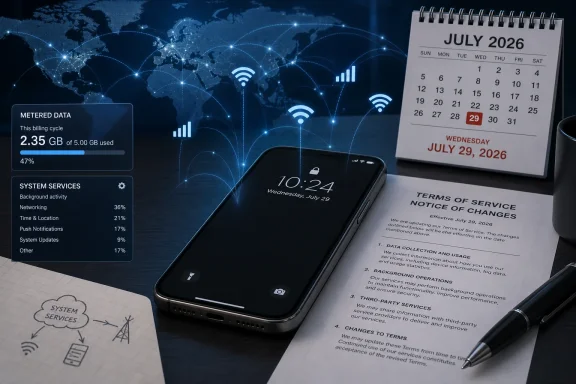
Google’s updated Play Terms of Service take effect July 29, 2026, and make explicit that system services on certified Android devices can use network connectivity, including cellular data, when the user is not actively using the phone, even when the screen is locked. The change is not a new Android feature so much as a forced moment of clarity: the background behavior many users assumed was occasional, invisible, or Wi-Fi-bound is now written into the contract. The timing matters because the revised terms follow Google’s $135 million settlement over allegations that Android devices sent cellular data to Google while idle without users knowing. For Android users, Windows administrators managing mobile fleets, and anyone paying for metered connectivity, the practical message is blunt: idle does not mean offline.
Digital Trends framed the change as Android’s background data habit finally appearing in the fine print, and that is the right way to read it. Android phones have always depended on system services that keep the platform patched, synchronized, scanned, verified, and functional. What is changing is the legal and consumer-facing visibility of that behavior.
Google’s preview of the updated Play terms says system services on certified Android devices can require network connectivity and may use cellular data. It also says some communications may happen in the background when the user is not directly interacting with the device, including when the screen is locked. That is the sentence most users will recognize as the thing they suspected only after a data warning, roaming charge, prepaid balance drop, or overnight update.
The important distinction is that this is not merely about apps. Users are accustomed to blaming Instagram, TikTok, Outlook, Teams, OneDrive, Chrome, or some misbehaving game when data disappears. Google’s wording moves the conversation one layer lower, to Google Play services, the Play Store, and Android operating system updates — the platform plumbing beneath the app drawer.
That matters because platform plumbing is harder to reason about than apps. You can uninstall an app, restrict an app, or watch an app appear in a battery or network usage screen. System services are different: they are part of how a certified Android device remains certified, secure, current, and compatible with the Google ecosystem.
The updated language also shifts the default mental model. A phone with a locked screen may look inert, but the operating system still has work to do. It may check for updates, maintain service state, support security systems, or handle Play infrastructure tasks that Google says keep certified Android devices running properly.
The discomfort is not that a modern smartphone talks to servers. The discomfort is that the person paying the carrier bill may not have understood when, why, or how much of that communication could happen over cellular data while the phone appeared unused.
Reuters reported the settlement as resolving claims that Google’s Android operating system collected cellular data without permission. Other consumer and Android-focused outlets covered the same settlement through the lens of payouts, eligibility, and the mechanics of getting money to affected users. Digital Trends, by contrast, connected the settlement’s aftermath to the newly explicit Play terms language users will encounter going forward.
Google has not framed the update as an admission that every Android device has been secretly torching mobile plans. The stronger and more accurate reading is narrower: Google is now spelling out that certified Android devices may use cellular data for system services even when users are not actively operating the device. That is a disclosure change with real consequences because it tells users and administrators what baseline behavior they should expect.
The settlement allegations were emotionally powerful because they violated the ordinary person’s model of device activity. If an app is open and streaming video, data use is obvious. If the screen is off, all apps appear closed, and the phone is sitting on a desk, many users expect the meter to be mostly still. The revised Play terms make that expectation harder to defend.
There is a legal and product-management pattern here. Large platform companies often respond to litigation not by redesigning every system involved, but by making the disclosure layer more explicit. The user then receives clearer notice that the system may behave as designed, even if that design remains difficult to opt out of fully.
That is why the settlement matters beyond the dollar amount. A $135 million fund is large enough to show the seriousness of the allegations, but the longer-lasting change may be the text users accept before using Google Play. Money compensates backward; terms shape the permission structure going forward.
Google Play services in particular is the connective tissue for large parts of the Android experience. It supports platform APIs, app compatibility, security functions, account-backed features, and background operations that many apps assume will exist. The Play Store is not only a storefront; it is also the update and distribution channel for apps and some platform components. Android operating system updates carry the obvious weight: fixing bugs, closing vulnerabilities, and keeping devices usable over time.
That stack needs network access. The updated terms say these pieces can require network access to keep certified Android devices running properly. In security terms, that is defensible. A phone that never checks in, never updates, and never receives protective changes becomes a liability.
But network access is not free in every environment. It can mean a prepaid user’s remaining data, an employee’s corporate pooled plan, a traveler’s roaming allowance, a hotspot-backed deployment, or a rugged device in the field with a narrow monthly cap. The technical necessity of background service traffic does not erase the billing reality.
That is the tension Google is trying to formalize. Android’s maintenance model assumes a device that can communicate. Users’ billing models vary wildly, from unlimited 5G plans to costly international roaming to capped IoT-style deployments. The same background behavior that is invisible on one plan becomes expensive on another.
For WindowsForum readers, the analogy is familiar. Windows Update, Microsoft Defender, OneDrive, Intune, Edge, Store apps, and telemetry controls all sit somewhere on the spectrum between user preference and platform requirement. Microsoft has spent years moving more Windows servicing into background channels, while administrators have spent the same years trying to pin down when those channels wake up, what they download, and which switches actually win. Android is now having a similar disclosure fight in phone form.
A locked screen is a human-interface state, not a network isolation mode. It prevents casual physical access, hides sensitive content, and signals that the user is not interacting with the device. It does not inherently disable radios, halt background jobs, stop system schedulers, freeze security checks, or suspend the Play infrastructure.
The confusion comes from the visual metaphor. A dark phone looks asleep, so users expect dormancy. In reality, a smartphone is closer to a server with a battery and a glass front: quiet at the surface, active underneath, and constantly balancing power, network, notification, security, and update tasks.
That is not inherently sinister. A phone that waited for manual interaction before every security or operability check would be worse for most people. It would miss time-sensitive fixes, delay protections, and create a support nightmare for app developers and device vendors.
But the settlement allegations and the new terms language expose the other half of the tradeoff. If the device can do useful work in the background, it can also consume user-paid resources in the background. The lock screen reduces interaction; it does not guarantee silence.
That distinction should now be part of every Android data conversation. If a user says, “I was not using my phone,” that may be true in the ordinary sense. It no longer means the phone was not using the network.
For most users on unlimited domestic plans, the difference may be academic. A few background transfers are not usually visible unless the carrier throttles, deprioritizes, or itemizes usage in an annoying way. But Android is not used only in the comfortable middle of the U.S. unlimited-plan market.
The edge cases are where the language bites. Prepaid users may pay for small buckets of data. Travelers may pay roaming rates that turn small background transfers into real money. Enterprise devices may sit on pooled plans where thousands of endpoints turn small background tasks into a measurable budget line. Kiosks, field-service phones, logistics devices, retail scanners, and emergency spares can spend long stretches idle while still remaining enrolled, patched, and reachable.
That is why the disclosure has an IT dimension even though the story broke in consumer-phone coverage. A single handset using modest data in the background is a user annoyance. A managed fleet doing the same thing unpredictably is a cost-control and change-management problem.
The updated terms do not promise that every Android device will suddenly burn through data overnight. Digital Trends was careful on this point, and it is an important hedge. The language confirms that background cellular data use is part of how these services can operate; it does not quantify the volume for every model, carrier, Android version, region, or policy configuration.
That lack of quantification is exactly what administrators will find frustrating. The term tells you the category of behavior is permitted. It does not hand you a clean capacity-planning number.
That tradeoff is easy to defend in principle and hard to live with in practice. Nobody wants malware protections delayed because a user forgot to toggle updates back on. Nobody wants a critical operating problem to persist across millions of phones because every device is waiting for manual approval. Nobody wants abuse-prevention changes treated as optional decorations.
At the same time, users and administrators have learned to distrust the idea that every automatic update is harmless. A bad rollout can break battery life, Bluetooth, authentication, device management, app compatibility, or enterprise workflows. Even when the fix is necessary, the timing can be terrible.
Android’s updated language therefore preserves a hierarchy: user settings matter, until Google determines that a higher-order issue justifies overriding them. That is not unique to Google. Modern operating systems increasingly reserve emergency powers for vendors because attackers move quickly and fragmented user choice can become a security liability.
The problem is that “critical security issue,” “serious operability problem,” and “prevent abuse” are broad categories from the user’s perspective. They may be technically justified, but they are not a granular scheduling contract. The updated terms tell users that the override exists; they do not turn that override into a change-control workflow.
For enterprise administrators, that means Play settings should not be treated as a complete patch-governance boundary. They are one input in the update system, not the supreme authority over every system-level change.
The table exposes the real shift: this is about expectation management. Google is not promising quiet. It is documenting activity.
That matters because modern devices increasingly blur the difference between user-initiated and system-initiated work. If a user taps “update,” the network transaction feels voluntary. If the same device performs a system update task at rest, the user may experience the cost without remembering any choice. The revised terms make that second category explicit.
It also shifts support conversations. A carrier rep, IT help desk, or technically literate family member can no longer treat background system data as a weird anomaly. It is an acknowledged operating condition for certified Android devices.
The larger operational issue is that Android is not just a consumer phone platform. It is a corporate endpoint platform, a frontline-worker platform, a retail platform, a healthcare platform, a warehouse platform, and a companion platform in many Microsoft-heavy environments. Many Windows shops are also Android shops because employees use Android phones for Microsoft 365, Teams, Authenticator, Outlook, Edge, Intune enrollment, VPN access, and line-of-business apps.
For those organizations, background cellular data is not merely a privacy irritant. It touches cost allocation, mobile device management policy, update windows, compliance, travel policy, and incident response. If a fleet of phones is expected to remain patched and secure, those phones need connectivity. If that connectivity is cellular and metered, someone must budget for the invisible maintenance layer.
This is where Windows administrators should resist the temptation to dismiss the story as “phone stuff.” The same governance logic that applies to Windows Update for Business or endpoint protection applies here. You need to know which components update automatically, which controls are enforceable, which controls are advisory, and what happens when the vendor invokes security or operability exceptions.
The updated Play terms give administrators a useful sentence to point to, but not a full management strategy. They confirm the existence of background system-service traffic. They do not replace telemetry, carrier reporting, MDM policy review, or network design.
In practice, IT teams should treat Android system services as active by default. That does not mean panic. It means planning data pools, roaming rules, update controls, and user expectations around the idea that a locked phone can still communicate.
For ordinary users, certification is invisible. They buy a phone from a carrier, retailer, or manufacturer and expect the Play Store to exist. They expect apps to work. They expect Google account services, app updates, malware scanning, and operating system components to behave normally. Certification is the invisible agreement behind that normality.
That is why the terms focus on system services that keep certified devices running properly. A certified Android phone is not merely a slab of hardware running open-source Android code. It is a device participating in Google’s service layer.
The upside is convenience and security. The downside is that the service layer has its own operational needs. Some of those needs involve network connectivity, and the updated terms say cellular data may be used.
This is not surprising to engineers, but it can be surprising to users. Many people understand that apps phone home. Fewer understand that the app ecosystem itself has a phone-home requirement. Fewer still distinguish between an app update, a Play services change, a Play Store maintenance action, and an Android operating system update.
The revised language compresses all of that into a user-facing warning: system services may use data. The simplicity is useful, but it hides the complexity administrators must manage.
Control is the sharper issue because users are not asking whether computers need networks. They are asking whether their settings, their idle state, and their data plan mean what they think they mean. If background cellular data can occur when the phone is locked, and if some updates can happen despite user settings, then the user’s control is conditional.
Conditional control is now normal in consumer operating systems. Apple, Microsoft, and Google all reserve some authority to protect the platform, maintain services, and keep security systems current. The problem is that the user interface often presents controls as more absolute than they are.
A toggle can say “off,” but the platform may still have exceptions. An update preference can say “manual,” but emergency fixes may still arrive. A screen can be locked, but network activity may continue. These are not contradictions if disclosed clearly; they are contradictions if users discover them through a bill.
That is why Google’s new wording is consequential even if the technical behavior is old. Disclosure changes the ethics of the system. It moves the argument from “we never told you” to “we told you in the terms.” Whether that is enough for users is a different question.
The history of tech consent suggests many users will not read the terms closely. But courts, regulators, administrators, journalists, and support teams will. Fine print becomes operational reality when something goes wrong.
That is why the revised Play terms are more important for some users than others. Unlimited-plan users in strong domestic coverage may never care. They may prefer that the phone quietly maintains itself and keeps security current. The cost is hidden inside a flat monthly bill.
For constrained users, the calculus changes. A prepaid user may want every background transfer controlled. A traveler may want the phone to behave differently on roaming data than on home-network data. A parent managing a child’s phone may wonder why data moved overnight. A small business may not have the tools to distinguish app usage from system maintenance.
The updated terms do not solve those problems. They tell users that such behavior can exist and that carrier fees remain their responsibility. That is important, but it is not the same as giving a precise meter, approval prompt, or guaranteed Wi-Fi-only mode for every system activity.
This is the familiar asymmetry of platform economics. Google controls the service architecture. Device makers and carriers package it. Users pay the carrier bill. When the service architecture consumes a paid resource in the background, accountability becomes diffuse.
Clearer terms reduce surprise. They do not eliminate the underlying asymmetry.
The updated terms’ exceptions for critical security issues, serious operability problems, and abuse prevention are therefore not outrageous. In fact, they are predictable. A vendor responsible for a large ecosystem cannot let every user or device administrator veto every urgent platform action indefinitely.
But the legitimacy of emergency authority depends on restraint and transparency. If exceptions are rare, targeted, and clearly tied to genuine security or operability needs, users will tolerate them. If exceptions become a routine path around user preferences, trust erodes quickly.
This is where the settlement’s shadow matters. Google is not introducing these disclosures in a vacuum. It is doing so after allegations that Android devices sent cellular data to Google while idle without users knowing. That history makes users less likely to grant the benefit of the doubt.
For administrators, the proper response is not to block all automatic maintenance. That would be reckless. The better response is to demand observability: carrier reporting, device-level usage views, MDM logs where available, and clear internal documentation of what Android system services may do.
Security requires background work. Governance requires knowing that background work exists.
Android’s updated Play terms fit that same pattern. The vendor wants a serviceable platform. Users want control. Administrators want predictability. Carriers want to bill for usage. Regulators and courts want disclosure. None of those interests fully align.
The lesson is that mobile devices should be managed like endpoints, not accessories. If an Android phone participates in authentication, email, Teams, line-of-business apps, VPN, device compliance, or field operations, then its background service behavior belongs in the same conversation as Windows patch rings and endpoint security agents.
That does not require overengineering. It requires basic hygiene: know which devices are metered, which users roam, which update controls are available, and which users need a plain-language warning that locked phones can still use data. It also means avoiding false promises. Do not tell users that disabling app auto-updates guarantees no system data use. The updated terms say otherwise.
The operationally mature stance is simple: assume certified Android devices may perform system work over cellular data unless specifically constrained and verified. Then design policy around that assumption.
This is what consent increasingly looks like in platform computing. Users are not asked to approve every packet, update, scan, or maintenance task. They are asked to accept an ecosystem whose services require periodic network activity, some of it invisible, some of it system-level, and some of it override-capable when security or operability is at stake.
That may be reasonable. It may also feel unsatisfying. A terms update is not the same as a dashboard, and a disclosure is not the same as granular control. The gap between “you have been informed” and “you can meaningfully manage this” remains the heart of the issue.
Digital Trends’ coverage rightly emphasizes the user-facing frustration: Android gives people plenty of switches, yet some system-level decisions still sit above those switches. That sentence applies to more than Android. It describes the modern endpoint model across phones, PCs, browsers, and cloud-tethered apps.
The difference here is that cellular data is a metered, user-paid resource in many contexts. When the system uses it, consent feels less abstract. The device is not just processing in the background; it may be spending something.
For Google, the July 29, 2026 Play terms update is a disclosure repair after a costly legal fight; for users, it is a warning that the quiet moments still count. The next battle will not be over whether Android system services need connectivity — they do — but over whether Google, carriers, device makers, and enterprise tools can make that connectivity visible enough, controllable enough, and predictable enough that consent feels like more than a sentence buried in fine print.
 Google Turns a Hidden Operating Assumption Into a User-Facing Term
Digital Trends framed the change as Android’s background data habit finally appearing in the fine print, and that is the right way to read it. Android phones have always depended on system services that keep the platform patched, synchronized, scanned, verified, and functional. What is changing is the legal and consumer-facing visibility of that behavior.Google’s preview of the updated Play terms says system services on certified Android devices can require network connectivity and may use cellular data. It also says some communications may happen in the background when the user is not directly interacting with the device, including when the screen is locked. That is the sentence most users will recognize as the thing they suspected only after a data warning, roaming charge, prepaid balance drop, or overnight update.
The important distinction is that this is not merely about apps. Users are accustomed to blaming Instagram, TikTok, Outlook, Teams, OneDrive, Chrome, or some misbehaving game when data disappears. Google’s wording moves the conversation one layer lower, to Google Play services, the Play Store, and Android operating system updates — the platform plumbing beneath the app drawer.
That matters because platform plumbing is harder to reason about than apps. You can uninstall an app, restrict an app, or watch an app appear in a battery or network usage screen. System services are different: they are part of how a certified Android device remains certified, secure, current, and compatible with the Google ecosystem.
The updated language also shifts the default mental model. A phone with a locked screen may look inert, but the operating system still has work to do. It may check for updates, maintain service state, support security systems, or handle Play infrastructure tasks that Google says keep certified Android devices running properly.
The discomfort is not that a modern smartphone talks to servers. The discomfort is that the person paying the carrier bill may not have understood when, why, or how much of that communication could happen over cellular data while the phone appeared unused.
The $135 Million Settlement Gives the Fine Print Its Bite
The revised terms follow Google’s $135 million settlement over allegations that Android devices sent cellular data to Google while idle without users knowing. That context changes the story from a routine terms-of-service cleanup into a broader accountability moment. The dispute was not simply whether Android devices used data, but whether users meaningfully understood and consented to background cellular transfers that consumed data they paid for.Reuters reported the settlement as resolving claims that Google’s Android operating system collected cellular data without permission. Other consumer and Android-focused outlets covered the same settlement through the lens of payouts, eligibility, and the mechanics of getting money to affected users. Digital Trends, by contrast, connected the settlement’s aftermath to the newly explicit Play terms language users will encounter going forward.
Google has not framed the update as an admission that every Android device has been secretly torching mobile plans. The stronger and more accurate reading is narrower: Google is now spelling out that certified Android devices may use cellular data for system services even when users are not actively operating the device. That is a disclosure change with real consequences because it tells users and administrators what baseline behavior they should expect.
The settlement allegations were emotionally powerful because they violated the ordinary person’s model of device activity. If an app is open and streaming video, data use is obvious. If the screen is off, all apps appear closed, and the phone is sitting on a desk, many users expect the meter to be mostly still. The revised Play terms make that expectation harder to defend.
There is a legal and product-management pattern here. Large platform companies often respond to litigation not by redesigning every system involved, but by making the disclosure layer more explicit. The user then receives clearer notice that the system may behave as designed, even if that design remains difficult to opt out of fully.
That is why the settlement matters beyond the dollar amount. A $135 million fund is large enough to show the seriousness of the allegations, but the longer-lasting change may be the text users accept before using Google Play. Money compensates backward; terms shape the permission structure going forward.
Android’s Quietest Services Are Also Its Most Important Ones
The most consequential words in the updated terms are not “cellular data.” They are “system services.” Google Play services, the Play Store, and Android operating system updates are not optional accessories in the way a weather widget or game launcher is optional. They are part of the mechanism that lets a certified Android phone behave like a modern Android phone.Google Play services in particular is the connective tissue for large parts of the Android experience. It supports platform APIs, app compatibility, security functions, account-backed features, and background operations that many apps assume will exist. The Play Store is not only a storefront; it is also the update and distribution channel for apps and some platform components. Android operating system updates carry the obvious weight: fixing bugs, closing vulnerabilities, and keeping devices usable over time.
That stack needs network access. The updated terms say these pieces can require network access to keep certified Android devices running properly. In security terms, that is defensible. A phone that never checks in, never updates, and never receives protective changes becomes a liability.
But network access is not free in every environment. It can mean a prepaid user’s remaining data, an employee’s corporate pooled plan, a traveler’s roaming allowance, a hotspot-backed deployment, or a rugged device in the field with a narrow monthly cap. The technical necessity of background service traffic does not erase the billing reality.
That is the tension Google is trying to formalize. Android’s maintenance model assumes a device that can communicate. Users’ billing models vary wildly, from unlimited 5G plans to costly international roaming to capped IoT-style deployments. The same background behavior that is invisible on one plan becomes expensive on another.
For WindowsForum readers, the analogy is familiar. Windows Update, Microsoft Defender, OneDrive, Intune, Edge, Store apps, and telemetry controls all sit somewhere on the spectrum between user preference and platform requirement. Microsoft has spent years moving more Windows servicing into background channels, while administrators have spent the same years trying to pin down when those channels wake up, what they download, and which switches actually win. Android is now having a similar disclosure fight in phone form.
The Locked Screen Was Never a Network Boundary
The sentence that will irritate users most is the one that says background communication can occur when the screen is locked. That is because a locked screen feels like a boundary. It is not.A locked screen is a human-interface state, not a network isolation mode. It prevents casual physical access, hides sensitive content, and signals that the user is not interacting with the device. It does not inherently disable radios, halt background jobs, stop system schedulers, freeze security checks, or suspend the Play infrastructure.
The confusion comes from the visual metaphor. A dark phone looks asleep, so users expect dormancy. In reality, a smartphone is closer to a server with a battery and a glass front: quiet at the surface, active underneath, and constantly balancing power, network, notification, security, and update tasks.
That is not inherently sinister. A phone that waited for manual interaction before every security or operability check would be worse for most people. It would miss time-sensitive fixes, delay protections, and create a support nightmare for app developers and device vendors.
But the settlement allegations and the new terms language expose the other half of the tradeoff. If the device can do useful work in the background, it can also consume user-paid resources in the background. The lock screen reduces interaction; it does not guarantee silence.
That distinction should now be part of every Android data conversation. If a user says, “I was not using my phone,” that may be true in the ordinary sense. It no longer means the phone was not using the network.
The New Terms Put Users on the Hook for Carrier Fees
Google’s updated wording is not just a technical disclosure. It also reinforces responsibility for third-party fees, including carrier or internet provider charges tied to content, Google Play, and system services. That matters because the economic risk remains with the user even when the triggering activity is system-level.For most users on unlimited domestic plans, the difference may be academic. A few background transfers are not usually visible unless the carrier throttles, deprioritizes, or itemizes usage in an annoying way. But Android is not used only in the comfortable middle of the U.S. unlimited-plan market.
The edge cases are where the language bites. Prepaid users may pay for small buckets of data. Travelers may pay roaming rates that turn small background transfers into real money. Enterprise devices may sit on pooled plans where thousands of endpoints turn small background tasks into a measurable budget line. Kiosks, field-service phones, logistics devices, retail scanners, and emergency spares can spend long stretches idle while still remaining enrolled, patched, and reachable.
That is why the disclosure has an IT dimension even though the story broke in consumer-phone coverage. A single handset using modest data in the background is a user annoyance. A managed fleet doing the same thing unpredictably is a cost-control and change-management problem.
The updated terms do not promise that every Android device will suddenly burn through data overnight. Digital Trends was careful on this point, and it is an important hedge. The language confirms that background cellular data use is part of how these services can operate; it does not quantify the volume for every model, carrier, Android version, region, or policy configuration.
That lack of quantification is exactly what administrators will find frustrating. The term tells you the category of behavior is permitted. It does not hand you a clean capacity-planning number.
The Update Switch Is Real, but It Is Not Sovereign
The most uncomfortable part of the updated Play terms may be the update language. Users may be able to manage some updates in Google Play settings. But certain updates can still happen if they fix a critical security issue, address a serious operability problem, or prevent abuse.That tradeoff is easy to defend in principle and hard to live with in practice. Nobody wants malware protections delayed because a user forgot to toggle updates back on. Nobody wants a critical operating problem to persist across millions of phones because every device is waiting for manual approval. Nobody wants abuse-prevention changes treated as optional decorations.
At the same time, users and administrators have learned to distrust the idea that every automatic update is harmless. A bad rollout can break battery life, Bluetooth, authentication, device management, app compatibility, or enterprise workflows. Even when the fix is necessary, the timing can be terrible.
Android’s updated language therefore preserves a hierarchy: user settings matter, until Google determines that a higher-order issue justifies overriding them. That is not unique to Google. Modern operating systems increasingly reserve emergency powers for vendors because attackers move quickly and fragmented user choice can become a security liability.
The problem is that “critical security issue,” “serious operability problem,” and “prevent abuse” are broad categories from the user’s perspective. They may be technically justified, but they are not a granular scheduling contract. The updated terms tell users that the override exists; they do not turn that override into a change-control workflow.
For enterprise administrators, that means Play settings should not be treated as a complete patch-governance boundary. They are one input in the update system, not the supreme authority over every system-level change.
Before and After July 29, the Assumption Changes
The simplest way to understand the revised Play terms is not that Android suddenly becomes different on July 29, 2026. It is that the user’s legal and operational assumption changes. Before the update, many users inferred behavior from the device’s appearance. After the update, Google is telling them directly that system services may communicate in the background and may use cellular data.| Area | Before the updated terms take effect | Updated terms taking effect July 29, 2026 |
|---|---|---|
| User expectation | A locked, idle phone may be assumed to be mostly still | Google states some system-service communication may occur while idle, including when the screen is locked |
| Services in focus | Users often think first about individual apps | Google names system services, including Google Play services, the Play Store, and Android operating system updates |
| Network path | Background activity may be noticed only after usage appears | Google says system services can require network connectivity and may use cellular data |
| Update control | Users may rely on Google Play settings to manage some updates | Some updates can still happen for critical security issues, serious operability problems, or abuse prevention |
| Cost consequence | Carrier data use may feel unexpected | Users remain responsible for carrier or other third-party data fees |
That matters because modern devices increasingly blur the difference between user-initiated and system-initiated work. If a user taps “update,” the network transaction feels voluntary. If the same device performs a system update task at rest, the user may experience the cost without remembering any choice. The revised terms make that second category explicit.
It also shifts support conversations. A carrier rep, IT help desk, or technically literate family member can no longer treat background system data as a weird anomaly. It is an acknowledged operating condition for certified Android devices.
The Settlement Coverage Missed the Fleet-Management Angle
Most early coverage of the $135 million settlement understandably focused on consumers: who qualifies, whether payment forms are legitimate, how much money might arrive, and what Google agreed to disclose. That is useful service journalism. It is not the whole story.The larger operational issue is that Android is not just a consumer phone platform. It is a corporate endpoint platform, a frontline-worker platform, a retail platform, a healthcare platform, a warehouse platform, and a companion platform in many Microsoft-heavy environments. Many Windows shops are also Android shops because employees use Android phones for Microsoft 365, Teams, Authenticator, Outlook, Edge, Intune enrollment, VPN access, and line-of-business apps.
For those organizations, background cellular data is not merely a privacy irritant. It touches cost allocation, mobile device management policy, update windows, compliance, travel policy, and incident response. If a fleet of phones is expected to remain patched and secure, those phones need connectivity. If that connectivity is cellular and metered, someone must budget for the invisible maintenance layer.
This is where Windows administrators should resist the temptation to dismiss the story as “phone stuff.” The same governance logic that applies to Windows Update for Business or endpoint protection applies here. You need to know which components update automatically, which controls are enforceable, which controls are advisory, and what happens when the vendor invokes security or operability exceptions.
The updated Play terms give administrators a useful sentence to point to, but not a full management strategy. They confirm the existence of background system-service traffic. They do not replace telemetry, carrier reporting, MDM policy review, or network design.
In practice, IT teams should treat Android system services as active by default. That does not mean panic. It means planning data pools, roaming rules, update controls, and user expectations around the idea that a locked phone can still communicate.
Action checklist for admins
- Review Android fleet policies for Google Play services, Play Store updates, operating system updates, and background data behavior.
- Audit carrier plans for capped, pooled, prepaid, roaming, or international usage exposure.
- Update user-facing mobile policies to say that locked or idle Android devices may still use cellular data for system services.
- Validate which update controls are available through Google Play settings and which exceptions may override them.
- Monitor real-world cellular usage by device class before and after the July 29, 2026 terms change.
- For travel and field deployments, prefer Wi-Fi staging windows before devices enter roaming or low-cap environments.
“Certified Android” Is the Quiet Boundary Line
The updated terms specifically refer to certified Android devices. That phrase matters because Google Play, Google Play services, and the Play Store are tied to Google’s certified Android ecosystem, not to every possible Android-derived device in the world.For ordinary users, certification is invisible. They buy a phone from a carrier, retailer, or manufacturer and expect the Play Store to exist. They expect apps to work. They expect Google account services, app updates, malware scanning, and operating system components to behave normally. Certification is the invisible agreement behind that normality.
That is why the terms focus on system services that keep certified devices running properly. A certified Android phone is not merely a slab of hardware running open-source Android code. It is a device participating in Google’s service layer.
The upside is convenience and security. The downside is that the service layer has its own operational needs. Some of those needs involve network connectivity, and the updated terms say cellular data may be used.
This is not surprising to engineers, but it can be surprising to users. Many people understand that apps phone home. Fewer understand that the app ecosystem itself has a phone-home requirement. Fewer still distinguish between an app update, a Play services change, a Play Store maintenance action, and an Android operating system update.
The revised language compresses all of that into a user-facing warning: system services may use data. The simplicity is useful, but it hides the complexity administrators must manage.
The Privacy Debate Is Really a Control Debate
It is tempting to frame the entire story as privacy. That is part of it, but not all of it. The settlement allegations concerned Android devices sending cellular data to Google while idle without users knowing. That raises privacy questions, but it also raises control and cost questions.Control is the sharper issue because users are not asking whether computers need networks. They are asking whether their settings, their idle state, and their data plan mean what they think they mean. If background cellular data can occur when the phone is locked, and if some updates can happen despite user settings, then the user’s control is conditional.
Conditional control is now normal in consumer operating systems. Apple, Microsoft, and Google all reserve some authority to protect the platform, maintain services, and keep security systems current. The problem is that the user interface often presents controls as more absolute than they are.
A toggle can say “off,” but the platform may still have exceptions. An update preference can say “manual,” but emergency fixes may still arrive. A screen can be locked, but network activity may continue. These are not contradictions if disclosed clearly; they are contradictions if users discover them through a bill.
That is why Google’s new wording is consequential even if the technical behavior is old. Disclosure changes the ethics of the system. It moves the argument from “we never told you” to “we told you in the terms.” Whether that is enough for users is a different question.
The history of tech consent suggests many users will not read the terms closely. But courts, regulators, administrators, journalists, and support teams will. Fine print becomes operational reality when something goes wrong.
The Carrier Bill Is Where Abstraction Ends
Background data is easy to minimize when discussed in abstract terms. A few kilobytes here, a check-in there, a maintenance ping, a security update, a store refresh. The abstraction ends when a user pays for data by the megabyte, crosses a roaming boundary, or shares a capped pool with hundreds of devices.That is why the revised Play terms are more important for some users than others. Unlimited-plan users in strong domestic coverage may never care. They may prefer that the phone quietly maintains itself and keeps security current. The cost is hidden inside a flat monthly bill.
For constrained users, the calculus changes. A prepaid user may want every background transfer controlled. A traveler may want the phone to behave differently on roaming data than on home-network data. A parent managing a child’s phone may wonder why data moved overnight. A small business may not have the tools to distinguish app usage from system maintenance.
The updated terms do not solve those problems. They tell users that such behavior can exist and that carrier fees remain their responsibility. That is important, but it is not the same as giving a precise meter, approval prompt, or guaranteed Wi-Fi-only mode for every system activity.
This is the familiar asymmetry of platform economics. Google controls the service architecture. Device makers and carriers package it. Users pay the carrier bill. When the service architecture consumes a paid resource in the background, accountability becomes diffuse.
Clearer terms reduce surprise. They do not eliminate the underlying asymmetry.
The Security Argument Is Strong, but It Needs Guardrails
Google’s strongest argument is security. System services, Play Store protections, and Android operating system updates exist because unmanaged endpoints are dangerous. A phone that cannot receive critical fixes quickly is not a victory for user autonomy; it is a soft target.The updated terms’ exceptions for critical security issues, serious operability problems, and abuse prevention are therefore not outrageous. In fact, they are predictable. A vendor responsible for a large ecosystem cannot let every user or device administrator veto every urgent platform action indefinitely.
But the legitimacy of emergency authority depends on restraint and transparency. If exceptions are rare, targeted, and clearly tied to genuine security or operability needs, users will tolerate them. If exceptions become a routine path around user preferences, trust erodes quickly.
This is where the settlement’s shadow matters. Google is not introducing these disclosures in a vacuum. It is doing so after allegations that Android devices sent cellular data to Google while idle without users knowing. That history makes users less likely to grant the benefit of the doubt.
For administrators, the proper response is not to block all automatic maintenance. That would be reckless. The better response is to demand observability: carrier reporting, device-level usage views, MDM logs where available, and clear internal documentation of what Android system services may do.
Security requires background work. Governance requires knowing that background work exists.
What Windows Shops Should Learn From Android’s Fine Print
WindowsForum readers live in a world where endpoint servicing is already a political fight. Windows administrators know that “automatic” is not a neutral word. It can mean secure, current, and supportable. It can also mean surprise reboots, broken drivers, bandwidth spikes, and users blaming IT for a vendor decision.Android’s updated Play terms fit that same pattern. The vendor wants a serviceable platform. Users want control. Administrators want predictability. Carriers want to bill for usage. Regulators and courts want disclosure. None of those interests fully align.
The lesson is that mobile devices should be managed like endpoints, not accessories. If an Android phone participates in authentication, email, Teams, line-of-business apps, VPN, device compliance, or field operations, then its background service behavior belongs in the same conversation as Windows patch rings and endpoint security agents.
That does not require overengineering. It requires basic hygiene: know which devices are metered, which users roam, which update controls are available, and which users need a plain-language warning that locked phones can still use data. It also means avoiding false promises. Do not tell users that disabling app auto-updates guarantees no system data use. The updated terms say otherwise.
The operationally mature stance is simple: assume certified Android devices may perform system work over cellular data unless specifically constrained and verified. Then design policy around that assumption.
The Real Change Is Consent by Architecture
The most important thing Google has done is not to announce a new background-data feature. It is to align the terms of service with the architecture of modern Android. That architecture assumes ongoing service connectivity. The user agreement is catching up.This is what consent increasingly looks like in platform computing. Users are not asked to approve every packet, update, scan, or maintenance task. They are asked to accept an ecosystem whose services require periodic network activity, some of it invisible, some of it system-level, and some of it override-capable when security or operability is at stake.
That may be reasonable. It may also feel unsatisfying. A terms update is not the same as a dashboard, and a disclosure is not the same as granular control. The gap between “you have been informed” and “you can meaningfully manage this” remains the heart of the issue.
Digital Trends’ coverage rightly emphasizes the user-facing frustration: Android gives people plenty of switches, yet some system-level decisions still sit above those switches. That sentence applies to more than Android. It describes the modern endpoint model across phones, PCs, browsers, and cloud-tethered apps.
The difference here is that cellular data is a metered, user-paid resource in many contexts. When the system uses it, consent feels less abstract. The device is not just processing in the background; it may be spending something.
The New Android Rule of Thumb
The practical lesson is not that Android users should panic or that every certified device is about to become a data hog. It is that users and administrators should stop treating inactivity as proof of network silence. The updated Play terms make that assumption obsolete.- Google’s updated Play Terms of Service take effect July 29, 2026.
- The revised terms follow a $135 million settlement over allegations involving idle Android cellular data transfers.
- Google says system services on certified Android devices may require network connectivity and may use cellular data.
- That background activity can occur while the user is not actively using the phone, including when the screen is locked.
- Google Play settings may manage some updates, but certain updates can still occur for critical security, serious operability, or abuse-prevention reasons.
- Users and organizations on capped, prepaid, pooled, or roaming plans should treat Android system services as active by default.
For Google, the July 29, 2026 Play terms update is a disclosure repair after a costly legal fight; for users, it is a warning that the quiet moments still count. The next battle will not be over whether Android system services need connectivity — they do — but over whether Google, carriers, device makers, and enterprise tools can make that connectivity visible enough, controllable enough, and predictable enough that consent feels like more than a sentence buried in fine print.
References
- Primary source: Digital Trends
Published: Wed, 08 Jul 2026 10:40:38 GMT
Loading…
www.digitaltrends.com - Official source: play.google.com
Loading…
play.google.com - Related coverage: cbsnews.com
Loading…
www.cbsnews.com - Related coverage: legalclarity.org
Loading…
legalclarity.org - Official source: google.com
Loading…
www.google.com - Related coverage: investing.com
Loading…
www.investing.com
- Official source: support.google.com
Loading…
support.google.com - Related coverage: tomsguide.com
Google settles Android data lawsuit for $135 million | Tom's Guide
Google has agreed to a $135 million settlement after a class action lawsuit alleged Android phones were collecting users' data without permission.www.tomsguide.com - Related coverage: androidcentral.com
Google's $135M Android data settlement is getting closer, and you can now set your payout method | Android Central
Google has begun payouts for a $135 million Android data settlement, with claims now open.www.androidcentral.com - Related coverage: androidauthority.com
Google's paying out $135M to settle Android data harvesting accusations
Google will pay out $135 million to settle claims that it was inappropriately using Android users' cellular data to transfer information.www.androidauthority.com - Related coverage: techrepublic.com
Google $135M Settlement: Millions of Android Users May Qualify for Payout
Android users may be eligible for a payout from Google’s $135 million settlement over background data use. Here’s who qualifies and how to claim.www.techrepublic.com
- Related coverage: thestar.com.my
Google to pay $135 million to settle Android data transfer lawsuit | The Star
Jan 28 (Reuters) - Google will pay $135 million to settle a proposed class action by smartphone users who accused Google of programming its Android operating system to collect their cellular data without permission.www.thestar.com.my
- Related coverage: claimhub24.com
Google Android $135M Cellular Data Settlement: Eligibility, Payouts
The Google Android cellular data settlement is moving forward. Check eligibility, deadlines, payment options, and the latest case status.claimhub24.com - Related coverage: classaction.org
- Related coverage: sahmcapital.com
'Google to pay $135 million to settle Android data transfer lawsuit'- Reuters
https://www.reuters.com/sustainability/boards-policy-regulation/google-pay-135-million-settle-android-data-transfer-lawsuit-2026-01-28/www.sahmcapital.com - Related coverage: openclassactions.com
- Related coverage: courthousenews.com
- Related coverage: kiplinger.com
$425 Million Google Class Action Lawsuit: Do You Qualify for a Payout? | Kiplinger
Google was found liable for violating the privacy of 98 million users in a class action lawsuit. Are you one of them?www.kiplinger.com - Related coverage: techradar.com
You could get up to $7,500 from AT&T's $177 million data breach settlement – here's how to claim it | TechRadar
The settlement covers two massive data breaches from 2019 and 2024www.techradar.com