

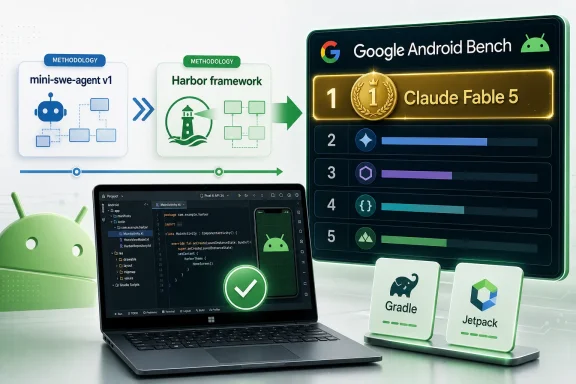
Google updated Android Bench, moved its Android-specific AI coding evaluation from the earlier mini-swe-agent v1 setup to the standardized Harbor framework, and refreshed the leaderboard with Claude Fable 5 in first place among the assessed models. The answer-first takeaway is simple: Claude Fable 5’s lead is a meaningful signal inside Google’s updated Android-specific benchmark, but it should not be treated as a universal coding crown or as a direct continuation of older results. If your team builds Android apps, use the new leaderboard to shortlist tools, then run your own repository or sanitized-task tests before approving any AI coding assistant for production work.
What changed: Google’s Android Bench has shifted from the earlier mini-swe-agent v1 setup to the Harbor framework, and the updated ranking now places Claude Fable 5 first among the models assessed under the refreshed Android-specific methodology. Daily Beirut reported the leaderboard refresh and the move to Harbor as the central update.
Why it matters: The benchmark framework is part of the result. A model’s ranking under one evaluation setup should not be casually compared with a ranking produced under another. The updated Android Bench is best read as a new baseline for Android-specific AI coding evaluation, not as a simple extension of the older mini-swe-agent v1 results.
What to do next: Treat the updated leaderboard as a screening tool. Confirm which methodology a vendor or internal proposal is citing, test candidate tools against representative Android work, and separate model capability from security, privacy, compliance, and operational approval.
That distinction matters. A general software benchmark may show whether a model can solve broad coding tasks. An Android-specific benchmark is narrower by design. It asks whether a model performs well on tasks framed around Android development rather than on programming in the abstract.
Daily Beirut reported that Google updated its evaluation process for AI models focused on Android coding and refreshed the rankings with Claude Fable 5 leading the assessed models. The same report described the benchmark’s move from the older mini-swe-agent v1 setup to the standardized Harbor framework. That framework change is the core context for the ranking.
The practical result is not “Claude Fable 5 is the best coding model for every developer.” The more precise statement is: Claude Fable 5 leads Google’s updated Android-specific ranking under the current Android Bench methodology described in the report. That is still useful, but its usefulness comes from the benchmark’s scope.
For WindowsForum readers, the Android label should not make the topic feel distant. Many Android developers work from Windows laptops, Windows workstations, and managed corporate endpoints. If an AI coding assistant is being used beside Android Studio or other development tooling on a Windows machine, the practical question is not whether the model is impressive in a demo. The question is whether it can be evaluated, governed, reviewed, and tested in a way that fits the team’s development process.
According to the source material, earlier Android Bench evaluation used mini-swe-agent v1, while the updated benchmark uses Harbor. The source also identifies previously assessed examples including GPT-5.5, Claude Opus 4.7, and Gemini 3.1 Pro Preview, and it identifies Claude Fable 5 as the updated leader.
That is enough to draw one important conclusion: old and new rankings should be read in their methodological context. A result produced under mini-swe-agent v1 and a result produced under Harbor are not automatically interchangeable.
Benchmarks are not neutral scoreboards floating above the tools they test. They depend on task selection, evaluation rules, and the surrounding framework. When the framework changes, the meaning of the ranking changes with it. That does not make the new ranking invalid. It makes the methodology essential reading.
Google’s move to Harbor is therefore best understood as a standardization step. Daily Beirut framed Harbor as a standardized framework intended to provide more consistent tools for evaluating AI models tailored to Android use cases. That makes the updated Android Bench more useful as a baseline for current comparison, but it also means readers should avoid flattening the older and newer results into a single continuous ladder.
For engineering teams, the correct response is not cynicism. It is disciplined interpretation. The updated Android Bench can help teams decide which models deserve a closer look. It cannot, by itself, decide which model belongs in a production workflow.
The table is deliberately limited. It does not claim detailed scoring behavior, task mechanics, repository access rules, build configurations, or enterprise policy effects that are not established in the verified facts. The verified shift is the move from mini-swe-agent v1 to Harbor, the refreshed leaderboard, the listed models, and the ability for developers to submit Android tasks and benchmark results.
That is still enough to matter. When the harness changes, historical comparison becomes more nuanced. A model that ranked well under one setup may not map cleanly to a ranking under another. The updated Android Bench should be treated as the current reference point, not as a simple continuation of every earlier result.
Android Bench is Google’s attempt to make that question more specific for Android development. Daily Beirut summarized Android Bench as a way for developers to compare AI capabilities within Android coding tasks. That is a narrower question than generic coding skill, and the narrower framing is exactly why the benchmark is useful.
The specialization matters because Android work is not one uniform task. Some teams may be focused on bug fixes. Others may be focused on modernization, testing, build stability, or reducing review friction. A public benchmark cannot represent every private codebase, but a domain-specific benchmark can be more relevant than a broad coding leaderboard when the team’s actual work is Android development.
The same point applies to model selection. A model can look attractive in broad coding comparisons and still fail to be the right choice for a particular Android team. Conversely, a model that performs well on Android Bench may deserve a pilot even if the final decision still depends on cost, tooling, governance, integration, and team experience.
The key is to keep the benchmark in its lane. Android Bench is evidence. It is not proof that a model will perform well on every internal project. It is not approval to connect a tool to private repositories. It is not a substitute for code review. It is a structured signal about Android-specific coding capability under Google’s updated evaluation approach.
That is the practical meaning of Google’s move from mini-swe-agent v1 to Harbor. The updated Android Bench should be treated as a refreshed baseline under a revised evaluation approach. Claude Fable 5 leading under the new framework is notable because it tells teams which model led in Google’s current Android-specific ranking. The framework change tells teams how to interpret that result.
For engineering teams, the follow-up questions are straightforward:
The Harbor transition should therefore change how AI coding claims are read. A claim that points to the updated Android Bench is more focused than a vague claim about general coding ability. But it still needs context. Public rankings are starting points. Production adoption requires local evidence.
That can make Android Bench more useful because real development pain is unevenly distributed. Public benchmarks improve when they include tasks that resemble the problems developers actually face. If community-submitted tasks are clear, well scoped, and carefully reviewed, they can help expose whether models are improving on practical Android work rather than only on polished examples.
There is a risk, too. Open contribution requires curation. Poorly specified tasks can reward guessing. Narrow or ambiguous tasks can distort the signal. Tasks without meaningful validation can create false confidence. Google will need to maintain quality if Android Bench is to remain a useful benchmark rather than a loose collection of examples.
Still, the direction is promising. A benchmark for AI coding should keep finding ways to make models prove they can solve work that developers recognize. If the task set becomes more representative over time, the leaderboard becomes more useful as a first-pass filter for model evaluation.
For Android teams, the action item is simple: if your organization has recurring Android development problems that AI assistants routinely mishandle, consider whether those patterns can be turned into clean, shareable benchmark tasks. That does not mean exposing private code, proprietary product logic, customer data, secrets, or internal infrastructure. It means abstracting common failure patterns into tasks that can be evaluated safely.
That makes Android Bench relevant to Windows admins and engineering leads if their organization permits or is considering AI coding assistants for Android projects. The benchmark does not replace security review, procurement review, or internal testing. It gives teams a more focused way to decide which models deserve deeper evaluation for Android work.
The Windows-admin angle should stay concrete and limited. Android Bench can help structure a pilot, but it does not answer questions about data retention, identity controls, endpoint management, repository permissions, or vendor contracts. Those topics require separate review using the organization’s own policies and the vendor’s actual product documentation.
A practical pilot can start here:
For Windows-based development teams, the immediate use case is triage. If leadership wants to standardize on an AI coding assistant, Android Bench can help narrow the list for Android projects. The final decision should come from internal pilots using the team’s own work, standards, and approval process.
The bounded interpretation is the correct one: Claude Fable 5 leads among the models assessed in Google’s updated Android-specific ranking under the methodology described in the source material. That does not prove it is the best model for every Android team, every codebase, every budget, every IDE setup, or every enterprise environment.
The risk with any leaderboard is that it compresses engineering judgment into rank. First place becomes “use this.” Second place becomes “worse.” That is not how software teams should make decisions. A model that ranks lower may still be more suitable for a team because of cost, latency, integration, governance, availability, developer preference, or internal evaluation results. A model that ranks first may be the best pilot candidate but still needs to survive local testing.
Google’s methodology change makes that nuance even more important. Since Android Bench moved from mini-swe-agent v1 to Harbor, readers should avoid treating old and new results as one continuous ladder. The updated leaderboard is a new baseline under a new evaluation approach. That does not diminish Claude Fable 5’s position; it explains what the position means.
Daily Beirut’s summary centers the ranking update, but the deeper implication is methodological. Google is not simply publishing another AI leaderboard. It is trying to make Android coding evaluation more specific, more consistent, and more open to developer-submitted tasks and benchmark results. If that effort succeeds, the biggest winner may not be any single model. It may be Android developers who get better evidence before adopting tools that can reshape their codebases.
The best response is verification. Use the leaderboard, read the available methodology, run your own tests where possible, and treat every model claim as provisional until it survives your review process.
Android Bench’s value is that it is domain-specific. Its limitation is that no benchmark can fully represent production development. Both statements can be true.
A high position on Android Bench suggests that a model performed well on Android-style tasks under the benchmark’s setup. It does not prove the model will understand a private product’s architecture, preserve internal conventions, reduce review burden, or avoid risky edits. It does not prove the surrounding product is safe to connect to internal systems. It does not prove the tool will save time once human review, testing, and governance are included.
For engineering managers, the practical consequence is to build a two-layer evaluation. First, use public benchmarks like Android Bench to narrow the field. Second, run private evaluations on representative work. The private evaluation should measure not only whether the model produces a patch, but whether that patch is useful after review.
For developers, the lesson is more immediate. The best AI assistant is not necessarily the one that produces the most code. It is the one that produces useful, reviewable changes with the least disruption. Android Bench’s emphasis on Android-specific tasks moves the public conversation closer to that standard.
For admins, the benchmark offers language to challenge vague procurement claims. If a vendor says its model is top-tier for Android, ask whether that means Android Bench, which methodology, and whether the result used Harbor. Ask whether the vendor can support a controlled pilot. Ask what happens to prompts, patches, logs, test output, and source context. Those questions go beyond the benchmark, but the benchmark helps start the conversation in a concrete place.
This is where AI coding leaves the novelty phase. Once models are judged by specific development tasks, they become part of engineering process design. The question becomes less “Can the model code?” and more “Can this model-supported workflow improve our delivery process without creating review, reliability, privacy, or management problems we cannot handle?”
That view is easy to understand without overstating the technical details. Android development has its own platform context, tooling expectations, project structures, release pressures, and quality requirements. A generic benchmark can still be useful, but it may not provide the most relevant signal for teams that spend their time shipping Android apps.
This is why Android Bench’s task-submission process matters. If the benchmark continues absorbing practical developer tasks, it can become a better map of where AI assistance is improving and where it remains brittle. That map could influence which models developers test, how teams design pilots, and how vendors describe Android-specific capability.
There is a feedback loop here. Benchmarks shape model claims. Model claims shape procurement and developer adoption. Developer experience then shapes which tasks teams want to see reflected in the benchmark. Google is building that loop around Android coding evaluation, and AI vendors will have incentives to optimize for it.
That incentive can be healthy if the benchmark remains broad, well curated, and transparent enough for developers to understand what a ranking means. It can be unhealthy if teams treat the leaderboard as a substitute for judgment. The difference will come down to how the benchmark is used.
For now, the safest reading is this: Android Bench is becoming more useful because it is becoming more Android-specific and more standardized. But it is still a benchmark, not a deployment plan.
This timeline matters because AI benchmark history can become misleading quickly. A single leaderboard screenshot rarely explains what changed underneath. For Android Bench, the framework change is not a footnote. It is the context required to read the ranking correctly.
If a team is evaluating tools today, it should not ask only “who is first?” It should ask “first under which methodology?” and “first on tasks that look enough like ours to justify a pilot?” Those questions turn a leaderboard into a useful starting point.
Start by treating the updated leaderboard as a filter, not a final answer. Claude Fable 5’s lead makes it a model worth watching closely within this benchmark context, but local evaluation still matters. A team should test candidate tools against work that reflects its own codebase, review standards, release expectations, and risk tolerance.
A useful internal evaluation does not need to be grand. It can begin with a small set of representative tasks: a bug fix, a test update, a modest refactor, or a contained feature change. The important point is to judge the output the way the team would judge any other contribution. Does it build? Does it pass tests? Is it easy to review? Does it make unnecessary changes? Does it preserve conventions? Does it save time after review, or merely generate more work?
Teams should also capture failure modes. A model that fails clearly may be easier to manage than one that produces confident but subtly wrong patches. A model that needs careful prompting may still be useful if the workflow is predictable. A model that creates large, unfocused diffs may be unsuitable even if it performs well in a public benchmark.
The same evaluation should be repeated when major variables change. A new model version, a new benchmark framework, a new IDE extension, a new agent wrapper, or a new vendor policy can change the practical risk profile. AI coding tools are not static infrastructure. They need periodic revalidation.
For organizations with Windows-managed developer fleets, Android Bench can be one part of a broader approval process. The benchmark can help engineering teams decide what to test. Endpoint, identity, security, legal, and compliance teams still need to decide how the tool is allowed to operate. Those are separate questions, and keeping them separate prevents a common mistake: using a model capability score as if it were a security approval.
A model can rank well in an Android-specific benchmark while the product that exposes the model still requires careful review. Teams need to know how the tool handles source context, whether prompts and outputs are retained, what administrative controls exist, how access is managed, and how the tool behaves inside the developer workflow. Android Bench does not answer those product-governance questions.
That does not weaken the benchmark. It clarifies its role. Android Bench is a capability signal. Procurement and governance require additional evidence.
A better vendor conversation would sound like this:
That is a healthy development. As AI coding tools become more capable, the question becomes less about whether they can produce plausible code and more about whether they can perform useful work in a specific engineering context. Specialized benchmarks are better suited to that question than generic demonstrations.
The danger is that specialized benchmarks can be overread. A benchmark designed for Android development should not be used to make sweeping claims about every kind of programming. A ranking under one framework should not be merged casually with a ranking under another. A public result should not eliminate the need for internal validation.
The right balance is disciplined optimism. Android Bench gives Android teams a better starting point than generic coding hype. Harbor gives the updated benchmark a clearer baseline. Claude Fable 5’s lead gives teams a model to evaluate closely. Community-submitted tasks may help the benchmark reflect real development work more accurately over time.
None of that removes the need for engineering judgment.
For developers, the benchmark is a useful shortcut to the next question: which tools are worth testing on our work? For engineering managers, it is a reminder to separate public benchmark performance from local productivity and review impact. For Windows admins and enterprise IT teams, it is a prompt to ask sharper questions before AI coding assistants are allowed near private code and managed developer environments.
The forward-looking point is encouraging. Android Bench is moving AI coding evaluation toward domain-specific measurement, standardization, and developer participation. If Google keeps the benchmark well curated and transparent, it could become a more useful signal for Android teams deciding which AI assistants deserve trust.
But trust still has to be earned locally. Use Android Bench to narrow the field. Use Harbor-era results as the current baseline. Treat Claude Fable 5’s lead as meaningful but bounded. Then test the tools against your own standards before letting any AI assistant become part of the way your team ships Android software.
 What Changed, Why It Matters, What To Do Next
What changed: Google’s Android Bench has shifted from the earlier mini-swe-agent v1 setup to the Harbor framework, and the updated ranking now places Claude Fable 5 first among the models assessed under the refreshed Android-specific methodology. Daily Beirut reported the leaderboard refresh and the move to Harbor as the central update.Why it matters: The benchmark framework is part of the result. A model’s ranking under one evaluation setup should not be casually compared with a ranking produced under another. The updated Android Bench is best read as a new baseline for Android-specific AI coding evaluation, not as a simple extension of the older mini-swe-agent v1 results.
What to do next: Treat the updated leaderboard as a screening tool. Confirm which methodology a vendor or internal proposal is citing, test candidate tools against representative Android work, and separate model capability from security, privacy, compliance, and operational approval.
Google Is Turning Android AI Coding Into a Measured Discipline
Android Bench exists because generic coding performance does not automatically answer the question Android teams actually ask: can this model help with Android development work under conditions that resemble real engineering?That distinction matters. A general software benchmark may show whether a model can solve broad coding tasks. An Android-specific benchmark is narrower by design. It asks whether a model performs well on tasks framed around Android development rather than on programming in the abstract.
Daily Beirut reported that Google updated its evaluation process for AI models focused on Android coding and refreshed the rankings with Claude Fable 5 leading the assessed models. The same report described the benchmark’s move from the older mini-swe-agent v1 setup to the standardized Harbor framework. That framework change is the core context for the ranking.
The practical result is not “Claude Fable 5 is the best coding model for every developer.” The more precise statement is: Claude Fable 5 leads Google’s updated Android-specific ranking under the current Android Bench methodology described in the report. That is still useful, but its usefulness comes from the benchmark’s scope.
For WindowsForum readers, the Android label should not make the topic feel distant. Many Android developers work from Windows laptops, Windows workstations, and managed corporate endpoints. If an AI coding assistant is being used beside Android Studio or other development tooling on a Windows machine, the practical question is not whether the model is impressive in a demo. The question is whether it can be evaluated, governed, reviewed, and tested in a way that fits the team’s development process.
The Benchmark Is the Story, Not Just the Leaderboard
The easy headline is that Claude Fable 5 now leads Google’s updated Android AI coding rankings. The more consequential story is that Google changed the measuring instrument underneath the ranking.According to the source material, earlier Android Bench evaluation used mini-swe-agent v1, while the updated benchmark uses Harbor. The source also identifies previously assessed examples including GPT-5.5, Claude Opus 4.7, and Gemini 3.1 Pro Preview, and it identifies Claude Fable 5 as the updated leader.
That is enough to draw one important conclusion: old and new rankings should be read in their methodological context. A result produced under mini-swe-agent v1 and a result produced under Harbor are not automatically interchangeable.
Benchmarks are not neutral scoreboards floating above the tools they test. They depend on task selection, evaluation rules, and the surrounding framework. When the framework changes, the meaning of the ranking changes with it. That does not make the new ranking invalid. It makes the methodology essential reading.
Google’s move to Harbor is therefore best understood as a standardization step. Daily Beirut framed Harbor as a standardized framework intended to provide more consistent tools for evaluating AI models tailored to Android use cases. That makes the updated Android Bench more useful as a baseline for current comparison, but it also means readers should avoid flattening the older and newer results into a single continuous ladder.
For engineering teams, the correct response is not cynicism. It is disciplined interpretation. The updated Android Bench can help teams decide which models deserve a closer look. It cannot, by itself, decide which model belongs in a production workflow.
| Evaluation area | Earlier Android Bench context | Updated Android Bench context | Practical consequence |
|---|---|---|---|
| Benchmark framework | mini-swe-agent v1 | Harbor | Treat Harbor-era results as a refreshed baseline |
| Scope of the ranking | Android-specific AI coding evaluation under the earlier setup | Android-specific AI coding evaluation under the updated setup | Do not read old and new scores as identical measurements |
| Models mentioned in the source material | GPT-5.5, Claude Opus 4.7, Gemini 3.1 Pro Preview | Claude Fable 5 leads the updated ranking | Use the updated leaderboard for current shortlisting, then verify locally |
| Developer participation | Source material describes Android Bench as a way to compare Android coding capability | Source material says developers can submit Android tasks and benchmark results | Community input may make the benchmark more representative if well curated |
That is still enough to matter. When the harness changes, historical comparison becomes more nuanced. A model that ranked well under one setup may not map cleanly to a ranking under another. The updated Android Bench should be treated as the current reference point, not as a simple continuation of every earlier result.
Android Bench Narrows the Question Developers Actually Ask
Most developers do not ask, “Which model is best at programming?” They ask, “Which model will help with this codebase without making the review process worse?”Android Bench is Google’s attempt to make that question more specific for Android development. Daily Beirut summarized Android Bench as a way for developers to compare AI capabilities within Android coding tasks. That is a narrower question than generic coding skill, and the narrower framing is exactly why the benchmark is useful.
The specialization matters because Android work is not one uniform task. Some teams may be focused on bug fixes. Others may be focused on modernization, testing, build stability, or reducing review friction. A public benchmark cannot represent every private codebase, but a domain-specific benchmark can be more relevant than a broad coding leaderboard when the team’s actual work is Android development.
The same point applies to model selection. A model can look attractive in broad coding comparisons and still fail to be the right choice for a particular Android team. Conversely, a model that performs well on Android Bench may deserve a pilot even if the final decision still depends on cost, tooling, governance, integration, and team experience.
The key is to keep the benchmark in its lane. Android Bench is evidence. It is not proof that a model will perform well on every internal project. It is not approval to connect a tool to private repositories. It is not a substitute for code review. It is a structured signal about Android-specific coding capability under Google’s updated evaluation approach.
Harbor Gives Teams a New Baseline
The AI benchmark problem is not only hype. It is continuity. When a benchmark changes its framework, the new results may be more useful, but they are not always directly comparable to older results.That is the practical meaning of Google’s move from mini-swe-agent v1 to Harbor. The updated Android Bench should be treated as a refreshed baseline under a revised evaluation approach. Claude Fable 5 leading under the new framework is notable because it tells teams which model led in Google’s current Android-specific ranking. The framework change tells teams how to interpret that result.
For engineering teams, the follow-up questions are straightforward:
- Which Android Bench methodology is being cited?
- Is the claim based on the older mini-swe-agent v1 setup or the updated Harbor framework?
- Which model version is being discussed?
- Does the cited benchmark result resemble the team’s actual Android work closely enough to justify a pilot?
- Has the team reproduced useful results internally?
The Harbor transition should therefore change how AI coding claims are read. A claim that points to the updated Android Bench is more focused than a vague claim about general coding ability. But it still needs context. Public rankings are starting points. Production adoption requires local evidence.
Community Tasks Can Make the Benchmark More Useful
The most interesting part of Google’s update may not be Claude Fable 5 at the top or Harbor under the hood. It is the reported ability for developers to submit Android development tasks and benchmark results.That can make Android Bench more useful because real development pain is unevenly distributed. Public benchmarks improve when they include tasks that resemble the problems developers actually face. If community-submitted tasks are clear, well scoped, and carefully reviewed, they can help expose whether models are improving on practical Android work rather than only on polished examples.
There is a risk, too. Open contribution requires curation. Poorly specified tasks can reward guessing. Narrow or ambiguous tasks can distort the signal. Tasks without meaningful validation can create false confidence. Google will need to maintain quality if Android Bench is to remain a useful benchmark rather than a loose collection of examples.
Still, the direction is promising. A benchmark for AI coding should keep finding ways to make models prove they can solve work that developers recognize. If the task set becomes more representative over time, the leaderboard becomes more useful as a first-pass filter for model evaluation.
For Android teams, the action item is simple: if your organization has recurring Android development problems that AI assistants routinely mishandle, consider whether those patterns can be turned into clean, shareable benchmark tasks. That does not mean exposing private code, proprietary product logic, customer data, secrets, or internal infrastructure. It means abstracting common failure patterns into tasks that can be evaluated safely.
Why This Matters on Windows Desktops and Managed Developer Machines
Android Bench is a Google project, but its impact will be felt in development environments that include Windows desktops, Windows laptops, and enterprise-managed endpoints. Many organizations do not evaluate AI coding assistants only as developer conveniences. They evaluate them as tools that may interact with source code, local files, terminals, logs, prompts, patches, and internal workflows.That makes Android Bench relevant to Windows admins and engineering leads if their organization permits or is considering AI coding assistants for Android projects. The benchmark does not replace security review, procurement review, or internal testing. It gives teams a more focused way to decide which models deserve deeper evaluation for Android work.
The Windows-admin angle should stay concrete and limited. Android Bench can help structure a pilot, but it does not answer questions about data retention, identity controls, endpoint management, repository permissions, or vendor contracts. Those topics require separate review using the organization’s own policies and the vendor’s actual product documentation.
A practical pilot can start here:
- Use the updated Android Bench leaderboard to identify candidate models for Android work.
- Confirm whether any cited claims refer to Harbor or the older mini-swe-agent v1 setup.
- Run a small internal evaluation using representative repositories or sanitized tasks.
- Compare model output against existing build, test, review, and release standards.
- Review the surrounding tool separately from the model ranking, including what it can access and what data it stores or transmits.
- Decide whether the result justifies broader rollout, a limited pilot, or rejection.
For Windows-based development teams, the immediate use case is triage. If leadership wants to standardize on an AI coding assistant, Android Bench can help narrow the list for Android projects. The final decision should come from internal pilots using the team’s own work, standards, and approval process.
Action checklist for admins
- Identify which AI coding tools and models are already being used in Android development workflows.
- Treat Android Bench rankings as an input to pilot selection, not as standalone approval.
- Confirm whether benchmark claims refer to Harbor or the older mini-swe-agent v1 approach.
- Require internal testing against representative repositories or sanitized Android tasks before standardizing on a model.
- Review what the tool can access, including source code, local files, terminal output, logs, credentials, and private build information.
- Separate model capability evaluation from vendor security, compliance, privacy, and data-retention review.
- Ask vendors which Android Bench methodology and model version their claims refer to.
- Re-run internal tests when the benchmark framework, model version, or tool configuration changes.
Claude Fable 5’s Lead Is a Signal, Not a Coronation
Claude Fable 5 leading the updated Android Bench rankings is exactly the kind of result that will be clipped into slides, vendor decks, and developer debates. It deserves attention. It does not deserve overstatement.The bounded interpretation is the correct one: Claude Fable 5 leads among the models assessed in Google’s updated Android-specific ranking under the methodology described in the source material. That does not prove it is the best model for every Android team, every codebase, every budget, every IDE setup, or every enterprise environment.
The risk with any leaderboard is that it compresses engineering judgment into rank. First place becomes “use this.” Second place becomes “worse.” That is not how software teams should make decisions. A model that ranks lower may still be more suitable for a team because of cost, latency, integration, governance, availability, developer preference, or internal evaluation results. A model that ranks first may be the best pilot candidate but still needs to survive local testing.
Google’s methodology change makes that nuance even more important. Since Android Bench moved from mini-swe-agent v1 to Harbor, readers should avoid treating old and new results as one continuous ladder. The updated leaderboard is a new baseline under a new evaluation approach. That does not diminish Claude Fable 5’s position; it explains what the position means.
Daily Beirut’s summary centers the ranking update, but the deeper implication is methodological. Google is not simply publishing another AI leaderboard. It is trying to make Android coding evaluation more specific, more consistent, and more open to developer-submitted tasks and benchmark results. If that effort succeeds, the biggest winner may not be any single model. It may be Android developers who get better evidence before adopting tools that can reshape their codebases.
The best response is verification. Use the leaderboard, read the available methodology, run your own tests where possible, and treat every model claim as provisional until it survives your review process.
The Methodology Shift Rewrites How Teams Should Read AI Coding Claims
The updated Android Bench lands in an industry already saturated with AI coding claims. Vendors and internal advocates often promise faster development, easier bug fixing, better test generation, and smoother modernization. Benchmarks are supposed to cut through that noise, but only if readers understand what is being measured.Android Bench’s value is that it is domain-specific. Its limitation is that no benchmark can fully represent production development. Both statements can be true.
A high position on Android Bench suggests that a model performed well on Android-style tasks under the benchmark’s setup. It does not prove the model will understand a private product’s architecture, preserve internal conventions, reduce review burden, or avoid risky edits. It does not prove the surrounding product is safe to connect to internal systems. It does not prove the tool will save time once human review, testing, and governance are included.
For engineering managers, the practical consequence is to build a two-layer evaluation. First, use public benchmarks like Android Bench to narrow the field. Second, run private evaluations on representative work. The private evaluation should measure not only whether the model produces a patch, but whether that patch is useful after review.
For developers, the lesson is more immediate. The best AI assistant is not necessarily the one that produces the most code. It is the one that produces useful, reviewable changes with the least disruption. Android Bench’s emphasis on Android-specific tasks moves the public conversation closer to that standard.
For admins, the benchmark offers language to challenge vague procurement claims. If a vendor says its model is top-tier for Android, ask whether that means Android Bench, which methodology, and whether the result used Harbor. Ask whether the vendor can support a controlled pilot. Ask what happens to prompts, patches, logs, test output, and source context. Those questions go beyond the benchmark, but the benchmark helps start the conversation in a concrete place.
This is where AI coding leaves the novelty phase. Once models are judged by specific development tasks, they become part of engineering process design. The question becomes less “Can the model code?” and more “Can this model-supported workflow improve our delivery process without creating review, reliability, privacy, or management problems we cannot handle?”
Google’s Benchmark Is Also a Map of Android Priorities
A good benchmark reveals what its creator thinks matters. Android Bench reveals that Google sees Android development as distinct enough to deserve its own AI coding evaluation rather than relying only on broad software benchmarks.That view is easy to understand without overstating the technical details. Android development has its own platform context, tooling expectations, project structures, release pressures, and quality requirements. A generic benchmark can still be useful, but it may not provide the most relevant signal for teams that spend their time shipping Android apps.
This is why Android Bench’s task-submission process matters. If the benchmark continues absorbing practical developer tasks, it can become a better map of where AI assistance is improving and where it remains brittle. That map could influence which models developers test, how teams design pilots, and how vendors describe Android-specific capability.
There is a feedback loop here. Benchmarks shape model claims. Model claims shape procurement and developer adoption. Developer experience then shapes which tasks teams want to see reflected in the benchmark. Google is building that loop around Android coding evaluation, and AI vendors will have incentives to optimize for it.
That incentive can be healthy if the benchmark remains broad, well curated, and transparent enough for developers to understand what a ranking means. It can be unhealthy if teams treat the leaderboard as a substitute for judgment. The difference will come down to how the benchmark is used.
For now, the safest reading is this: Android Bench is becoming more useful because it is becoming more Android-specific and more standardized. But it is still a benchmark, not a deployment plan.
Timeline: How To Read the Update
| Stage | What changed | How readers should interpret it |
|---|---|---|
| Android Bench introduced | Google created an Android-specific AI coding ranking system | General coding ability was no longer the only question |
| Earlier evaluation approach | mini-swe-agent v1 was used in the benchmark process | Results reflected the earlier framework and should be read in that context |
| Updated evaluation approach | Google moved Android Bench to Harbor | New results should be treated as a refreshed baseline |
| Leaderboard refresh | Claude Fable 5 leads among assessed models | Strong signal within the updated Android-specific methodology, not a universal coding crown |
| Community participation | Developers can submit Android tasks and benchmark results | The benchmark may better reflect real Android work if submissions are well curated |
If a team is evaluating tools today, it should not ask only “who is first?” It should ask “first under which methodology?” and “first on tasks that look enough like ours to justify a pilot?” Those questions turn a leaderboard into a useful starting point.
What Android Teams Should Do Next
Android teams do not need to overreact to the updated Android Bench. They do need to adjust how they evaluate AI coding assistants.Start by treating the updated leaderboard as a filter, not a final answer. Claude Fable 5’s lead makes it a model worth watching closely within this benchmark context, but local evaluation still matters. A team should test candidate tools against work that reflects its own codebase, review standards, release expectations, and risk tolerance.
A useful internal evaluation does not need to be grand. It can begin with a small set of representative tasks: a bug fix, a test update, a modest refactor, or a contained feature change. The important point is to judge the output the way the team would judge any other contribution. Does it build? Does it pass tests? Is it easy to review? Does it make unnecessary changes? Does it preserve conventions? Does it save time after review, or merely generate more work?
Teams should also capture failure modes. A model that fails clearly may be easier to manage than one that produces confident but subtly wrong patches. A model that needs careful prompting may still be useful if the workflow is predictable. A model that creates large, unfocused diffs may be unsuitable even if it performs well in a public benchmark.
The same evaluation should be repeated when major variables change. A new model version, a new benchmark framework, a new IDE extension, a new agent wrapper, or a new vendor policy can change the practical risk profile. AI coding tools are not static infrastructure. They need periodic revalidation.
For organizations with Windows-managed developer fleets, Android Bench can be one part of a broader approval process. The benchmark can help engineering teams decide what to test. Endpoint, identity, security, legal, and compliance teams still need to decide how the tool is allowed to operate. Those are separate questions, and keeping them separate prevents a common mistake: using a model capability score as if it were a security approval.
The Procurement Trap: Benchmark Rank Is Not Product Approval
The updated Android Bench will almost certainly appear in sales conversations and internal tool proposals. That is not a problem by itself. Benchmarks should inform purchasing and adoption decisions. The problem comes when a benchmark rank is treated as if it answers every other question.A model can rank well in an Android-specific benchmark while the product that exposes the model still requires careful review. Teams need to know how the tool handles source context, whether prompts and outputs are retained, what administrative controls exist, how access is managed, and how the tool behaves inside the developer workflow. Android Bench does not answer those product-governance questions.
That does not weaken the benchmark. It clarifies its role. Android Bench is a capability signal. Procurement and governance require additional evidence.
A better vendor conversation would sound like this:
- Which Android Bench result are you citing?
- Was the result produced under Harbor or the older mini-swe-agent v1 setup?
- Which model version does the claim refer to?
- Can we reproduce a similar workflow on sanitized internal tasks?
- What data does your tool collect during coding sessions?
- What controls are available for administrators?
- How are prompts, patches, logs, and test output handled?
- What happens when the model or tool configuration changes?
The Bigger Signal: Specialized AI Benchmarks Are Becoming Necessary
Google’s Android Bench update is part of a larger shift in how AI coding tools are judged. Broad coding benchmarks are still useful, but teams increasingly need domain-specific evidence. Web development, database work, infrastructure automation, security remediation, and mobile development each have different failure modes. Android Bench is one example of the industry moving toward more targeted measurement.That is a healthy development. As AI coding tools become more capable, the question becomes less about whether they can produce plausible code and more about whether they can perform useful work in a specific engineering context. Specialized benchmarks are better suited to that question than generic demonstrations.
The danger is that specialized benchmarks can be overread. A benchmark designed for Android development should not be used to make sweeping claims about every kind of programming. A ranking under one framework should not be merged casually with a ranking under another. A public result should not eliminate the need for internal validation.
The right balance is disciplined optimism. Android Bench gives Android teams a better starting point than generic coding hype. Harbor gives the updated benchmark a clearer baseline. Claude Fable 5’s lead gives teams a model to evaluate closely. Community-submitted tasks may help the benchmark reflect real development work more accurately over time.
None of that removes the need for engineering judgment.
Bottom Line
Google’s Android Bench update is important because it changes the evaluation context, not just the leaderboard. The move from mini-swe-agent v1 to Harbor means the updated results should be read as a refreshed baseline for Android-specific AI coding assessment. Claude Fable 5’s first-place position is a strong signal within that updated methodology, but it is not a universal declaration that the model is best for every coding task or every Android organization.For developers, the benchmark is a useful shortcut to the next question: which tools are worth testing on our work? For engineering managers, it is a reminder to separate public benchmark performance from local productivity and review impact. For Windows admins and enterprise IT teams, it is a prompt to ask sharper questions before AI coding assistants are allowed near private code and managed developer environments.
The forward-looking point is encouraging. Android Bench is moving AI coding evaluation toward domain-specific measurement, standardization, and developer participation. If Google keeps the benchmark well curated and transparent, it could become a more useful signal for Android teams deciding which AI assistants deserve trust.
But trust still has to be earned locally. Use Android Bench to narrow the field. Use Harbor-era results as the current baseline. Treat Claude Fable 5’s lead as meaningful but bounded. Then test the tools against your own standards before letting any AI assistant become part of the way your team ships Android software.
References
- Primary source: Daily Beirut
Published: 2026-07-08T17:50:14.277252
Loading…
dailybeirut.com - Related coverage: android-developers.googleblog.com
Loading…
android-developers.googleblog.com - Related coverage: developer.android.com
Loading…
developer.android.com - Related coverage: gadgets360.com
Loading…
www.gadgets360.com - Official source: github.com
GitHub - android-bench/android-bench: Android Bench is a framework for benchmarking Large Language Models (LLMs) on Android development tasks. It evaluates an AI model's ability to understand mobile codebases, generate accurate patches, and solve
Android Bench is a framework for benchmarking Large Language Models (LLMs) on Android development tasks. It evaluates an AI model's ability to understand mobile codebases, generate accurate patches, and solve Android-specific engineering problems. - android-bench/android-bench github.com
- Official source: cloud.google.com
Loading…
cloud.google.com
- Related coverage: fable-five.com
Loading…
fable-five.com - Related coverage: antigravitylab.net
Loading…
antigravitylab.net - Official source: developers.google.com
Loading…
developers.google.com - Related coverage: eweek.com
Gemini Beats Claude, GPT in Google’s First Android AI Coding Benchmark | eWeek
Google’s new Android Bench ranks the top AI models for Android coding, with Gemini 3.1 Pro Preview leading Claude Opus 4.6 and GPT-5.2-Codex. www.eweek.com
- Related coverage: openaccess.thecvf.com
Loading…
openaccess.thecvf.com - Related coverage: androidcentral.com
Google will now show which AI models are best at building Android apps | Android Central
Of course, Gemini is on top.www.androidcentral.com - Related coverage: tomshardware.com
Anthropic restores Claude Fable 5 as US lifts export controls — single filter now blocks prompt that could identify software vulnerabilities and write code to exploit them | Tom's Hardware
Commerce withdrew the controls after testing confirmed weaker models could do the same thing.www.tomshardware.com - Related coverage: itpro.com
Anthropic just launched Claude Fable 5, its first Mythos-class AI model – but it has new safeguards to prevent misuse and will ‘fall back’ to Opus 4.8 for ‘high risk’ queries
The launch of Claude Fable 5 marks the first public release of a Mythos-class AI model www.itpro.com