

On July 8, 24/7 Wall St., syndicated by AOL, framed Nvidia as a possible value play inside a bruised semiconductor trade; the tighter answer is that Nvidia is not a classic value stock, but it may be relatively less expensive and more directly tied to durable AI infrastructure demand than the broader semiconductor basket.
The semiconductor trade has spent the year acting less like a normal technology group and more like a referendum on whether AI infrastructure spending can keep compounding. That is why the latest sell-off matters. According to the 24/7 Wall St. piece syndicated by AOL, the iShares Semiconductor ETF, trading under SOXX, has dropped 11% over the past week and sits around 16% below the all-time highs it reached at the end of June.
Ordinarily, that would be the setup for a clean bearish story: stretched sector, hot money, sudden reversal, famous short seller circling. But this is not a clean story, because the same source coverage says SOXX is still up more than 75% year to date despite the damage. A sector can be wounded and still be expensive; it can be down sharply and still not have surrendered the excess that created the risk in the first place.
Nvidia complicates the narrative. The 24/7 Wall St. analysis says Nvidia stock is up just 4% on the year, trailing the wider semiconductor surge by a wide margin. That underperformance is the basis for the “value play” argument: not that Nvidia has become conventionally cheap, but that it has not participated in the speculative sprint that pushed the semiconductor basket so far above its recent starting line.
That distinction matters. SOXX bundles together companies whose earnings cycles, product exposure, and AI leverage are not identical. Nvidia, by contrast, is the company most directly associated with the GPU infrastructure layer behind modern AI training, inference, cloud-scale acceleration, and production AI workloads. The market can sell chip stocks together, but the businesses do not all carry the same risk.
The strongest version of the argument is therefore not that Nvidia is suddenly “cheap.” It is that Nvidia may be a better risk-reward candidate than a broad semiconductor basket after a sharp sector correction, because its year-to-date move has been much more restrained and the cited forward multiple is less extreme than the AI narrative might imply.
That is the angle investors should keep. Nvidia is not a bargain-bin stock. It is a high-expectation AI infrastructure leader that may now look less stretched than the sector around it.
Part of the sell-off is about momentum. A fund that remains up more than 75% year to date after falling around 16% from late-June highs has not suffered a full valuation reset. It has suffered a momentum break inside a still-profitable trade. That kind of move often attracts both dip buyers and forced sellers, which is why the first leg down can feel chaotic rather than conclusive.
Another part is about cyclicality. The source material points to anxiety around DRAM and NAND makers, where investors fear a cyclical top could arrive before hard evidence of a slowdown appears. Memory markets are prone to boom-bust behavior because supply additions, pricing power, inventory swings, and large customer order patterns can turn quickly. If investors decide the memory cycle has peaked, the exit can get crowded long before earnings estimates fully catch down.
Nvidia’s case is different. The company is not immune to AI infrastructure cycles, hyperscaler budgets, valuation compression, or customer digestion periods. But its demand profile is tied to accelerated compute platforms, software ecosystems, networking, and the broader conversion of AI from experiments into production workloads. That makes Nvidia vulnerable to different risks than a memory supplier, even if both trade under the same “AI chips” umbrella.
The market often forgets this distinction during corrections. In a rally, investors want thematic purity: AI, semiconductors, infrastructure, growth. In a sell-off, they rediscover balance sheets, product cycles, customer concentration, and whether revenue is structural or cyclical. The 24/7 Wall St. argument is essentially that Nvidia looks better on that second pass than it did during the broad rally.
That table is the heart of the story. The sector’s recent pain looks similar on the surface — Nvidia and SOXX are both cited as roughly 16% off peak levels — but the path to that pain is different. SOXX soared and then corrected. Nvidia lagged, pulled back, and now screens as less aggressively priced relative to its own AI earnings narrative.
This is why the “go long Nvidia and short the semis” framing in the source material is more than a trader’s flourish. It captures a real distinction between owning the AI infrastructure leader and owning the sector’s aggregate enthusiasm. Whether that trade works is unknowable in advance, but the logic behind it is coherent: if AI compute demand holds up while the broader semiconductor cycle cools, Nvidia could outperform the basket even if the whole group remains volatile.
That symbolism is powerful but easy to overstate. Burry’s presence does not prove the AI trade is broken, just as a high-profile short does not automatically make Nvidia dangerous. It does, however, force investors to confront a question that the bull market often buried: how much of AI infrastructure pricing reflects durable earnings power, and how much reflects the assumption that hyperscaler spending will continue at a very high level?
The market loves narrative compression, and Burry provides it. A sector ETF down 11% in a week is a data point. Burry shorting the group is a story. Nvidia underperforming the ETF by a wide margin year to date is a complication. Put together, they produce the kind of tension that turns a pullback into a debate over the entire AI capital cycle.
The danger is that Burry’s shadow can flatten the analysis. There are several ways to be bearish on semiconductors. One can believe memory pricing has peaked. One can believe hyperscalers will impose CapEx ceilings. One can believe model efficiency will reduce some brute-force compute demand. One can believe valuations have simply run too far. These are related arguments, but they are not the same argument.
Nvidia is exposed to all of them, but not equally. A memory-cycle rollover may hit memory makers more directly than Nvidia. A sharp reduction in hyperscaler AI budgets would hit Nvidia harder. Efficiency gains in AI models could reduce the compute needed for some tasks, but they could also make AI cheaper to deploy, broadening demand and increasing inference volume. That uncertainty is exactly why the stock cannot be evaluated with a simple bubble-or-no-bubble framework.
The 24/7 Wall St. and AOL pieces lean toward the view that Nvidia’s demand is more structural than the more obviously cyclical parts of the semiconductor complex. That is not a guarantee; it is a thesis. Investors and IT buyers should evaluate it on its own terms rather than treating every chip stock as a synchronized levered bet on one AI chart.
That is the central tension in Nvidia’s valuation. If the earnings estimates are directionally right, 22.2 times forward earnings after a 16% drop from peak levels can look modest for a company with dominant AI accelerator positioning. If those estimates prove too optimistic because hyperscalers slow spending, customers digest inventory, or margins normalize, the same multiple can be a trap.
This is why “cheap” is the wrong word unless it is qualified. Nvidia may be less expensive than investors would expect for the company most associated with AI compute. It may be cheaper relative to semiconductor peers that have run much harder this year. It may be attractively priced if the AI infrastructure cycle keeps converting into earnings. But it is not cheap in the sense that a low-growth industrial company is cheap after a recessionary sell-off.
The source material’s better framing is comparative. Nvidia may be one of the more attractive names inside a damaged semiconductor trade because its year-to-date move has been far more muted than SOXX, its pullback is already meaningful, and the cited forward multiple depends on earnings forecasts that still reflect strong AI infrastructure expectations.
That relative framing is more credible than the maximalist version of the bull case. The maximalist version says Nvidia wins everything. The more useful version says Nvidia may hold up better, recover faster, or compound more durably than the sector basket if the correction separates structural AI compute demand from cyclical semiconductor exuberance. Investors should prefer the second argument because it can survive contact with volatility.
The 16% decline from peak levels is also doing psychological work. It gives growth investors permission to revisit a stock many may have considered too obvious, too crowded, or too fully valued. But a pullback is not a valuation thesis by itself. A stock can be down 16% and still expensive, or down 16% and newly attractive, depending on what changed in the business.
In Nvidia’s case, the source coverage argues that the business case has not deteriorated in line with the stock’s pullback. That should be treated as a thesis rather than a settled fact. The bear case is still largely about risk, concentration, spending discipline, and estimate vulnerability. The bull case is that those risks are now more reasonably reflected in Nvidia’s price than in the broader semiconductor basket.
The semiconductor market understands this, which is why every comment from major cloud platforms about AI capital expenditure is treated like macroeconomic data. AI infrastructure is capital intensive, concentrated among a relatively small number of massive buyers, and tied to future monetization that is still being proven across many enterprise use cases.
Nvidia bulls can respond that AI spend is strategically important. Major cloud and platform companies are competing to provide the compute layer for the next software cycle. In that framing, cutting too aggressively risks ceding ground. AI capacity is not just a cost center; it is a competitive weapon.
But CFOs eventually ask whether each marginal dollar of CapEx earns an adequate return. That is where the next phase of the AI trade becomes more demanding. The first phase rewarded capacity announcements. The next phase will reward utilization, pricing power, workload durability, and customer willingness to pay for AI-enhanced services. Nvidia can keep winning while investors become more selective, but the easy part of the story may already be gone.
For enterprise IT, this has a practical consequence. If hyperscalers keep spending aggressively, cloud AI services should keep expanding, and companies can consume increasingly capable AI features without owning the full infrastructure burden. If hyperscalers slow, enterprises may see tighter AI capacity allocation, less aggressive discounting, more pressure to commit to reserved capacity, or more expensive premium AI tiers.
This is where Nvidia’s supply-demand dynamics become a Windows and enterprise software issue. Microsoft Copilot-style experiences, developer assistants, document summarization, retrieval systems, meeting intelligence, endpoint security analysis, and agentic automation all consume accelerated compute somewhere in the stack. The user sees a button in Windows, Microsoft 365, a browser, an IDE, or a security console. The provider sees GPU capacity, inference cost, latency targets, and margin pressure.
If Nvidia supply remains tight relative to demand, cloud vendors and software providers have three broad choices. They can absorb the cost and pressure margins. They can raise prices or reserve the most capable AI features for higher-tier plans. Or they can ration performance by limiting usage, delaying rollouts, throttling features, or steering customers toward lighter-weight models.
If supply improves and cost per unit of AI output falls, the opposite becomes possible. Copilot-style features can become more responsive, usage caps can loosen, more regions can receive advanced features, and IT departments may find it easier to justify broad deployment instead of narrow pilots. In that sense, Nvidia’s hardware cycle can directly affect the price, availability, and timing of enterprise AI software.
That does not mean IT buyers should trade Nvidia stock to manage their software budgets. It means procurement teams should treat AI infrastructure as part of vendor due diligence. When evaluating Copilot, cloud AI services, developer tools, security copilots, or AI-enabled SaaS, ask vendors how pricing changes with usage, what happens if inference consumption rises, whether capacity is region-specific, and whether premium features depend on scarce accelerator capacity.
The source material notes that Nvidia could take a hit if hyperscalers scale back or announce a CapEx ceiling. That is the sentence to underline. The stock can look less stretched than peers, the product roadmap can be compelling, and the AI thesis can remain intact — while the shares still fall if the largest customers signal a pause.
Memory markets can turn brutally because supply and demand mismatches show up in pricing. When buyers over-order, inventories rise. When capacity additions arrive into slowing demand, margins compress. When investors anticipate that turn, they do not wait politely for the earnings miss; they sell first and ask questions later.
Nvidia’s GPU business is cyclical too, but its cycle is shaped by platform transitions, software ecosystem lock-in, networking architecture, system-level integration, and the pace at which customers can deploy and monetize accelerated computing. That does not make it invincible. It does make it harder to analyze using only the old memory-cycle playbook.
The source material suggests that Nvidia’s GPU demand may be more structural than demand for some other semiconductor categories. That is plausible, but it should not be overstated. Efficiency cuts both ways. Better algorithms can reduce the compute needed for a given task; they can also make many more tasks economically viable. The net effect depends on whether AI demand is elastic.
So far, much of the industry has behaved as if AI demand is elastic: make inference cheaper, and developers use more of it; lower latency, and products become more interactive; improve performance per watt, and previously marginal workloads become more practical. But elasticity is not infinity. There are limits imposed by data quality, use cases, regulation, enterprise adoption, integration costs, and the ordinary difficulty of turning AI demos into durable productivity gains.
This is where Nvidia’s case is strongest but also testable. Nvidia is not protected because it cannot fall. It is better positioned if the sell-off is concentrated in the most cyclical parts of semiconductors while AI compute demand remains intact. If the sell-off is instead the market’s first serious repricing of the entire AI infrastructure build-out, Nvidia will not stand apart so easily.
That layer is heavily dependent on accelerated compute. Even when AI features appear inside familiar software, the economics often trace back to cloud infrastructure. Copilot-style experiences, AI code assistants, document summarization, retrieval systems, meeting intelligence, endpoint security analysis, and workflow agents all consume compute. The user sees a feature. The provider manages capacity.
For Windows users, this affects product experience. If compute is abundant and affordable, AI features can become faster, more available, and more deeply integrated. If compute is scarce or expensive, vendors may limit usage, create premium tiers, delay advanced features, or design around smaller models with narrower capabilities.
For enterprise IT teams, the procurement implications are practical:
The key is not to forecast Nvidia’s next quarter from an IT desk. The key is to understand that AI software pricing is no longer just software pricing. It is partly infrastructure pricing. If Nvidia’s supply-demand balance remains tight, vendors will protect margins. If capacity becomes cheaper and more available, AI features can diffuse more broadly.
This is also why pilots should be designed with cost observability from the start. A limited Copilot or AI automation trial can look affordable when usage is light. The real test is what happens when hundreds or thousands of users begin relying on AI features daily. IT teams should model usage growth, clarify contractual caps, and avoid assuming that today’s preview pricing will remain tomorrow’s production economics.
For investors already holding Nvidia, the current setup argues against making the decision solely on the recent 16% pullback. The better question is whether the original AI infrastructure thesis remains intact and whether the cited 22.2-times forward earnings multiple still looks reasonable against future guidance. If the answer is yes, the pullback may be tolerable. If the answer is no, the multiple can compress quickly.
For investors considering a new position, the cleanest approach is patience and sizing discipline. Nvidia can be less stretched than SOXX and still volatile. A staged entry, a defined allocation limit, or a wait-for-confirmation approach is more defensible than treating the word “value” as permission to chase. The stock’s appeal depends on earnings support, not just a lower price.
For investors looking at the broader semiconductor trade, the source coverage makes a useful distinction: do not treat SOXX and Nvidia as interchangeable. SOXX gives diversified exposure to the semiconductor theme, including companies with different cyclical profiles. Nvidia gives more concentrated exposure to AI compute infrastructure. The right choice depends on whether the investor wants broad sector participation or a more specific bet on AI acceleration.
The thesis would be invalidated by clear evidence that the largest AI infrastructure buyers are slowing materially, capping spending, or guiding toward digestion rather than expansion. It would also weaken if Nvidia’s forward earnings estimates fall enough that the 22.2-times valuation no longer looks restrained, or if Nvidia begins to trade more like a cyclical hardware supplier than a platform-linked AI infrastructure company.
The most important signals to watch next are concrete:
That checklist keeps the debate grounded. The bullish case does not require every semiconductor stock to rebound. It requires AI compute demand, Nvidia earnings expectations, and customer spending plans to remain strong enough to justify the multiple. The bearish case does not require AI to fail. It only requires expectations to fall faster than the stock price.
The stock’s appeal depends on whether forward earnings estimates hold, whether hyperscalers keep funding AI infrastructure, and whether Nvidia continues to convert AI demand into revenue and margins. If those conditions remain intact, Nvidia can outperform a semiconductor basket weighed down by more cyclical names. If hyperscaler CapEx weakens or guidance rolls over, the “less expensive than peers” argument will not protect the stock.
For Windows users and enterprise IT teams, the market debate has a practical edge. Nvidia’s supply-demand balance can influence the cost and availability of cloud AI capacity, which can flow through to Copilot pricing, AI feature rollout timing, developer tools, security products, and enterprise procurement decisions. The AI button on the desktop is downstream from a capital-intensive infrastructure build.
So the answer is yes, Nvidia may be the more attractive AI semiconductor exposure after the sell-off — but no, that does not make it a simple value stock. The next confirmation will not come from slogans about AI. It will come from hyperscaler CapEx plans, Nvidia guidance, forward P/E stability, SOXX trend behavior, and whether enterprise AI pricing becomes easier or more restrictive from here.
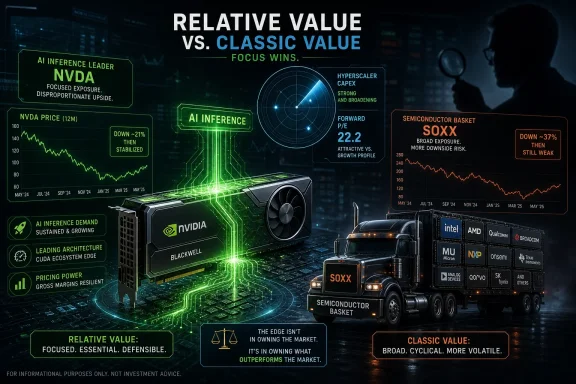 Nvidia Looks Less Stretched Than the Sector, Not Cheap in the Old Sense
The semiconductor trade has spent the year acting less like a normal technology group and more like a referendum on whether AI infrastructure spending can keep compounding. That is why the latest sell-off matters. According to the 24/7 Wall St. piece syndicated by AOL, the iShares Semiconductor ETF, trading under SOXX, has dropped 11% over the past week and sits around 16% below the all-time highs it reached at the end of June.Ordinarily, that would be the setup for a clean bearish story: stretched sector, hot money, sudden reversal, famous short seller circling. But this is not a clean story, because the same source coverage says SOXX is still up more than 75% year to date despite the damage. A sector can be wounded and still be expensive; it can be down sharply and still not have surrendered the excess that created the risk in the first place.
Nvidia complicates the narrative. The 24/7 Wall St. analysis says Nvidia stock is up just 4% on the year, trailing the wider semiconductor surge by a wide margin. That underperformance is the basis for the “value play” argument: not that Nvidia has become conventionally cheap, but that it has not participated in the speculative sprint that pushed the semiconductor basket so far above its recent starting line.
That distinction matters. SOXX bundles together companies whose earnings cycles, product exposure, and AI leverage are not identical. Nvidia, by contrast, is the company most directly associated with the GPU infrastructure layer behind modern AI training, inference, cloud-scale acceleration, and production AI workloads. The market can sell chip stocks together, but the businesses do not all carry the same risk.
The strongest version of the argument is therefore not that Nvidia is suddenly “cheap.” It is that Nvidia may be a better risk-reward candidate than a broad semiconductor basket after a sharp sector correction, because its year-to-date move has been much more restrained and the cited forward multiple is less extreme than the AI narrative might imply.
That is the angle investors should keep. Nvidia is not a bargain-bin stock. It is a high-expectation AI infrastructure leader that may now look less stretched than the sector around it.
The Semiconductor Sell-Off Is Really Two Stories Wearing One Ticker
SOXX is useful because it gives investors a clean way to buy the chip theme. It is also dangerous for analysis because it compresses very different businesses into one moving price. When the iShares Semiconductor ETF falls 11% in a week, the market is not necessarily saying one single thing about semiconductors. It may be saying several things at once.Part of the sell-off is about momentum. A fund that remains up more than 75% year to date after falling around 16% from late-June highs has not suffered a full valuation reset. It has suffered a momentum break inside a still-profitable trade. That kind of move often attracts both dip buyers and forced sellers, which is why the first leg down can feel chaotic rather than conclusive.
Another part is about cyclicality. The source material points to anxiety around DRAM and NAND makers, where investors fear a cyclical top could arrive before hard evidence of a slowdown appears. Memory markets are prone to boom-bust behavior because supply additions, pricing power, inventory swings, and large customer order patterns can turn quickly. If investors decide the memory cycle has peaked, the exit can get crowded long before earnings estimates fully catch down.
Nvidia’s case is different. The company is not immune to AI infrastructure cycles, hyperscaler budgets, valuation compression, or customer digestion periods. But its demand profile is tied to accelerated compute platforms, software ecosystems, networking, and the broader conversion of AI from experiments into production workloads. That makes Nvidia vulnerable to different risks than a memory supplier, even if both trade under the same “AI chips” umbrella.
The market often forgets this distinction during corrections. In a rally, investors want thematic purity: AI, semiconductors, infrastructure, growth. In a sell-off, they rediscover balance sheets, product cycles, customer concentration, and whether revenue is structural or cyclical. The 24/7 Wall St. argument is essentially that Nvidia looks better on that second pass than it did during the broad rally.
| Measure | Nvidia | iShares Semiconductor ETF SOXX |
|---|---|---|
| Year-to-date performance cited in source coverage | Up 4% | Up more than 75% |
| Recent pullback cited in source coverage | Down 16% from peak levels | Down around 16% from late-June all-time highs |
| Valuation cited in source coverage | 22.2 times forward earnings | Not specified |
| Core argument in source coverage | Less stretched than many AI-linked semiconductors | Broad sector basket correcting after a large run |
| Main risk described | Hyperscaler CapEx restraint and sympathy selling | Semiconductor cycle and crowded AI trade |
This is why the “go long Nvidia and short the semis” framing in the source material is more than a trader’s flourish. It captures a real distinction between owning the AI infrastructure leader and owning the sector’s aggregate enthusiasm. Whether that trade works is unknowable in advance, but the logic behind it is coherent: if AI compute demand holds up while the broader semiconductor cycle cools, Nvidia could outperform the basket even if the whole group remains volatile.
Michael Burry’s Shadow Makes the Trade Feel Bigger Than It Is
No semiconductor sell-off now arrives unaccompanied by a celebrity bear narrative. Dr. Michael Burry, whose reputation still rests heavily on his housing-market call before the financial crisis, is cited in the source material as looking “very wise” because of short positions against the group and individual bearish bets against Nvidia.That symbolism is powerful but easy to overstate. Burry’s presence does not prove the AI trade is broken, just as a high-profile short does not automatically make Nvidia dangerous. It does, however, force investors to confront a question that the bull market often buried: how much of AI infrastructure pricing reflects durable earnings power, and how much reflects the assumption that hyperscaler spending will continue at a very high level?
The market loves narrative compression, and Burry provides it. A sector ETF down 11% in a week is a data point. Burry shorting the group is a story. Nvidia underperforming the ETF by a wide margin year to date is a complication. Put together, they produce the kind of tension that turns a pullback into a debate over the entire AI capital cycle.
The danger is that Burry’s shadow can flatten the analysis. There are several ways to be bearish on semiconductors. One can believe memory pricing has peaked. One can believe hyperscalers will impose CapEx ceilings. One can believe model efficiency will reduce some brute-force compute demand. One can believe valuations have simply run too far. These are related arguments, but they are not the same argument.
Nvidia is exposed to all of them, but not equally. A memory-cycle rollover may hit memory makers more directly than Nvidia. A sharp reduction in hyperscaler AI budgets would hit Nvidia harder. Efficiency gains in AI models could reduce the compute needed for some tasks, but they could also make AI cheaper to deploy, broadening demand and increasing inference volume. That uncertainty is exactly why the stock cannot be evaluated with a simple bubble-or-no-bubble framework.
The 24/7 Wall St. and AOL pieces lean toward the view that Nvidia’s demand is more structural than the more obviously cyclical parts of the semiconductor complex. That is not a guarantee; it is a thesis. Investors and IT buyers should evaluate it on its own terms rather than treating every chip stock as a synchronized levered bet on one AI chart.
The 22.2-Times Question Is About Trust, Not Arithmetic
A forward price-to-earnings ratio of 22.2 times, as cited by 24/7 Wall St. and AOL, is the number that lets the source coverage frame Nvidia as a value candidate. On its face, that multiple does not sound outrageous for a company at the center of the AI infrastructure build-out. But forward multiples are only as reliable as the earnings forecasts underneath them.That is the central tension in Nvidia’s valuation. If the earnings estimates are directionally right, 22.2 times forward earnings after a 16% drop from peak levels can look modest for a company with dominant AI accelerator positioning. If those estimates prove too optimistic because hyperscalers slow spending, customers digest inventory, or margins normalize, the same multiple can be a trap.
This is why “cheap” is the wrong word unless it is qualified. Nvidia may be less expensive than investors would expect for the company most associated with AI compute. It may be cheaper relative to semiconductor peers that have run much harder this year. It may be attractively priced if the AI infrastructure cycle keeps converting into earnings. But it is not cheap in the sense that a low-growth industrial company is cheap after a recessionary sell-off.
The source material’s better framing is comparative. Nvidia may be one of the more attractive names inside a damaged semiconductor trade because its year-to-date move has been far more muted than SOXX, its pullback is already meaningful, and the cited forward multiple depends on earnings forecasts that still reflect strong AI infrastructure expectations.
That relative framing is more credible than the maximalist version of the bull case. The maximalist version says Nvidia wins everything. The more useful version says Nvidia may hold up better, recover faster, or compound more durably than the sector basket if the correction separates structural AI compute demand from cyclical semiconductor exuberance. Investors should prefer the second argument because it can survive contact with volatility.
The 16% decline from peak levels is also doing psychological work. It gives growth investors permission to revisit a stock many may have considered too obvious, too crowded, or too fully valued. But a pullback is not a valuation thesis by itself. A stock can be down 16% and still expensive, or down 16% and newly attractive, depending on what changed in the business.
In Nvidia’s case, the source coverage argues that the business case has not deteriorated in line with the stock’s pullback. That should be treated as a thesis rather than a settled fact. The bear case is still largely about risk, concentration, spending discipline, and estimate vulnerability. The bull case is that those risks are now more reasonably reflected in Nvidia’s price than in the broader semiconductor basket.
Hyperscaler CapEx Is the Fault Line Under the Whole Debate
The most serious risk in the source material is not Michael Burry. It is hyperscaler restraint. If the largest AI infrastructure buyers decide to slow, cap, or sequence spending more cautiously, Nvidia’s structural demand story becomes much harder to defend in the near term.The semiconductor market understands this, which is why every comment from major cloud platforms about AI capital expenditure is treated like macroeconomic data. AI infrastructure is capital intensive, concentrated among a relatively small number of massive buyers, and tied to future monetization that is still being proven across many enterprise use cases.
Nvidia bulls can respond that AI spend is strategically important. Major cloud and platform companies are competing to provide the compute layer for the next software cycle. In that framing, cutting too aggressively risks ceding ground. AI capacity is not just a cost center; it is a competitive weapon.
But CFOs eventually ask whether each marginal dollar of CapEx earns an adequate return. That is where the next phase of the AI trade becomes more demanding. The first phase rewarded capacity announcements. The next phase will reward utilization, pricing power, workload durability, and customer willingness to pay for AI-enhanced services. Nvidia can keep winning while investors become more selective, but the easy part of the story may already be gone.
For enterprise IT, this has a practical consequence. If hyperscalers keep spending aggressively, cloud AI services should keep expanding, and companies can consume increasingly capable AI features without owning the full infrastructure burden. If hyperscalers slow, enterprises may see tighter AI capacity allocation, less aggressive discounting, more pressure to commit to reserved capacity, or more expensive premium AI tiers.
This is where Nvidia’s supply-demand dynamics become a Windows and enterprise software issue. Microsoft Copilot-style experiences, developer assistants, document summarization, retrieval systems, meeting intelligence, endpoint security analysis, and agentic automation all consume accelerated compute somewhere in the stack. The user sees a button in Windows, Microsoft 365, a browser, an IDE, or a security console. The provider sees GPU capacity, inference cost, latency targets, and margin pressure.
If Nvidia supply remains tight relative to demand, cloud vendors and software providers have three broad choices. They can absorb the cost and pressure margins. They can raise prices or reserve the most capable AI features for higher-tier plans. Or they can ration performance by limiting usage, delaying rollouts, throttling features, or steering customers toward lighter-weight models.
If supply improves and cost per unit of AI output falls, the opposite becomes possible. Copilot-style features can become more responsive, usage caps can loosen, more regions can receive advanced features, and IT departments may find it easier to justify broad deployment instead of narrow pilots. In that sense, Nvidia’s hardware cycle can directly affect the price, availability, and timing of enterprise AI software.
That does not mean IT buyers should trade Nvidia stock to manage their software budgets. It means procurement teams should treat AI infrastructure as part of vendor due diligence. When evaluating Copilot, cloud AI services, developer tools, security copilots, or AI-enabled SaaS, ask vendors how pricing changes with usage, what happens if inference consumption rises, whether capacity is region-specific, and whether premium features depend on scarce accelerator capacity.
The source material notes that Nvidia could take a hit if hyperscalers scale back or announce a CapEx ceiling. That is the sentence to underline. The stock can look less stretched than peers, the product roadmap can be compelling, and the AI thesis can remain intact — while the shares still fall if the largest customers signal a pause.
Memory Anxiety Is Not the Same as GPU Anxiety
The source coverage contrasts Nvidia with hotter semiconductor names such as DRAM and NAND makers. That distinction deserves attention because many broad AI-bubble arguments become imprecise at this point. Memory and GPUs both benefit from AI infrastructure, but they sit in different places in the stack and respond differently to cycles.Memory markets can turn brutally because supply and demand mismatches show up in pricing. When buyers over-order, inventories rise. When capacity additions arrive into slowing demand, margins compress. When investors anticipate that turn, they do not wait politely for the earnings miss; they sell first and ask questions later.
Nvidia’s GPU business is cyclical too, but its cycle is shaped by platform transitions, software ecosystem lock-in, networking architecture, system-level integration, and the pace at which customers can deploy and monetize accelerated computing. That does not make it invincible. It does make it harder to analyze using only the old memory-cycle playbook.
The source material suggests that Nvidia’s GPU demand may be more structural than demand for some other semiconductor categories. That is plausible, but it should not be overstated. Efficiency cuts both ways. Better algorithms can reduce the compute needed for a given task; they can also make many more tasks economically viable. The net effect depends on whether AI demand is elastic.
So far, much of the industry has behaved as if AI demand is elastic: make inference cheaper, and developers use more of it; lower latency, and products become more interactive; improve performance per watt, and previously marginal workloads become more practical. But elasticity is not infinity. There are limits imposed by data quality, use cases, regulation, enterprise adoption, integration costs, and the ordinary difficulty of turning AI demos into durable productivity gains.
This is where Nvidia’s case is strongest but also testable. Nvidia is not protected because it cannot fall. It is better positioned if the sell-off is concentrated in the most cyclical parts of semiconductors while AI compute demand remains intact. If the sell-off is instead the market’s first serious repricing of the entire AI infrastructure build-out, Nvidia will not stand apart so easily.
Windows Users Should Care Because AI Hardware Is Becoming a Software Cost Driver
At first glance, a debate over Nvidia versus SOXX looks like market-page material, not WindowsForum material. But the semiconductor cycle now sits directly underneath the Windows ecosystem. Microsoft’s AI features, developer tools, security products, cloud services, and productivity software increasingly assume an AI infrastructure layer that someone must build, power, and pay for.That layer is heavily dependent on accelerated compute. Even when AI features appear inside familiar software, the economics often trace back to cloud infrastructure. Copilot-style experiences, AI code assistants, document summarization, retrieval systems, meeting intelligence, endpoint security analysis, and workflow agents all consume compute. The user sees a feature. The provider manages capacity.
For Windows users, this affects product experience. If compute is abundant and affordable, AI features can become faster, more available, and more deeply integrated. If compute is scarce or expensive, vendors may limit usage, create premium tiers, delay advanced features, or design around smaller models with narrower capabilities.
For enterprise IT teams, the procurement implications are practical:
| IT decision area | Why Nvidia supply-demand matters | What to ask vendors |
|---|---|---|
| Copilot and AI assistant rollout | AI features may carry usage-based or tier-based economics | Are there message caps, tenant limits, regional limits, or premium model charges? |
| Cloud AI services | GPU availability can influence pricing, latency, and reserved-capacity terms | Can capacity be reserved, and what happens if usage spikes? |
| Developer tools | Code assistants and agentic workflows can generate heavy inference demand | Is pricing per user, per token, per agent action, or bundled? |
| Security products | AI analysis of logs, endpoint signals, and incidents may require high-volume inference | Are AI features included, metered, or restricted to higher tiers? |
| Hybrid AI planning | On-premises alternatives may look more attractive if cloud AI pricing rises | Which workloads must stay local, and which can tolerate cloud latency and cost? |
This is also why pilots should be designed with cost observability from the start. A limited Copilot or AI automation trial can look affordable when usage is light. The real test is what happens when hundreds or thousands of users begin relying on AI features daily. IT teams should model usage growth, clarify contractual caps, and avoid assuming that today’s preview pricing will remain tomorrow’s production economics.
Investor Takeaway: What to Do Now, What Would Break the Thesis, and What to Watch
The practical takeaway is straightforward: Nvidia may be a reasonable candidate for investors who want selective AI semiconductor exposure, but the argument is relative, not absolute. It is less a “cheap stock” call than a “better-positioned than the crowded chip basket” call.For investors already holding Nvidia, the current setup argues against making the decision solely on the recent 16% pullback. The better question is whether the original AI infrastructure thesis remains intact and whether the cited 22.2-times forward earnings multiple still looks reasonable against future guidance. If the answer is yes, the pullback may be tolerable. If the answer is no, the multiple can compress quickly.
For investors considering a new position, the cleanest approach is patience and sizing discipline. Nvidia can be less stretched than SOXX and still volatile. A staged entry, a defined allocation limit, or a wait-for-confirmation approach is more defensible than treating the word “value” as permission to chase. The stock’s appeal depends on earnings support, not just a lower price.
For investors looking at the broader semiconductor trade, the source coverage makes a useful distinction: do not treat SOXX and Nvidia as interchangeable. SOXX gives diversified exposure to the semiconductor theme, including companies with different cyclical profiles. Nvidia gives more concentrated exposure to AI compute infrastructure. The right choice depends on whether the investor wants broad sector participation or a more specific bet on AI acceleration.
The thesis would be invalidated by clear evidence that the largest AI infrastructure buyers are slowing materially, capping spending, or guiding toward digestion rather than expansion. It would also weaken if Nvidia’s forward earnings estimates fall enough that the 22.2-times valuation no longer looks restrained, or if Nvidia begins to trade more like a cyclical hardware supplier than a platform-linked AI infrastructure company.
The most important signals to watch next are concrete:
| Signal to watch | Why it matters | Bullish reading | Bearish reading |
|---|---|---|---|
| Hyperscaler CapEx commentary | Largest cloud buyers drive AI infrastructure demand | Spending plans remain strong or rise | CapEx ceilings, delays, or digestion language |
| Nvidia guidance | Tests whether forward earnings support the valuation | Revenue and margin outlook remain firm | Guidance misses, margin pressure, or order caution |
| Forward P/E changes | Shows whether the stock is getting cheaper or estimates are falling | Multiple stays reasonable while estimates hold | Multiple looks low only because estimates are being cut |
| SOXX trend | Indicates whether sector pressure is isolated or broadening | SOXX stabilizes while Nvidia outperforms | SOXX keeps breaking down and drags leaders with it |
| Enterprise AI pricing | Connects infrastructure cost to real software demand | Vendors broaden features without steep price hikes | Usage caps, premium tiers, or rollout delays increase |
Timeline: How the Current Setup Came Together
| Point in the setup | What changed | Why it matters |
|---|---|---|
| Semiconductor rally | SOXX surged more than 75% year to date, according to the source coverage | Created valuation and momentum risk across the basket |
| Late-June peak | SOXX reached all-time highs, according to the source coverage | Established the reference point for the correction |
| Recent pullback | SOXX fell 11% in a week and around 16% from late-June highs | Turned a crowded AI trade into a risk-management debate |
| Nvidia comparison | Nvidia was cited as up only 4% year to date and down 16% from peak levels | Made Nvidia look less stretched than the broader semiconductor ETF |
| Valuation debate | 24/7 Wall St. cited Nvidia at 22.2 times forward earnings | Shifted the discussion from AI excitement to earnings trust |
| Next test | Hyperscaler CapEx, Nvidia guidance, forward multiple changes, and SOXX trend | Will show whether this is a buying opportunity or the start of a wider reset |
Admin Checklist for Investors and IT Buyers
| Audience | Action item | Why it matters now |
|---|---|---|
| Nvidia shareholders | Re-check position size against volatility tolerance | A less-stretched stock can still fall hard if AI spending expectations change |
| Prospective investors | Avoid treating “value” as “low risk” | The argument depends on forward earnings, not just recent underperformance |
| Semiconductor ETF holders | Review what SOXX actually owns and how cyclical the exposure is | The ETF is not a pure Nvidia proxy |
| Enterprise IT leaders | Ask AI vendors about usage limits, premium tiers, and capacity constraints | GPU economics can surface as software pricing and rollout limits |
| Cloud buyers | Compare pay-as-you-go, reserved capacity, and committed-use pricing for AI workloads | Capacity planning can matter as much as model selection |
| Windows administrators | Track how Copilot and AI security features are licensed and metered | AI features may change endpoint, identity, compliance, and support costs |
| Procurement teams | Build AI usage scenarios before signing broad deployments | Pilot costs may not reflect production-scale consumption |
| Finance teams | Tie AI software approvals to measurable productivity or risk-reduction goals | Infrastructure-backed AI features need ROI discipline |
Bottom Line
Nvidia is not a classic value play. It is a high-expectation AI infrastructure stock that now looks less stretched than a semiconductor basket that ran much harder. That is an important distinction, because the 24/7 Wall St. and AOL argument is strongest when framed as relative valuation and business-quality separation, not as a claim that Nvidia has become broadly cheap.The stock’s appeal depends on whether forward earnings estimates hold, whether hyperscalers keep funding AI infrastructure, and whether Nvidia continues to convert AI demand into revenue and margins. If those conditions remain intact, Nvidia can outperform a semiconductor basket weighed down by more cyclical names. If hyperscaler CapEx weakens or guidance rolls over, the “less expensive than peers” argument will not protect the stock.
For Windows users and enterprise IT teams, the market debate has a practical edge. Nvidia’s supply-demand balance can influence the cost and availability of cloud AI capacity, which can flow through to Copilot pricing, AI feature rollout timing, developer tools, security products, and enterprise procurement decisions. The AI button on the desktop is downstream from a capital-intensive infrastructure build.
So the answer is yes, Nvidia may be the more attractive AI semiconductor exposure after the sell-off — but no, that does not make it a simple value stock. The next confirmation will not come from slogans about AI. It will come from hyperscaler CapEx plans, Nvidia guidance, forward P/E stability, SOXX trend behavior, and whether enterprise AI pricing becomes easier or more restrictive from here.
References
- Primary source: aol.com
Published: Wed, 08 Jul 2026 15:15:31 GMT
Here’s Why Nvidia Might Be the New Value Play in Semiconductors - AOL
It’s been brutal to be a semiconductor investor lately, with the iShares Semiconductor ETF (NASDAQ:SOXX) tanking 11% in the past week and around 16% from all-time highs seen at the end of June. At this pace, it feels like a bear market is unavoidable, but before you hit the panic button, I’d...www.aol.com - Independent coverage: 24/7 Wall St.
Published: Wed, 08 Jul 2026 15:04:53 GMT
Here’s Why Nvidia Might Be the New Value Play in Semiconductors - 24/7 Wall St.
It’s been brutal to be a semiconductor investor lately, with the iShares Semiconductor ETF (NASDAQ:SOXX) tanking 11% in the past week and around 16% from all-time highs seen at the end of June. At this pace, it feels like a bear market is unavoidable, but before you hit the panic button...247wallst.com - Related coverage: developer.nvidia.com
Scaling Token Factory Revenue and AI Efficiency by Maximizing Performance per Watt | NVIDIA Technical Blog
In the AI era, power is the ultimate constraint, and every AI factory operates within a hard limit. This makes performance per watt—the rate at which power is…developer.nvidia.com
- Related coverage: simplywall.st
NVIDIA (NasdaqGS:NVDA) Stock Valuation, Peer Comparison & Price Targets - Simply Wall St
Research NVIDIA's (Nasdaq:NVDA) stock key valuation metrics while comparing it with its industry peers & market side by side.simplywall.st - Related coverage: nvidianews.nvidia.com
NVIDIA Kicks Off the Next Generation of AI With Rubin — Six New Chips, One Incredible AI Supercomputer | NVIDIA Newsroom
NVIDIA today kickstarted the next generation of AI with the launch of the NVIDIA Rubin platform, comprising six new chips designed to deliver one incredible AI supercomputer.nvidianews.nvidia.com - Related coverage: fool.com
Michael Burry Just Revealed His Next Big Short, and It's a Bet Against Nvidia, Micron, and AMD | The Motley Fool
Michael Burry of "The Big Short" fame is skeptical about the artificial intelligence infrastructure boom.www.fool.com
- Related coverage: benzinga.com
Nvidia, Tesla, Caterpillar: ETFs Most Exposed to Michael Burry's New Shorts - VanEck Semiconductor ETF (N - Benzinga
Michael Burry's latest shorts on Nvidia, Caterpillar, Tesla, and Applied Materials put AI, semiconductor, and industrial ETFs under the microscope.www.benzinga.com - Related coverage: nvidia.com
NVIDIA HGX Platform
NVIDIA HGX enables advanced AI and HPC workloads in every data center.www.nvidia.com - Related coverage: tomshardware.com
Nvidia CEO confirms Vera Rubin NVL72 is now in production — Jensen Huang uses CES keynote to announce the milestone | Tom's Hardware
Blackwell's successor is expected to arrive in the second half of 2026www.tomshardware.com - Related coverage: kiplinger.com
The Best Semiconductor ETFs: How You Can Mine the AI Gold Rush | Kiplinger
The best semiconductor ETFs hold the chipmakers benefitting from historically high spending by artificial intelligence hyperscalers and data center builders.www.kiplinger.com - Related coverage: techradar.com
Nvidia’s Rubin-powered DGX SuperPOD challenges Huawei’s AI dominance with fewer GPUs while delivering unmatched Exaflops performance at industrial scale | TechRadar
DGX racks integrate 600TB fast memory and NVMe storage per systemwww.techradar.com - Related coverage: windowscentral.com
SSD shortages might hit hard in 2026 thanks to NVIDIA, AI | Windows Central
NVIDIA's new Vera Rubin AI server systems are projected to require hundreds of millions of TB of NAND storage. Yes, that will seriously affect global SSD prices.www.windowscentral.com