

HP Tech Takes’ 2026 offline-FPS list puts nine PC campaigns back in the spotlight, from Borderlands 2 and Titanfall 2 to Doom (2016), BioShock, Far Cry 3, and Fallout 3, arguing that the best “offline” shooters are really durable single-player systems. The useful part of the list is not nostalgia. It is a reminder that PC gaming’s most resilient experiences are the ones that do not need a live-service calendar to justify their existence. In 2026, that makes the offline FPS less a comfort genre than a preservation strategy.
There is an important caveat before anyone treats this as a family-friendly shopping list: HP’s source material explicitly warns that some of these games are rated for mature audiences, that players should check each title’s ESRB rating before playing, and that M-rated games may contain content unsuitable for younger players. That warning matters here because several of these games build their identity around violence, horror, war, dystopia, or adult themes. “Offline” does not mean “safe for every player”; it means the core campaign can stand on its own.
The first-person shooter has spent years being pulled toward the network: ranked ladders, battle passes, seasonal events, competitive matchmaking, anti-cheat layers, online storefront entitlements, cloud saves, and social overlays. None of those things are inherently bad. Some of the greatest PC shooters are multiplayer institutions precisely because they depend on other people.
But HP’s list is not really about the whole FPS category. It is about the narrower, more durable promise of a campaign that can be installed, launched, and completed without asking the player to organize a squad, chase a meta, or keep pace with a seasonal treadmill. That is why the choices are interesting even when they are familiar. Borderlands 2, Titanfall 2, Doom (2016), Battlefield 1, Deus Ex: Mankind Divided, Dishonored 2, BioShock, Far Cry 3, and Fallout 3 are not just “old games that still work.” They are examples of a design philosophy that treats the player’s time as a finite resource rather than an engagement metric.
The best entries on the list are not offline because they lack ambition. They are offline because their ambition is concentrated. Titanfall 2 spends roughly 5 to 6 hours proving that a campaign can be short, replayable, and memorable. Deus Ex: Mankind Divided stretches 20 to 30 hours by letting the player approach problems through stealth, combat, hacking, or dialogue. Dishonored 2 builds replayability into the choice between Emily Kaldwin and Corvo Attano. These are different answers to the same question: how much agency can a single-player shooter deliver before it starts to feel padded?
That question has become more urgent for Windows PC users because the PC is both the best place to preserve old games and the easiest place to complicate them. Storefronts change, launchers change, operating systems change, controller support changes, and graphics APIs age. A good offline FPS survives those pressures better than a multiplayer title whose value depends on servers, matchmaking populations, or a current content roadmap. It is not immune to PC friction, but it carries more of its value locally.
That breadth is the point. Offline FPS is a useful umbrella only if the player knows what kind of offline experience they actually want. A player who wants 5 or 6 tightly paced hours should not be handed a 30-hour exploration-heavy game. A player who wants systemic stealth should not be told to play Doom (2016) first. A player who wants a campaign that feels like a playable war film may find Battlefield 1 more satisfying than a sprawling RPG hybrid.
HP’s source material gives enough practical data to make that distinction. The approximate lengths matter because they signal the design contract. Borderlands 2’s 15 to 25 hours for the main story, and up to 40 hours with side content, is a different commitment from Battlefield 1’s 6 to 8 hour campaign. Dishonored 2’s 12 to 16 hours per playthrough is not simply a length estimate; it reflects a game meant for multiple runs. Deus Ex: Mankind Divided’s 20 to 30 hours depends heavily on play style and exploration, which is exactly what one should expect from a first-person RPG with stealth and combat elements.
The comparison also reveals the one awkwardness in the original source: Fallout 3 appears as the ninth entry, but the supplied material does not include the same descriptive treatment or length estimate given to the other eight. That does not make it an unworthy inclusion. Bethesda’s own support material describes Fallout 3 as a single-player game, and the game’s place in PC history is obvious. But it does mean the source list is strongest when discussing the first eight entries, where setting, structure, and estimated time are all laid out clearly.
The game’s core trick is that it makes repetition feel like discovery. The source material emphasizes fast-paced shooter combat, role-playing elements, cel-shaded visual design, randomized weapon stats, skill trees, and side quests. Those pieces matter because Borderlands 2 does not rely solely on level scripting or set-piece spectacle. Its campaign survives long play sessions because the player is constantly sorting gear, adjusting builds, and deciding whether the next fight is worth the next loot roll.
That is also why the 15 to 25 hour main-story estimate, with up to 40 hours including side content, feels plausible as a design category rather than just a number. Borderlands 2 can be played as a story campaign, but it is happier as a road trip through violent absurdity. The writing is darkly humorous, the characters are broad, and Pandora is deliberately hostile. Its offline strength is that it gives the player a self-contained loot machine whose pleasures do not depend on whether the wider shooter market has moved on.
There is an irony here: Borderlands as a formula is famously compatible with co-op, but the reason Borderlands 2 belongs on an offline list is that its campaign loop still has enough structure to work alone. A weaker loot shooter becomes lonely without friends. Borderlands 2 remains noisy, busy, and mechanically generous even when the player is the whole party.
Official Steam and EA materials have long framed Titanfall 2 around both single-player and multiplayer, but its reputation in PC circles rests disproportionately on the campaign. That is because it is short without feeling thin. The 5 to 6 hour estimate is not a warning label. It is part of the design. Titanfall 2 moves quickly, introduces ideas confidently, and leaves before the player has time to resent the repetition.
The campaign’s offline value comes from pacing. Wall-running, parkour movement, on-foot combat, and Titan combat are not left as disconnected features; they are constantly recombined. BT-7274 is not just a weapon platform but a structural counterweight to Jack Cooper’s vulnerability. The player alternates between speed, scale, precision, and spectacle.
That compactness is especially valuable in 2026, when so many games compete by mass. Titanfall 2 argues for density instead. It is the weekend campaign as prestige format: not a subscription, not a hobby, not a social obligation, but a carefully authored burst of mechanics and emotion. In a market that often treats shortness as a defect, Titanfall 2 makes brevity feel like discipline.
Bethesda’s own campaign materials have described the modern Doom loop in terms of relentless demons, destructive guns, fast movement, and single-player combat, and HP’s source material lands on the same conclusion: Doom’s story is minimal because the combat is the thesis. Its soundtrack, weapon variety, upgrade options, and Glory Kill system all push the player forward. The game does not want the player hiding behind cover and waiting for health to regenerate. It wants aggression to become survival.
That is why Doom (2016) still matters as an offline PC recommendation. It is not merely a reboot of a famous name. It is a repudiation of a specific kind of shooter design that had become overly cautious: slow movement, chest-high walls, scripted vulnerability, and cinematic interruption. Doom turns the arena into a resource puzzle. Ammunition, health, armor, enemy positioning, and movement routes all become part of the same violent equation.
The 10 to 15 hour campaign estimate places it in a sweet spot. It is longer than Titanfall 2 and Battlefield 1, but not sprawling like Far Cry 3 or Deus Ex: Mankind Divided. It is big enough to feel substantial and focused enough to avoid bloat. For PC players who want the offline FPS reduced to its most kinetic form, Doom (2016) remains the cleanest recommendation on the list.
That anthology structure is what makes Battlefield 1 viable offline. Set during World War I, the campaign follows different soldiers across various theatres, giving each story its own emotional arc and gameplay style. EA’s own discussion of the single-player campaign emphasized “war stories” and systemic freedom: objectives, loadouts, improvisation, and different ways to approach combat situations. In other words, Battlefield 1 tries to bring a hint of multiplayer agency into authored solo missions.
The result is not the deepest campaign on the list, and at 6 to 8 hours it is not trying to be. Its strength is atmosphere and variety. The World War I setting remains unusual in modern FPS design, and the vignette format lets EA DICE move between tones, roles, and equipment without pretending one character could plausibly experience everything. That restraint matters because the subject matter is heavy. The campaign’s best case for itself is that it treats scale as a human problem rather than just a spectacle machine.
For offline players, Battlefield 1 is the list’s answer to a specific desire: the big-budget military FPS campaign with strong production values, voice acting, and period atmosphere. It is not as systemically open as Deus Ex, not as mechanically perfect as Doom, and not as emotionally concentrated as Titanfall 2. But it offers something those games do not: a shooter campaign built around the fragmentation of war itself.
Deus Ex: Mankind Divided, by Eidos Montréal, continues the cyberpunk story of augmented agent Adam Jensen in a near-future Prague where augmented humans face social and political backlash. Eidos Montréal’s own official materials frame Adam Jensen as an elite covert agent in a world that has grown to despise mechanically augmented humans, with player choice, weapons, augmentations, and consequences at the center. HP’s summary is more practical: missions can be approached through stealth, combat, hacking, or dialogue, and the world rewards exploration.
That makes Mankind Divided especially relevant to WindowsForum readers who enjoy PC games as configurable systems. The pleasure is not just completing a mission; it is solving a mission in a way that feels authored by the player. A vent, a conversation, a hackable terminal, a nonlethal takedown, a loud firefight, an alternate route — each becomes part of the same design language. The 20 to 30 hour estimate depends on play style because the game’s value is partially hidden in how much the player chooses to investigate.
Dishonored 2, by Arkane Studios, takes that principle into a more theatrical form. Set in the steampunk-influenced city of Karnaca, it lets the player choose Emily Kaldwin or Corvo Attano. HP’s source material notes that the choice affects abilities, dialogue, and how the story unfolds, and it highlights the game’s “play your way” philosophy. Steam’s own store description has likewise long emphasized Emily and Corvo as distinct voiced protagonists traveling to Karnaca, a city central to restoring Emily’s power.
The critical difference is that Dishonored 2 is built for replay. Its 12 to 16 hour per-playthrough estimate is tied to multiple runs, not simply completion time. Different characters, abilities, levels, paths, stealth choices, combat choices, and outcomes make the game feel less like a fixed route than a murderously elegant stage play. If Doom (2016) is about mastering pressure, Dishonored 2 is about mastering possibility.
Together, Deus Ex and Dishonored 2 make the case that offline FPS design is healthiest when it absorbs neighboring genres. The gun can remain present without being sovereign. The best moments in these games often happen when the player chooses not to fire.
BioShock’s offline value is atmosphere. The art deco architecture, audio design, environmental storytelling, plasmid powers, conventional weapons, and moral choice system combine into a game that feels more authored than expansive. It is not the largest world on the list, but it is one of the most memorable because Rapture is not a backdrop. It is the argument.
The 12 to 16 hour campaign estimate is also part of why BioShock still works. It is long enough for the city’s ideology and horror to accumulate, but not so long that the setting dissolves into routine. Its best spaces feel like crime scenes, museums, laboratories, and confessionals at once. The player is not merely moving through levels; the player is excavating a failed worldview.
That is why BioShock belongs in a 2026 offline FPS list even if its mechanics have been imitated and debated for years. The game’s most durable feature is not a weapon or a power. It is the confidence that a single-player shooter can carry philosophy, architecture, audio logs, moral pressure, and combat in the same container. Many games have borrowed that lesson. Few have made the container feel so complete.
The setup is direct: Jason Brody is stranded on a tropical island controlled by pirates and must survive and rescue his friends. The structure is broader: the island becomes a grid of threats, upgrades, activities, and opportunities. That combination of authored villainy and open-world routine became enormously influential. It also became something later games would struggle to escape.
In 2026, Far Cry 3 is worth playing partly because it lets players revisit the formula before it hardened into expectation. The outposts, hunting loops, crafting incentives, skill progression, and side activities still have a directness that later open-world games sometimes bury beneath excess. The 20 to 30 hour estimate, including side content, signals a substantial commitment but not an endless one.
Vaas remains the hook because he gives the game a human center of gravity. Open worlds often blur when they lack a strong antagonist; Far Cry 3 avoids that by making the island feel psychologically hostile as well as physically dangerous. It is not the subtlest game on the list, but subtlety was never the pitch. The pitch was danger, momentum, and a place that keeps offering the player one more thing to do.
Even with that limitation, Fallout 3’s inclusion makes editorial sense because it represents the RPG end of the offline first-person spectrum. Like Deus Ex: Mankind Divided, it complicates the meaning of “FPS” by putting shooting inside a broader role-playing structure. The player is not just clearing arenas or following a linear campaign. The appeal is exploration, character growth, questing, and the sense that combat is one part of a larger systems-driven world.
For Windows PC users, Fallout 3 also stands for a different kind of offline value: the long tail of moddable, revisitable, single-player PC games. That is not the same as saying every old PC game is effortless to run forever. It is saying that a self-contained single-player game offers a better chance of remaining meaningful as hardware, operating systems, and storefronts change around it.
The absence of a length estimate in the source material should not be ignored, though. If HP’s list is being used as a buying or backlog guide, Fallout 3 needs extra research before a player decides whether it fits a weekend, a month, or a long-term RPG mood. It belongs here, but it is the entry that most demands a second look before installation.
That does not make the list irresponsible. It makes context necessary. Offline games are sometimes recommended casually because they are convenient: good for laptops, travel, unreliable connections, or players who do not want multiplayer pressure. But convenience should not obscure content. A parent, teacher, younger player, or shared-family-PC user should treat the ESRB check as a real step, not an afterthought.
It is also worth noting that mature themes are part of why many of these campaigns endure. BioShock’s Rapture would not have the same force if the game sanded down its ideological horror. Doom would not be Doom if it treated its demonic violence timidly. Deus Ex would lose much of its identity if social distrust of augmented humans became mere decoration. The right conclusion is not that mature games should be avoided. It is that they should be chosen deliberately.
For a short, high-density campaign, Titanfall 2 is the obvious first stop. For aggressive mechanical purity, Doom (2016) is the cleanest pick. For a military anthology with production spectacle, Battlefield 1 is the better fit. For choice-heavy systems, Deus Ex: Mankind Divided and Dishonored 2 are the strongest recommendations. For atmosphere and narrative legacy, BioShock remains essential. For a longer open-world loop, Far Cry 3 and Borderlands 2 offer very different kinds of abundance. Fallout 3 is the broader RPG commitment, though HP’s supplied excerpt does not give enough detail to size that commitment precisely.
That kind of matching matters because “best” is too blunt a word for offline FPS games. The best offline shooter for a hotel laptop evening is probably not the best one for a holiday break. The best game for a player who hates stealth is not the best game for someone who wants to avoid killing. The best game for someone who wants a story with emotional momentum is not the best game for someone who wants buildcraft, side quests, and loot.
This is where the list becomes more useful than its headline. It says, implicitly, that offline PC gaming is not one taste. It is a set of escape routes from dependence: dependence on other players, dependence on active servers, dependence on a seasonal economy, and dependence on the modern assumption that every game must be a platform. The best offline FPS games are not smaller experiences. They are more self-contained ones.
HP’s 2026 list is therefore less a museum tour than a reminder of what PC players should continue demanding: campaigns that justify themselves without a login streak, a squad queue, or a future content promise. The next great offline FPS does not have to look like Borderlands 2, Titanfall 2, Doom (2016), Battlefield 1, Deus Ex: Mankind Divided, Dishonored 2, BioShock, Far Cry 3, or Fallout 3. But it should learn from their common discipline: build a world, define a loop, respect the player’s time, and make sure the game is still worth playing when the network is no longer the point.
There is an important caveat before anyone treats this as a family-friendly shopping list: HP’s source material explicitly warns that some of these games are rated for mature audiences, that players should check each title’s ESRB rating before playing, and that M-rated games may contain content unsuitable for younger players. That warning matters here because several of these games build their identity around violence, horror, war, dystopia, or adult themes. “Offline” does not mean “safe for every player”; it means the core campaign can stand on its own.
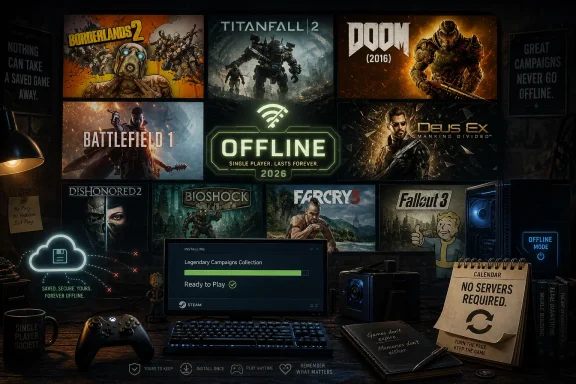 Offline Shooters Have Become the Anti-Live-Service Argument
The first-person shooter has spent years being pulled toward the network: ranked ladders, battle passes, seasonal events, competitive matchmaking, anti-cheat layers, online storefront entitlements, cloud saves, and social overlays. None of those things are inherently bad. Some of the greatest PC shooters are multiplayer institutions precisely because they depend on other people.But HP’s list is not really about the whole FPS category. It is about the narrower, more durable promise of a campaign that can be installed, launched, and completed without asking the player to organize a squad, chase a meta, or keep pace with a seasonal treadmill. That is why the choices are interesting even when they are familiar. Borderlands 2, Titanfall 2, Doom (2016), Battlefield 1, Deus Ex: Mankind Divided, Dishonored 2, BioShock, Far Cry 3, and Fallout 3 are not just “old games that still work.” They are examples of a design philosophy that treats the player’s time as a finite resource rather than an engagement metric.
The best entries on the list are not offline because they lack ambition. They are offline because their ambition is concentrated. Titanfall 2 spends roughly 5 to 6 hours proving that a campaign can be short, replayable, and memorable. Deus Ex: Mankind Divided stretches 20 to 30 hours by letting the player approach problems through stealth, combat, hacking, or dialogue. Dishonored 2 builds replayability into the choice between Emily Kaldwin and Corvo Attano. These are different answers to the same question: how much agency can a single-player shooter deliver before it starts to feel padded?
That question has become more urgent for Windows PC users because the PC is both the best place to preserve old games and the easiest place to complicate them. Storefronts change, launchers change, operating systems change, controller support changes, and graphics APIs age. A good offline FPS survives those pressures better than a multiplayer title whose value depends on servers, matchmaking populations, or a current content roadmap. It is not immune to PC friction, but it carries more of its value locally.
The List Works Because It Is Not One Kind of Shooter
The smartest thing about HP’s selection is that it does not pretend “offline FPS” means one thing. This is not a list of nine corridor shooters, nine open worlds, or nine immersive sims wearing a shooter’s jacket. It is a spread across loot-driven action, cinematic campaign design, arena combat, war anthology, cyberpunk role-playing, stealth sandboxes, narrative horror, tropical open-world survival, and Bethesda-style role-playing.That breadth is the point. Offline FPS is a useful umbrella only if the player knows what kind of offline experience they actually want. A player who wants 5 or 6 tightly paced hours should not be handed a 30-hour exploration-heavy game. A player who wants systemic stealth should not be told to play Doom (2016) first. A player who wants a campaign that feels like a playable war film may find Battlefield 1 more satisfying than a sprawling RPG hybrid.
HP’s source material gives enough practical data to make that distinction. The approximate lengths matter because they signal the design contract. Borderlands 2’s 15 to 25 hours for the main story, and up to 40 hours with side content, is a different commitment from Battlefield 1’s 6 to 8 hour campaign. Dishonored 2’s 12 to 16 hours per playthrough is not simply a length estimate; it reflects a game meant for multiple runs. Deus Ex: Mankind Divided’s 20 to 30 hours depends heavily on play style and exploration, which is exactly what one should expect from a first-person RPG with stealth and combat elements.
| Game | Listed creator or publisher | Offline campaign identity | Approximate length from source material |
|---|---|---|---|
| Borderlands 2 | 2K | Loot shooter with RPG progression on Pandora | 15–25 hours main story; up to 40 with side content |
| Titanfall 2 | Respawn Entertainment | Cinematic pilot-and-mech campaign built around Jack Cooper and BT-7274 | 5–6 hours |
| Doom (2016) | id Software | Aggressive arena FPS in a demon-overrun Mars research facility | 10–15 hours |
| Battlefield 1 | EA DICE | World War I campaign told through soldier vignettes | 6–8 hours |
| Deus Ex: Mankind Divided | Eidos Montréal | Cyberpunk first-person RPG about Adam Jensen in Prague | 20–30 hours |
| Dishonored 2 | Arkane Studios | Stealth-action sandbox in Karnaca with Emily Kaldwin or Corvo Attano | 12–16 hours per playthrough |
| BioShock | 2K Boston and 2K Australia | Narrative FPS set in the collapsed underwater city of Rapture | 12–16 hours |
| Far Cry 3 | Ubisoft | Open-world island shooter with Jason Brody and Vaas | 20–30 hours including side content |
| Fallout 3 | Bethesda Game Studios | Single-player RPG-shooter hybrid | Not specified in the source material |
Borderlands 2 Turns Offline Play Into a Loot Economy
Borderlands 2 remains the list’s clearest example of an offline shooter that does not have to be austere. Set on the planet Pandora five years after the events of the original Borderlands, it puts players in the role of a new Vault Hunter trying to stop Handsome Jack from controlling a newly discovered alien Vault. The offline appeal is not solitude; it is abundance.The game’s core trick is that it makes repetition feel like discovery. The source material emphasizes fast-paced shooter combat, role-playing elements, cel-shaded visual design, randomized weapon stats, skill trees, and side quests. Those pieces matter because Borderlands 2 does not rely solely on level scripting or set-piece spectacle. Its campaign survives long play sessions because the player is constantly sorting gear, adjusting builds, and deciding whether the next fight is worth the next loot roll.
That is also why the 15 to 25 hour main-story estimate, with up to 40 hours including side content, feels plausible as a design category rather than just a number. Borderlands 2 can be played as a story campaign, but it is happier as a road trip through violent absurdity. The writing is darkly humorous, the characters are broad, and Pandora is deliberately hostile. Its offline strength is that it gives the player a self-contained loot machine whose pleasures do not depend on whether the wider shooter market has moved on.
There is an irony here: Borderlands as a formula is famously compatible with co-op, but the reason Borderlands 2 belongs on an offline list is that its campaign loop still has enough structure to work alone. A weaker loot shooter becomes lonely without friends. Borderlands 2 remains noisy, busy, and mechanically generous even when the player is the whole party.
Titanfall 2 Is Short Because It Knows Exactly What It Is Doing
Titanfall 2 is the entry most often invoked as proof that the single-player FPS campaign did not die; it merely became rare. Respawn Entertainment’s campaign follows Jack Cooper, a soldier in the Frontier Militia who bonds with the Titan mech BT-7274. HP’s source material rightly puts that relationship at the center of the experience, because the campaign works not just as a movement showcase but as a buddy story.Official Steam and EA materials have long framed Titanfall 2 around both single-player and multiplayer, but its reputation in PC circles rests disproportionately on the campaign. That is because it is short without feeling thin. The 5 to 6 hour estimate is not a warning label. It is part of the design. Titanfall 2 moves quickly, introduces ideas confidently, and leaves before the player has time to resent the repetition.
The campaign’s offline value comes from pacing. Wall-running, parkour movement, on-foot combat, and Titan combat are not left as disconnected features; they are constantly recombined. BT-7274 is not just a weapon platform but a structural counterweight to Jack Cooper’s vulnerability. The player alternates between speed, scale, precision, and spectacle.
That compactness is especially valuable in 2026, when so many games compete by mass. Titanfall 2 argues for density instead. It is the weekend campaign as prestige format: not a subscription, not a hobby, not a social obligation, but a carefully authored burst of mechanics and emotion. In a market that often treats shortness as a defect, Titanfall 2 makes brevity feel like discipline.
Doom (2016) Rebuilds the Old FPS Contract With Modern Force
Doom (2016), by id Software, is the list’s purest shooter. Set in a Mars research facility overrun by demons from another dimension, it is intentionally light on narrative complication. The point is not to sit with moral ambiguity. The point is to move, shoot, glory-kill, restock, and repeat at a speed that makes hesitation feel like failure.Bethesda’s own campaign materials have described the modern Doom loop in terms of relentless demons, destructive guns, fast movement, and single-player combat, and HP’s source material lands on the same conclusion: Doom’s story is minimal because the combat is the thesis. Its soundtrack, weapon variety, upgrade options, and Glory Kill system all push the player forward. The game does not want the player hiding behind cover and waiting for health to regenerate. It wants aggression to become survival.
That is why Doom (2016) still matters as an offline PC recommendation. It is not merely a reboot of a famous name. It is a repudiation of a specific kind of shooter design that had become overly cautious: slow movement, chest-high walls, scripted vulnerability, and cinematic interruption. Doom turns the arena into a resource puzzle. Ammunition, health, armor, enemy positioning, and movement routes all become part of the same violent equation.
The 10 to 15 hour campaign estimate places it in a sweet spot. It is longer than Titanfall 2 and Battlefield 1, but not sprawling like Far Cry 3 or Deus Ex: Mankind Divided. It is big enough to feel substantial and focused enough to avoid bloat. For PC players who want the offline FPS reduced to its most kinetic form, Doom (2016) remains the cleanest recommendation on the list.
Battlefield 1 Finds a Single-Player Shape for a Multiplayer Series
Battlefield 1 is the oddest inclusion because Battlefield’s identity has traditionally been multiplayer scale: vehicles, classes, squads, destruction, and huge contested spaces. HP’s source material acknowledges that tension by calling the campaign a departure from the franchise’s multiplayer-focused tradition. The game’s solution is not to force one grand protagonist through World War I. It uses vignettes.That anthology structure is what makes Battlefield 1 viable offline. Set during World War I, the campaign follows different soldiers across various theatres, giving each story its own emotional arc and gameplay style. EA’s own discussion of the single-player campaign emphasized “war stories” and systemic freedom: objectives, loadouts, improvisation, and different ways to approach combat situations. In other words, Battlefield 1 tries to bring a hint of multiplayer agency into authored solo missions.
The result is not the deepest campaign on the list, and at 6 to 8 hours it is not trying to be. Its strength is atmosphere and variety. The World War I setting remains unusual in modern FPS design, and the vignette format lets EA DICE move between tones, roles, and equipment without pretending one character could plausibly experience everything. That restraint matters because the subject matter is heavy. The campaign’s best case for itself is that it treats scale as a human problem rather than just a spectacle machine.
For offline players, Battlefield 1 is the list’s answer to a specific desire: the big-budget military FPS campaign with strong production values, voice acting, and period atmosphere. It is not as systemically open as Deus Ex, not as mechanically perfect as Doom, and not as emotionally concentrated as Titanfall 2. But it offers something those games do not: a shooter campaign built around the fragmentation of war itself.
Deus Ex: Mankind Divided and Dishonored 2 Make the Gun Optional
The most interesting pair on the list is Deus Ex: Mankind Divided and Dishonored 2, because both challenge the assumption that an offline FPS must be primarily about shooting. HP’s source material describes Mankind Divided as a first-person RPG with stealth and combat elements, and Dishonored 2 as a first-person action-adventure game with strong stealth elements. That wording is important. These are not merely shooters with stealth sections; they are systems games where violence is one option among many.Deus Ex: Mankind Divided, by Eidos Montréal, continues the cyberpunk story of augmented agent Adam Jensen in a near-future Prague where augmented humans face social and political backlash. Eidos Montréal’s own official materials frame Adam Jensen as an elite covert agent in a world that has grown to despise mechanically augmented humans, with player choice, weapons, augmentations, and consequences at the center. HP’s summary is more practical: missions can be approached through stealth, combat, hacking, or dialogue, and the world rewards exploration.
That makes Mankind Divided especially relevant to WindowsForum readers who enjoy PC games as configurable systems. The pleasure is not just completing a mission; it is solving a mission in a way that feels authored by the player. A vent, a conversation, a hackable terminal, a nonlethal takedown, a loud firefight, an alternate route — each becomes part of the same design language. The 20 to 30 hour estimate depends on play style because the game’s value is partially hidden in how much the player chooses to investigate.
Dishonored 2, by Arkane Studios, takes that principle into a more theatrical form. Set in the steampunk-influenced city of Karnaca, it lets the player choose Emily Kaldwin or Corvo Attano. HP’s source material notes that the choice affects abilities, dialogue, and how the story unfolds, and it highlights the game’s “play your way” philosophy. Steam’s own store description has likewise long emphasized Emily and Corvo as distinct voiced protagonists traveling to Karnaca, a city central to restoring Emily’s power.
The critical difference is that Dishonored 2 is built for replay. Its 12 to 16 hour per-playthrough estimate is tied to multiple runs, not simply completion time. Different characters, abilities, levels, paths, stealth choices, combat choices, and outcomes make the game feel less like a fixed route than a murderously elegant stage play. If Doom (2016) is about mastering pressure, Dishonored 2 is about mastering possibility.
Together, Deus Ex and Dishonored 2 make the case that offline FPS design is healthiest when it absorbs neighboring genres. The gun can remain present without being sovereign. The best moments in these games often happen when the player chooses not to fire.
BioShock Proves Atmosphere Can Outlive Technology
BioShock, by 2K Boston and 2K Australia, is the list’s canonical narrative shooter. Set in Rapture, an underwater city built as a Utopian retreat by Andrew Ryan, it begins after that society has collapsed. 2K’s own store material still foregrounds Rapture as an undersea city that devolved into a dystopian nightmare, and HP’s source material correctly identifies the setting as the heart of the game’s lasting impact.BioShock’s offline value is atmosphere. The art deco architecture, audio design, environmental storytelling, plasmid powers, conventional weapons, and moral choice system combine into a game that feels more authored than expansive. It is not the largest world on the list, but it is one of the most memorable because Rapture is not a backdrop. It is the argument.
The 12 to 16 hour campaign estimate is also part of why BioShock still works. It is long enough for the city’s ideology and horror to accumulate, but not so long that the setting dissolves into routine. Its best spaces feel like crime scenes, museums, laboratories, and confessionals at once. The player is not merely moving through levels; the player is excavating a failed worldview.
That is why BioShock belongs in a 2026 offline FPS list even if its mechanics have been imitated and debated for years. The game’s most durable feature is not a weapon or a power. It is the confidence that a single-player shooter can carry philosophy, architecture, audio logs, moral pressure, and combat in the same container. Many games have borrowed that lesson. Few have made the container feel so complete.
Far Cry 3 Shows the Power and Danger of the Formula It Popularized
Far Cry 3, published by Ubisoft, is the list’s open-world representative. HP’s source material describes it as the entry that often gets credit for defining the modern Far Cry formula: open-world exploration, single-player FPS combat, hunting, crafting, survival mechanics, skill progression, and a strong main villain. Ubisoft’s own materials emphasize an island ruled by piracy and human misery, with Vaas presented as one of the franchise’s most notorious villains.The setup is direct: Jason Brody is stranded on a tropical island controlled by pirates and must survive and rescue his friends. The structure is broader: the island becomes a grid of threats, upgrades, activities, and opportunities. That combination of authored villainy and open-world routine became enormously influential. It also became something later games would struggle to escape.
In 2026, Far Cry 3 is worth playing partly because it lets players revisit the formula before it hardened into expectation. The outposts, hunting loops, crafting incentives, skill progression, and side activities still have a directness that later open-world games sometimes bury beneath excess. The 20 to 30 hour estimate, including side content, signals a substantial commitment but not an endless one.
Vaas remains the hook because he gives the game a human center of gravity. Open worlds often blur when they lack a strong antagonist; Far Cry 3 avoids that by making the island feel psychologically hostile as well as physically dangerous. It is not the subtlest game on the list, but subtlety was never the pitch. The pitch was danger, momentum, and a place that keeps offering the player one more thing to do.
Fallout 3 Is the Incomplete Entry That Still Belongs in the Conversation
Fallout 3 is the least developed entry in the supplied source material: HP’s list names Fallout 3 by Bethesda Game Studios, but the provided excerpt stops before giving it the same full treatment as the others. That means any responsible discussion has to be careful. The article can fairly include Fallout 3 as part of the list, and Bethesda’s own support material identifies it as a single-player game, but the source material does not provide a campaign-length estimate or detailed setting description in the way it does for the other eight.Even with that limitation, Fallout 3’s inclusion makes editorial sense because it represents the RPG end of the offline first-person spectrum. Like Deus Ex: Mankind Divided, it complicates the meaning of “FPS” by putting shooting inside a broader role-playing structure. The player is not just clearing arenas or following a linear campaign. The appeal is exploration, character growth, questing, and the sense that combat is one part of a larger systems-driven world.
For Windows PC users, Fallout 3 also stands for a different kind of offline value: the long tail of moddable, revisitable, single-player PC games. That is not the same as saying every old PC game is effortless to run forever. It is saying that a self-contained single-player game offers a better chance of remaining meaningful as hardware, operating systems, and storefronts change around it.
The absence of a length estimate in the source material should not be ignored, though. If HP’s list is being used as a buying or backlog guide, Fallout 3 needs extra research before a player decides whether it fits a weekend, a month, or a long-term RPG mood. It belongs here, but it is the entry that most demands a second look before installation.
Mature Content Is a Feature of the List, Not a Footnote
The ESRB warning at the top of HP’s source material is not legal padding. It is a genuine reader-service note because this list leans hard into adult material. Doom (2016) is built around brutal demon combat. Battlefield 1 uses the machinery and trauma of World War I as its setting. BioShock explores the collapse of a utopian project into violence and exploitation. Deus Ex: Mankind Divided centers social and political backlash against augmented humans. Far Cry 3 revolves around a pirate-controlled island and a villain designed to unsettle.That does not make the list irresponsible. It makes context necessary. Offline games are sometimes recommended casually because they are convenient: good for laptops, travel, unreliable connections, or players who do not want multiplayer pressure. But convenience should not obscure content. A parent, teacher, younger player, or shared-family-PC user should treat the ESRB check as a real step, not an afterthought.
It is also worth noting that mature themes are part of why many of these campaigns endure. BioShock’s Rapture would not have the same force if the game sanded down its ideological horror. Doom would not be Doom if it treated its demonic violence timidly. Deus Ex would lose much of its identity if social distrust of augmented humans became mere decoration. The right conclusion is not that mature games should be avoided. It is that they should be chosen deliberately.
The Practical PC Lesson Is to Match the Game to the Constraint
The most useful way to read HP’s list is not as a ranking but as a constraint map. How much time do you have? How much narrative do you want? How much mechanical freedom do you tolerate? Do you want to aim, explore, sneak, loot, role-play, or simply move fast and break things?For a short, high-density campaign, Titanfall 2 is the obvious first stop. For aggressive mechanical purity, Doom (2016) is the cleanest pick. For a military anthology with production spectacle, Battlefield 1 is the better fit. For choice-heavy systems, Deus Ex: Mankind Divided and Dishonored 2 are the strongest recommendations. For atmosphere and narrative legacy, BioShock remains essential. For a longer open-world loop, Far Cry 3 and Borderlands 2 offer very different kinds of abundance. Fallout 3 is the broader RPG commitment, though HP’s supplied excerpt does not give enough detail to size that commitment precisely.
That kind of matching matters because “best” is too blunt a word for offline FPS games. The best offline shooter for a hotel laptop evening is probably not the best one for a holiday break. The best game for a player who hates stealth is not the best game for someone who wants to avoid killing. The best game for someone who wants a story with emotional momentum is not the best game for someone who wants buildcraft, side quests, and loot.
This is where the list becomes more useful than its headline. It says, implicitly, that offline PC gaming is not one taste. It is a set of escape routes from dependence: dependence on other players, dependence on active servers, dependence on a seasonal economy, and dependence on the modern assumption that every game must be a platform. The best offline FPS games are not smaller experiences. They are more self-contained ones.
What Still Holds Up When the Servers Are Beside the Point
The enduring appeal of these nine games is not that they reject modern PC gaming wholesale. Several have multiplayer modes, online storefront baggage, or editions that complicate the picture. Their real achievement is that the campaign remains the thing worth showing up for.- Titanfall 2 is the short-campaign benchmark: 5 to 6 hours, high invention, little waste.
- Doom (2016) is the pure combat pick: 10 to 15 hours of movement-driven aggression.
- Deus Ex: Mankind Divided and Dishonored 2 are the systems-player picks, rewarding stealth, exploration, and alternate routes.
- Borderlands 2 and Far Cry 3 are the longer-form choices for players who want side content and progression loops.
- BioShock is still the narrative-atmosphere landmark, with Rapture carrying as much weight as the combat.
- Battlefield 1 is the big-budget historical anthology, strongest for players who want variety and production value over sandbox depth.
HP’s 2026 list is therefore less a museum tour than a reminder of what PC players should continue demanding: campaigns that justify themselves without a login streak, a squad queue, or a future content promise. The next great offline FPS does not have to look like Borderlands 2, Titanfall 2, Doom (2016), Battlefield 1, Deus Ex: Mankind Divided, Dishonored 2, BioShock, Far Cry 3, or Fallout 3. But it should learn from their common discipline: build a world, define a loop, respect the player’s time, and make sure the game is still worth playing when the network is no longer the point.
References
- Primary source: HP
Published: 2026-07-09T05:20:19.578856
Loading…
www.hp.com - Related coverage: gamesradar.com
Loading…
www.gamesradar.com - Related coverage: pcgamer.com
Loading…
www.pcgamer.com - Related coverage: eidosmontreal.com
Loading…
www.eidosmontreal.com - Related coverage: ea.com
Loading…
www.ea.com - Related coverage: mrakoplashgames.cz
Loading…
mrakoplashgames.cz