

CVE-2026-47241 is a denial-of-service flaw in Ruby’s Net::IMAP client library affecting older
The vulnerable path is narrow but important. Several Net::IMAP commands accept a raw string argument. The advisory describes a condition where that raw string is validated against CRLF injection but still sent verbatim, allowing crafted user-controlled input to interfere with IMAP command sequencing. In the described failure mode, the next IMAP command can be absorbed as a continuation of the first command; the result is not mailbox theft or remote code execution, but a denial-of-service condition in which IMAP operations wait or hang until another command is sent or the connection closes. If user-controlled strings never reach those raw command arguments, the dependency may be present without the vulnerable path being reachable. If they do, patch and review that code path promptly.
Windows administrators should look beyond the obvious places. Ruby may be present in:
The known impact is denial of service. The described behavior depends on a specific application shape: user-controlled input must be passed into raw Net::IMAP command arguments, and the application must then hit the sequencing behavior described in the advisory. In many applications,
CISA’s ADP SSVC context, where present in the CVE record, should be read narrowly. The provided fields identify exploitation as none, automatable as yes, and technical impact as partial. That does not prove active attacks, and it does not turn the issue into a critical vulnerability. It does mean that if an application exposes the right input path, the triggering condition can be repeated mechanically.
The right posture is therefore neither panic nor dismissal. Patch vulnerable deployments, verify the actual loaded gem version, and review the small set of code paths where untrusted strings may be used as raw protocol input.
Raw arguments are different. They are escape hatches for callers that need to send syntax the abstraction does not fully model. That flexibility is useful, but it shifts responsibility to the caller. If the raw string is a hard-coded constant written by a developer, the risk may be limited. If the raw string is assembled from user-controlled input, application data has crossed into protocol syntax.
That is the important engineering lesson from CVE-2026-47241. Blocking CRLF characters is necessary in a line-oriented protocol, but the advisory shows that it was not sufficient for this command-continuation failure mode. IMAP is stateful; a client and server are not exchanging isolated strings with no memory. They are walking through a sequence of tagged commands, responses, selected mailbox state, and continuations. When one argument changes how the next command is interpreted, the failure can become a hang rather than a clean validation error.
For developers, the rule is simple: avoid feeding user-controlled strings into raw IMAP command arguments. For administrators, the matching rule is also simple: do not assume a mail connector is harmless because it “only reads email.” If it is part of a business workflow and it can be wedged, availability matters.
That split matters because real-world Ruby deployments age unevenly. A maintained application using Bundler may receive a straightforward dependency update. A long-running integration may be pinned to an old gem set because it is tied to a vendor product, a fragile deployment script, an abandoned plugin, or a private Ruby runtime installed years ago.
Windows environments can hide this especially well. A server may not be thought of as a Ruby server, yet still contain Ruby-based tooling under a packaged application directory, a build-agent workspace, a developer install, or a vendor-supplied runtime. “We do not run Ruby as a platform” is not the same as “no Ruby dependency is present.”
The safe operational approach is discovery first. Find
Look for the version in the output. It should show
You can also query Bundler directly:
If the application has multiple deployment directories, run the command from the directory used by the service or scheduled job, not from a developer checkout that may have different dependencies.
Check the lockfile as supporting evidence:
The lockfile should resolve to a fixed version. A broad declaration in
If Windows has more than one Ruby installation, first identify the executable:
Then repeat the version check with the full path to the Ruby executable used by the application, for example:
If the service runs under a different account, check the environment under that account or inspect the service command line. A user profile gem path may differ from the one used by
Also search gemspecs:
If the app uses Bundler with a vendored path, run from the app directory:
The important point is to verify the vendored copy the app actually loads, not the system-wide gem list.
If you find an embedded
If the product is vendor-supported and does not expose a normal gem update path, do not manually replace files unless the vendor supports that action. Record the embedded version, open a vendor case, and ask for a build that includes fixed Net::IMAP.
Inspect the action for tasks that run Ruby, rake, rails, or a packaged script. Then run the version check from that script’s working directory with the same Ruby executable.
For Windows services:
For CI runners, check the build image or runner workspace. If the pipeline installs gems during the build, confirm the lockfile and build log show a fixed
If a scanner continues to flag a patched instance, attach evidence rather than debating the scanner. Useful evidence includes:
That matters most in workflows where mail is operational input. A support system may poll a mailbox to create tickets. An abuse desk may ingest reports. A billing process may read payment or order notifications. A monitoring bridge may convert mail into incidents. If those workers hang or fall behind, users experience the outage even though the underlying vulnerability is rated low.
The advisory’s threading detail is relevant because many applications try to reuse connections for efficiency. Shared protocol state and concurrent commands are a sensitive combination. If an unexpected continuation changes the command sequence, the application’s mental model of “the next command” no longer matches what the protocol conversation is doing. The result can be a blocked client rather than a neat exception.
For Windows admins, the likely exposure is a backend service, cross-platform tool, or packaged application rather than a desktop mail client. The patching workflow should therefore follow the application: identify the process, identify its Ruby runtime, identify the resolved gem, and confirm the fixed version after deployment.
“User-controlled” should be interpreted realistically. It may include:
Search Ruby code for direct Net::IMAP usage and wrappers around it. Useful searches include:
Then inspect call sites where strings are assembled before being passed to IMAP methods. Pay special attention to helpers that hide the underlying call. A method named
The safer design is to avoid raw arguments unless a protocol feature genuinely requires them. If raw input is unavoidable, validate against a narrow grammar that matches the application’s business need. For example, a folder selector should not accept arbitrary protocol syntax if the application only supports a known set of folder names. A search feature should use structured query construction rather than concatenating untrusted strings into a protocol fragment.
The harder cases are the ones every IT department accumulates. A line-of-business application may vendor its gems. A third-party product may include Ruby components but expose no normal Bundler workflow. A Windows service may have been installed years ago with a private Ruby runtime. A CI runner may restore a stale bundle from cache. A developer workstation may be the only place a fragile mailbox migration script still runs.
Patch validation should be concrete. Do not close the ticket because a dependency declaration changed. Close it because the deployed lockfile, runtime command, package bundle, or service environment confirms a fixed version. If there are multiple Ruby environments on a Windows host, check the one the service actually runs.
Testing should focus on the mail workflow, not just application startup. Mail workers should connect, authenticate, select folders, search, fetch, move, and close connections under realistic conditions. If the application uses threaded IMAP operations, tests should confirm that command ordering remains serialized where required and that timeouts or connection resets recover cleanly.
For vulnerability-management records, include both CVE-2026-47241 and the GitHub advisory identifier GHSA-c4fp-cxrr-mj66. That helps deduplicate scanner findings and gives developers a clear path back to the upstream advisory.
Do not add unsupported conclusions. The record should not be treated as evidence of active exploitation if the available CISA-ADP field says exploitation is none. It should not be inflated into a data-theft issue without a separate application flaw. It should not be dismissed simply because the impact is partial. Availability bugs in mail-processing systems can still cause operational incidents.
The CVE record language indicating that the item is not being prioritized for NVD enrichment efforts should also be read carefully. It does not remove the need to patch affected deployments. It only means teams may not have additional NVD analysis to rely on. For this case, the CNA-provided advisory information, the affected ranges, the fixed versions, and the limited CISA-ADP fields are sufficient for normal vulnerability handling.
There is a mature way to handle this class of finding. It belongs in the patch queue, not the panic queue. It should be fixed in the next normal release cycle for internal systems and faster for tenant-facing or externally influenced mail automation where user-controlled values plausibly reach IMAP commands. If the application is important for customer support, billing, abuse response, or compliance, treat availability as business impact even when the security label is low.
Email integrations are especially likely to escape formal ownership. They start as glue: fetch invoices from a mailbox, create tickets from support messages, ingest alerts, reconcile bounce mail, process form submissions. Over time, the glue becomes business infrastructure. When it fails, users do not complain that Net::IMAP hung; they complain that tickets, alerts, or messages stopped moving.
CVE-2026-47241 is therefore a useful test of inventory maturity. Can the organization answer which systems use Net::IMAP? Can it distinguish production from development? Can it identify which code paths use raw arguments? Can it upgrade a gem without breaking an old mailbox workflow? If not, the vulnerability has already taught the more important lesson.
There is also a vendor-management angle. If a commercial product ships Ruby and uses Net::IMAP internally, customers may not be able to patch the gem directly. The right action is to ask the vendor whether the product includes
The work is in finding where the gem is actually loaded. On Windows, that means checking Bundler projects, vendored bundles, embedded runtimes, scheduled tasks, services, CI runners, and vendor-packaged applications. Verification should always end with the runtime-resolved
Treat this as a clean, bounded supply-chain maintenance item. Patch the gem, prove the running version, remove unsafe raw argument paths where user-controlled input can reach them, and keep mail-processing systems observable enough that a stuck IMAP worker is noticed before customers notice the missing mail.
net-imap versions and fixed in the 0.6.5 and 0.5.15 release lines. The direct answer: patch any Ruby application, service, scheduled job, CI runner, packaged tool, or vendor bundle that includes net-imap in the affected ranges; move current 0.6-line deployments to 0.6.5 and older pinned deployments to 0.5.15; and verify the version that actually resolves at runtime, not just the dependency version written in a manifest.The vulnerable path is narrow but important. Several Net::IMAP commands accept a raw string argument. The advisory describes a condition where that raw string is validated against CRLF injection but still sent verbatim, allowing crafted user-controlled input to interfere with IMAP command sequencing. In the described failure mode, the next IMAP command can be absorbed as a continuation of the first command; the result is not mailbox theft or remote code execution, but a denial-of-service condition in which IMAP operations wait or hang until another command is sent or the connection closes. If user-controlled strings never reach those raw command arguments, the dependency may be present without the vulnerable path being reachable. If they do, patch and review that code path promptly.
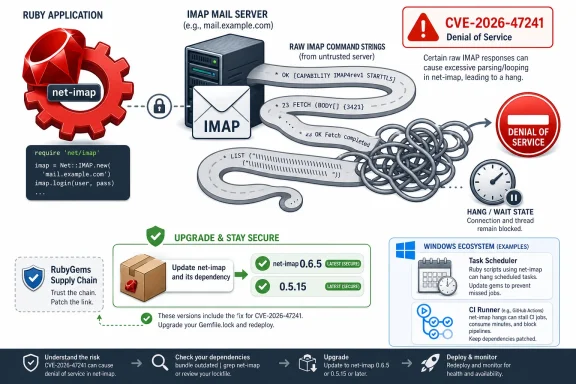 Immediate Remediation
- If your application uses the 0.6 line of Net::IMAP, target version 0.6.5.
- If your application is pinned to an older line, target version 0.5.15.
- Confirm the runtime-resolved version of
net-imap, not only the Gemfile or gemspec constraint. - Search for code that passes user, tenant, mailbox, folder, search, label, routing-rule, or metadata values into raw IMAP command arguments.
- Prefer structured Net::IMAP APIs over raw command strings wherever possible.
- Where raw command arguments are unavoidable, constrain inputs with an allowlist and test protocol metacharacters, continuations, and concurrent use.
Who Is Affected
The affected application is not “Windows” itself, Outlook, Exchange, or an IMAP server by default. The affected component is the Rubynet-imap gem when used in the vulnerable version ranges and in a way that lets user-controlled data reach raw IMAP command arguments.Windows administrators should look beyond the obvious places. Ruby may be present in:
- A Ruby on Rails application hosted on Windows or deployed from Windows build agents.
- A scheduled job launched through Windows Task Scheduler.
- A CI runner that tests mail-processing workflows.
- A packaged third-party application that embeds its own Ruby runtime.
- A vendor bundle containing preinstalled gems.
- A developer or operations workstation that runs mailbox migration or automation scripts.
- A container image built on a host managed by a Windows-centered IT team.
net-imap version, and does that code pass attacker-influenced strings into raw IMAP command arguments? If the answer to both is yes, the issue is reachable enough to treat as a normal security fix. If the answer is unclear, start by proving the resolved version and then reviewing IMAP usage.The Score Says Low; the Architecture Says Patch Deliberately
The CVE material identifies CVE-2026-47241 as an availability issue rather than a confidentiality or integrity problem. That matters. This is not a vulnerability that should be described as mailbox compromise, credential theft, message disclosure, or remote code execution unless some separate application flaw creates that additional impact.The known impact is denial of service. The described behavior depends on a specific application shape: user-controlled input must be passed into raw Net::IMAP command arguments, and the application must then hit the sequencing behavior described in the advisory. In many applications,
net-imap may be present but the risky path may not be used. In others, especially tenant-facing or user-configurable mail workflows, the risky path may be close to production.CISA’s ADP SSVC context, where present in the CVE record, should be read narrowly. The provided fields identify exploitation as none, automatable as yes, and technical impact as partial. That does not prove active attacks, and it does not turn the issue into a critical vulnerability. It does mean that if an application exposes the right input path, the triggering condition can be repeated mechanically.
The right posture is therefore neither panic nor dismissal. Patch vulnerable deployments, verify the actual loaded gem version, and review the small set of code paths where untrusted strings may be used as raw protocol input.
Why Raw Protocol Arguments Are a Trap
Net::IMAP is the Ruby library used by applications that need to talk to an IMAP server. It can select mailboxes, search messages, fetch content, move mail, inspect flags, and support higher-level workflows around email. Most applications should use structured library methods where the library understands the protocol shape.Raw arguments are different. They are escape hatches for callers that need to send syntax the abstraction does not fully model. That flexibility is useful, but it shifts responsibility to the caller. If the raw string is a hard-coded constant written by a developer, the risk may be limited. If the raw string is assembled from user-controlled input, application data has crossed into protocol syntax.
That is the important engineering lesson from CVE-2026-47241. Blocking CRLF characters is necessary in a line-oriented protocol, but the advisory shows that it was not sufficient for this command-continuation failure mode. IMAP is stateful; a client and server are not exchanging isolated strings with no memory. They are walking through a sequence of tagged commands, responses, selected mailbox state, and continuations. When one argument changes how the next command is interpreted, the failure can become a hang rather than a clean validation error.
For developers, the rule is simple: avoid feeding user-controlled strings into raw IMAP command arguments. For administrators, the matching rule is also simple: do not assume a mail connector is harmless because it “only reads email.” If it is part of a business workflow and it can be wedged, availability matters.
The Affected Branches Tell a Maintenance Story
The advisory names two affected version ranges: the newer 0.6 line from>= 0.6.0 to < 0.6.4.1, and older versions < 0.5.15. The fixed versions listed in the CVE and advisory material are 0.6.5 and 0.5.15.| Net::IMAP line | Affected versions | Fixed version to target | Practical reading |
|---|---|---|---|
| 0.6 branch | >= 0.6.0, < 0.6.4.1 | 0.6.5 | Newer applications should move to the fixed 0.6 release line. |
| pre-0.5.15 branch | < 0.5.15 | 0.5.15 | Older pinned deployments need at least the patched 0.5 release. |
Windows environments can hide this especially well. A server may not be thought of as a Ruby server, yet still contain Ruby-based tooling under a packaged application directory, a build-agent workspace, a developer install, or a vendor-supplied runtime. “We do not run Ruby as a platform” is not the same as “no Ruby dependency is present.”
The safe operational approach is discovery first. Find
net-imap, identify the resolved version, determine whether the version falls in an affected range, and only then decide whether code-path review is needed.Exact Verification Steps for Ruby on Windows
Do not close this finding because someone editedGemfile. Close it because the deployed environment resolves net-imap to a fixed version.1. Verify through Bundler
From the application directory that containsGemfile.lock, run:bundle info net-imapLook for the version in the output. It should show
0.6.5, 0.5.15, or a later fixed version appropriate for the branch you are using.You can also query Bundler directly:
bundle exec ruby -e "require 'bundler/setup'; spec = Gem.loaded_specs['net-imap']; puts spec ? spec.version : 'net-imap not loaded by Bundler'"If the application has multiple deployment directories, run the command from the directory used by the service or scheduled job, not from a developer checkout that may have different dependencies.
Check the lockfile as supporting evidence:
Select-String -Path .\Gemfile.lock -Pattern "net-imap"The lockfile should resolve to a fixed version. A broad declaration in
Gemfile, such as allowing a newer version, is not enough if Gemfile.lock still pins an affected release.2. Verify the Ruby process outside Bundler
Some scripts do not run through Bundler. On the target host, use the same Ruby executable that the job or service uses:ruby -e "require 'net/imap'; spec = Gem.loaded_specs['net-imap']; puts spec ? spec.version : 'net-imap loaded without gemspec version'"If Windows has more than one Ruby installation, first identify the executable:
Code:
where.exe ruby
ruby -v
gem env home
gem env path& "C:\Ruby32-x64\bin\ruby.exe" -e "require 'net/imap'; spec = Gem.loaded_specs['net-imap']; puts spec ? spec.version : 'net-imap loaded without gemspec version'"If the service runs under a different account, check the environment under that account or inspect the service command line. A user profile gem path may differ from the one used by
LocalSystem, a domain service account, or a CI runner account.3. Verify vendor bundles
Some applications ship dependencies undervendor\bundle, vendor\gems, gems, or a private ruby\lib\ruby\gems tree. Search the application directory:
Code:
Get-ChildItem -Path "C:\Path\To\App" -Recurse -Directory -ErrorAction SilentlyContinue |
  Where-Object { $_.Name -match "^net-imap-" } |
  Select-Object FullName
Code:
Get-ChildItem -Path "C:\Path\To\App" -Recurse -Filter "*.gemspec" -ErrorAction SilentlyContinue |
  Select-String -Pattern "net-imap|version"
Code:
bundle config get path
bundle exec ruby -e "require 'net/imap'; puts Gem.loaded_specs['net-imap'].version"4. Verify packaged applications with embedded Ruby
For packaged tools, look for a private Ruby runtime and gem directory:
Code:
Get-ChildItem -Path "C:\Program Files","C:\Program Files (x86)" -Recurse -ErrorAction SilentlyContinue |
  Where-Object { $_.Name -in @("ruby.exe","Gemfile.lock") -or $_.FullName -match "net-imap" } |
Select-Object FullNameruby.exe, run the version check with that executable:& "C:\Path\To\Product\ruby\bin\ruby.exe" -e "require 'net/imap'; spec = Gem.loaded_specs['net-imap']; puts spec ? spec.version : 'net-imap loaded without gemspec version'"If the product is vendor-supported and does not expose a normal gem update path, do not manually replace files unless the vendor supports that action. Record the embedded version, open a vendor case, and ask for a build that includes fixed Net::IMAP.
5. Verify scheduled tasks, services, and CI runners
For scheduled tasks:Get-ScheduledTask | Select-Object TaskName,TaskPath,StateInspect the action for tasks that run Ruby, rake, rails, or a packaged script. Then run the version check from that script’s working directory with the same Ruby executable.
For Windows services:
Code:
Get-CimInstance Win32_Service |
  Where-Object { $_.PathName -match "ruby|rails|rake|bundle|imap" } |
Select-Object Name,State,StartName,PathNamenet-imap. If the runner reuses a cached bundle, clear or refresh the cache after updating.Clarifying the Version Ranges Without Overreading Them
The operational answer is clear: current 0.6-line users should move to 0.6.5, and older pinned users should move to 0.5.15. Do not treat advisory boundary wording as a reason to remain below the fixed versions. If your project is on the 0.6 branch, standardize on 0.6.5 or later in that line. If your project is constrained to the older branch, standardize on 0.5.15.If a scanner continues to flag a patched instance, attach evidence rather than debating the scanner. Useful evidence includes:
- The resolved
net-imapversion frombundle info net-imap. - The runtime output of
Gem.loaded_specs['net-imap'].version. - The relevant
Gemfile.lockexcerpt. - The application or service path showing which Ruby executable is used.
- The deployment artifact, container digest, or package build number that contains the fixed dependency.
Timeline
- The GitHub-reviewed advisory data for GHSA-c4fp-cxrr-mj66 describes a denial-of-service issue in Net::IMAP caused by incomplete validation of raw arguments.
- The CVE record for CVE-2026-47241 identifies GitHub, Inc. as the assigning CNA and describes the affected Net::IMAP ranges and fixed versions.
- CISA-ADP data associated with the CVE record marks exploitation as none, automatable as yes, and technical impact as partial.
Where the Denial of Service Actually Bites
The practical impact is not that an IMAP server is automatically taken down. The more likely impact is that the Ruby application using IMAP gets stuck, waits too long, exhausts worker capacity, or leaves queues behind schedule.That matters most in workflows where mail is operational input. A support system may poll a mailbox to create tickets. An abuse desk may ingest reports. A billing process may read payment or order notifications. A monitoring bridge may convert mail into incidents. If those workers hang or fall behind, users experience the outage even though the underlying vulnerability is rated low.
The advisory’s threading detail is relevant because many applications try to reuse connections for efficiency. Shared protocol state and concurrent commands are a sensitive combination. If an unexpected continuation changes the command sequence, the application’s mental model of “the next command” no longer matches what the protocol conversation is doing. The result can be a blocked client rather than a neat exception.
For Windows admins, the likely exposure is a backend service, cross-platform tool, or packaged application rather than a desktop mail client. The patching workflow should therefore follow the application: identify the process, identify its Ruby runtime, identify the resolved gem, and confirm the fixed version after deployment.
The User-Controlled Input Clause Is the Whole Case
The most important condition is whether the raw string is derived from user-controlled input. Without that, a vulnerablenet-imap version may exist but be hard to reach. With that condition, an attacker or lower-privileged user may be able to trigger the denial-of-service behavior repeatedly.“User-controlled” should be interpreted realistically. It may include:
- A mailbox or folder name supplied by a tenant.
- A search term from a web form.
- A label, tag, or routing rule configured by a customer admin.
- Account metadata synchronized from an external system.
- A field imported from email metadata and later reused in an IMAP operation.
- A support or operations setting that lower-privileged users can modify.
Search Ruby code for direct Net::IMAP usage and wrappers around it. Useful searches include:
Code:
Get-ChildItem -Path "C:\Path\To\App" -Recurse -Include *.rb -ErrorAction SilentlyContinue |
Select-String -Pattern "Net::IMAP|send_command|uid|search|select|examine|fetch|store|copy|append"mailbox_query, imap_search, folder_select, or raw_command may be the real boundary.The safer design is to avoid raw arguments unless a protocol feature genuinely requires them. If raw input is unavoidable, validate against a narrow grammar that matches the application’s business need. For example, a folder selector should not accept arbitrary protocol syntax if the application only supports a known set of folder names. A search feature should use structured query construction rather than concatenating untrusted strings into a protocol fragment.
Action Checklist for Admins
- Inventory Ruby applications, scheduled jobs, CI runners, packaged tools, containers, and vendor bundles for the
net-imapgem. - Identify the Ruby executable used by each service or job.
- Check the resolved dependency version at runtime, not just the declared dependency constraint.
- Upgrade current 0.6-line deployments to Net::IMAP 0.6.5.
- Upgrade older pinned deployments to Net::IMAP 0.5.15.
- Review code paths where user, tenant, mailbox, folder, search, label, metadata, or rule input reaches raw IMAP command arguments.
- Prefer structured Net::IMAP APIs over raw command strings wherever possible.
- Avoid sharing one Net::IMAP connection across threads unless the application explicitly serializes commands in a safe order.
- Add monitoring for stuck IMAP workers, growing mail-ingestion queues, repeated connection resets, and long-running mailbox jobs after patch rollout.
- Document the fixed runtime version in the ticket before closing it.
- For vendor-packaged Ruby, request a vendor update if the product embeds an affected
net-imapversion.
The Patch Is the Easy Part; Finding the Dependency Is the Work
For a maintained Ruby project, remediation should be routine. Update the dependency, regenerate the lockfile, run mail integration tests, deploy through the normal pipeline, and confirm the runtime is using the fixed version. That is the best-case scenario.The harder cases are the ones every IT department accumulates. A line-of-business application may vendor its gems. A third-party product may include Ruby components but expose no normal Bundler workflow. A Windows service may have been installed years ago with a private Ruby runtime. A CI runner may restore a stale bundle from cache. A developer workstation may be the only place a fragile mailbox migration script still runs.
Patch validation should be concrete. Do not close the ticket because a dependency declaration changed. Close it because the deployed lockfile, runtime command, package bundle, or service environment confirms a fixed version. If there are multiple Ruby environments on a Windows host, check the one the service actually runs.
Testing should focus on the mail workflow, not just application startup. Mail workers should connect, authenticate, select folders, search, fetch, move, and close connections under realistic conditions. If the application uses threaded IMAP operations, tests should confirm that command ordering remains serialized where required and that timeouts or connection resets recover cleanly.
For vulnerability-management records, include both CVE-2026-47241 and the GitHub advisory identifier GHSA-c4fp-cxrr-mj66. That helps deduplicate scanner findings and gives developers a clear path back to the upstream advisory.
What the Advisory Data Adds—and What It Does Not
The advisory data provides the engineering facts defenders need: the affected package, the affected ranges, the fixed versions, the denial-of-service impact, and the user-controlled raw argument condition. That is enough to support routine remediation.Do not add unsupported conclusions. The record should not be treated as evidence of active exploitation if the available CISA-ADP field says exploitation is none. It should not be inflated into a data-theft issue without a separate application flaw. It should not be dismissed simply because the impact is partial. Availability bugs in mail-processing systems can still cause operational incidents.
The CVE record language indicating that the item is not being prioritized for NVD enrichment efforts should also be read carefully. It does not remove the need to patch affected deployments. It only means teams may not have additional NVD analysis to rely on. For this case, the CNA-provided advisory information, the affected ranges, the fixed versions, and the limited CISA-ADP fields are sufficient for normal vulnerability handling.
There is a mature way to handle this class of finding. It belongs in the patch queue, not the panic queue. It should be fixed in the next normal release cycle for internal systems and faster for tenant-facing or externally influenced mail automation where user-controlled values plausibly reach IMAP commands. If the application is important for customer support, billing, abuse response, or compliance, treat availability as business impact even when the security label is low.
Ruby, Windows, and the Supply-Chain Blind Spot
WindowsForum readers do not need to be Ruby shops to care about Ruby dependencies. Cross-platform tooling has blurred the old lines between “Windows application,” “Linux service,” and “developer script.” A Windows estate may contain Ruby in build agents, security tools, legacy automation, packaged applications, or one-off scripts that became production dependencies by repetition.Email integrations are especially likely to escape formal ownership. They start as glue: fetch invoices from a mailbox, create tickets from support messages, ingest alerts, reconcile bounce mail, process form submissions. Over time, the glue becomes business infrastructure. When it fails, users do not complain that Net::IMAP hung; they complain that tickets, alerts, or messages stopped moving.
CVE-2026-47241 is therefore a useful test of inventory maturity. Can the organization answer which systems use Net::IMAP? Can it distinguish production from development? Can it identify which code paths use raw arguments? Can it upgrade a gem without breaking an old mailbox workflow? If not, the vulnerability has already taught the more important lesson.
There is also a vendor-management angle. If a commercial product ships Ruby and uses Net::IMAP internally, customers may not be able to patch the gem directly. The right action is to ask the vendor whether the product includes
net-imap, which version is bundled, whether the vulnerable raw-argument path is reachable, and which update contains the fixed version. If the vendor says the component is not reachable, ask them to document the basis for that assessment.Admin Checklist
| Task | Command or evidence | Done |
|---|---|---|
| Find Ruby executables | where.exe ruby; service and scheduled-task command lines | |
| Find Bundler apps | Search for Gemfile.lock under application, CI, and deployment paths | |
| Find vendored gems | Search for net-imap-*, vendor\bundle, vendor\gems, and embedded gem directories | |
| Check Bundler-resolved version | bundle info net-imap or bundle exec ruby -e "puts Gem.loaded_specs['net-imap'].version" | |
| Check non-Bundler runtime version | ruby -e "require 'net/imap'; puts Gem.loaded_specs['net-imap'].version" | |
| Patch 0.6-line deployments | Confirm 0.6.5 or later fixed version | |
| Patch older pinned deployments | Confirm 0.5.15 | |
| Review raw argument usage | Search Ruby code for Net::IMAP calls and wrapper methods | |
| Validate running service | Use the same Ruby executable and account context as the service or job | |
| Record closure evidence | Lockfile excerpt, runtime version output, deployment artifact, and advisory ID |
Final Take
CVE-2026-47241 is not the kind of vulnerability that should trigger dramatic claims. It is a focused denial-of-service flaw in Ruby’s Net::IMAP client library, with a specific vulnerable condition: user-controlled input reaching raw IMAP command arguments in affected versions. The fixes are known: 0.6.5 for current 0.6-line deployments and 0.5.15 for older pinned deployments.The work is in finding where the gem is actually loaded. On Windows, that means checking Bundler projects, vendored bundles, embedded runtimes, scheduled tasks, services, CI runners, and vendor-packaged applications. Verification should always end with the runtime-resolved
net-imap version, not a hopeful dependency declaration.Treat this as a clean, bounded supply-chain maintenance item. Patch the gem, prove the running version, remove unsafe raw argument paths where user-controlled input can reach them, and keep mail-processing systems observable enough that a stuck IMAP worker is noticed before customers notice the missing mail.
References
- Primary source: NVD / Linux Kernel
Published: 2026-07-09T01:42:15-07:00
NVD - CVE-2026-47241
 nvd.nist.gov
- Security advisory: MSRC
Published: 2026-07-09T01:42:15-07:00
Original feed URL
Security Update Guide - Microsoft Security Response Center
 msrc.microsoft.com
- Related coverage: advisories.gitlab.com
Net::IMAP: Denial of Service via incomplete raw argument validation | GitLab Advisory Database (GLAD)
CVE-2026-47241 Net::IMAP: Denial of Service via incomplete raw argument validation: Several Net::IMAP commands accept a raw string argument which is only validated to prevent CRLF injection and then sent verbatim. …advisories.gitlab.com - Related coverage: vulnerability.circl.lu
Vulnerability-Lookup
Vulnerability-Lookup - Fast vulnerability lookup correlation from different sources.vulnerability.circl.lu