

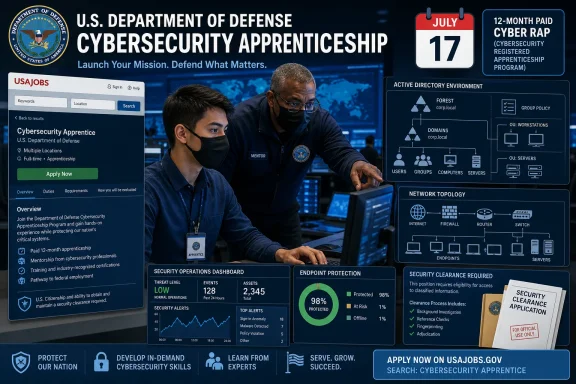
The Department of Defense opened applications this week for Cyber RAP, a 12-month paid cyber apprenticeship run by the DOD Office of the Chief Information Officer, with USAJobs applications open through July 17 and the listed annual salary set at $22,584. The practical significance is larger than one pilot hiring notice: the Pentagon is testing whether it can build cyber talent faster by recruiting for aptitude rather than credentials. For Windows administrators, federal contractors, SOC managers, and security-minded career switchers, this is not just a government workforce story. It is an early signal that the cyber labor market is being reordered around demonstrable capability, clearance eligibility, and mission fit.
DefenseScoop framed the opening as the Pentagon’s latest attempt to bolster the civilian cyber workforce through paid apprenticeships, while Nextgov/FCW emphasized that the DOD Office of the Chief Information Officer is directing the effort and that the application window is now live on USAJobs. Both accounts converge on the same core point: Cyber RAP is designed to pull people into defense cybersecurity who may not have degrees or conventional professional experience in cyber-related fields. That is the disruptive part, and also the part that will test whether government can move fast enough to benefit from its own rhetoric.
The program arrives with an unusually blunt message from DOD Chief Information Officer Kirsten Davies. “This program bypasses traditional academic gatekeeping to value what truly matters: raw aptitude, patriotic drive, and hands-on capability over traditional academic credentials,” Davies said, according to Nextgov/FCW and DefenseScoop. That line is the whole wager: the Pentagon is betting that the next useful cyber defender may look less like a résumé-screening success story and more like someone who can learn quickly, work under mission constraints, and survive the clearance process.
The most important thing about Cyber RAP is that it does not pretend the Pentagon can simply buy its way out of the cyber workforce shortage. DefenseScoop notes the obvious structural problem: the Pentagon faces challenges competing with the private sector to hire established cyber experts. Anyone who has tried to recruit for incident response, cloud security, identity engineering, threat hunting, or Windows endpoint hardening already knows the pattern. The fully formed candidate is expensive, heavily recruited, and often reluctant to trade private-sector flexibility for federal process.
Cyber RAP is a different move. Instead of competing only at the top of the market, DOD is trying to manufacture more entry-level talent inside its own mission environment. The apprenticeship is paid, full-time, and designed to last 12 months; it blends online learning, immersive hands-on labs, mentorship, and on-the-job training under senior department mentors, according to DefenseScoop’s account of the program materials.
That makes the program more consequential than a scholarship, boot camp, or public-awareness campaign. Apprentices are being trained for entry-level DOD cyber positions such as cyber defense analysts, cyber defense infrastructure support specialists, and cyber defense incident responders. Those are not abstract “cyber jobs.” They map to the operational grind that keeps networks defended: triage, infrastructure support, incident handling, monitoring, escalation, and response.
For the WindowsForum audience, the relevance should be obvious. Much of enterprise defense still runs through Windows identity, Windows endpoints, Windows Server estates, cloud-connected Microsoft 365 environments, and hybrid Active Directory architectures that carry decades of accumulated risk. A cyber defense analyst who understands phishing telemetry but cannot reason about endpoint logs, privileged accounts, patch cadence, lateral movement, and identity abuse will hit a ceiling fast. A training pipeline that creates hands-on defenders for DOD and the broader Defense Industrial Base could become a useful corrective to the credential-heavy hiring market that too often rewards vocabulary before operational judgment.
But the program is not open-ended. Applicants must be over 18, U.S. citizens, and able to obtain and maintain a government security clearance. Those requirements matter because they shift the real filter from college admissions to national-security suitability. The degree may be optional on the core path, but trustworthiness, citizenship, background, and willingness to enter a federal mission environment are not.
That distinction is important for applicants who hear “no degree required” and assume “low barrier.” Cyber RAP lowers one barrier while preserving others. The USAJobs listing, as quoted by DefenseScoop, says candidates should be committed to improving the efficiency of the federal government, passionate about the ideals of the American republic, and committed to upholding the rule of law and the United States Constitution. The program’s site also seeks a strong work ethic, eagerness and aptitude to learn complex material quickly, analytical and problem-solving capabilities, willingness to be “mobile and flexible,” and a commitment to work within the DOD.
In practical terms, the Pentagon is not looking for hobbyists who merely enjoy hacking challenges. It is looking for people it can shape into dependable civilian cyber operators. That requires aptitude, but also patience with process, tolerance for bureaucracy, and enough discipline to do the unglamorous work of defense.
That is where the Pentagon’s “mission” language has to carry weight. Davies said, in a statement quoted by DefenseScoop, “To maintain our decisive advantage and support the warfighter on the modern battlefield, the Department of War must recruit differently.” The department is not selling only a paycheck. It is selling access, training, mentorship, certifications, and a possible pathway into high-demand civilian cyber roles.
That trade may work for some candidates. It may appeal to young entrants, career changers with support structures, veterans or military-adjacent applicants seeking a civilian cyber path, and technically inclined people who have been screened out by degree requirements. It may be harder for mid-career workers who already earn more elsewhere or cannot afford a year at apprenticeship pay.
The low salary also creates an equity problem the Pentagon will have to watch closely. If a no-degree pathway is economically viable only for people who can absorb a year of low earnings, then “bypassing academic gatekeeping” risks replacing one filter with another. Skills-based hiring is powerful when it broadens access. It is weaker when the practical cost of entry quietly narrows the applicant pool.
The table matters because it prevents overclaiming. Cyber RAP is a genuine experiment in skills-based hiring, but it is not a universal abolition of credentials across every cyber role. The core Technical Specialist Pathway is the headline innovation because it explicitly does not require a college degree. The DMDC Agency Pathway is the reminder that federal workforce rules, mission requirements, and agency standards still shape who can be placed where.
This is not necessarily hypocrisy. Some roles are tied to classification systems, mission-specific standards, or organizational requirements that may be slower to change than a CIO statement. But it does mean applicants need to read the pathway carefully. “Cyber RAP” can mean a no-degree route into general civilian cyber work, or it can mean a specialized track where an accredited degree remains mandatory.
For DOD, the two-track model is a pragmatic compromise. It lets the department move fast in areas where it can prioritize aptitude while preserving compliance where agency rules require formal education. For the broader cyber market, it is also a useful template: not every role needs a degree, but not every requirement can be waved away with a slogan.
That is the right architecture for entry-level cyber work, at least on paper. Security operations cannot be learned by memorizing acronyms alone. Network defense requires pattern recognition, patience, escalation discipline, and enough systems knowledge to separate suspicious from merely noisy. Ethical hacking, if taught responsibly, can help defenders understand attacker behavior without confusing tool use for mastery. AI-assisted threat analysis is now part of the conversation because defenders are drowning in telemetry and alerts.
For Windows-heavy environments, the apprenticeship’s practical value will depend on how much of that training is grounded in the messy reality of enterprise systems. It is one thing to run a lab where the attack path is preordained. It is another to investigate a suspicious PowerShell chain, identify abnormal authentication behavior, review endpoint telemetry, understand why a patch did or did not apply, and explain the risk to a manager who wants the server back online.
The promise of mentorship is therefore just as important as the curriculum. Senior cyber professionals can teach apprentices how judgment is made under uncertainty. They can explain why a low-severity alert matters in one context and not another, why asset inventory is security work, why identity is the new perimeter but old endpoints still matter, and why incident response depends as much on communication as on tooling.
The cyber talent problem is especially acute in that ecosystem because not every supplier can hire like a prime contractor or a hyperscale cloud provider. Smaller organizations may be running Windows networks, VPNs, Microsoft 365 tenants, engineering systems, file shares, and legacy applications with limited security staff. They may face compliance demands without having the personnel bench to operationalize them well.
A successful DOD apprenticeship pipeline will not solve that by itself. But it could create a larger pool of people who understand defense missions, clearance expectations, and the operational realities of securing government-adjacent systems. Even if apprentices begin in DOD civilian roles, the training model could influence how contractors think about their own junior cyber pipelines.
The practical consequence is that Cyber RAP should be watched not only as a hiring program but as a standard-setting exercise. If the Pentagon can define what an entry-level cyber defender should learn in 12 months, contractors and vendors will pay attention. If the program stumbles, critics of skills-based hiring will point to it as proof that enthusiasm is not a substitute for preparation.
June 2026 — At the SAP NOW summit in Washington, D.C., Kirsten Davies said the apprenticeship had already generated more than 70,000 inquiries before it had officially launched.
This week in July 2026 — DOD announced that the Cyber RAP application window had officially opened on USAJobs.
July 17, 2026 — The current application window is scheduled to close.
But inquiries are not hires. DefenseScoop says the Pentagon did not disclose how many people it plans to hire through Cyber RAP. That omission matters. A program can be symbolically important and still operationally tiny. If the first cohort is small, Cyber RAP may serve more as a proof of concept than a near-term solution to DOD’s workforce gaps.
The unanswered scale question also changes how applicants should interpret the opening. High interest means competition. It also means the government will be sorting not just for eligibility but for fit, persistence, aptitude, and likely completion. People who have spent months waiting for the posting should assume they are entering a crowded funnel.
For policymakers, the 70,000-inquiry figure is evidence that the problem has never been a lack of people curious about cyber. The problem is converting curiosity into competence, and competence into trusted employment. Cyber RAP is one attempt to build that bridge. Its real test will be whether the bridge is wide enough to matter.
That is a serious commitment. Apprenticeships often involve mutual obligation: the employer invests in training, and the participant commits time and labor. But an unspecified repayment exposure can change the risk calculation for applicants who are not sure they can complete a full-time 12-month program.
The policy may be designed to discourage casual applicants from taking a slot and leaving. That concern is understandable, especially if the pilot has limited capacity and high demand. But the department should be as transparent as possible about repayment mechanics, because ambiguity can deter exactly the kind of nontraditional candidates the program says it wants to attract.
Applicants should not treat Cyber RAP as a free sample of government cyber training. It is a job-linked, mission-linked commitment. Anyone applying should understand the schedule, outside-work rules, completion expectations, waiver conditions, and possible repayment consequences before accepting a slot.
Cybersecurity is not one skill. It is a family of overlapping disciplines: endpoint defense, network analysis, identity security, vulnerability management, incident response, threat intelligence, cloud security, secure administration, scripting, governance, and more. Entry-level roles should not demand mastery of all of them, but they do require enough foundation to avoid becoming a liability in a high-trust environment.
DOD’s approach appears to be competency-based rather than purely credential-based. That is promising. But it also puts pressure on the design of assessments, labs, mentor feedback, and on-the-job evaluation. A bad credential filter can exclude good candidates. A bad skills filter can advance candidates who are good at exercises but weak in production environments.
The best version of Cyber RAP would test how people think. Can they document clearly? Can they ask good questions? Can they follow evidence rather than ego? Can they learn from a false positive? Can they handle the boredom of monitoring and the adrenaline of escalation? Can they respect legal and ethical boundaries while learning offensive concepts?
Those traits matter as much as whether someone can name a tool. The Pentagon’s line about script kiddies and teenagers is useful because it punctures credential worship. But the answer to immature adversaries is not immature defenders. It is disciplined training for people who may arrive through unconventional paths.
That does not invalidate the apprenticeship. Skills-based hiring in cyber has supporters well beyond one administration or one political frame. The private sector has been debating degree requirements for years because the mismatch between job postings and actual work is obvious. A Windows administrator who has spent years securing endpoints, writing scripts, managing identity, and troubleshooting outages may be better prepared for junior cyber work than a graduate who has never touched a production environment.
Still, rhetoric shapes perception. Phrases like “patriotic drive” and “America’s elite cyber workforce” will motivate some applicants and alienate others. The government is entitled to seek mission commitment, especially in national security roles. But if the goal is to tap “untapped potential,” the department should make sure the door is not perceived as open only to people who already know how to speak the preferred institutional language.
The strongest case for Cyber RAP is not ideological. It is operational. DOD needs defenders. The country needs more people capable of protecting government and defense networks. Degree requirements are a blunt instrument for identifying that talent. A well-run apprenticeship can be sharper.
The Pentagon’s pilot implicitly challenges that model. If a national-security organization can at least attempt a no-degree pathway for general civilian cyber roles, private employers should have a harder time defending degree requirements for routine junior SOC, endpoint, identity, and vulnerability roles. That does not mean lowering standards. It means replacing lazy proxies with better evidence.
Windows-heavy organizations have an especially rich internal talent pool if they know where to look. Desktop support technicians who understand user behavior, sysadmins who know Group Policy and identity pain points, help desk staff who spot phishing patterns, and junior infrastructure engineers who already troubleshoot production outages may be excellent cyber apprentices. They may lack the vocabulary of a security résumé, but they often understand the terrain attackers exploit.
The apprenticeship model also highlights the importance of mentorship. Too many organizations hire junior cyber staff and then leave them to drown in dashboards. A structured pathway with labs, training, senior guidance, and real work is more expensive than buying another tool, but it is also how people become useful defenders.
That nuance matters for applicants. A 12-month apprenticeship can be a powerful career launch, but only if participants finish with portable skills, credible credentials, and a realistic next step. If the program produces graduates who still struggle to land roles, its reputation will suffer quickly. If it produces capable entry-level defenders who are absorbed into DOD cyber teams, the model will gain political and institutional momentum.
The Pentagon also needs to avoid treating certifications as the main proof of success. Industry-recognized certifications are valuable, especially for people without degrees. But cyber work is ultimately judged by performance: can the person help defend systems, respond to incidents, support infrastructure, and improve security outcomes? A certification should validate training, not substitute for it.
For IT leaders, that is the broader lesson. Apprenticeship programs should be judged by whether graduates can do the job with appropriate supervision, not by whether the organization can announce a new pipeline. The measure is operational readiness.
DefenseScoop framed the opening as the Pentagon’s latest attempt to bolster the civilian cyber workforce through paid apprenticeships, while Nextgov/FCW emphasized that the DOD Office of the Chief Information Officer is directing the effort and that the application window is now live on USAJobs. Both accounts converge on the same core point: Cyber RAP is designed to pull people into defense cybersecurity who may not have degrees or conventional professional experience in cyber-related fields. That is the disruptive part, and also the part that will test whether government can move fast enough to benefit from its own rhetoric.
The program arrives with an unusually blunt message from DOD Chief Information Officer Kirsten Davies. “This program bypasses traditional academic gatekeeping to value what truly matters: raw aptitude, patriotic drive, and hands-on capability over traditional academic credentials,” Davies said, according to Nextgov/FCW and DefenseScoop. That line is the whole wager: the Pentagon is betting that the next useful cyber defender may look less like a résumé-screening success story and more like someone who can learn quickly, work under mission constraints, and survive the clearance process.
 The Pentagon Is Turning a Hiring Problem Into a Training Pipeline
The most important thing about Cyber RAP is that it does not pretend the Pentagon can simply buy its way out of the cyber workforce shortage. DefenseScoop notes the obvious structural problem: the Pentagon faces challenges competing with the private sector to hire established cyber experts. Anyone who has tried to recruit for incident response, cloud security, identity engineering, threat hunting, or Windows endpoint hardening already knows the pattern. The fully formed candidate is expensive, heavily recruited, and often reluctant to trade private-sector flexibility for federal process.Cyber RAP is a different move. Instead of competing only at the top of the market, DOD is trying to manufacture more entry-level talent inside its own mission environment. The apprenticeship is paid, full-time, and designed to last 12 months; it blends online learning, immersive hands-on labs, mentorship, and on-the-job training under senior department mentors, according to DefenseScoop’s account of the program materials.
That makes the program more consequential than a scholarship, boot camp, or public-awareness campaign. Apprentices are being trained for entry-level DOD cyber positions such as cyber defense analysts, cyber defense infrastructure support specialists, and cyber defense incident responders. Those are not abstract “cyber jobs.” They map to the operational grind that keeps networks defended: triage, infrastructure support, incident handling, monitoring, escalation, and response.
For the WindowsForum audience, the relevance should be obvious. Much of enterprise defense still runs through Windows identity, Windows endpoints, Windows Server estates, cloud-connected Microsoft 365 environments, and hybrid Active Directory architectures that carry decades of accumulated risk. A cyber defense analyst who understands phishing telemetry but cannot reason about endpoint logs, privileged accounts, patch cadence, lateral movement, and identity abuse will hit a ceiling fast. A training pipeline that creates hands-on defenders for DOD and the broader Defense Industrial Base could become a useful corrective to the credential-heavy hiring market that too often rewards vocabulary before operational judgment.
“No Degree Required” Is the Headline, but Clearance Eligibility Is the Gate
Cyber RAP’s public pitch is deliberately anti-gatekeeping. Davies told Nextgov/FCW that President Donald Trump and Defense Secretary Pete Hegseth “have given us a mandate to really get after skills-based training,” and said she worked to eliminate degree requirements “because if threat actors can be script kiddies and teenagers, then we need to be employing great skills where the skills are and figuring out how to incorporate them.” It is a memorable line because it says out loud what many security teams quietly know: the adversary does not care where someone went to school.But the program is not open-ended. Applicants must be over 18, U.S. citizens, and able to obtain and maintain a government security clearance. Those requirements matter because they shift the real filter from college admissions to national-security suitability. The degree may be optional on the core path, but trustworthiness, citizenship, background, and willingness to enter a federal mission environment are not.
That distinction is important for applicants who hear “no degree required” and assume “low barrier.” Cyber RAP lowers one barrier while preserving others. The USAJobs listing, as quoted by DefenseScoop, says candidates should be committed to improving the efficiency of the federal government, passionate about the ideals of the American republic, and committed to upholding the rule of law and the United States Constitution. The program’s site also seeks a strong work ethic, eagerness and aptitude to learn complex material quickly, analytical and problem-solving capabilities, willingness to be “mobile and flexible,” and a commitment to work within the DOD.
In practical terms, the Pentagon is not looking for hobbyists who merely enjoy hacking challenges. It is looking for people it can shape into dependable civilian cyber operators. That requires aptitude, but also patience with process, tolerance for bureaucracy, and enough discipline to do the unglamorous work of defense.
The Salary Makes the Mission Pitch Do Real Work
The annual salary listed for the apprenticeship is $22,584. That number is not a footnote; it is central to understanding what kind of applicant Cyber RAP can realistically attract. DefenseScoop reports that participants may hold other jobs outside the department if those jobs do not overlap with DOD work duty hours, which is a notable concession to economic reality. A full-time apprenticeship at that salary will be difficult for many adults with rent, dependents, debt, or existing professional obligations.That is where the Pentagon’s “mission” language has to carry weight. Davies said, in a statement quoted by DefenseScoop, “To maintain our decisive advantage and support the warfighter on the modern battlefield, the Department of War must recruit differently.” The department is not selling only a paycheck. It is selling access, training, mentorship, certifications, and a possible pathway into high-demand civilian cyber roles.
That trade may work for some candidates. It may appeal to young entrants, career changers with support structures, veterans or military-adjacent applicants seeking a civilian cyber path, and technically inclined people who have been screened out by degree requirements. It may be harder for mid-career workers who already earn more elsewhere or cannot afford a year at apprenticeship pay.
The low salary also creates an equity problem the Pentagon will have to watch closely. If a no-degree pathway is economically viable only for people who can absorb a year of low earnings, then “bypassing academic gatekeeping” risks replacing one filter with another. Skills-based hiring is powerful when it broadens access. It is weaker when the practical cost of entry quietly narrows the applicant pool.
Two Tracks Reveal the Compromise Behind the Anti-Degree Message
Cyber RAP is not a single undifferentiated pathway. Nextgov/FCW reports that the program includes two developmental tracks with different academic requirements, which DOD says are designed “to accommodate different agency missions and standards.” That is the bureaucratic reality underneath the reform language. The Pentagon wants to remove degree requirements where it can, but some placements still carry agency-specific qualification standards.| Track | Intended placement | Degree requirement | Training emphasis | Why it exists |
|---|---|---|---|---|
| Technical Specialist Pathway | General Pentagon civilian cyber roles | No college degree required | “Rapid, hands-on technical skill acquisition” | Builds entry-level cyber talent around practical capability |
| Defense Manpower Data Center Agency Pathway | Specialized placements within DMDC | Accredited degree required | Agency-tailored preparation | Meets that specific agency’s qualification standards |
This is not necessarily hypocrisy. Some roles are tied to classification systems, mission-specific standards, or organizational requirements that may be slower to change than a CIO statement. But it does mean applicants need to read the pathway carefully. “Cyber RAP” can mean a no-degree route into general civilian cyber work, or it can mean a specialized track where an accredited degree remains mandatory.
For DOD, the two-track model is a pragmatic compromise. It lets the department move fast in areas where it can prioritize aptitude while preserving compliance where agency rules require formal education. For the broader cyber market, it is also a useful template: not every role needs a degree, but not every requirement can be waved away with a slogan.
The Training Model Is Built Around the Work Defenders Actually Do
The program’s advertised skills are telling. DefenseScoop says participants may gain practical know-how in security operations, network defense, “ethical hacking,” and the application of AI to cyber threat analysis. The official program materials described by the outlet also promise competency-based education that combines online learning, immersive hands-on labs, and on-the-job training under senior mentors.That is the right architecture for entry-level cyber work, at least on paper. Security operations cannot be learned by memorizing acronyms alone. Network defense requires pattern recognition, patience, escalation discipline, and enough systems knowledge to separate suspicious from merely noisy. Ethical hacking, if taught responsibly, can help defenders understand attacker behavior without confusing tool use for mastery. AI-assisted threat analysis is now part of the conversation because defenders are drowning in telemetry and alerts.
For Windows-heavy environments, the apprenticeship’s practical value will depend on how much of that training is grounded in the messy reality of enterprise systems. It is one thing to run a lab where the attack path is preordained. It is another to investigate a suspicious PowerShell chain, identify abnormal authentication behavior, review endpoint telemetry, understand why a patch did or did not apply, and explain the risk to a manager who wants the server back online.
The promise of mentorship is therefore just as important as the curriculum. Senior cyber professionals can teach apprentices how judgment is made under uncertainty. They can explain why a low-severity alert matters in one context and not another, why asset inventory is security work, why identity is the new perimeter but old endpoints still matter, and why incident response depends as much on communication as on tooling.
The Defense Industrial Base Is the Unspoken Multiplier
DefenseScoop reports that successful apprentices are meant to move toward high-demand civilian cyber roles protecting DOD operations and the broader Defense Industrial Base. That second target is crucial. The DIB is where federal security policy collides with contractors, subcontractors, suppliers, and technology vendors that handle sensitive defense-related work. Weakness there can become weakness for the department itself.The cyber talent problem is especially acute in that ecosystem because not every supplier can hire like a prime contractor or a hyperscale cloud provider. Smaller organizations may be running Windows networks, VPNs, Microsoft 365 tenants, engineering systems, file shares, and legacy applications with limited security staff. They may face compliance demands without having the personnel bench to operationalize them well.
A successful DOD apprenticeship pipeline will not solve that by itself. But it could create a larger pool of people who understand defense missions, clearance expectations, and the operational realities of securing government-adjacent systems. Even if apprentices begin in DOD civilian roles, the training model could influence how contractors think about their own junior cyber pipelines.
The practical consequence is that Cyber RAP should be watched not only as a hiring program but as a standard-setting exercise. If the Pentagon can define what an entry-level cyber defender should learn in 12 months, contractors and vendors will pay attention. If the program stumbles, critics of skills-based hiring will point to it as proof that enthusiasm is not a substitute for preparation.
Timeline
Late April 2026 — The Pentagon first announced Cyber RAP as a pilot program aimed at building a new cyber workforce pipeline.June 2026 — At the SAP NOW summit in Washington, D.C., Kirsten Davies said the apprenticeship had already generated more than 70,000 inquiries before it had officially launched.
This week in July 2026 — DOD announced that the Cyber RAP application window had officially opened on USAJobs.
July 17, 2026 — The current application window is scheduled to close.
Seventy Thousand Inquiries Is Demand, Not Capacity
The number that will attract the most attention is the more than 70,000 inquiries Davies said the apprenticeship had already generated before official launch. That is a staggering level of interest for a pilot program with a $22,584 salary. It suggests that the supply of people who want a credible cyber on-ramp is much larger than the supply of accessible entry-level roles.But inquiries are not hires. DefenseScoop says the Pentagon did not disclose how many people it plans to hire through Cyber RAP. That omission matters. A program can be symbolically important and still operationally tiny. If the first cohort is small, Cyber RAP may serve more as a proof of concept than a near-term solution to DOD’s workforce gaps.
The unanswered scale question also changes how applicants should interpret the opening. High interest means competition. It also means the government will be sorting not just for eligibility but for fit, persistence, aptitude, and likely completion. People who have spent months waiting for the posting should assume they are entering a crowded funnel.
For policymakers, the 70,000-inquiry figure is evidence that the problem has never been a lack of people curious about cyber. The problem is converting curiosity into competence, and competence into trusted employment. Cyber RAP is one attempt to build that bridge. Its real test will be whether the bridge is wide enough to matter.
The Repayment Clause Is the Part Applicants Should Read Twice
DefenseScoop reports one detail that deserves more attention than it will probably get: participants who cannot complete the apprenticeship must pay back the government for the training they received unless granted a waiver. The program website, according to DefenseScoop, cites waiver circumstances such as personal or family illness or severe financial hardship, but does not state how much money dropouts would owe.That is a serious commitment. Apprenticeships often involve mutual obligation: the employer invests in training, and the participant commits time and labor. But an unspecified repayment exposure can change the risk calculation for applicants who are not sure they can complete a full-time 12-month program.
The policy may be designed to discourage casual applicants from taking a slot and leaving. That concern is understandable, especially if the pilot has limited capacity and high demand. But the department should be as transparent as possible about repayment mechanics, because ambiguity can deter exactly the kind of nontraditional candidates the program says it wants to attract.
Applicants should not treat Cyber RAP as a free sample of government cyber training. It is a job-linked, mission-linked commitment. Anyone applying should understand the schedule, outside-work rules, completion expectations, waiver conditions, and possible repayment consequences before accepting a slot.
Action checklist for admins
- Flag the July 17 deadline for eligible internal candidates, especially help desk, desktop support, junior sysadmin, and SOC-adjacent staff who may have aptitude but lack cyber credentials.
- Encourage applicants to prepare a USAJobs-ready résumé that emphasizes hands-on troubleshooting, scripting, incident response exposure, endpoint support, network fundamentals, and analytical problem-solving.
- Have candidates review clearance eligibility issues early, including citizenship, residence, employment history, and background-investigation readiness.
- Make sure applicants understand the 12-month, full-time nature of the apprenticeship and the listed $22,584 annual salary before they apply.
- If your organization supports DOD or the Defense Industrial Base, treat Cyber RAP as a signal to revisit your own entry-level cyber pipeline and degree requirements.
- Tell applicants to read the repayment and waiver language carefully before accepting any offer.
Skills-Based Hiring Sounds Easy Until the Assessment Starts
The appealing version of skills-based hiring says: stop requiring degrees, test people on what they can do, and hire the capable ones. The hard version asks: capable at what, measured how, under whose standards, and with what safeguards? Cyber RAP lives in that harder version.Cybersecurity is not one skill. It is a family of overlapping disciplines: endpoint defense, network analysis, identity security, vulnerability management, incident response, threat intelligence, cloud security, secure administration, scripting, governance, and more. Entry-level roles should not demand mastery of all of them, but they do require enough foundation to avoid becoming a liability in a high-trust environment.
DOD’s approach appears to be competency-based rather than purely credential-based. That is promising. But it also puts pressure on the design of assessments, labs, mentor feedback, and on-the-job evaluation. A bad credential filter can exclude good candidates. A bad skills filter can advance candidates who are good at exercises but weak in production environments.
The best version of Cyber RAP would test how people think. Can they document clearly? Can they ask good questions? Can they follow evidence rather than ego? Can they learn from a false positive? Can they handle the boredom of monitoring and the adrenaline of escalation? Can they respect legal and ethical boundaries while learning offensive concepts?
Those traits matter as much as whether someone can name a tool. The Pentagon’s line about script kiddies and teenagers is useful because it punctures credential worship. But the answer to immature adversaries is not immature defenders. It is disciplined training for people who may arrive through unconventional paths.
The Branding Fight Is a Distraction, but Not an Irrelevant One
DefenseScoop notes that Davies used the phrase “Department of War Secretary” for Pete Hegseth in a statement and described “Department of War” as a secondary name preferred by the Trump administration for the Department of Defense. The official DOD CIO web materials also use Department of War branding in describing the program. For applicants, the branding matters less than the program mechanics. For institutions, it is another reminder that workforce initiatives can become wrapped in political language.That does not invalidate the apprenticeship. Skills-based hiring in cyber has supporters well beyond one administration or one political frame. The private sector has been debating degree requirements for years because the mismatch between job postings and actual work is obvious. A Windows administrator who has spent years securing endpoints, writing scripts, managing identity, and troubleshooting outages may be better prepared for junior cyber work than a graduate who has never touched a production environment.
Still, rhetoric shapes perception. Phrases like “patriotic drive” and “America’s elite cyber workforce” will motivate some applicants and alienate others. The government is entitled to seek mission commitment, especially in national security roles. But if the goal is to tap “untapped potential,” the department should make sure the door is not perceived as open only to people who already know how to speak the preferred institutional language.
The strongest case for Cyber RAP is not ideological. It is operational. DOD needs defenders. The country needs more people capable of protecting government and defense networks. Degree requirements are a blunt instrument for identifying that talent. A well-run apprenticeship can be sharper.
What Windows and Security Teams Should Learn From the Pilot
Cyber RAP is aimed at DOD, but its lesson applies broadly: organizations that complain about a cyber talent shortage should audit how many promising people they are filtering out. Many enterprises still write entry-level postings that demand a degree, multiple certifications, years of experience, and familiarity with a stack no true entry-level candidate would have touched. Then they wonder why the pipeline is thin.The Pentagon’s pilot implicitly challenges that model. If a national-security organization can at least attempt a no-degree pathway for general civilian cyber roles, private employers should have a harder time defending degree requirements for routine junior SOC, endpoint, identity, and vulnerability roles. That does not mean lowering standards. It means replacing lazy proxies with better evidence.
Windows-heavy organizations have an especially rich internal talent pool if they know where to look. Desktop support technicians who understand user behavior, sysadmins who know Group Policy and identity pain points, help desk staff who spot phishing patterns, and junior infrastructure engineers who already troubleshoot production outages may be excellent cyber apprentices. They may lack the vocabulary of a security résumé, but they often understand the terrain attackers exploit.
The apprenticeship model also highlights the importance of mentorship. Too many organizations hire junior cyber staff and then leave them to drown in dashboards. A structured pathway with labs, training, senior guidance, and real work is more expensive than buying another tool, but it is also how people become useful defenders.
The Program’s Success Will Depend on Conversion, Not Ceremony
The opening of applications is the easy milestone. The harder milestones come later: selection, onboarding, training quality, completion rates, certification outcomes, placement into actual roles, and retention. The DOD CIO materials say successful completion can provide pathways into high-demand civilian cyber roles, and the official program page describes potential full-time employment after graduation. The word “pathway” is doing important work there. It is not the same as a guaranteed permanent job.That nuance matters for applicants. A 12-month apprenticeship can be a powerful career launch, but only if participants finish with portable skills, credible credentials, and a realistic next step. If the program produces graduates who still struggle to land roles, its reputation will suffer quickly. If it produces capable entry-level defenders who are absorbed into DOD cyber teams, the model will gain political and institutional momentum.
The Pentagon also needs to avoid treating certifications as the main proof of success. Industry-recognized certifications are valuable, especially for people without degrees. But cyber work is ultimately judged by performance: can the person help defend systems, respond to incidents, support infrastructure, and improve security outcomes? A certification should validate training, not substitute for it.
For IT leaders, that is the broader lesson. Apprenticeship programs should be judged by whether graduates can do the job with appropriate supervision, not by whether the organization can announce a new pipeline. The measure is operational readiness.
The Useful Signal Beneath the Noise
Cyber RAP is still a pilot, and the available reporting leaves major questions unanswered, including how many apprentices DOD plans to hire and what start date selected candidates should expect. But the concrete facts are enough for applicants and employers to act.- Applications are open on USAJobs through July 17.
- The apprenticeship is paid, full-time, and designed to last 12 months.
- The listed annual salary is $22,584.
- Applicants must be over 18, U.S. citizens, and able to obtain and maintain a government security clearance.
- The core Technical Specialist Pathway does not require a college degree.
- Participants who do not complete the apprenticeship may face repayment obligations unless granted a waiver.
References
- Primary source: Nextgov/FCW
Published: 2026-07-08T22:30:11.225374
Loading…
www.nextgov.com - Independent coverage: DefenseScoop
Published: 2026-07-08T19:30:11.219165
Loading…
defensescoop.com - Related coverage: dodcio.defense.gov
Loading…
dodcio.defense.gov - Related coverage: federalnewsnetwork.com
Loading…
federalnewsnetwork.com - Related coverage: meritalk.com
Loading…
www.meritalk.com - Related coverage: news.clearancejobs.com
Loading…
news.clearancejobs.com