

SNS Insider estimates the Portable Gaming Console Market was worth USD 15.23 billion in 2025 and will reach USD 36.29 billion by 2035, a 9.07% CAGR forecast that turns handheld gaming from a side category into a strategic battleground for hardware makers, cloud platforms, and Windows ecosystems. The most important part of that forecast is not the number; it is the way the category is being redefined. Portable consoles are no longer merely smaller consoles. They are becoming the front line where Nintendo Co., Ltd., Sony Interactive Entertainment LLC, Valve Corporation, Microsoft Corporation, Lenovo Group Limited, and Razer Inc. test competing theories of where gaming itself is going.
The simple story is that better chips, OLED screens, 5G, and cloud gaming are making handhelds more capable. The deeper story is that the market is splitting into three overlapping businesses: devices that run games locally, services that stream games to whatever screen is nearby, and ecosystems that try to make a player’s library follow them everywhere. For Windows users and IT departments, that means “portable gaming console” is no longer a consumer-electronics label safely quarantined from PCs, subscriptions, identity, cloud access, and endpoint policy.
Portable gaming used to be easy to define. A handheld was a dedicated device, a cartridge or download library, a battery, and a screen. It sat below the living-room console in performance, below the PC in flexibility, and outside the main enterprise computing conversation almost entirely.
That definition no longer survives contact with the current market. SNS Insider’s forecast frames the category around hybrid gaming consoles, cloud gaming, digital libraries, cross-platform compatibility, and subscription-based gaming ecosystems. Those are not cosmetic shifts. They describe a market in which the hardware is only one part of the product.
Nintendo’s strength is still the hybrid model: the machine that moves between handheld and TV play without asking the user to think about topology. Valve’s Steam Deck represents a different bet: make the PC library portable and solve the rough edges through hardware design, software updates, and developer support. Microsoft’s bet is more radical still, because Xbox Cloud Gaming and Game Pass make the portable device less important than the account, catalog, network, and controller path.
That is why the 2035 number matters. A market moving from USD 15.23 billion in 2025 to USD 36.29 billion by 2035 is not just selling more gadgets. It is shifting value from one-time hardware purchases toward recurring services, cross-device libraries, accessory ecosystems, and platform lock-in. The portable console is becoming the place where the industry tests whether players want a console, a PC, a cloud terminal, or all three in one bag.
2026–2035 — SNS Insider defines the forecast period for the market’s expected expansion.
2035 — SNS Insider projects the market will reach USD 36.29 billion.
Microsoft Corporation is the most revealing case for WindowsForum readers because its portable-gaming strategy is not primarily about building a classic handheld console. Microsoft is extending Xbox Cloud Gaming, Game Pass, and cross-platform services across devices. Lenovo Group Limited and Razer Inc., meanwhile, show how PC hardware companies see portable gaming as an extension of high-performance computing rather than a toy aisle.
This comparison is the market in miniature. Nintendo sells continuity between couch and commute. Valve sells continuity between desktop and handheld. Microsoft sells continuity between devices, with Xbox Cloud Gaming and Game Pass as the connective tissue. Lenovo and Razer sell the promise that portable does not have to mean underpowered.
The result is not a single market with a single winner. It is a layered market in which the same consumer may own a hybrid console, stream a Game Pass title to another screen, and still want a handheld PC for a digital library that lives outside the console world. That is messy for buyers, but it is attractive for vendors because every layer creates another path to monetization.
That matters because hybrid play solves a human problem before it solves a technical one. Most players do not want to manage device categories. They want to continue a game in the room they happen to be in, on the screen that happens to be available, for the amount of time they actually have.
Nintendo’s proprietary game series and family-friendly positioning also insulate it from the pure specification race. In a market increasingly obsessed with OLED screens, processors, refresh rates, and cloud services, Nintendo’s core advantage remains behavioral: it taught mainstream users that a console could be portable without feeling compromised. That is a more durable moat than a single display upgrade.
For Windows users, Nintendo’s lesson is uncomfortable but useful. Technical flexibility is not the same as product coherence. A Windows handheld can run more things, connect to more services, and behave more like a PC, but if sleep states, launchers, controller mapping, battery life, updates, and store fragmentation create friction, mainstream users may still prefer the simpler hybrid proposition.
The broader industry has absorbed that lesson. SNS Insider names hybrid gaming consoles as a consumer favorite because they let players toggle between handheld and TV-based gaming. The word “toggle” is doing a lot of work there. The winners in portable gaming will be the companies that make switching context feel less like a feature and more like muscle memory.
That phrase — console-like user experience — is the key. Valve did not make the PC disappear. It tried to make the PC tolerable at handheld scale. The Steam Deck’s importance is not merely that it runs PC games, but that it reframes compatibility, input, power management, storefront access, and game verification as part of the handheld product.
This is why the Steam Deck became more than a device. It became a pressure point on every Windows-based portable gaming machine. If a handheld PC runs Windows, it inherits Windows’ strengths: compatibility, breadth of software, multiple stores, familiar account management, and access to the wider PC ecosystem. It also inherits Windows’ weaknesses at small-screen, controller-first scale: update timing, background tasks, launcher sprawl, inconsistent touch targets, and the awkwardness of a desktop operating system pretending to be a living-room console.
Valve’s model shows that the future of handheld PCs is not only about faster processors or better screens. It is about reducing the distance between a player pressing the power button and a game behaving correctly. That distance is where many portable PCs either delight users or lose them.
For Microsoft, Lenovo, Razer, and every Windows-adjacent manufacturer, the Steam Deck is both a validation and a warning. It validates the idea that PC libraries can travel. It warns that the handheld PC category will be judged less by theoretical compatibility than by the quality of the first ten minutes: wake, update, launch, controller support, frame pacing, suspend, resume.
That is a fundamentally different business from selling a handheld. Microsoft does not need every portable screen to be an Xbox-branded machine if the user signs in, streams, subscribes, and stays inside the Xbox service fabric. The device becomes a client. The account becomes the console.
This is the logic behind subscription-based gaming ecosystems. Game Pass is not just a catalog; it is a habit engine. The more users expect their games to appear across PCs, consoles, phones, tablets, browsers, and handheld devices, the more the service becomes the thing they are actually buying. Hardware still matters, but it is demoted from destination to access point.
For WindowsForum readers, this is where gaming strategy starts to overlap with identity, cloud policy, and endpoint governance. Xbox Cloud Gaming depends on supported devices, supported regions, compatible controllers, and sufficient network performance. It also depends on subscriptions, recurring billing, Microsoft accounts, and cloud access paths that may exist on the same devices people use for work.
That does not mean Xbox Cloud Gaming is an enterprise threat by default. It means portable gaming is increasingly difficult to treat as isolated consumer behavior. A Windows handheld can be a gaming machine, a browser endpoint, a cloud-streaming client, a personal PC, and a travel device all at once. The line between “console” and “computer” gets blurrier every time cloud gaming works well enough that the local hardware stops being the limiting factor.
That is the same gravitational pull shaping Microsoft’s strategy, though the execution differs. The more important a company’s game catalog, identity system, and subscription model become, the less portable play has to be tied to a single piece of hardware. The portable device becomes a way to preserve engagement when the user leaves the living room.
Lenovo Group Limited represents the PC hardware view of the market. SNS Insider describes Lenovo’s handheld gaming push around powerful portable devices for gamers who want a PC-level experience on the go, with processors, graphics, and ergonomic designs aimed at demanding applications. That framing matters because it treats portable gaming as a performance segment, not merely a convenience segment.
Razer Inc. pushes from the enthusiast side. The source describes Razer as a gaming technology company known for high-end gaming laptops and peripherals, now participating in portable gaming through devices and peripherals built around immersive displays, responsive controls, and powerful performance. Razer’s presence signals that the handheld is becoming an accessory ecosystem as much as a console category.
Together, Sony, Lenovo, and Razer show why portable gaming will not collapse into one winner-takes-all format. Some users will buy the device that best extends a console ecosystem. Others will chase PC-level performance. Others will build a portable setup around controls, displays, audio, docking, and accessories.
That diversity is good for innovation but hard on buyers. It creates a market where “portable gaming console” can mean a hybrid console, a handheld PC, a cloud-streaming client, a remote-play screen, or a premium accessory platform. The risk is that vendors use the same language to describe products with very different dependencies, costs, and limitations.
OLED screens matter because handheld gaming is intimate. The screen is close, the session may be short, and visual quality has to compensate for the loss of a large display. Better panels make portable play feel premium even when raw compute is constrained.
5G and cloud gaming matter because they attack the oldest handheld limitation: the device can only run what its chip, battery, storage, thermals, and software stack can support. Streaming moves part of that burden off the device. It also creates new dependencies on network quality, latency, service availability, region support, and subscription status.
Cross-platform compatibility matters because players increasingly expect libraries and saves to move with them. A game that is trapped on one device feels worse in a world where music, documents, photos, and video already travel across screens. The gaming industry spent decades training users to accept walled gardens; portable play now pressures those walls from every direction.
Subscription-based gaming ecosystems matter because they change the economics of ownership. If a user thinks of a handheld as a gateway to a large rotating library, the purchase decision shifts from “what games can this machine run?” to “what service does this machine make easy?” That is why Game Pass and Xbox Cloud Gaming appear in any serious analysis of portable gaming’s future, even when Microsoft is not selling the dominant dedicated handheld.
The industry’s challenge is that these trends do not always reinforce one another. OLED screens can increase perceived quality but may raise cost. 5G can expand access but cannot eliminate latency physics or coverage gaps. Cloud gaming can lower hardware requirements but increases dependence on service policy. Subscriptions can make discovery easier but may make long-term ownership feel less certain.
The companies that win will be the ones that hide those trade-offs without pretending they do not exist. Portable gaming is not becoming simpler. It is becoming more abstract. The user sees a game; underneath it sit display supply chains, wireless networks, cloud infrastructure, operating systems, payment models, licensing agreements, and regional market differences.
North America is where premium handheld hardware, subscriptions, and ecosystem lock-in can be monetized aggressively. Consumers are more likely to have multiple screens, established digital libraries, and willingness to spend on accessories or services. That makes the region a proving ground for high-end devices and platform bundles.
Asia-Pacific is where scale tests the assumptions behind the category. A large gaming population does not automatically mean the same device mix, price tolerance, network conditions, or content preferences as North America. Cloud gaming and 5G may be more important in some contexts, while hybrid consoles or lower-friction portable devices may dominate others.
This regional split also matters for developers. A studio optimizing for portable play cannot assume one hardware profile, one network condition, or one monetization model. The same game may be played locally on a Steam Deck, streamed through Xbox Cloud Gaming, accessed through a subscription, or enjoyed on a hybrid console in a family setting.
For IT pros, the regional picture has a parallel inside companies. North America’s role as a leading market resembles the executive-user problem: high-end devices, fast networks, and premium subscriptions arrive first among users with purchasing power. Asia-Pacific’s growth story resembles the scale problem: once the behavior spreads, support models, network planning, and policy enforcement have to catch up.
The portable gaming market is therefore not just growing geographically. It is diversifying operationally. The same category name will cover premium hardware in one market, cloud-first access in another, and hybrid convenience somewhere else. That is exactly what makes the 9.07% CAGR forecast plausible — and exactly what makes the market hard to govern cleanly.
A handheld PC is still a PC, even when shaped like a console. That means drivers, updates, security software, storage, storefronts, browsers, account sign-ins, and network behavior matter. For a home user, those are convenience issues. For an organization, they can become policy issues.
The most obvious case is the employee-owned Windows handheld that connects to corporate Wi-Fi, signs into personal Microsoft services, installs game launchers, and occasionally doubles as a travel computer. It may not hold corporate data, but it can still consume bandwidth, create support confusion, or blur identity boundaries if users mix personal and work accounts carelessly. The device does not have to be malicious to complicate an environment.
Cloud gaming adds another wrinkle. Xbox Cloud Gaming is designed to stream to supported devices over sufficient connections, and Microsoft’s own support language emphasizes the need for an active subscription, supported device, compatible controller, and adequate network performance. On a home network, that is a setup checklist. On a managed network, it is traffic classification, acceptable-use policy, and help-desk triage.
For families and enthusiasts, the right answer may be simple: buy the device that fits the game library and budget. For admins, the right answer is documentation. Know which devices are allowed, which accounts may be used, whether cloud gaming traffic is permitted, and whether personal handheld PCs are treated as unmanaged endpoints.
SNS Insider’s six-company framing captures that fragmentation. Nintendo is strongest when portable play is integrated into a curated hybrid console experience. Valve is strongest when the PC library is the anchor. Microsoft is strongest when cloud access and Game Pass make the device interchangeable. Lenovo and Razer are strongest when performance, ergonomics, and premium hardware matter.
Those strategies can coexist, but they do not produce a single universal buyer recommendation. A user who wants offline travel play has different needs from a user who mostly streams at home. A user invested in a PC game library has different needs from a family built around exclusive console franchises. A user who treats Game Pass as the center of gaming life has different needs from one who buys individual games and expects local ownership.
This is where the industry’s language can become misleading. “Cloud gaming” sounds like freedom until the network is weak. “PC-quality gaming” sounds like freedom until battery life, heat, and compatibility intervene. “Cross-platform” sounds like freedom until licensing, saves, storefronts, and subscriptions draw new borders.
The portable gaming market will grow because each of these approaches solves a real problem. It will frustrate users because none of them solves every problem. The buyer’s question is shifting from “which handheld is best?” to “which compromises match the way I actually play?”
The winners will be the companies that make libraries, saves, subscriptions, connectivity, and accessories feel coherent. Nintendo’s value is the unified hybrid experience. Valve’s value is bringing a large PC library into a handheld-friendly environment. Microsoft’s value is making Xbox Cloud Gaming and Game Pass feel available wherever the user happens to be. Lenovo and Razer’s value is translating PC performance and gaming hardware credibility into portable form.
That is why OLED screens and 5G should be understood as enablers, not endpoints. OLED makes portable sessions feel better. 5G makes cloud access more plausible. Subscription-based ecosystems make discovery and engagement easier. Cross-platform compatibility makes the user less likely to abandon a library when switching devices.
The deeper prize is continuity. Every major company in the SNS Insider list is trying to prevent interruption. Nintendo prevents interruption between handheld and TV. Valve prevents interruption between PC library and couch. Microsoft prevents interruption between device categories. Sony prevents interruption between console ecosystem and remote access. Lenovo and Razer prevent interruption between PC-grade performance expectations and portable hardware.
That is the strategic heart of the forecast. The portable gaming console market is not growing simply because people like smaller devices. It is growing because the industry has realized that the next gaming platform may not be a box under a TV. It may be the continuity layer that follows the player.
That is why the next decade of portable gaming will be less about who builds the fastest device and more about who removes the most friction. The screen will improve, the networks will improve, and the chips will improve, but the real contest is continuity: whether a player can start, stop, move, resume, and keep paying without thinking about the machinery underneath. In that contest, the portable console is no longer the small version of the gaming business. It is becoming the place where the whole business is forced to reveal its future.
The simple story is that better chips, OLED screens, 5G, and cloud gaming are making handhelds more capable. The deeper story is that the market is splitting into three overlapping businesses: devices that run games locally, services that stream games to whatever screen is nearby, and ecosystems that try to make a player’s library follow them everywhere. For Windows users and IT departments, that means “portable gaming console” is no longer a consumer-electronics label safely quarantined from PCs, subscriptions, identity, cloud access, and endpoint policy.
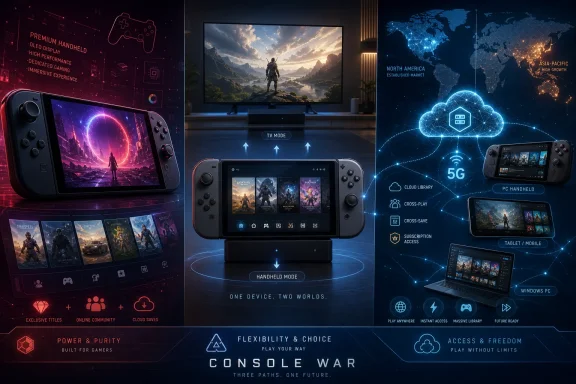 The Handheld Has Become the Console War in Miniature
Portable gaming used to be easy to define. A handheld was a dedicated device, a cartridge or download library, a battery, and a screen. It sat below the living-room console in performance, below the PC in flexibility, and outside the main enterprise computing conversation almost entirely.That definition no longer survives contact with the current market. SNS Insider’s forecast frames the category around hybrid gaming consoles, cloud gaming, digital libraries, cross-platform compatibility, and subscription-based gaming ecosystems. Those are not cosmetic shifts. They describe a market in which the hardware is only one part of the product.
Nintendo’s strength is still the hybrid model: the machine that moves between handheld and TV play without asking the user to think about topology. Valve’s Steam Deck represents a different bet: make the PC library portable and solve the rough edges through hardware design, software updates, and developer support. Microsoft’s bet is more radical still, because Xbox Cloud Gaming and Game Pass make the portable device less important than the account, catalog, network, and controller path.
That is why the 2035 number matters. A market moving from USD 15.23 billion in 2025 to USD 36.29 billion by 2035 is not just selling more gadgets. It is shifting value from one-time hardware purchases toward recurring services, cross-device libraries, accessory ecosystems, and platform lock-in. The portable console is becoming the place where the industry tests whether players want a console, a PC, a cloud terminal, or all three in one bag.
Timeline
2025 — SNS Insider values the Portable Gaming Console Market at USD 15.23 billion.2026–2035 — SNS Insider defines the forecast period for the market’s expected expansion.
2035 — SNS Insider projects the market will reach USD 36.29 billion.
Six Brands, Three Different Definitions of Portable Gaming
The six companies highlighted by SNS Insider do not all compete in the same way, which is precisely why the category is expanding. Nintendo Co., Ltd. competes through hybrid hardware and exclusive game experiences. Sony Interactive Entertainment LLC leans on its broader gaming ecosystem, remote play, and cloud-linked access. Valve Corporation uses the Steam Deck to bring PC-quality gaming into a handheld format.Microsoft Corporation is the most revealing case for WindowsForum readers because its portable-gaming strategy is not primarily about building a classic handheld console. Microsoft is extending Xbox Cloud Gaming, Game Pass, and cross-platform services across devices. Lenovo Group Limited and Razer Inc., meanwhile, show how PC hardware companies see portable gaming as an extension of high-performance computing rather than a toy aisle.
| Company | Portable-gaming role | Main bet | Why it matters |
|---|---|---|---|
| Nintendo Co., Ltd. | Hybrid console leader | Handheld and TV play in one experience | Defines the mass-market expectation for seamless portable gaming |
| Sony Interactive Entertainment LLC | Ecosystem and remote-play competitor | Multi-device access around a strong game portfolio | Shows that home-console brands cannot ignore portable play |
| Valve Corporation | Portable PC disruptor | Steam Deck and PC game-library portability | Turns handheld gaming into a PC ecosystem problem |
| Microsoft Corporation | Cloud and subscription platform | Xbox Cloud Gaming and Game Pass | Makes the device less central than the account and service layer |
| Lenovo Group Limited | PC hardware entrant | Powerful portable gaming devices | Brings Windows-class expectations to handheld form factors |
| Razer Inc. | Premium gaming hardware brand | Displays, controls, peripherals, and performance | Pushes portable gaming toward enthusiast-grade hardware |
The result is not a single market with a single winner. It is a layered market in which the same consumer may own a hybrid console, stream a Game Pass title to another screen, and still want a handheld PC for a digital library that lives outside the console world. That is messy for buyers, but it is attractive for vendors because every layer creates another path to monetization.
Nintendo Proved the Hybrid Thesis Before the Market Named It
Nintendo’s advantage is that it made the hybrid idea feel obvious. The SNS Insider source describes Nintendo as maintaining control of the portable gaming landscape through hybrid gaming consoles that combine portable convenience with the ability to connect to a home console experience. Nintendo’s official product language reinforces the same idea: the system is designed to shift from home console to portable system quickly, with TV, tabletop, and handheld modes treated as normal rather than exceptional.That matters because hybrid play solves a human problem before it solves a technical one. Most players do not want to manage device categories. They want to continue a game in the room they happen to be in, on the screen that happens to be available, for the amount of time they actually have.
Nintendo’s proprietary game series and family-friendly positioning also insulate it from the pure specification race. In a market increasingly obsessed with OLED screens, processors, refresh rates, and cloud services, Nintendo’s core advantage remains behavioral: it taught mainstream users that a console could be portable without feeling compromised. That is a more durable moat than a single display upgrade.
For Windows users, Nintendo’s lesson is uncomfortable but useful. Technical flexibility is not the same as product coherence. A Windows handheld can run more things, connect to more services, and behave more like a PC, but if sleep states, launchers, controller mapping, battery life, updates, and store fragmentation create friction, mainstream users may still prefer the simpler hybrid proposition.
The broader industry has absorbed that lesson. SNS Insider names hybrid gaming consoles as a consumer favorite because they let players toggle between handheld and TV-based gaming. The word “toggle” is doing a lot of work there. The winners in portable gaming will be the companies that make switching context feel less like a feature and more like muscle memory.
Valve Turned PC Gaming Into a Handheld Software Problem
Valve’s Steam Deck is the clearest proof that portable gaming is no longer synonymous with closed console gaming. SNS Insider credits Valve with bringing PC-quality gaming to a portable device through the Steam Deck, giving players access to a massive PC game library, powerful hardware, and flexible performance. Valve’s own official Steam Deck page leans into the same framing: portable PC gaming, designed for comfort and a console-like user experience.That phrase — console-like user experience — is the key. Valve did not make the PC disappear. It tried to make the PC tolerable at handheld scale. The Steam Deck’s importance is not merely that it runs PC games, but that it reframes compatibility, input, power management, storefront access, and game verification as part of the handheld product.
This is why the Steam Deck became more than a device. It became a pressure point on every Windows-based portable gaming machine. If a handheld PC runs Windows, it inherits Windows’ strengths: compatibility, breadth of software, multiple stores, familiar account management, and access to the wider PC ecosystem. It also inherits Windows’ weaknesses at small-screen, controller-first scale: update timing, background tasks, launcher sprawl, inconsistent touch targets, and the awkwardness of a desktop operating system pretending to be a living-room console.
Valve’s model shows that the future of handheld PCs is not only about faster processors or better screens. It is about reducing the distance between a player pressing the power button and a game behaving correctly. That distance is where many portable PCs either delight users or lose them.
For Microsoft, Lenovo, Razer, and every Windows-adjacent manufacturer, the Steam Deck is both a validation and a warning. It validates the idea that PC libraries can travel. It warns that the handheld PC category will be judged less by theoretical compatibility than by the quality of the first ten minutes: wake, update, launch, controller support, frame pacing, suspend, resume.
Microsoft Is Selling the Handheld Without Needing to Own the Handheld
Microsoft’s role in the SNS Insider list is the most strategic because it separates portable gaming from portable hardware. The source describes Microsoft as expanding through Xbox Cloud Gaming and cross-platform gaming services, focusing on streaming high-quality console games to a variety of portable devices rather than relying only on dedicated handheld hardware. Microsoft’s own Xbox Cloud Gaming messaging is consistent with that: stream and play games across supported devices, with Game Pass serving as the subscription layer.That is a fundamentally different business from selling a handheld. Microsoft does not need every portable screen to be an Xbox-branded machine if the user signs in, streams, subscribes, and stays inside the Xbox service fabric. The device becomes a client. The account becomes the console.
This is the logic behind subscription-based gaming ecosystems. Game Pass is not just a catalog; it is a habit engine. The more users expect their games to appear across PCs, consoles, phones, tablets, browsers, and handheld devices, the more the service becomes the thing they are actually buying. Hardware still matters, but it is demoted from destination to access point.
For WindowsForum readers, this is where gaming strategy starts to overlap with identity, cloud policy, and endpoint governance. Xbox Cloud Gaming depends on supported devices, supported regions, compatible controllers, and sufficient network performance. It also depends on subscriptions, recurring billing, Microsoft accounts, and cloud access paths that may exist on the same devices people use for work.
That does not mean Xbox Cloud Gaming is an enterprise threat by default. It means portable gaming is increasingly difficult to treat as isolated consumer behavior. A Windows handheld can be a gaming machine, a browser endpoint, a cloud-streaming client, a personal PC, and a travel device all at once. The line between “console” and “computer” gets blurrier every time cloud gaming works well enough that the local hardware stops being the limiting factor.
Sony, Lenovo, and Razer Show Why the Category Will Not Consolidate Cleanly
Sony Interactive Entertainment LLC sits in an unusual position. The SNS Insider source notes that Sony remains one of the leading companies in gaming because of its ecosystem, game development, and exclusive portfolio, while its portable competitiveness is strengthened by cloud gaming and remote play. In other words, Sony does not have to define portable gaming only through dedicated handheld hardware; it can extend the value of its existing ecosystem outward.That is the same gravitational pull shaping Microsoft’s strategy, though the execution differs. The more important a company’s game catalog, identity system, and subscription model become, the less portable play has to be tied to a single piece of hardware. The portable device becomes a way to preserve engagement when the user leaves the living room.
Lenovo Group Limited represents the PC hardware view of the market. SNS Insider describes Lenovo’s handheld gaming push around powerful portable devices for gamers who want a PC-level experience on the go, with processors, graphics, and ergonomic designs aimed at demanding applications. That framing matters because it treats portable gaming as a performance segment, not merely a convenience segment.
Razer Inc. pushes from the enthusiast side. The source describes Razer as a gaming technology company known for high-end gaming laptops and peripherals, now participating in portable gaming through devices and peripherals built around immersive displays, responsive controls, and powerful performance. Razer’s presence signals that the handheld is becoming an accessory ecosystem as much as a console category.
Together, Sony, Lenovo, and Razer show why portable gaming will not collapse into one winner-takes-all format. Some users will buy the device that best extends a console ecosystem. Others will chase PC-level performance. Others will build a portable setup around controls, displays, audio, docking, and accessories.
That diversity is good for innovation but hard on buyers. It creates a market where “portable gaming console” can mean a hybrid console, a handheld PC, a cloud-streaming client, a remote-play screen, or a premium accessory platform. The risk is that vendors use the same language to describe products with very different dependencies, costs, and limitations.
OLED, 5G, and Subscriptions Are the New Bill of Materials
The SNS Insider source lists OLED screens, 5G, cloud gaming, cross-platform compatibility, subscription-based gaming ecosystems, and hybrid gaming consoles among the defining technology trends. These should not be read as a feature checklist. They are the new bill of materials for the portable gaming business.OLED screens matter because handheld gaming is intimate. The screen is close, the session may be short, and visual quality has to compensate for the loss of a large display. Better panels make portable play feel premium even when raw compute is constrained.
5G and cloud gaming matter because they attack the oldest handheld limitation: the device can only run what its chip, battery, storage, thermals, and software stack can support. Streaming moves part of that burden off the device. It also creates new dependencies on network quality, latency, service availability, region support, and subscription status.
Cross-platform compatibility matters because players increasingly expect libraries and saves to move with them. A game that is trapped on one device feels worse in a world where music, documents, photos, and video already travel across screens. The gaming industry spent decades training users to accept walled gardens; portable play now pressures those walls from every direction.
Subscription-based gaming ecosystems matter because they change the economics of ownership. If a user thinks of a handheld as a gateway to a large rotating library, the purchase decision shifts from “what games can this machine run?” to “what service does this machine make easy?” That is why Game Pass and Xbox Cloud Gaming appear in any serious analysis of portable gaming’s future, even when Microsoft is not selling the dominant dedicated handheld.
The industry’s challenge is that these trends do not always reinforce one another. OLED screens can increase perceived quality but may raise cost. 5G can expand access but cannot eliminate latency physics or coverage gaps. Cloud gaming can lower hardware requirements but increases dependence on service policy. Subscriptions can make discovery easier but may make long-term ownership feel less certain.
The companies that win will be the ones that hide those trade-offs without pretending they do not exist. Portable gaming is not becoming simpler. It is becoming more abstract. The user sees a game; underneath it sit display supply chains, wireless networks, cloud infrastructure, operating systems, payment models, licensing agreements, and regional market differences.
North America Buys the Premium Future While Asia-Pacific Tests the Scale
SNS Insider identifies North America as leading the portable gaming console market and Asia-Pacific as the fastest-growing region. That split is important because it suggests two different kinds of market power. North America leads through a mature gaming ecosystem, high consumer spending, and early adoption of advanced gaming technologies. Asia-Pacific grows fastest through a large gaming population, improving digital infrastructure, and rising smartphone and internet penetration.North America is where premium handheld hardware, subscriptions, and ecosystem lock-in can be monetized aggressively. Consumers are more likely to have multiple screens, established digital libraries, and willingness to spend on accessories or services. That makes the region a proving ground for high-end devices and platform bundles.
Asia-Pacific is where scale tests the assumptions behind the category. A large gaming population does not automatically mean the same device mix, price tolerance, network conditions, or content preferences as North America. Cloud gaming and 5G may be more important in some contexts, while hybrid consoles or lower-friction portable devices may dominate others.
This regional split also matters for developers. A studio optimizing for portable play cannot assume one hardware profile, one network condition, or one monetization model. The same game may be played locally on a Steam Deck, streamed through Xbox Cloud Gaming, accessed through a subscription, or enjoyed on a hybrid console in a family setting.
For IT pros, the regional picture has a parallel inside companies. North America’s role as a leading market resembles the executive-user problem: high-end devices, fast networks, and premium subscriptions arrive first among users with purchasing power. Asia-Pacific’s growth story resembles the scale problem: once the behavior spreads, support models, network planning, and policy enforcement have to catch up.
The portable gaming market is therefore not just growing geographically. It is diversifying operationally. The same category name will cover premium hardware in one market, cloud-first access in another, and hybrid convenience somewhere else. That is exactly what makes the 9.07% CAGR forecast plausible — and exactly what makes the market hard to govern cleanly.
Windows Is Now Part of the Handheld Gaming Stack
The Windows angle is not that every portable gaming console runs Windows. It does not. The Windows angle is that portable gaming increasingly touches Windows accounts, PCs, browsers, cloud gaming, device management, accessories, and subscription services. Microsoft’s presence in the SNS Insider list makes that unavoidable.A handheld PC is still a PC, even when shaped like a console. That means drivers, updates, security software, storage, storefronts, browsers, account sign-ins, and network behavior matter. For a home user, those are convenience issues. For an organization, they can become policy issues.
The most obvious case is the employee-owned Windows handheld that connects to corporate Wi-Fi, signs into personal Microsoft services, installs game launchers, and occasionally doubles as a travel computer. It may not hold corporate data, but it can still consume bandwidth, create support confusion, or blur identity boundaries if users mix personal and work accounts carelessly. The device does not have to be malicious to complicate an environment.
Cloud gaming adds another wrinkle. Xbox Cloud Gaming is designed to stream to supported devices over sufficient connections, and Microsoft’s own support language emphasizes the need for an active subscription, supported device, compatible controller, and adequate network performance. On a home network, that is a setup checklist. On a managed network, it is traffic classification, acceptable-use policy, and help-desk triage.
For families and enthusiasts, the right answer may be simple: buy the device that fits the game library and budget. For admins, the right answer is documentation. Know which devices are allowed, which accounts may be used, whether cloud gaming traffic is permitted, and whether personal handheld PCs are treated as unmanaged endpoints.
Action checklist for admins
- Decide whether handheld gaming PCs are allowed on corporate Wi-Fi, guest Wi-Fi only, or blocked from managed networks.
- Document whether Xbox Cloud Gaming and similar game-streaming services are permitted, rate-limited, or restricted during business hours.
- Separate personal Microsoft accounts from work accounts on any Windows device that may touch corporate resources.
- Review endpoint-management rules for employee-owned Windows handhelds before users ask the help desk to support them.
- Watch bandwidth and latency complaints in offices where cloud gaming, video meetings, and software updates compete on the same network.
- Make acceptable-use language explicit: portable gaming hardware may look like a console, but many devices behave like PCs.
The Risk Is Fragmentation Masquerading as Choice
The portable gaming market’s great strength is also its greatest weakness. Choice looks wonderful in a buyer’s guide. It looks less wonderful when a user discovers that one device is best for a console library, another for PC games, another for streaming, another for battery life, and another for family multiplayer.SNS Insider’s six-company framing captures that fragmentation. Nintendo is strongest when portable play is integrated into a curated hybrid console experience. Valve is strongest when the PC library is the anchor. Microsoft is strongest when cloud access and Game Pass make the device interchangeable. Lenovo and Razer are strongest when performance, ergonomics, and premium hardware matter.
Those strategies can coexist, but they do not produce a single universal buyer recommendation. A user who wants offline travel play has different needs from a user who mostly streams at home. A user invested in a PC game library has different needs from a family built around exclusive console franchises. A user who treats Game Pass as the center of gaming life has different needs from one who buys individual games and expects local ownership.
This is where the industry’s language can become misleading. “Cloud gaming” sounds like freedom until the network is weak. “PC-quality gaming” sounds like freedom until battery life, heat, and compatibility intervene. “Cross-platform” sounds like freedom until licensing, saves, storefronts, and subscriptions draw new borders.
The portable gaming market will grow because each of these approaches solves a real problem. It will frustrate users because none of them solves every problem. The buyer’s question is shifting from “which handheld is best?” to “which compromises match the way I actually play?”
The Market Will Reward Ecosystems, Not Spec Sheets
Hardware still matters. No amount of ecosystem rhetoric can rescue a device with a poor screen, uncomfortable controls, weak battery life, or bad thermals. But the 2035 portable gaming market described by SNS Insider is not a pure hardware race.The winners will be the companies that make libraries, saves, subscriptions, connectivity, and accessories feel coherent. Nintendo’s value is the unified hybrid experience. Valve’s value is bringing a large PC library into a handheld-friendly environment. Microsoft’s value is making Xbox Cloud Gaming and Game Pass feel available wherever the user happens to be. Lenovo and Razer’s value is translating PC performance and gaming hardware credibility into portable form.
That is why OLED screens and 5G should be understood as enablers, not endpoints. OLED makes portable sessions feel better. 5G makes cloud access more plausible. Subscription-based ecosystems make discovery and engagement easier. Cross-platform compatibility makes the user less likely to abandon a library when switching devices.
The deeper prize is continuity. Every major company in the SNS Insider list is trying to prevent interruption. Nintendo prevents interruption between handheld and TV. Valve prevents interruption between PC library and couch. Microsoft prevents interruption between device categories. Sony prevents interruption between console ecosystem and remote access. Lenovo and Razer prevent interruption between PC-grade performance expectations and portable hardware.
That is the strategic heart of the forecast. The portable gaming console market is not growing simply because people like smaller devices. It is growing because the industry has realized that the next gaming platform may not be a box under a TV. It may be the continuity layer that follows the player.
The Practical Read Before 2035
The useful way to read SNS Insider’s forecast is not as a prediction that every gamer will buy the same kind of handheld. It is a warning that portable play is becoming a default expectation across the gaming industry, and that hardware, cloud services, and subscriptions are now competing to define what “portable” actually means.- The market is valued at USD 15.23 billion in 2025 and projected to reach USD 36.29 billion by 2035.
- The forecast CAGR is 9.07% across the 2026–2035 period.
- North America leads today, while Asia-Pacific is identified as the fastest-growing region.
- Nintendo, Valve, and Microsoft represent three different centers of gravity: hybrid hardware, portable PC gaming, and cloud-plus-subscription access.
- OLED screens, 5G, cloud gaming, cross-platform compatibility, and subscription-based gaming ecosystems are the forces turning handhelds into platform endpoints.
- For Windows users and admins, portable gaming now intersects with PCs, identity, networks, subscriptions, and unmanaged devices.
That is why the next decade of portable gaming will be less about who builds the fastest device and more about who removes the most friction. The screen will improve, the networks will improve, and the chips will improve, but the real contest is continuity: whether a player can start, stop, move, resume, and keep paying without thinking about the machinery underneath. In that contest, the portable console is no longer the small version of the gaming business. It is becoming the place where the whole business is forced to reveal its future.
References
- Primary source: SNS Insider
Published: 2026-07-09T13:00:16.604110
6 Leading Portable Gaming Console Brands to Watch in 2035
Explore the leading portable gaming console companies shaping the future of gaming through advanced handheld devices & cutting-edge technology.www.snsinsider.com - Related coverage: tomsguide.com
The best gaming consoles in 2026, tested by experts | Tom's Guide
We played 100+ hours on PlayStation, Xbox and Nintendo's latest consoles for the ultimate console showdown. Here's the system you should buy in 2026, after years of testing.www.tomsguide.com - Related coverage: tomshardware.com
- Related coverage: techradar.com
How to build a Steam Machine-killing compact gaming PC for less | TechRadar
Orange box? Black box!www.techradar.com - Related coverage: windowscentral.com
Valve releases Windows PC drivers for Steam Machine — but official dual-boot support for SteamOS gaming is still missing | Windows Central
Valve still allows Steam hardware owners to install Windows, providing compatible drivers to everyone.www.windowscentral.com - Related coverage: pcgamer.com
Somehow, the $1,000 Asus ROG Ally Xbox X is the best value gaming handheld I can think of right now | PC Gamer
Handheld gaming PC pricing is ridonculous.www.pcgamer.com
- Related coverage: xbox.com
XBOX Cloud Gaming | XBOX
Stream XBOX games to your phones, tablets, smart TVs and more with XBOX Cloud Gaming. Play free-to-play favorites, plus hundreds of games with XBOX Game Pass.www.xbox.com - Related coverage: news.xbox.com
Xbox Cloud Gaming: Now Running on Xbox Series X; Expanded PC and Apple Device Availability - XBOX Wire
At Xbox, our mission is simple: bring the joy and community of gaming to everyone on the planet. To achieve that, we aspire to empower everyone to play the games you want, with the people you want, anywhere you want. We are creating a future that combines the gaming heritage of Xbox and the...news.xbox.com - Related coverage: nintendo.com
Nintendo Switch – OLED Model - Nintendo - Official Site
Learn about the Nintendo Switch™ – OLED Model system, with its vibrant 7-inch OLED screen, wide adjustable stand, dock with a wired LAN port, 64 GB of internal storage, and enhanced audio.www.nintendo.com - Related coverage: lg.com
- Related coverage: grandviewresearch.com
Cloud Gaming Market Size And Share Report, 2025-2030
Cloud gaming market size was valued at $2.3 billion in 2024 and is projected to grow from $4.9 billion in 2026 to $21.0 billion by 2030, at a CAGR of 44.3%www.grandviewresearch.com
- Related coverage: gminsights.com
North America Gaming Handheld Market Size, Forecasts 2035
The North America gaming handheld market was estimated at USD 4.4 billion in 2025 and is expected to grow at a CAGR of 2.6% between 2026 and 2035, due to the rapid adoption of high-performance handheld gaming PCs.www.gminsights.com - Related coverage: researchandmarkets.com
Gaming Handheld Market Size, Market Share, Application Analysis, Regional Outlook, Growth Trends, Key Players, Competitive Strategies and Forecasts, 2025 to 2033
Gaming Handheld Market Size, Market Share, Application Analysis, Regional Outlook, Growth Trends, Key Players, Competitive Strategies and Forecasts, 2025 to 2033www.researchandmarkets.com - Related coverage: thetechshowdown.com
Handheld Gaming Console Guide 2026 | The Tech Showdown
A buying guide for handheld gaming consoles covering Steam Deck OLED, ASUS ROG Xbox Ally X, ASUS ROG Xbox Ally 7-inch, Lenovo Legion Go 2, MSI Claw, Nintendo Switch 2, and Logitech G Cloud.thetechshowdown.com - Related coverage: pcworld.com
Xbox is cooked. Why your next gaming console will be a PC | PCWorld
With Microsoft bored of Xbox, it's now time for PCs to shine where consoles once dominated.www.pcworld.com - Related coverage: jayrespawns.com
PC Gaming Handhelds 2026: Market Breakdown | Jay Respawns
Steam Deck owned PC gaming handhelds in 2022. ROG Ally and Lenovo changed that by 2023. Full 2026 breakdown of hardware tiers, market share, and OS trade-offs.jayrespawns.com
- Related coverage: pmarketresearch.com
Worldwide Handheld Game Console Market 2026 – PW Consulting
The Global Handheld Game Console Market was valued at USD 21.94 Billion in 2025 and is projected to reach USD 45.60 Billion by 2032, growing at a CAGR of 11.0%.pmarketresearch.com - Related coverage: switchbladegaming.com
Best Handheld Gaming PC to Buy in 2026: Steam Deck vs ROG Ally vs Legion Go Buyer Guide - Switchblade Gaming
Best handheld gaming PC 2026 buyer guide — full comparison of Steam Deck OLED, ROG Ally X and Legion Go covering specs, performance, battery life, total cost of ownership, and clear winner recommendations for six buyer types. Find out which handheld gaming PC is right for your game...www.switchbladegaming.com - Related coverage: omdia.tech.informa.com
How handheld gaming has become more complex – and more lucrative
PDF documentomdia.tech.informa.com
- Related coverage: together.nbcuni.com