

CISA’s advisory on CVE-2026-14480 has a simple bottom line for OpenPLC operators: OpenPLC v3 is end-of-life, the vendor’s remediation is to upgrade to OpenPLC v4, and any legacy OpenPLC v3 web UI that cannot be migrated immediately should be isolated from nonessential users and networks now. The flaw is an authenticated arbitrary file write in the OpenPLC v3 web UI program-upload workflow. CISA describes a path where an attacker with low privileges can supply a filename that is later treated as a file-system destination, potentially allowing writes anywhere the OpenPLC webserver process can write and enabling native code execution through the normal program compilation and runtime-start process.
The uncomfortable part is not only the high severity score. It is that the attack path rides along a workflow every PLC environment already has to trust: upload control logic, compile it, and start the runtime. That makes this less like a strange edge-case bug and more like a warning about where legacy engineering interfaces sit in the control-system trust model.
CISA’s advisory is blunt: OpenPLC Runtime v3 contains an authenticated arbitrary file write vulnerability in the legacy web UI program-upload workflow. The application stores an attacker-supplied filename,
That would be serious in an ordinary web application. In a PLC runtime, it is worse because the vulnerable workflow is adjacent to the machinery that turns user-authored control logic into executable runtime behavior. CISA’s description says an attacker can place a malicious
This is the kind of ICS vulnerability that looks mundane until it is placed in context. It requires authentication, so it is not the same threat model as an unauthenticated internet worm. But the exploit chain described by CISA does not require a second software bug, exotic memory corruption, or a phishing attachment opened in the control room. It turns an ordinary administrative action — uploading and compiling PLC logic — into the moment where attacker-controlled code can join the runtime.
The operational lesson is narrow but important. Any account that can reach the legacy OpenPLC v3 web UI and use the upload workflow should be treated as sensitive. Any network path that exposes that interface to users who do not absolutely need it should be treated as a temporary risk. And any OpenPLC v3 deployment that still matters operationally should be moved into a migration plan rather than kept in place as an unpatched legacy component.
CISA’s description of the vulnerable workflow shows the chain in plain terms. First, the legacy web UI accepts an attacker-supplied filename through
Each step is individually understandable. Together, they form a privilege escalation path from “can upload a PLC program through the web interface” to “can influence native code compiled into the runtime.” That is why this vulnerability lands with a CVSS v3.1 base score of 9.9 and CRITICAL severity, even though it requires low privileges rather than no privileges.
The key failure is the mixing of trust zones that should be separated: web input, stored program metadata, file-system destinations, and build-system inputs. Web applications often store filenames because users expect uploaded programs to have recognizable names. PLC runtimes often compile user logic because that is part of the control-program lifecycle. But when the name chosen at upload time can become an absolute path, and when the destination can be a directory involved in runtime compilation, the application has accidentally given a low-privileged user a steering wheel for the build process.
The broader message for anyone building or deploying control-system tooling is this: a compiler is a security boundary. If untrusted or weakly trusted users can influence what enters it, the system must treat that path with the same seriousness as a plugin loader, a package installer, or a software update mechanism.
The difference between the v3.1 and v4.0 ratings is not a contradiction. CVSS v4.0 represents certain impacts differently, and CISA’s table preserves both views. For admins, the important part is not whether the advisory says 9.9 or 8.7; it is that both scoring systems treat the issue as severe, reachable over a network, low complexity, and capable of producing major impact after authentication.
The “PR:L” part is the hinge. This is not an unauthenticated scenario based on the facts CISA has published. But authenticated access is still meaningful risk when the application treats any logged-in user as trusted enough to influence program upload and compilation. A single unnecessary account, exposed management path, or overbroad engineering role can turn “requires login” into a much thinner defense than it sounds.
The practical response is to reduce who can reach and use the vulnerable workflow while migration is planned. That means narrowing network access to the web UI, reviewing accounts with program-upload rights, and treating compile and runtime-start actions as privileged events rather than routine background noise.
In ordinary enterprise software, admins often wait for a maintenance release, test it, deploy it, and move on. Here, the affected product line is itself out of support. That means organizations running OpenPLC v3 have to treat the advisory less like a one-off patch event and more like evidence that the platform has aged out of the security lifecycle.
CISA’s advisory does not say that v4 is affected by CVE-2026-14480, and the affected-products section is limited to OpenPLC v3 with product status listed as known affected. The practical conclusion is narrow but important: if you are on v3, the official remediation path is migration, not waiting for a v3 hotfix.
That may be simple for a classroom image, a research VM, or a demonstration controller. It may be harder for an environment that has wrapped OpenPLC v3 around custom scripts, I/O mappings, lab exercises, test rigs, or integration procedures. End-of-life software in control environments often persists because it is connected to something physical, validated by habit, and considered “good enough” until a vulnerability changes the risk calculation.
The migration problem is also why blanket advice to “just upgrade” can be lazy. PLC environments are not web apps where rolling forward a minor version can always be undone with a quick deployment rollback. Control logic, I/O mappings, protocol assumptions, HMI integrations, runtime behavior, operator procedures, and safety assumptions may all need validation. For educational deployments, the risk may be lost lab time. For production-adjacent deployments, the risk may be unintended operational change.
Still, CISA’s language leaves little room for a comfortable middle. If OpenPLC v3 is no longer receiving security updates, then compensating controls are temporary risk management, not a fix. The right framing for an owner is not “can we block this one CVE forever?” but “why is an end-of-life PLC runtime still reachable by anyone who does not absolutely need it?”
The attacker does not need to defeat the compiler. The attacker uses the fact that compilation is expected. By writing a malicious
This is why admins should be careful not to reduce the issue to simple file extension filtering. CISA’s description specifically calls out malicious
For organizations that cannot immediately migrate, the legacy upload workflow should be treated as privileged. Accounts that can upload programs should be reviewed. Old users should be removed. Shared passwords should be rotated or eliminated where possible. Any network path to the web UI should be narrowed to a management enclave or a small set of approved engineering hosts. Monitoring should pay attention not only to login failures, but also to unusual uploads, unexpected filenames or paths, compilation events, and runtime restarts.
Those facts are enough to justify urgent action. They are not enough to justify claims of a known active campaign, compromise of a named facility, or a universal critical-infrastructure emergency. Operators should avoid both extremes: panic on one side, and dismissal on the other.
The most defensible response is proportionate urgency. Do not assume compromise based on the advisory alone. Do not assume safety because exploitation requires authentication. Find the instances, determine whether they are v3, check whether the web UI is reachable from places it should not be, and decide whether migration to v4 can be scheduled now or whether interim isolation must happen first.
CISA lists affected critical infrastructure sectors as Critical Manufacturing, Energy, Transportation Systems, and Water and Wastewater, with worldwide deployment. That is a risk horizon, not proof that every affected instance controls a pump, conveyor, valve, breaker, or treatment process. Some instances may be benign lab systems. Others may be attached to physical I/O in ways their owners need to verify before making changes.
The advisory is also not a Windows patching event. CVE-2026-14480 is a vulnerability in OpenPLC v3, not in Windows. The Windows relevance for many WindowsForum readers is operational: Windows engineering workstations, browsers, file shares, VPN clients, and identity systems may be part of the environment that can reach an OpenPLC web UI. If that interface is reachable from a Windows-managed engineering network, Windows administrators may have a role in segmentation, credential review, monitoring, and incident response coordination even though the vulnerable product is OpenPLC.
That distinction matters. The fix is not a Windows cumulative update. The fix is product migration, plus exposure reduction until migration is complete.
The Windows relevance is practical rather than architectural. Engineering ecosystems are rarely pure. A PLC runtime may sit on a Linux board, a virtual machine, a container, or a lab host, while the people who manage it use Windows laptops joined to enterprise identity, file shares, VPN clients, browser password stores, and remote-access tools. If the OpenPLC web UI is reachable from that environment, a compromised or misused account can interact with the vulnerable workflow.
That is analysis, not a claim that every OpenPLC deployment sits behind Windows workstations or that every Windows environment is exposed. The point is simpler: administrators should map the actual management path. Which workstations can browse to the OpenPLC web UI? Which identities or local accounts can log in? Which network segments can reach the interface? Which users can upload programs? Which hosts can trigger compilation and runtime start?
CISA’s execution context is also worth reading carefully. Arbitrary file writes are possible anywhere writable by the OpenPLC webserver process, and code execution may occur as the OpenPLC runtime user. That is not automatically root or local administrator. But in a poorly isolated system, code execution as the runtime user may be enough to alter PLC behavior, interfere with availability, tamper with files, or explore the local environment for further weaknesses.
Windows admins should therefore resist two bad instincts. The first is dismissing the advisory because it is “OT” or “not Windows.” The second is treating it like a normal endpoint patching task. The right action is asset and exposure management: identify OpenPLC v3, validate segmentation, review credentials, and coordinate with whoever owns the control logic before making changes.
That detail should make defenders uncomfortable. Many exploit chains require the attacker to perform an obviously anomalous action: crash a service, spray traffic, brute-force an endpoint, upload a strange binary, or run a suspicious command. This chain can be staged so that the decisive moment is an expected engineering operation. A compile-and-start sequence is not noise in a PLC environment; it is work.
This creates a logging challenge. If an organization logs only authentication events and service crashes, it may miss the interesting part of the attack. If it logs only malware signatures, it may not see malicious source code being folded into a build. If it treats all program uploads as ordinary, it may have no baseline for what filenames, upload times, users, and compile events are normal.
It also creates a human-factors problem. In many facilities, operators and engineers are trained to restore service and keep systems running. If a runtime needs to be compiled and started, they may do it as part of normal maintenance. If the UI presents the action as normal, the workflow itself lends legitimacy to the attacker’s preparation. That is why the advisory’s “no user interaction” CVSS field can coexist with an operator-triggered compilation: the attacker does not need to trick a victim into opening a malicious document; the system’s routine administrative process supplies the execution moment.
The defensive answer is not to make engineers afraid of their own tools. It is to put stronger guardrails around the tool. Program upload rights should be role-based, not broadly shared. Compile and runtime-start events should be auditable. Management interfaces should not be reachable from general-purpose networks. File-system permissions should be least privilege, so the webserver process cannot write into build-sensitive directories unless operations truly require it. And where the supported product path is v4, migration planning should start before the next advisory makes the decision under worse conditions.
CISA credits Grady DeRosa with reporting this vulnerability. That attribution matters because it frames the advisory as coordinated disclosure, not as a reason to treat OpenPLC itself as uniquely suspect. The problem is not disclosure. The problem is unsupported software lingering in places where its risk profile has changed.
Open source also changes the patch calculus. In theory, organizations can inspect and modify the code themselves. In practice, most operators should not respond to an ICS code-execution advisory by inventing a local security fork of an end-of-life PLC runtime unless they have the engineering depth to maintain it. A one-line path validation change may sound tempting, but the advisory’s actual risk crosses web handling, database storage, file permissions, build behavior, and operational workflow. A partial fix can create false confidence.
That is why the recommendation to upgrade to v4 should be taken seriously as a product lifecycle statement. It is not only about this one bug. It is about moving from a legacy runtime that is no longer receiving patches, bug fixes, or security updates to the supported line. Even if migration requires testing, retraining, or project conversion work, it is the remediation path CISA lists from the vendor.
For admins, the hardest part may be cultural. In IT, end-of-life software is often visible because vulnerability scanners, endpoint agents, and asset inventories complain about it. In OT and lab environments, a runtime can remain invisible because it does not look like a corporate endpoint, or because touching it is considered riskier than leaving it alone. CVE-2026-14480 is a reminder that leaving it alone is also a decision.
Start with network discovery, but do not rely on it alone. Ask engineering teams where OpenPLC has been used. Check documentation for training labs and test stands. Review VM inventories, container registries, backup images, and old project folders. Search configuration-management notes for “OpenPLC,” “OpenPLC_v3,” and related service names. If a runtime was built for a one-time pilot, assume it may still exist until proven otherwise.
Once an instance is found, classify it before touching it. Is it production, production-adjacent, lab-only, classroom-only, or abandoned? Is it connected to physical I/O? Can it influence a process, even indirectly? Who owns the logic? Who can log in? What network segments can reach the web UI? Is the instance still needed, or can it be retired instead of migrated?
For systems that are still needed, reduce exposure before doing deeper work. Limit access to the web UI to known engineering hosts. Remove users who no longer need access. Disable or rotate shared credentials if doing so will not break an operational process. Place the system behind stronger network controls while migration is planned. If the instance is lab-only, verify that “lab-only” also means it is not reachable from broader campus, corporate, guest, or VPN networks.
Then prepare migration like an engineering change, not a casual software update. Export or copy existing programs and configuration data using approved procedures. Record current runtime behavior, I/O assumptions, and any connected scripts or integrations. Build a test OpenPLC v4 environment. Validate program behavior in a safe setting before connecting to physical equipment. Schedule downtime if required. Keep a rollback plan, but do not let rollback become a permanent return to v3.
Monitoring during this window should focus on the workflow CISA describes. Watch for uploads from unexpected users or hosts. Look for filenames or paths that do not resemble normal program names. Pay attention to compile events and runtime starts outside maintenance windows. Review file-system changes in directories that should not receive uploaded program content. Treat any unexplained
None of this replaces migration. It buys time for migration to happen safely. The forward-looking close is simple: OpenPLC v3 has crossed from “legacy but useful” into “legacy and security-relevant.” If you still need OpenPLC, move toward v4. If you cannot move today, isolate the v3 web UI, tighten who can upload and compile programs, and make the migration plan visible enough that it does not become another forgotten control-system exception.
The uncomfortable part is not only the high severity score. It is that the attack path rides along a workflow every PLC environment already has to trust: upload control logic, compile it, and start the runtime. That makes this less like a strange edge-case bug and more like a warning about where legacy engineering interfaces sit in the control-system trust model.
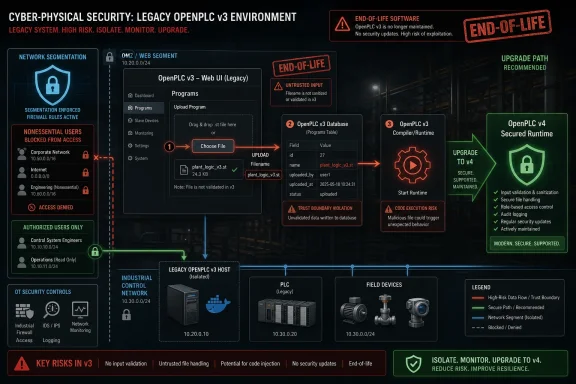 A File Upload Bug Becomes a Control-System Code Path
CISA’s advisory is blunt: OpenPLC Runtime v3 contains an authenticated arbitrary file write vulnerability in the legacy web UI program-upload workflow. The application stores an attacker-supplied filename, prog_file, directly in the Programs.File database field, then later uses that stored value as the destination path for an uploaded file without validating or restricting it. Because Python’s os.path.join() honors attacker-controlled absolute paths, an authenticated user can write files anywhere the OpenPLC webserver process can write.That would be serious in an ordinary web application. In a PLC runtime, it is worse because the vulnerable workflow is adjacent to the machinery that turns user-authored control logic into executable runtime behavior. CISA’s description says an attacker can place a malicious
.cpp file in the runtime core directory and escalate the arbitrary file write to arbitrary native code execution when an operator triggers the normal program compilation and runtime start process.This is the kind of ICS vulnerability that looks mundane until it is placed in context. It requires authentication, so it is not the same threat model as an unauthenticated internet worm. But the exploit chain described by CISA does not require a second software bug, exotic memory corruption, or a phishing attachment opened in the control room. It turns an ordinary administrative action — uploading and compiling PLC logic — into the moment where attacker-controlled code can join the runtime.
The operational lesson is narrow but important. Any account that can reach the legacy OpenPLC v3 web UI and use the upload workflow should be treated as sensitive. Any network path that exposes that interface to users who do not absolutely need it should be treated as a temporary risk. And any OpenPLC v3 deployment that still matters operationally should be moved into a migration plan rather than kept in place as an unpatched legacy component.
The Advisory Is Really About Trust Boundaries, Not Just Path Handling
The formal weakness is CWE-73, External Control of File Name or Path. That classification is accurate, but it understates the architectural lesson. The bug is not merely that a path was accepted from the user; it is that user-controlled metadata became file-system authority, and that file-system authority fed into a compiler.CISA’s description of the vulnerable workflow shows the chain in plain terms. First, the legacy web UI accepts an attacker-supplied filename through
prog_file. Second, that value is stored in Programs.File. Third, the application later treats that stored value as a destination path. Fourth, os.path.join() does not neutralize an absolute path supplied by an attacker. Fifth, the normal OpenPLC program compilation and runtime-start process can turn the resulting file placement into native code execution.Each step is individually understandable. Together, they form a privilege escalation path from “can upload a PLC program through the web interface” to “can influence native code compiled into the runtime.” That is why this vulnerability lands with a CVSS v3.1 base score of 9.9 and CRITICAL severity, even though it requires low privileges rather than no privileges.
The key failure is the mixing of trust zones that should be separated: web input, stored program metadata, file-system destinations, and build-system inputs. Web applications often store filenames because users expect uploaded programs to have recognizable names. PLC runtimes often compile user logic because that is part of the control-program lifecycle. But when the name chosen at upload time can become an absolute path, and when the destination can be a directory involved in runtime compilation, the application has accidentally given a low-privileged user a steering wheel for the build process.
The broader message for anyone building or deploying control-system tooling is this: a compiler is a security boundary. If untrusted or weakly trusted users can influence what enters it, the system must treat that path with the same seriousness as a plugin loader, a package installer, or a software update mechanism.
Why the Score Is High Even Though the Attacker Must Log In
CVE scoring often causes confusion in ICS environments because the numbers compress both technical exploitability and operational consequence into a single value. CVE-2026-14480 is a good example. The CVSS v3.1 score is 9.9, CRITICAL, with network attack vector, low attack complexity, low privileges required, no user interaction, changed scope, and high impact to confidentiality, integrity, and availability. The CVSS v4.0 score is 8.7, HIGH, with high impacts to the vulnerable system’s confidentiality, integrity, and availability.| Scoring system | Base score | Severity | Vector string | Practical reading |
|---|---|---|---|---|
| CVSS v3.1 | 9.9 | CRITICAL | CVSS:3.1/AV:N/AC:L/PR:L/UI:N/S:C/C:H/I:H/A:H | Low-privileged network access can cross a scope boundary and fully compromise the affected runtime context. |
| CVSS v4.0 | 8.7 | HIGH | CVSS:4.0/AV:N/AC:L/AT:N/PR:L/UI:N/VC:H/VI:H/VA:H/SC:N/SI:N/SA:NA | The vulnerable system itself faces high confidentiality, integrity, and availability impact. |
The “PR:L” part is the hinge. This is not an unauthenticated scenario based on the facts CISA has published. But authenticated access is still meaningful risk when the application treats any logged-in user as trusted enough to influence program upload and compilation. A single unnecessary account, exposed management path, or overbroad engineering role can turn “requires login” into a much thinner defense than it sounds.
The practical response is to reduce who can reach and use the vulnerable workflow while migration is planned. That means narrowing network access to the web UI, reviewing accounts with program-upload rights, and treating compile and runtime-start actions as privileged events rather than routine background noise.
End-of-Life Turns a Vulnerability Into a Migration Deadline
The vendor recommendation is not “apply this patch.” It is “upgrade to OpenPLC v4.” CISA’s remediation section says OpenPLC v3 is end-of-life and is no longer receiving patches, bug fixes, or security updates. That changes the nature of the response.In ordinary enterprise software, admins often wait for a maintenance release, test it, deploy it, and move on. Here, the affected product line is itself out of support. That means organizations running OpenPLC v3 have to treat the advisory less like a one-off patch event and more like evidence that the platform has aged out of the security lifecycle.
CISA’s advisory does not say that v4 is affected by CVE-2026-14480, and the affected-products section is limited to OpenPLC v3 with product status listed as known affected. The practical conclusion is narrow but important: if you are on v3, the official remediation path is migration, not waiting for a v3 hotfix.
That may be simple for a classroom image, a research VM, or a demonstration controller. It may be harder for an environment that has wrapped OpenPLC v3 around custom scripts, I/O mappings, lab exercises, test rigs, or integration procedures. End-of-life software in control environments often persists because it is connected to something physical, validated by habit, and considered “good enough” until a vulnerability changes the risk calculation.
The migration problem is also why blanket advice to “just upgrade” can be lazy. PLC environments are not web apps where rolling forward a minor version can always be undone with a quick deployment rollback. Control logic, I/O mappings, protocol assumptions, HMI integrations, runtime behavior, operator procedures, and safety assumptions may all need validation. For educational deployments, the risk may be lost lab time. For production-adjacent deployments, the risk may be unintended operational change.
Still, CISA’s language leaves little room for a comfortable middle. If OpenPLC v3 is no longer receiving security updates, then compensating controls are temporary risk management, not a fix. The right framing for an owner is not “can we block this one CVE forever?” but “why is an end-of-life PLC runtime still reachable by anyone who does not absolutely need it?”
The Legacy Web UI Is the Weak Link Because It Sits at the Center of the Workflow
The vulnerable component is the legacy web UI program-upload workflow. That matters because the web UI is not a decorative management surface; it is part of the controller’s program lifecycle. CISA’s advisory ties the flaw directly to uploaded program handling, stored filename metadata, and the later compilation/runtime-start path.The attacker does not need to defeat the compiler. The attacker uses the fact that compilation is expected. By writing a malicious
.cpp file into a location involved in the runtime build process, the attacker can rely on the normal workflow to complete the execution chain. That is not an exploit bolted onto the side of the system; it is an abuse of the system’s own conveyor belt.This is why admins should be careful not to reduce the issue to simple file extension filtering. CISA’s description specifically calls out malicious
.cpp placement as the route to native code execution, but the underlying weakness is path control. If user input can choose where a file lands, defenders need to constrain the destination to an intended upload directory and ensure the webserver process cannot write into build-sensitive locations.For organizations that cannot immediately migrate, the legacy upload workflow should be treated as privileged. Accounts that can upload programs should be reviewed. Old users should be removed. Shared passwords should be rotated or eliminated where possible. Any network path to the web UI should be narrowed to a management enclave or a small set of approved engineering hosts. Monitoring should pay attention not only to login failures, but also to unusual uploads, unexpected filenames or paths, compilation events, and runtime restarts.
What CISA’s Facts Do — and Do Not — Prove
CISA’s advisory supports several concrete conclusions. OpenPLC v3 is affected. The vulnerability is an authenticated arbitrary file write in the legacy web UI program-upload workflow. The flaw can be escalated to arbitrary native code execution through normal program compilation and runtime start. The product is end-of-life. The vendor’s remediation is to upgrade to OpenPLC v4. The advisory assigns high severity under CVSS v3.1 and CVSS v4.0.Those facts are enough to justify urgent action. They are not enough to justify claims of a known active campaign, compromise of a named facility, or a universal critical-infrastructure emergency. Operators should avoid both extremes: panic on one side, and dismissal on the other.
The most defensible response is proportionate urgency. Do not assume compromise based on the advisory alone. Do not assume safety because exploitation requires authentication. Find the instances, determine whether they are v3, check whether the web UI is reachable from places it should not be, and decide whether migration to v4 can be scheduled now or whether interim isolation must happen first.
CISA lists affected critical infrastructure sectors as Critical Manufacturing, Energy, Transportation Systems, and Water and Wastewater, with worldwide deployment. That is a risk horizon, not proof that every affected instance controls a pump, conveyor, valve, breaker, or treatment process. Some instances may be benign lab systems. Others may be attached to physical I/O in ways their owners need to verify before making changes.
The advisory is also not a Windows patching event. CVE-2026-14480 is a vulnerability in OpenPLC v3, not in Windows. The Windows relevance for many WindowsForum readers is operational: Windows engineering workstations, browsers, file shares, VPN clients, and identity systems may be part of the environment that can reach an OpenPLC web UI. If that interface is reachable from a Windows-managed engineering network, Windows administrators may have a role in segmentation, credential review, monitoring, and incident response coordination even though the vulnerable product is OpenPLC.
That distinction matters. The fix is not a Windows cumulative update. The fix is product migration, plus exposure reduction until migration is complete.
The Windows Angle Is the Engineering Workstation, Not Just the Runtime Host
For WindowsForum readers, the most immediate question is whether this is a “Windows vulnerability.” It is not, in the usual sense. CISA’s advisory is product-focused, and the affected product is OpenPLC v3.The Windows relevance is practical rather than architectural. Engineering ecosystems are rarely pure. A PLC runtime may sit on a Linux board, a virtual machine, a container, or a lab host, while the people who manage it use Windows laptops joined to enterprise identity, file shares, VPN clients, browser password stores, and remote-access tools. If the OpenPLC web UI is reachable from that environment, a compromised or misused account can interact with the vulnerable workflow.
That is analysis, not a claim that every OpenPLC deployment sits behind Windows workstations or that every Windows environment is exposed. The point is simpler: administrators should map the actual management path. Which workstations can browse to the OpenPLC web UI? Which identities or local accounts can log in? Which network segments can reach the interface? Which users can upload programs? Which hosts can trigger compilation and runtime start?
CISA’s execution context is also worth reading carefully. Arbitrary file writes are possible anywhere writable by the OpenPLC webserver process, and code execution may occur as the OpenPLC runtime user. That is not automatically root or local administrator. But in a poorly isolated system, code execution as the runtime user may be enough to alter PLC behavior, interfere with availability, tamper with files, or explore the local environment for further weaknesses.
Windows admins should therefore resist two bad instincts. The first is dismissing the advisory because it is “OT” or “not Windows.” The second is treating it like a normal endpoint patching task. The right action is asset and exposure management: identify OpenPLC v3, validate segmentation, review credentials, and coordinate with whoever owns the control logic before making changes.
The Real Risk Is Operational Normalcy
The most subtle aspect of CVE-2026-14480 is that exploitation can be completed through normal operator behavior. CISA says the arbitrary file write can be escalated through the normal OpenPLC program compilation process, with code execution occurring when the operator triggers a normal program compilation and runtime start.That detail should make defenders uncomfortable. Many exploit chains require the attacker to perform an obviously anomalous action: crash a service, spray traffic, brute-force an endpoint, upload a strange binary, or run a suspicious command. This chain can be staged so that the decisive moment is an expected engineering operation. A compile-and-start sequence is not noise in a PLC environment; it is work.
This creates a logging challenge. If an organization logs only authentication events and service crashes, it may miss the interesting part of the attack. If it logs only malware signatures, it may not see malicious source code being folded into a build. If it treats all program uploads as ordinary, it may have no baseline for what filenames, upload times, users, and compile events are normal.
It also creates a human-factors problem. In many facilities, operators and engineers are trained to restore service and keep systems running. If a runtime needs to be compiled and started, they may do it as part of normal maintenance. If the UI presents the action as normal, the workflow itself lends legitimacy to the attacker’s preparation. That is why the advisory’s “no user interaction” CVSS field can coexist with an operator-triggered compilation: the attacker does not need to trick a victim into opening a malicious document; the system’s routine administrative process supplies the execution moment.
The defensive answer is not to make engineers afraid of their own tools. It is to put stronger guardrails around the tool. Program upload rights should be role-based, not broadly shared. Compile and runtime-start events should be auditable. Management interfaces should not be reachable from general-purpose networks. File-system permissions should be least privilege, so the webserver process cannot write into build-sensitive directories unless operations truly require it. And where the supported product path is v4, migration planning should start before the next advisory makes the decision under worse conditions.
OpenPLC’s Strength Is Also Why Old Deployments Need Discipline
OpenPLC’s value comes from being accessible, inspectable, and useful for education, research, prototyping, and automation. Those strengths are not negated by a serious vulnerability in an end-of-life version. The healthier lesson is that industrial tooling benefits when researchers can find issues, vendors can respond, and operators can make lifecycle decisions based on public advisories.CISA credits Grady DeRosa with reporting this vulnerability. That attribution matters because it frames the advisory as coordinated disclosure, not as a reason to treat OpenPLC itself as uniquely suspect. The problem is not disclosure. The problem is unsupported software lingering in places where its risk profile has changed.
Open source also changes the patch calculus. In theory, organizations can inspect and modify the code themselves. In practice, most operators should not respond to an ICS code-execution advisory by inventing a local security fork of an end-of-life PLC runtime unless they have the engineering depth to maintain it. A one-line path validation change may sound tempting, but the advisory’s actual risk crosses web handling, database storage, file permissions, build behavior, and operational workflow. A partial fix can create false confidence.
That is why the recommendation to upgrade to v4 should be taken seriously as a product lifecycle statement. It is not only about this one bug. It is about moving from a legacy runtime that is no longer receiving patches, bug fixes, or security updates to the supported line. Even if migration requires testing, retraining, or project conversion work, it is the remediation path CISA lists from the vendor.
For admins, the hardest part may be cultural. In IT, end-of-life software is often visible because vulnerability scanners, endpoint agents, and asset inventories complain about it. In OT and lab environments, a runtime can remain invisible because it does not look like a corporate endpoint, or because touching it is considered riskier than leaving it alone. CVE-2026-14480 is a reminder that leaving it alone is also a decision.
Action checklist for admins
- Inventory OpenPLC deployments and confirm whether any instance is OpenPLC v3.
- Treat OpenPLC v3 as end-of-life and plan migration to OpenPLC v4 rather than waiting for a v3 patch.
- Restrict access to the legacy web UI to only trusted engineering hosts and required users.
- Remove stale accounts, rotate shared credentials where possible, and limit program-upload privileges.
- Ensure OpenPLC management interfaces are not reachable from unnecessary networks.
- Review logs for unusual program uploads, unexpected filenames or paths, compilation events, and runtime restarts.
- Verify file-system permissions so the OpenPLC webserver process cannot write to build-sensitive locations beyond what operations require.
- Perform impact analysis and risk assessment before changing production or production-adjacent control systems.
- Coordinate migration with the people who own control logic, I/O mappings, HMI dependencies, and operating procedures.
- Preserve configuration backups and program copies before making changes, but protect those backups as sensitive engineering assets.
What Defenders Should Watch While They Migrate
The near-term defensive problem is visibility. If an organization does not know where OpenPLC v3 is running, it cannot make a meaningful risk decision. Asset discovery should include obvious servers and VMs, but also lab benches, training images, engineering laptops, Raspberry Pi-style controllers, containers, archived project environments, and demonstration rigs that may still be reachable on internal networks.Start with network discovery, but do not rely on it alone. Ask engineering teams where OpenPLC has been used. Check documentation for training labs and test stands. Review VM inventories, container registries, backup images, and old project folders. Search configuration-management notes for “OpenPLC,” “OpenPLC_v3,” and related service names. If a runtime was built for a one-time pilot, assume it may still exist until proven otherwise.
Once an instance is found, classify it before touching it. Is it production, production-adjacent, lab-only, classroom-only, or abandoned? Is it connected to physical I/O? Can it influence a process, even indirectly? Who owns the logic? Who can log in? What network segments can reach the web UI? Is the instance still needed, or can it be retired instead of migrated?
For systems that are still needed, reduce exposure before doing deeper work. Limit access to the web UI to known engineering hosts. Remove users who no longer need access. Disable or rotate shared credentials if doing so will not break an operational process. Place the system behind stronger network controls while migration is planned. If the instance is lab-only, verify that “lab-only” also means it is not reachable from broader campus, corporate, guest, or VPN networks.
Then prepare migration like an engineering change, not a casual software update. Export or copy existing programs and configuration data using approved procedures. Record current runtime behavior, I/O assumptions, and any connected scripts or integrations. Build a test OpenPLC v4 environment. Validate program behavior in a safe setting before connecting to physical equipment. Schedule downtime if required. Keep a rollback plan, but do not let rollback become a permanent return to v3.
Monitoring during this window should focus on the workflow CISA describes. Watch for uploads from unexpected users or hosts. Look for filenames or paths that do not resemble normal program names. Pay attention to compile events and runtime starts outside maintenance windows. Review file-system changes in directories that should not receive uploaded program content. Treat any unexplained
.cpp placement in runtime-sensitive locations as a serious signal.None of this replaces migration. It buys time for migration to happen safely. The forward-looking close is simple: OpenPLC v3 has crossed from “legacy but useful” into “legacy and security-relevant.” If you still need OpenPLC, move toward v4. If you cannot move today, isolate the v3 web UI, tighten who can upload and compile programs, and make the migration plan visible enough that it does not become another forgotten control-system exception.
References
- Primary source: CISA
Published: 2026-07-09T12:00:00+00:00

OpenPLC v3 | CISA
www.cisa.gov
- Related coverage: openplc.discussion.community
- Related coverage: eci.intel.com

OpenPLC Software PLC — ECI documentation
eci.intel.com
- Related coverage: deepwiki.com
Program Management | thiagoralves/OpenPLC_v3 | DeepWiki
The Program Management feature in OpenPLC allows users to upload, compile, launch, update, and remove PLC programs. This page explains how programs are managed in the OpenPLC system, from uploading Stdeepwiki.com - Related coverage: openplcproject.gitlab.io
OpenPLC - Developer Docs: OpenPLC Runtime version 3
openplcproject.gitlab.io
- Related coverage: spoken-tutorial.org
- Official source: github.com
- Related coverage: repothread.com