

CISA published Schneider Electric CPCERT advisory SEVD-2026-104-03 as ICSA-26-190-03 for CVE-2026-4832, affecting Schneider Electric Easergy MiCOM Px40 protection relays that run firmware below the vendor’s listed thresholds. Operators should act today by inventorying affected relay models and firmware, checking whether SNMP is enabled and reachable, restricting SNMP to protected management paths, and planning Schneider-supported firmware changes through normal OT change control. For sites that do not need SNMP, Schneider’s specific support action is to contact the Schneider Electric Customer Care Center to upgrade firmware to a version without SNMP functionality.
If a device is in one of these rows and its firmware is below the applicable threshold, treat it as in scope until Schneider Electric or a qualified engineering authority confirms otherwise. Do not rely on generic product naming alone. Record the exact relay model, firmware branch, location, network zone, and SNMP exposure before deciding the mitigation path.
But industrial security has always been poorly served by treating the CVSS score as the whole story. The Easergy MiCOM Px40 line is a protection relay series used in Medium Voltage, High Voltage, and Extra High Voltage protection environments. These are not consumer routers forgotten under a desk; they are devices that help supervise and protect electrical systems, deployed in environments where uptime, safety, and operational confidence matter.
The advisory’s stated risk is narrow: failure to apply the mitigations may risk unauthorized exposure of basic device identification through the SNMP protocol. Schneider Electric and CISA are not saying that an attacker can remotely trip a relay, rewrite protection logic, or directly disrupt power flows through this CVE. The impact described is unauthorized access to sensitive device information when an unauthenticated attacker can interrogate the SNMP port.
That is still not nothing. In an operational technology network, basic device identification can be reconnaissance gold. It can tell an intruder what class of equipment exists, which family it belongs to, how a site may be segmented, and where a later-stage attacker should focus attention. In enterprise IT, a banner leak is often an inventory nuisance; in power and industrial environments, inventory can become a target map.
The harder truth is that SNMP is frequently treated as plumbing rather than exposure. It is useful, old, widely supported, and often inherited from years of monitoring practice. It is also exactly the sort of protocol that becomes dangerous when “monitoring” access is allowed to sprawl across network zones, jump hosts, vendor links, and management workstations.
MITRE’s description of CWE-798, which classifies use of hard-coded credentials, is broader than this one Schneider case. Hard-coded credentials can be passwords, keys, or other embedded secrets used for inbound authentication, outbound communication, or internal protection. In the Schneider advisory, the described consequence is not full administrative compromise; it is unauthorized access to sensitive device information through SNMP interrogation.
That narrower impact should shape the response. This is not a reason to panic-shutdown relay networks or rush untested firmware into substations on a Friday afternoon. It is a reason to ask whether SNMP should be enabled, who can reach it, whether monitoring paths are properly constrained, and whether current firmware levels sit below Schneider’s affected-version thresholds.
In OT, security work must respect change control. Protection relays are not patched like browsers. Firmware updates may require outage planning, vendor coordination, engineering validation, backup of device configurations, regression testing, spare-device availability, and rollback preparation. The right response is therefore not “patch everything immediately” in the casual IT sense; it is identify exposure immediately, constrain reachable management paths immediately, and plan firmware changes deliberately.
The operating question for asset owners is simple: can an unauthenticated user, compromised workstation, vendor laptop, monitoring server, jump host, or routed subnet interrogate the SNMP port on an affected relay? If the answer is yes, the immediate task is containment. If the answer is unknown, the immediate task is discovery. If the answer is no, the next task is documented verification and firmware planning.
Relay families persist for years, sometimes across multiple ownership, support, and modernization cycles. A site may have newer engineering workstations and monitoring servers while still depending on relay hardware installed under a different network philosophy. That mismatch is where advisory response often breaks down. Security teams may have vulnerability-tracking workflows, but engineering teams may hold the only reliable device records.
The affected-version matrix in the advisory is therefore the key operational artifact. It does not name one product build; it names a series of relay families and version thresholds. Any asset below the applicable threshold is known affected. Any asset whose model or firmware cannot be confirmed should be treated as an unresolved exposure item until verified.
This is where Windows administrators may find themselves unexpectedly relevant. Many OT environments still rely on Windows-based engineering workstations, historian servers, monitoring consoles, domain services, jump boxes, backup tooling, and remote-access platforms. Even when the vulnerable product is not Windows, the route to it often runs through Windows-managed networks and identities. A relay reachable only from a tightly controlled engineering station is a different risk than a relay reachable from a broad corporate monitoring VLAN.
The practical first step is not scanning the internet for Schneider relays. It is building a defensible internal map: which Easergy MiCOM Px40 units exist, which firmware versions they run, whether SNMP is enabled, and which systems can query the SNMP port. Without that map, the advisory becomes another PDF in a compliance folder. With it, the organization can separate genuine exposure from theoretical exposure.
A useful inventory record should include the relay model group, firmware version, serial or asset identifier, physical location, electrical function, network interface details, management VLAN or zone, SNMP status, permitted SNMP managers, remote-access dependencies, responsible engineering owner, and next planned maintenance window. That may sound like more detail than a vulnerability ticket usually carries, but for protection relays it is the difference between informed mitigation and guesswork.
Schneider’s advisory is specific: the risk is unauthorized exposure of basic device identification through SNMP. That phrasing may sound modest, but “basic” information can still answer operationally sensitive questions. Which relay family is present? Which firmware line is running? Which network segment contains protection assets? Which monitoring path crosses from one zone to another? In a segmented OT network, even learning that a device exists in a particular enclave can be useful.
The vulnerability condition is also telling: an unauthenticated attacker must be able to interrogate the SNMP port. The word “able” carries the real architectural burden. If the SNMP port is reachable from an attacker-controlled position, the security model has already allowed a monitoring path to become a reconnaissance path. If it is reachable from the internet, the network architecture has failed far beyond this CVE.
Operators should therefore verify reachability rather than assume it. Start from the documented monitoring hosts and confirm they are the only systems with permitted SNMP access. Review firewall rules, router ACLs, VPN routes, jump-host permissions, and any temporary vendor access rules. Confirm whether SNMP is reachable from corporate user networks, server networks, wireless networks, remote-access pools, engineering laptops, or third-party maintenance paths. If it is, restrict it.
CISA’s general recommendations are therefore not decorative boilerplate. Minimize network exposure for all control system devices and systems, ensure they are not accessible from the internet, locate control system networks and remote devices behind firewalls, isolate them from business networks, and use more secure methods such as VPNs when remote access is required. Those recommendations appear in advisory after advisory because they are the difference between a CVE being a local maintenance item and a live exposure.
The advisory also includes the caution that VPNs may have vulnerabilities and should be kept current, and that a VPN is only as secure as the connected devices. That is the sentence many organizations still underweight. A VPN does not magically transform a vendor laptop, shared admin account, unmanaged home PC, or over-permissive jump server into a trusted endpoint. It merely moves the perimeter.
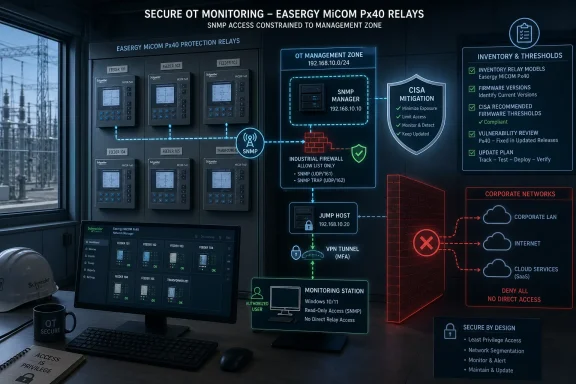
For this advisory, network segmentation should be concrete. Permit SNMP only from approved monitoring systems that have a documented operational need. Deny SNMP from business networks and general-purpose server ranges. Require remote users to land on controlled jump infrastructure rather than routing broadly into the control network. Log and review unexpected SNMP queries. Where possible, alert when new hosts attempt to query relay networks.
That is the exact support path operators should capture in the ticket, change request, or remediation plan: for no-SNMP environments, contact Schneider Electric Customer Care Center to upgrade firmware to a version without SNMP functionality. Do not merely write “disable SNMP” unless Schneider and site engineering confirm that is the right action for the installed relay and firmware path. The vendor guidance points to a firmware version without SNMP functionality, coordinated through Schneider support.
That is a notable remedy. It does not merely tune access control or change a password; it removes SNMP functionality through firmware for customers who can operate without it. That tells defenders something about the nature of the residual risk: if a monitoring protocol is unnecessary, the safest version of the feature is no feature at all.
For customers who choose not to apply that upgrade, Schneider says they should immediately use relays only in a protected network environment, use firewalls to protect and separate the control system network from other networks, and use VPN tunnels if remote access is required. For customers who require SNMP, Schneider gives the same immediate network mitigations: protected environment, firewalls, and VPN tunnels where remote access is necessary.
This is the right framing for OT. There are sites where SNMP may be deeply tied into monitoring and outage response workflows. Simply turning it off could degrade visibility, break alarm paths, or create a different operational risk. There are also sites where SNMP is enabled because it was once useful, never documented, and never retired. The advisory gives both kinds of customers a path.
The “no SNMP required” path should be attractive to sites that can validate it. A firmware version without SNMP functionality reduces future dependence on firewall correctness, ACL hygiene, and monitoring-tool behavior. Network controls are still necessary, but removing unnecessary protocol surface is cleaner than trusting every future firewall change not to reintroduce reachability.
The “SNMP required” path is more demanding. It means defenders must prove that the SNMP port is reachable only from systems that have a legitimate monitoring role. It also means watching for unexpected SNMP queries, not merely configuring a firewall once and assuming the diagram remains true.
2026-05-12 — Schneider Electric updated the risk associated with successful exploitation and revised the remediation table to a mitigation table to emphasize that multiple mitigation options are available.
CISA later published the Schneider Electric CPCERT advisory as ICSA-26-190-03.
That May 12 revision is easy to miss, but it is editorially important. A “remediation table” implies a fix path. A “mitigation table” implies a set of risk-reduction choices. In industrial environments, that language is not semantics; it reflects reality. Not every site can immediately change firmware, not every site can disable SNMP, and not every relay can be treated as a normal endpoint.
CISA publication raises the advisory’s visibility beyond Schneider’s own security notification page. That does not mean the vulnerability suddenly became worse when it appeared in the ICS advisory feed. It means the advisory became more visible to public-sector, critical-infrastructure, and security-operations audiences that track CISA ICS bulletins as part of vulnerability intake.
The gap between initial vendor release and public-sector visibility is also a reminder that mature OT vulnerability management cannot rely on one feed. If an organization only watches CISA, it may learn about some vendor advisories later than customers following vendor notifications directly. If it only watches vendors, it may miss the broader sector context CISA adds. The strongest programs monitor both.
An attacker who can query SNMP and identify Schneider Electric Easergy MiCOM Px40 devices gains a sharper picture of the site’s electrical protection landscape. That information can be correlated with network location, naming conventions, routing paths, firewall gaps, maintenance windows, and other discovered services. Even if CVE-2026-4832 does not alter device behavior, it can reduce the attacker’s uncertainty.
The CVSS vector’s low confidentiality impact is therefore not wrong; it is incomplete as a planning tool. CVSS measures a vulnerability in a standardized way. It does not know whether a relay is in a training lab, a manufacturing plant, a substation, a transportation facility, or a high-value energy environment. The advisory’s background section identifies critical infrastructure sectors and worldwide deployment context, which is why a medium severity rating still deserves serious triage.
There is also an institutional risk. If an organization discovers that relays expose identity data through SNMP to unauthenticated internal callers, it may reveal broader governance problems: weak segmentation, undocumented monitoring dependencies, overbroad firewall rules, or lack of protocol-level logging. The CVE may be the first symptom, not the underlying disease.
This is why the best response is not limited to asking, “Are we affected by CVE-2026-4832?” The better questions are: “Which control devices can be queried without authentication? Which management protocols cross zone boundaries? Which Windows servers or monitoring systems can reach relay networks? Which remote-access paths can reach them? What would we see if someone started enumerating them?”
Those questions should lead to evidence. Pull firewall policy exports. Review monitoring-platform configurations. Check switch and router ACLs. Confirm VPN split-tunnel and route behavior. Examine jump-host group membership. Look for SNMP traffic in network logs or packet captures where available. Compare observed traffic against the approved monitoring list. If the approved list does not exist, create it before the next advisory forces the same exercise again.
That fabric can either contain the risk or amplify it. If a Windows-based monitoring server is the only system permitted to query relay SNMP, and it sits in a well-controlled management zone, the exposure is bounded. If ordinary corporate endpoints, general server VLANs, or vendor remote-access hosts can reach relay SNMP, the exposure becomes a lateral-movement aid.
The same applies to identity. A relay may not authenticate the SNMP query path described in the advisory, but the systems that can reach the relay should be strongly governed. If the firewall rule says “management server can query relays,” then the management server becomes a high-value asset. Its local administrators, service accounts, remote-login policies, EDR coverage, backup integrity, and change history all matter.
OT security failures often look like network diagrams that were correct five years ago. A temporary vendor access rule becomes permanent. A monitoring subnet expands. A firewall object named “Engineering” quietly includes more hosts than intended. A Windows jump box accumulates tools and credentials. By the time an advisory arrives, the vulnerability is only one part of a larger trust problem.
For IT teams supporting OT, CVE-2026-4832 is a useful reason to audit management reachability. Do not stop at Schneider relays. Use the event to validate that business networks cannot reach control-system devices directly, that remote access terminates into controlled jump infrastructure, and that monitoring protocols are allowed by exception rather than inherited convenience.
Concrete Windows-side actions include reviewing membership in OT administration groups, checking whether monitoring servers are patched and hardened, confirming that RDP access is limited to approved administrators, validating that service accounts are not reused across business and OT environments, and ensuring that backups for engineering workstations and monitoring systems are protected from tampering. None of those steps fixes relay firmware, but each reduces the chance that a compromised Windows asset becomes the path to relay enumeration.
At the same time, “not internet-exposed” is not a complete defense. CISA’s recommendation to ensure control system devices are not accessible from the internet is the floor, not the ceiling. Many real intrusions begin with enterprise compromise and move inward. If a phishing incident, stolen VPN credential, unmanaged contractor laptop, or compromised server can reach OT monitoring paths, the internet boundary has already been bypassed.
This distinction matters for prioritization. Organizations should triage devices by both firmware status and network reachability. A relay below the relevant firmware threshold and reachable from a broad set of hosts deserves urgent containment. A relay below the threshold but reachable only from a hardened monitoring system still needs mitigation planning, but the immediate risk profile is different.
Likewise, a relay updated beyond the affected threshold should not become an excuse for bad segmentation. Firmware can remove this specific weakness, but it cannot repair an architecture that allows management protocols to cross from business networks into control zones without strict justification. Schneider’s and CISA’s recommendations repeatedly return to protected environments, firewalls, isolation, and VPNs because architecture determines blast radius.
The smart operational posture is layered. Reduce or remove SNMP where it is not needed. Constrain it where it is needed. Upgrade firmware where appropriate. Monitor for unexpected queries. Validate remote-access paths. Document the decision so the next audit does not rediscover the same uncertainty.
This is not a loophole to delay action. It is a mandate to do serious change management. If a site does not require SNMP, the path to firmware without SNMP functionality should be evaluated with Schneider support. If a site requires SNMP, firewall and network controls should be verified, not assumed. If remote access is required, VPN infrastructure should be current and the connected devices should be treated as part of the trust boundary.
The advisory also recommends physical controls, locked cabinets, disciplined programming-software use, and scanning mobile data exchange methods before use with isolated networks. Those points may look generic, but they speak to the same theme: OT security depends on controlling both digital and physical paths into systems that were not designed for casual exposure.
A vulnerability intake process that merely records CVE-2026-4832 as “medium, monitor” misses the operational accountability. Someone must own the asset list. Someone must own the network path. Someone must own the decision about SNMP. Someone must own the firmware plan. If nobody owns all four, the organization owns the risk by default.
For the third category, reduce reachability now. That may mean firewall changes, ACL tightening, VPN route review, disabling unused access paths, or limiting monitoring traffic to a small set of known systems. For the second category, preserve the current isolation and schedule the vendor-supported firmware path. For any no-SNMP environment, put Schneider’s Customer Care Center action directly into the remediation plan rather than leaving the ticket at “patch later.”
The forward-looking lesson is bigger than one CVE. Industrial environments accumulate management protocols, Windows administration paths, vendor access rules, and monitoring dependencies over long periods of time. CVE-2026-4832 is a medium-rated information-disclosure issue, but it asks a high-value architectural question: who can ask your protection relays what they are?
If the answer is “only the systems that truly need to know,” the advisory becomes a manageable firmware and documentation exercise. If the answer is “we are not sure,” this is the moment to find out.
 Quick Scope Check
| Easergy MiCOM family or model group | Affected firmware threshold |
|---|---|
| P14x | All versions prior to B4A |
| P24x | All versions prior to D3A |
| P341 | All versions prior to E3F |
| P342, P343, P344, P345 | All versions prior to B3F |
| P442, P444 | All versions prior to E3A |
| P443, P445, P446, P543, P544, P545, P546 | All versions prior to H6A |
| P841 | All versions prior to G6A |
| P643 | All versions prior to B3F |
| P642, P645 | All versions prior to B4A |
| P741, P742, P743 | All versions prior to B2A |
| P746 | All versions prior to B4E |
| P746 | All versions prior to C4E |
| P849 | All versions prior to B4A |
A Medium-Rated Bug in Equipment That Does Not Live in a Medium-Risk World
CISA’s advisory for CVE-2026-4832 lists the issue as a medium-severity vulnerability with a CVSS 3.1 base score of 5.3 and a vector of CVSS:3.1/AV:N/AC:L/PR:N/UI:N/S:U/C:L/I:N/A:N. In plain English, the scoring says the attack is network-reachable, low-complexity, requires no privileges, needs no user interaction, and affects confidentiality at a low level. That is why the number is not eye-popping.But industrial security has always been poorly served by treating the CVSS score as the whole story. The Easergy MiCOM Px40 line is a protection relay series used in Medium Voltage, High Voltage, and Extra High Voltage protection environments. These are not consumer routers forgotten under a desk; they are devices that help supervise and protect electrical systems, deployed in environments where uptime, safety, and operational confidence matter.
The advisory’s stated risk is narrow: failure to apply the mitigations may risk unauthorized exposure of basic device identification through the SNMP protocol. Schneider Electric and CISA are not saying that an attacker can remotely trip a relay, rewrite protection logic, or directly disrupt power flows through this CVE. The impact described is unauthorized access to sensitive device information when an unauthenticated attacker can interrogate the SNMP port.
That is still not nothing. In an operational technology network, basic device identification can be reconnaissance gold. It can tell an intruder what class of equipment exists, which family it belongs to, how a site may be segmented, and where a later-stage attacker should focus attention. In enterprise IT, a banner leak is often an inventory nuisance; in power and industrial environments, inventory can become a target map.
The harder truth is that SNMP is frequently treated as plumbing rather than exposure. It is useful, old, widely supported, and often inherited from years of monitoring practice. It is also exactly the sort of protocol that becomes dangerous when “monitoring” access is allowed to sprawl across network zones, jump hosts, vendor links, and management workstations.
The Vulnerability Is Simple; the Operational Context Is Not
Per Schneider Electric’s advisory, CVE-2026-4832 is a CWE-798 Use of Hard-coded Credentials vulnerability. The vulnerability exists when an unauthenticated attacker is able to interrogate the SNMP port, potentially causing unauthorized access to sensitive device information. Schneider Electric CPCERT reported the issue to CISA, and CISA published the vendor advisory through its ICS advisory channel.MITRE’s description of CWE-798, which classifies use of hard-coded credentials, is broader than this one Schneider case. Hard-coded credentials can be passwords, keys, or other embedded secrets used for inbound authentication, outbound communication, or internal protection. In the Schneider advisory, the described consequence is not full administrative compromise; it is unauthorized access to sensitive device information through SNMP interrogation.
That narrower impact should shape the response. This is not a reason to panic-shutdown relay networks or rush untested firmware into substations on a Friday afternoon. It is a reason to ask whether SNMP should be enabled, who can reach it, whether monitoring paths are properly constrained, and whether current firmware levels sit below Schneider’s affected-version thresholds.
In OT, security work must respect change control. Protection relays are not patched like browsers. Firmware updates may require outage planning, vendor coordination, engineering validation, backup of device configurations, regression testing, spare-device availability, and rollback preparation. The right response is therefore not “patch everything immediately” in the casual IT sense; it is identify exposure immediately, constrain reachable management paths immediately, and plan firmware changes deliberately.
The operating question for asset owners is simple: can an unauthenticated user, compromised workstation, vendor laptop, monitoring server, jump host, or routed subnet interrogate the SNMP port on an affected relay? If the answer is yes, the immediate task is containment. If the answer is unknown, the immediate task is discovery. If the answer is no, the next task is documented verification and firmware planning.
Schneider’s Product Matrix Shows Why Asset Inventory Is the Real First Step
The affected list is broad across the Easergy MiCOM Px40 family, and that breadth creates the first practical problem: many organizations will not know from a central CMDB exactly which relay variant and firmware branch is installed in each bay, panel, or remote site. OT asset records often lag reality, especially where relay installations predate current cybersecurity governance, were inherited through acquisition, or were installed under earlier engineering standards.Relay families persist for years, sometimes across multiple ownership, support, and modernization cycles. A site may have newer engineering workstations and monitoring servers while still depending on relay hardware installed under a different network philosophy. That mismatch is where advisory response often breaks down. Security teams may have vulnerability-tracking workflows, but engineering teams may hold the only reliable device records.
The affected-version matrix in the advisory is therefore the key operational artifact. It does not name one product build; it names a series of relay families and version thresholds. Any asset below the applicable threshold is known affected. Any asset whose model or firmware cannot be confirmed should be treated as an unresolved exposure item until verified.
This is where Windows administrators may find themselves unexpectedly relevant. Many OT environments still rely on Windows-based engineering workstations, historian servers, monitoring consoles, domain services, jump boxes, backup tooling, and remote-access platforms. Even when the vulnerable product is not Windows, the route to it often runs through Windows-managed networks and identities. A relay reachable only from a tightly controlled engineering station is a different risk than a relay reachable from a broad corporate monitoring VLAN.
The practical first step is not scanning the internet for Schneider relays. It is building a defensible internal map: which Easergy MiCOM Px40 units exist, which firmware versions they run, whether SNMP is enabled, and which systems can query the SNMP port. Without that map, the advisory becomes another PDF in a compliance folder. With it, the organization can separate genuine exposure from theoretical exposure.
A useful inventory record should include the relay model group, firmware version, serial or asset identifier, physical location, electrical function, network interface details, management VLAN or zone, SNMP status, permitted SNMP managers, remote-access dependencies, responsible engineering owner, and next planned maintenance window. That may sound like more detail than a vulnerability ticket usually carries, but for protection relays it is the difference between informed mitigation and guesswork.
SNMP Turns Device Identity Into a Network Boundary Test
SNMP has a way of making security conversations uncomfortable because it sits at the intersection of convenience and habit. Operations teams like it because it enables monitoring, status collection, and integration with existing tools. Attackers like management protocols because they often reveal what a network contains before any overt exploitation begins.Schneider’s advisory is specific: the risk is unauthorized exposure of basic device identification through SNMP. That phrasing may sound modest, but “basic” information can still answer operationally sensitive questions. Which relay family is present? Which firmware line is running? Which network segment contains protection assets? Which monitoring path crosses from one zone to another? In a segmented OT network, even learning that a device exists in a particular enclave can be useful.
The vulnerability condition is also telling: an unauthenticated attacker must be able to interrogate the SNMP port. The word “able” carries the real architectural burden. If the SNMP port is reachable from an attacker-controlled position, the security model has already allowed a monitoring path to become a reconnaissance path. If it is reachable from the internet, the network architecture has failed far beyond this CVE.
Operators should therefore verify reachability rather than assume it. Start from the documented monitoring hosts and confirm they are the only systems with permitted SNMP access. Review firewall rules, router ACLs, VPN routes, jump-host permissions, and any temporary vendor access rules. Confirm whether SNMP is reachable from corporate user networks, server networks, wireless networks, remote-access pools, engineering laptops, or third-party maintenance paths. If it is, restrict it.
CISA’s general recommendations are therefore not decorative boilerplate. Minimize network exposure for all control system devices and systems, ensure they are not accessible from the internet, locate control system networks and remote devices behind firewalls, isolate them from business networks, and use more secure methods such as VPNs when remote access is required. Those recommendations appear in advisory after advisory because they are the difference between a CVE being a local maintenance item and a live exposure.
The advisory also includes the caution that VPNs may have vulnerabilities and should be kept current, and that a VPN is only as secure as the connected devices. That is the sentence many organizations still underweight. A VPN does not magically transform a vendor laptop, shared admin account, unmanaged home PC, or over-permissive jump server into a trusted endpoint. It merely moves the perimeter.
For this advisory, network segmentation should be concrete. Permit SNMP only from approved monitoring systems that have a documented operational need. Deny SNMP from business networks and general-purpose server ranges. Require remote users to land on controlled jump infrastructure rather than routing broadly into the control network. Log and review unexpected SNMP queries. Where possible, alert when new hosts attempt to query relay networks.
The Mitigation Split Is the Story’s Most Important Detail
Schneider Electric’s mitigation guidance divides customers into two practical groups: those who do not require SNMP and those who do. That distinction is more useful than the usual all-purpose “apply updates” language because it forces a business-function decision. If SNMP is not required, Schneider says customers should contact Schneider Electric’s Customer Care Center to upgrade the firmware to a version without SNMP functionality.That is the exact support path operators should capture in the ticket, change request, or remediation plan: for no-SNMP environments, contact Schneider Electric Customer Care Center to upgrade firmware to a version without SNMP functionality. Do not merely write “disable SNMP” unless Schneider and site engineering confirm that is the right action for the installed relay and firmware path. The vendor guidance points to a firmware version without SNMP functionality, coordinated through Schneider support.
That is a notable remedy. It does not merely tune access control or change a password; it removes SNMP functionality through firmware for customers who can operate without it. That tells defenders something about the nature of the residual risk: if a monitoring protocol is unnecessary, the safest version of the feature is no feature at all.
For customers who choose not to apply that upgrade, Schneider says they should immediately use relays only in a protected network environment, use firewalls to protect and separate the control system network from other networks, and use VPN tunnels if remote access is required. For customers who require SNMP, Schneider gives the same immediate network mitigations: protected environment, firewalls, and VPN tunnels where remote access is necessary.
This is the right framing for OT. There are sites where SNMP may be deeply tied into monitoring and outage response workflows. Simply turning it off could degrade visibility, break alarm paths, or create a different operational risk. There are also sites where SNMP is enabled because it was once useful, never documented, and never retired. The advisory gives both kinds of customers a path.
The “no SNMP required” path should be attractive to sites that can validate it. A firmware version without SNMP functionality reduces future dependence on firewall correctness, ACL hygiene, and monitoring-tool behavior. Network controls are still necessary, but removing unnecessary protocol surface is cleaner than trusting every future firewall change not to reintroduce reachability.
The “SNMP required” path is more demanding. It means defenders must prove that the SNMP port is reachable only from systems that have a legitimate monitoring role. It also means watching for unexpected SNMP queries, not merely configuring a firewall once and assuming the diagram remains true.
The Timeline Shows a Vendor Advisory Becoming a Public ICS Signal
The timeline here is short but revealing. Schneider Electric’s advisory began in April, changed in May, and then appeared through CISA’s ICS advisory channel. The May revision matters because it changed both the risk description and the way the remediation table was framed.Timeline
2026-04-14 — Schneider Electric’s advisory was initially released as the original release.2026-05-12 — Schneider Electric updated the risk associated with successful exploitation and revised the remediation table to a mitigation table to emphasize that multiple mitigation options are available.
CISA later published the Schneider Electric CPCERT advisory as ICSA-26-190-03.
That May 12 revision is easy to miss, but it is editorially important. A “remediation table” implies a fix path. A “mitigation table” implies a set of risk-reduction choices. In industrial environments, that language is not semantics; it reflects reality. Not every site can immediately change firmware, not every site can disable SNMP, and not every relay can be treated as a normal endpoint.
CISA publication raises the advisory’s visibility beyond Schneider’s own security notification page. That does not mean the vulnerability suddenly became worse when it appeared in the ICS advisory feed. It means the advisory became more visible to public-sector, critical-infrastructure, and security-operations audiences that track CISA ICS bulletins as part of vulnerability intake.
The gap between initial vendor release and public-sector visibility is also a reminder that mature OT vulnerability management cannot rely on one feed. If an organization only watches CISA, it may learn about some vendor advisories later than customers following vendor notifications directly. If it only watches vendors, it may miss the broader sector context CISA adds. The strongest programs monitor both.
Why “Basic Device Identification” Still Belongs in a Threat Model
Security teams sometimes underrate information disclosure because it is not destructive by itself. That habit comes from enterprise environments where exposed version banners, service names, and hostnames are common and triaged behind remote-code-execution flaws. In ICS, information disclosure can be more strategically useful because attackers may know less about the target environment at the start.An attacker who can query SNMP and identify Schneider Electric Easergy MiCOM Px40 devices gains a sharper picture of the site’s electrical protection landscape. That information can be correlated with network location, naming conventions, routing paths, firewall gaps, maintenance windows, and other discovered services. Even if CVE-2026-4832 does not alter device behavior, it can reduce the attacker’s uncertainty.
The CVSS vector’s low confidentiality impact is therefore not wrong; it is incomplete as a planning tool. CVSS measures a vulnerability in a standardized way. It does not know whether a relay is in a training lab, a manufacturing plant, a substation, a transportation facility, or a high-value energy environment. The advisory’s background section identifies critical infrastructure sectors and worldwide deployment context, which is why a medium severity rating still deserves serious triage.
There is also an institutional risk. If an organization discovers that relays expose identity data through SNMP to unauthenticated internal callers, it may reveal broader governance problems: weak segmentation, undocumented monitoring dependencies, overbroad firewall rules, or lack of protocol-level logging. The CVE may be the first symptom, not the underlying disease.
This is why the best response is not limited to asking, “Are we affected by CVE-2026-4832?” The better questions are: “Which control devices can be queried without authentication? Which management protocols cross zone boundaries? Which Windows servers or monitoring systems can reach relay networks? Which remote-access paths can reach them? What would we see if someone started enumerating them?”
Those questions should lead to evidence. Pull firewall policy exports. Review monitoring-platform configurations. Check switch and router ACLs. Confirm VPN split-tunnel and route behavior. Examine jump-host group membership. Look for SNMP traffic in network logs or packet captures where available. Compare observed traffic against the approved monitoring list. If the approved list does not exist, create it before the next advisory forces the same exercise again.
The Windows Angle Is the Path, Not the Product
This is not a Windows vulnerability. No Microsoft build, patch, or Windows feature is implicated by the Schneider advisory. But for WindowsForum readers, the connection is still practical because Windows is often the administrative fabric around OT assets: engineering laptops, Active Directory domains, monitoring dashboards, backup servers, remote desktop hosts, VPN clients, patch-management systems, and security tooling.That fabric can either contain the risk or amplify it. If a Windows-based monitoring server is the only system permitted to query relay SNMP, and it sits in a well-controlled management zone, the exposure is bounded. If ordinary corporate endpoints, general server VLANs, or vendor remote-access hosts can reach relay SNMP, the exposure becomes a lateral-movement aid.
The same applies to identity. A relay may not authenticate the SNMP query path described in the advisory, but the systems that can reach the relay should be strongly governed. If the firewall rule says “management server can query relays,” then the management server becomes a high-value asset. Its local administrators, service accounts, remote-login policies, EDR coverage, backup integrity, and change history all matter.
OT security failures often look like network diagrams that were correct five years ago. A temporary vendor access rule becomes permanent. A monitoring subnet expands. A firewall object named “Engineering” quietly includes more hosts than intended. A Windows jump box accumulates tools and credentials. By the time an advisory arrives, the vulnerability is only one part of a larger trust problem.
For IT teams supporting OT, CVE-2026-4832 is a useful reason to audit management reachability. Do not stop at Schneider relays. Use the event to validate that business networks cannot reach control-system devices directly, that remote access terminates into controlled jump infrastructure, and that monitoring protocols are allowed by exception rather than inherited convenience.
Concrete Windows-side actions include reviewing membership in OT administration groups, checking whether monitoring servers are patched and hardened, confirming that RDP access is limited to approved administrators, validating that service accounts are not reused across business and OT environments, and ensuring that backups for engineering workstations and monitoring systems are protected from tampering. None of those steps fixes relay firmware, but each reduces the chance that a compromised Windows asset becomes the path to relay enumeration.
Affected Does Not Mean Exposed, and Unexposed Does Not Mean Done
The advisory labels the listed products as known affected, but that does not mean every affected relay is exploitable from a meaningful attacker position. Exposure depends on whether SNMP is enabled, whether the SNMP port is reachable, and where an attacker would have to be to interrogate it. A vulnerable relay in a physically isolated lab is not the same as a vulnerable relay reachable from a flat corporate network.At the same time, “not internet-exposed” is not a complete defense. CISA’s recommendation to ensure control system devices are not accessible from the internet is the floor, not the ceiling. Many real intrusions begin with enterprise compromise and move inward. If a phishing incident, stolen VPN credential, unmanaged contractor laptop, or compromised server can reach OT monitoring paths, the internet boundary has already been bypassed.
This distinction matters for prioritization. Organizations should triage devices by both firmware status and network reachability. A relay below the relevant firmware threshold and reachable from a broad set of hosts deserves urgent containment. A relay below the threshold but reachable only from a hardened monitoring system still needs mitigation planning, but the immediate risk profile is different.
Likewise, a relay updated beyond the affected threshold should not become an excuse for bad segmentation. Firmware can remove this specific weakness, but it cannot repair an architecture that allows management protocols to cross from business networks into control zones without strict justification. Schneider’s and CISA’s recommendations repeatedly return to protected environments, firewalls, isolation, and VPNs because architecture determines blast radius.
The smart operational posture is layered. Reduce or remove SNMP where it is not needed. Constrain it where it is needed. Upgrade firmware where appropriate. Monitor for unexpected queries. Validate remote-access paths. Document the decision so the next audit does not rediscover the same uncertainty.
Advisory Language Does Not Transfer Accountability Away From Operators
Vendor and government advisories can identify affected products, describe known impacts, and recommend mitigations, but asset owners still have to apply those recommendations safely in their own environments. In industrial settings, the wrong mitigation can be harmful if deployed without impact analysis. CISA commonly reminds organizations to perform proper impact analysis and risk assessment before deploying defensive measures, and that advice is particularly relevant for protection equipment.This is not a loophole to delay action. It is a mandate to do serious change management. If a site does not require SNMP, the path to firmware without SNMP functionality should be evaluated with Schneider support. If a site requires SNMP, firewall and network controls should be verified, not assumed. If remote access is required, VPN infrastructure should be current and the connected devices should be treated as part of the trust boundary.
The advisory also recommends physical controls, locked cabinets, disciplined programming-software use, and scanning mobile data exchange methods before use with isolated networks. Those points may look generic, but they speak to the same theme: OT security depends on controlling both digital and physical paths into systems that were not designed for casual exposure.
A vulnerability intake process that merely records CVE-2026-4832 as “medium, monitor” misses the operational accountability. Someone must own the asset list. Someone must own the network path. Someone must own the decision about SNMP. Someone must own the firmware plan. If nobody owns all four, the organization owns the risk by default.
Admin Checklist
- Inventory all Schneider Electric Easergy MiCOM Px40 relays and record exact model groups and firmware versions against Schneider’s affected-version thresholds.
- For every relay in scope, record physical location, responsible engineering owner, network zone, IP address, management path, and whether the device supports or uses SNMP in the current operating design.
- Determine whether SNMP is enabled and whether each site actually requires SNMP for monitoring or operations. Do not assume that enabled means required.
- Verify SNMP reachability from the network, not just from documentation. Confirm which monitoring servers, engineering workstations, jump hosts, VPN pools, vendor access paths, and business networks can reach the SNMP port.
- If SNMP is reachable from general corporate networks, remote-access pools, ordinary user endpoints, broad server VLANs, or undocumented hosts, treat that as an immediate segmentation issue and restrict access.
- For environments that do not require SNMP, contact Schneider Electric Customer Care Center to upgrade firmware to a version without SNMP functionality.
- For environments that require SNMP, keep relays in a protected network environment and permit SNMP only from explicitly approved monitoring systems.
- Use firewalls or equivalent access controls to separate the control system network from other networks. Rules should be specific by source, destination, protocol, and operational purpose.
- If remote access is required, use VPN tunnels or another secure remote-access architecture, keep remote-access infrastructure updated, and remember that the connected endpoint becomes part of the trust boundary.
- Review whether VPN users, vendor accounts, jump hosts, and engineering laptops have broader network reach than their job requires. Remove inherited or temporary access that is no longer justified.
- Confirm that Windows-based monitoring servers, engineering workstations, and jump boxes with access to relay networks are hardened, patched, backed up, monitored, and limited to approved administrators.
- Log or monitor SNMP traffic where feasible. At minimum, know which hosts should be querying relays and investigate queries from anything else.
- Back up relay configurations and relevant engineering workstation data before firmware work. Confirm that backups are restorable and protected from unauthorized modification.
- Plan firmware upgrades through OT change control. Include engineering review, vendor coordination if needed, maintenance-window planning, operational impact analysis, rollback steps, and post-change validation.
- Prioritize remediation by combining firmware status and reachability. A below-threshold relay reachable from many hosts deserves faster containment than a below-threshold relay accessible only from a tightly controlled monitoring host.
- Document the final decision for each relay: upgraded to a non-SNMP firmware path, retained with SNMP and protected by network controls, scheduled for future firmware work, or removed from service.
- Revisit firewall and monitoring rules after the immediate response. The goal is not just to close this advisory; it is to prevent management protocols from silently expanding across OT boundaries again.
What Operators Should Do Next
The most useful next step is a short, disciplined exposure review. Start with the affected firmware table, not with assumptions about product naming. Identify every Easergy MiCOM Px40 relay, confirm its firmware, and decide whether it is below the relevant threshold. Then determine whether SNMP is enabled and reachable. That gives the organization three practical categories: not affected by threshold, affected but not meaningfully reachable, and affected with reachable SNMP exposure.For the third category, reduce reachability now. That may mean firewall changes, ACL tightening, VPN route review, disabling unused access paths, or limiting monitoring traffic to a small set of known systems. For the second category, preserve the current isolation and schedule the vendor-supported firmware path. For any no-SNMP environment, put Schneider’s Customer Care Center action directly into the remediation plan rather than leaving the ticket at “patch later.”
The forward-looking lesson is bigger than one CVE. Industrial environments accumulate management protocols, Windows administration paths, vendor access rules, and monitoring dependencies over long periods of time. CVE-2026-4832 is a medium-rated information-disclosure issue, but it asks a high-value architectural question: who can ask your protection relays what they are?
If the answer is “only the systems that truly need to know,” the advisory becomes a manageable firmware and documentation exercise. If the answer is “we are not sure,” this is the moment to find out.
References
- Primary source: CISA
Published: 2026-07-09T12:00:00+00:00
Loading…
www.cisa.gov - Related coverage: se.com
Loading…
www.se.com - Related coverage: iportal2.schneider-electric.com
Loading…
iportal2.schneider-electric.com - Related coverage: download.schneider-electric.com
Loading…
download.schneider-electric.com