

Canonical Managed Kubeflow landed on Microsoft Azure in an article published July 9, 2026, positioning Canonical’s fully managed Kubeflow service as an Azure Marketplace deployment that runs entirely inside the customer’s own cloud tenancy. The pitch is not merely “Kubeflow, but easier.” It is a bet that enterprises want open-source MLOps without inheriting the operational blast radius of running Kubeflow themselves. For Windows and Azure-centric IT shops, the important detail is the one buried under the launch gloss: Canonical wants to manage the hard parts while keeping data, models, and training workloads out of Canonical’s hands.
That distinction matters because Kubeflow has always been both enticing and exhausting. It promises a portable machine-learning control plane built on Kubernetes, with pipelines, notebooks, hyperparameter tuning, dashboards, and metadata tracking. But in practice, the same modularity that makes Kubeflow powerful has also made it a second platform inside the first one: Kubernetes underneath, Istio in the middle, ML workflows above, and a queue of upgrades, storage claims, identity mappings, and GPU scheduling problems waiting for whoever volunteered to “just install Kubeflow.”
Canonical’s Azure launch is therefore best understood as a sovereignty-and-operations play, not a simple marketplace listing. The company is saying that customers should be able to keep the architectural benefits of upstream Kubeflow, run the service inside their Azure tenancy, integrate with Microsoft Entra ID and role-based access controls from launch, and still hand off backups, upstream fixes, security patches, and version migrations. If Canonical can deliver that consistently, it may remove one of the biggest reasons enterprises choose narrower proprietary MLOps platforms: not features, but fear of operating the open-source alternative.
Kubeflow’s central bargain has always been attractive to engineering leaders: put machine-learning workflows on Kubernetes, use open-source components, and avoid tying the organization’s model lifecycle to a single cloud’s proprietary AI stack. The problem is that the bargain has often been presented as if “cloud native” means “operationally simple.” Anyone who has run a serious Kubernetes estate knows that the opposite can be true.
The Register’s July 9 partner article, contributed by Canonical, frames the issue as a “day two” trap. That is the right lens. Building a Kubeflow environment is not the same as operating one through upstream changes, certificate problems, service-mesh routing, storage bottlenecks, and security patches. The first demo gets applause; the third upgrade window gets a war room.
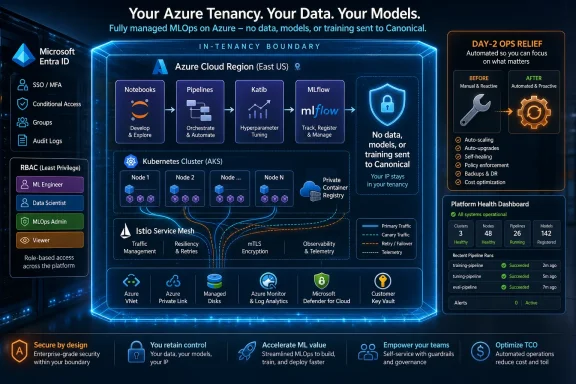
Canonical’s answer is Canonical Managed Kubeflow on Microsoft Azure: a fully managed service that runs entirely inside the customer’s cloud tenancy. Canonical says no data, no models, and no training workloads are ever sent to Canonical. That is the kind of sentence procurement teams, CISOs, and platform owners immediately circle, because it tries to separate managed operations from data custody.
The company is also careful to stress that the service is built on pure upstream Kubeflow. That matters because “managed open source” sometimes turns into “open-source-shaped proprietary platform” after enough vendor glue is added. Canonical’s claim is that customers are not buying a dead-end fork; they are buying managed operations around a portable Kubeflow architecture.
The pitch fits a broader enterprise mood. AI teams want faster access to training infrastructure, experiment tracking, fine-tuning pipelines, and batch scoring. IT teams want identity integration, patching discipline, budget control, and audit trails. Legal and compliance teams want data and model sovereignty. Canonical is trying to turn those competing demands into one answer: managed service, inside your tenancy, upstream architecture.
That is a sharper proposition than “we host Kubeflow for you.” Hosting would be easy to understand and hard to approve. In-tenancy management is messier to explain, but more plausible for regulated organizations that cannot casually move datasets, weights, or training jobs outside their established cloud boundary.
Each of those components is useful. Katib supports automated tuning workflows. Pipelines turns ML processes into repeatable workflows. Notebooks gives data scientists interactive environments. Central Dashboard becomes the front door for the platform. The issue is that useful components do not automatically combine into a low-maintenance platform.
A platform team deploying Kubeflow is implicitly accepting responsibility for multiple release cadences, dependency graphs, configuration surfaces, and failure modes. A dashboard failure is one problem. A pipeline orchestration failure is another. A storage latency issue affecting notebooks is another. A service-mesh misconfiguration that breaks multi-tenancy or routing can look like an application outage until someone traces it down through the Kubernetes layer.
Canonical’s article points directly at Istio as a major source of operational friction. Kubeflow leans on Istio for routing, multi-tenancy, and security. That means a Kubeflow operator may need to understand ingress behavior, TLS certificates, virtual services, authentication flows, and the way traffic policy interacts with user namespaces. These are not incidental details; they are the platform.
The second structural problem is change. Kubeflow moves with the open-source ecosystem around it, and that ecosystem includes Kubernetes APIs, controllers, storage integrations, and the component projects Kubeflow depends on. Upgrading from one version to the next is not guaranteed to be a neat package-manager exercise. A small deprecation in the wrong layer can become a broken machine-learning workflow in production.
The third problem is workload shape. Machine learning is not just another stateless web app. Training jobs can demand GPUs, high-throughput storage, large temporary compute bursts, and reliable access to persistent data. Notebooks need volumes. Pipelines need artifacts and metadata. Training runs need scheduling that does not strand expensive accelerators. The MLOps platform inherits the hard parts of both Kubernetes and data infrastructure.
This is why Kubeflow has often landed awkwardly inside enterprises. Data scientists see a platform for reproducible ML workflows. Platform engineers see a complex distributed system. Finance sees idle GPUs. Security sees another multi-tenant control plane. Compliance sees a new place where datasets, parameters, and model versions need to be tracked. Everyone is looking at the same tool and seeing a different risk.
Canonical’s managed service is designed to collapse those risks into a service contract. That does not make the complexity vanish. It moves the operational center of gravity from the customer’s backlog to Canonical’s managed-services team.
The Azure Marketplace route also changes the internal sale. A platform engineering lead asking for time to build Kubeflow is asking for people, clusters, testing cycles, documentation, and ongoing operations. A team procuring a managed Azure Marketplace service is asking for a defined service path. Those are very different conversations with finance and security.
Canonical says customers can launch a first production-ready cluster in less than 30 minutes directly from the Azure Marketplace. That should be read carefully. Less than 30 minutes does not mean an enterprise has solved data governance, model risk, cost management, GPU quota planning, or production release discipline in half an hour. It means the platform bootstrap problem is being compressed enough that teams can start evaluating workflows instead of spending the first sprint wrestling infrastructure into shape.
That matters because MLOps projects often die in the swamp between “proof of concept” and “repeatable production path.” Data scientists may have models ready to test. Application teams may have use cases waiting. But the infrastructure team is still working through identity, ingress, persistent volumes, logging, patch windows, and upgrade strategy. The longer that gap persists, the more likely teams are to fall back to bespoke scripts, local notebooks, or cloud-specific services that solve the immediate problem while creating longer-term lock-in.
Canonical’s Azure service tries to offer another path: keep the open-source workflow layer, but stop making the customer become the Kubeflow operations team. The in-tenancy claim is the hinge. If the service runs entirely in the customer’s cloud tenancy, then the customer can argue that its data perimeter remains intact even while Canonical handles operational tasks.
That is especially important for organizations standardizing around Microsoft Entra ID. Canonical says the service integrates with enterprise identity management, including Microsoft Entra ID, and role-based access controls right from launch. For IT administrators, that means the platform can be treated as part of the enterprise access-control fabric rather than a standalone island of accounts and permissions.
Identity integration is not glamorous, but it is often the difference between a pilot and a deployable service. Machine-learning platforms handle sensitive datasets, derived features, model weights, training logs, and outputs that can leak business logic. If access control is not tied into enterprise identity from the start, the platform becomes another exception that security teams eventually have to unwind.
A managed service normally creates a trust question. Who can see the data? Where do logs go? Are models copied into vendor-controlled infrastructure? Are training workloads executed outside the customer’s cloud account? Are artifacts replicated somewhere for support? Canonical’s wording is designed to answer those questions before they become blockers.
For compliance teams, “100 percent in-tenancy” is not marketing fluff. It is the claim that the underlying data, source code, and custom weights never leave the customer’s perimeter. That can simplify internal reviews for industries where training data is regulated, commercially sensitive, or subject to jurisdictional rules. It also helps organizations that are still forming policies around generative AI model weights and fine-tuning datasets.
But in-tenancy does not remove every governance obligation. Customers still need to define who can create notebooks, who can run pipelines, who can access datasets, who can launch GPU-heavy jobs, and who can promote a model artifact toward production. A managed Kubeflow service can provide the platform controls; it cannot decide the organization’s model governance policy.
The same applies to logs and metadata. Canonical’s source material says the included MLflow server automatically logs every dataset version, hyperparameter choice, and model version. That is valuable because reproducibility and auditability are chronic weaknesses in ad hoc machine-learning programs. But a metadata trail is only useful if teams treat it as a system of record rather than an afterthought.
This is where Canonical’s managed service could have its largest practical effect. By making MLflow part of the managed environment, Canonical is not just offering training orchestration. It is nudging customers toward a more disciplined model lifecycle in which experiments, datasets, parameters, and versions are captured as part of normal workflow execution.
For fraud detection, that audit trail is not optional theater. For churn and demand forecasting, it can explain why a model behaved differently after a retraining run. For predictive maintenance, it can tie changing sensor patterns to model updates. For generative AI fine-tuning, it can help teams understand which dataset and hyperparameter choices produced a given model version.
That is a meaningful argument, but it should not be oversold. Upstream Kubeflow can make workflows more portable than a platform built entirely around one cloud provider’s proprietary ML service. But real portability includes data locations, storage classes, network assumptions, identity mappings, accelerator availability, cost models, and operational runbooks. The pipeline definition is only one piece of the migration puzzle.
Still, upstream compatibility matters. Enterprises have spent the last few years learning that “AI platform” can become another form of cloud gravity. Once data scientists build pipelines around a vendor-specific interface, once model metadata lives in a proprietary registry, and once deployment workflows depend on a specific service, moving becomes expensive. Even when the code can be exported, the operating model often cannot.
Canonical’s bet is that customers want a middle road. They want managed operations, but not a proprietary MLOps cul-de-sac. They want the option to run on Azure today, on-premises OpenStack where required, and additional public clouds later. Whether that becomes true portability will depend on how much of the customer’s workflow remains standard Kubeflow and how much becomes wrapped in environment-specific integration.
The most interesting part is that Canonical is not promising to make Kubernetes irrelevant. It is promising to make Kubernetes less visible to the data science workflow and less punishing for the platform team. That is a more credible promise. Kubernetes remains the substrate; Kubeflow remains the ML control plane; Canonical becomes the operator responsible for keeping the machinery aligned.
This table exposes the real trade. DIY Kubeflow maximizes internal control but also maximizes internal responsibility. Canonical Managed Kubeflow on Azure attempts to preserve the control boundary while outsourcing the undifferentiated operations. The on-premises OpenStack angle gives Canonical a hybrid story that cloud-only MLOps services cannot easily match.
That hybrid story is likely to matter more as AI programs mature. Early AI projects often optimize for speed. Mature AI programs optimize for repeatability, governance, cost control, and workload placement. Some training may sit comfortably in Azure. Some workloads may need to remain closer to on-premises data. Some future deployments may follow procurement, latency, or sovereignty requirements into other public clouds.
Canonical’s challenge will be proving that its management layer does not become its own form of dependency. Customers may accept vendor dependence for operations if the workload definitions and architecture remain portable. They will be less forgiving if “upstream Kubeflow” becomes true only in the abstract while day-to-day usage relies on Canonical-specific assumptions.
On the generative AI side, Canonical names distributed pre-training, targeted fine-tuning, and model distillation. These are exactly the kinds of workloads that punish weak platform engineering. Distributed pre-training requires coordinated compute, networking, provisioning, and fault tolerance. Fine-tuning jobs can consume expensive accelerators intensely and then leave capacity idle if automation does not scale down cleanly. Distillation creates multi-stage workflows where tracking the relationship between teacher models, student models, metrics, and artifacts matters.
The mention of LoRA and PEFT is important because it grounds the service in the current practical pattern of enterprise GenAI. Most organizations are not training frontier models from scratch. They are adapting models, refining them against internal data, and trying to do so without turning every experiment into a bespoke infrastructure project. A Kubeflow pipeline that can ingest data, run a fine-tuning job, and scale capacity back down is an operations-control mechanism as much as a developer convenience.
Model distillation adds another layer. Compressing larger models into smaller production-ready versions is not a one-step act. It involves experiments, comparisons, validation, and repeatable metrics. Canonical’s integrated MLflow server matters here because teams need to compare training results and keep a history of what was done. Without that record, model optimization becomes folklore.
Traditional machine-learning workloads are less fashionable but often more operationally mature. Canonical names predictive maintenance, fraud detection, and churn and demand forecasting. These are not lab curiosities. They are the sorts of systems where drift, retraining, auditability, and batch throughput affect revenue, risk, or operational continuity.
Predictive maintenance depends on changing streams of IoT and time-series data. Fraud detection requires an evidentiary trail that can stand up to compliance scrutiny. Churn and demand forecasting may require temporary compute scale to process millions of rows, followed by teardown to control cloud spend. These workloads benefit from boring reliability more than novelty.
That is the paradox of enterprise AI infrastructure in 2026: the glamorous workloads need discipline, and the boring workloads need modernization. A managed Kubeflow service on Azure is useful only if it can serve both. If it becomes merely a sandbox for GenAI experiments, it will disappoint the platform teams Canonical is courting. If it can host repeatable traditional ML pipelines and newer fine-tuning workflows under one governed operating model, it becomes far more strategic.
For WindowsForum’s audience, this is the most familiar part of the story. Microsoft shops have spent years pulling applications into centralized identity and access governance. The same pressure now applies to AI and ML platforms. A data scientist’s notebook is not just a workspace; it can become a route to sensitive data. A pipeline is not just automation; it can transform source data into model artifacts. A model version is not just an output; it may encode commercially sensitive behavior.
Role-based access control matters because Kubeflow is multi-user by design. Different teams may need separate namespaces, different permissions, and different resource quotas. Admins need to know who can create workloads, who can modify contributors, and who can access the artifacts produced by a run. If those controls are detached from enterprise identity, they become another place for drift.
The managed-service framing helps here because identity integration is not a one-time checkbox. It has to survive upgrades, configuration changes, user lifecycle events, and policy shifts. If Canonical is handling version migrations and upstream fixes, it also has to preserve the assumptions that make Entra ID and role-based controls reliable in the customer’s environment.
The risk is not that Canonical lacks awareness of identity. The risk is that AI teams often move faster than governance teams. A platform that can be deployed in less than 30 minutes can also be misused quickly if organizations treat deployment speed as permission to skip policy design. The right interpretation is that Canonical may reduce the infrastructure lead time; it does not eliminate the need to define access boundaries before workloads arrive.
A direct Marketplace path means Canonical’s service can be evaluated through existing Azure purchasing motions. That can shorten the distance between platform evaluation and production pilot, especially in organizations where new vendor onboarding is slower than cloud-service procurement. It also positions Canonical alongside other cloud-native services that Azure customers already review through central governance.
But Marketplace convenience cuts both ways. Easy procurement can produce shadow platforms if central IT is not involved. A business unit may see “managed Kubeflow,” launch quickly, and only later discover that data classification, budget alerts, identity scoping, model registry policy, and incident response were not ready. The service’s in-tenancy model helps, but it does not automatically align the deployment with enterprise operating standards.
For admins, the right move is to treat the listing as a fast entry point, not a substitute for architecture review. The questions are straightforward: Which tenancy? Which identities? Which datasets? Which network boundaries? Which teams? Which workloads? Which cost controls? Which model approval process? A managed service answers “who patches Kubeflow,” not “who owns model risk.”
That distinction is especially important because Canonical is targeting both generative AI and traditional ML. A fine-tuning experiment can be politically exciting and technically immature. A fraud detection pipeline can be boring and business-critical. Putting both onto the same platform without policy separation is an avoidable mistake.
But managed does not mean unmanaged by the customer. It means the customer’s responsibilities shift upward. Instead of debugging every operator upgrade, admins should be defining platform guardrails, cost controls, identity policy, and workload onboarding processes. Instead of hand-tuning every storage integration, they should be deciding which datasets belong in which workflows and how model artifacts are approved.
This is a healthier division of labor. Canonical should be better at managing Kubeflow internals than a general enterprise platform team that touches the stack only during incidents. The customer should be better at deciding who may use which data and which model outputs can affect business decisions. Managed Kubeflow is most valuable when each side handles the work it is structurally best positioned to do.
The danger is that organizations interpret “zero operational overhead” too literally. There is no such thing as zero overhead for a production ML platform. There is only overhead that is automated, outsourced, standardized, or ignored. Canonical is promising to absorb a large part of the infrastructure overhead; customers still own governance, financial discipline, and the business consequences of the models they train.
That is why the MLflow logging claim matters. Automatically recording every dataset version, hyperparameter choice, and model version gives admins and ML leads a foundation for accountability. But someone still has to review that record, define retention, connect it to compliance needs, and decide how it affects promotion to production.
A typical enterprise may have notebooks in one place, pipelines in another, model files in object storage, experiment notes in spreadsheets, deployment scripts in repositories, and approval trails in tickets. That mess often survives because it is distributed across teams and therefore no single owner feels the full pain. Kubeflow’s promise is to bring more of that lifecycle into a coherent platform. Canonical’s promise is to keep that coherent platform from becoming a full-time maintenance sink.
Cloud-native proprietary platforms can be simpler to adopt, but they often deepen the organization’s dependence on one provider’s model lifecycle. DIY Kubeflow can be more portable, but it creates an internal skills burden. Canonical is trying to occupy the space between those options: open-source architecture with vendor-managed operations.
That middle position is commercially attractive but technically demanding. Canonical has to keep upstream Kubeflow recognizable, Azure integration smooth, in-tenancy boundaries credible, and day-two operations boring. The service will be judged less by launch-day deployment speed than by how it behaves during upgrades, security events, scaling pressure, and messy real-world user behavior.
The best outcome for customers is not that they never think about Kubeflow again. It is that Kubeflow becomes ordinary infrastructure: patched, backed up, integrated with identity, governed by roles, and reliable enough that data scientists can build pipelines without filing infrastructure tickets for every serious experiment.
The worst outcome would be another layer of abstraction that hides problems until they become expensive. If autoscaling is poorly governed, cloud spend can still spike. If identity groups are loosely mapped, sensitive data can still be exposed. If model metadata is ignored, reproducibility can still fail. If teams assume “managed” means “approved,” governance can still lag behind experimentation.
Canonical’s Azure move gives those organizations an option that does not require abandoning open-source MLOps principles. It also gives them a way to evaluate Kubeflow without immediately staffing a dedicated team to nurse the platform through every upgrade and service-mesh issue. That may be enough to reopen conversations in companies that previously dismissed Kubeflow as too hard to operate.
The story also hints at a broader Canonical strategy. By using the same architecture as its on-premises OpenStack integration and promising additional public clouds later, Canonical is positioning Managed Kubeflow as a hybrid and multi-cloud operating model. That is an important distinction from services that are born inside one hyperscaler and never quite escape it.
Still, customers should resist the temptation to treat portability as a binary property. A pipeline that can move is useful. A dataset that cannot move, an identity model that must be rebuilt, or a GPU capacity plan that changes across environments can still complicate migration. The practical question is not “Is this portable?” but “Which parts of our ML lifecycle would we have to change if we moved?”
That question should be asked before the first production workload lands. If teams design pipelines, metadata practices, and access rules with portability in mind, Canonical’s upstream Kubeflow foundation has a chance to pay off. If they build Azure-specific assumptions into every workflow, the platform may still be open source while the operating model becomes cloud-specific.
That distinction matters because Kubeflow has always been both enticing and exhausting. It promises a portable machine-learning control plane built on Kubernetes, with pipelines, notebooks, hyperparameter tuning, dashboards, and metadata tracking. But in practice, the same modularity that makes Kubeflow powerful has also made it a second platform inside the first one: Kubernetes underneath, Istio in the middle, ML workflows above, and a queue of upgrades, storage claims, identity mappings, and GPU scheduling problems waiting for whoever volunteered to “just install Kubeflow.”
Canonical’s Azure launch is therefore best understood as a sovereignty-and-operations play, not a simple marketplace listing. The company is saying that customers should be able to keep the architectural benefits of upstream Kubeflow, run the service inside their Azure tenancy, integrate with Microsoft Entra ID and role-based access controls from launch, and still hand off backups, upstream fixes, security patches, and version migrations. If Canonical can deliver that consistently, it may remove one of the biggest reasons enterprises choose narrower proprietary MLOps platforms: not features, but fear of operating the open-source alternative.
 Canonical Is Selling Relief From Kubeflow, Not Just Kubeflow
Kubeflow’s central bargain has always been attractive to engineering leaders: put machine-learning workflows on Kubernetes, use open-source components, and avoid tying the organization’s model lifecycle to a single cloud’s proprietary AI stack. The problem is that the bargain has often been presented as if “cloud native” means “operationally simple.” Anyone who has run a serious Kubernetes estate knows that the opposite can be true.The Register’s July 9 partner article, contributed by Canonical, frames the issue as a “day two” trap. That is the right lens. Building a Kubeflow environment is not the same as operating one through upstream changes, certificate problems, service-mesh routing, storage bottlenecks, and security patches. The first demo gets applause; the third upgrade window gets a war room.
Canonical’s answer is Canonical Managed Kubeflow on Microsoft Azure: a fully managed service that runs entirely inside the customer’s cloud tenancy. Canonical says no data, no models, and no training workloads are ever sent to Canonical. That is the kind of sentence procurement teams, CISOs, and platform owners immediately circle, because it tries to separate managed operations from data custody.
The company is also careful to stress that the service is built on pure upstream Kubeflow. That matters because “managed open source” sometimes turns into “open-source-shaped proprietary platform” after enough vendor glue is added. Canonical’s claim is that customers are not buying a dead-end fork; they are buying managed operations around a portable Kubeflow architecture.
The pitch fits a broader enterprise mood. AI teams want faster access to training infrastructure, experiment tracking, fine-tuning pipelines, and batch scoring. IT teams want identity integration, patching discipline, budget control, and audit trails. Legal and compliance teams want data and model sovereignty. Canonical is trying to turn those competing demands into one answer: managed service, inside your tenancy, upstream architecture.
That is a sharper proposition than “we host Kubeflow for you.” Hosting would be easy to understand and hard to approve. In-tenancy management is messier to explain, but more plausible for regulated organizations that cannot casually move datasets, weights, or training jobs outside their established cloud boundary.
The Kubeflow Operations Trap Was Never a Documentation Problem
Kubeflow’s reputation for operational difficulty is not just the result of weak tutorials or impatient users. It comes from the shape of the system itself. As Canonical notes, Kubeflow is not a single cohesive application; it is a constellation of open-source microservices, including Katib, Pipelines, Notebooks, and Central Dashboard.Each of those components is useful. Katib supports automated tuning workflows. Pipelines turns ML processes into repeatable workflows. Notebooks gives data scientists interactive environments. Central Dashboard becomes the front door for the platform. The issue is that useful components do not automatically combine into a low-maintenance platform.
A platform team deploying Kubeflow is implicitly accepting responsibility for multiple release cadences, dependency graphs, configuration surfaces, and failure modes. A dashboard failure is one problem. A pipeline orchestration failure is another. A storage latency issue affecting notebooks is another. A service-mesh misconfiguration that breaks multi-tenancy or routing can look like an application outage until someone traces it down through the Kubernetes layer.
Canonical’s article points directly at Istio as a major source of operational friction. Kubeflow leans on Istio for routing, multi-tenancy, and security. That means a Kubeflow operator may need to understand ingress behavior, TLS certificates, virtual services, authentication flows, and the way traffic policy interacts with user namespaces. These are not incidental details; they are the platform.
The second structural problem is change. Kubeflow moves with the open-source ecosystem around it, and that ecosystem includes Kubernetes APIs, controllers, storage integrations, and the component projects Kubeflow depends on. Upgrading from one version to the next is not guaranteed to be a neat package-manager exercise. A small deprecation in the wrong layer can become a broken machine-learning workflow in production.
The third problem is workload shape. Machine learning is not just another stateless web app. Training jobs can demand GPUs, high-throughput storage, large temporary compute bursts, and reliable access to persistent data. Notebooks need volumes. Pipelines need artifacts and metadata. Training runs need scheduling that does not strand expensive accelerators. The MLOps platform inherits the hard parts of both Kubernetes and data infrastructure.
This is why Kubeflow has often landed awkwardly inside enterprises. Data scientists see a platform for reproducible ML workflows. Platform engineers see a complex distributed system. Finance sees idle GPUs. Security sees another multi-tenant control plane. Compliance sees a new place where datasets, parameters, and model versions need to be tracked. Everyone is looking at the same tool and seeing a different risk.
Canonical’s managed service is designed to collapse those risks into a service contract. That does not make the complexity vanish. It moves the operational center of gravity from the customer’s backlog to Canonical’s managed-services team.
Azure Gives Canonical the Enterprise Landing Zone It Needed
The Azure piece is not incidental. Microsoft Azure is where many enterprises already centralize identity, governance, procurement, and cloud spending commitments. By making Canonical Managed Kubeflow available directly from the Azure Marketplace, Canonical is meeting customers where cloud platform teams already buy and govern services.The Azure Marketplace route also changes the internal sale. A platform engineering lead asking for time to build Kubeflow is asking for people, clusters, testing cycles, documentation, and ongoing operations. A team procuring a managed Azure Marketplace service is asking for a defined service path. Those are very different conversations with finance and security.
Canonical says customers can launch a first production-ready cluster in less than 30 minutes directly from the Azure Marketplace. That should be read carefully. Less than 30 minutes does not mean an enterprise has solved data governance, model risk, cost management, GPU quota planning, or production release discipline in half an hour. It means the platform bootstrap problem is being compressed enough that teams can start evaluating workflows instead of spending the first sprint wrestling infrastructure into shape.
That matters because MLOps projects often die in the swamp between “proof of concept” and “repeatable production path.” Data scientists may have models ready to test. Application teams may have use cases waiting. But the infrastructure team is still working through identity, ingress, persistent volumes, logging, patch windows, and upgrade strategy. The longer that gap persists, the more likely teams are to fall back to bespoke scripts, local notebooks, or cloud-specific services that solve the immediate problem while creating longer-term lock-in.
Canonical’s Azure service tries to offer another path: keep the open-source workflow layer, but stop making the customer become the Kubeflow operations team. The in-tenancy claim is the hinge. If the service runs entirely in the customer’s cloud tenancy, then the customer can argue that its data perimeter remains intact even while Canonical handles operational tasks.
That is especially important for organizations standardizing around Microsoft Entra ID. Canonical says the service integrates with enterprise identity management, including Microsoft Entra ID, and role-based access controls right from launch. For IT administrators, that means the platform can be treated as part of the enterprise access-control fabric rather than a standalone island of accounts and permissions.
Identity integration is not glamorous, but it is often the difference between a pilot and a deployable service. Machine-learning platforms handle sensitive datasets, derived features, model weights, training logs, and outputs that can leak business logic. If access control is not tied into enterprise identity from the start, the platform becomes another exception that security teams eventually have to unwind.
The In-Tenancy Claim Is the Whole Story
Canonical’s strongest claim is also the one that deserves the most scrutiny: the service is fully managed, but it runs entirely within the customer’s own cloud tenancy, and no data, no models, and no training workloads are ever sent to Canonical. If that boundary holds operationally and contractually, it gives Canonical a cleaner answer to the biggest objection against managed MLOps services.A managed service normally creates a trust question. Who can see the data? Where do logs go? Are models copied into vendor-controlled infrastructure? Are training workloads executed outside the customer’s cloud account? Are artifacts replicated somewhere for support? Canonical’s wording is designed to answer those questions before they become blockers.
For compliance teams, “100 percent in-tenancy” is not marketing fluff. It is the claim that the underlying data, source code, and custom weights never leave the customer’s perimeter. That can simplify internal reviews for industries where training data is regulated, commercially sensitive, or subject to jurisdictional rules. It also helps organizations that are still forming policies around generative AI model weights and fine-tuning datasets.
But in-tenancy does not remove every governance obligation. Customers still need to define who can create notebooks, who can run pipelines, who can access datasets, who can launch GPU-heavy jobs, and who can promote a model artifact toward production. A managed Kubeflow service can provide the platform controls; it cannot decide the organization’s model governance policy.
The same applies to logs and metadata. Canonical’s source material says the included MLflow server automatically logs every dataset version, hyperparameter choice, and model version. That is valuable because reproducibility and auditability are chronic weaknesses in ad hoc machine-learning programs. But a metadata trail is only useful if teams treat it as a system of record rather than an afterthought.
This is where Canonical’s managed service could have its largest practical effect. By making MLflow part of the managed environment, Canonical is not just offering training orchestration. It is nudging customers toward a more disciplined model lifecycle in which experiments, datasets, parameters, and versions are captured as part of normal workflow execution.
For fraud detection, that audit trail is not optional theater. For churn and demand forecasting, it can explain why a model behaved differently after a retraining run. For predictive maintenance, it can tie changing sensor patterns to model updates. For generative AI fine-tuning, it can help teams understand which dataset and hyperparameter choices produced a given model version.
Upstream Kubeflow Is the Portability Argument, but Operations Are the Lock-In
Canonical’s “pure upstream Kubeflow” claim is aimed squarely at customers worried about lock-in. The company says the pipelines customers run on Azure can also run on Canonical’s on-premises OpenStack solution or future cloud releases. It also says Managed Kubeflow on Azure uses the same architecture as Canonical’s on-premises OpenStack integration, with managed services on additional public clouds to follow.That is a meaningful argument, but it should not be oversold. Upstream Kubeflow can make workflows more portable than a platform built entirely around one cloud provider’s proprietary ML service. But real portability includes data locations, storage classes, network assumptions, identity mappings, accelerator availability, cost models, and operational runbooks. The pipeline definition is only one piece of the migration puzzle.
Still, upstream compatibility matters. Enterprises have spent the last few years learning that “AI platform” can become another form of cloud gravity. Once data scientists build pipelines around a vendor-specific interface, once model metadata lives in a proprietary registry, and once deployment workflows depend on a specific service, moving becomes expensive. Even when the code can be exported, the operating model often cannot.
Canonical’s bet is that customers want a middle road. They want managed operations, but not a proprietary MLOps cul-de-sac. They want the option to run on Azure today, on-premises OpenStack where required, and additional public clouds later. Whether that becomes true portability will depend on how much of the customer’s workflow remains standard Kubeflow and how much becomes wrapped in environment-specific integration.
The most interesting part is that Canonical is not promising to make Kubernetes irrelevant. It is promising to make Kubernetes less visible to the data science workflow and less punishing for the platform team. That is a more credible promise. Kubernetes remains the substrate; Kubeflow remains the ML control plane; Canonical becomes the operator responsible for keeping the machinery aligned.
| Operating model | Where it runs | Who handles core operations | Data and workload boundary | Portability claim |
|---|---|---|---|---|
| DIY Kubeflow on Kubernetes | Customer-managed Kubernetes environment | Customer platform team | Customer-defined | Depends on customer architecture and integrations |
| Canonical Managed Kubeflow on Azure | Customer’s own Azure cloud tenancy | Canonical managed-services team | No data, models, or training workloads sent to Canonical | Built on pure upstream Kubeflow |
| Canonical on-premises OpenStack integration | Customer on-premises OpenStack environment | Canonical-managed architecture | Customer-controlled environment | Same architecture as the Azure managed service |
That hybrid story is likely to matter more as AI programs mature. Early AI projects often optimize for speed. Mature AI programs optimize for repeatability, governance, cost control, and workload placement. Some training may sit comfortably in Azure. Some workloads may need to remain closer to on-premises data. Some future deployments may follow procurement, latency, or sovereignty requirements into other public clouds.
Canonical’s challenge will be proving that its management layer does not become its own form of dependency. Customers may accept vendor dependence for operations if the workload definitions and architecture remain portable. They will be less forgiving if “upstream Kubeflow” becomes true only in the abstract while day-to-day usage relies on Canonical-specific assumptions.
The Workloads Explain Why This Is Arriving Now
Canonical’s source material divides the service’s workload story into generative AI and traditional machine learning. That is more than a marketing split. It reflects the reality that enterprise AI portfolios now contain both speculative, compute-hungry generative AI initiatives and older ML workloads that quietly run essential business processes.On the generative AI side, Canonical names distributed pre-training, targeted fine-tuning, and model distillation. These are exactly the kinds of workloads that punish weak platform engineering. Distributed pre-training requires coordinated compute, networking, provisioning, and fault tolerance. Fine-tuning jobs can consume expensive accelerators intensely and then leave capacity idle if automation does not scale down cleanly. Distillation creates multi-stage workflows where tracking the relationship between teacher models, student models, metrics, and artifacts matters.
The mention of LoRA and PEFT is important because it grounds the service in the current practical pattern of enterprise GenAI. Most organizations are not training frontier models from scratch. They are adapting models, refining them against internal data, and trying to do so without turning every experiment into a bespoke infrastructure project. A Kubeflow pipeline that can ingest data, run a fine-tuning job, and scale capacity back down is an operations-control mechanism as much as a developer convenience.
Model distillation adds another layer. Compressing larger models into smaller production-ready versions is not a one-step act. It involves experiments, comparisons, validation, and repeatable metrics. Canonical’s integrated MLflow server matters here because teams need to compare training results and keep a history of what was done. Without that record, model optimization becomes folklore.
Traditional machine-learning workloads are less fashionable but often more operationally mature. Canonical names predictive maintenance, fraud detection, and churn and demand forecasting. These are not lab curiosities. They are the sorts of systems where drift, retraining, auditability, and batch throughput affect revenue, risk, or operational continuity.
Predictive maintenance depends on changing streams of IoT and time-series data. Fraud detection requires an evidentiary trail that can stand up to compliance scrutiny. Churn and demand forecasting may require temporary compute scale to process millions of rows, followed by teardown to control cloud spend. These workloads benefit from boring reliability more than novelty.
That is the paradox of enterprise AI infrastructure in 2026: the glamorous workloads need discipline, and the boring workloads need modernization. A managed Kubeflow service on Azure is useful only if it can serve both. If it becomes merely a sandbox for GenAI experiments, it will disappoint the platform teams Canonical is courting. If it can host repeatable traditional ML pipelines and newer fine-tuning workflows under one governed operating model, it becomes far more strategic.
Microsoft Entra ID Turns MLOps Into an Enterprise Access Problem
The launch-time integration with Microsoft Entra ID and role-based access controls deserves more attention than it will probably receive. Identity is where experimental platforms become enterprise systems. Without it, a machine-learning environment remains a special-case cluster with special-case users, special-case secrets, and special-case exceptions.For WindowsForum’s audience, this is the most familiar part of the story. Microsoft shops have spent years pulling applications into centralized identity and access governance. The same pressure now applies to AI and ML platforms. A data scientist’s notebook is not just a workspace; it can become a route to sensitive data. A pipeline is not just automation; it can transform source data into model artifacts. A model version is not just an output; it may encode commercially sensitive behavior.
Role-based access control matters because Kubeflow is multi-user by design. Different teams may need separate namespaces, different permissions, and different resource quotas. Admins need to know who can create workloads, who can modify contributors, and who can access the artifacts produced by a run. If those controls are detached from enterprise identity, they become another place for drift.
The managed-service framing helps here because identity integration is not a one-time checkbox. It has to survive upgrades, configuration changes, user lifecycle events, and policy shifts. If Canonical is handling version migrations and upstream fixes, it also has to preserve the assumptions that make Entra ID and role-based controls reliable in the customer’s environment.
The risk is not that Canonical lacks awareness of identity. The risk is that AI teams often move faster than governance teams. A platform that can be deployed in less than 30 minutes can also be misused quickly if organizations treat deployment speed as permission to skip policy design. The right interpretation is that Canonical may reduce the infrastructure lead time; it does not eliminate the need to define access boundaries before workloads arrive.
The Marketplace Listing Is Procurement Theater With Real Consequences
Azure Marketplace availability is easy to dismiss as a distribution detail. It is not. Marketplace placement changes who can buy, how quickly teams can start, and which internal budget mechanisms come into play. In enterprise cloud, procurement is architecture by another name.A direct Marketplace path means Canonical’s service can be evaluated through existing Azure purchasing motions. That can shorten the distance between platform evaluation and production pilot, especially in organizations where new vendor onboarding is slower than cloud-service procurement. It also positions Canonical alongside other cloud-native services that Azure customers already review through central governance.
But Marketplace convenience cuts both ways. Easy procurement can produce shadow platforms if central IT is not involved. A business unit may see “managed Kubeflow,” launch quickly, and only later discover that data classification, budget alerts, identity scoping, model registry policy, and incident response were not ready. The service’s in-tenancy model helps, but it does not automatically align the deployment with enterprise operating standards.
For admins, the right move is to treat the listing as a fast entry point, not a substitute for architecture review. The questions are straightforward: Which tenancy? Which identities? Which datasets? Which network boundaries? Which teams? Which workloads? Which cost controls? Which model approval process? A managed service answers “who patches Kubeflow,” not “who owns model risk.”
That distinction is especially important because Canonical is targeting both generative AI and traditional ML. A fine-tuning experiment can be politically exciting and technically immature. A fraud detection pipeline can be boring and business-critical. Putting both onto the same platform without policy separation is an avoidable mistake.
The Admin Burden Moves, but It Does Not Disappear
Canonical’s strongest marketing line is operational relief. Its managed-services team handles backups, upstream fixes, security patches, and version migrations. That is a major burden removed from platform engineers, especially those who did not set out to become Istio-and-Kubeflow specialists.But managed does not mean unmanaged by the customer. It means the customer’s responsibilities shift upward. Instead of debugging every operator upgrade, admins should be defining platform guardrails, cost controls, identity policy, and workload onboarding processes. Instead of hand-tuning every storage integration, they should be deciding which datasets belong in which workflows and how model artifacts are approved.
This is a healthier division of labor. Canonical should be better at managing Kubeflow internals than a general enterprise platform team that touches the stack only during incidents. The customer should be better at deciding who may use which data and which model outputs can affect business decisions. Managed Kubeflow is most valuable when each side handles the work it is structurally best positioned to do.
The danger is that organizations interpret “zero operational overhead” too literally. There is no such thing as zero overhead for a production ML platform. There is only overhead that is automated, outsourced, standardized, or ignored. Canonical is promising to absorb a large part of the infrastructure overhead; customers still own governance, financial discipline, and the business consequences of the models they train.
That is why the MLflow logging claim matters. Automatically recording every dataset version, hyperparameter choice, and model version gives admins and ML leads a foundation for accountability. But someone still has to review that record, define retention, connect it to compliance needs, and decide how it affects promotion to production.
Action checklist for admins
- Confirm which Azure tenancy will host Canonical Managed Kubeflow before any pilot begins.
- Map Microsoft Entra ID groups to role-based access controls for platform admins, data scientists, and reviewers.
- Define which datasets, model weights, and source repositories are approved for use in the managed environment.
- Set policies for GPU-heavy jobs, autoscaling behavior, and teardown of temporary capacity after fine-tuning or batch scoring.
- Validate backup, patching, upstream fix, and version migration responsibilities with Canonical before production onboarding.
- Require MLflow metadata logging to be part of the model review process, not merely a background feature.
The Real Competition Is Not Just Other MLOps Platforms
Canonical Managed Kubeflow on Azure will inevitably be compared with managed AI platforms from the major clouds and with commercial MLOps vendors. That comparison is fair, but incomplete. The more immediate competitor inside many organizations is the internal DIY platform that already exists in fragments.A typical enterprise may have notebooks in one place, pipelines in another, model files in object storage, experiment notes in spreadsheets, deployment scripts in repositories, and approval trails in tickets. That mess often survives because it is distributed across teams and therefore no single owner feels the full pain. Kubeflow’s promise is to bring more of that lifecycle into a coherent platform. Canonical’s promise is to keep that coherent platform from becoming a full-time maintenance sink.
Cloud-native proprietary platforms can be simpler to adopt, but they often deepen the organization’s dependence on one provider’s model lifecycle. DIY Kubeflow can be more portable, but it creates an internal skills burden. Canonical is trying to occupy the space between those options: open-source architecture with vendor-managed operations.
That middle position is commercially attractive but technically demanding. Canonical has to keep upstream Kubeflow recognizable, Azure integration smooth, in-tenancy boundaries credible, and day-two operations boring. The service will be judged less by launch-day deployment speed than by how it behaves during upgrades, security events, scaling pressure, and messy real-world user behavior.
The best outcome for customers is not that they never think about Kubeflow again. It is that Kubeflow becomes ordinary infrastructure: patched, backed up, integrated with identity, governed by roles, and reliable enough that data scientists can build pipelines without filing infrastructure tickets for every serious experiment.
The worst outcome would be another layer of abstraction that hides problems until they become expensive. If autoscaling is poorly governed, cloud spend can still spike. If identity groups are loosely mapped, sensitive data can still be exposed. If model metadata is ignored, reproducibility can still fail. If teams assume “managed” means “approved,” governance can still lag behind experimentation.
What Windows and Azure Shops Should Read Between the Lines
For Microsoft-heavy organizations, this launch is part of a larger pattern: AI infrastructure is being pulled into the same governance orbit as the rest of enterprise IT. Identity, tenancy, marketplace procurement, role-based controls, and cloud cost management are no longer peripheral concerns for data science. They are the difference between a credible AI platform and another uncontrolled technical estate.Canonical’s Azure move gives those organizations an option that does not require abandoning open-source MLOps principles. It also gives them a way to evaluate Kubeflow without immediately staffing a dedicated team to nurse the platform through every upgrade and service-mesh issue. That may be enough to reopen conversations in companies that previously dismissed Kubeflow as too hard to operate.
The story also hints at a broader Canonical strategy. By using the same architecture as its on-premises OpenStack integration and promising additional public clouds later, Canonical is positioning Managed Kubeflow as a hybrid and multi-cloud operating model. That is an important distinction from services that are born inside one hyperscaler and never quite escape it.
Still, customers should resist the temptation to treat portability as a binary property. A pipeline that can move is useful. A dataset that cannot move, an identity model that must be rebuilt, or a GPU capacity plan that changes across environments can still complicate migration. The practical question is not “Is this portable?” but “Which parts of our ML lifecycle would we have to change if we moved?”
That question should be asked before the first production workload lands. If teams design pipelines, metadata practices, and access rules with portability in mind, Canonical’s upstream Kubeflow foundation has a chance to pay off. If they build Azure-specific assumptions into every workflow, the platform may still be open source while the operating model becomes cloud-specific.
The Practical Read for Platform Teams
The practical meaning of Canonical Managed Kubeflow on Azure is that enterprises now have a cleaner way to test whether Kubeflow’s open-source MLOps value outweighs its historical operations cost. The product does not make ML governance easy, and it does not make cloud compute cheap. It does, however, attack the part of Kubeflow adoption that has most often exhausted platform teams before data scientists get durable value.- Canonical Managed Kubeflow is a fully managed service on Microsoft Azure that runs entirely inside the customer’s own cloud tenancy.
- Canonical says no data, models, or training workloads are ever sent to Canonical.
- The service is built on pure upstream Kubeflow and uses the same architecture as Canonical’s on-premises OpenStack integration.
- Launch support includes Microsoft Entra ID integration and role-based access controls.
- Canonical’s managed-services team handles backups, upstream fixes, security patches, and version migrations.
- The strongest use cases are repeatable workflows: distributed pre-training, LoRA or PEFT fine-tuning, model distillation, predictive maintenance, fraud detection, and large-scale forecasting.
References
- Primary source: The Register
Published: 2026-07-09T15:30:09.313815
Loading…
www.theregister.com - Related coverage: kubeflow.org
Loading…
www.kubeflow.org - Related coverage: canonical.com
Loading…
canonical.com - Related coverage: kubeflow.cn
Loading…
kubeflow.cn - Related coverage: blog.kubeflow.org
Loading…
blog.kubeflow.org - Official source: marketplace.microsoft.com
Loading…
marketplace.microsoft.com