

Microsoft expects Windows 11 security releases to carry a higher volume of fixes because AI is helping the company identify issues earlier. Admins should prepare now for heavier Patch Tuesday payloads by tightening update rings, expanding pilot coverage, defining rollback criteria, and requiring clear owners and expiry dates for any patch exceptions.
That is the direct operational takeaway. Microsoft is not saying AI will replace security engineers, and it is not saying Patch Tuesday has already become heavier in practice. It is saying customers should expect more security updates in each release as the company uses AI earlier in its security work and updates its Secure Development Lifecycle to account for AI-enabled attack techniques and exploit paths. For Windows users and administrators, the question is no longer whether AI changes vulnerability discovery. It is whether enterprise patching processes can absorb more security change without turning every monthly update into an avoidable crisis.
Patch Tuesday has always been a compromise between urgency and order. Microsoft batches fixes on a predictable cadence so enterprises can plan, test, deploy, and recover, while attackers and defenders both analyze the same advisories and binaries after release. That model assumes a manageable flow of vulnerability discovery, triage, engineering, validation, and deployment.
Microsoft’s latest message changes the planning assumption. The company says AI is helping it identify potential issues earlier and that customers should expect a higher volume of security updates in each security release. That does not mean every future Patch Tuesday will automatically be huge. It means Microsoft is preparing the Windows ecosystem for more fixes to be ready for each security release because more issues may be found sooner.
The company is also updating its Secure Development Lifecycle so that it explicitly accounts for possible AI-enabled attack techniques and exploit paths. In plain English, Microsoft is not treating AI only as a scanner bolted onto the end of the process. It is trying to adjust the assumptions behind design, review, threat modeling, validation, and servicing.
The distinction matters. This is a reported change in Microsoft’s security engineering direction, not proof that Windows 11 updates have already become larger in the field. Admins should treat it as an early warning and planning signal: patch operations built around a familiar monthly workload may need more capacity, clearer decision rules, and better exception hygiene.
Microsoft appears to recognize the tension. The company says it is investing in update quality while gaining speed, including Windows-specific tools and AI-assisted systems to help generate and validate security fixes. That phrase — generate and validate — is doing important work. Finding a vulnerability is only the first part of the problem. Producing a reliable fix for Windows, with its broad hardware, driver, software, and enterprise-management surface, is the harder operational challenge.
Microsoft also says humans remain in the loop for code review and risk-based decisions. That is not a minor caveat. AI can accelerate discovery, propose fixes, assist validation, and surface patterns, but shipping a Windows security update is still an engineering judgment with compatibility, reliability, and customer-impact consequences.
The table is tidy; production environments are not. Windows is an ecosystem of kernels, drivers, services, management layers, OEM images, endpoint agents, business applications, accessibility dependencies, remote-work patterns, and legacy assumptions. More fixes can mean more security debt paid down, but it can also mean more code paths changing under real workloads.
That is the tension Microsoft now has to manage. It cannot be slow if AI-assisted techniques make vulnerability discovery and exploit analysis faster. It also cannot allow higher security throughput to become a synonym for quality regression. Windows customers remember broken updates more vividly than quiet ones, and one high-impact regression can make even a necessary security release feel like an operational gamble.
What changed:
But update volume has its own risk profile. Every additional fix increases the amount of code being changed and the number of interactions that may need testing. A post-update failure may involve Windows itself, a driver, firmware, an endpoint protection agent, a VPN client, a browser control, a line-of-business application, device policy, or simple coincidence. Enterprises do not experience Patch Tuesday as an abstract list of vulnerabilities. They experience it as maintenance windows, reboot timing, failed installs, user tickets, compliance dashboards, security exceptions, and sometimes urgent rollback decisions.
For home users, the advice remains simple: keep automatic updates enabled, maintain backups, and avoid delaying security updates without a clear reason. Larger security releases may mean more visible restarts or longer install times, but the alternative is usually worse: running behind the threat environment.
For IT pros, this is a capacity and governance problem. Patch management programs designed around familiar monthly volume may need recalibration. Security teams may have more issues to classify. Endpoint teams may have more change to validate. Application owners may need clearer expectations. Executives may ask why security updates are getting larger, and the plain answer is: Microsoft says AI is helping identify issues earlier, so more fixes may be ready for each release.
Security fixes are not all alike. Some close obvious remote attack paths. Some reduce exploitability without eliminating an entire bug class. Some harden behavior in ways that are technically correct but compatibility-sensitive. Some are urgent on servers but less urgent on consumer devices. Some may need staging or rework because the operational risk of a rushed fix could be significant.
AI can help widen the search and speed parts of validation, but it cannot remove the judgment involved in servicing Windows at scale. Microsoft has to balance security urgency, compatibility, hardware diversity, enterprise controls, regulated environments, accessibility requirements, telemetry, and the reality that many customers experience cumulative updates as one combined event rather than as neatly separated security and quality changes.
That is why enterprise customers should mirror Microsoft’s own stated posture. If Microsoft is keeping humans in the loop for code review and risk-based decisions, organizations should keep accountable humans in the loop for rollout decisions. A deployment pause should have an owner. A rollback should have criteria. A patch exception should have an expiry date. A known issue should have a communication path. A pilot failure should trigger a defined decision, not an improvised meeting chain.
Thursday announcement — Microsoft said it is using AI to identify potential issues earlier, updating its Secure Development Lifecycle for AI-enabled attack techniques and exploit paths, and expecting a higher volume of security updates in each security release.
Near-term admin implication — Windows 11 patch planning should assume heavier security payloads may arrive and should prepare testing, rollback, exception, and communication processes accordingly.
Longer-term implication — If AI-assisted discovery continues to increase vulnerability throughput, the organizations best positioned to cope will be the ones that treat patching as an engineering discipline rather than a once-a-month compliance chore.
That requires better staging, better telemetry, better ownership, and better communication between security, endpoint, application, and business teams.
Many organizations still treat patching as a compliance task first and an engineering discipline second. They measure whether devices are current, but not always whether critical applications were tested, whether rollback procedures work, whether privileged systems are prioritized, or whether exceptions are retired. Larger security releases will punish that immaturity.
The first operational question is ring design. Pilot groups must represent the real environment: hardware classes, device age, remote workers, VPN users, executives, developers, frontline workers, specialized peripherals, accessibility configurations, security agents, and line-of-business applications. A pilot ring made only of IT staff on modern laptops is not a meaningful test. It is a ritual.
The second question is pilot coverage. If a business-critical workflow is not represented before broad deployment, the organization is effectively testing it in production. That may be acceptable for low-risk applications, but it is a poor default for payroll, clinical systems, manufacturing controls, call-center platforms, point-of-sale devices, identity administration, remote access, or regulated workflows.
The third question is rollback criteria. Teams should define in advance what counts as a deployment blocker. For example: a repeatable boot failure on a supported hardware model, a VPN failure affecting remote users, a line-of-business application crash, a spike in endpoint agent failures, or a measurable increase in failed installations. Without predefined criteria, teams waste precious time arguing whether a signal is serious enough to pause.
The fourth question is exception hygiene. Every deferred update needs an owner, a reason, an expiry date, and compensating controls. “Do not patch this server” is not an exception process. It is an unmanaged risk. In a higher-volume security environment, exceptions that never expire become quiet inventory of vulnerable systems.
The fifth question is communication. Application owners need to know when validation is required. Help desks need a known-issues channel. Security teams need a way to explain priority without flooding operations with raw vulnerability counts. Executives need a concise message: larger security releases do not necessarily mean Windows suddenly became less secure; they may mean more latent issues are being found and fixed earlier.
Keep automatic updates enabled. Save work before expected restart windows. Maintain a current backup of important files. Avoid registry hacks or unsupported tools that interfere with servicing. If an update causes a problem, use normal recovery options rather than disabling updates indefinitely.
The expected increase in security update volume should not be read as a reason to avoid Windows Update. It is the opposite. If more vulnerabilities are being found and fixed earlier, delaying updates simply leaves the device behind the security curve.
The best outcome for consumers will look boring: updates arrive, install, reboot, and close more vulnerabilities than before. No special knowledge of AI-assisted security engineering should be required.
Admins should respond with concrete preparation, not abstract anxiety.
Start with update rings. Make pilots representative. Define rollback criteria. Assign exception owners. Add expiry dates. Improve post-update telemetry. Prepare application owners. Brief leadership before the first unusually heavy release forces the conversation.
The organizations that handle this well will not be the ones with the most dramatic AI strategy. They will be the ones with disciplined patch operations: clear ownership, staged deployment, reliable testing, fast incident correlation, and exceptions that do not live forever.
Microsoft is trying to increase security throughput. Windows admins now need to increase operational readiness to match it.
That is the direct operational takeaway. Microsoft is not saying AI will replace security engineers, and it is not saying Patch Tuesday has already become heavier in practice. It is saying customers should expect more security updates in each release as the company uses AI earlier in its security work and updates its Secure Development Lifecycle to account for AI-enabled attack techniques and exploit paths. For Windows users and administrators, the question is no longer whether AI changes vulnerability discovery. It is whether enterprise patching processes can absorb more security change without turning every monthly update into an avoidable crisis.
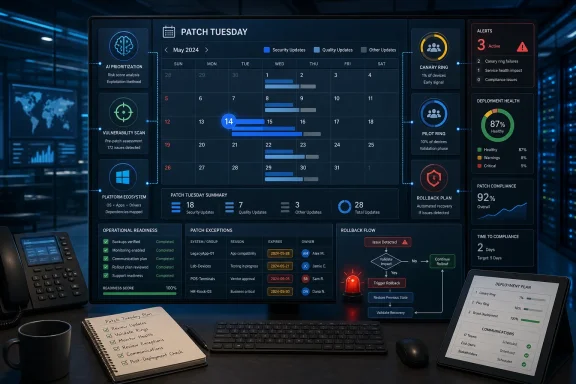 Microsoft Is Preparing Customers for Larger Windows 11 Security Releases
Patch Tuesday has always been a compromise between urgency and order. Microsoft batches fixes on a predictable cadence so enterprises can plan, test, deploy, and recover, while attackers and defenders both analyze the same advisories and binaries after release. That model assumes a manageable flow of vulnerability discovery, triage, engineering, validation, and deployment.Microsoft’s latest message changes the planning assumption. The company says AI is helping it identify potential issues earlier and that customers should expect a higher volume of security updates in each security release. That does not mean every future Patch Tuesday will automatically be huge. It means Microsoft is preparing the Windows ecosystem for more fixes to be ready for each security release because more issues may be found sooner.
The company is also updating its Secure Development Lifecycle so that it explicitly accounts for possible AI-enabled attack techniques and exploit paths. In plain English, Microsoft is not treating AI only as a scanner bolted onto the end of the process. It is trying to adjust the assumptions behind design, review, threat modeling, validation, and servicing.
The distinction matters. This is a reported change in Microsoft’s security engineering direction, not proof that Windows 11 updates have already become larger in the field. Admins should treat it as an early warning and planning signal: patch operations built around a familiar monthly workload may need more capacity, clearer decision rules, and better exception hygiene.
The Old Bargain Was Predictability; the New Bargain Is Throughput
The practical effect for Windows customers is straightforward. Microsoft expects more vulnerabilities to be found earlier, and it expects more fixes to be included in security releases. That is positive if the fixes are correct, prioritized well, and shipped without destabilizing machines. It is risky if higher throughput overwhelms testing windows, change boards, help desks, or rollback plans.Microsoft appears to recognize the tension. The company says it is investing in update quality while gaining speed, including Windows-specific tools and AI-assisted systems to help generate and validate security fixes. That phrase — generate and validate — is doing important work. Finding a vulnerability is only the first part of the problem. Producing a reliable fix for Windows, with its broad hardware, driver, software, and enterprise-management surface, is the harder operational challenge.
Microsoft also says humans remain in the loop for code review and risk-based decisions. That is not a minor caveat. AI can accelerate discovery, propose fixes, assist validation, and surface patterns, but shipping a Windows security update is still an engineering judgment with compatibility, reliability, and customer-impact consequences.
| Patch Tuesday dimension | What Microsoft says is changing | What admins should change now |
|---|---|---|
| Discovery | AI helps identify potential issues earlier. | Assume more issues may be ready for each monthly release; make vulnerability intake, prioritization, and reporting processes ready for larger release notes. |
| Release volume | Microsoft expects a higher volume of security updates in each security release. | Revisit deployment calendars, maintenance windows, bandwidth planning, reboot expectations, and staffing for the week after Patch Tuesday. |
| Development process | The Secure Development Lifecycle is being updated for AI-enabled attack techniques and exploit paths. | Update internal threat-modeling assumptions: prioritize exposed endpoints, privileged systems, remote access paths, identity components, and business-critical Windows workloads. |
| Fix validation | Windows-specific tools and AI-assisted harnesses help generate and validate fixes. | Do not assume automation eliminates risk; expand pilot coverage and require measurable pass/fail criteria before broad rollout. |
| Final judgment | Microsoft says humans remain involved in code review and risk-based decisions. | Mirror that discipline internally: assign human owners for rollout decisions, pauses, exceptions, and rollback approvals. |
That is the tension Microsoft now has to manage. It cannot be slow if AI-assisted techniques make vulnerability discovery and exploit analysis faster. It also cannot allow higher security throughput to become a synonym for quality regression. Windows customers remember broken updates more vividly than quiet ones, and one high-impact regression can make even a necessary security release feel like an operational gamble.
What Actually Changed — and What Has Not Been Proven Yet
The most important clarification is this: Microsoft has said it expects higher-volume security updates and is changing its security development process for AI-era threats. It has not proven that every Patch Tuesday is already larger, and it has not promised that AI will autonomously find, fix, validate, and ship Windows patches.What changed:
- Microsoft is using AI to identify potential issues earlier.
- Microsoft expects customers to see a higher volume of security updates in each security release.
- Microsoft is updating its Secure Development Lifecycle to address potential AI-enabled attack techniques and exploit paths.
- Microsoft says it is investing in quality while increasing speed.
- Microsoft says human review and risk-based decision-making remain part of the process.
- That Patch Tuesday payloads will consistently become larger in practice.
- That larger releases will create more customer-visible regressions.
- That Microsoft’s AI-assisted validation will materially improve update reliability.
- That attackers will exploit every newly patched issue faster than before.
- That enterprise patching teams can absorb the additional volume without changing process.
Bigger Security Releases Are Both Useful and Operationally Demanding
More security fixes at once can be good news. A vulnerability found and patched before exploitation is a win. A bug fixed in a scheduled security release is better than a bug left latent because no one had time to find, validate, or remediate it.But update volume has its own risk profile. Every additional fix increases the amount of code being changed and the number of interactions that may need testing. A post-update failure may involve Windows itself, a driver, firmware, an endpoint protection agent, a VPN client, a browser control, a line-of-business application, device policy, or simple coincidence. Enterprises do not experience Patch Tuesday as an abstract list of vulnerabilities. They experience it as maintenance windows, reboot timing, failed installs, user tickets, compliance dashboards, security exceptions, and sometimes urgent rollback decisions.
For home users, the advice remains simple: keep automatic updates enabled, maintain backups, and avoid delaying security updates without a clear reason. Larger security releases may mean more visible restarts or longer install times, but the alternative is usually worse: running behind the threat environment.
For IT pros, this is a capacity and governance problem. Patch management programs designed around familiar monthly volume may need recalibration. Security teams may have more issues to classify. Endpoint teams may have more change to validate. Application owners may need clearer expectations. Executives may ask why security updates are getting larger, and the plain answer is: Microsoft says AI is helping identify issues earlier, so more fixes may be ready for each release.
The Human-in-the-Loop Promise Is the Load-Bearing Claim
Microsoft’s most important reassurance is that developers will still verify AI findings and make risk-based decisions. This is the line between AI as an engineering accelerant and AI as a production risk.Security fixes are not all alike. Some close obvious remote attack paths. Some reduce exploitability without eliminating an entire bug class. Some harden behavior in ways that are technically correct but compatibility-sensitive. Some are urgent on servers but less urgent on consumer devices. Some may need staging or rework because the operational risk of a rushed fix could be significant.
AI can help widen the search and speed parts of validation, but it cannot remove the judgment involved in servicing Windows at scale. Microsoft has to balance security urgency, compatibility, hardware diversity, enterprise controls, regulated environments, accessibility requirements, telemetry, and the reality that many customers experience cumulative updates as one combined event rather than as neatly separated security and quality changes.
That is why enterprise customers should mirror Microsoft’s own stated posture. If Microsoft is keeping humans in the loop for code review and risk-based decisions, organizations should keep accountable humans in the loop for rollout decisions. A deployment pause should have an owner. A rollback should have criteria. A patch exception should have an expiry date. A known issue should have a communication path. A pilot failure should trigger a defined decision, not an improvised meeting chain.
Timeline
Earlier security planning model — Enterprises generally built monthly Windows patching around a predictable cadence of release, test, deploy, monitor, and remediate.Thursday announcement — Microsoft said it is using AI to identify potential issues earlier, updating its Secure Development Lifecycle for AI-enabled attack techniques and exploit paths, and expecting a higher volume of security updates in each security release.
Near-term admin implication — Windows 11 patch planning should assume heavier security payloads may arrive and should prepare testing, rollback, exception, and communication processes accordingly.
Longer-term implication — If AI-assisted discovery continues to increase vulnerability throughput, the organizations best positioned to cope will be the ones that treat patching as an engineering discipline rather than a once-a-month compliance chore.
The Admin Burden Shifts From Installing Updates to Absorbing Them
The standard advice — install security updates promptly — is still correct. It is no longer sufficient. If Microsoft’s security releases carry more fixes, the administrative burden shifts from simply applying updates to absorbing a faster stream of meaningful change.That requires better staging, better telemetry, better ownership, and better communication between security, endpoint, application, and business teams.
Many organizations still treat patching as a compliance task first and an engineering discipline second. They measure whether devices are current, but not always whether critical applications were tested, whether rollback procedures work, whether privileged systems are prioritized, or whether exceptions are retired. Larger security releases will punish that immaturity.
The first operational question is ring design. Pilot groups must represent the real environment: hardware classes, device age, remote workers, VPN users, executives, developers, frontline workers, specialized peripherals, accessibility configurations, security agents, and line-of-business applications. A pilot ring made only of IT staff on modern laptops is not a meaningful test. It is a ritual.
The second question is pilot coverage. If a business-critical workflow is not represented before broad deployment, the organization is effectively testing it in production. That may be acceptable for low-risk applications, but it is a poor default for payroll, clinical systems, manufacturing controls, call-center platforms, point-of-sale devices, identity administration, remote access, or regulated workflows.
The third question is rollback criteria. Teams should define in advance what counts as a deployment blocker. For example: a repeatable boot failure on a supported hardware model, a VPN failure affecting remote users, a line-of-business application crash, a spike in endpoint agent failures, or a measurable increase in failed installations. Without predefined criteria, teams waste precious time arguing whether a signal is serious enough to pause.
The fourth question is exception hygiene. Every deferred update needs an owner, a reason, an expiry date, and compensating controls. “Do not patch this server” is not an exception process. It is an unmanaged risk. In a higher-volume security environment, exceptions that never expire become quiet inventory of vulnerable systems.
The fifth question is communication. Application owners need to know when validation is required. Help desks need a known-issues channel. Security teams need a way to explain priority without flooding operations with raw vulnerability counts. Executives need a concise message: larger security releases do not necessarily mean Windows suddenly became less secure; they may mean more latent issues are being found and fixed earlier.
Action Checklist for Admins
- Rework update rings. Use at least a small canary group, a broader pilot ring, a phased production ring, and a final ring for sensitive or harder-to-recover systems. Make sure each ring has clear entry and exit criteria.
- Make pilot coverage representative. Include different hardware models, driver sets, VPN users, remote workers, developers, executives, frontline devices, security tools, accessibility configurations, and critical business applications.
- Define rollback criteria before Patch Tuesday. Decide what events pause deployment: boot failures, authentication problems, VPN breakage, application crashes, endpoint agent failures, installation failure spikes, or confirmed business-process disruption.
- Assign owners for exceptions. Every deferred Windows 11 security update should have a named business or technical owner, a documented reason, an expiry date, and compensating controls.
- Set expiry dates by default. Exceptions should expire automatically unless renewed with justification. Permanent deferrals should require higher approval because they become long-term exposure.
- Separate known issues from general help-desk noise. Track post-update incidents by update, device model, driver version, application, location, user role, and install status so teams can distinguish real update regressions from unrelated problems.
- Prepare application owners. Tell owners of critical applications that higher security-fix volume may require more frequent validation. Give them a test window and a clear sign-off process.
- Review maintenance windows. Larger releases may need more time for download, installation, reboot, validation, and remediation. Confirm that remote and low-bandwidth users are not an afterthought.
- Test rollback paths. Confirm that uninstall, recovery, restore, redeployment, and emergency communication procedures actually work. A rollback plan that has never been tested is only a hope.
- Brief leadership now. Explain that Microsoft expects more security fixes per release because AI is helping identify issues earlier. The ask is not panic; it is more disciplined patch operations.
What Windows 11 Users Should Do
For individual Windows 11 users, the practical advice is much simpler than the enterprise playbook.Keep automatic updates enabled. Save work before expected restart windows. Maintain a current backup of important files. Avoid registry hacks or unsupported tools that interfere with servicing. If an update causes a problem, use normal recovery options rather than disabling updates indefinitely.
The expected increase in security update volume should not be read as a reason to avoid Windows Update. It is the opposite. If more vulnerabilities are being found and fixed earlier, delaying updates simply leaves the device behind the security curve.
The best outcome for consumers will look boring: updates arrive, install, reboot, and close more vulnerabilities than before. No special knowledge of AI-assisted security engineering should be required.
What to Do Now
Microsoft’s message is not that Patch Tuesday has already become unmanageable. It is that Windows 11 security releases are expected to include more fixes because AI is helping find issues earlier and because Microsoft is adapting its Secure Development Lifecycle for AI-enabled attack techniques.Admins should respond with concrete preparation, not abstract anxiety.
Start with update rings. Make pilots representative. Define rollback criteria. Assign exception owners. Add expiry dates. Improve post-update telemetry. Prepare application owners. Brief leadership before the first unusually heavy release forces the conversation.
The organizations that handle this well will not be the ones with the most dramatic AI strategy. They will be the ones with disciplined patch operations: clear ownership, staged deployment, reliable testing, fast incident correlation, and exceptions that do not live forever.
Microsoft is trying to increase security throughput. Windows admins now need to increase operational readiness to match it.
References
- Primary source: The Verge
Published: 2026-07-09T17:10:08.766662
Loading…
www.theverge.com - Official source: microsoft.com
Defense at AI speed: Microsoft’s new multi-model agentic security system tops leading industry benchmark | Microsoft Security Blog
Today Microsoft is announcing a major step forward in AI-powered cyber defense: a new multi-model agentic scanning harness (codenamed MDASH).www.microsoft.com - Official source: learn.microsoft.com
Loading…
learn.microsoft.com - Official source: blogs.windows.com
Preparing for what’s next: Windows security and resiliency innovations help organizations mitigate risks, recover faster and prepare for the era of AI
Today, we introduced agentic platform and cloud-powered flexibility capabilities into Windows that bring together human creativity and intelligent agents. To fully embrace these agblogs.windows.com - Official source: techcommunity.microsoft.com
Loading…
techcommunity.microsoft.com - Related coverage: techradar.com
Microsoft unveils MDASH, its AI agent-driven security platform — and it's already spotted a host of new Windows flaws | TechRadar
100 AI agents worked in unison to discover 16 flawswww.techradar.com
- Related coverage: axios.com
Microsoft introduces AI agents to cybersecurity tools
The tech giant is the latest major cyber vendor to introduce agents to triage data breaches and phishing emails.www.axios.com
- Related coverage: itpro.com
Observability will be key to agentic AI safety, says Microsoft Security exec | IT Pro
Agentic AI adoption will require a re-evaluation of enterprise risk management, according to Microsoft corporate VPwww.itpro.com - Related coverage: windowsforum.com
Windows 11 June 2026 Patch Tuesday (June 9): Secure Boot & Key New Features
Microsoft’s June 2026 Patch Tuesday for Windows 11 is scheduled for June 9, bringing the usual security fixes alongside new user-facing features such as low-latency performance boosts, Shared Audio, richer NPU monitoring, setup-time user-folder naming, and Secure Boot certificate updates. The... windowsforum.com
- Related coverage: dokumen.pub
Loading…
dokumen.pub - Related coverage: studylib.es
Loading…
studylib.es - Related coverage: therecord.media
Loading…
therecord.media - Related coverage: fossforce.com
Loading…
fossforce.com - Related coverage: labs.cloudsecurityalliance.org
ai accelerated patch wave enterprise remediation model v1 csa styled
PDF documentlabs.cloudsecurityalliance.org
- Related coverage: 3h4x.github.io
Loading…
3h4x.github.io - Related coverage: tomshardware.com
Loading…
www.tomshardware.com - Related coverage: theweek.com
Mythos: Anthropic’s new AI model experts fear is unsafe | The Week
Anthropic is not releasing the model to the public over safety concerns and potential hacking possibilitiestheweek.com