

A vr.org APK teardown published around Spotify build 9.1.66.1259 says Spotify is preparing a Gemini-powered Android XR smart-glasses experience that links a Google account, uses voice and camera context, and projects the phone-run app onto glasses instead of running a full app locally. The tempting headline is that Spotify may soon let glasses “see” your surroundings and generate music for the moment. The more important story is that Android XR’s glasses model is starting to look less like a miniature phone strapped to your face and more like a sensor-rich extension of the phone you already carry. If that model holds, it could decide whether AI glasses become a real app platform or another novelty category trapped between demos, privacy anxiety, and developer indifference.
The vr.org report is not an announcement from Spotify, Google, or Samsung. It is an APK teardown, and that matters: the evidence comes from unreleased code in Spotify version 9.1.66.1259, not from a public product brief or launch-stage demo. Features found this way can ship, mutate, slip by months, or disappear entirely. Treat the finding as a directional signal, not a delivery promise.
But it is still a strong signal because of what the code reportedly describes. The teardown points to a Spotify experience built specifically for Android XR smart glasses, with Gemini acting as the connective tissue between the user, the music service, the glasses, and the phone. The user links a Google account, then asks Gemini to control playback, discover music contextually, and create personalized playlists on the fly.
That is a more complete product shape than a stray string labeled “XR support.” It implies identity, assistant routing, playback control, discovery, and playlist generation. It also implies that Spotify is not merely checking whether its existing Android app renders somewhere in an XR shell. It appears to be exploring a different interaction model, one in which the user does not open Spotify so much as invoke Spotify through Gemini.
That distinction is the story. Smart-glasses apps are not going to behave like phone apps that happen to be floating in your peripheral vision. If the Spotify teardown is representative of where Android XR is going, the app becomes a capability exposed to an assistant, with visual and audio context supplied by the glasses and compute supplied by the phone.
For a mature service such as Spotify, that is both opportunity and risk. The opportunity is obvious: music is one of the easiest categories to imagine on glasses with speakers in the temples. The risk is that the app’s front door shifts from Spotify’s carefully designed interface to Google’s assistant layer. The user may still be paying Spotify and hearing Spotify, but the moment of intent belongs to Gemini.
According to the source material, AI glasses do not run a full APK on the device. The app experience runs on the smartphone, and the resulting activity is projected onto the glasses. The glasses act as a display and sensor array. The phone does the computing.
Google’s Android XR developer material describes this broad model through projected APIs for Android XR: phone-based app experiences can be bridged into the user’s field of view, while hardware access from the glasses can be exposed back to the phone-side app context. The developer does not have to assume that every pair of glasses is a self-contained Android device with its own app runtime, app store, thermal ceiling, battery envelope, and input model. The phone remains the host.
That is not merely an implementation detail. It is the difference between asking developers to build for a new platform and asking them to extend an existing one. A projected model lets the Android app remain the canonical app, while the glasses surface becomes a new presentation and interaction layer.
For Spotify, that could mean the Android app still owns authentication, playback state, account entitlements, music recommendations, and network behavior. The glasses experience would then become a lightweight, context-sensitive front end. Gemini listens, interprets, and brokers the action; the phone executes; the glasses display or speak the result.
The practical consequence is that Android XR glasses do not need to win by becoming powerful computers. They can win by being useful sensors and displays attached to a powerful computer already in the user’s pocket. That sounds less glamorous than a fully independent wearable computer, but it is much more plausible for hardware people trying to ship something that looks like eyewear rather than a dev kit.
This comparison explains why Spotify’s reported work is more interesting than yet another “XR app” headline. If the Android XR glasses ecosystem depends on projected phone experiences, then the first major apps to adopt that model are not just adding device support. They are validating the platform architecture.
The new ingredient is context. The teardown reportedly describes a Gemini experience that can analyze the user’s environment through the glasses’ camera and serve music inspired by what is around them. That pushes Spotify from a catalog interface toward an ambient recommendation system.
In the phone era, music discovery is usually explicit. You search, browse, tap, follow, like, skip, and save. Even algorithmic playlists require a surface: a home screen, a made-for-you hub, a search box, a row of recommendations, a notification. The user has to meet the app on the app’s terms.
On glasses, the more natural model is declarative. The user says, in effect, “play something for this,” and the system is expected to understand what this means. That may include location, visual surroundings, time of day, motion state, recent listening, and the user’s stated mood. The teardown’s environmental-music example is eye-catching because it compresses all of that into one understandable demo: the glasses look, Gemini interprets, Spotify plays.
That is also why Spotify makes sense as an early candidate. Music tolerates ambiguity better than many other app categories. If Gemini picks the wrong playlist for a walk, the user skips. If Gemini misreads a work document, a medical context, or a navigation instruction, the stakes are higher. Music is a forgiving domain for testing contextual AI because the output is subjective and easily reversible.
Still, the user experience has to be better than a gimmick. “Play something inspired by what I’m seeing” is a good keynote demo. A durable product needs to handle the ordinary cases: pause, resume, play my commute mix, make this more upbeat, save that track, start something quiet for focus, don’t play explicit songs, continue on my speaker when I get home. The teardown suggests Spotify is thinking across both sides of that divide: playback control and contextual creation.
The most important interface shift is that Gemini becomes the mediator. In a conventional Android app, Spotify owns the UI and the user’s intent flows through Spotify’s controls. In this model, Gemini may own the moment of intent and Spotify becomes the service that fulfills it. That is useful for users, but strategically delicate for app makers, because platforms that mediate intent tend to gain leverage over the services behind them.
The Spotify teardown makes that visible. The user does not appear to be launching a miniature Spotify interface and tapping around in air. The user links a Google account and uses Gemini. Spotify supplies the music service; Google supplies the interaction fabric.
That is good for adoption because it lowers friction. A normal person does not want to learn a new gesture language to make glasses useful. They want to speak naturally and get a result. Gemini is the obvious layer for that, and Android XR is being positioned around exactly that kind of assistant-first interaction.
But the same design also changes the politics of app distribution. If Gemini becomes the default way users ask for music, maps, messages, translations, summaries, and recommendations, then the assistant layer becomes the place where preferences are shaped. Which music app answers a generic request? How does the system choose between Spotify and another service? How much control does the app have over the response? How much data does the assistant see before the app receives the request?
These are not abstract questions for developers. They determine whether Android XR is a healthy app platform or a collection of services subordinated to a platform assistant. Spotify is large enough to negotiate and visible enough to matter. Smaller developers may have less leverage when the assistant becomes the primary interface.
For Google, this is the strategic tightrope. Android became dominant in part because it gave hardware makers and developers a broad platform to build on. Gemini-led Android XR could be more coherent than earlier Android experiments in wearables and TV, but coherence can become control. If every meaningful interaction passes through Gemini, developers will want guarantees that they are not merely interchangeable fulfillment endpoints.
The projected-app model helps here because it preserves the phone app as the locus of execution. The app is not reduced to a cloud skill or a thin plugin. It remains an Android application with its own account model, business logic, and user relationship. The question is how much of that relationship survives at the moment the user simply asks their glasses for music.
Music is a native smart-glasses use case. Glasses can have open-ear speakers. They are worn during walks, commutes, errands, travel, and work sessions. They are already positioned near the ear and near the eyes, which makes audio feedback and visual context natural. Unlike productivity suites or video editors, a music service can be useful on glasses without requiring a large display.
Spotify also brings cultural weight. It is not a niche XR experiment or a first-party showcase. It is a mainstream consumer app with habits, subscriptions, playlists, and social identity attached. If Spotify is preparing for Android XR glasses before the hardware is widely available, that suggests somebody believes there will be enough users, enough platform stability, or enough strategic pressure to justify early work.
That is the ecosystem signal Google needs. Google’s audio glasses are described in the source material as due this fall, while Samsung’s Galaxy Glasses are expected imminently. Samsung’s Galaxy Unpacked event on July 22 is therefore not just another hardware launch window; it is a test of whether Android XR glasses can present a credible app story before consumers decide whether the category is real.
Samsung has the hardware distribution, retail presence, and Galaxy ecosystem to make the first wave visible. Google has Android, Gemini, and developer APIs. Spotify, if the teardown bears out, supplies the kind of third-party validation that tells users this is not only a Google demo and tells developers that major services are already experimenting.
That triangulation matters because AI glasses have a trust problem before they have a specs problem. Many people can imagine wearing lighter glasses that answer questions, play music, summarize messages, and provide directions. Many of the same people recoil when the device has a camera and an AI assistant attached to their face. A familiar app such as Spotify can soften the first impression by making the device feel useful rather than alien.
But Spotify cannot solve the category’s social problem by itself. In fact, its reported feature exposes the problem clearly.
This is the central contradiction of AI glasses. Contextual AI is the feature that makes them more than headphones with notifications. The glasses can understand what the user is looking at, where attention is directed, and what the environment might imply. That is what allows the system to translate a sign, identify an object, remember where something was left, describe a scene, or pick music that fits the room.
But the presence of a camera on a face changes the social contract. A phone camera is visible as an action; someone raises the device, points it, and records. Glasses can make capture feel passive, continuous, or ambiguous even when they are not recording. The uncertainty is part of the issue. People around the wearer may not know whether the device is seeing, analyzing, storing, or streaming.
Spotify’s reported use case sounds benign compared with surveillance or facial recognition. A playlist inspired by surroundings is not, on its face, a dystopian feature. Yet it depends on the same pipeline that worries people: camera input, AI interpretation, account-linked personalization, and service output. The difference between delightful context and invasive sensing is partly technical, partly policy, and partly social.
Google and Samsung will therefore have to sell not only capability but restraint. Indicators, permissions, on-device processing claims, data retention rules, app review policies, and enterprise controls will matter. So will mundane design choices: how obvious the camera is, when it is active, whether bystanders get a visible signal, and how easily the wearer can disable contextual sensing.
Spotify will have its own questions to answer if this ships. Does environmental analysis flow through Gemini, Spotify, or both? What does Spotify receive: a text prompt, a semantic summary, raw visual data, or something else? Is the feature tied to a Google account link only for assistant routing, or does that link deepen cross-service personalization? Can users use voice playback controls without camera-based recommendations?
The teardown does not answer those questions, and it should not be treated as if it does. But any serious evaluation of Android XR glasses has to put privacy at the center, because the most compelling demos are precisely the ones that require the most sensitive sensing.
Spotify is a useful example. The regular phone app is dense: album art, carousels, tabs, search screens, queue controls, lyrics, podcasts, audiobooks, recommendations, downloads, social features, and account settings. Most of that does not belong on lightweight AI smart glasses. The glasses experience has to expose the few actions that make sense in the moment and hide the rest.
That requires product judgment. For music, likely primitives include play, pause, skip, volume, like, save, identify, continue, create, and modify mood. For other apps, the primitives will differ. A messaging app may need read, summarize, dictate, send, and defer. A navigation app may need next turn, alternate route, destination, nearby place, and hazard awareness. A field-service app may need identify asset, capture note, show instruction, and escalate.
Android XR’s projected APIs may reduce platform risk, but they do not remove interaction-design risk. Developers still have to decide what their app becomes when the user is not looking at a phone. That is a conceptual rewrite even when it is not a full technical port.
The upside is that developers can stage the work. They can begin by projecting a narrow experience, using phone-side logic and existing accounts. They can test a few assistant-facing intents rather than rebuilding the whole application. They can keep their primary Android app as the source of truth. That is a much friendlier adoption path than demanding an entire standalone glasses app on day one.
The likely winners will be apps that already have strong intent models. Music, messaging, navigation, translation, notes, reminders, ride-hailing, delivery, calendar, fitness, and field workflows all map naturally to short commands and contextual responses. Apps that depend on prolonged visual manipulation may struggle unless glasses displays become more capable and socially accepted.
This also means that the first wave of Android XR apps may feel less like “apps” than features. Users may not care. If the glasses play the right music, summarize the right message, or show the right instruction at the right moment, the absence of a traditional app interface may be a virtue.
The Spotify teardown is consumer-focused, but its architecture has enterprise consequences. If the phone remains the computer and the glasses are a display and sensor array, then management cannot stop at the glasses. The phone, the app, the account link, the projected context, and the assistant permissions all become part of the risk surface.
That will matter in offices, schools, hospitals, factories, retail floors, government environments, and any workplace with confidential information. A user asking Gemini to select music based on surroundings is one benign scenario. A user wearing the same class of device near whiteboards, customer records, unreleased products, production lines, or regulated data is another.
The first administrative temptation will be to ban the hardware. Some organizations will, especially in sensitive environments. But broad bans tend to erode when executives, sales teams, accessibility users, or field workers find legitimate uses. The better long-term posture is to classify AI glasses as managed peripherals tied to managed phones and governed by explicit camera, microphone, assistant, and app-projection policies.
That seamlessness is the point for consumers and the headache for governance. IT teams will need vendor documentation that explains what data moves where. They will need management hooks that distinguish audio playback from camera context, and assistant invocation from app projection. They will need app developers to expose controls rather than bury every XR feature inside a consumer toggle.
If Android XR glasses catch on, the enterprise fight will not be about whether employees can listen to Spotify at work. It will be about whether organizations can control ambient AI sensing without breaking every useful glasses workflow along the way.
That changes how we should read the Spotify teardown. Six months before a vague platform future, unreleased code can look speculative. Near a hardware event, it looks like ecosystem preparation. Spotify does not need to announce anything on Samsung’s stage for the signal to matter. The fact that a major consumer app appears to be building against Android XR’s projected model suggests the platform has crossed from concept into developer road map.
Samsung also has a different job than Google. Google must convince developers that Android XR is coherent, capable, and worth targeting. Samsung must convince buyers that glasses are desirable, wearable, and useful enough to purchase. Spotify helps with the second job because music is instantly understandable.
A glasses launch can drown in abstractions: AI, XR, multimodal context, spatial computing, projected APIs, assistant surfaces. A user asking for music that fits what they are seeing is concrete. It compresses the whole platform pitch into one human action. That is exactly the kind of demo hardware makers want, even if the implementation remains unannounced.
The danger is overpromising. The smart-glasses category has a history of demos that imply more fluency than the shipping product delivers. If Samsung or Google leans too hard on ambient intelligence without clear limits, users will discover the limits themselves and punish the category for it. Spotify’s reported feature should be framed as a likely direction for interaction, not proof that glasses will understand every moment with cinematic precision.
The better pitch is narrower and more credible: your phone still powers your apps; your glasses supply fast context and lightweight output; Gemini helps you express intent; major services can plug into that flow. That is enough. It does not need to become science fiction to be useful.
Spotify may test this and decide the privacy optics are wrong. Google may alter Android XR’s assistant or projected-app behavior before launch. Samsung’s hardware may arrive with different capabilities than expected. Account-linking flows may change. Camera-based music selection may be limited, renamed, region-gated, or pushed behind experimental settings.
The correct conclusion is therefore not “Spotify will definitely ship camera-aware Gemini playlists on Android XR glasses.” The correct conclusion is that Spotify appears to be investigating a serious Android XR glasses integration, and the shape of that integration aligns with Google’s projected model for lightweight AI glasses.
That is still news. In platform transitions, early code often tells us which abstractions developers are taking seriously. Spotify appears to be taking Gemini, Google account linking, voice playback, contextual discovery, personalized playlist generation, and phone-projected glasses experiences seriously enough to leave evidence in a real build.
The caveat should temper certainty, not erase the signal. If every teardown is dismissed because it is unreleased, we miss the early contours of platform strategy. If every teardown is treated as a launch announcement, we mislead users. The useful middle position is to ask what the code reveals about direction, incentives, and architecture. On those terms, this one reveals a lot.
That points toward a broader design rule. Glasses should not make users manage more screens. They should reduce the number of moments when users have to pull out a phone. The phone remains the computer, but the interaction moves closer to perception and speech.
For developers, that means success will depend less on porting screens and more on exposing intents. What can the user ask for? What context can improve the answer? What should be shown, spoken, or silently acted upon? What should be deferred to the phone because it is too complex, private, or visually dense for glasses?
Spotify has an advantage because many music intents are already conversational. “Play something relaxing,” “skip this,” “make a playlist for the gym,” or “give me something like this” are natural requests. Gemini adds the possibility of “for where I am” or “for what I’m looking at.” That is a real expansion of the app’s interface.
But disappearing at the right moment is harder than it sounds. If the assistant gets too much wrong, users will want controls. If the app hides too much, users will distrust it. If the glasses surface too much, the experience becomes distracting. The product challenge is to make the app feel present when needed and absent when not.
The projected model helps because it allows escalation. A quick voice command can happen on glasses. A more complicated choice can move to the phone. The system does not have to force every interaction through one display. That flexibility may become Android XR’s strongest practical advantage over more self-contained visions of wearable computing.
For users, the promise is convenience with a privacy bill attached. For developers, the promise is a shorter ramp into a new form factor, provided they rethink interaction rather than merely resize interfaces. For admins, the warning is that smart glasses will arrive as extensions of managed phones and consumer accounts, not as neatly isolated devices.
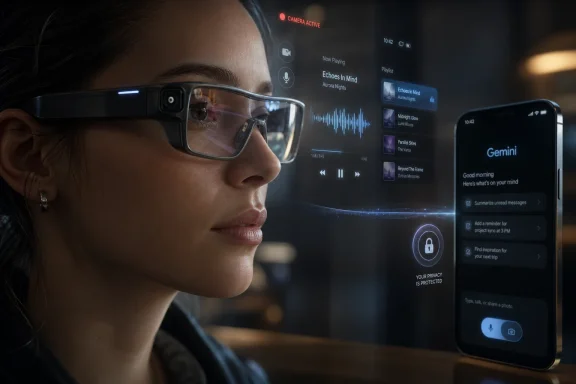 Spotify’s Teardown Is Really a Platform Leak
The vr.org report is not an announcement from Spotify, Google, or Samsung. It is an APK teardown, and that matters: the evidence comes from unreleased code in Spotify version 9.1.66.1259, not from a public product brief or launch-stage demo. Features found this way can ship, mutate, slip by months, or disappear entirely. Treat the finding as a directional signal, not a delivery promise.But it is still a strong signal because of what the code reportedly describes. The teardown points to a Spotify experience built specifically for Android XR smart glasses, with Gemini acting as the connective tissue between the user, the music service, the glasses, and the phone. The user links a Google account, then asks Gemini to control playback, discover music contextually, and create personalized playlists on the fly.
That is a more complete product shape than a stray string labeled “XR support.” It implies identity, assistant routing, playback control, discovery, and playlist generation. It also implies that Spotify is not merely checking whether its existing Android app renders somewhere in an XR shell. It appears to be exploring a different interaction model, one in which the user does not open Spotify so much as invoke Spotify through Gemini.
That distinction is the story. Smart-glasses apps are not going to behave like phone apps that happen to be floating in your peripheral vision. If the Spotify teardown is representative of where Android XR is going, the app becomes a capability exposed to an assistant, with visual and audio context supplied by the glasses and compute supplied by the phone.
For a mature service such as Spotify, that is both opportunity and risk. The opportunity is obvious: music is one of the easiest categories to imagine on glasses with speakers in the temples. The risk is that the app’s front door shifts from Spotify’s carefully designed interface to Google’s assistant layer. The user may still be paying Spotify and hearing Spotify, but the moment of intent belongs to Gemini.
The Phone Is Still the Center of Gravity
The most consequential line in the vr.org piece is also the shortest: “The phone remains the computer.” That sentence explains why the teardown matters beyond Spotify, and why Android XR glasses may have a better shot with developers than earlier wearable platforms did.According to the source material, AI glasses do not run a full APK on the device. The app experience runs on the smartphone, and the resulting activity is projected onto the glasses. The glasses act as a display and sensor array. The phone does the computing.
Google’s Android XR developer material describes this broad model through projected APIs for Android XR: phone-based app experiences can be bridged into the user’s field of view, while hardware access from the glasses can be exposed back to the phone-side app context. The developer does not have to assume that every pair of glasses is a self-contained Android device with its own app runtime, app store, thermal ceiling, battery envelope, and input model. The phone remains the host.
That is not merely an implementation detail. It is the difference between asking developers to build for a new platform and asking them to extend an existing one. A projected model lets the Android app remain the canonical app, while the glasses surface becomes a new presentation and interaction layer.
For Spotify, that could mean the Android app still owns authentication, playback state, account entitlements, music recommendations, and network behavior. The glasses experience would then become a lightweight, context-sensitive front end. Gemini listens, interprets, and brokers the action; the phone executes; the glasses display or speak the result.
The practical consequence is that Android XR glasses do not need to win by becoming powerful computers. They can win by being useful sensors and displays attached to a powerful computer already in the user’s pocket. That sounds less glamorous than a fully independent wearable computer, but it is much more plausible for hardware people trying to ship something that looks like eyewear rather than a dev kit.
| App model | Where the main app experience runs | What the glasses provide | Developer burden | User tradeoff |
|---|---|---|---|---|
| Projected Android XR glasses experience | Smartphone | Display, sensors, camera/audio context, assistant-facing surface | Extend an existing Android app with projected behavior | Lighter glasses, but dependent on the phone |
| Full app running directly on glasses | Glasses hardware | Compute, display, sensors, local app runtime | Build and optimize for a constrained standalone device | More independence, but heavier battery, thermal, and performance constraints |
Gemini Turns Spotify From an App Into an Intent
The Spotify feature described by vr.org is not just voice control. Voice control is old. Bluetooth earbuds have handled basic playback commands for years, and smart speakers made verbal music requests mundane long ago.The new ingredient is context. The teardown reportedly describes a Gemini experience that can analyze the user’s environment through the glasses’ camera and serve music inspired by what is around them. That pushes Spotify from a catalog interface toward an ambient recommendation system.
In the phone era, music discovery is usually explicit. You search, browse, tap, follow, like, skip, and save. Even algorithmic playlists require a surface: a home screen, a made-for-you hub, a search box, a row of recommendations, a notification. The user has to meet the app on the app’s terms.
On glasses, the more natural model is declarative. The user says, in effect, “play something for this,” and the system is expected to understand what this means. That may include location, visual surroundings, time of day, motion state, recent listening, and the user’s stated mood. The teardown’s environmental-music example is eye-catching because it compresses all of that into one understandable demo: the glasses look, Gemini interprets, Spotify plays.
That is also why Spotify makes sense as an early candidate. Music tolerates ambiguity better than many other app categories. If Gemini picks the wrong playlist for a walk, the user skips. If Gemini misreads a work document, a medical context, or a navigation instruction, the stakes are higher. Music is a forgiving domain for testing contextual AI because the output is subjective and easily reversible.
Still, the user experience has to be better than a gimmick. “Play something inspired by what I’m seeing” is a good keynote demo. A durable product needs to handle the ordinary cases: pause, resume, play my commute mix, make this more upbeat, save that track, start something quiet for focus, don’t play explicit songs, continue on my speaker when I get home. The teardown suggests Spotify is thinking across both sides of that divide: playback control and contextual creation.
The most important interface shift is that Gemini becomes the mediator. In a conventional Android app, Spotify owns the UI and the user’s intent flows through Spotify’s controls. In this model, Gemini may own the moment of intent and Spotify becomes the service that fulfills it. That is useful for users, but strategically delicate for app makers, because platforms that mediate intent tend to gain leverage over the services behind them.
The First Real Android XR App War Is Over the Front Door
Every new computing platform begins with a fight over the front door. On PCs, it was the desktop and browser. On smartphones, it was the home screen, app store, notifications, and later the voice assistant. On smart glasses, the front door is likely to be the assistant.The Spotify teardown makes that visible. The user does not appear to be launching a miniature Spotify interface and tapping around in air. The user links a Google account and uses Gemini. Spotify supplies the music service; Google supplies the interaction fabric.
That is good for adoption because it lowers friction. A normal person does not want to learn a new gesture language to make glasses useful. They want to speak naturally and get a result. Gemini is the obvious layer for that, and Android XR is being positioned around exactly that kind of assistant-first interaction.
But the same design also changes the politics of app distribution. If Gemini becomes the default way users ask for music, maps, messages, translations, summaries, and recommendations, then the assistant layer becomes the place where preferences are shaped. Which music app answers a generic request? How does the system choose between Spotify and another service? How much control does the app have over the response? How much data does the assistant see before the app receives the request?
These are not abstract questions for developers. They determine whether Android XR is a healthy app platform or a collection of services subordinated to a platform assistant. Spotify is large enough to negotiate and visible enough to matter. Smaller developers may have less leverage when the assistant becomes the primary interface.
For Google, this is the strategic tightrope. Android became dominant in part because it gave hardware makers and developers a broad platform to build on. Gemini-led Android XR could be more coherent than earlier Android experiments in wearables and TV, but coherence can become control. If every meaningful interaction passes through Gemini, developers will want guarantees that they are not merely interchangeable fulfillment endpoints.
The projected-app model helps here because it preserves the phone app as the locus of execution. The app is not reduced to a cloud skill or a thin plugin. It remains an Android application with its own account model, business logic, and user relationship. The question is how much of that relationship survives at the moment the user simply asks their glasses for music.
Why Spotify Is the App Google Needed to Be Seen Building
Platforms rarely fail because they lack a beautiful weather demo. They fail because the apps people already use do not arrive in time, do not work well enough, or do not fit the new form factor. That is why Spotify matters more than the particular playlist trick in the teardown.Music is a native smart-glasses use case. Glasses can have open-ear speakers. They are worn during walks, commutes, errands, travel, and work sessions. They are already positioned near the ear and near the eyes, which makes audio feedback and visual context natural. Unlike productivity suites or video editors, a music service can be useful on glasses without requiring a large display.
Spotify also brings cultural weight. It is not a niche XR experiment or a first-party showcase. It is a mainstream consumer app with habits, subscriptions, playlists, and social identity attached. If Spotify is preparing for Android XR glasses before the hardware is widely available, that suggests somebody believes there will be enough users, enough platform stability, or enough strategic pressure to justify early work.
That is the ecosystem signal Google needs. Google’s audio glasses are described in the source material as due this fall, while Samsung’s Galaxy Glasses are expected imminently. Samsung’s Galaxy Unpacked event on July 22 is therefore not just another hardware launch window; it is a test of whether Android XR glasses can present a credible app story before consumers decide whether the category is real.
Samsung has the hardware distribution, retail presence, and Galaxy ecosystem to make the first wave visible. Google has Android, Gemini, and developer APIs. Spotify, if the teardown bears out, supplies the kind of third-party validation that tells users this is not only a Google demo and tells developers that major services are already experimenting.
That triangulation matters because AI glasses have a trust problem before they have a specs problem. Many people can imagine wearing lighter glasses that answer questions, play music, summarize messages, and provide directions. Many of the same people recoil when the device has a camera and an AI assistant attached to their face. A familiar app such as Spotify can soften the first impression by making the device feel useful rather than alien.
But Spotify cannot solve the category’s social problem by itself. In fact, its reported feature exposes the problem clearly.
The Camera Makes the Magic and the Backlash
The vr.org source material states the uncomfortable truth plainly: “You do not get one without the other.” The same camera that lets Gemini analyze a scene for music is the camera that makes bystanders uneasy.This is the central contradiction of AI glasses. Contextual AI is the feature that makes them more than headphones with notifications. The glasses can understand what the user is looking at, where attention is directed, and what the environment might imply. That is what allows the system to translate a sign, identify an object, remember where something was left, describe a scene, or pick music that fits the room.
But the presence of a camera on a face changes the social contract. A phone camera is visible as an action; someone raises the device, points it, and records. Glasses can make capture feel passive, continuous, or ambiguous even when they are not recording. The uncertainty is part of the issue. People around the wearer may not know whether the device is seeing, analyzing, storing, or streaming.
Spotify’s reported use case sounds benign compared with surveillance or facial recognition. A playlist inspired by surroundings is not, on its face, a dystopian feature. Yet it depends on the same pipeline that worries people: camera input, AI interpretation, account-linked personalization, and service output. The difference between delightful context and invasive sensing is partly technical, partly policy, and partly social.
Google and Samsung will therefore have to sell not only capability but restraint. Indicators, permissions, on-device processing claims, data retention rules, app review policies, and enterprise controls will matter. So will mundane design choices: how obvious the camera is, when it is active, whether bystanders get a visible signal, and how easily the wearer can disable contextual sensing.
Spotify will have its own questions to answer if this ships. Does environmental analysis flow through Gemini, Spotify, or both? What does Spotify receive: a text prompt, a semantic summary, raw visual data, or something else? Is the feature tied to a Google account link only for assistant routing, or does that link deepen cross-service personalization? Can users use voice playback controls without camera-based recommendations?
The teardown does not answer those questions, and it should not be treated as if it does. But any serious evaluation of Android XR glasses has to put privacy at the center, because the most compelling demos are precisely the ones that require the most sensitive sensing.
Developers Get a Shorter Ramp, Not a Free Ride
The projected model is encouraging for developers, but it should not be mistaken for zero work. A phone app projected into glasses still has to be redesigned for glanceability, voice-first control, interruption, privacy, and constrained output. The fact that the phone does the compute does not mean the phone UI becomes wearable by magic.Spotify is a useful example. The regular phone app is dense: album art, carousels, tabs, search screens, queue controls, lyrics, podcasts, audiobooks, recommendations, downloads, social features, and account settings. Most of that does not belong on lightweight AI smart glasses. The glasses experience has to expose the few actions that make sense in the moment and hide the rest.
That requires product judgment. For music, likely primitives include play, pause, skip, volume, like, save, identify, continue, create, and modify mood. For other apps, the primitives will differ. A messaging app may need read, summarize, dictate, send, and defer. A navigation app may need next turn, alternate route, destination, nearby place, and hazard awareness. A field-service app may need identify asset, capture note, show instruction, and escalate.
Android XR’s projected APIs may reduce platform risk, but they do not remove interaction-design risk. Developers still have to decide what their app becomes when the user is not looking at a phone. That is a conceptual rewrite even when it is not a full technical port.
The upside is that developers can stage the work. They can begin by projecting a narrow experience, using phone-side logic and existing accounts. They can test a few assistant-facing intents rather than rebuilding the whole application. They can keep their primary Android app as the source of truth. That is a much friendlier adoption path than demanding an entire standalone glasses app on day one.
The likely winners will be apps that already have strong intent models. Music, messaging, navigation, translation, notes, reminders, ride-hailing, delivery, calendar, fitness, and field workflows all map naturally to short commands and contextual responses. Apps that depend on prolonged visual manipulation may struggle unless glasses displays become more capable and socially accepted.
This also means that the first wave of Android XR apps may feel less like “apps” than features. Users may not care. If the glasses play the right music, summarize the right message, or show the right instruction at the right moment, the absence of a traditional app interface may be a virtue.
IT Departments Should Treat Glasses as Endpoints With Sensors
Consumer coverage of smart glasses tends to focus on whether ordinary people will wear them. Enterprise and IT teams have a different question: what happens when a device with cameras, microphones, speakers, assistant access, account linking, and phone projection enters the workplace?The Spotify teardown is consumer-focused, but its architecture has enterprise consequences. If the phone remains the computer and the glasses are a display and sensor array, then management cannot stop at the glasses. The phone, the app, the account link, the projected context, and the assistant permissions all become part of the risk surface.
That will matter in offices, schools, hospitals, factories, retail floors, government environments, and any workplace with confidential information. A user asking Gemini to select music based on surroundings is one benign scenario. A user wearing the same class of device near whiteboards, customer records, unreleased products, production lines, or regulated data is another.
The first administrative temptation will be to ban the hardware. Some organizations will, especially in sensitive environments. But broad bans tend to erode when executives, sales teams, accessibility users, or field workers find legitimate uses. The better long-term posture is to classify AI glasses as managed peripherals tied to managed phones and governed by explicit camera, microphone, assistant, and app-projection policies.
Action checklist for admins
- Inventory AI glasses as sensor-bearing endpoints, not merely Bluetooth audio accessories.
- Require managed-phone enrollment before allowing projected Android XR experiences in work contexts.
- Review Google account linking, Gemini access, and third-party app permissions before approving glasses workflows.
- Define where camera-based contextual features are prohibited, such as secure rooms, regulated work areas, and customer-data environments.
- Update acceptable-use policies so employees know when smart-glasses sensing is allowed, restricted, or banned.
- Pilot with low-risk apps first, then evaluate logs, user behavior, support burden, and privacy complaints before wider deployment.
That seamlessness is the point for consumers and the headache for governance. IT teams will need vendor documentation that explains what data moves where. They will need management hooks that distinguish audio playback from camera context, and assistant invocation from app projection. They will need app developers to expose controls rather than bury every XR feature inside a consumer toggle.
If Android XR glasses catch on, the enterprise fight will not be about whether employees can listen to Spotify at work. It will be about whether organizations can control ambient AI sensing without breaking every useful glasses workflow along the way.
Samsung’s July 22 Moment Is About Confidence, Not Just Hardware
Samsung’s Galaxy Unpacked on July 22 looms over this story because hardware timing and developer confidence reinforce each other. The source material says Samsung’s Galaxy Glasses are expected imminently, while Google’s audio glasses are due this fall. Even if exact ship dates, regional availability, or product names shift, the market is clearly moving from platform preview to launch posture.That changes how we should read the Spotify teardown. Six months before a vague platform future, unreleased code can look speculative. Near a hardware event, it looks like ecosystem preparation. Spotify does not need to announce anything on Samsung’s stage for the signal to matter. The fact that a major consumer app appears to be building against Android XR’s projected model suggests the platform has crossed from concept into developer road map.
Samsung also has a different job than Google. Google must convince developers that Android XR is coherent, capable, and worth targeting. Samsung must convince buyers that glasses are desirable, wearable, and useful enough to purchase. Spotify helps with the second job because music is instantly understandable.
A glasses launch can drown in abstractions: AI, XR, multimodal context, spatial computing, projected APIs, assistant surfaces. A user asking for music that fits what they are seeing is concrete. It compresses the whole platform pitch into one human action. That is exactly the kind of demo hardware makers want, even if the implementation remains unannounced.
The danger is overpromising. The smart-glasses category has a history of demos that imply more fluency than the shipping product delivers. If Samsung or Google leans too hard on ambient intelligence without clear limits, users will discover the limits themselves and punish the category for it. Spotify’s reported feature should be framed as a likely direction for interaction, not proof that glasses will understand every moment with cinematic precision.
The better pitch is narrower and more credible: your phone still powers your apps; your glasses supply fast context and lightweight output; Gemini helps you express intent; major services can plug into that flow. That is enough. It does not need to become science fiction to be useful.
The Caveat Is Not Fine Print
APK teardowns are valuable because they reveal what companies are testing before they are ready to talk. They are also dangerous because readers tend to convert “found in code” into “coming soon.” The source material explicitly warns that code in an unreleased build may change, be delayed, or be deleted, and that warning deserves more than a ritual nod.Spotify may test this and decide the privacy optics are wrong. Google may alter Android XR’s assistant or projected-app behavior before launch. Samsung’s hardware may arrive with different capabilities than expected. Account-linking flows may change. Camera-based music selection may be limited, renamed, region-gated, or pushed behind experimental settings.
The correct conclusion is therefore not “Spotify will definitely ship camera-aware Gemini playlists on Android XR glasses.” The correct conclusion is that Spotify appears to be investigating a serious Android XR glasses integration, and the shape of that integration aligns with Google’s projected model for lightweight AI glasses.
That is still news. In platform transitions, early code often tells us which abstractions developers are taking seriously. Spotify appears to be taking Gemini, Google account linking, voice playback, contextual discovery, personalized playlist generation, and phone-projected glasses experiences seriously enough to leave evidence in a real build.
The caveat should temper certainty, not erase the signal. If every teardown is dismissed because it is unreleased, we miss the early contours of platform strategy. If every teardown is treated as a launch announcement, we mislead users. The useful middle position is to ask what the code reveals about direction, incentives, and architecture. On those terms, this one reveals a lot.
The Winners Will Be the Apps That Disappear at the Right Moment
The paradox of Android XR glasses is that the best apps may be the least app-like. Spotify’s reported integration is compelling precisely because it reduces the need to open Spotify. The service becomes available at the moment of need, through voice, context, and assistant mediation.That points toward a broader design rule. Glasses should not make users manage more screens. They should reduce the number of moments when users have to pull out a phone. The phone remains the computer, but the interaction moves closer to perception and speech.
For developers, that means success will depend less on porting screens and more on exposing intents. What can the user ask for? What context can improve the answer? What should be shown, spoken, or silently acted upon? What should be deferred to the phone because it is too complex, private, or visually dense for glasses?
Spotify has an advantage because many music intents are already conversational. “Play something relaxing,” “skip this,” “make a playlist for the gym,” or “give me something like this” are natural requests. Gemini adds the possibility of “for where I am” or “for what I’m looking at.” That is a real expansion of the app’s interface.
But disappearing at the right moment is harder than it sounds. If the assistant gets too much wrong, users will want controls. If the app hides too much, users will distrust it. If the glasses surface too much, the experience becomes distracting. The product challenge is to make the app feel present when needed and absent when not.
The projected model helps because it allows escalation. A quick voice command can happen on glasses. A more complicated choice can move to the phone. The system does not have to force every interaction through one display. That flexibility may become Android XR’s strongest practical advantage over more self-contained visions of wearable computing.
What This Means Before the Glasses Ship
The Spotify teardown should be read as an ecosystem weather report. It does not guarantee a product, but it shows which way the wind is blowing: toward assistant-mediated, phone-powered, sensor-aware app experiences for lightweight AI glasses. That is a more realistic path than pretending glasses are ready to replace phones, and a more ambitious path than treating them as earbuds with a camera.For users, the promise is convenience with a privacy bill attached. For developers, the promise is a shorter ramp into a new form factor, provided they rethink interaction rather than merely resize interfaces. For admins, the warning is that smart glasses will arrive as extensions of managed phones and consumer accounts, not as neatly isolated devices.
- Spotify build 9.1.66.1259 reportedly contains evidence of a Gemini-integrated Android XR smart-glasses experience.
- The described model links a Google account and lets Gemini handle voice playback, contextual discovery, and personalized playlist creation.
- The architecture is the bigger story: the app runs on the phone while activity is projected onto the glasses.
- The glasses act as a display and sensor array, keeping the hardware lighter while preserving the phone as the compute device.
- Camera-based context is both the feature that makes AI glasses interesting and the reason privacy scrutiny will be intense.
- Samsung’s Galaxy Unpacked on July 22 and Google’s fall hardware timing make third-party app readiness strategically important now, not later.
References
- Primary source: vr.org
Published: Thu, 09 Jul 2026 17:46:31 GMT
Loading…
vr.org - Related coverage: techradar.com
Loading…
www.techradar.com - Related coverage: androidcentral.com
Loading…
www.androidcentral.com - Related coverage: t3.com
Loading…
www.t3.com - Related coverage: android-developers.googleblog.com
Loading…
android-developers.googleblog.com - Related coverage: blog.google
Loading…
blog.google
- Related coverage: macrumors.com
Loading…
www.macrumors.com - Related coverage: developer.android.com
Loading…
developer.android.com - Related coverage: samsungmobilepress.com
Loading…
www.samsungmobilepress.com - Related coverage: roadtovr.com
Loading…
www.roadtovr.com - Official source: 9to5google.com
Loading…
9to5google.com - Related coverage: smartglassesdaily.com
Loading…
smartglassesdaily.com - Related coverage: tomsguide.com
Loading…
www.tomsguide.com - Related coverage: axios.com
Loading…
www.axios.com - Related coverage: cincodias.elpais.com
Loading…
cincodias.elpais.com