

How-To Geek’s Android explainer argues that AOSP remains open source, but the Android phone most people buy from Samsung, OnePlus, or another certified vendor is a layered product where Google services, OEM code, drivers, and policy controls define the real experience. The uncomfortable truth is that Android’s openness has become less a consumer right than an industry input. Manufacturers, app developers, carriers, and Google all benefit from an open base, but the user standing at the end of that chain gets a device whose most important functions are increasingly proprietary, certified, and mediated.
That distinction matters because “Android is open source” is still technically true and increasingly incomplete. The Android Open Source Project, or AOSP, is real; anyone with the skill and patience can study it, compile it, fork it, and build a device around it. But the Android that dominates the market is not merely AOSP with a launcher on top. It is AOSP plus Google Play Services, Google certification, OEM skins, closed hardware enablement, cloud-backed security features, proprietary app dependencies, and, increasingly, installation rules that treat openness as something to be managed rather than assumed.
The result is not a simple Google-bad story. It is a more interesting and more consequential one: Google preserved Android’s reach by making the core open enough for manufacturers to adopt, but powerful enough in its proprietary layers that consumers and developers rarely experience Android as a fully open platform. Android won the market by being open where the industry needed leverage against Apple, and closed where Google needed coherence, security, monetization, and control.
The How-To Geek piece gets the first-order fact right: the core Android operating system is AOSP, the Android Open Source Project. That is the source-code foundation of Android, and it remains the reason Android could spread across phones, tablets, TVs, car systems, handheld gaming devices, Blu-ray players, industrial hardware, and countless embedded products without every manufacturer having to invent a mobile operating system from scratch.
Google’s own AOSP documentation is frank about the strategic intent. The company says it opened Android so carriers, OEMs, and developers would have a platform that no single industry player could use as a choke point. That framing matters because it reveals the target audience. AOSP was never primarily a consumer liberation project; it was an ecosystem construction project.
For device makers, that openness is enormously valuable. Samsung or OnePlus can start with a mature operating-system base, adapt it to their hardware, build services and interfaces around it, and ship a differentiated product without paying a per-device Android license for the open-source code itself. A company building a handheld gaming device or a Blu-ray player can use AOSP as the backbone of a product that may not look like a phone at all. That is real openness, not marketing gloss.
But the openness stops being clean as soon as we move from the source tree to the phone in a buyer’s hand. A commercial Android phone is not just the open OS. It includes manufacturer interfaces, preinstalled apps, hardware-specific drivers, camera stacks, modem integrations, biometric systems, security components, firmware, update channels, and contractual Google layers. Those are the pieces users actually touch when they unlock a device, pay at a terminal, receive a push notification, restore a backup, scan for malware, or locate a lost phone.
That is why the phrase “Android is open source” can mislead without being false. AOSP is open in the way a chassis design might be open; the car at the dealership still contains proprietary electronics, locked modules, licensed software, and vendor-controlled diagnostics. The source code exists, but the consumer product is defined by everything bolted to it.
The legal line is important. The GPL can force publication of kernel modifications, but it does not magically turn a phone into a hackable object. Hardware makers can comply with the license while still designing boot chains, firmware checks, secure enclaves, and device-locking systems that prevent ordinary users from installing modified software on the device they purchased.
That tension is commonly described as “tivoization,” a term that came from TiVo DVRs. The idea is simple: a company can publish the source code it is legally required to publish while still preventing the customer from running modified builds on the hardware. In that world, the code is open for inspection, compliance, and sometimes upstream improvement, but the device remains locked as a consumer product.
How-To Geek correctly points to the licensing history here. The Linux kernel remains under an older version of the GPL, and Linus Torvalds, who maintains the Linux kernel, has not moved the kernel to a newer license version designed to restrict tivoization. That decision has helped keep Linux palatable to hardware vendors that would otherwise avoid it or wrap it in more hostile architectures. It also means users often receive a legally open kernel inside a practically closed device.
This is one of Android’s central compromises. If the kernel license were more aggressive about user modification rights, some hardware makers might have chosen a different technical base. If it were weaker, Android would have lost one of the few enforceable open-source obligations in the stack. The current bargain gives the ecosystem broad adoption and source availability, but not necessarily user control.
This architecture solved a real problem. Android’s fragmentation was not a theoretical complaint; it was a structural hazard. If every security improvement, location update, or developer-service enhancement had to wait for each phone maker and carrier to ship a full OS update, users would receive improvements slowly or never. Google Play Services gave Google a way to update critical functionality outside the traditional firmware pipeline.
For users, that often feels like progress. Malware scanning improves without waiting for an OEM build. Push messaging works consistently across devices. Lost-device features can improve through Google’s service layer. Developers can target APIs that behave similarly on Samsung, OnePlus, Pixel, and other certified phones.
But the same mechanism that improves reliability also centralizes power. If developers build against Google’s proprietary APIs because those APIs are more capable, more consistent, or simply more widely present, then AOSP alone becomes a thinner target. The open platform remains available, but the app ecosystem increasingly expects the proprietary companion layer.
That is the quiet lock-in. Not a padlock, not a single switch, not one moment when Android stopped being open. Instead, it is a decade-plus drift in which the best-supported path for developers and users runs through Google’s proprietary services, while the purely open path becomes more fragile, more technical, and less compatible with everyday expectations.
GrapheneOS is the best counterexample to lazy claims that open Android is dead. Its documentation says it does not include Google apps and services by default, and it offers sandboxed Google Play so users can install official Google Play components as regular apps without the special privileged position they hold on standard certified Android. That is an ambitious attempt to separate app compatibility from Google’s default platform power.
Yet GrapheneOS also demonstrates the problem How-To Geek is describing. Its usage guide says sandboxed Google Play is close to fully functional and provides near-complete compatibility with the app ecosystem that depends on Google Play, but it also acknowledges hard edges. Banking apps are a particularly problematic class because many depend on Play services and integrity checks. Some will work; some require sandboxed Google Play; some may refuse to cooperate with an operating system that is not Google-certified.
That distinction is crucial. A de-Googled Android phone can be technically superior for privacy-minded users and still be commercially harder to recommend to the average person if a bank, transit agency, employer app, car system, game, or payment feature assumes Google’s stack. App compatibility becomes the enforcement mechanism. No one has to ban alternative Android distributions if enough important apps quietly degrade on them.
This is why “soft lockout” is a useful phrase. Google does not need to prevent AOSP forks from existing. It only needs the mainstream app economy to depend on proprietary APIs, device certification, and integrity signals that alternative systems must either replicate, route around, or ask developers to support explicitly.
That is why this story should not be flattened into nostalgia for a freer Android past. The freer past was also messier. Users installed APKs from random sites. Manufacturers abandoned devices early. Carriers delayed updates. Malware authors exploited social engineering and weak installation flows. Android needed stronger central security services, and Google was the only actor with the reach to provide them across brands.
The problem is that the same tools that protect users can also narrow the platform. A malware-scanning system can become a gatekeeping system. A developer-verification program can be framed as identity assurance while making anonymous, hobbyist, experimental, or politically sensitive software harder to distribute. A device-certification program can improve baseline quality while turning Google’s approval into a practical prerequisite for mainstream compatibility.
Google’s newer Android developer verification push makes that tension explicit. Google’s official materials describe a system in which apps installed on certified Android devices must be registered by developers with verified identities, while Google has also emphasized that sideloading is not going away and that advanced flows remain for power users. The policy is not the same as Apple’s App Store model, but it moves Android closer to a world where installation outside Google Play still passes through a Google-defined trust framework on certified devices.
That phrase “certified devices” is doing a lot of work. Most mainstream Android phones are certified because consumers expect Google Play, Play Protect, Find My Device, and the rest of the Google layer. So a policy aimed at certified devices is, for practical purposes, a policy aimed at the Android phones normal people buy.
That is not inherently scandalous. A platform at Android’s scale requires coordination. Chip vendors, phone makers, app developers, carriers, regulators, and security teams all depend on predictable release engineering. A fully chaotic public process would be unusable for the companies that actually ship phones.
But it does reinforce the broader point. AOSP is open source, yet Google remains the project’s maintainer and release conductor. External contributors can propose changes, but Google reviews and decides whether accepted changes are cherrypicked internally. The public codebase is a release mechanism and collaboration surface, not the full center of Android’s day-to-day power.
For hobbyists and independent OS projects, that means openness arrives on Google’s schedule and within Google’s architecture. For OEMs, that is acceptable because they have commercial relationships, hardware roadmaps, and access paths ordinary outsiders lack. For users who imagine Android as a community-owned platform in the Linux desktop sense, it is a rude discovery.
Android is open in the way a standard can be open while its dominant implementation remains controlled by the company with the market, services, certification, and developer gravity. The code matters, but the ecosystem matters more.
That is not “AOSP in your pocket.” It is a highly integrated consumer electronics product built from Google software, Samsung software, Qualcomm platform work, camera tuning, display calibration, charging systems, stylus support, security subsystems, proprietary apps, and cloud services. The fact that its operating system field says Android is true but radically incomplete.
This is why the open-source discussion often feels disconnected from how phones are sold. Consumers buy camera quality, battery life, app compatibility, AI features, update promises, carrier support, mobile payments, messaging reliability, and warranty service. Almost none of those are delivered by AOSP alone. They are delivered by the proprietary stack around it.
OEMs also have little incentive to make the full product open. Samsung wants differentiation. OnePlus wants differentiation. Chip vendors want to protect hardware enablement and intellectual property. Carriers want compliance and provisioning control. Google wants consistent services and security. The consumer may want ownership, but ownership is only one pressure among many, and often not the strongest one.
So when a buyer asks whether their Android phone is open source, the honest answer is layered. The ancestry is open. The core platform is open. The shipped phone is a proprietary product using open-source foundations.
This is how lock-in becomes invisible. No single developer thinks, “I will undermine Android openness today.” A banking app adds integrity checks because fraud is expensive. A messaging app uses Google’s notification transport because timely delivery matters. A game depends on Play Games Services because its users expect achievements, licensing, cloud saves, or account features. A mobility app uses Google location APIs because battery-efficient location is hard.
Each decision is defensible. Together, they produce an Android ecosystem where a device without Google services feels like a compatibility experiment. That does not mean every app fails; GrapheneOS’s sandboxed Google Play work exists precisely because compatibility can be preserved in many cases. But it means the burden shifts to alternative OS projects and users, not to mainstream developers.
The most consequential part is attestation. Security-sensitive apps increasingly want to know whether the app, OS, and device environment are trusted. That instinct is understandable for banks and payment systems. But if “trusted” collapses into “Google-certified,” then a well-secured alternative operating system can be treated as suspect simply because it is not blessed through the mainstream certification channel.
GrapheneOS’s documentation argues that developers can use Android’s hardware attestation directly and permit properly signed alternative operating systems. That is the more open path. But the easier path is to rely on Google’s services and certification signals, and easy paths tend to win.
Android’s twist is that the base can be open while the operational environment is not. That makes the rhetoric more confusing. With Windows, no one expects the platform to be open. With Android, people do, because the claim is historically and technically grounded. But in both worlds, control often lives in update channels, trust frameworks, driver models, account systems, management policies, app stores, endpoint security, and hardware roots of trust.
For enterprise IT, this matters more than ideology. If your organization deploys Android devices, the question is not “Is Android open source?” It is “Which Android are we depending on?” A fleet of Samsung phones with Google Mobile Services is a very different operational object from an AOSP-derived kiosk, a GrapheneOS device, a ruggedized scanner, or an uncertified tablet sourced through a low-cost channel.
The risk profile changes accordingly. Certified commercial Android gives app compatibility, Play Protect, enterprise management hooks, and predictable user expectations. AOSP-based devices can be excellent for tightly controlled appliances but may require custom update infrastructure, app curation, and security validation. De-Googled devices can reduce some Google data flows and improve user control, but they may require testing against banking, identity, messaging, VPN, MDM, and line-of-business apps that assume Google services.
The lesson for IT is not to pick a side in the open-source debate. It is to stop treating “Android” as one thing.
Effective in 2026 — Google says it publishes source code to AOSP in Q2 and Q4 to align with its trunk-stable development model and ecosystem stability goals.
March 2026 — Google’s Android developer verification materials describe the broader rollout of developer identity verification through Play Console and Android Developer Console.
September 30, 2026 — Google’s developer verification timeline says apps must be registered by verified developers to be installed and updated on certified Android devices in Brazil, Indonesia, Singapore, and Thailand.
Google’s genius with Android was to leave the base open while making the default experience compelling. AOSP gave manufacturers an escape from Apple’s integrated model. Google Play Services gave users and developers a consistent layer across an otherwise chaotic hardware market. Certification gave Google a way to maintain baseline compatibility and security. Each layer made sense in isolation.
Over time, however, the defaults hardened into dependency. A user can choose a de-Googled device, but then must understand sandboxed Play services, banking-app compatibility, notification behavior, app-store choices, and attestation limits. A developer can avoid proprietary Google APIs, but may sacrifice convenience, reliability, or market expectations. An OEM can use AOSP without Google, but will struggle to sell a mainstream phone that lacks the Google app and service bundle consumers expect.
That is not the end of openness, but it is a narrowing of practical openness. The right to fork matters less if the fork cannot run the apps people need. The right to inspect source matters less if the device will not boot modified software. The right to sideload matters less if sideloaded apps must still fit a Google-defined verification regime on certified devices.
This is where Google’s security argument and critics’ lock-in argument meet. Google can accurately say it is protecting users from malware and fraud. Critics can accurately say the protection increases Google’s leverage over software distribution. Both can be true because platform security and platform control often use the same machinery.
AOSP gives the world visible, modifiable, redistributable code. That is not trivial. Without AOSP, the mobile market would likely be more vertically closed, and countless devices would either not exist or would run weaker proprietary systems. Android’s open base remains one of the most important open-source success stories in consumer technology.
But power has migrated upward. The kernel license opens some modifications, while boot policies may restrict installation. The OS source is public, while Google services carry many expected features. App developers can target open APIs, while the market rewards Google-integrated ones. Users can sideload, while certified-device policies increasingly formalize which developers are trusted. Alternative distributions can exist, while mainstream apps may treat them as second-class environments.
That is why How-To Geek’s headline lands: Android is open source, but your phone is not. The missing clause is that your phone was never designed to be merely an open-source artifact. It is a commercial endpoint in a platform economy.
That distinction matters because “Android is open source” is still technically true and increasingly incomplete. The Android Open Source Project, or AOSP, is real; anyone with the skill and patience can study it, compile it, fork it, and build a device around it. But the Android that dominates the market is not merely AOSP with a launcher on top. It is AOSP plus Google Play Services, Google certification, OEM skins, closed hardware enablement, cloud-backed security features, proprietary app dependencies, and, increasingly, installation rules that treat openness as something to be managed rather than assumed.
The result is not a simple Google-bad story. It is a more interesting and more consequential one: Google preserved Android’s reach by making the core open enough for manufacturers to adopt, but powerful enough in its proprietary layers that consumers and developers rarely experience Android as a fully open platform. Android won the market by being open where the industry needed leverage against Apple, and closed where Google needed coherence, security, monetization, and control.
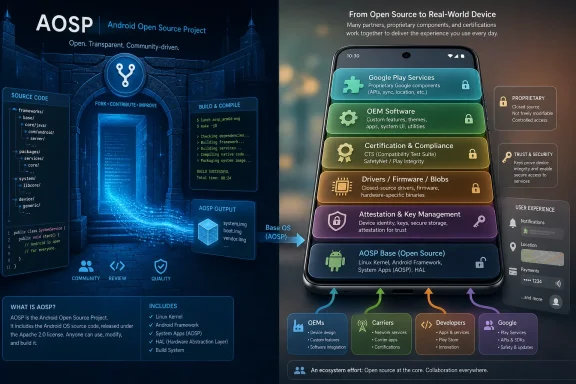 Android’s Open Core Was Built for an Ecosystem, Not for Your Phone
The How-To Geek piece gets the first-order fact right: the core Android operating system is AOSP, the Android Open Source Project. That is the source-code foundation of Android, and it remains the reason Android could spread across phones, tablets, TVs, car systems, handheld gaming devices, Blu-ray players, industrial hardware, and countless embedded products without every manufacturer having to invent a mobile operating system from scratch.Google’s own AOSP documentation is frank about the strategic intent. The company says it opened Android so carriers, OEMs, and developers would have a platform that no single industry player could use as a choke point. That framing matters because it reveals the target audience. AOSP was never primarily a consumer liberation project; it was an ecosystem construction project.
For device makers, that openness is enormously valuable. Samsung or OnePlus can start with a mature operating-system base, adapt it to their hardware, build services and interfaces around it, and ship a differentiated product without paying a per-device Android license for the open-source code itself. A company building a handheld gaming device or a Blu-ray player can use AOSP as the backbone of a product that may not look like a phone at all. That is real openness, not marketing gloss.
But the openness stops being clean as soon as we move from the source tree to the phone in a buyer’s hand. A commercial Android phone is not just the open OS. It includes manufacturer interfaces, preinstalled apps, hardware-specific drivers, camera stacks, modem integrations, biometric systems, security components, firmware, update channels, and contractual Google layers. Those are the pieces users actually touch when they unlock a device, pay at a terminal, receive a push notification, restore a backup, scan for malware, or locate a lost phone.
That is why the phrase “Android is open source” can mislead without being false. AOSP is open in the way a chassis design might be open; the car at the dealership still contains proprietary electronics, locked modules, licensed software, and vendor-controlled diagnostics. The source code exists, but the consumer product is defined by everything bolted to it.
The GPL Opens the Kernel but Not the Device
The Linux kernel is the strongest open-source anchor in Android because it is licensed under the GNU General Public License. As How-To Geek notes, that license requires companies distributing modified versions of the kernel to publish corresponding source for those modifications. This is why Android device makers routinely release kernel source packages, even when nearly everything around them remains closed.The legal line is important. The GPL can force publication of kernel modifications, but it does not magically turn a phone into a hackable object. Hardware makers can comply with the license while still designing boot chains, firmware checks, secure enclaves, and device-locking systems that prevent ordinary users from installing modified software on the device they purchased.
That tension is commonly described as “tivoization,” a term that came from TiVo DVRs. The idea is simple: a company can publish the source code it is legally required to publish while still preventing the customer from running modified builds on the hardware. In that world, the code is open for inspection, compliance, and sometimes upstream improvement, but the device remains locked as a consumer product.
How-To Geek correctly points to the licensing history here. The Linux kernel remains under an older version of the GPL, and Linus Torvalds, who maintains the Linux kernel, has not moved the kernel to a newer license version designed to restrict tivoization. That decision has helped keep Linux palatable to hardware vendors that would otherwise avoid it or wrap it in more hostile architectures. It also means users often receive a legally open kernel inside a practically closed device.
This is one of Android’s central compromises. If the kernel license were more aggressive about user modification rights, some hardware makers might have chosen a different technical base. If it were weaker, Android would have lost one of the few enforceable open-source obligations in the stack. The current bargain gives the ecosystem broad adoption and source availability, but not necessarily user control.
Google Play Services Became the Operating System People Recognize
The most important shift in Android is not that AOSP disappeared. It is that many features users associate with “Android” now live outside AOSP in Google Play Services and related proprietary Google components. How-To Geek names the practical examples: location services, Play Protect security scanning, Find My Device, backup services, push notifications, and developer APIs. Google’s own Play services documentation describes the same broad role in more corporate language, presenting it as core software that provides security, notifications, device-location help, fraud protection, account features, and APIs across certified Android devices.This architecture solved a real problem. Android’s fragmentation was not a theoretical complaint; it was a structural hazard. If every security improvement, location update, or developer-service enhancement had to wait for each phone maker and carrier to ship a full OS update, users would receive improvements slowly or never. Google Play Services gave Google a way to update critical functionality outside the traditional firmware pipeline.
For users, that often feels like progress. Malware scanning improves without waiting for an OEM build. Push messaging works consistently across devices. Lost-device features can improve through Google’s service layer. Developers can target APIs that behave similarly on Samsung, OnePlus, Pixel, and other certified phones.
But the same mechanism that improves reliability also centralizes power. If developers build against Google’s proprietary APIs because those APIs are more capable, more consistent, or simply more widely present, then AOSP alone becomes a thinner target. The open platform remains available, but the app ecosystem increasingly expects the proprietary companion layer.
That is the quiet lock-in. Not a padlock, not a single switch, not one moment when Android stopped being open. Instead, it is a decade-plus drift in which the best-supported path for developers and users runs through Google’s proprietary services, while the purely open path becomes more fragile, more technical, and less compatible with everyday expectations.
The Difference Between AOSP, Certified Android, and De-Googled Android Is the Whole Story
AOSP, a commercial Google-certified Android phone, and a privacy-focused Android distribution such as GrapheneOS all belong to the Android family, but they solve different problems. Treating them as interchangeable is how the openness debate becomes confused.| Android variant | What it is | Who controls the key experience | Google Play Services | App compatibility | Practical tradeoff |
|---|---|---|---|---|---|
| AOSP | The Android Open Source Project core | Google maintains the project, but the code is open | Not included by default | Limited for apps expecting Google APIs | Maximum base openness, minimum consumer polish |
| Certified commercial Android | AOSP plus OEM software and Google services | Google, OEMs, carriers, and hardware vendors | Present on certified Google Android phones | Highest compatibility with mainstream apps | Best usability, least practical openness |
| GrapheneOS-style de-Googled Android | A privacy-focused Android distribution built away from default Google integration | The distribution controls its defaults and security model | Not included by default; GrapheneOS offers sandboxed Google Play | Strong but uneven for apps with Play services or attestation dependencies | More user control, more compatibility management |
Yet GrapheneOS also demonstrates the problem How-To Geek is describing. Its usage guide says sandboxed Google Play is close to fully functional and provides near-complete compatibility with the app ecosystem that depends on Google Play, but it also acknowledges hard edges. Banking apps are a particularly problematic class because many depend on Play services and integrity checks. Some will work; some require sandboxed Google Play; some may refuse to cooperate with an operating system that is not Google-certified.
That distinction is crucial. A de-Googled Android phone can be technically superior for privacy-minded users and still be commercially harder to recommend to the average person if a bank, transit agency, employer app, car system, game, or payment feature assumes Google’s stack. App compatibility becomes the enforcement mechanism. No one has to ban alternative Android distributions if enough important apps quietly degrade on them.
This is why “soft lockout” is a useful phrase. Google does not need to prevent AOSP forks from existing. It only needs the mainstream app economy to depend on proprietary APIs, device certification, and integrity signals that alternative systems must either replicate, route around, or ask developers to support explicitly.
Security Is the Best Argument for Lockdown—and the Most Dangerous One
Google’s strongest argument is security. It is not imaginary. Android’s openness made it more flexible than iOS, but also made it easier for users to install hostile software, for attackers to abuse sideloading workflows, and for low-quality devices to ship with dubious software practices. Play Protect, certified devices, developer verification, app-integrity APIs, and Google-controlled updateable modules all exist in part because the Android ecosystem is too large and too uneven to secure through old-fashioned OS releases alone.That is why this story should not be flattened into nostalgia for a freer Android past. The freer past was also messier. Users installed APKs from random sites. Manufacturers abandoned devices early. Carriers delayed updates. Malware authors exploited social engineering and weak installation flows. Android needed stronger central security services, and Google was the only actor with the reach to provide them across brands.
The problem is that the same tools that protect users can also narrow the platform. A malware-scanning system can become a gatekeeping system. A developer-verification program can be framed as identity assurance while making anonymous, hobbyist, experimental, or politically sensitive software harder to distribute. A device-certification program can improve baseline quality while turning Google’s approval into a practical prerequisite for mainstream compatibility.
Google’s newer Android developer verification push makes that tension explicit. Google’s official materials describe a system in which apps installed on certified Android devices must be registered by developers with verified identities, while Google has also emphasized that sideloading is not going away and that advanced flows remain for power users. The policy is not the same as Apple’s App Store model, but it moves Android closer to a world where installation outside Google Play still passes through a Google-defined trust framework on certified devices.
That phrase “certified devices” is doing a lot of work. Most mainstream Android phones are certified because consumers expect Google Play, Play Protect, Find My Device, and the rest of the Google layer. So a policy aimed at certified devices is, for practical purposes, a policy aimed at the Android phones normal people buy.
AOSP Is Open, but the Development Center of Gravity Is Not
Google also controls Android through timing and process. AOSP is public, but Android development is not a purely community-driven bazaar. Google oversees core development, decides what lands, manages release branches, and works internally before pushing platform source to public AOSP branches. Its current AOSP documentation points developers towardandroid-latest-release, says aosp-main became read-only on March 27, 2025, and states that effective in 2026 Google publishes source code to AOSP in Q2 and Q4 to align with its trunk-stable model.That is not inherently scandalous. A platform at Android’s scale requires coordination. Chip vendors, phone makers, app developers, carriers, regulators, and security teams all depend on predictable release engineering. A fully chaotic public process would be unusable for the companies that actually ship phones.
But it does reinforce the broader point. AOSP is open source, yet Google remains the project’s maintainer and release conductor. External contributors can propose changes, but Google reviews and decides whether accepted changes are cherrypicked internally. The public codebase is a release mechanism and collaboration surface, not the full center of Android’s day-to-day power.
For hobbyists and independent OS projects, that means openness arrives on Google’s schedule and within Google’s architecture. For OEMs, that is acceptable because they have commercial relationships, hardware roadmaps, and access paths ordinary outsiders lack. For users who imagine Android as a community-owned platform in the Linux desktop sense, it is a rude discovery.
Android is open in the way a standard can be open while its dominant implementation remains controlled by the company with the market, services, certification, and developer gravity. The code matters, but the ecosystem matters more.
The Samsung Example Shows How Far the Phone Is from the Source Tree
The How-To Geek article embeds a Samsung Galaxy S26 Ultra product card, and even though that card is not the analytical heart of the piece, it accidentally illustrates the thesis better than a paragraph of abstraction could. The listed device is a Samsung-branded Android phone with a Snapdragon 8 Elite Gen 5, a 6.9-inch Dynamic Super AMOLED 2X display, 12 or 16 GB of RAM, 256GB, 512GB, or 1TB of storage, a 5,000 mAh battery, a 12MP f/2.2 front camera, a multi-camera rear system, 60W wired Super Fast Charging, 25W wireless charging, and an S-Pen.That is not “AOSP in your pocket.” It is a highly integrated consumer electronics product built from Google software, Samsung software, Qualcomm platform work, camera tuning, display calibration, charging systems, stylus support, security subsystems, proprietary apps, and cloud services. The fact that its operating system field says Android is true but radically incomplete.
This is why the open-source discussion often feels disconnected from how phones are sold. Consumers buy camera quality, battery life, app compatibility, AI features, update promises, carrier support, mobile payments, messaging reliability, and warranty service. Almost none of those are delivered by AOSP alone. They are delivered by the proprietary stack around it.
OEMs also have little incentive to make the full product open. Samsung wants differentiation. OnePlus wants differentiation. Chip vendors want to protect hardware enablement and intellectual property. Carriers want compliance and provisioning control. Google wants consistent services and security. The consumer may want ownership, but ownership is only one pressure among many, and often not the strongest one.
So when a buyer asks whether their Android phone is open source, the honest answer is layered. The ancestry is open. The core platform is open. The shipped phone is a proprietary product using open-source foundations.
App Developers Follow the APIs That Work
Developers are rational. They use the APIs that solve problems, reach users, reduce support costs, and pass security checks. If Google Play Services provides better location behavior, push messaging, account integration, app integrity, payment-adjacent trust, or anti-abuse tooling than the bare open platform, developers will adopt it. Once enough developers do that, Google’s proprietary layer becomes part of the de facto Android platform.This is how lock-in becomes invisible. No single developer thinks, “I will undermine Android openness today.” A banking app adds integrity checks because fraud is expensive. A messaging app uses Google’s notification transport because timely delivery matters. A game depends on Play Games Services because its users expect achievements, licensing, cloud saves, or account features. A mobility app uses Google location APIs because battery-efficient location is hard.
Each decision is defensible. Together, they produce an Android ecosystem where a device without Google services feels like a compatibility experiment. That does not mean every app fails; GrapheneOS’s sandboxed Google Play work exists precisely because compatibility can be preserved in many cases. But it means the burden shifts to alternative OS projects and users, not to mainstream developers.
The most consequential part is attestation. Security-sensitive apps increasingly want to know whether the app, OS, and device environment are trusted. That instinct is understandable for banks and payment systems. But if “trusted” collapses into “Google-certified,” then a well-secured alternative operating system can be treated as suspect simply because it is not blessed through the mainstream certification channel.
GrapheneOS’s documentation argues that developers can use Android’s hardware attestation directly and permit properly signed alternative operating systems. That is the more open path. But the easier path is to rely on Google’s services and certification signals, and easy paths tend to win.
The Windows Analogy Is Not Perfect, but IT Pros Should Recognize the Pattern
WindowsForum readers should recognize the shape of this problem even if the mobile stack is different. Microsoft Windows is not open source, but Windows admins understand the distinction between the OS, Microsoft services, OEM drivers, firmware, security baselines, app distribution, identity providers, and management tooling. A Windows PC is not justntoskrnl.exe; it is the whole operational environment around it.Android’s twist is that the base can be open while the operational environment is not. That makes the rhetoric more confusing. With Windows, no one expects the platform to be open. With Android, people do, because the claim is historically and technically grounded. But in both worlds, control often lives in update channels, trust frameworks, driver models, account systems, management policies, app stores, endpoint security, and hardware roots of trust.
For enterprise IT, this matters more than ideology. If your organization deploys Android devices, the question is not “Is Android open source?” It is “Which Android are we depending on?” A fleet of Samsung phones with Google Mobile Services is a very different operational object from an AOSP-derived kiosk, a GrapheneOS device, a ruggedized scanner, or an uncertified tablet sourced through a low-cost channel.
The risk profile changes accordingly. Certified commercial Android gives app compatibility, Play Protect, enterprise management hooks, and predictable user expectations. AOSP-based devices can be excellent for tightly controlled appliances but may require custom update infrastructure, app curation, and security validation. De-Googled devices can reduce some Google data flows and improve user control, but they may require testing against banking, identity, messaging, VPN, MDM, and line-of-business apps that assume Google services.
The lesson for IT is not to pick a side in the open-source debate. It is to stop treating “Android” as one thing.
Timeline
March 27, 2025 — Google’s AOSP documentation saysaosp-main became read-only, pushing contributors toward the newer android-latest-release workflow.Effective in 2026 — Google says it publishes source code to AOSP in Q2 and Q4 to align with its trunk-stable development model and ecosystem stability goals.
March 2026 — Google’s Android developer verification materials describe the broader rollout of developer identity verification through Play Console and Android Developer Console.
September 30, 2026 — Google’s developer verification timeline says apps must be registered by verified developers to be installed and updated on certified Android devices in Brazil, Indonesia, Singapore, and Thailand.
The Openness Debate Is Really About Who Gets Defaults
The most powerful position in technology is not always ownership of code. It is ownership of defaults. Defaults decide which services run, which APIs developers target, which warnings users see, which devices are certified, which stores feel safe, which apps pass checks, and which alternatives require explanation.Google’s genius with Android was to leave the base open while making the default experience compelling. AOSP gave manufacturers an escape from Apple’s integrated model. Google Play Services gave users and developers a consistent layer across an otherwise chaotic hardware market. Certification gave Google a way to maintain baseline compatibility and security. Each layer made sense in isolation.
Over time, however, the defaults hardened into dependency. A user can choose a de-Googled device, but then must understand sandboxed Play services, banking-app compatibility, notification behavior, app-store choices, and attestation limits. A developer can avoid proprietary Google APIs, but may sacrifice convenience, reliability, or market expectations. An OEM can use AOSP without Google, but will struggle to sell a mainstream phone that lacks the Google app and service bundle consumers expect.
That is not the end of openness, but it is a narrowing of practical openness. The right to fork matters less if the fork cannot run the apps people need. The right to inspect source matters less if the device will not boot modified software. The right to sideload matters less if sideloaded apps must still fit a Google-defined verification regime on certified devices.
This is where Google’s security argument and critics’ lock-in argument meet. Google can accurately say it is protecting users from malware and fraud. Critics can accurately say the protection increases Google’s leverage over software distribution. Both can be true because platform security and platform control often use the same machinery.
Action checklist for admins
- Inventory Android fleets by category: certified commercial Android, AOSP-derived appliance, de-Googled device, ruggedized OEM build, or uncertified device.
- Test line-of-business apps against Google Play Services dependencies, push notifications, location APIs, Play Protect assumptions, and device-integrity checks.
- For privacy-focused or de-Googled deployments, validate banking, identity, VPN, MDM, authenticator, and emergency communications workflows before rollout.
- Require vendors to document kernel-source availability, update commitments, bootloader policy, security-patch cadence, and Google certification status.
- Review sideloading and third-party-store workflows in light of Google’s developer verification direction, especially for internally distributed APKs.
- Treat “Android support” in procurement language as insufficient; specify the services, certification status, management APIs, and update model required.
The Real Split Is Between Open Source as Code and Open Source as Power
Open source can mean many things. It can mean visible source code. It can mean the right to modify. It can mean the ability to distribute a fork. It can mean the ability to install modified software on owned hardware. It can mean an ecosystem where alternatives have a fair chance to interoperate. Android satisfies some of those meanings and frustrates others.AOSP gives the world visible, modifiable, redistributable code. That is not trivial. Without AOSP, the mobile market would likely be more vertically closed, and countless devices would either not exist or would run weaker proprietary systems. Android’s open base remains one of the most important open-source success stories in consumer technology.
But power has migrated upward. The kernel license opens some modifications, while boot policies may restrict installation. The OS source is public, while Google services carry many expected features. App developers can target open APIs, while the market rewards Google-integrated ones. Users can sideload, while certified-device policies increasingly formalize which developers are trusted. Alternative distributions can exist, while mainstream apps may treat them as second-class environments.
That is why How-To Geek’s headline lands: Android is open source, but your phone is not. The missing clause is that your phone was never designed to be merely an open-source artifact. It is a commercial endpoint in a platform economy.
The Practical Shape of Android’s Openness
The useful conclusion is not that Android is secretly closed or that Google has betrayed open source. The useful conclusion is that Android’s openness is real at the foundation and conditional at the point of use. Anyone making decisions about phones, fleets, apps, or alternative OSes should reason from that reality rather than from slogans.- AOSP is the open core, not the full consumer Android experience.
- Google Play Services supplies many features users and developers think of as Android itself.
- OEM phones from companies such as Samsung and OnePlus add large proprietary layers above AOSP.
- The Linux kernel’s GPL obligations expose some source code, but do not guarantee installable user modifications.
- De-Googled distributions such as GrapheneOS prove alternatives can exist, but app compatibility and attestation remain hard constraints.
- For IT buyers, certification status, update policy, service dependencies, and app compatibility matter more than the abstract Android brand.
References
- Primary source: How-To Geek
Published: Thu, 09 Jul 2026 17:05:20 GMT
Loading…
www.howtogeek.com - Related coverage: discuss.grapheneos.org
Loading…
discuss.grapheneos.org - Related coverage: source.android.com
Loading…
source.android.com - Official source: developers.google.com
Loading…
developers.google.com - Related coverage: privacygear.nl
Loading…
privacygear.nl - Official source: support.google.com
Loading…
support.google.com
- Related coverage: trucepriv.co
- Related coverage: techradar.com
Loading…
www.techradar.com - Related coverage: androidcentral.com
Loading…
www.androidcentral.com - Related coverage: tomsguide.com
Loading…
www.tomsguide.com - Related coverage: android-developers.googleblog.com
Android Developers Blog: Android developer verification: Rolling out to all developers on Play Console and Android Developer Console
News and insights on the Android platform, developer tools, and events.android-developers.googleblog.com
- Related coverage: developer.android.com
Loading…
developer.android.com - Related coverage: android.com
Android – Certified
The Android team at Google ensures certified devices are secured and working well out of the box. Learn about certification on Android devices.www.android.com - Related coverage: androidheadlines.com
Loading…
www.androidheadlines.com - Related coverage: digitalchildhoodinstitute.org
- Related coverage: t3.com
"Sideloading is really important. It’s not going away": Android boss reassures phone users they can still install apps from wherever they want | T3
Android will continue to be an open platform, but with more protectionswww.t3.com