

Microsoft plans to bring Microsoft Purview Insider Risk Management’s Data Security Triage Agent summaries into the Microsoft Defender alert queue for worldwide standard multi-tenant environments. According to Microsoft 365 Roadmap ID 567472, preview availability is scheduled for August 2026 and general availability is scheduled for December 2026.
The change does not replace Purview’s investigation tools or create a new insider-risk detection system. It brings the agent’s interpretation of an Insider Risk Management alert into the console where security operations teams may already be reviewing alerts. That distinction matters because the practical bottleneck in insider-risk response is often not collecting another signal, but getting enough context to the appropriate analyst before an alert is dismissed, escalated incorrectly, or delayed by organizational handoffs.
Microsoft is effectively testing whether bringing a concise summary to the receiving analyst can make the initial review faster without blurring the line between triage and investigation.
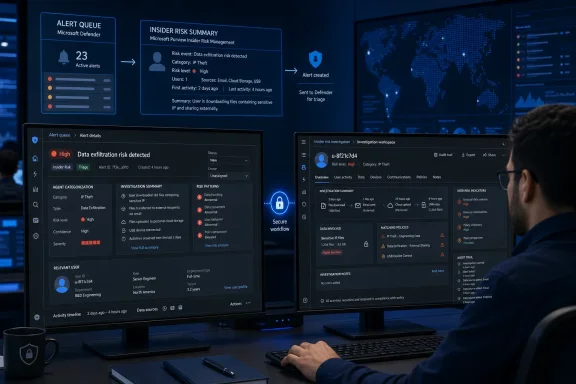
The feature’s full roadmap title—Microsoft Purview: Insider Risk Management - DS Triage Agent for IRM available in Defender—is awkward, but its stated purpose is straightforward. For Insider Risk Management alerts handled by the Data Security Triage Agent, Microsoft plans to make the resulting summary available in the Defender alert queue.
According to the Microsoft 365 roadmap entry, the information presented in Defender will include the agent’s categorization, an investigation summary, identified risk patterns, and relevant user details. The roadmap does not describe this as a transfer of the complete Insider Risk Management investigation experience into Defender.
Instead, the planned integration places selected agent output alongside the alert so that an analyst can begin assessing its significance without first moving to another portal. Whether the summary provides enough context to support a sound initial decision—and how much context is visible to each role—will need to be validated during the preview.
The full investigation remains in Microsoft Purview. Analysts who need to examine the underlying alert, review available activity and risk details, or follow the organization’s governed Insider Risk Management process will still use the Purview experience.
That division is not necessarily a weakness. A security operations center and an insider-risk investigation team have overlapping interests, but they do not always have identical authority, training, or responsibilities. Defender serves security operations, while Purview’s Insider Risk Management experience addresses sensitive user activity and policy-defined risks within a specialized investigative and governance context.
The important preview question is whether the handoff between the two environments feels like a deliberate escalation rather than another portal boundary. A summary in Defender will be valuable if it helps an authorized analyst decide whether deeper Purview review is warranted. It will be less useful if it is too vague to guide the next step or so definitive that analysts mistake it for a completed investigation.
August 2026 — Microsoft schedules preview availability for the Web platform in worldwide standard multi-tenant environments.
December 2026 — Microsoft schedules general availability for the same platform and cloud instance.
These are roadmap targets, not guarantees of tenant-specific deployment on a particular day. The roadmap entry does not establish equivalent dates for other cloud environments.
It also does not settle feature-specific licensing, administrative activation, default activation, permission mappings, or the exact tenant rollout sequence. Those remain roadmap unknowns unless Microsoft publishes additional documentation specifically covering the Defender integration described by Roadmap ID 567472.
The roadmap identifies four summary components:
Agent categorization could provide an immediate indication of how the triage agent has interpreted the alert. The investigation summary could compress available information into a more readable account. Identified risk patterns could help explain why multiple activities matter together. Relevant user details could provide context needed to interpret the alert.
Those are the expected functions suggested by the feature description, not yet validated operational outcomes.
A raw policy alert may show that an event met configured conditions without communicating the full sequence or business context. Copying or moving files, for example, can be associated with ordinary project work, an approved transfer, an unusual but legitimate assignment, or the collection of sensitive material for an unauthorized purpose. The event alone may not resolve which explanation is correct.
Patterns can therefore be more useful than isolated events. A sequence involving access to sensitive material and movement to an unexpected destination may deserve closer review even when no individual event is conclusive. Microsoft identifies intellectual-property theft, data leakage, and security violations as examples of the risks addressed by Insider Risk Management.
The planned summary could help an analyst recognize those patterns earlier, but categorization must not become an unearned verdict. A machine-generated label can influence attention and work order; it cannot establish intent or misconduct by itself.
The August preview should reveal whether Microsoft clearly distinguishes observed activity, inferred patterns, and the agent’s categorization. If those elements are blended into one confident narrative, analysts may find it difficult to tell what the system observed from what it concluded.
For overloaded teams, a concise summary could still be consequential. The first few minutes of review often determine whether an alert is assigned, deferred, referred to another team, or closed. If the summary communicates the relevant pattern clearly, it may reduce duplicate reading and help a Defender analyst recognize when specialist handling is appropriate.
If it is vague, repetitive, or overconfident, it may simply add another block of generated text to an already crowded alert experience. The preview’s real test is not whether Defender displays the four components. It is whether authorized reviewers can use them to make better initial decisions.
That creates a potential two-stage workflow, but organizations should treat its exact behavior as a preview-validation question rather than an established operating model.
The desired workflow may be that Defender helps a security analyst understand why an IRM alert needs attention, while Purview supports the deeper investigation. The roadmap does not yet provide enough operational detail to guarantee that this is how every tenant, role, or alert type will behave.
That uncertainty is exactly why preview testing matters.
A summary may be useful to a SOC analyst without providing everything required for an Insider Risk Management investigator. Conversely, information that is appropriate for a specialist investigation may be unnecessary or overly sensitive for a broad group of security operators.
Organizations should therefore avoid designing final runbooks around assumptions about the interface. They should first test:
Putting IRM agent summaries in the Defender alert queue brings those operating models into closer contact. Security analysts who encounter the alert may receive more context about an Insider Risk Management pattern before deciding whether to involve a specialist team.
That could lower the practical cost of asking whether an alert involving a user or sensitive activity deserves deeper review. It could also expose gaps in ownership that were previously hidden by the separation between portals.
Consider an alert associated with unusual movement of sensitive material. A Defender reviewer may need to determine whether the event belongs in the active security workload, whether it should be referred to an Insider Risk Management investigator, or whether the available information is insufficient to decide.
The planned summary may make that initial assessment easier. It will not necessarily determine whether the activity was authorized, whether the user had a legitimate business reason, whether the account was operating normally, or whether organizational context outside Microsoft’s platforms changes the interpretation.
This is why the feature should not be reduced to “AI summaries arrive in another portal.” The material change is who may encounter the agent’s interpretation and at what point in the review process.
That broader exposure requires clear ownership. Organizations should determine whether all analysts who can access the relevant Defender queue need to see IRM summary information. They should also decide when a security analyst must stop reviewing and transfer responsibility to an authorized Insider Risk Management investigator.
The goal is not to make every SOC analyst an insider-risk investigator. It is to prevent potentially important context from being overlooked while preserving the organization’s investigative boundaries.
Roadmap ID 567472 does not provide the feature-specific permission map needed to settle those questions. Nor does it confirm whether existing role assignments will automatically expose every summary component. Until Microsoft provides more detail or tenants can test the preview, access behavior should be treated as unknown.
That problem is especially important in insider-risk work. The same behavior can have multiple explanations, and relevant context may exist outside the security platform. An employee may be changing roles, completing an approved transfer, responding to a customer, following an unusual assignment, or acting under instructions that are not visible in the alert.
A useful summary would identify the observed sequence, the pattern detected by the agent, and the limits of the available context. Whether the Defender presentation will make those distinctions clear is a preview question.
Microsoft’s statement that the full investigation remains in Purview establishes an important product boundary. It means the Defender summary should not be treated as a replacement for the deeper investigative experience. Organizations do not need to repeat that warning in every runbook step, but they should build the distinction into analyst training and escalation procedures.
Preview participants should test whether the wording encourages appropriate skepticism. Questions should include:
The roadmap description says the summary will include relevant user details, but it does not define the precise content of those details for every scenario. It also does not publish a feature-specific matrix showing how individual Defender and Purview permissions will govern each summary component.
Organizations should not assume that every security operator either will or should see the same information.
Existing pseudonymization, role-based access, and auditing expectations provide the baseline for planning, but their behavior in this specific cross-product experience needs to be verified. The preview should be used to observe what each test role actually sees rather than relying on assumptions based on job title or broad portal access.
A carefully controlled summary could reduce the need to copy alert information into spreadsheets, tickets, email, or chat. That would be a practical benefit. The opposite outcome is also possible if analysts cannot determine who owns the alert or how to refer it, causing sensitive information to be repeated across informal channels.
Testing should therefore include the handoff itself:
The roadmap record lists the Web platform, worldwide standard multi-tenant environments, Preview and General Availability release phases, and a status of in development. It schedules preview for August 2026 and general availability for December 2026.
The record also carries the exact creation and last-modified timestamp of July 9, 2026 at 23:00:39.7653153 UTC. That timestamp should be attributed specifically to the roadmap record. It should not be used to imply that Microsoft published feature-specific operational documentation on the same date.
Several implementation questions remain unanswered by the supplied roadmap facts:
Administrators should monitor Roadmap ID 567472 for changes and wait for feature-specific Microsoft material before treating licensing, activation, or permissions as settled. If Microsoft later publishes deployment instructions, those instructions should take precedence over assumptions based on other Purview agents or adjacent Defender integrations.
The underlying program also matters. A Defender summary cannot compensate for unclear ownership, poorly designed Insider Risk Management policies, or an escalation process that exists only informally. The integration may reduce friction between teams, but it cannot decide which team is authorized to investigate or what organizational action is appropriate.
A useful plan should include intellectual-property theft, data leakage, security violations, and benign activity that may superficially resemble one of those risks. The goal is not to prove that the agent can generate text. It is to determine whether the summary helps the receiving analyst choose the correct next step.
Teams should compare the initial Defender interpretation with what an authorized investigator later finds in Purview. The important measures are not merely page views or feature adoption. More useful questions include:
Another useful exercise is parallel review. Give one analyst the planned Defender workflow and another the established Purview-centered process, while ensuring both are appropriately authorized. Compare their conclusions, time spent, escalation choices, and the context each considered.
A faster decision is not automatically a better one. The feature succeeds only if it improves the quality or timeliness of triage without encouraging unsupported conclusions.
Teams also need a fallback. If the summary is unavailable, unclear, or inconsistent with the deeper investigation, reviewers should know who takes ownership and how to continue. AI-assisted triage is still an operational dependency, and operational dependencies need failure paths.
According to Microsoft 365 Roadmap ID 567472:
The opportunity is real: an analyst may receive useful insider-risk context earlier in the alert-review process. The risk is equally real: a concise narrative may be mistaken for a complete and verified finding.
Organizations do not need to resolve every implementation detail before August 2026. They do need to know who owns the workflow, who may see the information, how access will be reviewed, and what evidence will justify escalation.
Microsoft is moving the summary closer to the security queue. The preview will determine whether that shorter distance produces better decisions.
The change does not replace Purview’s investigation tools or create a new insider-risk detection system. It brings the agent’s interpretation of an Insider Risk Management alert into the console where security operations teams may already be reviewing alerts. That distinction matters because the practical bottleneck in insider-risk response is often not collecting another signal, but getting enough context to the appropriate analyst before an alert is dismissed, escalated incorrectly, or delayed by organizational handoffs.
Microsoft is effectively testing whether bringing a concise summary to the receiving analyst can make the initial review faster without blurring the line between triage and investigation.
 Microsoft Is Moving the Interpretation, Not the Investigation
The feature’s full roadmap title—Microsoft Purview: Insider Risk Management - DS Triage Agent for IRM available in Defender—is awkward, but its stated purpose is straightforward. For Insider Risk Management alerts handled by the Data Security Triage Agent, Microsoft plans to make the resulting summary available in the Defender alert queue.According to the Microsoft 365 roadmap entry, the information presented in Defender will include the agent’s categorization, an investigation summary, identified risk patterns, and relevant user details. The roadmap does not describe this as a transfer of the complete Insider Risk Management investigation experience into Defender.
Instead, the planned integration places selected agent output alongside the alert so that an analyst can begin assessing its significance without first moving to another portal. Whether the summary provides enough context to support a sound initial decision—and how much context is visible to each role—will need to be validated during the preview.
The full investigation remains in Microsoft Purview. Analysts who need to examine the underlying alert, review available activity and risk details, or follow the organization’s governed Insider Risk Management process will still use the Purview experience.
That division is not necessarily a weakness. A security operations center and an insider-risk investigation team have overlapping interests, but they do not always have identical authority, training, or responsibilities. Defender serves security operations, while Purview’s Insider Risk Management experience addresses sensitive user activity and policy-defined risks within a specialized investigative and governance context.
The important preview question is whether the handoff between the two environments feels like a deliberate escalation rather than another portal boundary. A summary in Defender will be valuable if it helps an authorized analyst decide whether deeper Purview review is warranted. It will be less useful if it is too vague to guide the next step or so definitive that analysts mistake it for a completed investigation.
Timeline
July 9, 2026 at 23:00:39.7653153 UTC — The Microsoft 365 roadmap record shows Roadmap ID 567472 as created and last modified at this timestamp. Microsoft lists the feature as in development.August 2026 — Microsoft schedules preview availability for the Web platform in worldwide standard multi-tenant environments.
December 2026 — Microsoft schedules general availability for the same platform and cloud instance.
These are roadmap targets, not guarantees of tenant-specific deployment on a particular day. The roadmap entry does not establish equivalent dates for other cloud environments.
It also does not settle feature-specific licensing, administrative activation, default activation, permission mappings, or the exact tenant rollout sequence. Those remain roadmap unknowns unless Microsoft publishes additional documentation specifically covering the Defender integration described by Roadmap ID 567472.
What to do now
- Identify who owns Insider Risk Management in Purview and who owns alert handling in Defender.
- Review the organization’s expectations for pseudonymization, role-based access, and auditing.
- Prepare a preview test plan covering access, summary quality, escalation, and deeper Purview review.
- Monitor Microsoft 365 Roadmap ID 567472 for date, scope, and rollout changes.
Practical admin checklist
- Name the Purview owner, Defender owner, and decision-maker for cross-team escalation.
- Define which preview participants need to review IRM alerts in Defender and which investigators need access to the complete Purview experience.
- Review existing pseudonymization, role-based access, and audit expectations before testing broader visibility.
- Write down the conditions under which a Defender reviewer should refer an alert to the Insider Risk Management team.
- Build representative tests around intellectual-property theft, data leakage, security violations, and benign activity that could resemble risky behavior.
- Compare the Defender summary with the underlying Purview investigation material available to authorized testers.
- Record missing context, ambiguous wording, overconfident categorization, and access-control surprises.
- Test what happens when the summary is unavailable, delayed, incomplete, or inconsistent with an investigator’s later findings.
- Monitor Roadmap ID 567472 throughout preview planning and before any production process changes.
A Four-Part Summary Could Change the First Five Minutes
Roadmap announcements often describe interface changes that sound larger than they are. This one deserves attention because the information Microsoft plans to surface sits at the point where an analyst decides whether an alert requires deeper review.The roadmap identifies four summary components:
- Agent categorization
- An investigation summary
- Identified risk patterns
- Relevant user details
Agent categorization could provide an immediate indication of how the triage agent has interpreted the alert. The investigation summary could compress available information into a more readable account. Identified risk patterns could help explain why multiple activities matter together. Relevant user details could provide context needed to interpret the alert.
Those are the expected functions suggested by the feature description, not yet validated operational outcomes.
A raw policy alert may show that an event met configured conditions without communicating the full sequence or business context. Copying or moving files, for example, can be associated with ordinary project work, an approved transfer, an unusual but legitimate assignment, or the collection of sensitive material for an unauthorized purpose. The event alone may not resolve which explanation is correct.
Patterns can therefore be more useful than isolated events. A sequence involving access to sensitive material and movement to an unexpected destination may deserve closer review even when no individual event is conclusive. Microsoft identifies intellectual-property theft, data leakage, and security violations as examples of the risks addressed by Insider Risk Management.
The planned summary could help an analyst recognize those patterns earlier, but categorization must not become an unearned verdict. A machine-generated label can influence attention and work order; it cannot establish intent or misconduct by itself.
The August preview should reveal whether Microsoft clearly distinguishes observed activity, inferred patterns, and the agent’s categorization. If those elements are blended into one confident narrative, analysts may find it difficult to tell what the system observed from what it concluded.
For overloaded teams, a concise summary could still be consequential. The first few minutes of review often determine whether an alert is assigned, deferred, referred to another team, or closed. If the summary communicates the relevant pattern clearly, it may reduce duplicate reading and help a Defender analyst recognize when specialist handling is appropriate.
If it is vague, repetitive, or overconfident, it may simply add another block of generated text to an already crowded alert experience. The preview’s real test is not whether Defender displays the four components. It is whether authorized reviewers can use them to make better initial decisions.
Defender Becomes a Front Door, but Purview Keeps the Case File
The significance of Roadmap ID 567472 is not that Microsoft is merging Defender and Purview into one investigative product. The roadmap describes a narrower change: selected output from the IRM Data Security Triage Agent will become available in the Defender alert queue, while the full investigation continues in Purview.That creates a potential two-stage workflow, but organizations should treat its exact behavior as a preview-validation question rather than an established operating model.
| Investigation layer | Planned Defender experience | Purview experience |
|---|---|---|
| Primary purpose in this workflow | Initial review of an IRM alert with agent-generated context | Complete Insider Risk Management investigation |
| Information confirmed by the roadmap | Categorization, investigation summary, risk patterns, and relevant user details | Full investigation remains available in Purview |
| Decision to validate during preview | Whether the summary is sufficient to refer, defer, or continue reviewing an alert | Whether deeper review confirms, changes, or rejects the initial interpretation |
| Access question | Which Defender roles can see each summary component | Which authorized roles can conduct the full investigation |
| Governance question | How much sensitive context should appear during initial review | How evidence, identity, and investigative actions are controlled |
That uncertainty is exactly why preview testing matters.
A summary may be useful to a SOC analyst without providing everything required for an Insider Risk Management investigator. Conversely, information that is appropriate for a specialist investigation may be unnecessary or overly sensitive for a broad group of security operators.
Organizations should therefore avoid designing final runbooks around assumptions about the interface. They should first test:
- Which user details appear in Defender.
- Whether pseudonymization is preserved as expected.
- Which roles can view the summary.
- Whether summary access implies any access to the deeper Purview material.
- How clearly Defender directs an authorized user toward the complete investigation.
- Whether the summary changes after additional activity or investigator action.
- How an analyst can distinguish agent output from underlying alert details.
Insider Risk Stops Being a Purview-Only Conversation
The deeper significance of the release is organizational rather than cosmetic. Insider Risk Management sits at the boundary between cybersecurity, compliance, data governance, privacy, legal review, and employee relations. Defender, by contrast, is commonly associated with the SOC and technical security response.Putting IRM agent summaries in the Defender alert queue brings those operating models into closer contact. Security analysts who encounter the alert may receive more context about an Insider Risk Management pattern before deciding whether to involve a specialist team.
That could lower the practical cost of asking whether an alert involving a user or sensitive activity deserves deeper review. It could also expose gaps in ownership that were previously hidden by the separation between portals.
Consider an alert associated with unusual movement of sensitive material. A Defender reviewer may need to determine whether the event belongs in the active security workload, whether it should be referred to an Insider Risk Management investigator, or whether the available information is insufficient to decide.
The planned summary may make that initial assessment easier. It will not necessarily determine whether the activity was authorized, whether the user had a legitimate business reason, whether the account was operating normally, or whether organizational context outside Microsoft’s platforms changes the interpretation.
This is why the feature should not be reduced to “AI summaries arrive in another portal.” The material change is who may encounter the agent’s interpretation and at what point in the review process.
That broader exposure requires clear ownership. Organizations should determine whether all analysts who can access the relevant Defender queue need to see IRM summary information. They should also decide when a security analyst must stop reviewing and transfer responsibility to an authorized Insider Risk Management investigator.
The goal is not to make every SOC analyst an insider-risk investigator. It is to prevent potentially important context from being overlooked while preserving the organization’s investigative boundaries.
Roadmap ID 567472 does not provide the feature-specific permission map needed to settle those questions. Nor does it confirm whether existing role assignments will automatically expose every summary component. Until Microsoft provides more detail or tenants can test the preview, access behavior should be treated as unknown.
The Agent Must Preserve Uncertainty, Not Erase It
Generated security summaries are attractive because they promise to turn a large amount of activity into a readable narrative. Narratives are easier to process than event streams, but they also carry rhetorical force. Once events are arranged into a coherent story, the story can appear more certain than the underlying information warrants.That problem is especially important in insider-risk work. The same behavior can have multiple explanations, and relevant context may exist outside the security platform. An employee may be changing roles, completing an approved transfer, responding to a customer, following an unusual assignment, or acting under instructions that are not visible in the alert.
A useful summary would identify the observed sequence, the pattern detected by the agent, and the limits of the available context. Whether the Defender presentation will make those distinctions clear is a preview question.
Microsoft’s statement that the full investigation remains in Purview establishes an important product boundary. It means the Defender summary should not be treated as a replacement for the deeper investigative experience. Organizations do not need to repeat that warning in every runbook step, but they should build the distinction into analyst training and escalation procedures.
Preview participants should test whether the wording encourages appropriate skepticism. Questions should include:
- Does the summary describe events and patterns separately from conclusions?
- Does categorization appear as an agent judgment rather than a proven finding?
- Can reviewers identify what information supports the summary?
- Is missing context apparent, or does the narrative sound complete?
- Do investigators frequently reach a different interpretation after deeper Purview review?
- Are serious cases understated because the summary lacks business context?
- Are benign cases presented with language that implies intent?
Privacy and Access Need to Be Tested Where the Context Appears
Insider-risk information can expose patterns of user behavior and relationships among people, files, devices, and sensitive business processes. Bringing a summary into another operational surface changes where that context may be encountered, even if the complete investigation remains in Purview.The roadmap description says the summary will include relevant user details, but it does not define the precise content of those details for every scenario. It also does not publish a feature-specific matrix showing how individual Defender and Purview permissions will govern each summary component.
Organizations should not assume that every security operator either will or should see the same information.
Existing pseudonymization, role-based access, and auditing expectations provide the baseline for planning, but their behavior in this specific cross-product experience needs to be verified. The preview should be used to observe what each test role actually sees rather than relying on assumptions based on job title or broad portal access.
A carefully controlled summary could reduce the need to copy alert information into spreadsheets, tickets, email, or chat. That would be a practical benefit. The opposite outcome is also possible if analysts cannot determine who owns the alert or how to refer it, causing sensitive information to be repeated across informal channels.
Testing should therefore include the handoff itself:
- A Defender analyst receives an IRM alert.
- The analyst reviews the available agent summary.
- The analyst decides that specialist review is required.
- Ownership transfers to an authorized Purview investigator.
- The receiving investigator can locate the complete investigation.
- Both teams can establish who reviewed the information and what decision followed.
The Roadmap Leaves Important Operational Questions Open
Microsoft 365 Roadmap ID 567472 provides a feature description, release targets, platform, cloud scope, and development status. It is not a deployment guide.The roadmap record lists the Web platform, worldwide standard multi-tenant environments, Preview and General Availability release phases, and a status of in development. It schedules preview for August 2026 and general availability for December 2026.
The record also carries the exact creation and last-modified timestamp of July 9, 2026 at 23:00:39.7653153 UTC. That timestamp should be attributed specifically to the roadmap record. It should not be used to imply that Microsoft published feature-specific operational documentation on the same date.
Several implementation questions remain unanswered by the supplied roadmap facts:
- Whether additional licensing will be required for this specific Defender integration.
- Whether it will be enabled automatically or require an administrator to activate it.
- Whether the underlying triage agent must be configured in a particular way.
- Which Defender and Purview permissions expose each summary component.
- Whether existing roles will inherit access.
- Whether rollout will occur simultaneously for all eligible tenants.
- How quickly summaries will appear after an alert is generated or processed.
- Whether summaries will update as the underlying investigation changes.
- How the experience will behave for unsupported, incomplete, or unavailable agent output.
- Whether Microsoft will provide tenant-specific notices before deployment.
Administrators should monitor Roadmap ID 567472 for changes and wait for feature-specific Microsoft material before treating licensing, activation, or permissions as settled. If Microsoft later publishes deployment instructions, those instructions should take precedence over assumptions based on other Purview agents or adjacent Defender integrations.
The underlying program also matters. A Defender summary cannot compensate for unclear ownership, poorly designed Insider Risk Management policies, or an escalation process that exists only informally. The integration may reduce friction between teams, but it cannot decide which team is authorized to investigate or what organizational action is appropriate.
Preview Testing Should Focus on Decisions, Not Screenshots
The scheduled August 2026 preview gives eligible organizations an opportunity to evaluate the workflow before the December 2026 general-availability target. Testing should begin with representative decisions rather than an interface tour.A useful plan should include intellectual-property theft, data leakage, security violations, and benign activity that may superficially resemble one of those risks. The goal is not to prove that the agent can generate text. It is to determine whether the summary helps the receiving analyst choose the correct next step.
Teams should compare the initial Defender interpretation with what an authorized investigator later finds in Purview. The important measures are not merely page views or feature adoption. More useful questions include:
- Did the summary shorten the time needed to identify the correct owner?
- Did it cause appropriate referrals into Purview?
- Did investigators frequently reverse the initial categorization?
- Did the summary omit context that materially changed the assessment?
- Did reviewers mistake agent language for verified evidence?
- Did users see more identity or activity information than their responsibilities required?
- Could reviewers continue when the summary was absent or incomplete?
- Did the integration reduce duplicate review, or merely move it between portals?
Another useful exercise is parallel review. Give one analyst the planned Defender workflow and another the established Purview-centered process, while ensuring both are appropriately authorized. Compare their conclusions, time spent, escalation choices, and the context each considered.
A faster decision is not automatically a better one. The feature succeeds only if it improves the quality or timeliness of triage without encouraging unsupported conclusions.
Teams also need a fallback. If the summary is unavailable, unclear, or inconsistent with the deeper investigation, reviewers should know who takes ownership and how to continue. AI-assisted triage is still an operational dependency, and operational dependencies need failure paths.
What Security Teams Should Carry Into the August Preview
The essential point is that Microsoft is not collapsing Purview into Defender. It plans to place a concise, agent-generated layer of Insider Risk Management analysis in the Defender alert queue while keeping the complete investigation in Microsoft Purview.According to Microsoft 365 Roadmap ID 567472:
- The feature is in development for the Web platform.
- Its listed cloud scope is worldwide standard multi-tenant.
- The roadmap record was created and last modified on July 9, 2026 at 23:00:39.7653153 UTC.
- Preview availability is scheduled for August 2026.
- General availability is scheduled for December 2026.
- The Defender presentation is planned to include agent categorization, an investigation summary, identified risk patterns, and relevant user details.
- The full Insider Risk Management investigation will remain in Purview.
The opportunity is real: an analyst may receive useful insider-risk context earlier in the alert-review process. The risk is equally real: a concise narrative may be mistaken for a complete and verified finding.
Organizations do not need to resolve every implementation detail before August 2026. They do need to know who owns the workflow, who may see the information, how access will be reviewed, and what evidence will justify escalation.
Microsoft is moving the summary closer to the security queue. The preview will determine whether that shorter distance produces better decisions.
References
- Primary source: Microsoft 365 Roadmap
Published: 2026-07-09T23:00:39.7653153Z
Loading…
www.microsoft.com - Official source: learn.microsoft.com
Loading…
learn.microsoft.com - Official source: download.microsoft.com
- Official source: adoption.microsoft.com
Loading…
adoption.microsoft.com - Official source: techcommunity.microsoft.com
Loading…
techcommunity.microsoft.com - Official source: marketingassets.microsoft.com
SEC_24_JUL_EB_EN-US_Crash_Course_In_Microsoft_Purview_CORE
An asian gorgeous mother carrying her baby and working on laptop at home.marketingassets.microsoft.com
- Official source: marketplace.microsoft.com
Loading…
marketplace.microsoft.com - Related coverage: techriver.com
- Related coverage: reality-tech.com
- Official source: cdn-dynmedia-1.microsoft.com