

Intel reportedly turned chips that would normally have been scrapped into sellable budget CPUs during Q1 2026, as overwhelming demand led customers to accept lower-spec silicon and helped the company report $13.6 billion in revenue, more than $1 billion above the $12.36 billion expectation. The provocative version of the story is that Intel has begun selling defective processors. The more consequential version is that scarcity has made almost every functional piece of silicon commercially valuable—and given Intel room to charge more even while shipping fewer processors.
That distinction matters because semiconductor binning is routine, whereas shipping unreliable or improperly labeled CPUs would be an extraordinary quality-control failure. The available reporting supports the former interpretation far more strongly than the latter: Intel is reportedly extracting additional budget products from the weakest usable parts of its wafer output, not abandoning specifications altogether.
The original report, published by BGR and distributed through AOL, rests on comments from Ben Bajarin, an analyst at market research firm Creative Strategies, Inc. According to Bajarin, Intel was selling lower-quality chips that might normally have been discarded, and customers were taking them despite their shortcomings.
That description quickly became “Intel is selling scrap CPUs” as it moved through the technology press. It is an irresistible headline, but it can leave readers with the wrong mental picture: processors dug out of a reject container, stamped with a familiar brand, and quietly shipped into PCs or servers.
Chip production does not divide quite so cleanly into perfect processors and garbage. A manufactured wafer contains many individual dies, and those dies do not all reach the same combination of clock speed, power consumption, functional units, and operating voltage. Some become premium products, some become mainstream or entry-level products, and some cannot be sold economically under the product structure available at the time.
That final qualification—economically—is the center of this story. A die can be unsuitable for one product while remaining capable of operating as another, lower-specification product after underperforming cores, cache blocks, or other features are disabled. The finished CPU must still meet the specifications under which it is sold.
BGR’s account goes further, reporting that Intel is packaging edge dies that failed to reach even its previous lowest specification threshold as budget SKUs. The most reasonable interpretation is not that Intel has waived all testing requirements, but that it has found additional configurations in which this marginal silicon can be validated, labeled, and sold.
Tom’s Hardware, which first amplified Bajarin’s account, described these processors as dies that were “binned down” into usable SKUs. TechRadar likewise emphasized that a lower-tier processor produced through binning should function like any other processor sold under the same model and specification.
This is therefore not evidence that Intel is shipping unsafe or knowingly unstable CPUs. It is evidence that the company’s previous line between commercially usable silicon and uneconomic silicon has moved.
Premium SKUs harvest the best silicon because they require more functional components, higher frequencies, lower leakage, or some combination of those traits. Midrange products absorb dies that cannot reach the premium target but remain capable of meeting less demanding specifications. Entry-level products provide another layer of salvage.
Eventually, however, the manufacturer reaches a floor. A weaker die may technically contain useful computing capacity, but introducing another product around it costs money. It needs validation, firmware support, inventory handling, sales forecasting, documentation, platform qualification, and a customer willing to purchase it.
Under ordinary market conditions, that customer may not exist. Computer manufacturers do not necessarily want another slow CPU occupying space in their product catalog, and distributors do not want inventory that can be sold only through heavy discounts. A die with a theoretical use can consequently remain worthless in practice.
Overwhelming demand changes that calculation. If an original-equipment manufacturer is short of processors, a lower-performance product becomes more attractive than an empty motherboard socket. If a data-center operator needs additional general-purpose capacity, a budget CPU that meets a defined service requirement may be more valuable than waiting for an ideal model that cannot be delivered.
Intel’s reportedly salvaged edge dies occupy that newly valuable territory. They are weaker than the company’s conventional output targets but, according to the reporting, strong enough to be packaged into budget SKUs that buyers will accept.
The table’s final row is important. Nothing in the reporting establishes that every physically defective die can suddenly become a CPU. A processor that cannot be made functional and compliant remains unusable. What Intel appears to have changed is the number of economically viable stopping points before reaching that final category.
That is why “yield salvage” is more precise than “selling defective CPUs.” Intel is squeezing revenue from the lower tail of a manufacturing distribution by matching marginal output with customers whose minimum acceptable specification has fallen.
For years, the low end of the CPU market was difficult to monetize elegantly. Consumers often postponed purchases rather than accept a substantial performance compromise. PC manufacturers used budget processors, but only in systems where every dollar mattered and where competition among suppliers kept prices under pressure.
The AI infrastructure cycle has disrupted that balance. GPUs remain the most visible beneficiaries because they perform the parallel computations associated with training and many inference workloads, but a data center is not assembled from accelerators alone. CPUs coordinate work, operate services, feed data, run control software, manage storage and networking, and handle the large body of general-purpose computation surrounding an AI model.
As AI shifts, in the source report’s phrasing, “with less focus on training and more on practical use,” those supporting roles can become more numerous rather than less important. Deployed AI services need application servers, databases, orchestration layers, monitoring, security, data processing, and agent-like systems that interact with external tools. Accelerators may execute the model, but CPUs keep the larger service functioning.
At the same time, semiconductor demand does not exist in isolated product silos. CPUs, GPUs, memory, storage components, packaging, substrates, and fabrication capacity participate in overlapping supply chains. Pressure in one part of the market can redirect manufacturing investment, equipment, materials, and customer spending across the others.
BGR attributes part of the CPU shortage to GPUs competing for wafer capacity and receiving priority. That is directionally plausible as an industry argument, but Intel’s own circumstances are more complicated than a simple choice between manufacturing one CPU or one GPU on an interchangeable wafer. Different products use different process technologies, suppliers, packaging systems, and production plans.
The defensible conclusion is narrower: AI infrastructure demand has made the entire computing supply chain less forgiving. Buyers are competing for processors and supporting components, while storage prices have reportedly risen by hundreds of percent in some cases. Under those conditions, a lower-spec CPU can clear the market at a price that would previously have left it sitting in inventory.
Yield salvage offers a compelling part of that explanation. Turning a die that would have produced no revenue into a packaged processor creates an attractive incremental sale. Much of the wafer’s fabrication cost has already been incurred, so recovering another usable product can improve the economics of the entire wafer.
Bajarin described this as “found” revenue. The phrase captures the accounting appeal: Intel is monetizing output that would otherwise have been discarded or written off as having little commercial value.
It would nevertheless be a mistake to treat salvaged edge dies as the sole—or even necessarily the largest—reason Intel outperformed expectations. The company’s quarterly financial report to the SEC points much more directly to rising average selling prices as the principal driver of revenue growth.
Server CPU ASPs rose 27%. According to the source report, 16% of data-center revenue growth came purely from price increases. Intel was therefore earning more per processor at the same time that the demand environment made previously marginal processors sellable.
That combination is unusually powerful. A chipmaker normally tries to improve revenue through some mixture of higher unit volume, a richer product mix, higher prices, or better yield. Intel reportedly benefited from both higher prices and a broader definition of sellable yield, even as supply constraints limited how many processors it could ship.
Intel’s filing reinforces the scarcity argument by stating that demand exceeded available product supply. It also reported lower processor volumes than in the comparable period: client volume was down while client ASPs were higher, and server volume was also down while server ASPs climbed sharply. Revenue growth arrived despite fewer units moving through the market.
This is the clearest signal in the entire episode. Intel did not need a broad surge in shipments to improve its revenue. It needed a market willing to pay more for its conventional products and accept more of the marginal output surrounding them.
One route to better yield is manufacturing improvement. Intel can reduce defects, improve process control, narrow performance variation across the wafer, and increase the number of dies that meet existing specifications. This creates more good products without changing what those products are.
A second route is product salvage. Intel can introduce or supply lower-tier configurations that tolerate characteristics previously considered uneconomic. The physical output may not have improved, but a larger portion of it now has a paying destination.
Tom’s Hardware subsequently added nuance to the original story through reporting based on comments from industry veteran Dan Hutcheson. That account stressed that binning is a decades-old practice and suggested Intel has also tightened variability between the center and edge of its wafers through better process discipline.
Those explanations can coexist. Manufacturing improvements could push some edge dies into a usable range, while intense demand gives Intel customers for the weakest validated products in that range. Better process control increases the potential supply, and a shortage ensures that the newly recoverable supply finds buyers.
The distinction matters to investors and customers. If Q1 2026’s benefit came mainly from a temporary willingness to buy unusually low-tier products, the opportunity could shrink when supply normalizes. If Intel has structurally improved the consistency of its manufacturing output, more revenue per wafer could remain even after shortages ease.
The public evidence does not establish exactly how much of the financial lift belongs to each mechanism. Bajarin’s reported explanation supports yield salvage, Intel’s filing supports higher pricing and constrained supply, and the follow-up manufacturing analysis supports improved process consistency. Together they describe a favorable convergence rather than a single miracle.
Not merely because of binning. The defining obligation is that the finished processor must meet the electrical, thermal, functional, and performance requirements of the SKU printed on its package. Its history on the wafer matters less to a customer than whether it passes validation for the product ultimately sold.
A die originally intended for a higher-tier processor may have some components disabled and operate at lower frequencies within a lower power envelope. If it passes the lower SKU’s requirements, it is not functionally inferior to the specification the buyer purchased. The customer never had a contractual claim to the disabled capabilities.
The concern would arise if Intel were relaxing validation standards, shipping parts outside their advertised parameters, or creating budget SKUs with inadequate platform support. The reporting does not demonstrate any of those practices.
BGR’s language about dies failing even the lowest previous threshold deserves scrutiny, but it still does not prove that Intel is shipping processors that fail their new sold specification. It suggests Intel has developed a lower commercial category capable of absorbing dies that had no category before.
For system builders, the practical rule remains familiar: evaluate the exact SKU, its supported memory, power limits, core configuration, performance, warranty, and platform requirements. Do not infer that an entry-level processor is defective simply because its silicon may once have been a candidate for scrap.
At the same time, buyers should not let the reassuring familiarity of binning obscure the commercial shift. Intel is reportedly reaching deeper into its output distribution than it found worthwhile under normal demand. That makes transparent product naming, accurate specifications, and consistent firmware support particularly important.
An OEM builds around schedules as much as specifications. A laptop delayed because its selected processor is unavailable may miss a sales window, strand other components in inventory, or force an expensive redesign. A slightly slower CPU available on time can be the rational choice.
The same logic applies in data centers, although the calculations become more complex. Lower-performance processors can still serve storage nodes, management systems, development environments, web services, control planes, and workloads where capacity or deployment speed matters more than peak per-core performance.
This gives Intel room to create or expand budget offerings without relying entirely on consumers seeking cheap upgrades. Large customers can absorb substantial volumes when those processors solve an availability problem across a standardized fleet.
There is also an asymmetry in negotiation. When supply exceeds demand, customers can reject marginal products, demand discounts, or wait for better parts. When demand exceeds supply, manufacturers can allocate inventory, prioritize higher-margin buyers, and offer substitutes on less flexible terms.
That is why scarcity has changed the clearing price of marginal silicon. A processor does not need to become technically better to become commercially valuable. The customer’s alternative merely needs to become worse.
For Windows PC buyers, that could appear as a wider spread of entry-level systems, greater use of unfamiliar CPU variants, or higher prices for configurations that once occupied the value segment. For enterprise buyers, it can mean accepting mixed processor tiers in order to obtain enough systems on schedule.
A richer mix can be healthy if customers are voluntarily choosing more capable processors because their workloads require them. Demand-based price increases are more painful because the buyer may pay more without receiving a proportional increase in computing capacity.
Intel’s quarterly report indicates that both premium product mix and pricing actions contributed. Customers were therefore being pulled upward by workload requirements and pushed upward by supply economics.
This has consequences beyond CPU invoices. A more expensive processor can increase the insured value of a server, financing costs, depreciation, spare-parts budgets, and the penalty attached to overprovisioning. If storage, memory, and other components are simultaneously constrained, the cost of a complete deployment can rise faster than any single component category suggests.
It also makes low-tier salvage strategically useful. Intel can preserve premium supply for customers willing to pay high ASPs while offering marginal dies to buyers whose first priority is simply obtaining a processor. The budget SKU does not undermine pricing power if it serves a separate availability-sensitive segment.
The danger for customers is that “budget” becomes relative. A low-tier processor created during a shortage may still be priced aggressively compared with historical entry-level products. What matters to Intel is not whether the chip is inexpensive in absolute terms, but whether it generates more revenue than scrapping it.
Demand normalization would test how durable this structure is. If buyers regain the ability to reject weak configurations, Intel may need to discount these products or narrow the portfolio again. But if practical AI deployment keeps general-purpose compute demand high, the new lower tier may become permanent.
Yet “AI demand” can become an all-purpose explanation that obscures more specific constraints. Intel’s available supply reflects manufacturing capacity, process transitions, outsourced components, packaging, substrates, memory availability, customer inventory, and decisions about which products receive priority.
Intel’s own filing acknowledges both internal and external supply constraints. That wording is broader and more useful than attributing every shortage directly to GPU production.
The significance of AI is that it amplifies pressure across those constraints. It increases accelerator purchases, encourages data-center expansion, raises demand for servers and storage, and changes how customers value immediate access to computing capacity. It need not be the sole cause to be the force that converts a manageable bottleneck into a seller’s market.
This distinction matters for forecasting. If Intel’s shortage were caused by a single temporary manufacturing issue, the opportunity to sell unusually marginal silicon might disappear quickly once that issue was fixed. If the pressure reflects a broad infrastructure buildout, demand can move from one constrained component to another without truly subsiding.
The report’s phrase “with less focus on training and more on practical use” points toward the latter scenario. Training concentrates enormous computation in a relatively limited number of facilities. Practical deployment can spread AI workloads across clouds, corporate data centers, edge systems, workstations, and ordinary PCs.
Such a transition would not eliminate demand for high-end accelerators, but it could increase demand for CPUs that orchestrate, preprocess, secure, and serve AI applications. Intel’s salvaged dies would then be a small expression of a much larger market shift: even unglamorous general-purpose compute has become scarce infrastructure.
When a preferred CPU is unavailable, procurement may approve substitute systems with different core counts, clock speeds, power characteristics, integrated features, or platform generations. Each substitute may satisfy the vendor’s specification while producing meaningful differences in application performance and fleet management.
Those differences can complicate operating-system deployment rings, driver packages, firmware testing, virtualization capacity planning, endpoint performance baselines, and replacement-part inventory. They can also undermine assumptions embedded in purchasing standards—for example, that every system bearing the same commercial model name has equivalent compute capacity.
Budget SKUs assembled from salvaged dies may be entirely reliable while still being a poor fit for workloads selected around a faster processor. A machine that passes basic acceptance testing can later struggle under compilation, analytics, local virtual machines, security scanning, or AI-assisted productivity workloads.
Administrators should therefore treat processor substitution as a configuration change, not a clerical variation. The SKU’s actual specifications and measured performance matter more than the vendor’s broad product-family branding.
There are reasons the opportunity could fade. New low-tier SKUs create validation and support costs, can confuse customers, and may cannibalize more profitable products. If supply catches up, buyers may once again refuse processors with less attractive performance or efficiency.
There are equally strong reasons Intel may institutionalize the practice. A broader set of validated configurations gives the company more ways to monetize each wafer, respond to changing demand, and segment customers according to willingness to pay. Better manufacturing consistency could further expand the pool of recoverable dies.
The strongest version of this model is not merely “sell chips that used to be scrap.” It is to design processors, test strategies, and product families from the beginning around maximum salvage flexibility. Redundant functional blocks, configurable core counts, adaptable power limits, and carefully structured tiers can create more possible destinations for imperfect dies.
Chipmakers already use many of those techniques. The reported change is primarily one of market tolerance: customers are now willing to absorb the lowest commercially viable configurations.
That tolerance gives Intel valuable information. It identifies performance floors, price points, and workloads where buyers prefer immediate availability to ideal specifications. Intel can use those signals to decide whether today’s salvage SKU should become tomorrow’s planned entry-level product.
If AI deployment continues spreading from concentrated training clusters into practical services, Intel may keep finding customers for every validated CPU it can package, from premium server silicon to the weakest viable edge die. The lasting consequence would be a processor market with more tiers, less buyer leverage, and prices shaped as much by availability as by performance—a market in which yesterday’s scrap is not an embarrassment, but tomorrow’s inventory.
That distinction matters because semiconductor binning is routine, whereas shipping unreliable or improperly labeled CPUs would be an extraordinary quality-control failure. The available reporting supports the former interpretation far more strongly than the latter: Intel is reportedly extracting additional budget products from the weakest usable parts of its wafer output, not abandoning specifications altogether.
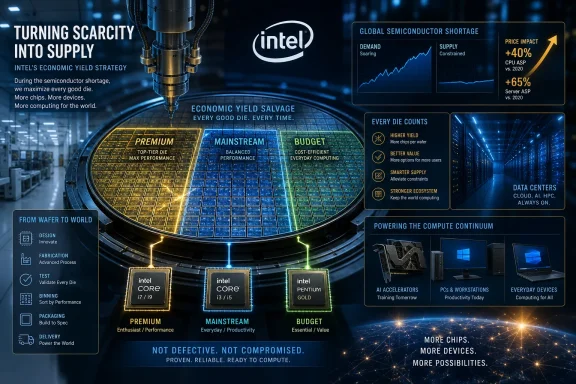 “Scrap” Is an Economic Category, Not a Retail Product Label
The original report, published by BGR and distributed through AOL, rests on comments from Ben Bajarin, an analyst at market research firm Creative Strategies, Inc. According to Bajarin, Intel was selling lower-quality chips that might normally have been discarded, and customers were taking them despite their shortcomings.That description quickly became “Intel is selling scrap CPUs” as it moved through the technology press. It is an irresistible headline, but it can leave readers with the wrong mental picture: processors dug out of a reject container, stamped with a familiar brand, and quietly shipped into PCs or servers.
Chip production does not divide quite so cleanly into perfect processors and garbage. A manufactured wafer contains many individual dies, and those dies do not all reach the same combination of clock speed, power consumption, functional units, and operating voltage. Some become premium products, some become mainstream or entry-level products, and some cannot be sold economically under the product structure available at the time.
That final qualification—economically—is the center of this story. A die can be unsuitable for one product while remaining capable of operating as another, lower-specification product after underperforming cores, cache blocks, or other features are disabled. The finished CPU must still meet the specifications under which it is sold.
BGR’s account goes further, reporting that Intel is packaging edge dies that failed to reach even its previous lowest specification threshold as budget SKUs. The most reasonable interpretation is not that Intel has waived all testing requirements, but that it has found additional configurations in which this marginal silicon can be validated, labeled, and sold.
Tom’s Hardware, which first amplified Bajarin’s account, described these processors as dies that were “binned down” into usable SKUs. TechRadar likewise emphasized that a lower-tier processor produced through binning should function like any other processor sold under the same model and specification.
This is therefore not evidence that Intel is shipping unsafe or knowingly unstable CPUs. It is evidence that the company’s previous line between commercially usable silicon and uneconomic silicon has moved.
Intel Is Mining the Tail of the Wafer
Silicon manufacturing is a business of distributions. A process may produce many dies near its expected performance target, a smaller number that exceed it, and another group that falls below it by varying degrees. The manufacturer’s product portfolio determines how much of that distribution can be converted into revenue.Premium SKUs harvest the best silicon because they require more functional components, higher frequencies, lower leakage, or some combination of those traits. Midrange products absorb dies that cannot reach the premium target but remain capable of meeting less demanding specifications. Entry-level products provide another layer of salvage.
Eventually, however, the manufacturer reaches a floor. A weaker die may technically contain useful computing capacity, but introducing another product around it costs money. It needs validation, firmware support, inventory handling, sales forecasting, documentation, platform qualification, and a customer willing to purchase it.
Under ordinary market conditions, that customer may not exist. Computer manufacturers do not necessarily want another slow CPU occupying space in their product catalog, and distributors do not want inventory that can be sold only through heavy discounts. A die with a theoretical use can consequently remain worthless in practice.
Overwhelming demand changes that calculation. If an original-equipment manufacturer is short of processors, a lower-performance product becomes more attractive than an empty motherboard socket. If a data-center operator needs additional general-purpose capacity, a budget CPU that meets a defined service requirement may be more valuable than waiting for an ideal model that cannot be delivered.
Intel’s reportedly salvaged edge dies occupy that newly valuable territory. They are weaker than the company’s conventional output targets but, according to the reporting, strong enough to be packaged into budget SKUs that buyers will accept.
| Silicon outcome | Traditional disposition | Reported Q1 2026 disposition | Commercial rationale |
|---|---|---|---|
| Highest-performing dies | Premium CPUs | Premium CPUs | Maximum performance and selling price |
| Weaker but compliant dies | Midrange or low-tier CPUs | Midrange or low-tier CPUs | Standard binning captures usable output |
| Marginal edge dies | Often treated as low-expectation output or scrap | Reportedly packaged into budget SKUs | Scarcity creates buyers for lower specifications |
| Unusable dies | Scrapped | Scrapped | Cannot become a validated product |
That is why “yield salvage” is more precise than “selling defective CPUs.” Intel is squeezing revenue from the lower tail of a manufacturing distribution by matching marginal output with customers whose minimum acceptable specification has fallen.
Demand Has Rewritten the Value of a Slow Processor
The reported strategy works only because Intel’s customers have lost some of their ability to be selective. Bajarin’s characterization is blunt: customers were snapping up parts that they might previously have rejected or ignored.For years, the low end of the CPU market was difficult to monetize elegantly. Consumers often postponed purchases rather than accept a substantial performance compromise. PC manufacturers used budget processors, but only in systems where every dollar mattered and where competition among suppliers kept prices under pressure.
The AI infrastructure cycle has disrupted that balance. GPUs remain the most visible beneficiaries because they perform the parallel computations associated with training and many inference workloads, but a data center is not assembled from accelerators alone. CPUs coordinate work, operate services, feed data, run control software, manage storage and networking, and handle the large body of general-purpose computation surrounding an AI model.
As AI shifts, in the source report’s phrasing, “with less focus on training and more on practical use,” those supporting roles can become more numerous rather than less important. Deployed AI services need application servers, databases, orchestration layers, monitoring, security, data processing, and agent-like systems that interact with external tools. Accelerators may execute the model, but CPUs keep the larger service functioning.
At the same time, semiconductor demand does not exist in isolated product silos. CPUs, GPUs, memory, storage components, packaging, substrates, and fabrication capacity participate in overlapping supply chains. Pressure in one part of the market can redirect manufacturing investment, equipment, materials, and customer spending across the others.
BGR attributes part of the CPU shortage to GPUs competing for wafer capacity and receiving priority. That is directionally plausible as an industry argument, but Intel’s own circumstances are more complicated than a simple choice between manufacturing one CPU or one GPU on an interchangeable wafer. Different products use different process technologies, suppliers, packaging systems, and production plans.
The defensible conclusion is narrower: AI infrastructure demand has made the entire computing supply chain less forgiving. Buyers are competing for processors and supporting components, while storage prices have reportedly risen by hundreds of percent in some cases. Under those conditions, a lower-spec CPU can clear the market at a price that would previously have left it sitting in inventory.
The Revenue Beat Was Mostly a Pricing Story
Intel’s $13.6 billion in Q1 2026 revenue exceeded the referenced $12.36 billion expectation by more than $1 billion. That naturally encouraged analysts to look for an operational surprise large enough to explain the gap.Yield salvage offers a compelling part of that explanation. Turning a die that would have produced no revenue into a packaged processor creates an attractive incremental sale. Much of the wafer’s fabrication cost has already been incurred, so recovering another usable product can improve the economics of the entire wafer.
Bajarin described this as “found” revenue. The phrase captures the accounting appeal: Intel is monetizing output that would otherwise have been discarded or written off as having little commercial value.
It would nevertheless be a mistake to treat salvaged edge dies as the sole—or even necessarily the largest—reason Intel outperformed expectations. The company’s quarterly financial report to the SEC points much more directly to rising average selling prices as the principal driver of revenue growth.
Server CPU ASPs rose 27%. According to the source report, 16% of data-center revenue growth came purely from price increases. Intel was therefore earning more per processor at the same time that the demand environment made previously marginal processors sellable.
That combination is unusually powerful. A chipmaker normally tries to improve revenue through some mixture of higher unit volume, a richer product mix, higher prices, or better yield. Intel reportedly benefited from both higher prices and a broader definition of sellable yield, even as supply constraints limited how many processors it could ship.
Intel’s filing reinforces the scarcity argument by stating that demand exceeded available product supply. It also reported lower processor volumes than in the comparable period: client volume was down while client ASPs were higher, and server volume was also down while server ASPs climbed sharply. Revenue growth arrived despite fewer units moving through the market.
This is the clearest signal in the entire episode. Intel did not need a broad surge in shipments to improve its revenue. It needed a market willing to pay more for its conventional products and accept more of the marginal output surrounding them.
A Better Yield Number Can Hide Two Different Improvements
The industry often uses “yield” as shorthand for the percentage of dies on a wafer that become viable products. That sounds like a purely technical measurement, but commercial yield also depends on the available product definitions and the market’s willingness to purchase them.One route to better yield is manufacturing improvement. Intel can reduce defects, improve process control, narrow performance variation across the wafer, and increase the number of dies that meet existing specifications. This creates more good products without changing what those products are.
A second route is product salvage. Intel can introduce or supply lower-tier configurations that tolerate characteristics previously considered uneconomic. The physical output may not have improved, but a larger portion of it now has a paying destination.
Tom’s Hardware subsequently added nuance to the original story through reporting based on comments from industry veteran Dan Hutcheson. That account stressed that binning is a decades-old practice and suggested Intel has also tightened variability between the center and edge of its wafers through better process discipline.
Those explanations can coexist. Manufacturing improvements could push some edge dies into a usable range, while intense demand gives Intel customers for the weakest validated products in that range. Better process control increases the potential supply, and a shortage ensures that the newly recoverable supply finds buyers.
The distinction matters to investors and customers. If Q1 2026’s benefit came mainly from a temporary willingness to buy unusually low-tier products, the opportunity could shrink when supply normalizes. If Intel has structurally improved the consistency of its manufacturing output, more revenue per wafer could remain even after shortages ease.
The public evidence does not establish exactly how much of the financial lift belongs to each mechanism. Bajarin’s reported explanation supports yield salvage, Intel’s filing supports higher pricing and constrained supply, and the follow-up manufacturing analysis supports improved process consistency. Together they describe a favorable convergence rather than a single miracle.
“Budget” Does Not Mean Intel Can Ignore Validation
For Windows users, the obvious concern is reliability. Intel has reportedly taken dies once considered too weak for its previous product structure and turned them into processors, so should buyers expect more crashes, overheating, or early failures?Not merely because of binning. The defining obligation is that the finished processor must meet the electrical, thermal, functional, and performance requirements of the SKU printed on its package. Its history on the wafer matters less to a customer than whether it passes validation for the product ultimately sold.
A die originally intended for a higher-tier processor may have some components disabled and operate at lower frequencies within a lower power envelope. If it passes the lower SKU’s requirements, it is not functionally inferior to the specification the buyer purchased. The customer never had a contractual claim to the disabled capabilities.
The concern would arise if Intel were relaxing validation standards, shipping parts outside their advertised parameters, or creating budget SKUs with inadequate platform support. The reporting does not demonstrate any of those practices.
BGR’s language about dies failing even the lowest previous threshold deserves scrutiny, but it still does not prove that Intel is shipping processors that fail their new sold specification. It suggests Intel has developed a lower commercial category capable of absorbing dies that had no category before.
For system builders, the practical rule remains familiar: evaluate the exact SKU, its supported memory, power limits, core configuration, performance, warranty, and platform requirements. Do not infer that an entry-level processor is defective simply because its silicon may once have been a candidate for scrap.
At the same time, buyers should not let the reassuring familiarity of binning obscure the commercial shift. Intel is reportedly reaching deeper into its output distribution than it found worthwhile under normal demand. That makes transparent product naming, accurate specifications, and consistent firmware support particularly important.
OEMs Are Buying Availability, Not Just Performance
The strongest demand signal may not come from enthusiasts choosing processors at retail. It comes from Intel’s direct customers—PC manufacturers, server vendors, distributors, cloud operators, and other large buyers—accepting products they might have declined in a looser supply environment.An OEM builds around schedules as much as specifications. A laptop delayed because its selected processor is unavailable may miss a sales window, strand other components in inventory, or force an expensive redesign. A slightly slower CPU available on time can be the rational choice.
The same logic applies in data centers, although the calculations become more complex. Lower-performance processors can still serve storage nodes, management systems, development environments, web services, control planes, and workloads where capacity or deployment speed matters more than peak per-core performance.
This gives Intel room to create or expand budget offerings without relying entirely on consumers seeking cheap upgrades. Large customers can absorb substantial volumes when those processors solve an availability problem across a standardized fleet.
There is also an asymmetry in negotiation. When supply exceeds demand, customers can reject marginal products, demand discounts, or wait for better parts. When demand exceeds supply, manufacturers can allocate inventory, prioritize higher-margin buyers, and offer substitutes on less flexible terms.
That is why scarcity has changed the clearing price of marginal silicon. A processor does not need to become technically better to become commercially valuable. The customer’s alternative merely needs to become worse.
For Windows PC buyers, that could appear as a wider spread of entry-level systems, greater use of unfamiliar CPU variants, or higher prices for configurations that once occupied the value segment. For enterprise buyers, it can mean accepting mixed processor tiers in order to obtain enough systems on schedule.
Higher ASPs Are the More Durable Warning
The scrap narrative is colorful, but Intel’s pricing power deserves more attention from IT departments. A 27% increase in server CPU ASPs is not a minor adjustment. It indicates that Intel sold a more expensive mix, applied demand-based pricing, or achieved some combination of both.A richer mix can be healthy if customers are voluntarily choosing more capable processors because their workloads require them. Demand-based price increases are more painful because the buyer may pay more without receiving a proportional increase in computing capacity.
Intel’s quarterly report indicates that both premium product mix and pricing actions contributed. Customers were therefore being pulled upward by workload requirements and pushed upward by supply economics.
This has consequences beyond CPU invoices. A more expensive processor can increase the insured value of a server, financing costs, depreciation, spare-parts budgets, and the penalty attached to overprovisioning. If storage, memory, and other components are simultaneously constrained, the cost of a complete deployment can rise faster than any single component category suggests.
It also makes low-tier salvage strategically useful. Intel can preserve premium supply for customers willing to pay high ASPs while offering marginal dies to buyers whose first priority is simply obtaining a processor. The budget SKU does not undermine pricing power if it serves a separate availability-sensitive segment.
The danger for customers is that “budget” becomes relative. A low-tier processor created during a shortage may still be priced aggressively compared with historical entry-level products. What matters to Intel is not whether the chip is inexpensive in absolute terms, but whether it generates more revenue than scrapping it.
Demand normalization would test how durable this structure is. If buyers regain the ability to reject weak configurations, Intel may need to discount these products or narrow the portfolio again. But if practical AI deployment keeps general-purpose compute demand high, the new lower tier may become permanent.
The AI Explanation Is Real but Too Convenient on Its Own
The source report presents AI as the dominant force behind tightening CPU supply. That argument has substance: large AI systems require extensive general-purpose infrastructure around accelerators, and a move from model training toward widespread deployment can multiply the number of environments running AI-related services.Yet “AI demand” can become an all-purpose explanation that obscures more specific constraints. Intel’s available supply reflects manufacturing capacity, process transitions, outsourced components, packaging, substrates, memory availability, customer inventory, and decisions about which products receive priority.
Intel’s own filing acknowledges both internal and external supply constraints. That wording is broader and more useful than attributing every shortage directly to GPU production.
The significance of AI is that it amplifies pressure across those constraints. It increases accelerator purchases, encourages data-center expansion, raises demand for servers and storage, and changes how customers value immediate access to computing capacity. It need not be the sole cause to be the force that converts a manageable bottleneck into a seller’s market.
This distinction matters for forecasting. If Intel’s shortage were caused by a single temporary manufacturing issue, the opportunity to sell unusually marginal silicon might disappear quickly once that issue was fixed. If the pressure reflects a broad infrastructure buildout, demand can move from one constrained component to another without truly subsiding.
The report’s phrase “with less focus on training and more on practical use” points toward the latter scenario. Training concentrates enormous computation in a relatively limited number of facilities. Practical deployment can spread AI workloads across clouds, corporate data centers, edge systems, workstations, and ordinary PCs.
Such a transition would not eliminate demand for high-end accelerators, but it could increase demand for CPUs that orchestrate, preprocess, secure, and serve AI applications. Intel’s salvaged dies would then be a small expression of a much larger market shift: even unglamorous general-purpose compute has become scarce infrastructure.
Windows Fleets Need to Track SKUs More Closely
The immediate risk to Windows administrators is not that a secretly defective processor will enter the fleet. It is that shortage-driven purchasing will create greater hardware variation than the organization intended.When a preferred CPU is unavailable, procurement may approve substitute systems with different core counts, clock speeds, power characteristics, integrated features, or platform generations. Each substitute may satisfy the vendor’s specification while producing meaningful differences in application performance and fleet management.
Those differences can complicate operating-system deployment rings, driver packages, firmware testing, virtualization capacity planning, endpoint performance baselines, and replacement-part inventory. They can also undermine assumptions embedded in purchasing standards—for example, that every system bearing the same commercial model name has equivalent compute capacity.
Budget SKUs assembled from salvaged dies may be entirely reliable while still being a poor fit for workloads selected around a faster processor. A machine that passes basic acceptance testing can later struggle under compilation, analytics, local virtual machines, security scanning, or AI-assisted productivity workloads.
Administrators should therefore treat processor substitution as a configuration change, not a clerical variation. The SKU’s actual specifications and measured performance matter more than the vendor’s broad product-family branding.
Action checklist for admins
- Record the exact CPU SKU in every approved desktop, laptop, workstation, and server configuration.
- Require vendors to disclose processor substitutions before shipment rather than accepting “equivalent or better” language without review.
- Benchmark lower-tier alternatives against representative Windows workloads, not only synthetic peak-performance tests.
- Validate BIOS, firmware, drivers, power management, virtualization, and security tooling on each substituted platform.
- Compare per-core, per-system, and per-workload costs before accepting shortage-driven pricing.
- Preserve warranty and return documentation for newly introduced budget configurations and monitor their failure rates separately.
Intel Has Found a Margin Tool It May Not Want to Give Back
The strategic question is whether yield salvage remains an emergency response or becomes part of Intel’s permanent product planning. Once a company proves that customers will purchase output previously considered scrap, returning that output to the waste stream becomes difficult to justify.There are reasons the opportunity could fade. New low-tier SKUs create validation and support costs, can confuse customers, and may cannibalize more profitable products. If supply catches up, buyers may once again refuse processors with less attractive performance or efficiency.
There are equally strong reasons Intel may institutionalize the practice. A broader set of validated configurations gives the company more ways to monetize each wafer, respond to changing demand, and segment customers according to willingness to pay. Better manufacturing consistency could further expand the pool of recoverable dies.
The strongest version of this model is not merely “sell chips that used to be scrap.” It is to design processors, test strategies, and product families from the beginning around maximum salvage flexibility. Redundant functional blocks, configurable core counts, adaptable power limits, and carefully structured tiers can create more possible destinations for imperfect dies.
Chipmakers already use many of those techniques. The reported change is primarily one of market tolerance: customers are now willing to absorb the lowest commercially viable configurations.
That tolerance gives Intel valuable information. It identifies performance floors, price points, and workloads where buyers prefer immediate availability to ideal specifications. Intel can use those signals to decide whether today’s salvage SKU should become tomorrow’s planned entry-level product.
What Buyers Should Carry Forward
The headline sounds like a quality scandal, but the evidence points to a scarcity and pricing story. Intel reportedly found buyers for lower-quality edge dies, while its own financial reporting shows that higher average selling prices and constrained supply were central to Q1 2026 revenue growth.- Intel reported $13.6 billion in Q1 2026 revenue, more than $1 billion above the referenced $12.36 billion expectation.
- Ben Bajarin attributed part of the upside to better yield salvage and “found” revenue from low-expectation dies.
- The reported processors are budget SKUs created from marginal silicon, not proven out-of-spec retail products.
- Server CPU average selling prices rose 27%, making pricing power at least as important as salvage.
- Intel reportedly generated 16% of its data-center revenue growth purely through price increases.
- Windows and server buyers should verify exact SKUs, performance, platform support, and substitution terms before purchasing.
If AI deployment continues spreading from concentrated training clusters into practical services, Intel may keep finding customers for every validated CPU it can package, from premium server silicon to the weakest viable edge die. The lasting consequence would be a processor market with more tiers, less buyer leverage, and prices shaped as much by availability as by performance—a market in which yesterday’s scrap is not an embarrassment, but tomorrow’s inventory.
References
- Primary source: aol.com
Published: 2026-07-09T22:30:10.536498
Intel Is Reportedly Selling CPUs It Would Normally 'Scrap' Due To Overwhelming Demand - AOL
Intel just had a very profitable quarter, and a big reason why is reportedly that the electronics giant has been selling CPUs it would've previously scrapped.www.aol.com - Related coverage: techradar.com
Intel reportedly selling 'scrap or low-expectation' chips is an ominous sign that CPU price hikes might get worse | TechRadar
Revenue is up at Intel, and getting more mileage from 'low-expectation' chips is seemingly part of that equationwww.techradar.com - Related coverage: trendforce.com
[News] Intel Reportedly Sells Chips Typically Scrapped as CPU Demand Surges; 1Q26 Server CPU ASPs Up 27%
Intel is reportedly selling chips that would typically be scrapped, as strong CPU demand is prompting customers to accept such parts. According to Tom...www.trendforce.com - Related coverage: resource-recycling.com
Intel boosts margins by selling what it used to scrap
On April 27, Resource Recycling reported on Intel's latest earnings call. But the company's results also contained a critical detailresource-recycling.com - Related coverage: bgr.com
Intel Is Reportedly Selling CPUs It Would Normally 'Scrap' Due To Overwhelming Demand
Intel just had a very profitable quarter, and a big reason why is reportedly that the electronics giant has been selling CPUs it would've previously scrapped.www.bgr.com - Related coverage: techspot.com
Intel says it's selling every chip it can produce, so it's feeding AI servers first | TechSpot
Intel's fourth-quarter results reflected rising demand for its AI and data center products, offset by persistent supply constraints that continue to pressure its consumer segment. The semiconductor...www.techspot.com
- Related coverage: overclock3d.net
Salvaging scraps - Intel boosts revenue by selling "scrap" CPUs - OC3D
Intel is reportedly supplementing its revenue by selling CPUs it would have previously considered "scraps".overclock3d.net - Related coverage: tomshardware.com
Intel tells PC makers to adopt 18A CPUs or lose their supply, report claims — Intel 7 supply dries up, pressuring notebook and PC manufacturers in the US, China, and Taiwan | Tom's Hardware
Older Intel 7-based processors are locked up for servers and industrial use, leaving OEMs with little choice.www.tomshardware.com - Related coverage: phonearena.com
Selling defective edge-die chips pays off for Intel - PhoneArena
Intel reported stronger than expected Q1 revenue and earnings thanks to sales of binned chips.www.phonearena.com - Related coverage: arstechnica.com
Demand for Intel's processors is apparently there, but the supply is not - Ars Technica
Intel is allocating more of its own production to its money-making server chips.arstechnica.com - Related coverage: app.dealroom.co
Intel boosts profit margins by selling 'scrap' CPUs as demand outstrips supply | Dealroom.co
Intel has confirmed that part of its unexpectedly strong first-quarter earnings came from selling chips that would normally be scrapped or classified as low-expectation products. The company's revenue reached $13.6 billion, beating expectations of $12.36 billion, whilst non-GAAP gross...app.dealroom.co - Related coverage: cdrdv2-public.intel.com
- Related coverage: csis-website-prod.s3.amazonaws.com
