

Adesina Abass, a Microsoft Certified Trainer and research enthusiast associated with Fortress Technologies, is being spotlighted for work spanning AI-driven threat intelligence, cloud infrastructure security, and Microsoft-based security solutions designed to help enterprises secure Microsoft Azure environments as they grow in scale and operational complexity. The significance of the profile is not that it presents another collection of cloud-security tools, but that it frames security as an architectural and organizational discipline. Its central argument is that enterprises cannot bolt protection onto Azure after deployment and expect fragmented controls, overloaded analysts, and periodic compliance reviews to behave like a coherent defense system. At cloud scale, resilience must be designed into identity, connectivity, monitoring, governance, and the people responsible for operating them.
Security frequently appears manageable while an organization’s cloud estate is small. A limited number of subscriptions, workloads, identities, administrators, and network paths can still be reviewed manually, and the people who built the environment may retain enough institutional knowledge to recognize unusual behavior without elaborate processes.
Growth breaks that informal model. Workloads multiply, deployment velocity increases, privileges accumulate, and automation creates resources faster than a central security team can inspect them. A configuration mistake that once affected one application can be reproduced across an entire environment, while an overly broad identity can become a route through multiple connected systems.
Tribune Online’s account of Abass’s work begins from this scaling problem. It describes a professional focus on helping organizations move from fragmented security deployments toward unified, enterprise-ready defense models capable of supporting growth without automatically increasing exposure.
That distinction matters. Cloud security is often discussed as if the challenge were simply selecting enough defensive products. In practice, enterprises may own substantial security capabilities and remain vulnerable because those capabilities are configured independently, produce disconnected signals, or operate without an agreed model for identity, responsibility, and response.
The problem is not always a missing control. It is frequently the space between controls: an alert that never reaches the right team, a policy that applies to one environment but not another, a privileged account that outlives its original purpose, or a cloud resource deployed outside the monitoring boundary.
This is why the architecture-first theme running through the profile is more consequential than the customary language of cybersecurity leadership. Security at scale is primarily a systems-design problem. Tools matter, but their value depends on where they sit in the architecture, what information they share, which policies they enforce, and how quickly people can act on their output.
For Windows administrators and Microsoft-focused IT departments, the implications extend beyond Azure specialists. Cloud identity, endpoint operations, application access, network design, audit evidence, and incident response increasingly overlap. A weakness in the cloud control structure can therefore affect the broader enterprise even when the original resource is not a traditional Windows server.
That means security decisions become part of the environment’s structure. Network connectivity is organized around defined trust boundaries, access is driven by identity, and monitoring and response capabilities are embedded into the Azure infrastructure instead of added only after a workload reaches production.
This approach changes the sequence of enterprise cloud projects. Under a reactive model, a business team deploys an application and security later reviews what was built. The security team then discovers that logging is incomplete, privileges are broader than intended, connections are difficult to trace, and changing the architecture would disrupt an already operational service.
An architecture-driven model moves those discussions forward. Teams determine how access should be granted, what activity must be recorded, how configuration will be evaluated, and who owns an alert before the environment becomes difficult to change.
Microsoft’s own Azure guidance broadly supports that direction, emphasizing coherent governance, explicit verification, limited privileges, continuous assessment, and automated enforcement. The underlying lesson is straightforward: consistent security cannot depend on every engineer remembering every requirement during every deployment.
Architecture converts intent into repeatable behavior. If access requirements, monitoring expectations, and configuration baselines are built into the deployment model, teams have less room to create unobserved exceptions. If those decisions remain in documents or meeting notes, adherence will vary with workload pressure, staff turnover, and individual experience.
This does not mean architecture eliminates risk or manual work. A poorly designed standard can consistently enforce the wrong outcome, and rigid controls can encourage teams to seek unofficial workarounds. Enterprise security architecture must therefore combine standardization with an exception process that is visible, justified, time-limited, and reviewed.
The profile does not provide a detailed reference architecture or disclose the precise technical components used in Abass’s projects. It instead presents the strategic principles: secure connectivity, identity-driven access, embedded monitoring, and integrated response. That limits the ability to evaluate individual implementations, but it also keeps attention on the larger operating model rather than turning the account into a product catalogue.
Azure environments contain access relationships between employees, administrators, applications, automation, services, and external collaborators. Each relationship can create privilege, and each privilege can persist beyond the project, role, or business requirement that originally justified it.
At small scale, those relationships may be reviewed individually. At enterprise scale, the number of identities and permissions makes informal oversight unreliable. The organization needs a consistent model for deciding who or what may access a resource, under which conditions, and for how long.
That is why identity cannot remain an authentication task performed at the edge of an application. It has to operate as part of the security control plane. The access decision, the privilege granted, the context surrounding the request, and the resulting activity all become inputs to the wider defense system.
For administrators, this shifts the daily security question. It is no longer enough to ask whether an account has a valid credential. The important questions are whether that account needs the requested access, whether the access level is proportionate, whether the request is consistent with expected behavior, and whether the organization can revoke the privilege without unraveling dependent services.
The most dangerous identities are not necessarily obvious human administrator accounts. Workloads and automated processes can hold durable permissions, execute continuously, and interact with resources at machine speed. If their privileges are poorly governed, compromise or misuse can produce effects before a human operator understands what happened.
The source material does not claim that Abass invented identity-centric security, nor should the profile be read that way. Its value lies in showing how established security ideas must be applied as an architectural whole. Identity-driven access becomes effective when it is aligned with monitoring, network structure, configuration policy, and incident response—not when it operates as another independent security project.
The intended result is not autonomous security in which software replaces analysts. It is a more manageable operational queue. Security personnel should spend more time investigating meaningful danger and less time sorting repetitive or low-value alerts.
That is a credible objective because enterprise security teams often face a volume problem before they face an intelligence problem. Multiple systems can flag the same underlying event, while minor deviations may be presented beside incidents with a much larger potential impact. If everything is treated as urgent, the system has effectively failed to prioritize anything.
AI can help correlate activity, establish patterns, and identify anomalies that a static rule might miss. It can also assist with ranking events according to observed behavior and context. But those capabilities become useful only if they influence how the security team works.
A detection that enters a neglected dashboard has little operational value. A priority score that analysts do not understand may be ignored. An automated classification that cannot be challenged can hide errors behind the apparent authority of a machine-generated result.
This makes workflow design as important as the model itself. Teams need to know which data informs the system, how alerts are grouped, what produces escalation, and when human review is mandatory. They must also measure whether prioritization is improving response or simply moving false positives into a different order.
The Tribune Online account says Abass’s work uses AI-driven threat intelligence to improve situational awareness and accelerate decision-making during active situations. That is a more defensible formulation than claiming AI can independently solve enterprise incident response. The value is in reducing uncertainty and helping people focus—not in removing accountability from them.
There is also a governance question. Behavioral analysis is only as reliable as the visibility provided to it, and visibility can be distorted by missing logs, inconsistent telemetry, or unmonitored resources. If the architecture does not produce dependable data, an intelligent detection layer may create confidence without corresponding coverage.
AI cannot compensate for an environment the organization does not understand. It performs best when identities are governed, assets are inventoried, activity is recorded, and response responsibilities are already defined. In that sense, the profile’s three themes are interdependent: architecture supplies context, intelligence identifies risk, and governance keeps the foundation from drifting.
The architectural layer determines whether the organization can see and control the environment. The intelligence layer helps distinguish consequential behavior from background noise. The governance layer checks whether the architecture remains aligned with the standards the enterprise intended to enforce.
This model also exposes why tool-by-tool security programs struggle. An organization can have advanced detection but poor asset coverage. It can have extensive policy documentation but no continuous assessment. It can build a hardened initial environment that gradually becomes inconsistent as new workloads and exceptions accumulate.
A mature program treats these as one lifecycle. Architecture establishes the intended state, telemetry reveals what is happening, intelligence helps interpret the activity, governance identifies drift, and response processes correct the resulting problems.
The profile does not publish performance measurements for this model. It gives no comparative alert-reduction figures, remediation times, audit results, or quantified changes in exposure. Those omissions matter because they prevent independent assessment of how well the described approach performed in specific enterprise deployments.
Still, the operating logic is sound and consistent with the direction of Microsoft’s published Azure guidance. The strongest reading of the profile is therefore not that it proves a unique technical breakthrough, but that it documents a disciplined application of established cloud-security principles at enterprise scale.
That process may produce evidence, but it does not necessarily produce security. A resource can become misconfigured immediately after the evidence is collected. An access policy can change between reviews. A baseline can exist on paper while newly deployed assets operate outside it.
The source material says Abass has led deployments of automated compliance and governance controls that continuously evaluate configuration posture, access policies, and security baselines across Azure environments. This is the point at which governance stops being a periodic inspection and becomes an operational function.
Continuous evaluation reduces the distance between drift and discovery. Instead of waiting for an audit or incident to reveal that a resource violates policy, the environment can surface deviations as they arise. Depending on the control and business context, the organization can notify an owner, require remediation, prevent a deployment, or document an approved exception.
Automation also creates consistency. Manual review depends on who conducts it, what information is available, and how much time the reviewer has. Automated evaluation applies the same defined condition repeatedly across the selected scope.
That consistency is especially important when infrastructure changes rapidly. Cloud teams may deploy, update, and retire resources throughout the day. A security process built around monthly spreadsheets cannot reliably govern an environment operating at deployment-pipeline speed.
Yet automated compliance has limits that the broader industry sometimes understates. A configuration can satisfy a technical control and still support a risky business process. A system can report compliance with a baseline while an unmeasured dependency remains exposed. Some obligations require human judgment, documentary evidence, or evaluation of processes that a cloud scanner cannot observe.
The correct goal is therefore not to automate the declaration that an enterprise is secure or compliant. It is to automate the evidence collection, configuration assessment, and routine enforcement that machines can perform consistently, leaving people to interpret exceptions and assess controls that require context.
The source says these processes reduce human error, improve audit readiness, and help teams maintain standards across rapidly changing infrastructure. Those are practical gains. They do not eliminate the need for review, but they can replace the frantic reconstruction of past decisions with a continuously maintained record of current posture.
The profile links Abass’s work to enterprise resilience, but resilience should not be confused with simple resistance. A resilient environment assumes that some controls will fail and organizes the remaining layers to contain, detect, and recover from the failure.
That requires response capabilities to be part of the architecture. Monitoring must provide enough context to understand what changed. Access controls must allow compromised privileges to be restricted. Network design must reduce unnecessary paths. Governance records must help distinguish legitimate exceptions from attacker-created changes.
The response process also needs ownership. An alert without an accountable team is merely a notification. A recommended action without authority to execute it can sit unresolved while risk grows.
Automation can shorten the interval between detection and action, but it should be applied according to consequence. Low-risk enrichment and notification tasks are natural candidates for automation. Actions that can interrupt critical services require stronger safeguards, testing, and clearly defined approval paths.
This is where enterprise design becomes less glamorous but more valuable. The technical ability to detect suspicious behavior matters, but so do contact lists, escalation rules, maintenance responsibilities, logging retention, and recovery procedures. Those operational details determine whether a security capability performs during an actual incident.
The profile’s architecture-driven framing implicitly recognizes this dependency. Monitoring and response are described as embedded capabilities, not optional services that can be connected after the environment is built. That turns resilience from an aspirational claim into a set of design obligations.
Cloud environments do not remain secure because one architect made sound decisions at the beginning. They remain secure because engineers understand the model, operators recognize abnormal behavior, administrators manage access consistently, and new team members can work without creating invisible exceptions.
A technically sophisticated deployment can degrade when the people operating it do not understand why its controls exist. Engineers may disable a policy to complete an urgent release, grant excessive access to resolve a support issue, or create an unmonitored resource because the approved process seems too slow.
Training reduces that gap between architecture and operation. It gives teams a shared vocabulary for discussing identity, configuration, monitoring, and response. It also helps them recognize when a proposed shortcut undermines assumptions elsewhere in the system.
Mentorship is particularly important because enterprise security knowledge is rarely captured completely in formal documentation. Experienced practitioners know which alerts tend to reveal deeper problems, where exceptions accumulate, and how business pressures influence technical decisions. Structured knowledge sharing makes that experience less dependent on a few individuals.
The source says Abass supports initiatives that give engineers and security practitioners practical skills in cloud-security operations and Microsoft security technologies. It also credits structured mentoring and knowledge-sharing sessions with helping teams sustain secure environments after initial deployments.
That emphasis is notable. Consulting and implementation work can create dependency if the customer cannot operate what was delivered. A sustainable security program should leave the organization more capable, not merely more instrumented.
People are not the weakest link by definition; unsupported people are. If staff are expected to manage a complex Azure environment without practical training, clear ownership, or time to understand changes, mistakes are a predictable system outcome rather than an individual moral failure.
The account highlights scalable security architecture, AI-driven detection, and automated compliance in Azure. Together, those themes present a coherent professional identity: a practitioner focused less on isolated defensive controls than on turning security principles into operating systems that enterprises can sustain.
What the available material does not provide is equally important. It does not identify customer organizations, disclose project scopes, show before-and-after measurements, describe a specific incident outcome, or present independent technical validation of the implementations.
That does not invalidate the profile, but it defines what can responsibly be concluded from it. The reporting establishes the areas of work attributed to Abass and explains the philosophy behind them. It does not give outside readers enough evidence to rank those implementations against alternatives or verify performance claims quantitatively.
A stronger public technical record would include anonymized case studies where client confidentiality prevents naming an organization. Useful measurements could show changes in alert volume, investigation time, configuration drift, policy coverage, remediation speed, or audit preparation effort.
Architecture diagrams with sensitive details removed could demonstrate how identity, connectivity, monitoring, and governance were connected. Lessons from unsuccessful approaches would also add credibility, because enterprise cloud projects rarely proceed without trade-offs, exceptions, and revisions.
Technology leadership profiles often concentrate on successful outcomes and strategic language. For practitioners, however, the most valuable information is frequently found in the friction: what could not be automated, which controls produced operational resistance, where detection quality depended on better data, and how teams handled legitimate exceptions.
The next step in documenting this work should therefore be technical depth. The profile supplies a persuasive thesis about cloud security at scale. Detailed implementation evidence would allow the wider security community to test, adapt, and learn from it.
Enterprise identities often cross workstation, application, and cloud boundaries. Administrative practices established in one part of the Microsoft environment influence access elsewhere. Security teams may investigate incidents whose first visible symptom appears on an endpoint even though the consequential activity occurs in Azure.
The organizational challenge is that responsibility remains divided. Identity teams, network teams, cloud engineers, Windows administrators, application owners, compliance personnel, and security operations may each control one part of the system. Attackers are not constrained by that organizational chart.
An architecture-first program must therefore connect technical controls with shared ownership. The team that deploys a workload needs to know its logging and access obligations. The team that monitors alerts needs enough architectural context to interpret them. The team that governs compliance needs a route to the person capable of remediating a failing control.
This is one reason fragmented security deployments persist even in well-funded enterprises. The fragmentation reflects organizational boundaries as much as product choices. Purchasing an integrated platform does not automatically create integrated responsibility.
The practical value of the approach attributed to Abass lies in treating those dependencies as design concerns. Secure cloud infrastructure is not simply an Azure configuration. It is an agreement about how identities, workloads, teams, and controls interact over the life of a service.
Coherence is a better test. Identities should be governed according to an agreed access model. Connectivity should reflect intentional trust boundaries. Monitoring should cover the resources the organization believes it is protecting. Governance should evaluate the same architecture that engineers are actually deploying.
AI-driven intelligence belongs inside that coherent system, not above it as a substitute for foundations. Automated compliance belongs there as well, continuously checking whether the intended security state still resembles the operational one.
This model also changes the relationship between security and growth. Under a fragmented approach, every new workload adds alerts, permissions, exceptions, and review work. Under a well-designed model, growth still adds risk, but standardized architecture and automated governance can prevent the operational burden from rising at the same rate.
That is the promise behind securing the cloud at scale. It does not mean making a large environment as simple as a small one. It means designing the large environment so complexity is visible, governed, and divided into manageable responsibilities.
As Azure environments continue to absorb more identities, workloads, automation, and business-critical data, the winners will not necessarily be the organizations with the largest security catalogues. They will be the ones capable of translating policy into architecture, architecture into observable behavior, and observable behavior into timely action—a model the work attributed to Adesina Abass places at the center of enterprise resilience.
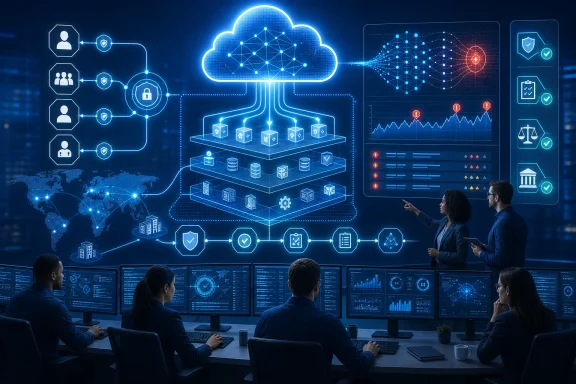 Cloud Scale Turns Small Security Gaps Into Enterprise Problems
Security frequently appears manageable while an organization’s cloud estate is small. A limited number of subscriptions, workloads, identities, administrators, and network paths can still be reviewed manually, and the people who built the environment may retain enough institutional knowledge to recognize unusual behavior without elaborate processes.Growth breaks that informal model. Workloads multiply, deployment velocity increases, privileges accumulate, and automation creates resources faster than a central security team can inspect them. A configuration mistake that once affected one application can be reproduced across an entire environment, while an overly broad identity can become a route through multiple connected systems.
Tribune Online’s account of Abass’s work begins from this scaling problem. It describes a professional focus on helping organizations move from fragmented security deployments toward unified, enterprise-ready defense models capable of supporting growth without automatically increasing exposure.
That distinction matters. Cloud security is often discussed as if the challenge were simply selecting enough defensive products. In practice, enterprises may own substantial security capabilities and remain vulnerable because those capabilities are configured independently, produce disconnected signals, or operate without an agreed model for identity, responsibility, and response.
The problem is not always a missing control. It is frequently the space between controls: an alert that never reaches the right team, a policy that applies to one environment but not another, a privileged account that outlives its original purpose, or a cloud resource deployed outside the monitoring boundary.
This is why the architecture-first theme running through the profile is more consequential than the customary language of cybersecurity leadership. Security at scale is primarily a systems-design problem. Tools matter, but their value depends on where they sit in the architecture, what information they share, which policies they enforce, and how quickly people can act on their output.
For Windows administrators and Microsoft-focused IT departments, the implications extend beyond Azure specialists. Cloud identity, endpoint operations, application access, network design, audit evidence, and incident response increasingly overlap. A weakness in the cloud control structure can therefore affect the broader enterprise even when the original resource is not a traditional Windows server.
Architecture Must Carry the Security Policy
The most substantive part of the Tribune Online profile is its description of Abass’s architectural approach. Rather than treating security as a collection of isolated tools, the account says he focuses on integrating Microsoft security services into cloud environments from the earliest deployment stages.That means security decisions become part of the environment’s structure. Network connectivity is organized around defined trust boundaries, access is driven by identity, and monitoring and response capabilities are embedded into the Azure infrastructure instead of added only after a workload reaches production.
This approach changes the sequence of enterprise cloud projects. Under a reactive model, a business team deploys an application and security later reviews what was built. The security team then discovers that logging is incomplete, privileges are broader than intended, connections are difficult to trace, and changing the architecture would disrupt an already operational service.
An architecture-driven model moves those discussions forward. Teams determine how access should be granted, what activity must be recorded, how configuration will be evaluated, and who owns an alert before the environment becomes difficult to change.
Microsoft’s own Azure guidance broadly supports that direction, emphasizing coherent governance, explicit verification, limited privileges, continuous assessment, and automated enforcement. The underlying lesson is straightforward: consistent security cannot depend on every engineer remembering every requirement during every deployment.
Architecture converts intent into repeatable behavior. If access requirements, monitoring expectations, and configuration baselines are built into the deployment model, teams have less room to create unobserved exceptions. If those decisions remain in documents or meeting notes, adherence will vary with workload pressure, staff turnover, and individual experience.
This does not mean architecture eliminates risk or manual work. A poorly designed standard can consistently enforce the wrong outcome, and rigid controls can encourage teams to seek unofficial workarounds. Enterprise security architecture must therefore combine standardization with an exception process that is visible, justified, time-limited, and reviewed.
The profile does not provide a detailed reference architecture or disclose the precise technical components used in Abass’s projects. It instead presents the strategic principles: secure connectivity, identity-driven access, embedded monitoring, and integrated response. That limits the ability to evaluate individual implementations, but it also keeps attention on the larger operating model rather than turning the account into a product catalogue.
Identity Becomes the Boundary That Networks Once Supplied
The profile’s emphasis on identity-driven access reflects a basic reality of modern cloud operations. Enterprises can no longer assume that a user or workload is trustworthy merely because it communicates through an internal network or originates from a familiar location.Azure environments contain access relationships between employees, administrators, applications, automation, services, and external collaborators. Each relationship can create privilege, and each privilege can persist beyond the project, role, or business requirement that originally justified it.
At small scale, those relationships may be reviewed individually. At enterprise scale, the number of identities and permissions makes informal oversight unreliable. The organization needs a consistent model for deciding who or what may access a resource, under which conditions, and for how long.
That is why identity cannot remain an authentication task performed at the edge of an application. It has to operate as part of the security control plane. The access decision, the privilege granted, the context surrounding the request, and the resulting activity all become inputs to the wider defense system.
For administrators, this shifts the daily security question. It is no longer enough to ask whether an account has a valid credential. The important questions are whether that account needs the requested access, whether the access level is proportionate, whether the request is consistent with expected behavior, and whether the organization can revoke the privilege without unraveling dependent services.
The most dangerous identities are not necessarily obvious human administrator accounts. Workloads and automated processes can hold durable permissions, execute continuously, and interact with resources at machine speed. If their privileges are poorly governed, compromise or misuse can produce effects before a human operator understands what happened.
The source material does not claim that Abass invented identity-centric security, nor should the profile be read that way. Its value lies in showing how established security ideas must be applied as an architectural whole. Identity-driven access becomes effective when it is aligned with monitoring, network structure, configuration policy, and incident response—not when it operates as another independent security project.
AI Is Useful Only When It Changes the Queue
AI-driven threat intelligence is the most fashionable element of the work attributed to Abass, but the profile describes it in practical rather than theatrical terms. It says machine-learning algorithms are applied to behavioral and activity data to improve threat detection and prioritization.The intended result is not autonomous security in which software replaces analysts. It is a more manageable operational queue. Security personnel should spend more time investigating meaningful danger and less time sorting repetitive or low-value alerts.
That is a credible objective because enterprise security teams often face a volume problem before they face an intelligence problem. Multiple systems can flag the same underlying event, while minor deviations may be presented beside incidents with a much larger potential impact. If everything is treated as urgent, the system has effectively failed to prioritize anything.
AI can help correlate activity, establish patterns, and identify anomalies that a static rule might miss. It can also assist with ranking events according to observed behavior and context. But those capabilities become useful only if they influence how the security team works.
A detection that enters a neglected dashboard has little operational value. A priority score that analysts do not understand may be ignored. An automated classification that cannot be challenged can hide errors behind the apparent authority of a machine-generated result.
This makes workflow design as important as the model itself. Teams need to know which data informs the system, how alerts are grouped, what produces escalation, and when human review is mandatory. They must also measure whether prioritization is improving response or simply moving false positives into a different order.
The Tribune Online account says Abass’s work uses AI-driven threat intelligence to improve situational awareness and accelerate decision-making during active situations. That is a more defensible formulation than claiming AI can independently solve enterprise incident response. The value is in reducing uncertainty and helping people focus—not in removing accountability from them.
There is also a governance question. Behavioral analysis is only as reliable as the visibility provided to it, and visibility can be distorted by missing logs, inconsistent telemetry, or unmonitored resources. If the architecture does not produce dependable data, an intelligent detection layer may create confidence without corresponding coverage.
AI cannot compensate for an environment the organization does not understand. It performs best when identities are governed, assets are inventoried, activity is recorded, and response responsibilities are already defined. In that sense, the profile’s three themes are interdependent: architecture supplies context, intelligence identifies risk, and governance keeps the foundation from drifting.
Three Layers Turn Controls Into a Security System
The work attributed to Abass can be understood as three connected layers rather than three separate specialties. Each addresses a different failure mode in enterprise cloud operations, and each becomes weaker when implemented without the others.| Security layer | Enterprise problem addressed | Approach described in the profile | Practical operational result |
|---|---|---|---|
| Cloud infrastructure security | Growth creates inconsistent connectivity, access, and visibility | Build secure networking, identity-driven access, monitoring, and response into Azure architecture | Fewer unmonitored resources and fewer security decisions left until after deployment |
| AI-driven threat intelligence | Analysts face excessive alert volume and incomplete context | Apply machine learning to behavioral and activity data for detection and prioritization | Greater focus on significant threats and faster decisions during active situations |
| Automated compliance and governance | Configuration and access controls drift as environments change | Continuously evaluate posture, access policies, and security baselines | More consistent standards, reduced human error, and stronger audit readiness |
This model also exposes why tool-by-tool security programs struggle. An organization can have advanced detection but poor asset coverage. It can have extensive policy documentation but no continuous assessment. It can build a hardened initial environment that gradually becomes inconsistent as new workloads and exceptions accumulate.
A mature program treats these as one lifecycle. Architecture establishes the intended state, telemetry reveals what is happening, intelligence helps interpret the activity, governance identifies drift, and response processes correct the resulting problems.
The profile does not publish performance measurements for this model. It gives no comparative alert-reduction figures, remediation times, audit results, or quantified changes in exposure. Those omissions matter because they prevent independent assessment of how well the described approach performed in specific enterprise deployments.
Still, the operating logic is sound and consistent with the direction of Microsoft’s published Azure guidance. The strongest reading of the profile is therefore not that it proves a unique technical breakthrough, but that it documents a disciplined application of established cloud-security principles at enterprise scale.
Continuous Governance Replaces the Annual Compliance Scramble
Compliance is often treated as a reporting exercise conducted before an audit. Teams gather screenshots, export configurations, locate approvals, and try to reconstruct why permissions or exceptions were granted months earlier.That process may produce evidence, but it does not necessarily produce security. A resource can become misconfigured immediately after the evidence is collected. An access policy can change between reviews. A baseline can exist on paper while newly deployed assets operate outside it.
The source material says Abass has led deployments of automated compliance and governance controls that continuously evaluate configuration posture, access policies, and security baselines across Azure environments. This is the point at which governance stops being a periodic inspection and becomes an operational function.
Continuous evaluation reduces the distance between drift and discovery. Instead of waiting for an audit or incident to reveal that a resource violates policy, the environment can surface deviations as they arise. Depending on the control and business context, the organization can notify an owner, require remediation, prevent a deployment, or document an approved exception.
Automation also creates consistency. Manual review depends on who conducts it, what information is available, and how much time the reviewer has. Automated evaluation applies the same defined condition repeatedly across the selected scope.
That consistency is especially important when infrastructure changes rapidly. Cloud teams may deploy, update, and retire resources throughout the day. A security process built around monthly spreadsheets cannot reliably govern an environment operating at deployment-pipeline speed.
Yet automated compliance has limits that the broader industry sometimes understates. A configuration can satisfy a technical control and still support a risky business process. A system can report compliance with a baseline while an unmeasured dependency remains exposed. Some obligations require human judgment, documentary evidence, or evaluation of processes that a cloud scanner cannot observe.
The correct goal is therefore not to automate the declaration that an enterprise is secure or compliant. It is to automate the evidence collection, configuration assessment, and routine enforcement that machines can perform consistently, leaving people to interpret exceptions and assess controls that require context.
The source says these processes reduce human error, improve audit readiness, and help teams maintain standards across rapidly changing infrastructure. Those are practical gains. They do not eliminate the need for review, but they can replace the frantic reconstruction of past decisions with a continuously maintained record of current posture.
Resilience Depends on What Happens After Detection
Security architecture is often evaluated at deployment, while resilience becomes visible only under pressure. An organization may have strong preventive controls and still struggle when an active threat crosses an identity boundary, changes a configuration, or reaches a critical workload.The profile links Abass’s work to enterprise resilience, but resilience should not be confused with simple resistance. A resilient environment assumes that some controls will fail and organizes the remaining layers to contain, detect, and recover from the failure.
That requires response capabilities to be part of the architecture. Monitoring must provide enough context to understand what changed. Access controls must allow compromised privileges to be restricted. Network design must reduce unnecessary paths. Governance records must help distinguish legitimate exceptions from attacker-created changes.
The response process also needs ownership. An alert without an accountable team is merely a notification. A recommended action without authority to execute it can sit unresolved while risk grows.
Automation can shorten the interval between detection and action, but it should be applied according to consequence. Low-risk enrichment and notification tasks are natural candidates for automation. Actions that can interrupt critical services require stronger safeguards, testing, and clearly defined approval paths.
This is where enterprise design becomes less glamorous but more valuable. The technical ability to detect suspicious behavior matters, but so do contact lists, escalation rules, maintenance responsibilities, logging retention, and recovery procedures. Those operational details determine whether a security capability performs during an actual incident.
The profile’s architecture-driven framing implicitly recognizes this dependency. Monitoring and response are described as embedded capabilities, not optional services that can be connected after the environment is built. That turns resilience from an aspirational claim into a set of design obligations.
Training Is Part of the Control Environment
Tribune Online also identifies Abass as a Microsoft Certified Trainer and research enthusiast, and says his leadership extends into mentoring, professional development, and knowledge sharing. This part of the profile could easily be dismissed as a conventional biographical addition, but it is closely connected to the scaling problem.Cloud environments do not remain secure because one architect made sound decisions at the beginning. They remain secure because engineers understand the model, operators recognize abnormal behavior, administrators manage access consistently, and new team members can work without creating invisible exceptions.
A technically sophisticated deployment can degrade when the people operating it do not understand why its controls exist. Engineers may disable a policy to complete an urgent release, grant excessive access to resolve a support issue, or create an unmonitored resource because the approved process seems too slow.
Training reduces that gap between architecture and operation. It gives teams a shared vocabulary for discussing identity, configuration, monitoring, and response. It also helps them recognize when a proposed shortcut undermines assumptions elsewhere in the system.
Mentorship is particularly important because enterprise security knowledge is rarely captured completely in formal documentation. Experienced practitioners know which alerts tend to reveal deeper problems, where exceptions accumulate, and how business pressures influence technical decisions. Structured knowledge sharing makes that experience less dependent on a few individuals.
The source says Abass supports initiatives that give engineers and security practitioners practical skills in cloud-security operations and Microsoft security technologies. It also credits structured mentoring and knowledge-sharing sessions with helping teams sustain secure environments after initial deployments.
That emphasis is notable. Consulting and implementation work can create dependency if the customer cannot operate what was delivered. A sustainable security program should leave the organization more capable, not merely more instrumented.
People are not the weakest link by definition; unsupported people are. If staff are expected to manage a complex Azure environment without practical training, clear ownership, or time to understand changes, mistakes are a predictable system outcome rather than an individual moral failure.
The Profile Builds a Strong Thesis but Leaves Evidence to Be Published
Technology Leadership Magazine spotlighted Abass’s work in a profile titled From Insight to Action: Showcasing Adesina Abass’s Leadership in Microsoft-Based Cloud Security. According to Tribune Online, that feature examined how his security strategies translate advanced cybersecurity concepts into deployable enterprise solutions.The account highlights scalable security architecture, AI-driven detection, and automated compliance in Azure. Together, those themes present a coherent professional identity: a practitioner focused less on isolated defensive controls than on turning security principles into operating systems that enterprises can sustain.
What the available material does not provide is equally important. It does not identify customer organizations, disclose project scopes, show before-and-after measurements, describe a specific incident outcome, or present independent technical validation of the implementations.
That does not invalidate the profile, but it defines what can responsibly be concluded from it. The reporting establishes the areas of work attributed to Abass and explains the philosophy behind them. It does not give outside readers enough evidence to rank those implementations against alternatives or verify performance claims quantitatively.
A stronger public technical record would include anonymized case studies where client confidentiality prevents naming an organization. Useful measurements could show changes in alert volume, investigation time, configuration drift, policy coverage, remediation speed, or audit preparation effort.
Architecture diagrams with sensitive details removed could demonstrate how identity, connectivity, monitoring, and governance were connected. Lessons from unsuccessful approaches would also add credibility, because enterprise cloud projects rarely proceed without trade-offs, exceptions, and revisions.
Technology leadership profiles often concentrate on successful outcomes and strategic language. For practitioners, however, the most valuable information is frequently found in the friction: what could not be automated, which controls produced operational resistance, where detection quality depended on better data, and how teams handled legitimate exceptions.
The next step in documenting this work should therefore be technical depth. The profile supplies a persuasive thesis about cloud security at scale. Detailed implementation evidence would allow the wider security community to test, adapt, and learn from it.
Windows Teams Cannot Treat Azure Security as Someone Else’s Job
A Windows-focused administrator might view this as a cloud-security story aimed at a separate infrastructure team. That separation is increasingly artificial.Enterprise identities often cross workstation, application, and cloud boundaries. Administrative practices established in one part of the Microsoft environment influence access elsewhere. Security teams may investigate incidents whose first visible symptom appears on an endpoint even though the consequential activity occurs in Azure.
The organizational challenge is that responsibility remains divided. Identity teams, network teams, cloud engineers, Windows administrators, application owners, compliance personnel, and security operations may each control one part of the system. Attackers are not constrained by that organizational chart.
An architecture-first program must therefore connect technical controls with shared ownership. The team that deploys a workload needs to know its logging and access obligations. The team that monitors alerts needs enough architectural context to interpret them. The team that governs compliance needs a route to the person capable of remediating a failing control.
This is one reason fragmented security deployments persist even in well-funded enterprises. The fragmentation reflects organizational boundaries as much as product choices. Purchasing an integrated platform does not automatically create integrated responsibility.
The practical value of the approach attributed to Abass lies in treating those dependencies as design concerns. Secure cloud infrastructure is not simply an Azure configuration. It is an agreement about how identities, workloads, teams, and controls interact over the life of a service.
Action checklist for admins
- Inventory the Azure environments, workloads, identities, and connections that fall under your team’s responsibility.
- Confirm that every production resource is covered by defined monitoring, ownership, and incident-escalation processes.
- Review access according to current operational need rather than historical role assignments.
- Identify security and compliance checks that remain manual, inconsistent, or dependent on periodic spreadsheets.
- Test whether alerts reach a team with enough context and authority to investigate and act.
- Document exceptions, assign owners, and establish review conditions so temporary access or configuration changes do not become permanent.
- Include cloud-security architecture and operational response in administrator training and knowledge-transfer plans.
Enterprise Security Maturity Is Measured by Coherence
The most useful conclusion from the available reporting is that cloud-security maturity cannot be measured by counting controls. A long inventory of products says little about whether the environment can prevent a risky deployment, recognize suspicious behavior, prioritize an incident, or restore a trusted state.Coherence is a better test. Identities should be governed according to an agreed access model. Connectivity should reflect intentional trust boundaries. Monitoring should cover the resources the organization believes it is protecting. Governance should evaluate the same architecture that engineers are actually deploying.
AI-driven intelligence belongs inside that coherent system, not above it as a substitute for foundations. Automated compliance belongs there as well, continuously checking whether the intended security state still resembles the operational one.
This model also changes the relationship between security and growth. Under a fragmented approach, every new workload adds alerts, permissions, exceptions, and review work. Under a well-designed model, growth still adds risk, but standardized architecture and automated governance can prevent the operational burden from rising at the same rate.
That is the promise behind securing the cloud at scale. It does not mean making a large environment as simple as a small one. It means designing the large environment so complexity is visible, governed, and divided into manageable responsibilities.
What Administrators Should Carry Into the Next Deployment
The profile of Abass is most valuable when read as an argument about operating discipline rather than as a celebration of individual technologies. Its concrete lessons apply before the next Azure resource is created, not only after the next security alert arrives.- Adesina Abass is associated with Fortress Technologies and is identified as a Microsoft Certified Trainer and research enthusiast.
- His attributed work covers AI-driven threat intelligence, cloud infrastructure security, and Microsoft-based security solutions.
- The reported approach places identity, connectivity, monitoring, and response inside Azure architecture from the start.
- AI is used to improve detection and prioritization so analysts can concentrate on more significant threats.
- Automated governance continuously evaluates configurations, access policies, and security baselines.
- Training and mentorship are treated as necessary for sustaining secure environments after deployment.
As Azure environments continue to absorb more identities, workloads, automation, and business-critical data, the winners will not necessarily be the organizations with the largest security catalogues. They will be the ones capable of translating policy into architecture, architecture into observable behavior, and observable behavior into timely action—a model the work attributed to Adesina Abass places at the center of enterprise resilience.