

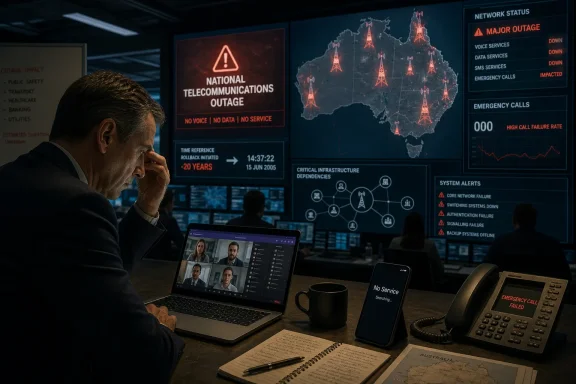
Telstra detected its nationwide mobile outage at about 4.30am on July 8, 2026, but chief executive Vicki Brady was not alerted for another two and a half hours, after an operations leader whose Telstra phone would not connect resorted to leaving her a message through Microsoft Teams. The workaround succeeded, but it also exposed the central contradiction in Telstra’s defence: a crisis process can operate exactly as designed and still be inadequate for the crisis it is supposed to manage. When the same failure that disables customers also obstructs the company’s command chain, redundancy cannot remain a promise buried in a procedure.
The technical trigger was startlingly mundane for an incident with national consequences. Planned work on a vital time server ended with the server restarting and winding its clock back 20 years, disrupting the synchronisation on which other parts of the mobile network depended. What began as a problem involving calls and data then became a much more serious test of Telstra’s ability to identify failed Triple Zero calls, understand the spreading impact and communicate honestly while its own picture of the outage was still deteriorating.
The most important question is therefore not whether Telstra had a plan. It plainly did. The question is whether that plan assumed that the company’s own network, its internal communications and its early technical estimates would remain trustworthy precisely when all three were under stress.
The detail that will follow Telstra long after the network is restored is not merely that Brady was overseas on a family holiday. It is that a senior operations leader could not call the chief executive because his own phone was not connecting, leaving Microsoft Teams as the route around Telstra’s failed telecommunications infrastructure.
According to Nick Bonyhady’s reporting in The Sydney Morning Herald, the operations leader sent Brady a Teams message and she called back. Brady subsequently defended the escalation process, saying, “All of those processes worked as they should have.”
That statement is narrowly defensible. The operations leader attempted to make contact, found an alternate channel, left a message and ultimately reached the chief executive. If a crisis-management procedure is judged only by whether the required notification eventually occurs, the box can be ticked.
But operational resilience is not a compliance exercise. A two-and-a-half-hour gap between Telstra detecting a nationwide failure and alerting its chief executive is a significant delay when mobile services, business systems, transport operations and emergency calling may be affected.
The use of Teams should not itself be treated as embarrassing. Enterprise collaboration platforms are designed to work over any available internet connection, and using one during a carrier outage is entirely rational. The embarrassment lies in Teams apparently becoming an improvised escape route rather than one component of a deliberately tested, carrier-independent executive communications system.
That distinction matters. An alternate channel is not genuine redundancy merely because it happens to work after the primary channel fails. It becomes operational redundancy when the organisation has confirmed that the alternate channel is independent, monitored, accessible to the right people and capable of escalating an unread message when minutes matter.
Telstra’s experience also illustrates why the phrase out-of-band communication needs to mean more than installing several apps on the same corporate handset. A phone containing Telstra service, Teams, email and an internet calling application can appear to offer four communications methods while still having only one functioning network path. If that path disappears, the apparent diversity disappears with it.
For chief executives, incident commanders and critical engineering leads, the relevant unit of redundancy is not the application. It is the underlying carrier, internet connection, device, identity system and power source required to make the application work.
Telstra’s public account said nodes that keep time synchronised across parts of its mobile network were not operating as expected. The company’s official outage update said it identified the issue at approximately 4.30am on July 8 and began restoring affected nodes, while Michael Ackland, Telstra’s chief financial officer, later described a software defect associated with the timing failure.
The extraordinary rollback helps explain why a seemingly limited maintenance activity could create effects far beyond one machine. It does not, by itself, explain why the network permitted a restarted time source to distribute an implausible date, why dependent systems accepted it or why safeguards failed to isolate the problem before customers were disconnected.
Those are questions for Telstra’s root-cause investigation. They are also questions that should determine whether the public eventually receives a meaningful engineering account or another corporate chronology in which the triggering defect is described without explaining the failed controls around it.
A strong post-incident review must distinguish the trigger from the causes of the outage. The restarted server may have triggered the incident, but the larger causes could include change-management weaknesses, insufficient validation, dependency concentration, inadequate rollback controls or monitoring that detected symptoms only after corrupted time had already propagated. Those possibilities remain to be tested, not assumed.
This distinction is familiar to experienced IT teams. Blaming a bad update, an incorrect value or a malfunctioning server is easy because it identifies the object nearest the explosion. Resilience engineering asks why one object had the authority and reach to produce an explosion of that size.
The public version of that question is simpler: why could planned work on a time server kick millions of people off a national network? Telstra will not restore confidence by explaining only what the server did. It must explain why the network allowed it to matter so much.
If a national carrier detects a potentially widespread outage at about 4.30am and the chief executive is alerted two and a half hours later, either the escalation threshold was too high, the escalation path was too slow or both. The fact that the responsible executive was overseas may complicate contact, but geographic location is precisely the kind of foreseeable condition a crisis plan is expected to handle.
A mature escalation model should not depend on one person repeatedly trying one chief executive through one communication method. It should establish parallel notifications to the acting executive, incident commander, board-level contact, regulatory liaison, communications team and government-relations function, with automatic escalation if acknowledgement does not arrive within a defined interval.
Ackland was already the executive fronting the media while Brady was away. That raises another governance question: if the chief financial officer was effectively acting in her absence, what decision required Brady to be reached, and what was the deadline for reaching her? A crisis plan should make that authority model explicit before an incident begins.
There is also a difference between notification and operational awareness. Sending a Teams message satisfies the first only when the recipient notices and understands it. High-severity incident systems generally need acknowledgement, repeated paging and escalation through multiple channels because an unread message is not the same as a received alert.
Microsoft was not responsible for the outage, and Teams did what Telstra’s own phone service could not: it carried the message. Yet the episode is a warning to every organisation that treats a cloud collaboration tool as an invisible utility. Telstra’s emergency communication depended on another company’s platform, identity services, software and internet connectivity remaining available.
That dependency was useful and, in this case, successful. But useful dependency is not independence. Telstra’s next crisis plan must account for the possibility that Teams, the internet connection used to reach it, or the identity system required to sign in may be unavailable at the same time as the mobile network.
The resemblance is more than a media-friendly coincidence. In both incidents, an internet-based communications platform running outside the failed carrier network provided a route around the outage. In both, the episode made the company’s executives look like ordinary customers searching for any connection that still worked.
The Optus comparison is especially damaging because the lesson was public and obvious. After the 2023 outage, Optus leaders obtained backup SIM cards from competing networks. That is not a complete resilience strategy, but it recognises a fundamental principle: a carrier’s executives cannot rely exclusively on the carrier whose failure they are responsible for managing.
Telstra had nearly three years to incorporate that lesson into its own crisis planning. Bonyhady’s account does not establish whether the operations leader had a backup SIM and chose Teams because it was faster, or whether Teams was the only available path. Either possibility demands scrutiny.
If a backup service existed but was slower or less reliable than sending a Teams message, Telstra needs to examine how quickly its alternate communications can actually be activated. If no independent carrier path existed, the lesson from Optus was observed but not operationalised.
The comparison extends into the technical progression of the incidents. Optus’s 2023 failure involved incorrect routing information spreading through layers of its network, complicating efforts to determine the full scale and restore service. In Telstra’s case, the consequences also evolved as the initial time-synchronisation failure was followed by a continuing problem affecting some Triple Zero calls.
Different mechanisms can create the same management trap. Engineers repair the first visible fault, executives describe the incident using the best numbers available, and the organisation later discovers that the failure has propagated into systems it believed were protected. Early certainty then ages badly.
Telstra has a distinctive position in Australia’s emergency-calling system. The Australian Communications and Media Authority explains that Telstra acts as the Emergency Call Person for Triple Zero and 112, answering emergency calls and transferring them to police, fire or ambulance services. During this incident, the government said the core Triple Zero system remained operational, but some callers were unable to connect to it through the affected carrier network.
That distinction is technically important but emotionally irrelevant to someone whose emergency call fails. The emergency answering platform can remain healthy while a defect elsewhere in the path prevents a caller from reaching it. From the caller’s perspective, Triple Zero did not work.
The first public description from Ackland referred to a “small number of reports” of failed calls. The number then became 333. A day later, Telstra said more than 600 Triple Zero calls had failed.
Telstra says the situation worsened as the problem spread from one server to another. On Friday, Ackland rejected the suggestion that the company had deliberately downplayed the incident, saying: “The situation got worse, and we now believe we have addressed all of those issues.”
That explanation may be accurate, but it reveals why early outage communications should be framed around uncertainty rather than reassuring estimates. When a complex network is still failing, “we have received only a small number of reports” does not mean that only a small number of failures occurred. It means only that the reporting, telemetry and welfare-check processes have identified a small number so far.
This is a classic observability problem. A company experiencing a network malfunction is often using that same network’s logs, alarms, call records and customer reports to understand the malfunction. The systems providing the evidence may themselves be delayed, incomplete or affected.
The correct early posture is therefore not alarmism, but explicit uncertainty: the confirmed number is a floor, the full impact is still being established, and additional failures may emerge. That wording may be less comforting in the first press conference, but it is more credible when the count later doubles.
The failed-call figures also show why public communications cannot be treated as a side function delegated after engineers begin recovery. Communication is part of incident containment. Customers need to know whether they should use another device, another carrier, a landline or Wi-Fi calling, and they need that advice before they discover the problem during an emergency.
Outage reporting creates an irresistible pressure to produce numbers. Journalists ask how many people are affected, governments demand estimates, customers want to know whether the problem is local, and markets look for evidence of material damage. Executives who admit they do not yet know can appear unprepared.
But false precision is more damaging than uncertainty. Suggesting that perhaps only thousands of customers were affected, while millions were potentially exposed to a network-wide defect, created a narrative Telstra later had to unwind as more evidence emerged.
The progression from a “small number of reports” to 333 failed Triple Zero calls and then more than 600 is not simply a communications embarrassment. It indicates that Telstra’s initial operational picture was unable to reveal the eventual public-safety impact.
The response should not be to prevent executives from speaking until every log has been reconciled. It should be to give them better language and confidence ranges: confirmed failures, suspected failures, services at risk, areas still under investigation and the time at which the next update will be delivered.
This is where technical incident management and corporate communications frequently collide. Engineers speak in hypotheses because they know the system is not fully understood. Corporate spokespeople prefer declarative sentences because those sound controlled. During a cascading outage, the engineers’ grammar is usually the safer one.
Those rules matter, but meeting a notification schedule is not the same as controlling a crisis. A company can issue updates at the prescribed intervals while still underestimating the incident, routing executives through fragile channels and failing to explain which safeguards did not work.
Brady’s argument that Telstra’s crisis-management processes operated correctly is therefore less reassuring than intended. If all processes worked correctly while the chief executive remained unaware for two and a half hours, the process itself becomes evidence.
Boards and regulators should ask for more than a statement that escalation occurred. They should ask when each executive and authority was notified, which channels were attempted, how long acknowledgement took, what information was included and which decisions were delayed while the contact process unfolded.
The same scrutiny should apply to technical change controls. Planned work affecting critical timing infrastructure should have a defined blast radius, pre-change validation, a tested rollback path and monitoring capable of rejecting an impossible date before dependent systems consume it.
No control can eliminate every outage. The purpose of resilience is to prevent a single error from becoming a national incident and, when prevention fails, to stop the incident spreading faster than the organisation can understand it.
July 8, roughly two and a half hours later: Vicki Brady is alerted after an operations leader, unable to reach her through his phone, sends a message using Microsoft Teams and she calls back.
July 8, Wednesday morning: Michael Ackland publicly describes the number of reported Triple Zero failures as small and suggests the wider customer impact may be limited.
July 8, later that day: The identified count reaches 333 failed Triple Zero calls as Telstra continues welfare checks and investigates the outage.
July 9: Telstra reports that more than 600 Triple Zero calls failed and says a related software issue continued after the initial mobile service disruption.
July 10, Friday: Brady fronts the media after returning to Australia and defends Telstra’s crisis-management processes while promising an investigation and transparency about resulting changes.
A useful investigation must test at least three layers. The first is the direct technical failure: how planned work led a time server to restart 20 years in the past and how that bad state reached dependent systems. The second is containment: why redundancy, validation or isolation controls did not stop the fault from spreading.
The third layer is organisational response. Telstra must establish why it took two and a half hours to alert Brady, whether that delay affected decisions, whether the acting-authority structure was adequate and whether executives possessed genuinely independent communication methods.
It must also reconstruct the changing Triple Zero count. Investigators should determine when Telstra first had evidence that the emergency-calling impact was larger than publicly described, whether monitoring could have surfaced that evidence earlier and whether the language used in the initial briefing properly reflected uncertainty.
Transparency will require more than publishing the root trigger. Telstra should identify the failed controls, remediation owners, deadlines and the evidence that fixes have been independently tested. Otherwise, “lessons learned” will remain a phrase rather than an operational result.
Accountability is the harder part. Brady did not commit to blanket compensation, discounts or a financial penalty for executives, according to the Herald. Compensation and executive pay are not substitutes for technical reform, but refusing to discuss them reinforces the impression that customers bear the disruption while management retains discretion over the consequences.
A credible response does not require a ritual resignation. It requires evidence that the people responsible for risk and resilience face incentives tied to whether promised controls are implemented and tested.
Teams worked because some form of internet connectivity and Microsoft’s service remained available. In another incident, Teams may be the system that fails while mobile voice continues working. In a cyberattack, the collaboration account could be disabled or corporate identity systems could block access.
Resilience comes from diversity across failure domains, not loyalty to one vendor or excitement about another. A robust crisis kit could include a competing carrier, an independently managed device, a secondary internet connection, offline contact details and a collaboration service reachable without the primary corporate network.
The Optus and Telstra incidents show that executives need the same practical redundancy often recommended to emergency workers and business-continuity teams. A backup SIM is simple, but it should not be assumed to solve every problem. Multi-carrier incidents, device failures, dead batteries, overloaded networks and compromised credentials can defeat simplistic plans.
The goal is not to construct a communications bunker for every manager. It is to ensure that a small, clearly defined crisis team can continue communicating when the organisation’s principal product has failed.
Telstra’s next plan will be judged before the next outage, not during it: by whether executives have truly independent communications, whether impossible time changes are automatically contained, whether emergency-call risks are surfaced early and whether provisional numbers are presented honestly. Microsoft Teams rescued one message this time; the measure of reform is whether Telstra ever needs that kind of improvisation again.
The technical trigger was startlingly mundane for an incident with national consequences. Planned work on a vital time server ended with the server restarting and winding its clock back 20 years, disrupting the synchronisation on which other parts of the mobile network depended. What began as a problem involving calls and data then became a much more serious test of Telstra’s ability to identify failed Triple Zero calls, understand the spreading impact and communicate honestly while its own picture of the outage was still deteriorating.
The most important question is therefore not whether Telstra had a plan. It plainly did. The question is whether that plan assumed that the company’s own network, its internal communications and its early technical estimates would remain trustworthy precisely when all three were under stress.
 Microsoft Teams Became Telstra’s Emergency Back Channel
The detail that will follow Telstra long after the network is restored is not merely that Brady was overseas on a family holiday. It is that a senior operations leader could not call the chief executive because his own phone was not connecting, leaving Microsoft Teams as the route around Telstra’s failed telecommunications infrastructure.According to Nick Bonyhady’s reporting in The Sydney Morning Herald, the operations leader sent Brady a Teams message and she called back. Brady subsequently defended the escalation process, saying, “All of those processes worked as they should have.”
That statement is narrowly defensible. The operations leader attempted to make contact, found an alternate channel, left a message and ultimately reached the chief executive. If a crisis-management procedure is judged only by whether the required notification eventually occurs, the box can be ticked.
But operational resilience is not a compliance exercise. A two-and-a-half-hour gap between Telstra detecting a nationwide failure and alerting its chief executive is a significant delay when mobile services, business systems, transport operations and emergency calling may be affected.
The use of Teams should not itself be treated as embarrassing. Enterprise collaboration platforms are designed to work over any available internet connection, and using one during a carrier outage is entirely rational. The embarrassment lies in Teams apparently becoming an improvised escape route rather than one component of a deliberately tested, carrier-independent executive communications system.
That distinction matters. An alternate channel is not genuine redundancy merely because it happens to work after the primary channel fails. It becomes operational redundancy when the organisation has confirmed that the alternate channel is independent, monitored, accessible to the right people and capable of escalating an unread message when minutes matter.
Telstra’s experience also illustrates why the phrase out-of-band communication needs to mean more than installing several apps on the same corporate handset. A phone containing Telstra service, Teams, email and an internet calling application can appear to offer four communications methods while still having only one functioning network path. If that path disappears, the apparent diversity disappears with it.
For chief executives, incident commanders and critical engineering leads, the relevant unit of redundancy is not the application. It is the underlying carrier, internet connection, device, identity system and power source required to make the application work.
A Twenty-Year Clock Error Became a Nationwide Trust Failure
Time synchronisation sounds like background plumbing, but modern networks use time as part of the machinery that coordinates events, validates transactions and keeps distributed systems operating in the correct sequence. If critical systems suddenly disagree about the date by 20 years, failures can appear in places far removed from the server where the original error occurred.Telstra’s public account said nodes that keep time synchronised across parts of its mobile network were not operating as expected. The company’s official outage update said it identified the issue at approximately 4.30am on July 8 and began restoring affected nodes, while Michael Ackland, Telstra’s chief financial officer, later described a software defect associated with the timing failure.
The extraordinary rollback helps explain why a seemingly limited maintenance activity could create effects far beyond one machine. It does not, by itself, explain why the network permitted a restarted time source to distribute an implausible date, why dependent systems accepted it or why safeguards failed to isolate the problem before customers were disconnected.
Those are questions for Telstra’s root-cause investigation. They are also questions that should determine whether the public eventually receives a meaningful engineering account or another corporate chronology in which the triggering defect is described without explaining the failed controls around it.
A strong post-incident review must distinguish the trigger from the causes of the outage. The restarted server may have triggered the incident, but the larger causes could include change-management weaknesses, insufficient validation, dependency concentration, inadequate rollback controls or monitoring that detected symptoms only after corrupted time had already propagated. Those possibilities remain to be tested, not assumed.
This distinction is familiar to experienced IT teams. Blaming a bad update, an incorrect value or a malfunctioning server is easy because it identifies the object nearest the explosion. Resilience engineering asks why one object had the authority and reach to produce an explosion of that size.
The public version of that question is simpler: why could planned work on a time server kick millions of people off a national network? Telstra will not restore confidence by explaining only what the server did. It must explain why the network allowed it to matter so much.
The Escalation Delay Was a Design Failure, Not a Teams Success
Brady’s defence focuses attention on whether staff followed procedure. That is understandable from a governance perspective, but it risks protecting the procedure from the very evidence that should force it to change.If a national carrier detects a potentially widespread outage at about 4.30am and the chief executive is alerted two and a half hours later, either the escalation threshold was too high, the escalation path was too slow or both. The fact that the responsible executive was overseas may complicate contact, but geographic location is precisely the kind of foreseeable condition a crisis plan is expected to handle.
A mature escalation model should not depend on one person repeatedly trying one chief executive through one communication method. It should establish parallel notifications to the acting executive, incident commander, board-level contact, regulatory liaison, communications team and government-relations function, with automatic escalation if acknowledgement does not arrive within a defined interval.
Ackland was already the executive fronting the media while Brady was away. That raises another governance question: if the chief financial officer was effectively acting in her absence, what decision required Brady to be reached, and what was the deadline for reaching her? A crisis plan should make that authority model explicit before an incident begins.
There is also a difference between notification and operational awareness. Sending a Teams message satisfies the first only when the recipient notices and understands it. High-severity incident systems generally need acknowledgement, repeated paging and escalation through multiple channels because an unread message is not the same as a received alert.
Microsoft was not responsible for the outage, and Teams did what Telstra’s own phone service could not: it carried the message. Yet the episode is a warning to every organisation that treats a cloud collaboration tool as an invisible utility. Telstra’s emergency communication depended on another company’s platform, identity services, software and internet connectivity remaining available.
That dependency was useful and, in this case, successful. But useful dependency is not independence. Telstra’s next crisis plan must account for the possibility that Teams, the internet connection used to reach it, or the identity system required to sign in may be unavailable at the same time as the mobile network.
Optus Had Already Demonstrated the Same Executive Blind Spot
Australia did not need a theoretical exercise to discover that a telecommunications executive may lose access to their own company’s service during an outage. Optus demonstrated the problem in 2023, when then-chief executive Kelly Bayer Rosmarin used WhatsApp over Wi-Fi to call into a radio program because the Optus network was down.The resemblance is more than a media-friendly coincidence. In both incidents, an internet-based communications platform running outside the failed carrier network provided a route around the outage. In both, the episode made the company’s executives look like ordinary customers searching for any connection that still worked.
| Crisis detail | Telstra outage | Optus outage |
|---|---|---|
| Year | 2026 | 2023 |
| Executive | Vicki Brady | Kelly Bayer Rosmarin |
| Primary communications problem | Telstra operations leader’s phone would not connect | Optus network was unavailable |
| Working alternative | Microsoft Teams | WhatsApp over Wi-Fi |
| Organisational lesson | Executive notification needed carrier-independent escalation | Optus leaders subsequently adopted backup SIM cards from other networks |
Telstra had nearly three years to incorporate that lesson into its own crisis planning. Bonyhady’s account does not establish whether the operations leader had a backup SIM and chose Teams because it was faster, or whether Teams was the only available path. Either possibility demands scrutiny.
If a backup service existed but was slower or less reliable than sending a Teams message, Telstra needs to examine how quickly its alternate communications can actually be activated. If no independent carrier path existed, the lesson from Optus was observed but not operationalised.
The comparison extends into the technical progression of the incidents. Optus’s 2023 failure involved incorrect routing information spreading through layers of its network, complicating efforts to determine the full scale and restore service. In Telstra’s case, the consequences also evolved as the initial time-synchronisation failure was followed by a continuing problem affecting some Triple Zero calls.
Different mechanisms can create the same management trap. Engineers repair the first visible fault, executives describe the incident using the best numbers available, and the organisation later discovers that the failure has propagated into systems it believed were protected. Early certainty then ages badly.
Triple Zero Turned a Network Incident Into a Public-Safety Test
A mobile outage affecting calls and data is disruptive. An outage associated with failed Triple Zero calls enters a different category because the harm is no longer measured only in disconnected customers, stalled payments or lost productivity.Telstra has a distinctive position in Australia’s emergency-calling system. The Australian Communications and Media Authority explains that Telstra acts as the Emergency Call Person for Triple Zero and 112, answering emergency calls and transferring them to police, fire or ambulance services. During this incident, the government said the core Triple Zero system remained operational, but some callers were unable to connect to it through the affected carrier network.
That distinction is technically important but emotionally irrelevant to someone whose emergency call fails. The emergency answering platform can remain healthy while a defect elsewhere in the path prevents a caller from reaching it. From the caller’s perspective, Triple Zero did not work.
The first public description from Ackland referred to a “small number of reports” of failed calls. The number then became 333. A day later, Telstra said more than 600 Triple Zero calls had failed.
Telstra says the situation worsened as the problem spread from one server to another. On Friday, Ackland rejected the suggestion that the company had deliberately downplayed the incident, saying: “The situation got worse, and we now believe we have addressed all of those issues.”
That explanation may be accurate, but it reveals why early outage communications should be framed around uncertainty rather than reassuring estimates. When a complex network is still failing, “we have received only a small number of reports” does not mean that only a small number of failures occurred. It means only that the reporting, telemetry and welfare-check processes have identified a small number so far.
This is a classic observability problem. A company experiencing a network malfunction is often using that same network’s logs, alarms, call records and customer reports to understand the malfunction. The systems providing the evidence may themselves be delayed, incomplete or affected.
The correct early posture is therefore not alarmism, but explicit uncertainty: the confirmed number is a floor, the full impact is still being established, and additional failures may emerge. That wording may be less comforting in the first press conference, but it is more credible when the count later doubles.
The failed-call figures also show why public communications cannot be treated as a side function delegated after engineers begin recovery. Communication is part of incident containment. Customers need to know whether they should use another device, another carrier, a landline or Wi-Fi calling, and they need that advice before they discover the problem during an emergency.
“Small Number” Was an Observation Presented Like a Conclusion
Ackland’s early briefing appears to have reflected the information Telstra had at the time. The problem was not necessarily that the information was false; it was that a provisional count sounded like a settled assessment of scale.Outage reporting creates an irresistible pressure to produce numbers. Journalists ask how many people are affected, governments demand estimates, customers want to know whether the problem is local, and markets look for evidence of material damage. Executives who admit they do not yet know can appear unprepared.
But false precision is more damaging than uncertainty. Suggesting that perhaps only thousands of customers were affected, while millions were potentially exposed to a network-wide defect, created a narrative Telstra later had to unwind as more evidence emerged.
The progression from a “small number of reports” to 333 failed Triple Zero calls and then more than 600 is not simply a communications embarrassment. It indicates that Telstra’s initial operational picture was unable to reveal the eventual public-safety impact.
The response should not be to prevent executives from speaking until every log has been reconciled. It should be to give them better language and confidence ranges: confirmed failures, suspected failures, services at risk, areas still under investigation and the time at which the next update will be delivered.
This is where technical incident management and corporate communications frequently collide. Engineers speak in hypotheses because they know the system is not fully understood. Corporate spokespeople prefer declarative sentences because those sound controlled. During a cascading outage, the engineers’ grammar is usually the safer one.
Compliance Is the Floor, Not the Measure of Resilience
Australia’s outage rules require carriers to communicate with customers, the public, other providers and relevant authorities during major incidents. ACMA guidance also requires regular, accessible updates through multiple channels, reflecting lessons drawn from the 2023 Optus outage.Those rules matter, but meeting a notification schedule is not the same as controlling a crisis. A company can issue updates at the prescribed intervals while still underestimating the incident, routing executives through fragile channels and failing to explain which safeguards did not work.
Brady’s argument that Telstra’s crisis-management processes operated correctly is therefore less reassuring than intended. If all processes worked correctly while the chief executive remained unaware for two and a half hours, the process itself becomes evidence.
Boards and regulators should ask for more than a statement that escalation occurred. They should ask when each executive and authority was notified, which channels were attempted, how long acknowledgement took, what information was included and which decisions were delayed while the contact process unfolded.
The same scrutiny should apply to technical change controls. Planned work affecting critical timing infrastructure should have a defined blast radius, pre-change validation, a tested rollback path and monitoring capable of rejecting an impossible date before dependent systems consume it.
No control can eliminate every outage. The purpose of resilience is to prevent a single error from becoming a national incident and, when prevention fails, to stop the incident spreading faster than the organisation can understand it.
Timeline
July 8, about 4.30am: Telstra detects a problem affecting nodes that keep time synchronised across parts of its mobile network.July 8, roughly two and a half hours later: Vicki Brady is alerted after an operations leader, unable to reach her through his phone, sends a message using Microsoft Teams and she calls back.
July 8, Wednesday morning: Michael Ackland publicly describes the number of reported Triple Zero failures as small and suggests the wider customer impact may be limited.
July 8, later that day: The identified count reaches 333 failed Triple Zero calls as Telstra continues welfare checks and investigates the outage.
July 9: Telstra reports that more than 600 Triple Zero calls failed and says a related software issue continued after the initial mobile service disruption.
July 10, Friday: Brady fronts the media after returning to Australia and defends Telstra’s crisis-management processes while promising an investigation and transparency about resulting changes.
Telstra’s Investigation Must Test the Plan, Not Validate It
Brady promised that Telstra would complete its investigation, disclose the lessons and implement any necessary changes. That commitment is appropriate, but telecommunications history is full of post-incident reports that describe a sequence of technical events while leaving institutional assumptions untouched.A useful investigation must test at least three layers. The first is the direct technical failure: how planned work led a time server to restart 20 years in the past and how that bad state reached dependent systems. The second is containment: why redundancy, validation or isolation controls did not stop the fault from spreading.
The third layer is organisational response. Telstra must establish why it took two and a half hours to alert Brady, whether that delay affected decisions, whether the acting-authority structure was adequate and whether executives possessed genuinely independent communication methods.
It must also reconstruct the changing Triple Zero count. Investigators should determine when Telstra first had evidence that the emergency-calling impact was larger than publicly described, whether monitoring could have surfaced that evidence earlier and whether the language used in the initial briefing properly reflected uncertainty.
Transparency will require more than publishing the root trigger. Telstra should identify the failed controls, remediation owners, deadlines and the evidence that fixes have been independently tested. Otherwise, “lessons learned” will remain a phrase rather than an operational result.
Accountability is the harder part. Brady did not commit to blanket compensation, discounts or a financial penalty for executives, according to the Herald. Compensation and executive pay are not substitutes for technical reform, but refusing to discuss them reinforces the impression that customers bear the disruption while management retains discretion over the consequences.
A credible response does not require a ritual resignation. It requires evidence that the people responsible for risk and resilience face incentives tied to whether promised controls are implemented and tested.
Action checklist for admins
- Verify that incident leaders have at least one communications path using a different carrier, device and internet connection from the primary corporate service.
- Test executive notification trees with acknowledgement deadlines and automatic escalation rather than relying on voicemail or unread chat messages.
- Map hidden dependencies on time synchronisation, DNS, identity, certificates and cloud collaboration services.
- Configure monitoring to reject or quarantine implausible time changes before they propagate to production systems.
- Separate confirmed impact figures from estimates and label incomplete counts clearly during incident communications.
- Run outage exercises in which the primary mobile carrier, Teams or equivalent collaboration platform and corporate identity services are unavailable simultaneously.
- Record notification, decision and welfare-check timestamps so the post-incident review can reconstruct events without relying on memory.
The Lesson Is Not to Replace Telstra With Microsoft
It would be easy to reduce the episode to a joke: Telstra’s chief executive had to be contacted through Microsoft because Telstra could not provide the connection. That line captures the irony, but not the lesson.Teams worked because some form of internet connectivity and Microsoft’s service remained available. In another incident, Teams may be the system that fails while mobile voice continues working. In a cyberattack, the collaboration account could be disabled or corporate identity systems could block access.
Resilience comes from diversity across failure domains, not loyalty to one vendor or excitement about another. A robust crisis kit could include a competing carrier, an independently managed device, a secondary internet connection, offline contact details and a collaboration service reachable without the primary corporate network.
The Optus and Telstra incidents show that executives need the same practical redundancy often recommended to emergency workers and business-continuity teams. A backup SIM is simple, but it should not be assumed to solve every problem. Multi-carrier incidents, device failures, dead batteries, overloaded networks and compromised credentials can defeat simplistic plans.
The goal is not to construct a communications bunker for every manager. It is to ensure that a small, clearly defined crisis team can continue communicating when the organisation’s principal product has failed.
What Telstra Now Has to Prove
Telstra’s defence rests on process, but the evidence points to process as part of the problem. The company must now demonstrate that its investigation will examine the full system around the failed server rather than isolating blame on a software defect or maintenance task.- The outage was detected at about 4.30am, but Vicki Brady was not alerted for two and a half hours.
- Microsoft Teams provided the working path after a Telstra phone failed to connect.
- A restarted time server wound the clock back 20 years and disrupted dependent mobile-network systems.
- The reported Triple Zero impact rose from a “small number” to 333 calls and then more than 600.
- Optus had already exposed the need for carrier-independent executive communications in 2023.
- Telstra’s promised investigation will be credible only if it identifies failed controls, publishes concrete remedies and tests them under realistic outage conditions.
Telstra’s next plan will be judged before the next outage, not during it: by whether executives have truly independent communications, whether impossible time changes are automatically contained, whether emergency-call risks are surfaced early and whether provisional numbers are presented honestly. Microsoft Teams rescued one message this time; the measure of reform is whether Telstra ever needs that kind of improvisation again.
References
- Primary source: smh.com.au
Published: 2026-07-10T06:42:07.881416
Telstra’s plans went awry and now it wants customers to trust it to find the fix
For a company built on selling plans, Telstra has made a mess of them.www.smh.com.au
- Related coverage: acma.gov.au
- Related coverage: telstra.com.au
Emergency Call Service Determination | Telstra
Learn more about an update to the Telecommunications (Emergency Call Service) Determination 2019.www.telstra.com.au - Related coverage: minister.infrastructure.gov.au
- Related coverage: abc.net.au
Two weeks since the Optus outage, documents show backroom scrambling and urgent meetings occurred as the emergency played out - ABC News
Submissions to a Senate inquiry outline what happened behind the scenes as Optus rushed to fix its recent outage. www.abc.net.au
- Related coverage: theguardian.com
Optus outage: CEO says some services are being restored after millions across Australia lost mobile and internet | Optus | The Guardian
Telecommunications company says engineers investigating a network fault affecting service for customers todaywww.theguardian.com
- Related coverage: aph.gov.au
Chapter 2 - The Optus network outage
Chapter 2The Optus network outage2.1This chapter outlines the major events before, during, and after the Optus network outage on 8 November 2023. It provides a detailed, chronological list of relevant events, correspondence, public statements and announcements.2.2The chapter alsowww.aph.gov.au - Related coverage: optus.com.au
Senate Environment and Communications Committee Triple Zero service outage Optus Submission
PDF documentwww.optus.com.au
- Related coverage: infrastructure.gov.au
- Related coverage: netimes.com.au
- Related coverage: theregister.com
Telstra outage downs 000 calls, trains, payment systems
Telco says issues all sorted, but transport networks expected to be disrupted well into Thursdaywww.theregister.com