

NEC NSS’s confirmed government and intelligence identity work is being positioned alongside commercial examples involving Star Alliance and Major League Baseball. However, the supplied material does not establish that NEC NSS has a role in either deployment, identify the NEC products involved, or disclose whether the deployments use a shared, decentralized, or privacy-preserving architecture.
The next opportunity to seek those details is Identity Week America 2026, scheduled for September 2–3, 2026, where NEC is expected to exhibit and the event is advertising a Free All-Access Pass.
The supplied profile presents NEC NSS through its work in security-sensitive identity environments. The company is a wholly owned subsidiary of NEC America, operates under a special security agreement, and serves the U.S. government and intelligence community.
Those facts establish NEC NSS’s identity and customer base. They should not be expanded into claims about particular operational security capabilities that the supplied material does not document. The existence of the special security agreement does not itself certify a commercial product, establish how a deployment is controlled, or demonstrate that a particular privacy or security practice carries over to another NEC organization.
The commercial side of the story concerns NEC more broadly. Star Alliance and Major League Baseball are named as organizations deploying NEC biometric solutions, but that wording does not attribute their deployments to NEC NSS. It also does not establish that the two organizations use the same product or technical design.
The distinction matters because a corporate capability narrative can span multiple subsidiaries, products, customers, and deployment models. NEC NSS’s government-facing work may be relevant background when NEC discusses its larger identity portfolio, but buyers still need to know which legal entity supplies their system, which product is involved, and which organization is responsible for operating it.
The sharpest reading of the supplied facts is therefore not that NEC NSS has moved a government architecture into travel and entertainment. It is that NEC is placing NEC NSS’s confirmed government and intelligence identity pedigree alongside examples of broader NEC commercial adoption.
That positioning raises a legitimate reporting question: how, if at all, are the two sides connected at the product, operational, and architectural levels?
The supplied information supports that limited conclusion. It does not support descriptions of specific airport or stadium workflows, nor does it disclose customer throughput, hardware configurations, enrollment channels, ticketing integrations, mobile applications, cloud services, matching methods, or retention practices.
Those missing details prevent a more ambitious comparison. Star Alliance and MLB cannot be treated as evidence of a single NEC commercial platform unless NEC identifies the products and explains their relationship. They also cannot be cited as proof that NEC NSS technology has entered either environment.
This distinction is more than corporate labeling. The identity of the supplier can affect contracting, support, data-processing responsibilities, audit rights, incident procedures, and accountability. A buyer evaluating an NEC solution needs the deployment-specific answer rather than an inference based on another NEC entity’s work.
NEC should therefore clarify whether the commercial references are simply examples from its broader portfolio or whether NEC NSS supplies any technology, personnel, support, governance, or data-processing services to them. If NEC NSS has no role, that should be stated plainly. If it does have a role, NEC should define it precisely.
It should therefore not be described as strengthening NEC NSS’s credentials, proving controlled operations, or validating the design of an NEC biometric deployment. It is also not evidence that Star Alliance, MLB, or another commercial customer receives controls associated with NEC NSS’s government work.
A special security agreement and a commercial product assessment answer different questions. One concerns an organization’s operating arrangement. The other requires evidence about a named product and deployment, including responsible parties, data handling, user rights, customer separation, and contractual controls.
That separation protects the analysis from running ahead of the facts. NEC NSS’s government and intelligence work is relevant because it explains why NEC is emphasizing security-sensitive identity experience. It does not relieve a commercial buyer of the need to examine the system being purchased.
As general buyer guidance, organizations should ask vendors to map broad claims about corporate experience to the exact product, service, and contractual entity under consideration. If a vendor points to work performed by an affiliate or subsidiary, the buyer should determine whether the same personnel, technology, processes, or controls are actually part of the proposed deployment.
That statement identifies an industry direction from NEC NSS’s perspective. It does not disclose an NEC architecture, and it should not be presented as proof that the Star Alliance or MLB deployments implement decentralized identity.
Terms such as “decentralized” and “self-sovereign” can refer to materially different technical and governance arrangements. Without product documentation, the terminology does not reveal where a credential is held, where a biometric comparison occurs, whether each organization receives a separate identifier, or whether a central service participates in every transaction.
The supplied information also does not say whether NEC has implemented decentralized identifiers, verifiable credentials, user-held credentials, local biometric matching, or another defined standard or method in either named commercial deployment. Any claim that users receive more control in those deployments would therefore go beyond the available evidence.
The key issue is not whether decentralized identity is desirable in the abstract. It is whether NEC can connect the language to a named product and explain the practical allocation of control.
For a specific deployment, NEC should define:
The first is organizational identity: NEC NSS is a subsidiary of NEC America, operates under a special security agreement, and works with the U.S. government and intelligence community.
The second is broader NEC commercial activity: Star Alliance and MLB are organizations deploying NEC biometric solutions.
The third is strategic direction: Park describes a movement toward decentralized and self-sovereign identity.
The supplied material does not establish a technical chain connecting all three. It does not show that NEC NSS technology powers the commercial deployments, that those deployments embody Park’s stated direction, or that the same architecture appears across NEC customers.
That gap should be the focus of buyer and press questions. Corporate background can explain why a company believes it is qualified to compete, but product-level evidence shows what the customer is actually receiving.
Useful evidence could include a named product description, a clear allocation of responsibilities among NEC entities, a deployment-specific data-flow explanation, and documentation of user and customer controls. The point is not to demand disclosure of sensitive implementation details. It is to obtain enough information to evaluate the claims being made about privacy, decentralization, and organizational expertise.
As general buyer guidance, marketing categories should be translated into testable contract and design statements. “Decentralized,” for example, should correspond to an identified distribution of technical or administrative control. “User control” should correspond to actions the user can perform. “Customer separation” should correspond to documented boundaries. “Deletion” should identify the records covered and the responsible party.
Without that translation, broad identity language remains difficult to compare across products or deployments.
For Star Alliance and MLB, NEC should state whether NEC NSS supplies technology, personnel, support, or data-processing services. It should also identify the product or product family used in each case and say whether the deployments share any component.
This is the threshold question because the supplied material currently places NEC NSS’s pedigree and NEC’s commercial examples in the same narrative without establishing a product-level connection.
The request should remain tied to the actual deployment. A general description of what a biometric platform could do would not establish what Star Alliance, MLB, or another customer has implemented.
If information varies by customer configuration, NEC should identify which choices belong to NEC and which belong to the customer.
This question does not assume that NEC maintains a shared system. The purpose is to resolve that uncertainty directly.
The answer should also distinguish a common product from a common data environment. Two customers could use the same product without sharing records or services; conversely, separate interfaces could still depend on a common underlying component. Buyers need NEC to describe the actual boundaries.
If decentralized and self-sovereign identity remain a roadmap or industry direction rather than a feature of the named commercial deployments, NEC should say so. That would preserve the strategic significance of Park’s statement without treating it as evidence of an architecture that has not been disclosed.
A precise answer would also help buyers compare NEC’s terminology with their own technical, privacy, and governance requirements.
The answer should identify which party receives each request and what records or services the action affects. If these procedures are set by the customer rather than NEC, that division of responsibility should be explicit.
This is general buyer guidance rather than a claim about an existing NEC deployment. The supplied material does not disclose the user-choice mechanisms used by Star Alliance, MLB, or other NEC customers, making them appropriate questions rather than established features.
For the government-facing side, NEC can explain what aspect of NEC NSS’s experience is relevant to the commercial products being presented without implying that the special security agreement certifies those products.
For the commercial side, NEC can distinguish solutions provided by the broader NEC organization from any role performed by NEC NSS. It can also state whether Star Alliance and MLB use related products or are simply separate examples from the NEC portfolio.
For the architecture story, NEC can identify whether Park’s decentralized and self-sovereign identity direction is reflected in a shipping product, a customer deployment, a demonstration, or a longer-term strategy.
Those distinctions would not weaken NEC’s proposition. They would make it more verifiable by allowing customers to evaluate the product in front of them rather than infer its design from a corporate relationship or another customer’s deployment.
The next opportunity to seek those details is Identity Week America 2026, scheduled for September 2–3, 2026, where NEC is expected to exhibit and the event is advertising a Free All-Access Pass.
Fact box
Confirmed
Not disclosed
- NEC NSS is a wholly owned subsidiary of NEC America.
- NEC NSS operates under a special security agreement.
- Its work includes serving the U.S. government and intelligence community.
- Star Alliance and Major League Baseball are identified as organizations deploying NEC biometric solutions.
- Austin Park, Director of NEC NSS, describes decentralized and self-sovereign identity as an industry direction.
- NEC is scheduled to exhibit at Identity Week America 2026 on September 2–3, 2026.
Questions NEC should answer
- Whether NEC NSS supplies, operates, supports, or processes data for the Star Alliance or MLB deployments.
- Which NEC products those organizations use.
- Whether the deployments have any components, databases, enrollment systems, or services in common.
- Where biometric matching occurs or which party controls enrollment and retention.
- Whether either deployment implements decentralized identifiers, verifiable credentials, or user-held credentials.
- Which NEC entity and named product support each commercial deployment?
- What data is collected, where is it processed, and who controls it?
- Are customers technically and contractually isolated from one another?
- What does “decentralized” mean in a specific NEC implementation?
- How can users decline participation, withdraw, delete records, or use an alternative?
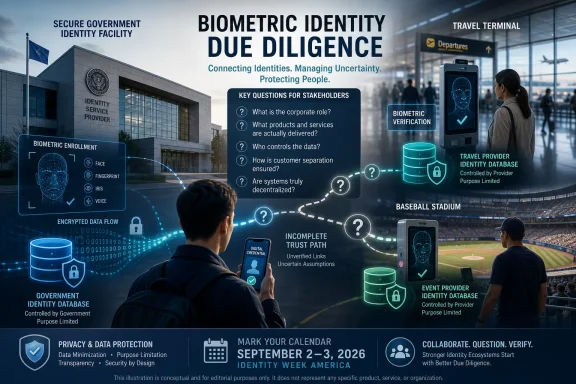 A Government Identity Pedigree Meets a Commercial Biometrics Story
The supplied profile presents NEC NSS through its work in security-sensitive identity environments. The company is a wholly owned subsidiary of NEC America, operates under a special security agreement, and serves the U.S. government and intelligence community.Those facts establish NEC NSS’s identity and customer base. They should not be expanded into claims about particular operational security capabilities that the supplied material does not document. The existence of the special security agreement does not itself certify a commercial product, establish how a deployment is controlled, or demonstrate that a particular privacy or security practice carries over to another NEC organization.
The commercial side of the story concerns NEC more broadly. Star Alliance and Major League Baseball are named as organizations deploying NEC biometric solutions, but that wording does not attribute their deployments to NEC NSS. It also does not establish that the two organizations use the same product or technical design.
The distinction matters because a corporate capability narrative can span multiple subsidiaries, products, customers, and deployment models. NEC NSS’s government-facing work may be relevant background when NEC discusses its larger identity portfolio, but buyers still need to know which legal entity supplies their system, which product is involved, and which organization is responsible for operating it.
The sharpest reading of the supplied facts is therefore not that NEC NSS has moved a government architecture into travel and entertainment. It is that NEC is placing NEC NSS’s confirmed government and intelligence identity pedigree alongside examples of broader NEC commercial adoption.
That positioning raises a legitimate reporting question: how, if at all, are the two sides connected at the product, operational, and architectural levels?
Star Alliance and MLB Are NEC Examples, Not NEC NSS Deployments
Star Alliance and MLB provide recognizable commercial context for NEC’s biometrics story. They show that NEC solutions are being deployed by organizations outside the government and intelligence settings associated with NEC NSS.The supplied information supports that limited conclusion. It does not support descriptions of specific airport or stadium workflows, nor does it disclose customer throughput, hardware configurations, enrollment channels, ticketing integrations, mobile applications, cloud services, matching methods, or retention practices.
Those missing details prevent a more ambitious comparison. Star Alliance and MLB cannot be treated as evidence of a single NEC commercial platform unless NEC identifies the products and explains their relationship. They also cannot be cited as proof that NEC NSS technology has entered either environment.
| Context | Organization | What the supplied material confirms | What remains unknown |
|---|---|---|---|
| Government and intelligence | U.S. government and intelligence community | NEC NSS performs identity-related work for these customers | The architecture and controls of particular deployments |
| Air travel | Star Alliance | The organization is deploying NEC biometric solutions | NEC NSS’s role, the named product, and the deployment architecture |
| Sports and entertainment | Major League Baseball | The organization is deploying NEC biometric solutions | NEC NSS’s role, the named product, and the deployment architecture |
| Industry event | Identity Week America 2026 | NEC is scheduled to exhibit September 2–3, 2026 | Which products and deployment details NEC will present |
NEC should therefore clarify whether the commercial references are simply examples from its broader portfolio or whether NEC NSS supplies any technology, personnel, support, governance, or data-processing services to them. If NEC NSS has no role, that should be stated plainly. If it does have a role, NEC should define it precisely.
The Special Security Agreement Is a Fact, Not a Product Certification
NEC NSS’s operation under a special security agreement is part of the company’s confirmed organizational background. The supplied facts do not explain the agreement’s terms or claim that it establishes a particular commercial security capability.It should therefore not be described as strengthening NEC NSS’s credentials, proving controlled operations, or validating the design of an NEC biometric deployment. It is also not evidence that Star Alliance, MLB, or another commercial customer receives controls associated with NEC NSS’s government work.
A special security agreement and a commercial product assessment answer different questions. One concerns an organization’s operating arrangement. The other requires evidence about a named product and deployment, including responsible parties, data handling, user rights, customer separation, and contractual controls.
That separation protects the analysis from running ahead of the facts. NEC NSS’s government and intelligence work is relevant because it explains why NEC is emphasizing security-sensitive identity experience. It does not relieve a commercial buyer of the need to examine the system being purchased.
As general buyer guidance, organizations should ask vendors to map broad claims about corporate experience to the exact product, service, and contractual entity under consideration. If a vendor points to work performed by an affiliate or subsidiary, the buyer should determine whether the same personnel, technology, processes, or controls are actually part of the proposed deployment.
Decentralized Identity Is a Stated Direction, Not a Disclosed Design
Austin Park, Director of NEC NSS, says the industry is shifting from centrally managed identities toward decentralized and self-sovereign identities in pursuit of better privacy, security, and user experiences.That statement identifies an industry direction from NEC NSS’s perspective. It does not disclose an NEC architecture, and it should not be presented as proof that the Star Alliance or MLB deployments implement decentralized identity.
Terms such as “decentralized” and “self-sovereign” can refer to materially different technical and governance arrangements. Without product documentation, the terminology does not reveal where a credential is held, where a biometric comparison occurs, whether each organization receives a separate identifier, or whether a central service participates in every transaction.
The supplied information also does not say whether NEC has implemented decentralized identifiers, verifiable credentials, user-held credentials, local biometric matching, or another defined standard or method in either named commercial deployment. Any claim that users receive more control in those deployments would therefore go beyond the available evidence.
The key issue is not whether decentralized identity is desirable in the abstract. It is whether NEC can connect the language to a named product and explain the practical allocation of control.
For a specific deployment, NEC should define:
- What element of the system is decentralized.
- Which party issues and controls the credential.
- Which parties can resolve or correlate identifiers.
- Whether verification depends on a central NEC or customer-operated service.
- What the user can independently access, revoke, transfer, or delete.
The Missing Link Is Product-Level Evidence
The available account contains three different layers that should not be collapsed into one another.The first is organizational identity: NEC NSS is a subsidiary of NEC America, operates under a special security agreement, and works with the U.S. government and intelligence community.
The second is broader NEC commercial activity: Star Alliance and MLB are organizations deploying NEC biometric solutions.
The third is strategic direction: Park describes a movement toward decentralized and self-sovereign identity.
The supplied material does not establish a technical chain connecting all three. It does not show that NEC NSS technology powers the commercial deployments, that those deployments embody Park’s stated direction, or that the same architecture appears across NEC customers.
That gap should be the focus of buyer and press questions. Corporate background can explain why a company believes it is qualified to compete, but product-level evidence shows what the customer is actually receiving.
Useful evidence could include a named product description, a clear allocation of responsibilities among NEC entities, a deployment-specific data-flow explanation, and documentation of user and customer controls. The point is not to demand disclosure of sensitive implementation details. It is to obtain enough information to evaluate the claims being made about privacy, decentralization, and organizational expertise.
As general buyer guidance, marketing categories should be translated into testable contract and design statements. “Decentralized,” for example, should correspond to an identified distribution of technical or administrative control. “User control” should correspond to actions the user can perform. “Customer separation” should correspond to documented boundaries. “Deletion” should identify the records covered and the responsible party.
Without that translation, broad identity language remains difficult to compare across products or deployments.
Five Questions to Take to Identity Week America 2026
NEC is scheduled to exhibit at Identity Week America 2026 on September 2–3, 2026, and the event is advertising a Free All-Access Pass. For readers considering attendance, the most useful action is to request answers tied to a named product and deployment rather than seek general assurances about NEC’s portfolio.1. Which NEC entity and product are involved?
NEC should identify the legal and operational entity responsible for each deployment being discussed. That answer should distinguish NEC NSS from NEC America and any other NEC organization.For Star Alliance and MLB, NEC should state whether NEC NSS supplies technology, personnel, support, or data-processing services. It should also identify the product or product family used in each case and say whether the deployments share any component.
This is the threshold question because the supplied material currently places NEC NSS’s pedigree and NEC’s commercial examples in the same narrative without establishing a product-level connection.
2. What is the deployment-specific data flow?
NEC should describe what information is collected, which parties receive it, where processing occurs, and which organization controls each stage. The answer should cover enrollment, verification, operational records, support access, retention, and deletion at a level sufficient for procurement and privacy review.The request should remain tied to the actual deployment. A general description of what a biometric platform could do would not establish what Star Alliance, MLB, or another customer has implemented.
If information varies by customer configuration, NEC should identify which choices belong to NEC and which belong to the customer.
3. Are customers and use cases isolated?
NEC should explain whether separate customers have technically and contractually separate environments, records, and identifiers. It should state whether information from one deployment can be accessed, searched, reused, or correlated in another.This question does not assume that NEC maintains a shared system. The purpose is to resolve that uncertainty directly.
The answer should also distinguish a common product from a common data environment. Two customers could use the same product without sharing records or services; conversely, separate interfaces could still depend on a common underlying component. Buyers need NEC to describe the actual boundaries.
4. What does “decentralized” mean in NEC’s implementation?
NEC should connect Park’s statement to a named product, demonstration, or deployment if such an implementation exists. It should identify what is decentralized, who holds the credential, how verification works, and which parties can observe or correlate transactions.If decentralized and self-sovereign identity remain a roadmap or industry direction rather than a feature of the named commercial deployments, NEC should say so. That would preserve the strategic significance of Park’s statement without treating it as evidence of an architecture that has not been disclosed.
A precise answer would also help buyers compare NEC’s terminology with their own technical, privacy, and governance requirements.
5. What choices and remedies does the user have?
NEC and the customer should explain how a person can decline biometric participation, use an alternative, withdraw after enrolling, request deletion, and challenge an error.The answer should identify which party receives each request and what records or services the action affects. If these procedures are set by the customer rather than NEC, that division of responsibility should be explicit.
This is general buyer guidance rather than a claim about an existing NEC deployment. The supplied material does not disclose the user-choice mechanisms used by Star Alliance, MLB, or other NEC customers, making them appropriate questions rather than established features.
A Focused Due-Diligence Checklist
Before relying on NEC’s government-facing background as support for a commercial procurement, a buyer should obtain five compact deliverables:- Entity and product identification: The contracting, operating, supporting, and data-processing roles of each NEC organization, together with the exact product under review.
- Deployment data flow: A description of collection, processing, access, retention, deletion, and the division of responsibilities between NEC, the customer, and other parties.
- Customer-separation statement: A clear account of whether systems, records, identifiers, or services are shared or isolated across deployments.
- Architecture definition: A product-specific explanation of any claim involving decentralization, self-sovereignty, user-held credentials, or user control.
- User-rights procedure: Documented methods for declining participation, using an alternative, withdrawing, requesting deletion, and disputing outcomes.
What NEC Can Clarify Next
Identity Week America 2026 gives NEC a concrete forum in which to close the gap between corporate narrative and deployment detail. The most valuable clarification would be a concise mapping of entity, product, customer, and architecture.For the government-facing side, NEC can explain what aspect of NEC NSS’s experience is relevant to the commercial products being presented without implying that the special security agreement certifies those products.
For the commercial side, NEC can distinguish solutions provided by the broader NEC organization from any role performed by NEC NSS. It can also state whether Star Alliance and MLB use related products or are simply separate examples from the NEC portfolio.
For the architecture story, NEC can identify whether Park’s decentralized and self-sovereign identity direction is reflected in a shipping product, a customer deployment, a demonstration, or a longer-term strategy.
Those distinctions would not weaken NEC’s proposition. They would make it more verifiable by allowing customers to evaluate the product in front of them rather than infer its design from a corporate relationship or another customer’s deployment.