

CISA has added two actively exploited file-upload flaws—CVE-2026-48939 in iCagenda and CVE-2026-56291 in Balbooa Forms—to its Known Exploited Vulnerabilities Catalog, putting exposed deployments on an urgent remediation and investigation track. The immediate targets are web applications rather than Windows itself, but an affected site may still run on Windows Server, use Microsoft-connected identities, or provide access to resources elsewhere in the enterprise.
CISA’s alert establishes that both vulnerabilities have been exploited in the wild. It does not provide exploit payloads, affected version ranges, indicators of compromise, or product-vendor remediation details. It also does not establish that either flaw necessarily results in code execution, total control of the asset, credential theft, or lateral movement in every deployment. The hardening and investigation steps below are therefore general defensive guidance, not substitutes for product-specific instructions.
If either product is exposed to the internet, identify the deployment, reduce the exposure, preserve evidence, and investigate immediately rather than waiting for the next routine maintenance window.
Both additions belong to the same vulnerability class: unrestricted upload of a file with a dangerous type. In plain English, an application intended to accept legitimate attachments may fail to prevent an attacker from submitting content that the hosting environment considers unsafe.
CISA identified CVE-2026-48939 as affecting iCagenda and CVE-2026-56291 as affecting Balbooa Forms. Both were added to the KEV Catalog based on evidence of active exploitation. That is the central news: these are not merely theoretical flaws or laboratory demonstrations.
The practical risk also depends on configuration. Upload security is influenced by where submitted files are stored, whether the hosting environment can interpret them, the permissions of the application identity, and the controls surrounding the server. Those questions must be answered locally because CISA’s alert does not describe the exploit payloads or the outcome of exploitation in each deployment.
CISA’s Known Exploited Vulnerabilities Catalog supplies a different signal: evidence that a vulnerability has been exploited in the wild. KEV inclusion does not explain every attack, identify every exposed version, or guarantee a particular post-exploitation result. It does tell defenders that the vulnerability has crossed the line from possibility to observed exploitation.
That distinction should affect response order. An internet-facing component known to be under exploitation may warrant action ahead of a higher-scoring weakness that is isolated, inaccessible, or protected by compensating controls.
For these two CVEs, the immediate sequence should be:
The alert’s limits matter just as much as its warning. It does not provide affected version ranges, so administrators should not declare a deployment safe solely because its version number differs from an unverified claim circulating elsewhere. It does not provide indicators of compromise, so a search for one rumored filename or address cannot establish that the server is clean. It does not publish exploit payloads, so defenders should not assume they know exactly what an attacker submitted. It does not include vendor remediation details, so general security advice must not be mistaken for an official product fix.
For covered agencies, the response must account for more than the existence of a CVE. Public exposure, exploitation status, and the impact that exploitation could have on the specific asset all influence prioritization and required action. That model is more operationally useful than treating every scanner finding as equally urgent.
The distinction is especially important here because CISA does not say that successful exploitation of either CVE grants total control of every affected asset. It also does not establish that exploitation invariably results in remote code execution, credential theft, data loss, or movement into internal systems. Those outcomes may be possible in some upload-vulnerability scenarios, but they must remain conditional unless supported for these specific products and deployments.
Administrators should instead determine what the affected application can actually do in their environment. Relevant questions include:
Organizations outside the federal scope can adopt the same prioritization logic voluntarily. CISA encourages all organizations to use the KEV Catalog as an input to vulnerability management, but that encouragement is not a legal requirement created by BOD 26-04.
If iCagenda or Balbooa Forms runs on Windows Server, administrators should identify the application pool, service account, writable directories, and relevant security telemetry. They should determine whether the application identity has permissions beyond what the website requires and whether the host can access sensitive internal resources.
The same concern applies if the application runs on another platform but connects to Microsoft infrastructure. A web application may use Microsoft-connected identity services, databases, file shares, email, cloud resources, or administrative tooling. Whether those connections can be abused depends on the deployment, privileges, and controls; it should not be assumed from the CVE description alone.
Coordination is therefore necessary. Application owners may know where the extension is installed. Hosting providers may control updates and server logs. Infrastructure teams may understand service identities and network routes. Security operations may hold endpoint and identity telemetry. Incident responders may need to preserve evidence before an administrator rebuilds the host.
The response should assign clear ownership for three decisions:
Begin by establishing an exposure window. Determine when the affected component was installed, when it became externally reachable, when access was restricted or the component was removed, and when any vendor-recommended update or mitigation was completed.
Next, preserve relevant evidence. Depending on the environment, that may include:
Because CISA does not provide indicators of compromise for these CVEs, the investigation should not depend on a single filename, hash, address, or request pattern. Administrators should instead look for behavior inconsistent with the application’s normal use.
For an upload feature, that can include files with unexpected extensions, misleading names, unusual content, or creation times that correspond with suspicious requests. Investigators should check whether such files were subsequently retrieved, renamed, moved, interpreted, or otherwise acted upon by the server.
Process and network telemetry may provide additional context. Unexpected child processes launched by a web-service identity, unusual command interpreters, unexplained file modifications, new scheduled activity, or outbound connections can justify escalation. These are general investigative signals, not confirmed behaviors for these two CVEs.
A clean vulnerability scan after remediation answers only whether the scanner still detects the vulnerable condition. It does not prove that exploitation never occurred.
The absence of findings must also be evaluated against the quality of available evidence. If logs cover only a few days, endpoint telemetry was disabled, or application records existed solely on the affected host, investigators may be unable to reach a high-confidence conclusion. “No suspicious activity was found in the available data” is more accurate than declaring that no compromise occurred when visibility was incomplete.
If credible evidence of unauthorized activity appears, the response should move beyond application maintenance. Depending on the findings, teams may need to isolate the host, preserve forensic evidence, rotate exposed credentials, review connected services, examine adjacent systems, and rebuild from a trusted source.
Those actions should be driven by evidence and local architecture. CISA’s alert alone does not establish that credentials were stolen, that persistence was created, or that other systems were reached.
That makes product discovery and exposure validation separate tasks. Finding the component in an inventory does not prove it is reachable. Failing to find it in an endpoint-management console does not prove it is absent, especially when application extensions were installed manually or are maintained by an outside provider.
Administrators should compare internal records with externally visible services. They should also ask business owners, developers, managed-service providers, and web-hosting companies about deployments that central IT may not manage directly.
The goal is not to build a perfect enterprise inventory before taking action. It is to answer the immediate operational questions quickly enough to reduce exposure:
Monitoring should also cover unexpected files in upload locations, unusual process creation under web-service identities, unauthorized application changes, and unexplained outbound traffic.
These measures can reduce the consequences of upload-validation failures generally. They do not establish which versions are affected, block the specific exploitation method, or replace instructions from the product vendors. Until authoritative product guidance is available, exposed affected components should not remain online merely because general hardening controls appear strong.
At the same time, KEV inclusion should not be stretched beyond what the entry establishes. For these additions, CISA confirms active exploitation and identifies the affected products and vulnerability class. The alert does not identify a common attacker, provide payloads, list affected versions, publish indicators, describe a shared campaign, or document the outcome of every successful exploit.
Defenders should preserve that distinction when briefing executives and system owners. A precise message is more useful than an exaggerated one:
That model works only when the underlying information is reliable. An organization cannot safely classify an application as internal if an abandoned hostname still exposes it. It cannot confidently declare remediation complete if an update was installed but no one checked for earlier exploitation. It cannot claim a clean investigation when the relevant logs were unavailable.
The two KEV additions should therefore produce a focused response rather than a broad, speculative alarm. Find the products. Confirm exposure. Contain affected public instances. Follow vendor guidance. Preserve evidence. Investigate the period before remediation. Escalate only when findings justify it, but do not use the absence of CVE-specific indicators as a reason to skip the investigation.
For administrators, the response is straightforward: identify the products, determine whether they are exposed, remove or mitigate affected public instances, preserve logs, and investigate for compromise that may have occurred before remediation. Do not assume a shared campaign, a specific exploit outcome, or a clean system merely because the vulnerable component has been updated or taken offline.
CISA’s alert establishes that both vulnerabilities have been exploited in the wild. It does not provide exploit payloads, affected version ranges, indicators of compromise, or product-vendor remediation details. It also does not establish that either flaw necessarily results in code execution, total control of the asset, credential theft, or lateral movement in every deployment. The hardening and investigation steps below are therefore general defensive guidance, not substitutes for product-specific instructions.
If either product is exposed to the internet, identify the deployment, reduce the exposure, preserve evidence, and investigate immediately rather than waiting for the next routine maintenance window.
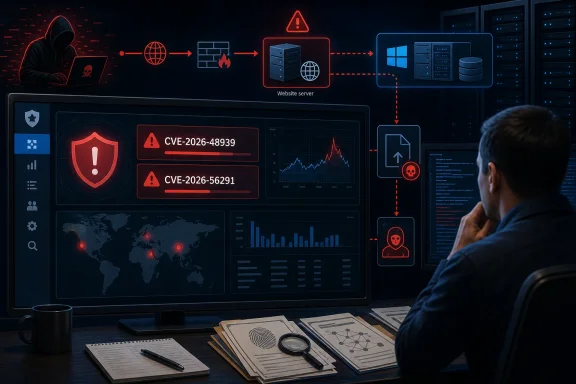 Two Upload Flaws Turn a Routine Web Feature Into an Attack Surface
Both additions belong to the same vulnerability class: unrestricted upload of a file with a dangerous type. In plain English, an application intended to accept legitimate attachments may fail to prevent an attacker from submitting content that the hosting environment considers unsafe.CISA identified CVE-2026-48939 as affecting iCagenda and CVE-2026-56291 as affecting Balbooa Forms. Both were added to the KEV Catalog based on evidence of active exploitation. That is the central news: these are not merely theoretical flaws or laboratory demonstrations.
| Vulnerability | Affected product | Vulnerability type | Exploitation status |
|---|---|---|---|
| CVE-2026-48939 | iCagenda | Unrestricted Upload of File with Dangerous Type | Evidence of active exploitation |
| CVE-2026-56291 | Balbooa Forms | Unrestricted Upload of File with Dangerous Type | Evidence of active exploitation |
Action checklist for admins
- Identify iCagenda and Balbooa Forms deployments across production, staging, test, legacy, and vendor-managed environments.
- Determine internet exposure, including access through alternate hostnames, direct addresses, reverse proxies, unpublished paths, and old domains.
- Take affected exposed instances out of service or mitigate them immediately. Follow the mitigation or update guidance provided by the product vendor; if none is available promptly, remove the affected component from internet exposure.
- Preserve logs and other evidence before rebuilding systems, deleting suspicious files, or making changes that could erase useful records.
- Investigate for pre-remediation compromise rather than treating removal, mitigation, or an update as proof that the system is clean.
- Review upload and temporary directories for unexpected files, then correlate file creation times with web requests and process activity.
- Examine endpoint, identity, network, application, and web-server telemetry for activity associated with the affected host.
- Document the exposure window, response actions, investigative findings, and any gaps caused by missing or short-retention logs.
- Escalate to incident response if evidence indicates that suspicious uploaded content was accessed, interpreted, executed, or followed by other unauthorized activity.
What changed
CISA added two CVEs to the Known Exploited Vulnerabilities Catalog based on evidence of active exploitation: CVE-2026-48939 affecting iCagenda and CVE-2026-56291 affecting Balbooa Forms. KEV inclusion changes the operational priority because exploitation has been observed outside a purely theoretical or research setting.
The fact that both entries concern dangerous file uploads does not prove that they are connected. CISA’s alert does not identify a shared campaign, common attacker, exploit chain, target profile, or reason for selecting the products. Administrators should respond to the confirmed exploitation signal without inventing a broader pattern that the available information does not establish.Who must act
Binding Operational Directive 26-04 applies only to Federal Civilian Executive Branch agencies. Those agencies must follow the directive’s applicable requirements and deadlines. Other organizations—including private companies, state and local governments, schools, healthcare providers, nonprofits, and individual website operators—are not required by that directive to remediate these vulnerabilities. CISA nevertheless encourages all organizations to prioritize vulnerabilities in the KEV Catalog as part of risk-based vulnerability management.
The practical risk also depends on configuration. Upload security is influenced by where submitted files are stored, whether the hosting environment can interpret them, the permissions of the application identity, and the controls surrounding the server. Those questions must be answered locally because CISA’s alert does not describe the exploit payloads or the outcome of exploitation in each deployment.
KEV Status Changes the Question From Severity to Evidence
Traditional vulnerability management often begins with scanner severity. Tools discover weaknesses, assign scores, and create queues that administrators work through according to standard service-level targets. That process remains useful, but it can become detached from how attackers choose reachable targets.CISA’s Known Exploited Vulnerabilities Catalog supplies a different signal: evidence that a vulnerability has been exploited in the wild. KEV inclusion does not explain every attack, identify every exposed version, or guarantee a particular post-exploitation result. It does tell defenders that the vulnerability has crossed the line from possibility to observed exploitation.
That distinction should affect response order. An internet-facing component known to be under exploitation may warrant action ahead of a higher-scoring weakness that is isolated, inaccessible, or protected by compensating controls.
For these two CVEs, the immediate sequence should be:
- Determine whether either product is present.
- Determine whether the relevant deployment is exposed.
- Remove or mitigate the exposed component.
- Preserve evidence.
- Investigate whether exploitation may have occurred before remediation.
- Follow subsequent vendor and CISA guidance as it becomes available.
The alert’s limits matter just as much as its warning. It does not provide affected version ranges, so administrators should not declare a deployment safe solely because its version number differs from an unverified claim circulating elsewhere. It does not provide indicators of compromise, so a search for one rumored filename or address cannot establish that the server is clean. It does not publish exploit payloads, so defenders should not assume they know exactly what an attacker submitted. It does not include vendor remediation details, so general security advice must not be mistaken for an official product fix.
BOD 26-04 Makes Asset Context Essential
CISA discusses the KEV additions within the risk-based framework of Binding Operational Directive 26-04. The directive governs Federal Civilian Executive Branch agencies, not every organization that uses the affected products.For covered agencies, the response must account for more than the existence of a CVE. Public exposure, exploitation status, and the impact that exploitation could have on the specific asset all influence prioritization and required action. That model is more operationally useful than treating every scanner finding as equally urgent.
The distinction is especially important here because CISA does not say that successful exploitation of either CVE grants total control of every affected asset. It also does not establish that exploitation invariably results in remote code execution, credential theft, data loss, or movement into internal systems. Those outcomes may be possible in some upload-vulnerability scenarios, but they must remain conditional unless supported for these specific products and deployments.
Administrators should instead determine what the affected application can actually do in their environment. Relevant questions include:
- Is the upload feature reachable from the internet?
- Where does the application store submitted files?
- Can the web server or another service interpret content from that location?
- Which identity runs the application?
- What permissions does that identity possess?
- Which databases, file shares, management services, or internal systems can the host reach?
- What logging exists for uploads, file access, process creation, identity use, and outbound connections?
Organizations outside the federal scope can adopt the same prioritization logic voluntarily. CISA encourages all organizations to use the KEV Catalog as an input to vulnerability management, but that encouragement is not a legal requirement created by BOD 26-04.
Windows Admins Cannot Leave the Problem With the Web Team
Neither CVE is described as a Windows vulnerability. Windows administrators may nevertheless own the operating system, identity configuration, network access, logging, or recovery processes that determine the scope of an incident involving an affected web application.If iCagenda or Balbooa Forms runs on Windows Server, administrators should identify the application pool, service account, writable directories, and relevant security telemetry. They should determine whether the application identity has permissions beyond what the website requires and whether the host can access sensitive internal resources.
The same concern applies if the application runs on another platform but connects to Microsoft infrastructure. A web application may use Microsoft-connected identity services, databases, file shares, email, cloud resources, or administrative tooling. Whether those connections can be abused depends on the deployment, privileges, and controls; it should not be assumed from the CVE description alone.
Coordination is therefore necessary. Application owners may know where the extension is installed. Hosting providers may control updates and server logs. Infrastructure teams may understand service identities and network routes. Security operations may hold endpoint and identity telemetry. Incident responders may need to preserve evidence before an administrator rebuilds the host.
The response should assign clear ownership for three decisions:
- Whether the organization operates either affected product.
- Whether any deployment is exposed or was exposed during the relevant period.
- Whether available evidence supports or reduces concern about pre-remediation compromise.
Remediation Is a Starting Point, Not a Clean Bill of Health
Closing the vulnerable path prevents or reduces future exploitation, but it does not determine whether an attacker acted before the response. That historical question requires investigation.Begin by establishing an exposure window. Determine when the affected component was installed, when it became externally reachable, when access was restricted or the component was removed, and when any vendor-recommended update or mitigation was completed.
Next, preserve relevant evidence. Depending on the environment, that may include:
- Web-server access and error logs
- Application and content-management logs
- Upload and temporary directories
- File-creation and file-integrity records
- Endpoint process and network telemetry
- Reverse-proxy, firewall, and load-balancer records
- Authentication and service-account activity
- Cloud-hosting and administrative audit logs
- Relevant backups or system snapshots
Because CISA does not provide indicators of compromise for these CVEs, the investigation should not depend on a single filename, hash, address, or request pattern. Administrators should instead look for behavior inconsistent with the application’s normal use.
For an upload feature, that can include files with unexpected extensions, misleading names, unusual content, or creation times that correspond with suspicious requests. Investigators should check whether such files were subsequently retrieved, renamed, moved, interpreted, or otherwise acted upon by the server.
Process and network telemetry may provide additional context. Unexpected child processes launched by a web-service identity, unusual command interpreters, unexplained file modifications, new scheduled activity, or outbound connections can justify escalation. These are general investigative signals, not confirmed behaviors for these two CVEs.
A clean vulnerability scan after remediation answers only whether the scanner still detects the vulnerable condition. It does not prove that exploitation never occurred.
The absence of findings must also be evaluated against the quality of available evidence. If logs cover only a few days, endpoint telemetry was disabled, or application records existed solely on the affected host, investigators may be unable to reach a high-confidence conclusion. “No suspicious activity was found in the available data” is more accurate than declaring that no compromise occurred when visibility was incomplete.
If credible evidence of unauthorized activity appears, the response should move beyond application maintenance. Depending on the findings, teams may need to isolate the host, preserve forensic evidence, rotate exposed credentials, review connected services, examine adjacent systems, and rebuild from a trusted source.
Those actions should be driven by evidence and local architecture. CISA’s alert alone does not establish that credentials were stolen, that persistence was created, or that other systems were reached.
Public Exposure Must Be Verified
An affected component does not need to appear on a prominent public homepage to be exposed. It may be reachable through an alternate hostname, direct address, old domain, reverse proxy, staging site, unpublished path, or legacy deployment that was never fully removed.That makes product discovery and exposure validation separate tasks. Finding the component in an inventory does not prove it is reachable. Failing to find it in an endpoint-management console does not prove it is absent, especially when application extensions were installed manually or are maintained by an outside provider.
Administrators should compare internal records with externally visible services. They should also ask business owners, developers, managed-service providers, and web-hosting companies about deployments that central IT may not manage directly.
The goal is not to build a perfect enterprise inventory before taking action. It is to answer the immediate operational questions quickly enough to reduce exposure:
- Do we use either product?
- Where is it deployed?
- Can an untrusted user reach the affected functionality?
- What can the hosting service access?
- What evidence is available from before remediation?
General Hardening Can Limit Consequences, but It Is Not CVE-Specific Guidance
After immediate containment and investigation, administrators should review the controls around the application. Uploaded content should, where practical, be stored outside executable application paths. The application identity should have only the permissions needed for its function. Public web servers should have limited access to sensitive management services and internal resources.Monitoring should also cover unexpected files in upload locations, unusual process creation under web-service identities, unauthorized application changes, and unexplained outbound traffic.
These measures can reduce the consequences of upload-validation failures generally. They do not establish which versions are affected, block the specific exploitation method, or replace instructions from the product vendors. Until authoritative product guidance is available, exposed affected components should not remain online merely because general hardening controls appear strong.
The KEV Process Sets a Higher Bar Than Rumor
CISA uses the KEV Catalog to identify vulnerabilities for which exploitation has been observed and remediation action is warranted. That makes the catalog more operationally significant than an unverified social-media report or an isolated claim that a weakness might be exploitable.At the same time, KEV inclusion should not be stretched beyond what the entry establishes. For these additions, CISA confirms active exploitation and identifies the affected products and vulnerability class. The alert does not identify a common attacker, provide payloads, list affected versions, publish indicators, describe a shared campaign, or document the outcome of every successful exploit.
Defenders should preserve that distinction when briefing executives and system owners. A precise message is more useful than an exaggerated one:
- Exploitation is confirmed.
- Local exposure must be checked urgently.
- Product-specific details remain limited.
- Remediation must follow authoritative vendor guidance when available.
- Pre-remediation compromise must be considered.
- Consequences must be determined from evidence and the organization’s own architecture.
Risk-Based Patching Depends on Trustworthy Context
BOD 26-04 reinforces a practical lesson: vulnerability counts alone do not describe risk. Evidence of exploitation, public reachability, asset privilege, and potential impact provide the context needed to decide what must be handled first.That model works only when the underlying information is reliable. An organization cannot safely classify an application as internal if an abandoned hostname still exposes it. It cannot confidently declare remediation complete if an update was installed but no one checked for earlier exploitation. It cannot claim a clean investigation when the relevant logs were unavailable.
The two KEV additions should therefore produce a focused response rather than a broad, speculative alarm. Find the products. Confirm exposure. Contain affected public instances. Follow vendor guidance. Preserve evidence. Investigate the period before remediation. Escalate only when findings justify it, but do not use the absence of CVE-specific indicators as a reason to skip the investigation.
Bottom Line
CISA has confirmed active exploitation of CVE-2026-48939 in iCagenda and CVE-2026-56291 in Balbooa Forms, but its alert does not provide affected versions, exploit payloads, indicators of compromise, or vendor remediation details. BOD 26-04 binds FCEB agencies only; other organizations are encouraged, not directed by that mandate, to prioritize KEV remediation.For administrators, the response is straightforward: identify the products, determine whether they are exposed, remove or mitigate affected public instances, preserve logs, and investigate for compromise that may have occurred before remediation. Do not assume a shared campaign, a specific exploit outcome, or a clean system merely because the vulnerable component has been updated or taken offline.
References
- Primary source: CISA
Published: 2026-07-10T12:00:00+00:00
Loading…
www.cisa.gov - Related coverage: nucleussec.com
Loading…
nucleussec.com - Related coverage: insideprivacy.com
CISA Releases Binding Operational Directive on Prioritizing Security Updates Based on Risk | Inside Privacy
On June 10, the Cybersecurity & Infrastructure Security Agency (CISA) released Binding Operational Directive (BOD) 26-04 on Prioritizing Securitywww.insideprivacy.com - Related coverage: afcea.org
CISA Issues Binding Directive on Security Updates to Federal Agencies
The agency aims to address high-risk cyber vulnerabilities.www.afcea.org - Related coverage: securityweek.com
Loading…
www.securityweek.com - Related coverage: jdsupra.com
Loading…
www.jdsupra.com
- Related coverage: techradar.com
CISA puts US government agencies on two-week deadline to patch Microsoft Defender BlueHammer zero-day exploit | TechRadar
BlueHammer was disclosed in early April by a disgruntled researcherwww.techradar.com