

Microsoft Foundry customers should deploy Claude Fable 5 only for tightly controlled experiments using synthetic, public, or explicitly approved data, while postponing production use involving source code, customer information, regulated records, credentials, privileged communications, or other sensitive material until retention terms receive formal organizational approval. The decisive fact is not that the model appears in Microsoft Foundry or GitHub Copilot, but that Anthropic requires prompts and completions to be retained for at least 30 days. Microsoft’s reported internal restriction shows why available and approved must remain separate states in enterprise AI.
Anthropic designated Claude Fable 5 a Covered Model on June 9, 2026, making zero-data-retention configurations incompatible with its use. Microsoft then reportedly limited employee access while its legal and compliance teams assessed what that requirement meant for sensitive internal and customer information, as detailed in reporting attributed to The Verge and Reuters.
The immediate answer for IT leaders is therefore a conditional one: go for isolated evaluation; no-go for sensitive production workloads unless governance owners explicitly accept the retention model. A successful deployment is not merely one that responds to an API call. It is one whose data flow, retention period, processor relationship, access boundaries, and approved use cases can survive scrutiny from security, privacy, legal, compliance, records-management, and customer-assurance teams.
The most useful detail in this launch is not a benchmark, coding demonstration, or marketplace listing. It is Microsoft’s reported decision to restrict its own employees from using Claude Fable 5 while specialists examined Anthropic’s retention requirements.
That internal caution does not prove the model is unsafe. It proves that a vendor can consider a model suitable for customer availability while still withholding broad approval for its own sensitive work. Those two decisions answer different questions.
Foundry availability asks whether Microsoft can offer access to a model through its platform. Internal approval asks whether employees may submit particular categories of Microsoft or customer information under the applicable contractual, technical, and policy controls. Conflating the two is how an interesting preview becomes an unreviewed data-processing channel.
This distinction matters because cloud marketplaces create a powerful visual shortcut. An administrator sees a model inside a familiar Microsoft portal, attached to an Azure subscription and presented alongside other enterprise services. The natural assumption is that Microsoft has normalized every important security and compliance decision.
Microsoft’s documentation points in the other direction. Claude models in Foundry are not necessarily processed under the same arrangements as models sold directly by Azure, and Anthropic is the data processor for the relevant Foundry offer. The Azure interface may be familiar, but the data-governance boundary must be evaluated on the offer’s actual terms rather than the logo surrounding its deployment button.
That is the sharper reading of Microsoft’s internal restriction: it is not hypocrisy, and it is not an indictment of multi-model AI. It is an example of the control enterprises should have had from the beginning—catalog availability without automatic authorization.
The technical integration may therefore look almost identical to an approved AI deployment while carrying a materially different information-lifecycle decision. An application sends instructions, context, documents, code, or tool results to the model and receives generated content. The governance change is that those prompts and completions cannot simply inherit an assumption of zero retention.
Thirty days sounds short beside the long retention schedules used for business records, backups, and audit logs. That comparison is misleading. The issue is not whether 30 days is objectively long; it is whether the information was permitted to enter that retained processing path at all.
A source file may contain intellectual property, customer identifiers, secrets, unpublished security fixes, internal URLs, incident evidence, or comments copied from private systems. A support transcript may include account details, diagnostic logs, contract terms, or information supplied under a customer confidentiality commitment. A legal document may carry privileged analysis that should never be routed into a new processing arrangement merely because an assistant can summarize it quickly.
The retention requirement also follows the interaction rather than the user’s intention. An engineer may believe a prompt is harmless while an agent automatically gathers repository context. An analyst may ask a general question while a retrieval system inserts sensitive passages. A support assistant may receive a sanitized user request but enrich it with an unsanitized case history.
This is why the decision cannot be reduced to telling employees not to paste secrets into chat. Modern AI systems collect context through files, connectors, retrieval pipelines, terminal output, development environments, agent tools, and application code. The prompt visible to a person can be only a small portion of the information ultimately sent for inference.
The relevant unit of approval is consequently the complete workload path: user input, system instructions, retrieved context, files, tool output, generated response, logs, downstream storage, and any human review process. If a team cannot describe that path, it is not ready to claim that the 30-day requirement is harmless.
A preview label and a mandatory retention rule create two separate gates. One concerns service maturity and the organization’s willingness to rely on a preview offering. The other concerns whether prompts and completions may be retained under Anthropic’s Covered Model policy.
Passing one gate does not pass the other. A business owner may accept preview-related operational uncertainty but still lack permission to submit customer data. Conversely, legal and privacy teams could accept the data-processing terms while an application owner rejects the model because the production architecture requires a generally available service.
The practical mistake would be to bundle every concern into a vague request to “approve Fable.” Governance works better when the decision is decomposed. Ask whether the model may be evaluated, which data classifications may be used, which users may access it, whether production use is allowed, and which specific applications are covered.
That approach prevents two predictable outcomes. The first is blanket prohibition, in which an organization loses the opportunity to test a potentially valuable model even with synthetic material. The second is blanket enablement, in which the model picker becomes the de facto approval system.
Microsoft’s reported internal limitation suggests that even a company deeply invested in GitHub Copilot and Foundry did not treat external availability as sufficient justification for unrestricted employee use. Enterprises should resist adopting a weaker standard than the platform company itself reportedly applied.
This phase can still answer useful questions. Teams can test whether Claude Fable 5 follows instructions, handles representative task complexity, produces usable output, fits an application’s workflow, and offers enough incremental value to justify a deeper review.
The evaluation should be deliberately boring from a data perspective. If the model cannot demonstrate value without immediate access to a live repository or production corpus, the team has not yet separated capability testing from data exposure.
Source-code experiments deserve particular discipline. “Use no customer data” is not an adequate rule when an AI coding workflow can ingest private repositories, configuration files, terminal output, issue descriptions, commit history, test fixtures, or generated patches. An isolated demonstration repository should contain no copied proprietary modules, credentials, customer examples, internal hostnames, or unpublished vulnerability material.
The same principle applies to document and agent evaluations. A fabricated procurement contract can test extraction and comparison. A synthetic incident report can test summarization. A mock customer case can test response drafting. A small, purpose-built environment can test tool use without granting an agent access to production systems.
This is not merely a watered-down trial. It is the first stage of a controlled evidence-gathering process. The result should tell decision-makers whether Claude Fable 5 is valuable enough to warrant spending legal, security, engineering, and compliance time on a more consequential approval.
If it does not show a clear advantage, the retention debate becomes academic. The organization can stop before accepting additional obligations or redesigning controls around a model that does not materially improve its work.
A developer can also expose far more than the file currently open. Agentic coding workflows may inspect related modules, tests, dependency files, build output, error messages, and tool results. A narrow request can create a broad context window.
For public open-source projects, training exercises, or disposable prototypes, the 30-day minimum may be acceptable if the organization has approved the service and no restricted information enters the workflow. For private repositories, the default should be no-go until an authorized review addresses the retention arrangement and the full scope of data the tool can access.
The crucial question is not whether a developer intends to paste a secret. It is whether the workflow can transmit information that the organization would refuse to place in a retained third-party prompt or completion.
This also makes repository classification more important than model enthusiasm. Some companies treat all private code as equally sensitive; others distinguish internal utilities from core product intellectual property. The Claude Fable 5 policy does not make that decision for them.
An enterprise can reasonably approve one repository and reject another. It can allow generated test code while blocking access to authentication components. It can authorize an isolated modernization experiment without allowing the model to browse the production monorepo.
Those distinctions should be enforced by access design rather than employee memory wherever possible. If a pilot depends entirely on every participant remembering which file, branch, document, or terminal window is safe, the pilot is already too broad.
WindowsForum’s earlier coverage of Microsoft’s available-versus-approved divide captured the central governance tension. The operational lesson is that a model picker cannot carry repository-level policy. IT and engineering leadership must decide what the model is allowed to see before developers discover what it can do.
The relevant data may also be broader than personally identifiable information. Customer source code, configuration data, tickets, contracts, business plans, security reports, usage records, and operational telemetry can all be confidential even when no conventional personal identifier appears.
An organization must therefore avoid using “no PII” as shorthand for “safe.” Data classification should account for contractual confidentiality, trade secrets, regulated information, security sensitivity, privilege, and internal policy—not just privacy law.
The Foundry context deserves close attention here. Microsoft documentation says Anthropic-hosted Claude processes data differently from models sold directly by Azure and identifies Anthropic as the data processor for the relevant offer. That should trigger examination of the actual processing chain rather than reliance on a generic statement that the workload runs “in Azure.”
For customer-facing production use, approval should be attached to a defined application and data flow. A general authorization to use Claude Fable 5 is too imprecise because the risk of a public-document assistant is not the same as the risk of a support agent that retrieves account history.
Teams should also consider the completion, not merely the input. Generated responses can repeat, transform, summarize, or combine supplied information. Anthropic’s rule covers prompts and model completions, so output handling belongs in the same assessment.
If an organization cannot identify which customer commitments apply, who is acting as processor, what categories of content enter prompts, and whether 30-day minimum retention is permitted, production deployment should wait. The potential productivity gain does not resolve those unanswered questions.
This is not a claim that Claude Fable 5 can never process regulated information. The verified facts available here do not support such a universal conclusion. They support a narrower and more defensible one: zero-data-retention configurations cannot use this Covered Model, and Anthropic requires a minimum retained window for prompts and completions.
That difference matters. Some organizations may determine that the processing terms, safeguards, contractual structure, and retention period meet their obligations for a particular workload. Others may be bound by requirements that make the model unacceptable.
No article can make that determination for them, because the decision depends on contracts, jurisdiction, data type, organizational policy, technical design, and the exact Foundry offer. The role of an IT decision framework is to prevent deployment before those owners have made the decision.
Privileged material deserves especially conservative treatment because convenience can obscure consequence. Asking a model to summarize counsel’s advice or organize investigation notes may feel like ordinary document assistance. It also introduces a new processing path for content whose handling can be central to later disputes.
Security teams should apply the same caution to incident material and unpublished vulnerabilities. Logs, proofs of concept, architecture diagrams, credentials, forensic artifacts, and remediation plans can be sensitive even when the intended use is defensive.
Microsoft’s reported internal review is instructive precisely because it involved sensitive internal and customer information. The company did not need evidence of a breach to pause. The unresolved retention obligation was enough to require evaluation.
First, define the task in plain language. “Use Fable for coding” is too broad; “evaluate generated unit tests against a synthetic repository” is specific enough to assess. “Use Fable for support” is too broad; “draft replies from a fabricated case dataset in an isolated pilot” is assessable.
Second, map the information path. Identify what users enter, what systems retrieve, which files or tools are accessible, what the model generates, where outputs are stored, and whether any prompt or completion can contain restricted data.
Third, classify the highest-sensitivity information reachable by the workload. An application is not low risk merely because its average input is harmless. Its approval must account for the most sensitive material it can realistically transmit.
Fourth, test the retention decision explicitly. The approver should acknowledge that Claude Fable 5 prompts and completions require at least 30 days of retention and that zero-data-retention configurations cannot use the model. A review that never states those facts has missed the central issue.
Fifth, record the scope and enforcement method. Approval should specify users, applications, environments, repositories, data classes, and whether the authorization covers experimentation or production. It should also identify how access will be restricted and how exceptions will be handled.
The possible outcomes should be more precise than approved or denied. A workload can be approved for synthetic data, approved for public data, conditionally approved for a named internal dataset, held pending contractual review, or rejected for a specified class of information.
This creates a useful separation between model approval and workload approval. The organization may recognize Claude Fable 5 as an available model while authorizing only a narrow set of uses. Future applications then inherit neither an automatic yes nor an automatic no.
WindowsForum’s discussion of the collision between retention and AI governance is best understood through this lens. The 30-day period is not just a privacy-policy detail. It is the condition that forces enterprises to turn general AI access into workload-specific authorization.
A multi-model interface can hide meaningful differences behind one user experience. Developers may see a list of model names, but the underlying providers, terms, retention policies, preview states, and processing arrangements can differ.
The model-selection control is therefore a governance boundary, not just a preference switch. Changing models can change the applicable data-handling assumptions even when the developer remains inside the same editor and uses the same Copilot identity.
Administrators should not assume that approval of GitHub Copilot automatically approves every model that may appear within it. The safer policy is to authorize the service, model, workload, and data class together.
That may feel cumbersome compared with enabling one product for an entire developer population. Yet it reflects the reality of multi-model platforms: the front end is becoming more consistent while the backend obligations remain heterogeneous.
This is where enterprise AI begins to resemble a software supply chain. A standard user interface can invoke components from different providers under different terms. Governance has to follow the selected component and the information sent to it.
The lesson extends beyond Anthropic. Organizations need a method that survives the next model release, the next provider, and the next retention-policy change. A policy written only for Claude Fable 5 will become obsolete; a policy distinguishing availability, approval, data classification, and workload scope will remain useful.
The same is true when a Foundry deployment would be connected directly to production retrieval systems before data classification is complete. Agent capability increases the consequences of weak scoping because the system may obtain context from tools and stores that users never manually paste into a prompt.
A controlled pilot should use dedicated resources and intentionally limited inputs. The goal is not to recreate the entire production environment on day one. It is to determine capability and integration value while preserving the option to stop without discovering that sensitive information has already entered the retained workflow.
User training remains necessary, but it cannot compensate for an architecture that grants excessive access. A policy banner saying “do not enter confidential information” does little if an attached retrieval pipeline automatically supplies confidential documents.
Approval records should also avoid euphemisms. If prompts and completions will be retained for at least 30 days, say so. If zero-data-retention controls are incompatible with the model, say so. If Anthropic is the processor for the Foundry offer, record that relationship rather than summarizing the arrangement as “Microsoft-hosted AI.”
Clear language improves decisions because it prevents stakeholders from approving one mental model while the application implements another. It also gives help-desk staff, security reviewers, auditors, and future application owners a common description of the system.
The related WindowsForum examination of Claude Fable 5 as a Foundry enterprise model shows the attraction: powerful models can be incorporated into Azure-centered development and agent workflows. This feature’s counterweight is that platform integration cannot substitute for data authorization.
That makes an in-place substitution particularly risky. An application team may focus on output quality and API compatibility while overlooking that the accepted retention basis has changed.
The safer approach is to preserve the existing approved model while Claude Fable 5 is evaluated as a separate workload. If the organization later accepts the retention requirement, migration can proceed under a revised approval rather than by silently invalidating the old one.
This is also why generic “latest model” aliases can be troublesome in governed environments. Even without assuming any particular implementation, enterprises should ensure that a production workload cannot drift into materially different processing terms merely because a preferred model changes.
Change management for AI needs to include policy-relevant model attributes. Capability, latency, and integration matter, but so do provider identity, retention, preview status, and the availability of zero-retention configurations.
A model upgrade that changes any of those attributes deserves review proportional to the workload’s sensitivity. For public content generation, that review may be brief. For customer records, proprietary code, or privileged material, it should be formal.
Enterprises routinely offer technologies that individual departments cannot use for every purpose. Cloud platforms provide tools that require customer configuration, contractual choices, risk acceptance, and workload-specific controls. Availability establishes possibility, not suitability.
Anthropic has been direct about the core condition. Its Covered Model documentation names Claude Fable 5, gives the June 9, 2026 designation date, requires at least 30 days of prompt and completion retention, and states that zero-data-retention configurations cannot use the model.
Microsoft’s Foundry documentation likewise identifies the model as preview and distinguishes Anthropic-hosted processing from models sold directly by Azure. The area of uncertainty is not the existence of the retention rule. It is how each enterprise’s obligations interact with that rule.
Microsoft’s reported internal response is consequently a useful governance signal. Faced with a model that was technically accessible but raised unresolved questions about sensitive information, the company reportedly limited employee use while legal and compliance teams evaluated it.
That is the process other enterprises should copy: pause the sensitive path, keep the evaluation path narrow, identify the decision owners, and avoid translating marketplace presence into universal permission.
Anthropic designated Claude Fable 5 a Covered Model on June 9, 2026, making zero-data-retention configurations incompatible with its use. Microsoft then reportedly limited employee access while its legal and compliance teams assessed what that requirement meant for sensitive internal and customer information, as detailed in reporting attributed to The Verge and Reuters.
The immediate answer for IT leaders is therefore a conditional one: go for isolated evaluation; no-go for sensitive production workloads unless governance owners explicitly accept the retention model. A successful deployment is not merely one that responds to an API call. It is one whose data flow, retention period, processor relationship, access boundaries, and approved use cases can survive scrutiny from security, privacy, legal, compliance, records-management, and customer-assurance teams.
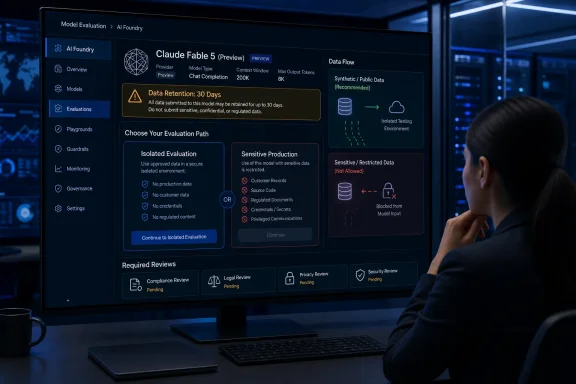 Microsoft’s Own Restriction Supplies the Missing Decision Rule
The most useful detail in this launch is not a benchmark, coding demonstration, or marketplace listing. It is Microsoft’s reported decision to restrict its own employees from using Claude Fable 5 while specialists examined Anthropic’s retention requirements.That internal caution does not prove the model is unsafe. It proves that a vendor can consider a model suitable for customer availability while still withholding broad approval for its own sensitive work. Those two decisions answer different questions.
Foundry availability asks whether Microsoft can offer access to a model through its platform. Internal approval asks whether employees may submit particular categories of Microsoft or customer information under the applicable contractual, technical, and policy controls. Conflating the two is how an interesting preview becomes an unreviewed data-processing channel.
This distinction matters because cloud marketplaces create a powerful visual shortcut. An administrator sees a model inside a familiar Microsoft portal, attached to an Azure subscription and presented alongside other enterprise services. The natural assumption is that Microsoft has normalized every important security and compliance decision.
Microsoft’s documentation points in the other direction. Claude models in Foundry are not necessarily processed under the same arrangements as models sold directly by Azure, and Anthropic is the data processor for the relevant Foundry offer. The Azure interface may be familiar, but the data-governance boundary must be evaluated on the offer’s actual terms rather than the logo surrounding its deployment button.
That is the sharper reading of Microsoft’s internal restriction: it is not hypocrisy, and it is not an indictment of multi-model AI. It is an example of the control enterprises should have had from the beginning—catalog availability without automatic authorization.
The 30-Day Rule Changes the Workload Before It Changes the Architecture
Anthropic’s Covered Model policy states that prompts and model completions for Claude Fable 5 must be retained for at least 30 days. Organizations using zero-data-retention configurations cannot use the model under those configurations, including when it is accessed through third-party platforms such as Microsoft Foundry.The technical integration may therefore look almost identical to an approved AI deployment while carrying a materially different information-lifecycle decision. An application sends instructions, context, documents, code, or tool results to the model and receives generated content. The governance change is that those prompts and completions cannot simply inherit an assumption of zero retention.
Thirty days sounds short beside the long retention schedules used for business records, backups, and audit logs. That comparison is misleading. The issue is not whether 30 days is objectively long; it is whether the information was permitted to enter that retained processing path at all.
A source file may contain intellectual property, customer identifiers, secrets, unpublished security fixes, internal URLs, incident evidence, or comments copied from private systems. A support transcript may include account details, diagnostic logs, contract terms, or information supplied under a customer confidentiality commitment. A legal document may carry privileged analysis that should never be routed into a new processing arrangement merely because an assistant can summarize it quickly.
The retention requirement also follows the interaction rather than the user’s intention. An engineer may believe a prompt is harmless while an agent automatically gathers repository context. An analyst may ask a general question while a retrieval system inserts sensitive passages. A support assistant may receive a sanitized user request but enrich it with an unsanitized case history.
This is why the decision cannot be reduced to telling employees not to paste secrets into chat. Modern AI systems collect context through files, connectors, retrieval pipelines, terminal output, development environments, agent tools, and application code. The prompt visible to a person can be only a small portion of the information ultimately sent for inference.
The relevant unit of approval is consequently the complete workload path: user input, system instructions, retrieved context, files, tool output, generated response, logs, downstream storage, and any human review process. If a team cannot describe that path, it is not ready to claim that the 30-day requirement is harmless.
Preview Status Is a Warning Against Institutional Assumptions
Microsoft Foundry listsclaude-fable-5 as a preview model. Preview status does not make a service automatically unsuitable for enterprise evaluation, but it should stop organizations from treating it as an established production dependency without additional review.A preview label and a mandatory retention rule create two separate gates. One concerns service maturity and the organization’s willingness to rely on a preview offering. The other concerns whether prompts and completions may be retained under Anthropic’s Covered Model policy.
Passing one gate does not pass the other. A business owner may accept preview-related operational uncertainty but still lack permission to submit customer data. Conversely, legal and privacy teams could accept the data-processing terms while an application owner rejects the model because the production architecture requires a generally available service.
The practical mistake would be to bundle every concern into a vague request to “approve Fable.” Governance works better when the decision is decomposed. Ask whether the model may be evaluated, which data classifications may be used, which users may access it, whether production use is allowed, and which specific applications are covered.
That approach prevents two predictable outcomes. The first is blanket prohibition, in which an organization loses the opportunity to test a potentially valuable model even with synthetic material. The second is blanket enablement, in which the model picker becomes the de facto approval system.
Microsoft’s reported internal limitation suggests that even a company deeply invested in GitHub Copilot and Foundry did not treat external availability as sufficient justification for unrestricted employee use. Enterprises should resist adopting a weaker standard than the platform company itself reportedly applied.
The Safe Starting Point Is a Data-Free Capability Trial
A low-risk evaluation should begin without proprietary or personal information. That means synthetic code, fabricated documents, public specifications, invented support cases, and test data designed to reveal no real customer, employee, security, legal, or operational details.This phase can still answer useful questions. Teams can test whether Claude Fable 5 follows instructions, handles representative task complexity, produces usable output, fits an application’s workflow, and offers enough incremental value to justify a deeper review.
The evaluation should be deliberately boring from a data perspective. If the model cannot demonstrate value without immediate access to a live repository or production corpus, the team has not yet separated capability testing from data exposure.
Source-code experiments deserve particular discipline. “Use no customer data” is not an adequate rule when an AI coding workflow can ingest private repositories, configuration files, terminal output, issue descriptions, commit history, test fixtures, or generated patches. An isolated demonstration repository should contain no copied proprietary modules, credentials, customer examples, internal hostnames, or unpublished vulnerability material.
The same principle applies to document and agent evaluations. A fabricated procurement contract can test extraction and comparison. A synthetic incident report can test summarization. A mock customer case can test response drafting. A small, purpose-built environment can test tool use without granting an agent access to production systems.
This is not merely a watered-down trial. It is the first stage of a controlled evidence-gathering process. The result should tell decision-makers whether Claude Fable 5 is valuable enough to warrant spending legal, security, engineering, and compliance time on a more consequential approval.
If it does not show a clear advantage, the retention debate becomes academic. The organization can stop before accepting additional obligations or redesigning controls around a model that does not materially improve its work.
Source Code Moves the Decision From Productivity to Intellectual Property
AI coding tools make the retention question unusually difficult because code is both the object of the task and a container for other sensitive information. A repository may encode business logic, security assumptions, integration details, customer-specific behavior, infrastructure patterns, and unreleased product plans.A developer can also expose far more than the file currently open. Agentic coding workflows may inspect related modules, tests, dependency files, build output, error messages, and tool results. A narrow request can create a broad context window.
For public open-source projects, training exercises, or disposable prototypes, the 30-day minimum may be acceptable if the organization has approved the service and no restricted information enters the workflow. For private repositories, the default should be no-go until an authorized review addresses the retention arrangement and the full scope of data the tool can access.
The crucial question is not whether a developer intends to paste a secret. It is whether the workflow can transmit information that the organization would refuse to place in a retained third-party prompt or completion.
This also makes repository classification more important than model enthusiasm. Some companies treat all private code as equally sensitive; others distinguish internal utilities from core product intellectual property. The Claude Fable 5 policy does not make that decision for them.
An enterprise can reasonably approve one repository and reject another. It can allow generated test code while blocking access to authentication components. It can authorize an isolated modernization experiment without allowing the model to browse the production monorepo.
Those distinctions should be enforced by access design rather than employee memory wherever possible. If a pilot depends entirely on every participant remembering which file, branch, document, or terminal window is safe, the pilot is already too broad.
WindowsForum’s earlier coverage of Microsoft’s available-versus-approved divide captured the central governance tension. The operational lesson is that a model picker cannot carry repository-level policy. IT and engineering leadership must decide what the model is allowed to see before developers discover what it can do.
Customer Data Requires More Than a Product Owner’s Permission
Customer information raises a different set of obligations. A product owner may want the model because it improves support, analysis, document processing, or agent performance, but that owner may not have authority to approve a new processor relationship or retention pattern.The relevant data may also be broader than personally identifiable information. Customer source code, configuration data, tickets, contracts, business plans, security reports, usage records, and operational telemetry can all be confidential even when no conventional personal identifier appears.
An organization must therefore avoid using “no PII” as shorthand for “safe.” Data classification should account for contractual confidentiality, trade secrets, regulated information, security sensitivity, privilege, and internal policy—not just privacy law.
The Foundry context deserves close attention here. Microsoft documentation says Anthropic-hosted Claude processes data differently from models sold directly by Azure and identifies Anthropic as the data processor for the relevant offer. That should trigger examination of the actual processing chain rather than reliance on a generic statement that the workload runs “in Azure.”
For customer-facing production use, approval should be attached to a defined application and data flow. A general authorization to use Claude Fable 5 is too imprecise because the risk of a public-document assistant is not the same as the risk of a support agent that retrieves account history.
Teams should also consider the completion, not merely the input. Generated responses can repeat, transform, summarize, or combine supplied information. Anthropic’s rule covers prompts and model completions, so output handling belongs in the same assessment.
If an organization cannot identify which customer commitments apply, who is acting as processor, what categories of content enter prompts, and whether 30-day minimum retention is permitted, production deployment should wait. The potential productivity gain does not resolve those unanswered questions.
Regulated and Privileged Material Belongs Behind the Hardest Gate
Regulated records should start in the no-go column unless the responsible compliance and legal authorities explicitly approve the workload. The same default should apply to attorney-client communications, litigation strategy, internal investigations, unreleased security findings, credentials, cryptographic material, and information protected by unusually strict contractual terms.This is not a claim that Claude Fable 5 can never process regulated information. The verified facts available here do not support such a universal conclusion. They support a narrower and more defensible one: zero-data-retention configurations cannot use this Covered Model, and Anthropic requires a minimum retained window for prompts and completions.
That difference matters. Some organizations may determine that the processing terms, safeguards, contractual structure, and retention period meet their obligations for a particular workload. Others may be bound by requirements that make the model unacceptable.
No article can make that determination for them, because the decision depends on contracts, jurisdiction, data type, organizational policy, technical design, and the exact Foundry offer. The role of an IT decision framework is to prevent deployment before those owners have made the decision.
Privileged material deserves especially conservative treatment because convenience can obscure consequence. Asking a model to summarize counsel’s advice or organize investigation notes may feel like ordinary document assistance. It also introduces a new processing path for content whose handling can be central to later disputes.
Security teams should apply the same caution to incident material and unpublished vulnerabilities. Logs, proofs of concept, architecture diagrams, credentials, forensic artifacts, and remediation plans can be sensitive even when the intended use is defensive.
Microsoft’s reported internal review is instructive precisely because it involved sensitive internal and customer information. The company did not need evidence of a breach to pause. The unresolved retention obligation was enough to require evaluation.
A Five-Gate Review Turns “Maybe” Into an Auditable Answer
IT leaders need a repeatable approval sequence rather than a debate driven by model reputation. The sequence should begin with the workload, not with a request for tenant-wide access.First, define the task in plain language. “Use Fable for coding” is too broad; “evaluate generated unit tests against a synthetic repository” is specific enough to assess. “Use Fable for support” is too broad; “draft replies from a fabricated case dataset in an isolated pilot” is assessable.
Second, map the information path. Identify what users enter, what systems retrieve, which files or tools are accessible, what the model generates, where outputs are stored, and whether any prompt or completion can contain restricted data.
Third, classify the highest-sensitivity information reachable by the workload. An application is not low risk merely because its average input is harmless. Its approval must account for the most sensitive material it can realistically transmit.
Fourth, test the retention decision explicitly. The approver should acknowledge that Claude Fable 5 prompts and completions require at least 30 days of retention and that zero-data-retention configurations cannot use the model. A review that never states those facts has missed the central issue.
Fifth, record the scope and enforcement method. Approval should specify users, applications, environments, repositories, data classes, and whether the authorization covers experimentation or production. It should also identify how access will be restricted and how exceptions will be handled.
The possible outcomes should be more precise than approved or denied. A workload can be approved for synthetic data, approved for public data, conditionally approved for a named internal dataset, held pending contractual review, or rejected for a specified class of information.
This creates a useful separation between model approval and workload approval. The organization may recognize Claude Fable 5 as an available model while authorizing only a narrow set of uses. Future applications then inherit neither an automatic yes nor an automatic no.
WindowsForum’s discussion of the collision between retention and AI governance is best understood through this lens. The 30-day period is not just a privacy-policy detail. It is the condition that forces enterprises to turn general AI access into workload-specific authorization.
GitHub Copilot Does Not Eliminate the Classification Problem
Microsoft reportedly restricted Claude Fable 5 for employees in the context of internal GitHub Copilot tooling. That detail should matter to organizations that assume Copilot integration provides a single, uniform governance profile across every selectable model.A multi-model interface can hide meaningful differences behind one user experience. Developers may see a list of model names, but the underlying providers, terms, retention policies, preview states, and processing arrangements can differ.
The model-selection control is therefore a governance boundary, not just a preference switch. Changing models can change the applicable data-handling assumptions even when the developer remains inside the same editor and uses the same Copilot identity.
Administrators should not assume that approval of GitHub Copilot automatically approves every model that may appear within it. The safer policy is to authorize the service, model, workload, and data class together.
That may feel cumbersome compared with enabling one product for an entire developer population. Yet it reflects the reality of multi-model platforms: the front end is becoming more consistent while the backend obligations remain heterogeneous.
This is where enterprise AI begins to resemble a software supply chain. A standard user interface can invoke components from different providers under different terms. Governance has to follow the selected component and the information sent to it.
The lesson extends beyond Anthropic. Organizations need a method that survives the next model release, the next provider, and the next retention-policy change. A policy written only for Claude Fable 5 will become obsolete; a policy distinguishing availability, approval, data classification, and workload scope will remain useful.
Broad Enablement Is the Wrong Default for a Preview Covered Model
The strongest case for waiting applies to organizations that cannot restrict access by workload or data source. If enabling Claude Fable 5 exposes it immediately to a large developer population with private repositories and few enforceable boundaries, the organization should wait.The same is true when a Foundry deployment would be connected directly to production retrieval systems before data classification is complete. Agent capability increases the consequences of weak scoping because the system may obtain context from tools and stores that users never manually paste into a prompt.
A controlled pilot should use dedicated resources and intentionally limited inputs. The goal is not to recreate the entire production environment on day one. It is to determine capability and integration value while preserving the option to stop without discovering that sensitive information has already entered the retained workflow.
User training remains necessary, but it cannot compensate for an architecture that grants excessive access. A policy banner saying “do not enter confidential information” does little if an attached retrieval pipeline automatically supplies confidential documents.
Approval records should also avoid euphemisms. If prompts and completions will be retained for at least 30 days, say so. If zero-data-retention controls are incompatible with the model, say so. If Anthropic is the processor for the Foundry offer, record that relationship rather than summarizing the arrangement as “Microsoft-hosted AI.”
Clear language improves decisions because it prevents stakeholders from approving one mental model while the application implements another. It also gives help-desk staff, security reviewers, auditors, and future application owners a common description of the system.
The related WindowsForum examination of Claude Fable 5 as a Foundry enterprise model shows the attraction: powerful models can be incorporated into Azure-centered development and agent workflows. This feature’s counterweight is that platform integration cannot substitute for data authorization.
Existing Zero-Retention Workloads Should Not Be Quietly Migrated
Organizations already operating AI workloads under zero-data-retention assumptions should treat migration to Claude Fable 5 as a policy change, not a routine model upgrade. Anthropic explicitly says Covered Models cannot be used in zero-data-retention configurations.That makes an in-place substitution particularly risky. An application team may focus on output quality and API compatibility while overlooking that the accepted retention basis has changed.
The safer approach is to preserve the existing approved model while Claude Fable 5 is evaluated as a separate workload. If the organization later accepts the retention requirement, migration can proceed under a revised approval rather than by silently invalidating the old one.
This is also why generic “latest model” aliases can be troublesome in governed environments. Even without assuming any particular implementation, enterprises should ensure that a production workload cannot drift into materially different processing terms merely because a preferred model changes.
Change management for AI needs to include policy-relevant model attributes. Capability, latency, and integration matter, but so do provider identity, retention, preview status, and the availability of zero-retention configurations.
A model upgrade that changes any of those attributes deserves review proportional to the workload’s sensitivity. For public content generation, that review may be brief. For customer records, proprietary code, or privileged material, it should be formal.
Microsoft’s Pause Is a Governance Pattern, Not a Verdict on Anthropic
It would be easy to frame this episode as Microsoft distrusting a partner’s model while selling access to customers. That reading is emotionally satisfying and operationally unhelpful.Enterprises routinely offer technologies that individual departments cannot use for every purpose. Cloud platforms provide tools that require customer configuration, contractual choices, risk acceptance, and workload-specific controls. Availability establishes possibility, not suitability.
Anthropic has been direct about the core condition. Its Covered Model documentation names Claude Fable 5, gives the June 9, 2026 designation date, requires at least 30 days of prompt and completion retention, and states that zero-data-retention configurations cannot use the model.
Microsoft’s Foundry documentation likewise identifies the model as preview and distinguishes Anthropic-hosted processing from models sold directly by Azure. The area of uncertainty is not the existence of the retention rule. It is how each enterprise’s obligations interact with that rule.
Microsoft’s reported internal response is consequently a useful governance signal. Faced with a model that was technically accessible but raised unresolved questions about sensitive information, the company reportedly limited employee use while legal and compliance teams evaluated it.
That is the process other enterprises should copy: pause the sensitive path, keep the evaluation path narrow, identify the decision owners, and avoid translating marketplace presence into universal permission.
The Fable 5 Decision Fits on One Approval Page
The practical framework is intentionally conservative because rollback cannot make previously submitted information unsubmitted. Organizations can widen access later after review; they cannot retroactively convert retained prompts into zero-retention transactions.- Deploy Claude Fable 5 now only for isolated evaluation using synthetic, public, or explicitly approved low-sensitivity information.
- Do not connect it to private source repositories, customer systems, regulated datasets, privileged documents, credentials, or sensitive security material without written workload-specific approval.
- Record that Anthropic requires prompts and completions to be retained for at least 30 days and that zero-data-retention configurations cannot use the model.
- Treat Microsoft Foundry availability, GitHub Copilot visibility, preview status, processor identity, and organizational approval as separate facts.
- Require a new review before moving an approved experiment into production or expanding its users, tools, repositories, connectors, or accessible data classes.
- Keep an already approved alternative model in place when zero data retention or a different processing arrangement is mandatory.
References
- Primary source: anthropic.com
Claude Fable \ Anthropic
Next generation of intelligence for the hardest knowledge work and coding problems.www.anthropic.com - Independent coverage: platform.claude.com
API and data retention - Claude API Docs
Learn about how Anthropic's APIs and associated features retain data, including information about zero data retention (ZDR) and HIPAA-ready API access.platform.claude.com - Independent coverage: support.claude.com
Loading…
support.claude.com - Independent coverage: github.blog
Claude Fable 5 is generally available for GitHub Copilot - GitHub Changelog
Editor’s Note (June 12, 2026): Following Anthropic’s announcement, effective today, access to Claude Fable 5 has been suspended across all GitHub Copilot experiences. All other Claude models including Claude Opus…github.blog
- Independent coverage: investing.com
Microsoft limits employee use of Anthropic’s Claude Fable 5 over data retention concerns, The Verge reports By Reuters
Microsoft limits employee use of Anthropic’s Claude Fable 5 over data retention concerns, The Verge reportswww.investing.com - Independent coverage: reddit.com
Loading…
www.reddit.com