

On July 9, 2026, Windows Central’s Daniel Rubino, Zac Bowden, and Jez Cordon used their podcast to connect Microsoft’s confirmed 4,800 job cuts, a claim that Xbox had accumulated 14 management layers, the leaked Project Aion concept, reported Snapdragon X2 Surface devices, and the reported cancellation of the Surface Go families. The subjects look scattered only from a distance. Together, they raise a common question: Which organizational, software, and hardware layers does Microsoft now consider essential—and which is it prepared to remove? Aion is experimental work leaked from 2024, not a product announcement or a confirmed replacement for Windows. The Surface reports are more immediately relevant to buyers: Surface Laptop 8 and Surface Pro 12 are identified as the Snapdragon X2 consumer devices, while Surface Go and Surface Laptop Go are reportedly canceled.
The Windows Central Podcast episode, presented by Rubino, Bowden, and Cordon, is most useful when treated not merely as a roundup but as a snapshot of several pressures inside Microsoft. Its principal threads—layoffs, Xbox management depth, an Edge-based operating-system experiment, and changes to Surface—each involve questioning an existing layer.
At Xbox, the questioned layer is management. In the leaked operating-system concept, it is the traditional Start menu and the assumption that native applications must define the desktop. In Surface, it is the compact, lower-cost Go branch. Across Microsoft, it is 4,800 positions.
These decisions should not be presented as parts of a single documented plan. The available material does not establish that one executive directive connects them, nor does it prove that every change serves the same objective. The defensible observation is narrower: Microsoft is simultaneously reducing headcount, examining management depth, experimenting with an AI-centered interface, and reportedly narrowing its first-party PC portfolio.
That distinction separates evidence from interpretation.
Evidence: The layoffs total 4,800; the podcast discusses 14 management layers at Xbox; Aion is described as leaked experimental work from 2024; Surface Laptop 8 and Surface Pro 12 are reported as Snapdragon X2 devices; and the two Go families are reportedly canceled.
Inference: Taken together, those developments suggest a preference for fewer organizational handoffs, a more central role for Copilot, and a Surface lineup concentrated on a smaller number of showcase devices.
The human and operational consequences are less abstract. A removed box on an organization chart represents a person and the knowledge attached to that role. A canceled product family can invalidate a procurement roadmap. An AI-led shell would ask users and administrators to accept a different control and trust model from the conventional Windows desktop.
If accurate, that figure helps explain why a restructuring might focus on reporting lines as well as payroll. A deep hierarchy can slow approvals, alter information as it moves upward, diffuse accountability, and make it difficult for a product team to determine who can authorize a decision.
That does not establish that management depth caused Xbox’s strategic or product problems. It also does not demonstrate that removing positions will improve outcomes. The 14-layer claim is evidence of organizational complexity, not a complete diagnosis.
Middle management is easy to caricature, yet effective managers translate strategy into executable work, resolve resource conflicts, protect specialist teams from executive churn, and ensure that decisions reach the people responsible for delivery. Removing layers can shorten a chain of command, but only if Microsoft also clarifies authority.
A flatter organization can fail in at least two ways. Senior leaders can retain too many decisions, creating a new bottleneck at the top, or responsibilities can be distributed without corresponding authority, leaving teams accountable for outcomes they cannot control. In either case, an organization chart may look simpler while daily work remains slow.
The meaningful test will therefore not be the number of boxes removed. It will be whether teams receive faster answers, whether product mandates become clearer, whether conflicting priorities are resolved earlier, and whether employees can identify who owns each consequential decision.
Microsoft has expanded its gaming organization through major acquisitions, but the supplied material does not support a definitive accounting of those deals’ outcomes. Nor does it substantiate claims that particular franchises were neglected or that the 4,800 layoffs fell disproportionately on Xbox. Those conclusions should not be inferred from the existence of the restructuring alone.
The supported concern is organizational: A business with many teams and management levels may struggle to translate strategy into timely product decisions. Acquisition increases the need for clear governance because it adds studios, leadership structures, technology, release plans, and competing priorities.
That creates a distinction between asset ownership and operating discipline. Buying a company gives Microsoft control of the acquired organization, but it does not automatically settle how much autonomy that organization should retain, which leaders make cross-company decisions, or how quickly resource disputes will be resolved.
The restructuring is therefore an accountability test, but its result remains unknown. Layoffs can lower costs and alter reporting lines quickly. They cannot, by themselves, prove that product judgment, employee coordination, or decision quality has improved.
For Xbox, the practical questions now are concrete:
The supplied source uses two names. Its opening paragraph calls the project “Project Ion,” while its dedicated topic heading calls it “Project Aion.” Because the topic heading uses Project Aion, that is the name used throughout this article. The inconsistency should remain visible as a limitation of the supplied material rather than being resolved through unsupported outside attribution.
The leaked nature of the concept further limits what can responsibly be concluded. A prototype can show that Microsoft explored an idea without showing that the company approved it for release, funded continued development, or intends to incorporate it into a shipping version of Windows.
Even within those limits, the design is notable. Building an operating-system-like experience inside Edge would reduce the visible distinction between browser and desktop. Instead of launching a browser from Windows, a user would operate inside a browser-derived environment where web applications, files, search, AI conversations, and task initiation share a common surface.
That model differs from simply adding another Copilot button to Windows. Conventional Windows begins with a local, general-purpose operating system and allows cloud services to enter through applications and browser sessions. The reported Aion concept begins with a web-native, Copilot-centered shell and treats the underlying platform as something the experience could potentially sit above.
Because the concept is described as platform-agnostic, it invites strategic interpretation—but that interpretation must be labeled clearly. If Microsoft pursued this design, it could attempt to make Edge, a Microsoft account, and Copilot the consistent interaction layer across more than one underlying operating system. That is analysis of the concept, not a reported Microsoft objective or a promise about where Aion will run.
For Windows users, the implications are mixed. A common web-native environment could simplify access to cloud-based work across devices. At the same time, it could reduce the prominence of the characteristics that historically distinguished Windows: broad native application compatibility, direct file-system interaction, flexible hardware support, and a desktop centered on user-selected programs.
The important fact is not that Microsoft has announced such a transition—it has not. The important fact is that Microsoft apparently considered the idea worth prototyping in 2024.
In a conventional desktop flow, the user selects a tool and performs a task. In a Copilot-led flow, the user describes an intended outcome and the system may choose or assemble the relevant tools. That can reduce steps when work spans multiple services, but it also makes the agent’s interpretation part of the workflow.
The difference is not cosmetic. If Copilot mediates application discovery, file retrieval, web access, and task execution, mistakes may affect what the environment opens, summarizes, groups, recommends, or acts upon. An error would no longer be confined to an optional chat session.
For enterprise IT, such a model would expand desktop governance beyond familiar controls such as application policies, browser settings, identity, data-loss prevention, and update rings. Administrators would also need to determine:
The practical trade-off is straightforward. More context can make an agent more useful, while less context can limit both risk and capability. Microsoft would need to show that a Copilot-centered environment can navigate that trade-off transparently, with controls understandable to users and enforceable by administrators.
Large technology companies build prototypes for many reasons. A prototype may become a product, contribute selected ideas to existing products, remain an internal demonstration, or be abandoned after testing its technical and commercial assumptions.
Aion’s reporting value is therefore limited but real. It shows the kinds of ideas Microsoft was willing to explore: Edge as the environment, Copilot in place of Start, web-native software in the foreground, and an experience not necessarily bound to one base platform.
That is not enough to justify an operating-system migration plan. Administrators should not alter Windows deployment schedules, application packaging, hardware refresh cycles, or support contracts because of leaked experimental work. Users should not assume that Microsoft has scheduled the familiar desktop for removal.
Aion belongs on a strategic watchlist instead. IT leaders can monitor shipping Windows and Edge features for signs that parts of the concept are moving into supported products. Relevant indicators would include deeper Copilot integration with application launching, file discovery, workflow orchestration, session context, and policy-controlled actions.
The distinction is essential:
The significant signal is not a future product name. It is Microsoft’s willingness to test whether Copilot could become the place where computing begins.
These details should not be expanded into an official, portfolio-wide Snapdragon X2 refresh. Based on the supplied material, the defensible claim is limited to the two reported consumer devices. Likewise, no broader official messaging about performance, flexibility, or the balance between on-device and cloud processing should be attributed without direct supporting material.
Even within those boundaries, the reported configuration choices matter. A 24 GB tier would sit between conventional mainstream configurations and more expensive high-memory systems. It could appeal to buyers whose workloads exceed light productivity but do not require a top configuration.
The 8 GB option addresses price sensitivity, but it also increases the importance of workload validation. Its suitability cannot be judged solely from the processor name, the age of the device, or an AI-PC label. Memory pressure depends on the full operating environment: browser use, collaboration tools, security software, background services, local applications, user behavior, and the expected service life.
The lineup described in the podcast divides between products reportedly moving forward and product families reportedly ending:
A reported 24 GB tier provides more room for the operating system, browser sessions, communication tools, security agents, productivity applications, and other background services to coexist. It may also reduce the risk that a newly purchased device becomes constrained as workloads change.
That does not make 24 GB a universal minimum. A tightly bounded browser-based role may not need the same capacity as software development, media work, heavy spreadsheet use, or large-scale multitasking. Device selection should follow workload evidence rather than a single fleet-wide rule.
The reported 8 GB configurations may be defensible for kiosks, shared terminals, limited browser workflows, lightweight office tasks, or deployments in which cost and a narrow application set matter more than broad multitasking. The key is to define that use before purchase.
An 8 GB configuration should not be approved on the assumption that a new processor compensates for insufficient memory. Nor should employees be expected to adapt complex work to a device chosen mainly because it presents the lowest entry price.
Before approving an 8 GB model, administrators should reproduce the actual operating environment, including:
The Go devices occupied roles that larger premium Surface systems do not automatically inherit. A compact Windows tablet can fit field work, counters, travel kits, classrooms, check-in stations, light-duty enterprise tasks, and users who prioritize size over peak performance. A smaller, less expensive laptop can serve organizations that want Microsoft hardware without moving into the upper portion of the Surface range.
A lower-memory configuration of a larger or more premium device does not necessarily replace those qualities. Purchase price is only one variable. Size, weight, keyboard design, mounting options, protective cases, charging, docking, repair procedures, accessory compatibility, and deployment behavior may all matter to an existing Go use case.
For enterprise buyers, the immediate issue is replacement planning. Existing Go devices can remain operational within their support and service constraints, but procurement teams need to know what comes next. A plan that assumed a future Surface Go refresh should now be paused until Microsoft clarifies the lineup or a suitable alternative is validated.
Organizations should inventory where Go devices are currently used and separate those deployments by requirement:
The reported cancellation also clarifies the likely role of Surface. Microsoft’s first-party hardware may increasingly emphasize a smaller group of showcase designs rather than represent every Windows form factor and price point. That can be a coherent portfolio choice, but it leaves partners to address compact and entry-level scenarios that still matter to organizations.
Aion imagines Copilot at the beginning of the user’s workflow. New Surface configurations are being discussed in a market where AI capability is increasingly part of PC positioning. Both developments depend on users and organizations finding enough practical value to justify changes in interfaces, device specifications, governance, and spending.
Users do not owe a feature adoption merely because its developer invested heavily in it. If an AI tool introduces uncertainty, interrupts established workflows, or requires extensive checking, its gross output may overstate its real productivity value.
The economic comparison must include the whole workflow. An AI system may produce a draft rapidly, but the organization must also count the time required to correct errors, restore formatting, verify facts, resolve permission problems, or repeat work through a conventional process.
A Copilot-centered shell would raise the standard further. Optional AI can be bypassed when it is unsuitable. An AI-centered interface would define the default path, making predictability, transparency, accessibility, and fallback behavior core operating-system concerns.
That is why organizations should replace broad enthusiasm with controlled testing.
Administrators can still act now.
For Xbox, the question is whether fewer management layers produce clearer ownership and faster decisions without removing the coordination and specialist knowledge teams still need. For Aion, the question is whether any part of the 2024 experiment emerges in supported Windows, Edge, or Copilot features—and whether Microsoft provides administrators with meaningful control over context and actions.
For Surface, the near-term issue is more practical. Buyers need confirmation of the reported Surface Laptop 8 and Surface Pro 12 configurations, evidence from real workloads, and clarity about the future of compact and lower-cost first-party hardware. Organizations that depend on Surface Go should begin evaluating alternatives now, but they do not need to replace functioning fleets merely because a successor is reportedly absent.
Microsoft may ultimately decide that Copilot should play a larger role in how users begin and complete work. It may also decide that Surface is most valuable as a focused showcase rather than a complete map of the Windows hardware market. Those are consequential choices, but neither should be treated as fully settled on the basis of a podcast and leaked experimental material.
The responsible response is neither dismissal nor panic. Confirm what has changed, separate reporting from analysis, test devices against real workloads, measure AI against a non-AI baseline, and preserve fallback paths.
The Surface Go story ends not with a guaranteed successor, but with a planning obligation: Administrators should stop assuming that Microsoft will fill the same role in the same form factor. Aion ends not with a migration date, but with a watchlist entry. And the layoffs end not with proof that Microsoft has fixed its organizational problems, but with a test that will be answered by the quality and speed of what the remaining teams deliver next.
What changed / what to do now
What changed
What to do now
- Microsoft’s layoffs are confirmed at 4,800 jobs.
- Project Aion is a leaked experimental concept from 2024, not an announced operating system.
- Surface Laptop 8 and Surface Pro 12 are the reported Snapdragon X2 consumer devices.
- Surface Go and Surface Laptop Go are reportedly canceled.
- Pause procurement maps that assume a new Surface Go or Surface Laptop Go will provide a direct replacement.
- Validate any 8 GB configuration against defined workloads rather than buying from the starting-price headline.
- Identify third-party alternatives for compact Windows tablets and lower-cost managed laptops.
- Treat Aion as watchlist material, not as a migration trigger.
- Pilot Copilot against specific workflows and retain a non-Copilot path while value, governance, and reliability are evaluated.
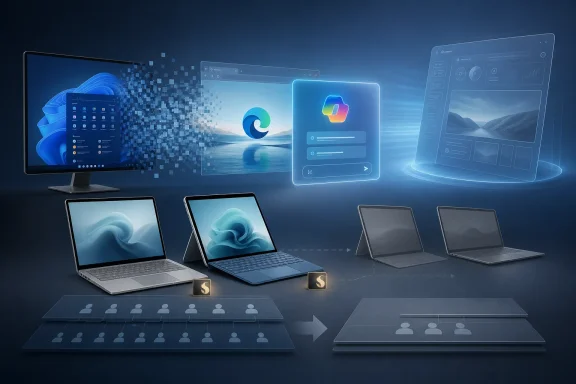 Microsoft Is Cutting Complexity by Cutting People, Products, and Interfaces
The Windows Central Podcast episode, presented by Rubino, Bowden, and Cordon, is most useful when treated not merely as a roundup but as a snapshot of several pressures inside Microsoft. Its principal threads—layoffs, Xbox management depth, an Edge-based operating-system experiment, and changes to Surface—each involve questioning an existing layer.At Xbox, the questioned layer is management. In the leaked operating-system concept, it is the traditional Start menu and the assumption that native applications must define the desktop. In Surface, it is the compact, lower-cost Go branch. Across Microsoft, it is 4,800 positions.
These decisions should not be presented as parts of a single documented plan. The available material does not establish that one executive directive connects them, nor does it prove that every change serves the same objective. The defensible observation is narrower: Microsoft is simultaneously reducing headcount, examining management depth, experimenting with an AI-centered interface, and reportedly narrowing its first-party PC portfolio.
That distinction separates evidence from interpretation.
Evidence: The layoffs total 4,800; the podcast discusses 14 management layers at Xbox; Aion is described as leaked experimental work from 2024; Surface Laptop 8 and Surface Pro 12 are reported as Snapdragon X2 devices; and the two Go families are reportedly canceled.
Inference: Taken together, those developments suggest a preference for fewer organizational handoffs, a more central role for Copilot, and a Surface lineup concentrated on a smaller number of showcase devices.
The human and operational consequences are less abstract. A removed box on an organization chart represents a person and the knowledge attached to that role. A canceled product family can invalidate a procurement roadmap. An AI-led shell would ask users and administrators to accept a different control and trust model from the conventional Windows desktop.
Fourteen Layers Explain More Than the Layoff Headline
The 4,800 job cuts are the immediate news, but the more revealing detail in the podcast is the claim that Xbox had accumulated 14 management layers, attributed in the discussion to an internal memo from Asha Sharma.If accurate, that figure helps explain why a restructuring might focus on reporting lines as well as payroll. A deep hierarchy can slow approvals, alter information as it moves upward, diffuse accountability, and make it difficult for a product team to determine who can authorize a decision.
That does not establish that management depth caused Xbox’s strategic or product problems. It also does not demonstrate that removing positions will improve outcomes. The 14-layer claim is evidence of organizational complexity, not a complete diagnosis.
Middle management is easy to caricature, yet effective managers translate strategy into executable work, resolve resource conflicts, protect specialist teams from executive churn, and ensure that decisions reach the people responsible for delivery. Removing layers can shorten a chain of command, but only if Microsoft also clarifies authority.
A flatter organization can fail in at least two ways. Senior leaders can retain too many decisions, creating a new bottleneck at the top, or responsibilities can be distributed without corresponding authority, leaving teams accountable for outcomes they cannot control. In either case, an organization chart may look simpler while daily work remains slow.
The meaningful test will therefore not be the number of boxes removed. It will be whether teams receive faster answers, whether product mandates become clearer, whether conflicting priorities are resolved earlier, and whether employees can identify who owns each consequential decision.
Xbox’s Acquisition Era Has Reached Its Accountability Phase
The podcast’s suggestion that Xbox might benefit from greater independence is best treated as commentary on the current arrangement, not as a verified Microsoft proposal. It reflects dissatisfaction with the relationship between Xbox’s scale and its ability to execute consistently.Microsoft has expanded its gaming organization through major acquisitions, but the supplied material does not support a definitive accounting of those deals’ outcomes. Nor does it substantiate claims that particular franchises were neglected or that the 4,800 layoffs fell disproportionately on Xbox. Those conclusions should not be inferred from the existence of the restructuring alone.
The supported concern is organizational: A business with many teams and management levels may struggle to translate strategy into timely product decisions. Acquisition increases the need for clear governance because it adds studios, leadership structures, technology, release plans, and competing priorities.
That creates a distinction between asset ownership and operating discipline. Buying a company gives Microsoft control of the acquired organization, but it does not automatically settle how much autonomy that organization should retain, which leaders make cross-company decisions, or how quickly resource disputes will be resolved.
The restructuring is therefore an accountability test, but its result remains unknown. Layoffs can lower costs and alter reporting lines quickly. They cannot, by themselves, prove that product judgment, employee coordination, or decision quality has improved.
For Xbox, the practical questions now are concrete:
- Have decision rights moved closer to the teams doing the work?
- Can studio leaders obtain timely answers on staffing, schedules, and scope?
- Are overlapping responsibilities being eliminated or merely redistributed?
- Do the remaining managers have spans of control they can realistically handle?
- Can employees identify the owner of a product outcome without navigating another informal hierarchy?
Project Aion Turns Edge From an Application Into the Environment
The leaked concept is described as a 2024 incubation project: experimental, platform-agnostic, web-native, and built inside Microsoft Edge, with Copilot taking the place normally occupied by the Start menu. It is not an announced product, a supported operating system, or a confirmed Windows replacement.The supplied source uses two names. Its opening paragraph calls the project “Project Ion,” while its dedicated topic heading calls it “Project Aion.” Because the topic heading uses Project Aion, that is the name used throughout this article. The inconsistency should remain visible as a limitation of the supplied material rather than being resolved through unsupported outside attribution.
The leaked nature of the concept further limits what can responsibly be concluded. A prototype can show that Microsoft explored an idea without showing that the company approved it for release, funded continued development, or intends to incorporate it into a shipping version of Windows.
Even within those limits, the design is notable. Building an operating-system-like experience inside Edge would reduce the visible distinction between browser and desktop. Instead of launching a browser from Windows, a user would operate inside a browser-derived environment where web applications, files, search, AI conversations, and task initiation share a common surface.
That model differs from simply adding another Copilot button to Windows. Conventional Windows begins with a local, general-purpose operating system and allows cloud services to enter through applications and browser sessions. The reported Aion concept begins with a web-native, Copilot-centered shell and treats the underlying platform as something the experience could potentially sit above.
Because the concept is described as platform-agnostic, it invites strategic interpretation—but that interpretation must be labeled clearly. If Microsoft pursued this design, it could attempt to make Edge, a Microsoft account, and Copilot the consistent interaction layer across more than one underlying operating system. That is analysis of the concept, not a reported Microsoft objective or a promise about where Aion will run.
For Windows users, the implications are mixed. A common web-native environment could simplify access to cloud-based work across devices. At the same time, it could reduce the prominence of the characteristics that historically distinguished Windows: broad native application compatibility, direct file-system interaction, flexible hardware support, and a desktop centered on user-selected programs.
The important fact is not that Microsoft has announced such a transition—it has not. The important fact is that Microsoft apparently considered the idea worth prototyping in 2024.
Replacing Start Means Replacing the User’s Control Plane
The Start menu is often treated as a visual feature, but its deeper role is functional. It is where users locate installed applications, search for files and settings, and choose what should run. Replacing it with Copilot would shift the operating system’s center of gravity from direct navigation toward interpreted intent.In a conventional desktop flow, the user selects a tool and performs a task. In a Copilot-led flow, the user describes an intended outcome and the system may choose or assemble the relevant tools. That can reduce steps when work spans multiple services, but it also makes the agent’s interpretation part of the workflow.
The difference is not cosmetic. If Copilot mediates application discovery, file retrieval, web access, and task execution, mistakes may affect what the environment opens, summarizes, groups, recommends, or acts upon. An error would no longer be confined to an optional chat session.
For enterprise IT, such a model would expand desktop governance beyond familiar controls such as application policies, browser settings, identity, data-loss prevention, and update rings. Administrators would also need to determine:
- Which files, messages, meetings, and browser sessions the agent may inspect.
- Which repositories it may search.
- Whether it may pass information between applications or security boundaries.
- Which actions require user confirmation.
- How prompts, retrieved context, outputs, and actions are logged.
- How administrators investigate an incorrect or unauthorized result.
- Whether a conventional navigation path remains available when the agent fails.
The practical trade-off is straightforward. More context can make an agent more useful, while less context can limit both risk and capability. Microsoft would need to show that a Copilot-centered environment can navigate that trade-off transparently, with controls understandable to users and enforceable by administrators.
Aion Is a Directional Signal, Not a Windows Replacement
The most tempting interpretation of the leak is that Microsoft is preparing to replace Windows with a Copilot operating system. The available evidence does not support that conclusion. Aion is described as experimental incubation work from 2024, making it evidence of exploration rather than a confirmed launch plan.Large technology companies build prototypes for many reasons. A prototype may become a product, contribute selected ideas to existing products, remain an internal demonstration, or be abandoned after testing its technical and commercial assumptions.
Aion’s reporting value is therefore limited but real. It shows the kinds of ideas Microsoft was willing to explore: Edge as the environment, Copilot in place of Start, web-native software in the foreground, and an experience not necessarily bound to one base platform.
That is not enough to justify an operating-system migration plan. Administrators should not alter Windows deployment schedules, application packaging, hardware refresh cycles, or support contracts because of leaked experimental work. Users should not assume that Microsoft has scheduled the familiar desktop for removal.
Aion belongs on a strategic watchlist instead. IT leaders can monitor shipping Windows and Edge features for signs that parts of the concept are moving into supported products. Relevant indicators would include deeper Copilot integration with application launching, file discovery, workflow orchestration, session context, and policy-controlled actions.
The distinction is essential:
- Migration trigger: A supported product, documented requirements, a release schedule, management controls, and a lifecycle commitment.
- Watchlist signal: A leak or prototype that reveals ideas worth monitoring but offers no dependable deployment target.
The significant signal is not a future product name. It is Microsoft’s willingness to test whether Copilot could become the place where computing begins.
Surface Hardware Is Narrowing Around Reported Snapdragon X2 Devices
Windows Central identifies Surface Laptop 8 and Surface Pro 12 as reported Snapdragon X2-powered consumer devices. The same discussion describes a new 24 GB memory tier and lower-cost 8 GB configurations.These details should not be expanded into an official, portfolio-wide Snapdragon X2 refresh. Based on the supplied material, the defensible claim is limited to the two reported consumer devices. Likewise, no broader official messaging about performance, flexibility, or the balance between on-device and cloud processing should be attributed without direct supporting material.
Even within those boundaries, the reported configuration choices matter. A 24 GB tier would sit between conventional mainstream configurations and more expensive high-memory systems. It could appeal to buyers whose workloads exceed light productivity but do not require a top configuration.
The 8 GB option addresses price sensitivity, but it also increases the importance of workload validation. Its suitability cannot be judged solely from the processor name, the age of the device, or an AI-PC label. Memory pressure depends on the full operating environment: browser use, collaboration tools, security software, background services, local applications, user behavior, and the expected service life.
The lineup described in the podcast divides between products reportedly moving forward and product families reportedly ending:
| Surface product or tier | Reported status | Processor or memory detail | Likely role | Practical consequence |
|---|---|---|---|---|
| Surface Laptop 8 | Reported consumer device | Snapdragon X2 | Mainstream premium laptop | A candidate for evaluation by buyers planning a first-party Windows-on-Arm refresh |
| Surface Pro 12 | Reported consumer device | Snapdragon X2 | Premium detachable PC | Extends the reported processor direction into the tablet-style Surface format |
| 24 GB configuration | Reported middle tier | 24 GB RAM | Higher-headroom configuration | May suit users who need more multitasking capacity without selecting the highest-memory model |
| 8 GB configuration | Reported lower-cost option | 8 GB RAM | Price-sensitive entry configuration | Should be approved only after testing against defined workloads |
| Surface Go | Reportedly canceled | Compact tablet family | Small, lower-cost Windows tablet | Removes the assumed path to a direct first-party Go refresh |
| Surface Laptop Go | Reportedly canceled | Compact laptop family | Smaller, lower-cost notebook | Requires buyers to reconsider entry-level and compact-device procurement plans |
The 24 GB Tier Is More Credible Than an 8 GB Headline
Memory capacity has become a proxy for a broader question: What must a current Windows PC handle comfortably over its expected service life?A reported 24 GB tier provides more room for the operating system, browser sessions, communication tools, security agents, productivity applications, and other background services to coexist. It may also reduce the risk that a newly purchased device becomes constrained as workloads change.
That does not make 24 GB a universal minimum. A tightly bounded browser-based role may not need the same capacity as software development, media work, heavy spreadsheet use, or large-scale multitasking. Device selection should follow workload evidence rather than a single fleet-wide rule.
The reported 8 GB configurations may be defensible for kiosks, shared terminals, limited browser workflows, lightweight office tasks, or deployments in which cost and a narrow application set matter more than broad multitasking. The key is to define that use before purchase.
An 8 GB configuration should not be approved on the assumption that a new processor compensates for insufficient memory. Nor should employees be expected to adapt complex work to a device chosen mainly because it presents the lowest entry price.
Before approving an 8 GB model, administrators should reproduce the actual operating environment, including:
- The standard Windows image and update level.
- Required endpoint protection and monitoring agents.
- VPN, identity, and device-management software.
- Typical browser tab counts and extensions.
- Collaboration and conferencing applications.
- Business applications used concurrently.
- Representative document, spreadsheet, or data-set sizes.
- External display and peripheral requirements.
- Resume, battery, thermal, and connectivity behavior over a full workday.
Killing Surface Go Leaves a Procurement Gap
Windows Central’s sources say Surface Go and Surface Laptop Go have been canceled. If that reporting holds, Microsoft is not merely removing duplicate model numbers. It is ending two recognizable entry paths into first-party Surface hardware.The Go devices occupied roles that larger premium Surface systems do not automatically inherit. A compact Windows tablet can fit field work, counters, travel kits, classrooms, check-in stations, light-duty enterprise tasks, and users who prioritize size over peak performance. A smaller, less expensive laptop can serve organizations that want Microsoft hardware without moving into the upper portion of the Surface range.
A lower-memory configuration of a larger or more premium device does not necessarily replace those qualities. Purchase price is only one variable. Size, weight, keyboard design, mounting options, protective cases, charging, docking, repair procedures, accessory compatibility, and deployment behavior may all matter to an existing Go use case.
For enterprise buyers, the immediate issue is replacement planning. Existing Go devices can remain operational within their support and service constraints, but procurement teams need to know what comes next. A plan that assumed a future Surface Go refresh should now be paused until Microsoft clarifies the lineup or a suitable alternative is validated.
Organizations should inventory where Go devices are currently used and separate those deployments by requirement:
- Compact tablet requirement: The small tablet form factor is essential.
- Low-cost Windows requirement: Price matters more than exact size or manufacturer.
- First-party Surface requirement: Accessories, support arrangements, or fleet standardization favor Microsoft hardware.
- Detachable requirement: Tablet and keyboard modes are both necessary.
- Light-duty role requirement: The device performs a narrow, controlled set of tasks.
- General productivity requirement: The Go device was selected mainly because it was inexpensive, not because its form factor was essential.
The reported cancellation also clarifies the likely role of Surface. Microsoft’s first-party hardware may increasingly emphasize a smaller group of showcase designs rather than represent every Windows form factor and price point. That can be a coherent portfolio choice, but it leaves partners to address compact and entry-level scenarios that still matter to organizations.
The AI Bubble Debate Is Really a Demand for Measurable Value
The podcast also discusses skepticism surrounding AI costs, consumer response, and productivity claims. That discussion is directly relevant to both Aion and the reported Surface devices.Aion imagines Copilot at the beginning of the user’s workflow. New Surface configurations are being discussed in a market where AI capability is increasingly part of PC positioning. Both developments depend on users and organizations finding enough practical value to justify changes in interfaces, device specifications, governance, and spending.
Users do not owe a feature adoption merely because its developer invested heavily in it. If an AI tool introduces uncertainty, interrupts established workflows, or requires extensive checking, its gross output may overstate its real productivity value.
The economic comparison must include the whole workflow. An AI system may produce a draft rapidly, but the organization must also count the time required to correct errors, restore formatting, verify facts, resolve permission problems, or repeat work through a conventional process.
A Copilot-centered shell would raise the standard further. Optional AI can be bypassed when it is unsuitable. An AI-centered interface would define the default path, making predictability, transparency, accessibility, and fallback behavior core operating-system concerns.
That is why organizations should replace broad enthusiasm with controlled testing.
Operational Copilot Pilot Checklist
- Select two or three workflows.
Choose specific, repeatable tasks with identifiable participants and outputs. Examples might include drafting a recurring internal report, summarizing a defined set of meeting notes, or preparing a first-pass response from an approved knowledge base. - Establish a no-Copilot baseline.
Record how the same participants complete each workflow using current tools. The baseline should include completion time and the amount of rework required before the output is accepted. - Define data-access boundaries.
Document which repositories, files, messages, meetings, and business records Copilot may access. Exclude sensitive or regulated data unless the organization has explicitly approved the relevant controls. - Run the pilot for 30 days.
Measure completion time and rework throughout the period rather than relying on a launch-day demonstration. Include failed attempts, abandoned outputs, and time spent verifying results. - Retain an opt-out workflow.
Keep a documented non-Copilot process available for cases in which the AI route is inaccurate, unavailable, inappropriate, or rejected by the user.
Evidence and Inference Across Xbox, Aion, and Surface
The podcast places gaming restructuring, an operating-system concept, and Surface reporting in one conversation. They can be compared, but the boundary between evidence and inference must remain visible.What the supplied material supports
- Microsoft cut 4,800 jobs.
- The podcast discusses a claim that Xbox had 14 management layers.
- The supplied source uses both Project Ion and Project Aion, with Project Aion in the dedicated heading.
- Aion is described as leaked experimental work from 2024.
- The concept reportedly places an Edge-based, Copilot-centered experience above the conventional desktop model.
- Surface Laptop 8 and Surface Pro 12 are the reported Snapdragon X2 consumer devices.
- A 24 GB tier and lower-cost 8 GB configurations are reported.
- Surface Go and Surface Laptop Go are reportedly canceled.
What remains interpretation or unknown
- Whether the layoffs will improve Xbox decision-making.
- Whether the 14-layer structure caused specific product outcomes.
- Whether Aion remains active inside Microsoft.
- Whether any Aion interface will appear in a shipping version of Windows.
- Whether Microsoft wants one interaction layer across multiple operating systems.
- Whether the reported Surface names and configurations will ship exactly as described.
- Whether an 8 GB model will be adequate for any particular organization’s workload.
- Whether Microsoft or its hardware partners will provide a direct replacement for the Go families.
Administrators Should Treat the Podcast as an Early-Warning System
None of the podcast’s major topics justifies panic. The layoffs are real, but their long-term product consequences are not yet known. Project Aion is leaked experimental work, not a supported operating system. The Surface devices and cancellations are reports that require planning attention, not reasons for an immediate fleet-wide change.Administrators can still act now.
Administrator Checklist
- Remove assumed Go successors from planning documents.
Mark any future Surface Go or Surface Laptop Go refresh as unconfirmed. Do not let a placeholder model silently become a procurement dependency. - Inventory existing Go deployments.
Record device counts, locations, support status, accessories, applications, mounts, docks, keyboards, chargers, and role-specific requirements. - Separate form-factor needs from price needs.
Determine whether each deployment requires a compact tablet, a detachable design, a lower-cost Windows PC, or simply a light-duty endpoint. - Build an alternative-device shortlist.
Identify third-party Windows devices and larger Surface models that may satisfy each requirement. Do not standardize until manageability, accessories, repair, and deployment behavior are tested. - Validate 8 GB devices against defined workloads.
Use the production software image and representative daily work. Include endpoint agents, collaboration tools, browser usage, peripherals, and realistic multitasking. - Document memory approval by role.
Avoid a single organization-wide conclusion that 8 GB is either always sufficient or never sufficient. Tie approval to tested workflows and expected device life. - Treat Aion as watchlist material.
Monitor supported Windows, Edge, and Copilot releases for concrete changes to launching, search, file access, context handling, and policy-controlled actions. Do not create an Aion migration project. - Run bounded Copilot pilots.
Select two or three workflows, establish a no-Copilot baseline, define data boundaries, measure completion time and rework for 30 days, and retain an opt-out process. - Review identity and information boundaries.
Ensure that any AI pilot respects existing access controls and does not expose information merely because it is technically discoverable by a user account. - Preserve conventional workflows.
Maintain documented methods for completing essential tasks when Copilot is unsuitable, inaccurate, unavailable, or restricted. - Watch Xbox and Microsoft support channels for operational effects.
Look for concrete changes in release schedules, support responsibilities, product ownership, and service commitments rather than assuming the consequences of the layoffs. - Require supported documentation before changing architecture.
Leaks can inform monitoring priorities, but migrations require published requirements, management controls, lifecycle commitments, and accountable product support.
What Comes Next
The next phase should be judged through shipping products and observable execution, not through the elegance of a single strategic narrative.For Xbox, the question is whether fewer management layers produce clearer ownership and faster decisions without removing the coordination and specialist knowledge teams still need. For Aion, the question is whether any part of the 2024 experiment emerges in supported Windows, Edge, or Copilot features—and whether Microsoft provides administrators with meaningful control over context and actions.
For Surface, the near-term issue is more practical. Buyers need confirmation of the reported Surface Laptop 8 and Surface Pro 12 configurations, evidence from real workloads, and clarity about the future of compact and lower-cost first-party hardware. Organizations that depend on Surface Go should begin evaluating alternatives now, but they do not need to replace functioning fleets merely because a successor is reportedly absent.
Microsoft may ultimately decide that Copilot should play a larger role in how users begin and complete work. It may also decide that Surface is most valuable as a focused showcase rather than a complete map of the Windows hardware market. Those are consequential choices, but neither should be treated as fully settled on the basis of a podcast and leaked experimental material.
The responsible response is neither dismissal nor panic. Confirm what has changed, separate reporting from analysis, test devices against real workloads, measure AI against a non-AI baseline, and preserve fallback paths.
The Surface Go story ends not with a guaranteed successor, but with a planning obligation: Administrators should stop assuming that Microsoft will fill the same role in the same form factor. Aion ends not with a migration date, but with a watchlist entry. And the layoffs end not with proof that Microsoft has fixed its organizational problems, but with a test that will be answered by the quality and speed of what the remaining teams deliver next.
References
- Primary source: Windows Central
Published: Fri, 10 Jul 2026 10:31:02 GMT
Loading…
www.windowscentral.com - Related coverage: techcrunch.com
Microsoft lays off nearly 5,000 employees across Xbox, commercial sales | TechCrunch
Microsoft cut around 4,800 roles, or 2.1% of its global workforce, on Monday — the latest in a series of layoffs that’s stoking fears of AI replacing jobs. The layoffs will hit Xbox and commercial sales the hardest.techcrunch.com - Related coverage: neowin.net
Microsoft's alleged unreleased lightweight Edge-based Windows 11 AI OS leaks - Neowin
Unreleased, never-before-seen screenshots and videos of a Windows OS that would have been powered by Edge and AI have leaked. www.neowin.net
- Official source: blogs.windows.com
Introducing the next Surface Pro and Surface Laptop, built for performance and flexibility
For more than 13 years, Surface has been shaped by the people who use it. Architects sketch buildings, developers train models, students build startups and field engineers solve problems that rarely make headlines. We didn't intend to design for onblogs.windows.com - Related coverage: computerbase.de
Loading…
www.computerbase.de - Related coverage: piunikaweb.com
Loading…
piunikaweb.com
- Related coverage: fortune.com
Xbox's CEO on 3,200 layoffs, four studios cut, and her warning that 'we spread ourselves too thin' | Fortune
Asha Sharma unveiled sweeping changes at the Microsoft unit Monday, including downsizing that will impact 20% of staff.fortune.com
- Related coverage: techspot.com
A leaked Microsoft experiment reveals a new OS built entirely around Copilot and AI agents | TechSpot
Back when Copilot was still a brand-new AI experience, Microsoft was already trying to turn the service into a cloud-based OS. That experiment appears to be long...www.techspot.com - Related coverage: fastcompany.com
Loading…
www.fastcompany.com - Related coverage: waredata.com
Loading…
www.waredata.com - Related coverage: bleepingcomputer.com
Loading…
www.bleepingcomputer.com - Related coverage: techxplore.com
Loading…
techxplore.com - Official source: news.microsoft.com
</rdf:Alt> </dc:title> <dc:description><rdf:Alt><rdf:li xml:lang="x-default"/> </rdf:Alt> </dc:description> <dc:creator><rdf:Seq><rdf:li>Joseph Galbraith (MBO Partners, Inc.)
</rdf:Alt> </dc:description> <dc:creator><rdf:Seq><rdf:li>Joseph Galbraith (MBO Partners, Inc.)news.microsoft.com